
Is "Allah" the same deity as "God"?
I first broached this topic in my 1983 book, In the Path of God ("Calling the Lord of Islam Allah seems to imply that Muslims direct their prayers to a divinity who differs from that of the Jews and Christians, whereas, in fact, Muslims worship the same Lord; Allah is merely the Arabic translation of God"). I then discussed it at greater length in June 2005 at "Is Allah God?" (again answering the question in the affirmative).
Here follow further developments.
For a Pakistani commentary on this discussion, with the replacement of Khuda with Allah, see the fascinating commentary by Ejaz Haider, "Khuda Hafiz ka Allah hee Hafiz," Daily Times. (August 14, 2005)
June 23, 2006 update: Robert Spencer interestingly splits the difference between what are usually irreconcilable positions:
Most Westerners do translate Allah into God. And Arabic speaking Jews and Christians use the word. Nevertheless, there are serious differences between the Christian, Jewish, and Muslim views of God -- serious enough to warrant keeping a distinction between them. This is especially true in light of the fact that the Islamic claim to be an Abrahamic faith is a supremacist claim which denies all legitimacy to Judaism and Christianity as they exist today.
Sep. 21, 2006 update: This topic has taken on new urgency with the uproar over Pope Benedict XVI's comments about Islam, prompting the pope to state today that Muslims "worship the one God and with whom we promote peace, liberty, social justice and moral values for the benefit of all humanity."
In this, Benedict confirms the view of Pope John Paul II who, while visiting Casablanca, Morocco, in August 1985, declared that Catholics and Muslims "believe in the same God, the one God, the living God."
Sep. 25, 2006 update: Pope Benedict reaffirmed this same point, this time even more forcefully. In the course of a statement to Muslim ambassadors, he quoted the Nostra Aetate issued by the Second Vatican Council in 1965:
The Church looks upon Muslims with respect. They worship the one God living and subsistent, merciful and almighty, Creator of heaven and earth, who has spoken to humanity and to whose decrees, even the hidden ones, they seek to submit themselves whole-heartedly, just as Abraham, to whom the Islamic faith readily relates itself, submitted to God.
The pope called this "the Magna Carta of Muslim-Christian dialogue."
Comment: Every twenty years, it appears, the church confirms that, indeed, Allah=God.
Aug. 15, 2007 update: A Roman Catholic bishop in the Netherlands, Tiny Muskens, has taken the Allah=God idea to an extreme, proposing that all monotheists refer to God as Allah, as a means to increase inter-faith understanding. The Associated Press relates how Muskens
told Dutch television on Monday[, Aug. 13] that God did not mind what he was named and that in Indonesia, where Muskens spent eight years, priests used the word "Allah" while celebrating Mass. "Allah is a very beautiful word for God. Shouldn't we all say that from now on we will name God Allah? ... What does God care what we call him? It is our problem."
A survey in the Netherlands' biggest-selling newspaper De Telegraaf on Wednesday found 92 percent of the more than 4,000 people polled disagreed with the bishop's view, which also drew ridicule. "Sure. Lets call God Allah. Lets then call a church a mosque and pray five times a day. Ramadan sounds like fun," Welmoet Koppenhol wrote in a letter to the newspaper. Gerrit de Fijter, chairman of the Protestant Church in the Netherlands, told the paper he welcomed any attempt to "create more dialogue," but added: "Calling God 'Allah' does no justice to Western identity. I see no benefit in it."
Aug. 23, 2007 update: For a rare, serious argument that Allah≠God, see Soeren Kern, "Who Is Allah?" which argues that "just because Christianity, Judaism and Islam are called "monotheistic" faiths, it does not follow that Christians, Jews and Muslims pray to the same God."
Aug. 29, 2007 update: An article by Ilan Barir on "The Yezidis of Iraq, an Endangered Minority," reminds me that for this religion too, God is called Allah. As Barir summarizes its belief system, "The Yezidi religion includes a belief in a single God, Allah, as well as the belief in an archangel that refused to obey the godly command to bow down to Adam."
This is as good a point as any to add to the Qur'anic reference provided in my original article, which was Sura 29:46. Here is Sura 5:44 (5:47 in some editions):
We have sent down the Torah.
Oct. 4, 2007 update: George W. Bush has also reaffirmed his belief that Allah is the same as God, in an interview today, saying, "I believe in an almighty God, and I believe that all the world, whether they be Muslim, Christian, or any other religion, prays to the same God. That's what I believe."
Dec. 4, 2007 update: The Associated Press has also decided that Allah=God and implemented this in its highly influential Stylebook.
From: updates@apstylebook.com [mailto:updates@apstylebook.com]
Sent: Tuesday, December 04, 2007 12:44 PM
To: XX
Subject: AP Stylebook UpdateA new entry has been added to the AP Stylebook:
Allah
The Muslim name for God. The word God should be used, unless the Arabic name is used in a quote written or spoken in English.
Dec. 24, 2007 update: Che Din Yusoff, a senior official at the publications control unit of Malaysia's Internal Security Ministry, has warned a Catholic publication, the Weekly Herald, not to use the term Allah in its Malay-language section to refer to its concept of God.
Che Din indicated this usage is erroneous because, Allah refers to the Muslim God. "Christians cannot use the word Allah. It is only applicable to Muslims. Allah is only for the Muslim god. This is a design to confuse the Muslim people."
Che Din instructed the newspaper to use the generic term for God, Tuhan. Che Din reasoned that because Christians do not use the word Allah in their English-language worship, they also should not use it in Malay. In addition, Che Din forbade three other Malay words to non-Muslims: solat for prayers, kaabah for the place Muslims worship to in Mecca, and baitula for the house of Allah.
In response, the editor of the Weekly Herald, Father Andrew Lawrence, explained his newspaper's usage of the word: "We follow the Bible. The Malay-language Bible uses Allah for God and Tuhan for Lord. In our prayers and in church during Malay mass, we use the word Allah. This is not something new. The word Allah has been used [by Christians] in Malaysia for a long time. There is no confusion."
Publishers in Malaysia are required to obtain annual permits from the government which expire on Dec. 31. the Weekly Herald is in discussion with the government to renew its permit; Che Din indicated this would happen only if it stops using the word Allah in its Malay pages.
Comment: This development makes for an interesting coda to the Tiny Muskens flap (see entry at Aug. 15, 2007).
Dec. 28, 2007 update: The Malaysian case promises to be an interesting one, for the Weekly Herald plans has sued the government and the internal security minister (a post held at the moment by Prime Minister Abdullah Ahmad Badawi) for banning the word Allah in its pages. "We are of the view that we have the right to use the word Allah," says its editor, the Rev. Lawrence Andrew.
The Sabah Evangelical Church of Borneo, has joined the suit because customs officials confiscated three boxes of children's educational materials from a church member going through the Kuala Lumpur airport in August on the grounds the books contained the word Allah to refer to the Christian God. This, he was told, could raise confusion and controversy among Muslims and the matter was classified as a security issue. In response, the church's lawyer, Lim Heng Seng, said that "The decision to declare Allah as only for Muslims, categorizing this as a security issue, and banning books with the word Allah' is unlawful." The pastor of the Sabah Evangelical Church, Jerry Dusing, noted that Christians in Sabah have long used the word Allah when they worship in the Malay language and that the word even appears in their Malay Bible. "The Christian usage of Allah predates Islam. Allah is the name of God in the old Arabic Bible as well as in the modern Arabic Bible," plus Christians in Egypt, Lebanon, Iraq, Indonesia and elsewhere use Allah without problem.
Comment: A serious court case could bring out the arguments of the two sides of this debate in an unprecedented fashion.
Dec. 30, 2007 update: No court case: the Malaysian government reversed itself, faxing a note to Father Lawrence that the Weekly Herald will receive a 2008 permit to publish, without conditions.
Jan. 4, 2008 update: Prime Minister Abdullah Ahmad Badawi himself has forbidden Christians to use the word Allah, Datuk Abdullah Mohd Zin of the Prime Minister's Department announced in a press conference. Badawi instructed him to clarify the matter, the Star explains:
"One of the reasons given to uphold the restriction is because that it has long been the practice of this country that the world Allah refers to God according to the Muslim faith." It was only proper for other religions to use the word God and not Allah when referring to their God in respective beliefs, Abdullah said, adding that the use of the word Allah shall not be made a public debate that may give the impression as if there is no freedom of religion in the country. "The use of the word Allah by non-Muslims may arouse sensitivity and create confusion among Muslims in the country," he said.
Jan. 14, 2008 update: Another politician has weighed on this issue, this time French president Nicolas Sarkozy during a visit to Saudi Arabia, announcing that "it is the same God" to which Muslims, Jews, and Christians address their prayers:
Sans doute, Musulmans, Juifs et Chrétiens ne croient-ils pas en Dieu de la même façon. Sans doute n'ont-ils pas la même manière de vénérer Dieu, de le prier, de le servir. Mais au fond, qui pourrait contester que c'est bien le même Dieu auquel s'adressent leurs prières? Que c'est bien le même besoin de croire. Que c'est le même besoin d'espérer qui leur fait tourner leurs regards et leurs mains vers le Ciel pour implorer la miséricorde de Dieu, le Dieu de la Bible, le Dieu des Evangiles et le Dieu du Coran? Finalement, le Dieu unique des religions du Livre.
Apr. 6, 2008 update: The novelist Rabih Alameddine has an amusing take on this issue today in the Los Angeles Times, in "'Allah' vs. 'God': Using English to separate the two has become a dangerous practice."
Allah means God.
In Arabic, Muslims, Jews, Christians and Zoroastrians all pray to Allah. In English, however, Christians and Jews pray to God, and Allah is the Muslim deity. No one would think of using the word "Allah" to talk about any other religion. The two words, "God" and "Allah," do not mean the same thing in English. They should. ...
We never say the French pray to Dieu, or Mexicans pray to Dios. Having Allah be different from God implies that Muslims pray to a special deity. It classifies Muslims as the Other. Separating Allah from God, we only see a vengeful, alarming deity, one responsible for those frightful fatwas and ghastly jihads—rarely the compassionate God. The opening line of every chapter in the Koran is "Bi Ism Allah, Al Rahman, Al Rahim": In the name of God, the Gracious, the Merciful. In the name of Allah. One and the same.
The separation is happening on all sides. This year, the Malaysian government issued an edict warning the Herald, a weekly English newspaper, that no religion except Islam can use the word Allah to denote God. No such edict, or fatwa for that matter, is needed for the New York Times: a quick search through the archives shows that Allah is used only as the Muslim God.
In these troubled times, creating more differences, further parsing so to speak, is troubling, even dangerous. I suggest we either not use the word Allah or, better yet, use it in a non-Muslim context.
Otherwise, the terrorists win.
One nation under Allah?
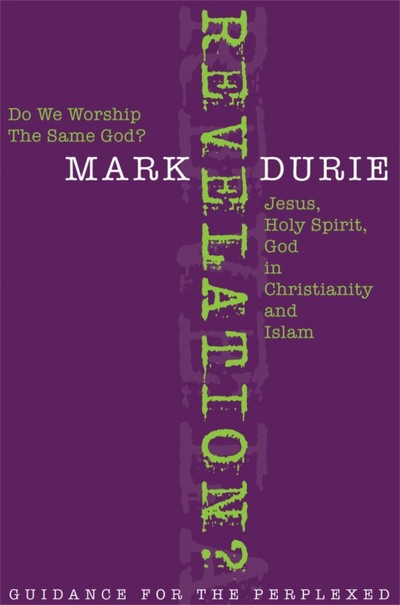
Apr. 18, 2008 update: Mark Durie, an Anglican pastor in Melbourne, Australia, published Revelation? Guide for the Perplexed in 2006. It takes up in depth the question whether Christians worship the same God as Muslims. They do not, he finds:
A careful study of the scriptures of Islam and Christianity shows that the LORD God of the Bible and Allah of the Quran are different personalities in many respects. They have such different personalities, and different capacities, that they cannot said to be the same. ... to claim they are the same god would only be misleading.
Durie summarizes those differences in Appendix A, "YHWH and Allah":
The Bible |
The Quran |
YHWH is God's name 'forever'. (Exodus 3:13–15) |
Allah is God's name. (The Quran) |
Evil is not from YHWH, but wilful rebellion against YHWH. YHWH is the author of good, not evil. (Deuteronomy 32:4; Psalm 92:15; 1 John 1:5) |
Allah is the author of both good and evil. (Q91:5–9) |
YHWH can make himself present with and in people and places: this is distinct from his omnipresence. (Exodus 33:14–15; Joel 2:27–29) |
Allah is everywhere at once, but nowhere in particular: he indwells nothing. (Q2:109; Q4:125) |
YHWH is holy, and his followers should be holy too. (Leviticus 19:1–2) |
The Holiness of Allah is rarely referred to in the Quran: it appears to be a minor or secondary attribute of Allah. (Q59:20-24) |
Human beings are created in God's image and should seek to be like him. (Genesis 1:26–27; Ephesians 5:1-2) |
Nothing in creation is like Allah, and people must not seek to be like him. (Q4:50–54) No human attribute may be associated with Allah, and when people use the same words to describe humans and Allah this is merely a figure of speech. |
YHWH loves sinners and reaches out to his enemies in love. (Exodus 34:5–7; 1 John 4:19) |
Allah will typically hate those who hate him, and love those who obey him, and he wants people to follow him in this. He is however under no obligation to love, and can love or hate whoever he chooses. (Q3:25–29) |
YHWH is faithful to his word, which is unchanging, and he does not lie. (Numbers 23:19) Although God can and often does make conditional promises – including covenants – his inherent faithfulness is not dependent upon human faithfulness, but reflects his utter holiness. (Hebrews 6:17–19; Malachi 3:6) |
Allah acts as he pleases and is the 'best of schemers' (Q3:54); he can, without impugning his perfection, abrogate something he has said earlier and replace it with a contradictory word. (Q16:100–104) He is not obligated to follow his covenants, nor does he obligate himself to people in any way. (Q17:85–89) |
"Revelation?" by Mark Durie
Revelation? carries endorsements from Bat Ye'or, Andrew Bostom, Peter Riddell, and Robert Spencer.
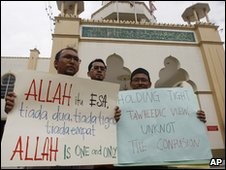
May 5, 2008 update: It appeared that the Malaysian government had given way for the Weekly Herald to use the word Allah (see the Dec. 30, 2007 update, above) but then the prime minister himself forbade Christians to do so (see the Jan. 4, 2008 update, above). Now comes word not only that the Weekly Herald is suing the government but that High Court Judge Lau Bee Lan ruled that prosecutors' objection to the lawsuit is "without merit" and she will allow the paper to argue against the government ban in court.
The Associated Press news item also indicates that the Sabah Evangelical Church of Borneo (on which, see Dec. 28, 2007 update, above) has also filed a separate lawsuit to import books using the word Allah for God.
Mar. 2, 2009 update: The Malaysian government is proving itself singularly incapable of deciding whether Allah means generically God or refers exclusively to the Muslim divine. The latest twists and turns:
The Malaysian government will issue a new decree restoring a ban on Christian publications using the word "Allah" to refer to God, officials said Sunday[, Mar.1]. Home Affairs Minister Syed Hamid Albar said a previous Feb. 16 decree that allowed Christian publications to use the word as long as they specified the material was not for Muslims was a mistake, the national Bernama news agency reported. The about-turn came after Islamic groups slammed the government and warned that even conditional use of the word by Christians would anger Muslims, who make up the country's majority. A senior ministry official confirmed Syed Hamid's comments, saying there were "interpretation mistakes" in the Feb. 16 decree that led to the confusion.
Comment: Kuala Lumpur's torments over this topic symbolize the on-going dilemma over the meaning of Allah.
Mar. 16, 2009 update: Here's an unexpected piece of evidence for Allah = God, coming from carnival in Brazil, as explained to me by Inna Paves.
Antonio Gabriel Nassara (1910-1996), the child of Lebanese Christian immigrants, was a talented caricaturist, parodist musician, journalist, artist, and social critic. One of his most famous songs, with Heraldo Lobo, was Allah-la-ô, whose lyrics read:
Allah-la-ô ô ô ô ô ô ô
Mas que calor ô ô ô ô ô ô
Atravessamos o deserto do Saara
O sol estava quente
E queimou a nossa cara
Viemos do Egito
E, muitas vezes, nós tivemos que rezar
Allah, Allah, Allah, meu bom Allah
Mande água pra Ioiô
Mande água pra Iaiá
Allah, meu bom Allah.
Translated:
Allah-la-o o o o o o o
What a hot weather o o o o o o o
We crossed the Sahara Desert.
The sun was hot
And burned our face.
We came from Egypt
And [on the way] several times we had to pray [to]
Allah, Allah, Allah, my good Allah
[Please] send water to Ioio [a name that rhymes with o o o o o o o]
[Please] send water to Iaia [another name, rhymes with Allah]
Allah, my good Allah.
Comments: (1) The song remains popular; for a recital from the just-completed 2009 carnival see "ESPECIAL CARNAVAL - ALLAH-LA-Ô" on YouTube.com. (2) A Christian here has used the word Allah to refer to God in general, though presumably most Brazilians understand this as a reference to the Muslim God.
Mar. 26, 2009 update: In justifying his decision on the constitutionality of a prayer in the Indiana House of Representatives, Federal District Judge David Hamilton wrote in passing that Allah generically means God:
The Arabic word "Allah" is used for "God" in Arabic translations of Jewish and Christian scriptures.
Nov. 16, 2009 update: In a book published today, Nazi Propaganda for the Arab World by Jeffrey Herf (Yale University Press), the Nazi leader Heinrich Himmler is quoted on p. 200 addressing Muslims and referring to "Almighty God – you say Allah, it is of course the same thing."
Jan. 1, 2010 update: Boris Havel argues in Keryx that God does not equal Allah at "Why some Western Scholars of Religion Claim That Christians and Muslims Worship The Same God?" In his summary,
contemporary western mainstream Orientalism is often more concerned with presenting an apologetic picture of Islam, ad hoc designed to serve current ideological and political trends and needs, than with serving as academic discipline in which scholarly methods of research and customary critical approach to sources are applied.
Jan. 3, 2010 update: Malaysia's High Court struck down the government ban on non-Muslims translating God as Allah. Minorities welcomed it as a blow against what many consider to be institutionalized religious discrimination. The government said it would challenge the ruling. Muslim commentators disagree on the issue. Former Prime Minister Mahathir Mohamad wants strict conditions for non-Muslim use of Allah: "What I am afraid of is that the term Allah might be used in such a way that could inflame the anger of Muslims, if [non-Muslims] were to use it on banners or write something that might not reflect Islam."
Jan. 6, 2010 update: Responding to a government appeal and under intense political pressure, Malaysia's High Court has suspended its decision to allow non-Muslims use the word Allah. Attorney-General Abdul Gani Patail welcomed the suspension.
The Wall Street Journal offers an explanation for this mess in "Malaysia and the Politics of 'Allah'":
The real reason [United Malays National Organization-led government] is politicizing the issue and pandering to its conservative base may be to deflect attention from its own political vulnerabilities. The opposition coalition, led by Anwar Ibrahim, has gained popularity by touting a vision of a secular country in which all religions have equal rights. Even the opposition's Islamic partner, the Pan-Malaysian Islamic Party—which hasn't always supported liberal ideas—issued a statement Monday saying that the Herald's use of "Allah" is its constitutional right.
Jan. 8, 2010 update: The Allah=God topic has taken a lethal turn in Kuala Lumpur, Malaysia, where three churches have been fire-bombed in the context of the controversy over Christians using Allah to name their God.
assailants on motorbikes were seen smashing the windows of the Metro Tabernacle Church, a Protestant church in Kuala Lumpur on Friday. The ground floor office of the three-storey church was destroyed in a blaze a little after midnight, said Kevin Ang, a church spokesman. Kuala Lumpur police Chief Mohamad Sabtu Osman said police had found a wrench, an empty petrol tin and two scorched motorbikes at the scene.
Separately, Molotov cocktails were thrown into the compounds of two other churches before dawn, causing minor damage in one and none in the other, church officials said.
Prime Minister Najib Razak condemned the attacks, saying such actions would "destroy our country's harmony". "The government will take whatever steps it can to prevent such acts," he said. There was tight security at all churches in Malaysia and at several mosques where protests against the court's ruling took place, says the BBC's Jennifer Pak in Kuala Lumpur.
Mass nationwide demonstrations failed to materialise on Friday, but protesters at mosques in Kuala Lumpur carried placards reading "Allah is only for us" and "Heresy arises from words wrongly used". "I hope the court will understand the feeling of the majority Muslims of Malaysia," said Ahmad Johari, at the National Mosque. "We can fight to the death over this issue," he told Associated Press news agency.
The government has appealed against the court verdict and the High Court has suspended the decision's implementation until the appeal is heard.
Jan. 10, 2010 update: The Associated Press reports that "Firebombs were thrown at two more churches in Malaysia early Sunday and another church was splashed with black paint, the latest in a series of assaults on Christian houses of worship following a court decision allowing non-Muslims to use "Allah" to refer to God."
Jan. 11, 2010 update: Seth Mydans supplies context for the Allah=God controversy in "Churches Attacked Amid Furor in Malaysia." An excerpt:
The attacks, unlike anything Malaysia has experienced before, have shaken the country, where many Muslims are angry over a Dec. 31 court ruling that overturned a government ban on the use of the word Allah to denote the Christian God. Though that usage is common in many countries, where Arabic- and Malay-language Bibles describe Jesus as the "son of Allah," many Muslims here insist that the word belongs exclusively to them and say that its use by other faiths could confuse Muslim worshipers.
Malay Muslims outside a mosque protesting Christian use of "Allah."
That dispute, in turn, has been described by some observers as a sign of political maneuvering, as the governing party struggles to maintain its dominance after setbacks in national and state elections in March 2008. Some political analysts and politicians accuse Prime Minister Najib Razak of raising racial and religious issues as he tries to solidify his Malay base. In a difficult balancing act, he must also woo ethnic Chinese and Indians whose opposition contributed to his party's setback in 2008.
"The political contestation is a lot more intensified," said Elizabeth Wong, a state official who is a member of Parti Keadilan Rakyat, an opposition party. "In Malaysia the central theme will always be about the Malay identity and about Islam. The parties come up with various policies or means to attempt to appeal to the Muslim Malay voters." Mr. Najib condemned the violence, saying the government would "take whatever steps it can to prevent such acts."
In an interview, the main opposition figure, Anwar Ibrahim, implied that the government was behind the current tensions. "This is the last hope — to incite racial and religious sentiments to cling to power," he said. "Immediately since the disastrous defeat in the March 2008 election they have been fanning this."
The government has appealed the court decision and has been granted a stay. The dispute has swelled into a nationwide confrontation, with small demonstrations at mosques and passionate outcries on the Internet.
The tensions are shaking a multiethnic, multiracial state that has tried to maintain harmony among its citizens: mostly Muslim Malays, who make up 60 percent of the population, and minority Chinese and Indians, who mostly practice Christianity, Hinduism and Buddhism. About 9 percent of Malaysia's population of 28 million people are Christians, most of them Chinese or Indian. Analysts say this is the first outright confrontation between Muslims and Christians.
But race has become a staple of political discourse in recent years, and religion has been its vehicle, said Ooi Kee Beng, a fellow at the Institute of Southeast Asian Studies in Singapore. "Religion has become a much more useful tool for parties who depend on playing on ethnic divisions," Mr. Ooi said. "They find it difficult to talk about racial issues but possible to talk about religious issues. We are seeing the result of that political opportunism over the last two decades."
May 2, 2010 update:The OurReligionIslam.com, sponsored by the Turkish "İhlas Net" scathingly rejects equaling Allah with God. (Bolding in the original.)
It is not permissible to say "God" instead of the Name "Allah" or "Allah" instead of the name "God," because god means ilah and idol. ... The word Allah is a proper name. There is no equivalent for it in any languages. This word does not have masculine or feminine form.
However, the word "god" has equivalents in every language and also masculine and feminine forms in some of them, e.g., ma'bud and ma'buda (in Arabic), tanrı and tanrıça (in Turkish), God and Goddess (in English), Dieu and Deesse (in French), and Gott and Göttin (in German). None of these words can be used instead of the name Allah.
It is necessary to use only the word Allah when you refer to Allah, because Allahu ta'ala declares, "My name is Allah. Worship Me by saying Allah." We must use the word He has commanded us to use. When the word ilah is meant, all nations can use its equivalents in their own languages, but the word Allah is the same in all languages.
July 31, 2010 update: A Malaysian court cleared the first defendant, Azuwan Shah Ahmad, 23 and Muslim, accused of firebombing some of the eleven churches in the aftermath of the "Allah = God" controversy. "There is insufficient evidence to link Azuwan Shah Ahmad, 23, to the offence," said Sessions Court judge S.M. Komathy Suppiah in acquitting him.
Oct. 1, 2010 update: Leonard Swidler of Temple University writes an editorial, "A Modest Suggestion: 'God,' Not Allah'," in the Fall 2010 issue of the Journal of Ecumenical Studies. He argues that the three major monotheisms "affirm authentic monotheism, that is, there is only one God, creator of all that exists; all other claimants to divinity are rejected," and therefore their basic concept of God is the same. He goes on to give Muslim advice:
to speak in English of "Allah" rather than "God" is to communicate to the listener a sub-message: My God is different from your God, and you can tell by his different name. To so speak/write is both inaccurate, and worse, builds a barrier and enmity precisely where there should be a bond and amity.
Jan. 21, 2012 update: That deep theological thinker, CAIR's Ibrahim Hooper, today pronounced on this topic, declaring in a press release ("CAIR to Santorum: Christians, Jews, Muslims Worship the Same God") that "Christians, Jews and Muslims all worship the same God."
August 23, 2013 update: The Malaysian government can appeal a 2009 lower court ruling that allowed the newspaper of the Roman Catholic Church in Malaysia to use Allah to refer to God.
Oct. 14, 2013 update: Court of Appeal Judge Datuk Mohd Zawawi Salleh ruled against Christians being able to refer to God as Allah. Interestingly, in deciding the Malaysian lawsuit, the judge refers at length to a comment on this website by Brutus Balan. For the text of his decision, see "Grounds of judgment by Judge Datuk Mohd Zawawi Salleh."
Oct. 29, 2013 update: For an astute discussion of the Malaysian court's decision, see "The Word 'Allah' only for Muslims" by Mohshin Habib. Habib starts by noting that this decision is "possibly the first time ever in the world's history of religion, members of a monotheist institution objected to another monotheist groups' using the same name for God that they use."
Jan. 3, 2014 update: The dispute in Malaysia over Christians using the word Allah reached a new level when Islamic authorities seized more than 300 copies of the Bible from the Bible Society of Malaysia near the capital, Kuala Lumpur, because they contain the word Allah in reference to God. Also, two society members were briefly detained.
The society's chairman, Lee Min Choon, recounts: "We were told that we were under investigation for breaking a Selangor state law banning non-Muslims from using the word Allah." The Council of Churches of Malaysia said it was "alarmed" by the raid and urged the government to "protect religious rights as provided under the Federal Constitution".
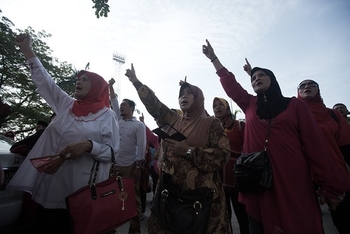
Malaysian Islamists rally after authorities seized hundreds of Bibles from a Christian group on Jan. 5.
Jan. 8, 2014 update: Police announced an investigation of Father Lawrence Andrew, a Roman Catholic Priest, after he announced publicly that Catholic churches in Selangor, a Malaysian state, would continue to use the word "Allah" to refer to God. (It bears noting that Father Lawrence is also editor of the Weekly Herald which used the word Allah and prompted a major court case, described above). He is being probed under Section 4 of the Sedition Act, colonial-era legislation that permits detention of someone accused of plotting violently to overthrow the government and is punishable by up to three years in prison or a fine of 5,000 ringgit ($1,522), or both. This follows on an edict in November 2013 in which the sultan of Selangor prohibited non-Muslims from using the word Allah for God.
The Wall Street Journal article on this topic also contains two interesting statistics:
- The Christian Federation of Malaysia finds that about 60 percent of Malaysia's 2.6 million Christians use the word Allah to mean God.
- A survey by the University of Malaya found that 77 percent of peninsular Malaysians believe that Muslims have exclusive right to use the word Allah and only 11 percent thought non-Muslims should be able to use the word.
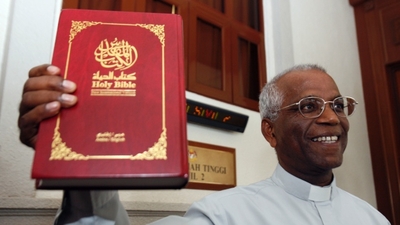 Father Lawrence Andrews uses the word Allah to mean God, challenging the Malaysian government's authority. |
Jan. 14, 2014 update: The Wall Street Journal has now weighed in on this controversy in an editorial, "Between God and Allah."
Members of the ruling United Malays National Organization (UMNO) have intimidated moderate Muslims and threatened violence against churches that dare continue using "Allah" in services. Such threats are irresponsible anywhere but particularly so in multiethnic Malaysia, where similar tensions have boiled over in the past. In 2010, after a High Court briefly reversed the ban on "Allah," mobs attacked churches, temples and even a convent school.
It goes on to ascribe this UMNO fanning of religious tensions to "political gain."
Touting such views is a convenient way for UMNO to steer public discourse away from corruption and clean elections. These concerns helped the opposition coalition win the popular vote last year for the first time since independence. Even the Islamist wing of the opposition, the Pan-Malaysian Islamic Party (PAS), has focused on good governance rather than using the Allah controversy to score political points. It insists that minority religions' use of "Allah" is their constitutional right.
UMNO has previously sought to curry favor with its Malay-Muslim base by flaunting its Islamist credentials. But that strategy may no longer appeal to the country's increasingly urban electorate. ... Malaysia's leaders would be wise to note this shift and drop the investigation of Father Andrew. Depriving religious minorities of their rights isn't in the long-term interest of Malaysia or UMNO.
Feb. 26, 2014 update: After deciding to implement the Shari'a, the government of Brunei banned non-Muslims from using 19 words associated with Islam in reference to other religions. This despite a substantial minority of the country not being Muslim. One of those words, of course, is Allah, the word even Christians in the country use to refer to God. The ban emulates some states in Malaysia, where up to 32 religious words may not be applied to other religions.
The other banned words (using their Arabic spellings) are azan, baitullah, fatwa, firman Allah, hadith, hajji, hukum Shari'a, ilahi, imam, Ka'ba, kalima as-shahada, masjid, mufti, mu'min, qibla, Qur'an, salat, and wali.
June 23, 2014 update: In a 4-3 judgment, Malaysia's Federal Court, the highest one in the land, delivered the final word on the use Allah in a Catholic publication, ruling that the Church had no grounds to appeal last year's lower court decision banning its use of Allah.
Nov. 4, 2014 update: Thomas Fuller of the New York Times surveys the Allah problem in Malaysia in anticipation of a court beginning to consider the 2007 seizure of Christian materials that called God Allah.
Fuller notes the many tensions in the multi-ethnic country but states that "there is probably no dispute more fundamental and more emotionally charged than who owns the word God." He quotes the governmental National Council for Islamic Religious Affairs fatwa: "the word Allah is a sacred word specific only to the religion and followers of Islam and it cannot be used or made to be similar with religions other than Islam." According to the Department of Islamic Development, Allah is not a generic name for God but signifies "the religion of the person who uses it. That is the reason why the usage needs to be monitored and preserved by the government in order to ensure that no one will be confused with the most exalted name."
 Moderate Muslims have responded with alarm. For example, Zainah Anwar sees a "headlong descent into a puritanical, extremist, intolerant brand of Islam in this country. ... For too long this government has given almost a carte blanche to the religious authorities and the belligerent supremacists to take the lead and define what Islam is and is not." That said, enforcement is selective.
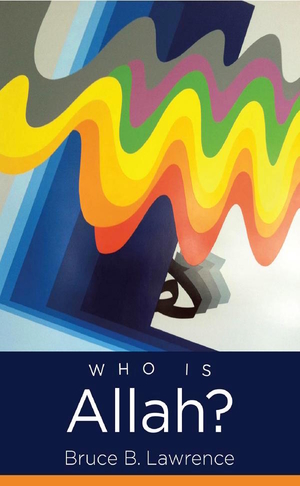
Apr. 6, 2015 update: In a book published today, Who Is Allah? Bruce B. Lawrence devotes two pages (16-18) to the question, "Can Allah Be Distinguished from God?" but he punts, implying without stating that the two are synonymous.
Sep. 10, 2015 update: Andrew Harrod at "Is Islam an 'Abrahamic' Faith along with Judaism and Christianity?" agrees with Mark Durie.
Dec. 17, 2015 updates: (1) Wheaton College, an evangelical school in Illinois, placed associate professor of political science Larycia Hawkins on paid administrative leave that could last all semester after she linked on Facebook to a Christianity Today interview with Yale theologian Miroslav Volf who said that
all Christians don't worship the same God, and all Muslims don't worship the same God. But I think that Muslims and Christians who embrace the normative traditions of their faith refer to the same object, to the same Being, when they pray, when they worship, when they talk about God. The reference is the same. The description of God is partly different.
Wheaton's statement indicates that Hawkins' theological statements "seemed inconsistent with Wheaton College's doctrinal convictions." More specifically, "her recently expressed views, including that Muslims and Christians worship the same God, appear to be in conflict with the College's Statement of Faith."
(2) With academic heavy-handedness, a Yale theologian named Miroslav Volf published an article titled "Wheaton professor's suspension is about anti-Muslim bigotry, not theology." Comment: I agree with his conclusion but denounce his politicized argument. Feb. 9, 2016 update: Hawkins and Wheaton College agreed to "part ways."
Dec. 27, 2015 update: Nabeel Qureshi, a Muslim convert to Christianity and writer on Christian topics for the Ravi Zacharias International Ministries, responded to the Hawkins controversy with a thoughtful commentary, "Do Muslims and Christians Worship the Same God?" whose key passage reads:
I believe that the phrase "Muslims and Christians worship the same God" is only true in a fairly uncontroversial sense: There is one Creator whom Muslims and Christians both attempt to worship. Apart from this banal observation, Muslims and Christians do not worship the same God. I do not condemn those that think they do, but the deeper I delve into the Christian faith, the more I realize that this assertion is not only untrue but also subverts Christian orthodoxy in favor of Islamic assertions.
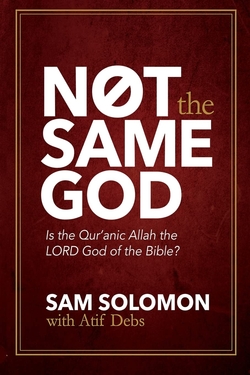 Dec. 28, 2015 update: The title of a book out today by Sam Solomon and Atif Debs, Not the Same God: Is the Qur'an Allah the LORD God of the Bible?, makes clear its view on this controversy.
Jan. 21, 2016 update: Nihad Awad (real name: Nehad Hammad), head of the Council on American-Islamic Relations (CAIR) not only has decreed that God and Allah are one but so are two monotheistic faiths. Here is the astonishing title of a political operative's bizarre venture into theology: "Our Religion Is One – Muslims and Christians Worship the Same God." The key paragraph:
Islam's Prophet Muhammad (peace be upon him) said: "Both in this world and in the Hereafter, I am the nearest of all people to Jesus, the son of Mary. The prophets are paternal brothers; their mothers are different, but their religion is one."
Aug. 6, 2025 update: Seventeen years later, Mark Durie returns to this topic, asking "how followers of Jesus in Islamic cultural contexts should refer to God, Jesus and the Holy Spirit" in an essay titled "What's in a name? God or Allah? Jesus or Isa."


