War is unpredictable but one thing is certain about the U.S.-Israeli campaign against Iran: Donald Trump will declare victory.
He will do so even if the fighting leaves the Iranian regime in place, more embittered and aggressive than ever, even if it leaves many Iranians dead with nothing accomplished, even if it leaves Israel more vulnerable, even if it diminishes his party's electoral prospects, even if it delegitimates the future assertion of preemptive American force. He will do so because, by definition, he always wins.
But for those of us who are not Donald Trump, what lies ahead? Who will win – indeed, what does winning even mean?
For leaders of the 47-year-old Islamic Republic of Iran, mere survival amounts to victory. Once the U.S. president and the Israeli prime minister overtly called on Iranians to overthrow their tyrants, just withstanding an aerial assault and an insurrection by its own population allows the regime – even with Supreme Leader Ali Khamene'i assassinated – plausibly to claim that outlasting all its enemies amounts to success. It also buys them future immunity from external attempts to impose regime change.
For Israelis, victory means the opposite, namely the downfall of a government that made "Death to Israel" its loudest, most frequent, and most consistent foreign policy assertion. Tehran's campaign of aggression included not only direct hostility versus Israel but also indirect ones via its "Ring of Fire" regional proxies (Hamas, Hezbollah, the Houthis, et al.) and an ideological one via Islamists globally.
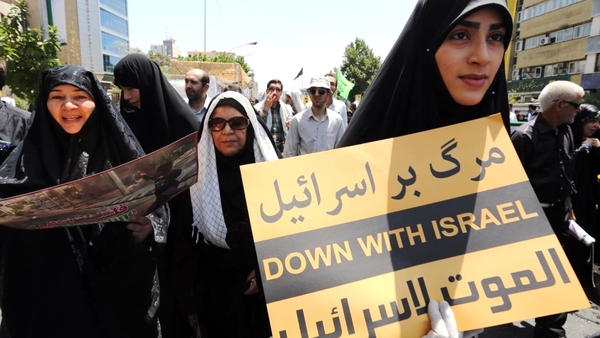 A demonstrator in Iran in July 2015. The Persian and Arabic slogans both call for "Death to Israel." |
For Americans, victory is more nuanced, depending on their foreign policy outlook. This has less to do with Democrats and Republicans than with how one sees America's place in the world, isolationist or engaged. MAGA purists and progressives already ideologically condemn the military campaign as an outrage and will continue to do so, regardless of its outcome. Centrists, in contrast, will acknowledge its success should Xi Jinping's and Vladimir Putin's favored ally pose a meaningfully lesser danger to the U.S.-led alliance, including Australia. All the better were the price of energy to go down and more Arabic-speaking governments huddle under the American umbrella.
As for predicting who will win the war, the United States and Israel deploy vastly greater economic resources and military power than Iran, but they face many hurdles to "unleash the prosperous and glorious future" that Trump promised Iranians.
First problem: unlike 1979, when Ayatollah Khomeini dominated opposition to the shah and effortlessly took control of Iran from him, no single figure dominates today. The shah's son, Reza Pahlavi, has gained impressively wide support but its strength under pressure has yet to be tested. Lack of unity would likely enable the regime to retain power.
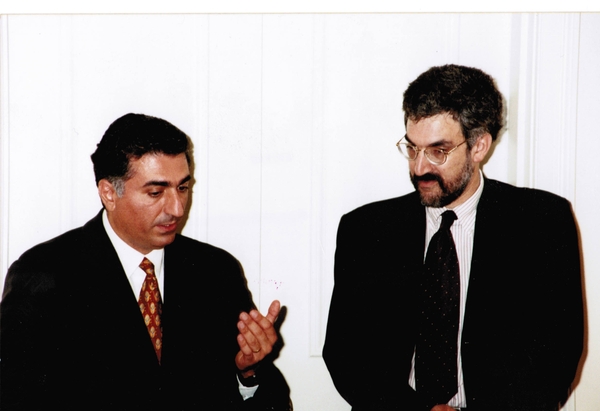 Reza Pahlavi with the author, New York City, June 2001. |
Second, overthrowing the regime depends on a massive uprising by Iranians that neither the U.S. nor Israeli governments controls. In the words of a mother of two, "The only thing on our mind right now is to get to safety. Nobody is thinking of protesting right now." Will the situation stabilize, permitting Iranians to protest effectively? Even so, can street protestors ever overthrow the brutal regime they failed against so many times before?
Third, the parallel U.S. and Israeli exhortations calling on Iranians to overthrow the mullahs' regime gives those mullahs and their henchmen every incentive to fight to the bitter end, using every means, engaging in barbarism without limits.
Fourth, the Western allies' weapons are limited in number. Expensive and complex, they take time to produce and other high-priority theaters, such as Ukraine and Taiwan, restrict the arsenal available for Iran. This renders the battlefield less unequal than it initially may appear.
Fifth, if Tehran successfully obstructs the roughly 20 percent of world oil and gas transiting the Strait of Hormuz, the resulting economic crisis could pressure the allies prematurely to end their campaign.
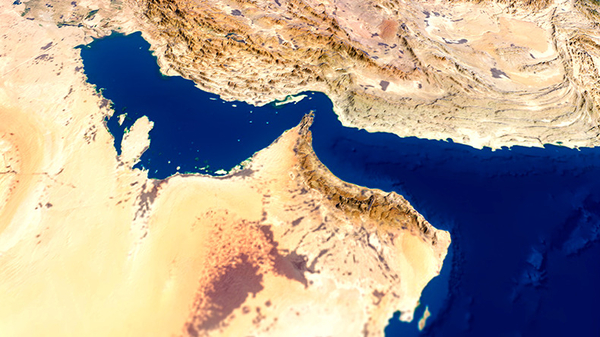 The Strait of Hormuz' choke point is only 21 miles (34 km) wide. |
Sixth, this conflict contradicts an iron law: air power alone has severe limitations, so only initiate war if prepared to deploy the infantry. In a democracy, that requires confidence that voters support the use of ground troops. For the U.S. president, that translates into winning Congressional authorization, something Trump ostentatiously did not seek. Accordingly, he stands exposed to the political winds.
Finally, our ignorance as outsiders impedes prediction. Did the allies coordinate with opposition forces within Iran? Did they provide money, intelligence, and arms? Netanyahu mentioned Iran's non-Persian minorities that make up over half the population; were they invited to join the process? Did the allies work out contingencies with the Persian Gulf states? Have they assured China's acquiescence?
Aware of the chaos that surrounds decision-making in the Trump Administration, not to speak of Trump's monumental inconsistency, I expressed doubts before Operation Epic Fury began. With it now underway, I fervently hope that policymakers in Washington and Jerusalem know what they are doing.
Much hangs in the balance. Terminating the Islamic Republic of Iran promises nearly 100 million Iranians the possibility of freedom and prosperity. It offers 500 million Middle Easterners a reduction in sabotage and violence. And it substantially releases 2 billion Muslims from the poison of today's most vibrant totalitarian ideology, Islamism.
So, bravo to Trump for finally responding to two generations of warfare against modernity and humanity. May he now not leave the battlefield and declare victory until the job is complete.
Mr. Pipes is founder of the Middle East Forum and author of Israel Victory: How Zionists Win Acceptance and Palestinians Get Liberated.
Apr. 7, 2026 update: On schedule, as predicted, Trump today declared a "Total and complete victory. 100 percent. No question about it."


