Each of the three central actors in the current conflict made a central mistake about its enemy. U.S. and Israeli leaders misunderstood key developments taking place in early January, while the Islamic Republic of Iran misjudged its neighbors.
These errors shaped the course of the war and will likely influence its outcome.
Going to war requires a government to have war goals, however murky and changeable. President Donald Trump wants a defanged Iran that cannot threaten U.S. interests. Israel's Prime Minister Benjamin Netanyahu wants regime change. Iran's leaders want to remain in power and stay true to their foundational principles of anti-Americanism and anti-Zionism.
It bears recalling that regime change loomed large in motivating the allies' war. In announcing the U.S. attack on Feb. 28, Trump addressed "the great, proud people of Iran," telling them "Now is the time to seize control of your destiny." Simultaneously, Netanyahu stated that "The time has come for all segments of the people in Iran ... to rid themselves of the yoke of tyranny."
The two also mentioned seizing uranium stockpiles, destroying military capabilities, and disbanding jihadi networks, but of those can all be reconstituted should the regime survive. Also, while the war has had far-reaching economic implications – disrupting energy markets, fertilizer availability, AI chip manufacturing, airline schedules, and much more – those also remain contingent on the fate of the Islamic Republic.
How, then, did government errors affect the war's supreme issue, regime change?
Washington
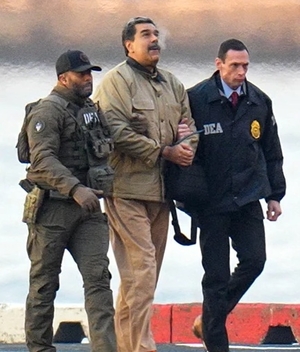 President Nicolás Maduro in U.S. custody, Jan. 3, 2026. |
On Mar. 23, Trump announced that "the United States of America and the country of Iran have had, over the last two days, very good and productive conversations regarding a complete and total resolution of our hostilities," later adding that the two sides had reached "major points of agreement" on "almost all points." This shift clearly signaled a willingness to do business with Tehran and thereby accept the regime's remaining in power, even if Trump pretended that the many assassinated regime leaders and amounted to "regime change" and even if, on Apr. 1, he denied that regime change ever was the U.S. goal.
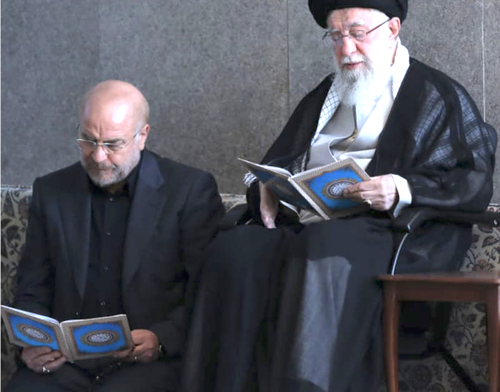 Iran's Parliamentary Speaker Mohammad Bagher Ghalibaf (L) sitting with Supreme Leader Ayatollah Ali Khamenei at a mourning ceremony in Tehran. |
Trouble is, the regime's many decades of "resistance" prepared it well for this war. Danny Citrinowicz of Israeli military intelligence notes that it "is successfully maintaining control over the maritime arena and the Strait of Hormuz, demonstrating resilience in the face of pressure from Israel and the United States, preserving a stockpile of approximately 440 kilograms (970 pounds) of uranium enriched to 60% purity, continuing to strike energy infrastructure, and sustaining a steady rate of missile and drone fire – all while preventing any significant signs of internal unrest, from mass protests to military defections." Reflecting this predicament, the U.S. government lifted sanctions on Russia and Iran oil exports.
Further, whereas Venezuela's ruling Chavismo ideology long since degenerated into hardly more than a self-serving justification for a grasping elite, Iran's Islamist ideology still retains the devotion of the small but critical element that run the country. Further, the state's lower strata have proven perhaps yet more determined than its upper ones. The search for a counterpart to Venezuela's intimidated Delcy Rodríguez will likely fail.
Jerusalem
Just days after the Maduro drama, Iran witnessed the most potent ever uprising against the Islamic Republic. It even appeared likely the regime would collapse. Israel's Mossad intelligence agency reportedly convinced Israel's Prime Minister Benjamin Netanyahu that January's uprising showed how an external push could help finally to overthrow the Islamic Republic. Accordingly, the Israeli air campaign assassinated key figures, reduced security-related buildings to rubble, and otherwise sought to diminish the regime's capabilities and its aura of invincibility.
Trouble is, the most salient legacy of the turn-of-the-year uprising consisted not of those vast numbers attempting regime overthrow but the regime's mass murdering of protestors. Official government figures acknowledge about 3,000 deaths; Trump spoke of 45,000 deaths while Iran's opposition spoke of crimes against humanity. In other words, the massacre appears to have had the intended effect of scaring Iranians from trying a repeat effort. The January uprising left not a sense of hope but of despair.
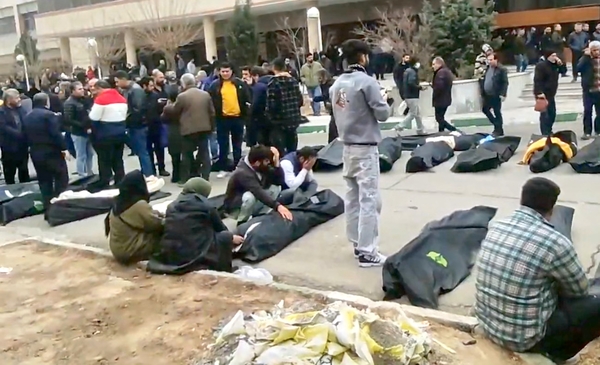 A video screen grab from around Jan. 10 purportedly outside a morgue in Kahrizak on the outskirts of Tehran. |
Thus did Washington and Jerusalem misunderstand early January's events in Venezuela and Iran, leading to war goals based on flawed assumptions. These U.S.-Israeli errors explain why overwhelming force has not yet translated into strategic success and may never do so.
Tehran
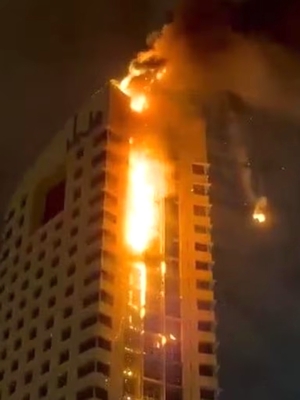 A high-rise building in Kuwait caught fire on being hit by an Iranian drone. |
Initially, it hoped to mobilize leaders of these states to demand to Trump to end hostilities. Later on, Iran's decentralized military doctrine ceded pre-delegated authority to field commanders, who duly kept firing away at neighbors; no one in authority instructed them otherwise.
These attacks backfired spectacularly. GCC states shifted from accommodation toward Iran to resolve and from neutrality to hostility. Interviews with GCC subjects found that many newly considered Iran "an enemy to be confronted and contained." Crown Prince Mohammed bin Salman, the effective ruler of Saudi Arabia, evolved from opposing the war on Iran to insisting that it be seen through to the end and the destruction of the Islamic Republic. Iran's almost 2,500 missile and drone attacks on the UAE prompted its leaders to help "open the Strait of Hormuz by force," according to the Wall Street Journal.
Should the Tehran regime survive, it will suffer the wrath of nearly all its neighbors, leading to a far greater isolation than ever before, with ominous implications for its future economy and security.
Survival?
But will the Islamic Republic survive? Analysts widely agree that smart aerial bombing can demoralize and alter the balance of power, but that it alone cannot effect regime change. Foreign occupation aside, that requires the subjects of a determined tyranny to take matters into their own hands and revolt. They can be ethnic minorities, key industrial workers, disaffected security personnel, renegade media stars, or other elements of society, but they must cohere, find each other, and act.
Thus far, this coalescence appears not to have happened in Iran. To the contrary, the U.S.-Israeli war hardened the regime and made it the more determined to survive. The airstrikes that killed leaders and took out military assets seem to have strengthened the most hardline politicians and security personnel while enhancing their ability to suppress dissent and revealing the lack of an acknowledged Ayatollah Khomeini-style leader to replace it.
Assuming the regime, however much weakened, does survive, it will pose many dangers. Economic incompetence, for example, has created an unparalleled water crisis. In the words of a Middle East Forum study, "The crisis is not a natural disaster, but a politically engineered catastrophe, the direct result of decades of mismanagement, corruption, and flawed ideology." Already in 2015, a former minister of agriculture warned that the Islamic Republic's short-sighted hydraulic practices would mean that approximately 70 percent of Iranians "will have no choice but to leave the country." In 2026, that translates to about 65 million people. An emptying of Iran most deeply affects Iran itself, but also its neighbors and the West, very much including Australia, that will be the refugees' preferred destinations.
Beyond economic challenges, even an enfeebled but doctrinal Islamic Republic will continue to disrupt an already volatile Middle East, sabotaging neighbors, attempting to control the Straits of Hormuz, and resurrecting its "ring of fire" strategy against Israel. Tehran will also export its Islamist ideology, inspiring substantial numbers of Muslim, Shiite and otherwise, around the globe, from a mosque in Melbourne to the mayor of New York City.
In the crudest dichotomy, the war's outcome will end either in regime change and a U.S.-Israeli victory; or Trump accepting the Islamic Republic's survival and an Iranian victory. While both sides made major mistakes, it appears the Western allies made worse ones. Unfortunately, they will likely fall short of their paramount war goal, that of regime change.
Mr. Pipes is founder of the Middle East Forum, is author of Israel Victory: How Zionists Win Acceptance and Palestinians Get Liberated (2024). © 2026 by Daniel Pipes. All rights reserved.
May 19, 2026 update: The New York Times reports on U.S. and Israeli plans to insert Mahmoud Ahmedinejad as the Delcy Rodriguez-style figure in Iran.
June 11, 2026 update: Trump explicitly compared Iran to Venezuela: "At some point in the not too distant future, we will be taking Kharg Island, and other oil infrastructure points, and assume total control of their Oil and Gas Markets, much like we have with Venezuela, which is working out brilliantly for both Venezuela and the United States of America."


