
The deepest differences between Muslims and Westerners concern not politics but sexuality. Each side has a long history of looking at the other's sexual mores with a mixture of astonishment and disgust. (The term termagant sums up the surprising way Westerners saw Muslim women before the seventeenth century.)
Here are some examples of customs and social attitudes from the Muslim side of the divide (in reverse chronological order) that have me, for one, shaking my head. I have made sure only to include instances in this weblog entry that represent a general outlook, and not just a single person's idiosyncrasy, anecdotes that reflect the Shari'a or societal consensus, not deviants and outcasts.
Iranian marriage site allows girls as young as 13: "Adam and Eve" accords with Iranian law and permits 13-year-old girls either to list themselves or be listed by a relative. Iran International explains that "The site's 80-question registration form emphasizes religious observance, gender-role expectations, political attitudes and views on hijab, make-up and social interaction, but includes no questions about consent, emotional readiness or psychological maturity for minors.
Virginity certificates in Iran list "elastic" hymens: The BBC reports on a "not uncommon" problem among Iranian newlyweds when she does not bleed.
"You tricked me into marrying you because you're not a virgin. Nobody would marry you if they knew the truth." This is what Maryam's husband said to her after they had sex for the first time. She tried to reassure him that, even though she didn't bleed, she had never had intercourse before. But he didn't believe her, and asked her to get a virginity certificate.
This is not uncommon in Iran. After getting engaged, many women go to a doctor and get a test that proves they've never had sex. ... Maryam's certificate stated that her hymen type was "elastic". This means she might not bleed after penetrative sex.
"It hurt my pride. I didn't do anything wrong, but my husband kept insulting me," she said. "I couldn't take it anymore, so I took some pills and tried to kill myself." Just in time, she was taken to a hospital and survived.
(August 11, 2022)
Five-year-old girl honor killed by her parents:
The news from #Manbij, Syria:
- An unknown assailant raped a five-year-old girl.
- Her parents responded by murdering the girl "in cold blood."
- Then they dumped her body in a garbage container.Me: Difficult to absorb such appalling, inhumane behavior.https://t.co/Uhb4OhvzYt
— Daniel Pipes دانيال بايبس (@DanielPipes) January 31, 2022
(January 31, 2022)
Husband murdered by second wife to prevent his taking a third wife: Polyandry implies disgruntled wives; sometimes, they take matters into their own hands, as happened in India to an Islamic teacher when his wife castrated him, leading to his death. (June 27, 2021)
Marrying a woman face unseen:
Christian man converts to Islam to marry a Muslim woman whose face he had never seen despite their knowing each other for 4 years.
Where might this have taken place: Nigeria, Yemen or Afghanistan?
No, studying psychology at the @UofT in Ontario, Canada. https://t.co/ADBiGLOyOr
— Daniel Pipes دانيال بايبس (@DanielPipes) April 24, 2021
Somali mother of eight stoned to death for taking a second husband: Somalia's Al-Shabaab had Habiba Ali Isak, 30 and the mother of eight children, publicly stoned to death in the southern town of Sakow, Jubba, for having cheated on her husband by taking a second husband. (October 26, 2017)
Mohamed Abu Abdalla, Al-Shabaab's ruler in Jubba, explained that "Her legal husband brought the case to the court. She admitted she illegally married a second husband. According to the Islamic Sharia she was publicly stoned to death this afternoon." Meanwhile, the offending second husband fled. (October 26, 2017)
Young Girls Married off in War-Torn Yemen: Child marriages are increasing drastically in Yemen, due to the civil war and the poverty and the displacement it caused. , fueled by a war that has thrown society into turmoil. UNICEF reported in March, as paraphrased by the Associated Press, that
early marriage in Yemen has become "alarmingly widespread." In a survey conducted in September in six provinces, 72 percent of female respondents said they got married before 18 — compared with around 50 percent in surveys before the war — and about 44 percent said they were wedded before they turned 15, the organization said.
"Parents marry off their daughters to be relieved of the cost of their care or because they believe a husband's family can offer better protection," UNICEF said. "Families also seek dowry payments to cope with conflict-related hardship."
Horror cases abound.
A father ran out of cash while buying qat — leaves habitually chewed as a stimulant in Yemen — so he gave his daughter to the dealer in marriage. Another man married off his daughter three times in two years for repeated dowries, all before she turned 18. In another case, a child bride who had been handed over by her father in exchange for a taxi bled to death after being forced to have sex days after her wedding.
(May 28, 2017)
Marrying off young daughters for the dowry in Yemen: As civil war grinds on in Yemen and families become destitute, one option to decrease expenses and raise capital is to marry off pre-pubescent girls. Sudarsan Raghavan reports from Khamer, Yemen, for the Washington Post about Fayrouz Ahmed Haider, 10 or 11 years old:
Fayrouz's mother needed a blood transfusion. The family sold their belongings after fleeing airstrikes in the northern city of Saada last year. But the money raised was not enough to pay their debts to the hospital and relatives. Their shy daughter, a shade under 4 feet tall, became their only source of income. "We needed the money from the dowry," said her father, Ahmed Haider Sayed. "Or else, I would never have married her off."
Due to her extreme youth, Fayrouz's husband had to sign a document promising not to consummate their marriage until she reached puberty. He paid $2,000 for her dowry, with $400 more at a future date. However, after the wedding, when they reached her husband's home, he started to flirt with her and ordered her to get into his bed. Scared, she ran into a bedroom and locked herself inside.
"He wanted to sleep with me," Fayrouz said. "But I ran so fast. I called my father and he called my grandfather." Her grandfather, who lived in the same town, came immediately. "They acted innocent in front of my grandfather," Fayrouz recalled. "When he arrived, I was dressed, packed and ready to leave."
They returned to Khamer. But she's still married. There's no way her parents can afford to return the dowry money. "She's staying with us until she reaches puberty," said Fayrouz's father, adding that her in-laws will pay the remaining $400 only after she returns.
Child marriages are common:
On a recent day, eight community elders sat in a [refugee] camp, some chewing khat, the narcotic leaf favored by most Yemeni men. Seven have married off their girls this year.
Even Salim, the elder who worked at the charity, is preparing to marry off his two daughters, ages 13 and 14. "I want to feel secure of their futures, if only for economic reasons," he said.
Mohammad Ali al-Ansi married off his two girls, ages 13 and 14, in April. "My heart is bleeding inside, but I was forced to do this," he said. "I have no job. It's difficult for me to feed my 10 children." He received $1,600 in dowry for each of his girls, he said. But after paying for their weddings and meeting other debts, the money has nearly run out. "If things get worse, there's no doubt I'll marry off my 12-year-old daughter," Ansi said.
More on Ansi's 14-year-old daughter Fatma, married to 21-year-old Zaid:
Fatma spent her day cooking and washing clothes for her in-laws. When asked the name of her husband's family, Fatma didn't know it. She remembers her father telling her and her sister, Amal, that the family needed money. She remembers that Amal was in tears because her new husband was taking her to another region. The two sisters have not seen each other since their weddings.
"I am too young to be married," Fatma said. "I want to study. I want to learn how to write. I have sacrificed for my family," she continued, her voice dropping to a whisper.
Minutes later, her husband arrived at the tent, and Fatma went silent. He said Fatma was "at a good age to marry." When asked if she could attend school, he shook his head no. "She's a little too old for school," he said.
(July 7, 2016)
Female sexual freedom among the Tuareg: Flora Drury has written up the sex habits of the Sahara's Muslim Tuareg people based on the work by Henrietta Butler. Some excerpts:
Their men became known as the 'blue men of the Sahara' because the dye from their distinctive indigo scarves rub off onto their faces giving them a mysterious air. The Tuareg evoke images of a long forgotten and romantic age.
But behind the ancient way of life is a culture so progressive it would even make some people in liberal western cultures blush. Women are allowed to have multiple sexual partners outside of marriage, keep all their property on divorce and are so revered by their sons-in-law that the young men wouldn't dare eat in the same room.
What is even more surprising is that even though the tribe has embraced Islam they have firmly held onto some of the customs that would not be acceptable to the wider Muslim world. ...
Before a woman marries, she is free to take as many lovers as she wants. 'They turn a blind eye,' explained Butler. 'The young girls have the same great freedoms as the boys.' ... For years, the men of the Tuareg have been able to ride to a young woman's tent, and sneak into the side entrance - while his well-trained camel stands quietly and waits. There, they will spend the night together - while the family, who all live in the tent, politely pretend not to notice. Should the woman choose to welcome a different man into her tent the next day, so be it.
Yet could all of this be under threat, Drury asks.
Butler has noticed more of the women taking up the hijab. And while she has been assured the women are wearing it for a fashion statement, rather than for religious reasons, she cannot be sure. 'It makes me very sad - you can see the regression,' Butler said. ...
But there is hope this proud tribe, which has survived for more than 1,000 years, will hold fast to the traditions which make them so very different from all others. After all, they believe their culture is preferable to anything they have yet to come across. 'They think they are superior to other races,' Butler said. 'They are very proud. They certainly consider themselves superior to us. 'Perhaps they consider other cultures a bit stupid and, dare I say it, primitive.'
Comment: I first encountered the Tuareg in Niger in 1968 and their mystery inspired me a year later to take up Arabic. I had planned with a friend after graduating college to spend a year in a Land Rover documenting aspects of Tuareg life. This did not happen; but my fascination with this people remains in place nearly a half-century later. (June 24, 2015)
The travails of Pakistani transvestites: Simon Tomlinson recounts the difficulty of cross-dressing in Pakistan:
Across conservative Pakistan, where extremists launch near-daily attacks and many follow a strict interpretation of their Muslim faith, male cross-dressers face a challenge balancing their two identities. Male and female roles are clearly defined in Pakistan and transgender people often face harassment and abuse. Some have left their villages for the anonymity of a big city, fearing the reactions of their families while still concealing their identity from neighbours and co-workers.
Surprisingly though, "A 2011 Supreme Court ruling allowed transgender people to get national identity cards recognising them as neither male nor female and allowing them to vote. Transgendered politicians have also run for office." (January 20, 2015)
Some Saudi restaurants ban single women: Restaurants in Saudi Arabia have posted "[Single] women not allowed" signs because they are seen as trouble. One owner explained he did so to avoid problems following cases of harassment. A blogger, Capable Politician, told of a typical single female:
She would come in alone and focuses on her mobile from which emanates loud music. She then takes out a cigarette and upsets other guests who may call in the Commission for the Promotion of Virtue and Prevention of Vice. This could cause problem for the restaurant. So the best thing is to keep women away from restaurants unless they have a male custodian. That way the restaurant is not shut down because of the misbehaviour of an adolescent or mentally unstable woman.
A second blogger, Talal, justified the decision similarly:
My brother has a restaurant and he says that even though there is a section for families, there are often instances of embarrassment. Several women would come in and would speak loudly without any respect for public behaviour. He says that it is difficult for him to get them to lower their voices.
A third, "Not A Simple Decision," added:
Restaurant managers are usually foreigners who do not know the right way to conduct themselves and their business when there are women without male custodians around. They would rather ban them than allow them in and face serious issues.
(November 23, 2014)
Female Indonesian police recruits must take a virginity test: Human Rights Watch published a report today, "Indonesia: 'Virginity Tests' for Female Police," about the practice of the Indonesian National Police to ascertain the sexual status of potential women staff:
The "virginity tests" are conducted under Chief Police Regulation No. 5/2009 on Health Inspection (Pemeriksaan Kesehatan) Guidelines for Police Candidates. Article 36 of the regulation requires female police academy applicants to undergo an "obstetrics and gynecology" examination. While the regulation does not specify that a "virginity test" is to be administered as part of the exam, two senior policewomen told Human Rights Watch that it has long been the practice.
The test is given early in the recruitment process as part of the applicants' physical exam. Police Medical and Health Center (Pusat Kedokteran dan Kesehatan) personnel conduct the tests primarily in police-operated hospitals. Human Rights Watch found that the examination has included the discredited and degrading "two-finger test" to determine whether female applicants' hymens are intact. ...
Indonesia's National Police jobs website states, as of November 5, 2014, that, "In addition to the medical and physical tests, women who want to be policewomen must also undergo virginity tests. So all women who want to become policewomen should keep their virginity." Married women are not eligible for the job.
The test is done without consideration of the applicants' dignity or feelings. A 24-year-old woman who took the test in 2008 recounts:
For the test, 20 applicants were told to enter an examination room in Makassar's Bhayangkara police hospital. We were ordered to strip to our underwear in three minutes. The medical staff then checked our eyes, nose, teeth, spine alignment, varicose veins, and hemorrhoids. Then we were told to enter a separate room without a door. The medical staff performed the "two-finger" test on two candidates [at a time] in the room.
Even just entering the room was very scary because we had to undress while there were 20 people in the room. We didn't know each other. Entering the virginity test examination room was really upsetting. I feared that after they performed the test I would not be a virgin anymore. They inserted two fingers. It really hurt. My friend even fainted because ... it really hurt, really hurt.
An 18-year-old woman who took the test in Bandung in 2013 told Human Rights Watch:
Twenty female applicants were told to enter a hall for the physical examination. They were then told to enter a room and told to lie down. The medical staffer, a female, then carried out the "two-finger" test. I am humiliated and scared for having to do the virginity test. There were candidates who fainted due to the stress.
A 19-year-old woman who took the test in Pekanbaru in 2014 told Human Rights Watch:
I did the health test in a hall at the State Police School (Sekolah Polisi Negara) building. They put up a curtain so that outsiders could not look inside. My group of about 20 girls was asked to enter the hall and was asked to take off our clothes, including our bras and underpants. It was humiliating. Only those who had menstruation can keep [wearing] underpants. Our group was the last one that day. The medical staff was probably already exhausted. ... We're asked to sit on a table for women giving birth. A female doctor did the virginity test ... the "two-finger" test.
As for the impact of these tests:
Yefri Heriyani, director of the women's rights group Nurani Perempuan in Padang, West Sumatra, who has encountered numerous female police applicants over the past 12 years, said that the virginity tests had left many of those women traumatized: "These policewomen experience trauma and stress while doing the virginity tests."
Of course, the tests have stimulated books and videos with advice on preparing for the test. "An Indonesian blogger, Anhar Wahyu, in his book Buku Persiapan Masuk TNI dan POLRI ("Preparation to Enter the Armed Forces and National Police"), provides tips to female applicants on how to ensure they pass the virginity test as well as how to respond if they 'fail' the test." (November 18, 2014)
Saudi groom divorces his bride on first seeing her face: An identified couple got married in Medina and only after the nuptials, when the photographer asked them to pose, did the man for the first time look at his wife's face. Then, the Daily Mail reports:
when the bride removed her veil and smiled for the camera, her new husband leapt to his feet in disgust. "You are not the girl I want to marry," he declared. "You are not the one I had imagined. I am sorry, but I divorce you." According to local daily Okaz, the bride immediately collapsed in a fit of tears as panicked wedding guests stepped in to try to resolve the dispute.
Comment: Discussion of this incident has been unremittingly negative toward the groom, but surely the woman (who chose to hide herself until after the wedding) and the whole notion of marrying a couple without their both seeing each other are equally to blame. (November 17, 2014)
Afghan girls who live as boys: For various reasons – economic, familial, educational – some Afghan families cut their pre-pubescent daughters' hair short, give them male names, and send them temporarily out in the world, Jenny Nordberg reports for the Atlantic. (September 8, 2014)
Female jihadis run brothel for ISIS militiamen: Female jihadis, mostly of British origin, are running brothels of as many as 3,000 Iraqi women kidnapped and forced to service ISIS men. The Daily Mirror reports:
Sources suggest that members of the all-women al-Khanssaa Brigade in Raqqa, Syria, are running brothels to satisfy the fighters' desires. One said: "These women are using barbaric interpretations of the Islamic faith to justify their actions. They believe the militants can use these women as they please as they are non-Muslims. The Yazidi people are being ethnically cleansed, and their women are being subjected to the most brutal treatment. It is the British women who have risen to the top of the Islamic State's sharia police and now they are in charge of this operation. It is as bizarre as it is perverse."
(September 10, 2014)
Temporary marriages in Iran to deal with pre-marital sex: A report from Iran's parliamentary research branch based on interviews with 142,000 students finds a lot of pre-marital sex underway: 80 percent of females have had it and 17 percent identify as homosexual. Things get interesting when the report offers a very Islamic solution, as paraphrased by FoxNews.com:
To get around societal boundaries that prohibit having a girlfriend or boyfriend, or being caught in public with someone of the opposite gender, the report suggests that young people utilize the Islamic Shia practice of a temporary marriage, or sigheh. ... A sigheh is a temporary arrangement, with mutual consent, that can last anywhere from one meeting to years. According to Sharia Law, a Muslim man can have up to four legal wives, but up to 99 of the temporary marriages.
(August 20, 2014)
Peeping Toms allowed if intention is to marry: In one of those fatwas that make everyone wonder what the Islamic establishment is thinking, an Egyptian Salafi named Usama al-Qawsi ruled live on Mehwar television that a man may surreptiously watch a woman "while she is showering" if he intends to marry her. To be precise, he said:
If you were really honest and wanted to marry that woman, and you were able to hide and watch her in secret, see the things that she wouldn't usually let you see before marrying her, then it is acceptable as long as your intentions are pure.
Of course, this ruling runs quite contrary to Islamic teachings, which requires that unmarried women be modestly dressed and men to lower their gaze. (August 18, 2014)
"ISIS wants to impregnate Yazidi women and smash our blond bloodline: Fears grow for the 300 women kidnapped from Sinjar": According to London's Daily Mail,
Fears are growing for the 300 Yazidi women reportedly kidnapped by Islamic State fighters last week amid claims they would be used to bear children to break up the ancient sect's bloodline. The minority group is originally Aryan and has retained a fairer complexion, blonde hair and blue eyes by only marrying within the community. But in a furious bid to convert all non-Muslims, ISIS jihadists have vowed to impregnate the hostages.
(August 13, 2014)
Family plans to honor kill daughter, 10, after her rape by a mullah: Rod Nordland of the New York Times tells the story datelined Kunduz, Afghanistan:
It was bad enough that the alleged rape took place in the sanctity of a mosque, and that the accused man was a mullah who invoked the familiar defense that it had been consensual sex. But the victim was only 10 years old. And there was more: The authorities said her family members openly planned to carry out an "honor killing" in the case — against the young girl. The mullah offered to marry his victim instead. This past week, the awful matter became even worse. On Tuesday, local policemen removed the girl from the shelter that had given her refuge and returned her to her family, despite complaints from women's activists that she was likely to be killed.
As for the accused mullah, Mohammad Amin, he
was arrested and confessed to having sex with the girl after Quran recitation classes at the mosque on May 1, but claimed that he thought the girl was older and that she responded to his advances. The girl's own testimony, and medical evidence, supported a rape so violent that it caused a fistula, or a break in the wall between the vagina and rectum, according to the police and the official bill of indictment. She bled so profusely after the attack that she was at one point in danger of losing her life because of a delay in getting medical care.
Photographs of the girl that Dr. Sarwari took in the hospital clearly show a pre-pubescent child, and the doctor said the girl weighed only 40 pounds. Few Afghans have birth records, and many do not know their precise ages. But the girl's mother said she was 10, and a forensic examination in the hospital agreed, saying she had not yet started menstruating or developing secondary sexual characteristics.
The case has had an impact in Kunduz, but not as Westerners might expect. Norland notes that "Most of the anger in Kunduz has been focused not on the mullah but on the women's activists and the shelter."
The head of the Women for Afghan Women shelter here where the girl took refuge, Dr. Hassina Sarwari, was at one point driven into hiding by death threats from the girl's family and other mullahs, who sought to play down the crime by arguing the girl was much older than 10. One militia commander sent Dr. Sarwari threatening texts and an ultimatum to return the girl to her family. The doctor said she now wanted to flee Afghanistan.
The head of the women's affairs office in Kunduz, Nederah Geyah, who actively campaigned to have the young girl protected from her family and the mullah prosecuted, resigned on May 21 and moved to another part of the country.
As for the family's reaction, the girl's father came under tremendous pressure by his village to kill her because she had "brought shame" to them. This fits the general pattern in Afghanistan, where honor killing the raped woman is "often more important to the victim's family than vengeance against the attacker."
The girl's aunt told how her husband ordered her to sneak the girl out of the hospital and deliver her to the male relatives outside, who planned to execute her and dump her body in the river. Also,
In the hospital room, the doctor found the girl's mother holding her child's hand, and both were weeping. "My daughter, may dust and soil protect you now," Dr. Sarwari quoted the mother as saying. "We will make you a bed of dust and soil. We will send you to the cemetery where you will be safe."
(July 19, 2014) Oct. 25, 2014 update: In a rare, surprising, and welcome denouement, a court sentenced Mullah Amin to 20 years in prison. The courtroom drama was yet more surprsising. Again, Ron Nordland:
Shackled with chains around his waist, attached to handcuffs, Mullah Amin was obliged to kneel on the floor of the crowded judge's chambers, which were used as the courtroom, while everyone else sat on chairs. The girl, whose name is being withheld for her safety outside her village, sat about six feet away and covered her face entirely with her veil so she would not have to see Mullah Amin, who did not once look at her.
She wept uncontrollably as the prosecutor, Mujahid Raidan, read the mullah's earlier, detailed confession and the investigative report detailing her horrific injuries. But when the mullah spoke in his own defense and claimed she had seduced him, the girl stopped sobbing and pulled aside her veil enough to speak directly to him. "Hey liar, hey liar," she said. "God hate you, you are dirt, you are dirt, you are a vampire." ... The prosecutor did not call the girl as a witness, but she insisted on being heard. "You shamed me, liar, you destroyed my life, you brought shame to my father," she called out. Addressing the judge, she said, "Please, director, hang him."
As for the girl's being still alive, Nordland explains that too:
After the girl was raped and activists heard her family plotting to kill her, she was put in a shelter run by Women for Afghan Women, or W.A.W., in Kunduz, and later sent by the group to Kabul for medical treatment. ... Over the objections of W.A.W., she was returned to her family members after they posted bond and made promises through elders not to harm her. W.A.W.'s social workers have remained in close contact with the family. ...
"She was raped and is a child, and if we killed her, how would we answer to God on the day of judgment?" said her uncle, Mohammad Rasoul, outside the court. Her father, Najimudin, who like many Afghans uses only one name, insisted the family had never planned to kill the girl.
Saudi women bear their future guardians: Lubna Al-Khamis, a Saudi woman complains in the Saudi daily Al-Jazirah that "Only in the Kingdom: A Woman Gives Birth to Her Own Guardian." Excerpts from the article, dated March 3, 2014:
Image a woman who carries a baby in her womb for nine months, suffers exhausting labor pains, and then nourishes [her baby] with her tears and milk, caring for him through the nights as her best years go by. She teaches him to read and write and plants noble humane values in him, often spending her own savings just to make him smile... And when that [baby] reaches the age of 18, he suddenly becomes her guardian.
This happens to every woman who suffers the fate of being widowed. Then the 'guardianship' passes from her husband to her brother, and later to her son when he reaches the age of 18. When that happens, a woman is forbidden to leave the kingdom without [her son's] permission or to renew basic state documents, like a passport. Additionally, if her father is deceased, she cannot remarry without [her son's] blessing. She also cannot be employed in many fields without presenting a signed letter of approval from her son.
(July 1, 2014)
Families hire bounty hunters to enforce arranged marriages: From a confused report from the BBC's Lucy Adams about the situation in Scotland on the eve of a UK law to criminalise forced marriage going into effect on June 16:
- A record 83 honour-based violence cases were referred to Police Scotland in the past year
- An estimated 8,000 women in the UK are forced into marriage each year.
- Some family members have no need for bounty hunters because, "after six months, because there is a lack of support services, the victim goes back. They cannot cope with life. They have been in a golden cage and find that they don't know how to make breakfast or lunch."
- Bounty hunters sometimes bring the wayward girls back ("the only reason she was not killed was her family did not want blood on their hands") and sometimes have them executed ("We have cases where the family paid more than £100,000 to track someone down and kill them").
(June 12, 2014)
Sudan court convicts woman for being gang-raped: An Ethiopian woman,18 and three months' pregnant, was looking for a house to buy in Omdurman, Sudan, when she was lured to an empty property and sexually attacked by three men who videoed the encounter and then posted it on social media. The woman was arrested, convicted of "indecent acts," fined 5,000 Sudanese pounds (US$880), sentenced to a month in jail (suspended because of her pregnancy), and faced deportation. She avoided charges of adultery and prostitution (with a possible death penalty by stoning) because she divorced. The three men admitted having sex with her were sentenced to 100 lashes for adultery; the two who distributed the video got 40 lashes. (February 21, 2014) May 6, 2014 update: A 25-year-old Indonesian widow, and her alleged sex partner, a married man, 40, were caught by eight males, one as young as 13, who gang-raped her, beat him, and threw raw sewage on them both. After this, the gang took the couple down to the local office of the Shari'a police, the Wilayatul Hisbah in Langsa, Aceh. The head of this police force, Ibrahim Latif, decided to have the couple caned "because they violated the religious bylaw on sexual relations." Their punishment: nine strokes in a public place. May 31, 2014 update: A girl, 15, was raped by 38 men in Ketereh, Malaysia (near Kota Bharu), including a father and two sons combination, then arrested by the police as part of their investigation.
Shaving a Muslim woman's pubic hair costs UK taxpayers £350K in legal bills: This one reflects more on the British life than Muslim one, and it's only barely to do with sex, but here goes:
The parents of retarded Muslim woman in her 30s, known only as "ED" in court documents, demanded in 2011 that, in accord with Islamic tradition, her pubic hair be removed. But the local council, which had looked after ED since 2008, argued that she lacked the mental capacity to consent to this procedure. In response, the parents applied to family court to have ED returned home. The counsel resisted.
The result was a multi-year legal battle to be tried at London's High Court in which the sides amassed 300 pages of expert testimony, 740 pages of witness statements, and much other evidence. Then, at the last minute, the parents dropped the case. The judge pronounced himself "utterly baffled" and decried the "astonishing sum of money" wasted on the process: £82,000 in legal costs for the parents, £130,000 for the official solicitor, appearing on ED's behalf, and £138,000 for the council – with the British taxpayer footing the entire £350,000 bill. (October 22, 2013)
13-year-old girl raped, buried alive in Pakistan: A girl on her way to seminary for Koran lessons in a village of Toba Tek Singh district, was abducted by two men who took her to a deserted place, raped her, and then, thinking she died during the assault, buried her in a shallow mud grave by the roadside, her father Siddique Mughal recounted. But, the girl regained consciousness and managed to dig out of the tomb. (October 28, 2013)
Asian worker speaks to a Saudi woman, gets beaten by her husband: A video (which can be seen here) from Saudi Arabia shows an Asian man slapped and hit in the face by a Saudi man who accuses him of the audacity to have talked to the Saudi's wife. As the Daily Mail explains:
The Saudi man then starts to repeatedly whip the Asian man with his belt. The victim falls to the floor crying out in pain, where he is kicked and whipped over and over. When he gets to his feet, the Saudi man appears to grab him by the throat and forces him up against the wall before continuing to beat him.
(October 28, 2013)
Afghan lovers beheaded: The Shari'a has draconian rules concerning sex outside marriage, but they are rules. For zina (fornication) to be punished requires four men of good reputation to have watched the sexual act in flagrante delicto, not an easy thing to arrange, and if their accusation does not meet the required standard, they themselves are punished. The rules also prescribe different penalties for unmarried and married offenders, with the latter being more severe.
In practice, however, these unwieldy rules tend to be ignored and Muslim communities often savage anyone suspected of zina or even a microscopic move toward zina; honor killings are a prime example of this pattern, with girls being murdered for the slightest flirtation. Another sort of example comes from the province of Helmand in southern Afghanistan, concerning a man and woman, both in their 20s. The Daily Telegraph (London) reports:
The elder brother of the male victim ...told officers the woman had run away with him recently and was living in their family home. On Monday, [Oct. 21,] 10 men broke into the house near the provincial capital Lashkar Gah and kidnapped the pair, police official Mohammad Ismail Hotak told the AFP news agency. "On Tuesday, local residents reported that there were two bodies in the graveyard. We went there and found them. Both were beheaded. From our investigations, we have found that the two had a love affair. We believe the family and relatives of the girl are behind the killing."
Comment: This is not Islam or even Islamism but customs built upon an Islamic base, what is called Islamicate. (October 23, 2013)
Muslim child marriages in Great Britain: Reporting on a ITV show, "Forced to Marry," Soeren Kern provides information on "Britain's Underage Muslim Marriage Epidemic." The documentary, which has two reporters posing as mother and brother of an unwilling 14-year-old girl they want to marry an older man in a nikah ceremony, caught 18 of the country's leading imams agreeing to break British law and oversee the nuptials. (The minimum legal age for marriage in Britain is 16.)
The imams who agreed to marry the girl openly mocked the legitimacy of British law, reflecting the rise of a parallel Islamic legal system in Britain. One of the Muslim clerics who agreed to perform the underage marriage is Mohammed Shahid Akhtar, the imam of the Central Jamia Masjid Ghamkol Sharif Mosque in Birmingham, the second-largest mosque in Britain with a capacity of more than 5,000 worshippers.On being informed that the girl did not want to get married, Akhtar replied: "She's 14. By Sharia, grace of God, she's legal to get married. Obviously Islam has made it easy for us. There is nothing against that. We're doing it because it's okay through Islam. You've got the kaffirs [non-believers], the law, the English people that ... you know, you can't get married twice but, by the grace of God, we can get married four times."
Another cleric who agreed to marry the 14 year old girl is Mufti Shams al-Huda al-Misbahi, who preaches at the Jamia Masjid Kanzul Iman Mosque in Heckmondwike, a town near Leeds in north-central England. When the undercover reporter, posing as the brother of the girl to be married, says, "She's not willing now, but she will be," Misbahi responds: "If you make her willing, she will be willing." He is then filmed saying that he would perform the marriage without providing an official marriage certificate valid under British law. "We'll make everything okay by Islam. We'll write down and put it in our records." Misbahi goes on to tell the undercover reporters that the girl will be able to live with her new husband after the ceremony. Misbahi is a senior Muslim cleric who has worked with the West Yorkshire Police as an advisor on community cohesion, a British concept that refers to the integration of Muslim immigrants within a multicultural society. Before being caught on camera advocating forced marriage, Misbahi had publicly condemned the practice for many years.
And so on and on. (October 15, 2013)
Kuwait government to ban foreign homosexuals: Yousouf Mindkar, director of public health at the Kuwaiti health ministry, told the newspaper Al-Rai that "Health centres conduct routine medical checks to assess the health of the expatriates when they come into the GCC countries. However, we will take stricter measures that will help us detect gays who will be then barred from entering Kuwait or any of the GCC member states." The Gulf Cooperation Council countries are Bahrain, Kuwait, Oman, Qatar, Saudi Arabia, and the United Arab Emirates. (October 7, 2013)
Saudi sheikh: Women's ovaries and pelvis damaged if they drive: Salah al-Luhaydan, a Saudi sheikh, has warned against women driving by claiming that this would damage their bodies and cause "disorders of varying degrees" among their children. This comments are hardly unique: in 2011, a Saudi report to the Majlis al-Ifta al-A'la found that women driving would "provoke a surge in prostitution, pornography, homosexuality and divorce" among male and female Saudis. More: Within ten years of ending the driving ban, there would be "no more virgins" left in the kingdom. (September 28, 2013)
Iranian parliament passes bill allowing men to marry 13-year-old adopted daughters: At present, it's illegal for adoptive fathers to marry their daughters, but that will change if the Guardian Council accepts legislation that permits a man to marry his adopted daughter as young as 13 years. According to the Iranian news website Tabnak, 42,000 children aged between 10 and 14 were married in 2010.
Shadi Sadr, a lawyer with the London-based "Justice for Iran," argues that "It's not part of the Iranian culture to marry your adopted child. ... this bill is legalising paedophilia and is endangering our children and normalising this crime in our culture. You should not be able to marry your adopted children, full stop. If a father marries his adopted daughter who is a minor and has sex, that's rape. ... With this bill, you can be a paedophile and get your bait in the pretext of adopting children."
The reformist newspaper, Shargh, warned: "How can someone be looking after you and at the same time be your husband?" It quoted Shiva Dolatabadi, head of Iran's society for protecting children's rights, warning: "You cannot open a way in which the role of a father or a mother can be mixed with that of an spouse. Children can't be safe in such a family." (September 26, 2013)
How many women per man in paradise? The number of angels that can dance on the head of a pin is a favored symbol of medieval Christian religious scholasticism (whether accurate or not is another matter), that is, the rigorous application of logic to theological tenets. Other religions also contain this strain too, such as pilpul in Judaism or kalam in Islam.
But Islam differs from the other monotheistic faiths in its extreme focus on sexual fantasies about the afterlife.
For example, in a lecture posted on March 23, 2013, Muhammad Ali Shanqiti, a Mauritanian born in 1970, with two higher degrees from New York's Columbia University, now serving as imam of Al-Ahmadi Mosque in Jeddah, figured out the number of women a Muslim man can enjoy in paradise. MEMRI located, translated, and transcribed his insights. Here is the heart of his lengthy reasoning:
If you get married in this world, then [in Paradise], you get your wife from this world, along with 70 black-eyed virgins with whom you are allowed to have sex, and each of these 70 virgins comes with 70 servant girls. ... Now, let's assume that you are married to four wives, each of whom comes with 70 black-eyed virgins, and each virgin comes with 70 servant girls.
Do the math: That's (70+70 x 70) x 4 + 4 = 19,884 women per virtuous Muslim man. (MEMRI calculates a mere 19,604 per virtuous Muslim man.) Half of these women, incidentally, will be virgins. (September 20, 2013)
Tunisian women offer themselves as "sex jihadis" to Syrian rebels, return pregnant: It sounds like something out of someone's overheated imagination but the Tunisian government (itself Islamist) has verified the news: Interior Minister Lotfi ben Jeddou revealed to the National Constituent Assembly that, responding to so-called sexual fatwas, some Tunisian women went to Syria specifically to have sex where each one is "having sexual relations with 20, 30, 100" fighters. Then, "After the sexual liaisons they have there in the name of jihad al-nikah [Arabic: jihad marriage] they come home pregnant." Ben Jeddou did not say how many women have done this; France 24 estimated the number in the hundreds. (September 20, 2013) Sep. 22, 2013 update: Steven Plaut responded to the above news with some biting wit:
Now I know exactly what you are thinking when you read this, and that is that this is a wonderful opportunity for far-Leftist anti-Israel Jews to join in these delegations of solidarity with the jihadi fighters in Syria. I mean, after all, why should anti-Semitic Jews be excluded from this Jihad al-Nikah??? SO I wanted to suggest that you take a moment and send an email to a group of radical anti-Israel Jewish women activists and suggest to them that they join in one of these solidarity delegations.
Heck, I know I would be willing to chip in to cover their travel costs. Here they have a wonderful opportunity to demonstrate their opposition to colonialism and Zionism and show their embrace for the jihad al-nikah. ... And since we certainly do not want to appear to be discriminating on the basis of sexual orientation, I see no reason why male homosexual anti-Israel radicals cannot also be invited to join in these delegations.
"Yemeni child bride, eight, dies of internal injuries on first night of forced marriage to groom five times her age": The Daily Mail headline tells the basics about a girl named Rawan in Hardh, near Saudi Arabia. (September 9, 2013)
Re-virginising cream for sale in Pakistan's pharmacies: Halima Mansour of the Express Tribune reports on and bemoans the ubiquity of various ointments with names such as "B-Virgin," "18 Again Vaginal Shrink Cream," and "Virgin Cream" that promise to restore a woman's virginity. (August 20, 2013)
 Some of the virginity-inducing creams. |
Jailed for being raped: The government of Dubai has sentenced Marte Deborah Dalelv, 24, a Norwegian woman on a business trip in Dubai who reported her rape to police, to 16 months in prison. She was charged with having extramarital sex, drinking alcohol, and perjury. The BBC recounts: Dalelv was out with colleagues in the evening of March 6, 2013, when the rape took place.
She reported it to the police, who proceeded to confiscate her passport and seize her money. She was charged four days later on three counts, including having sex outside marriage. Her alleged attacker, she said, received a 13-month sentence for extra-marital sex and alcohol consumption.
Marte Deborah Dalelv, 24, a Norwegian businesswoman.

This sentence reflects the fact that both Islamic and UAE law require either a confession or the testimony of four adult male witnesses of good standing who personally witnessed the crime in fragrante delicto. (July 20, 2013) Jan. 21, 2014 update: Dubai has done it again, charging an unnamed 24-year-old Austrian female tourist with illegal sex; she says she was raped in a car on Dec. 2 by the son of a policeman. The Austrian Times recounts:
She had been in the region with friends on holiday and accepted an offer by the man to drive her home. But once they had walked into an underground car park underneath a five-star hotel in Yemen he had raped her, she claims. The man then tried to drive the woman away from the hotel but she managed to jump out of the car screaming for help – where other guests helped her and the police were called. ... According to Austrian media the man initially claimed that the woman had offered him sex because she was drunk, and then later claimed that she was a prostitute who had demanded money for sex – something she also denies.
Oh, the Austrian reports a policeman told her she could avoid the charges by marrying the man she accused of the rape.The Times notes that in both of these cases, the European women brought their complaints to the same police station in the in Bur area of Dubai. Feb. 3, 2014 update: More on the Austrian woman, Marie, now released by Dubai's police and back in Austria after the intervention by Austria's foreign minister, Sebastian Kurz:
It was terrible. I never knew what was going on, they told me nothing when I said I'd been raped, instead everything was taken away form me and I was locked up. Nobody kept me informed about my situation. I was treated worse than a dog. Nobody spoke to me properly. It was horrendous. I just thought it would be like in Europe, counselling, maybe tests. But now I know better. Dubai is very different. ... I will never travel to an Arab land again.
Her lawyer Mohammad al Redha, says the alleged rapist no longer faces rape charges, but could face a fine for fornication.
Marry me, marry my friends too: Here's an off-beat story from the kingdom about a demanding bride:
A Saudi teacher has reportedly told the man who wanted to marry her that she had only one condition before accepting his proposal: He must marry her two friends at the school at the same time. The would-be groom was shocked by her unexpected demand, but came under strong pressure from relatives and friends who eventually persuaded him to accept to marry the three women, Saudi daily Al Youm reported. Under the deal, the bridegroom rented three apartments in the same building and lodged each of his brides in her own flat.
(April 21, 2013)
Eloping Somalis: During al-Shabaab's domination of Somalia, eloping was punishable by whipping or even death by stoning. But as their bizarre form of Islam has retreated, in the words of Abdi Guled of the Associated Press, "elopement once again is popular among young Somali couples, many of whom have dramatic stories of defying their families to follow their hearts and marry." Abdi tells the story of one couple:
Outside a dilapidated two-story building, Abdi Ali says goodbye to his veiled girlfriend Anisa and they take two separate streets to avoid attention. Soon they're aboard a minibus heading outside Mogadishu, pretending they don't know each other. After more than two hours of travel, they arrive at Walaweyn, a run-down town 90 kilometers (56 miles) north of Mogadishu, and are led inside a shanty by a man running a string of Arab worry beads through his fingers. Another man and woman walk out; they have just been married. Abdi Ali, who is 25, and his 23-year-old girlfriend will be next. ...
In the case of Ali and Anisa, they had dated in secret for two years. Anisa, who refused to give her full name for fear of family retribution, said they decided to elope after her parents refused her request to marry Ali, intending her to marry a cousin in America. "They tried to turn down my choice, and I had to do the same against their will," said Anisa, her soft voice and shy demeanor belying her determination. "You can't be engaged with just a stranger you have been forced to marry. We are living a civilized world." Anisa, with hennaed hands and bangle bracelets, is studying business at a Mogadishu university. She looks fondly at Ali, a lanky man with wispy hair who works as a tailor.
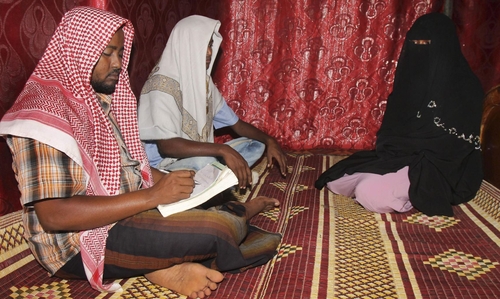 A Muslim religious figure sits on the left, Abdi Ali in the center, and Anisa on the right during a simple marriage ceremony on March 13, 2013, in Walaweyn, Somalia. |
Getting married does not change their living arrangements, however:
they will continue to keep their relationship secret, at least for now. Anisa will live with her parents and have clandestine meetings with Ali. Now that they have had the certificate, the two are looking forward to consummating their marriage when they can find time alone together. "Secret meetings, phone calls and anonymity will dictate our relationship," said Ali. "But we shall finally, officially, be married." ... Then the newlyweds board a minivan heading back to Mogadishu, sitting separately, as if they don't know each other.
Elopements are a good business in Walaweyn, a cow town.
Walaweyn's elopement activity is one of the most visible signs that the tight grip that Islamic militiamen once held here has loosened. After the al-Shabab rebels left in October 2012, elopement became an industry in this town. There are several eloping rooms, including some in buildings that once housed al-Shabab extremists. Guides welcome new arrivals to the town, asking them if they want to elope.
Elopements here have soared, says Sheikh Mohamed Salad, an Islamic cleric who marries eloping couples. "Already this year we married hundreds of people, unlike last year when you could barely receive ten or fewer a month," he said.
(April 17, 2013)
Cover baby girls in burqas: Abdullah Daoud, a Saudi religious figure, wants parents to cover female babies in burqas to protect them from sexual exploitation. To argue his case, Daoud claims that sexual molestation of babies takes place in Saudi Arabia, without providing specifics. (February 3, 2013)
Fayhan al-Ghamdi on a television show about Islam.
Saudi father pays "blood money" to mother for raping and killing their 5-year-old daughter: Fayhan al-Gamdi is a well-known Saudi religious figure and frequent guest on Islamic television shows (click here for an example: al-Ghamdi is sitting on the right side). Apparently worried that his little daughter Lama was not a virgin, he decided to take matters into his own hands, as a news report elaborates:

[Lama] Al Ghamdi was admitted to hospital on December 25, 2011 with multiple injuries, including a crushed skull, broken ribs and left arm, extensive bruising and burns. ... Randa Al Kaleeb, a social worker from the hospital where Lama was admitted, said the girl's back was broken and that she had been raped "everywhere." ... According to the victim's mother, hospital staff told her that her "child's rectum had been torn open and the abuser had attempted to burn it closed."
Fayhan confessed to having used cables and a cane to inflict the injuries. Lama died ten months later, on Oct. 22, 2012.
 The late Lama al-Ghamdi, 5. |
Marrying Syrian refugee women: L. Barkan of MEMRI uncovers the "lust jihad" whereby female Syrian refugees get wed via something called "protection marriage" (sutra in Arabic). This
involves Arab Muslim men marrying female Syrian refugees, often girls aged 12-16, under the pretext of saving them from the harsh living conditions in the refugee camps, protecting their honor, and assisting the Syrian revolution. According to reports, the girls' families are often willing to marry them off for a very low bride-price in order to spare them life in the camps while securing some income for the family's subsistence. Media reports indicate that these cases exist in Jordan, Turkey, Libya and other countries, and that Muslim men from across the Arab world travel to the countries neighboring Syria in search of a young refugee bride. Some reports claim that certain Muslim clerics encourage this practice, calling it "a national duty," and are even taking part in it themselves.
The Arab media's recent exposure of this phenomenon has triggered a wave of outrage among Syrians and other Arabs, and activists have launched a campaign against it, including on Facebook. According to the activists, these marriages constitute an exploitation of the refugees in the camps, especially of young girls. They have reported cases of girls marrying elderly men, marriages leading to rape and prostitution, and men from different Arab countries bargaining for Syrian women on the internet.
(November 12, 2012) Mar. 31, 2013 update: For more on this phenomenon, see "Jihadis' Exploitation of Muslim Girls" by Khaled Abu Toameh.
Islamic shrine in Indonesia hosts orgiastic sex: The shrine of Gunung Kemukus on a hilltop in central Java every year hosts an intermittent orgy where men and women have adulterous sex in order to improve their business. Aubrey Belford reports in "The Swingers' Guide to Islam" about Sarimah, a thickset, 63-year-old widowed grandmother, who lives in Solo, about an hour away:
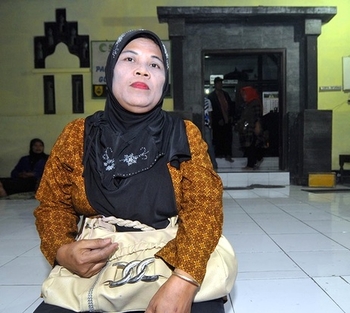 Sarimah waits for a sex partner for the evening. |
Sarimah arrives at dusk, ascending a path of stone steps that passes under a scattered canopy of trees in Java's hyper-real green, to the single grave believed to hold the legendary prince Pangeran Samodro and his stepmother, Nyai Ontrowulan. In the cramped room, Sarimah drops aromatic leaves in a brazier and moves over to the grave, sprinkling it with flowers. She kneels down, raises her hands in supplication and mutters to herself surahs from the holy Quran.
Sarimah gets up, and plants herself by the yellow stucco wall by the shrine's entrance, and waits to complete the next part of the ritual. It's just before maghrib, the fourth of the five daily prayers required of all Muslims. It's time to find a stranger — and have sex with them. ...
Like the of thousands of pilgrims that have turned up this night to Gunung Kemukus, Sarimah is here to seek her fortune. According to local belief, the ritual here can guarantee success in business, usually for those at or near the bottom of the ladder – bus drivers, rice farmers, market stall traders and the like. Pilgrims mostly come from Indonesia's Javanese-speaking core, but some travel days across the massive archipelago to get here.
The ritual needs to be done right, Belford explains:
First, prayers and offerings must be made at the grave of Pangeran Samodro and Nyai Ontrowulan. At some stage, pilgrims must wash themselves at either one or two of the sacred springs on the hill. Then they must find a sex partner who meets two conditions. First, your mate for the night must be of the opposite sex; and second, they cannot be your spouse. Many people believe the ritual only works if you return at seven consecutive, 35-day intervals.
The ritual includes much paid sex: Keontjoro Soeparno, a social psychologist at Gadjah Mada University, reckons that
about half of the women who show up are commercial sex workers. Another 25 percent are "part-timers," people like Sarimah who carry out the ritual but will accept money if it's on offer. ... Since the 1998 fall of the Suharto regime, religiously-minded authorities have cracked down on many legal red-light districts. Gunung Kemukus, on the other hand, has come to be seen as a safe place.
The government profits from the sex and so protects it:
When word got out recently that a radical vigilante group, the Islamic Defenders Front, was going to conduct a raid from Solo, the police showed up in force to protect the hill. The shrine is too valuable to shut down, he says. "This is tourism. Every component, every element, every layer of society gets something out of tourism."
Attitudes vary among the pilgrims:
Some people arrive with the blessing of their spouses; others do it secretly. For some, paying for sex invalidates the ritual; for others, it's just a shortcut. Everyone has a different idea of just how Islamic the whole thing is.
Back to Sarimah:
Each time she comes here, she finds a new man by about midnight. Often, the men will hand her money afterwards. She doesn't ask for it upfront, or haggle over the price – sometimes up to 200,000 rupiah, or about A$20 – but she accepts it gladly, she says, even though accepting money might detract a little from the ritual's spiritual power. At about 2am she heads home after bathing at one of the springs, bringing the water home in a plastic bottle to sprinkle over her stall, which buys her about three weeks of good business.
Sarimah had a successful evening:
"I just finished!" she exclaims gleefully. It turns out Sarimah had already found herself a partner, Wagiyo, a rice farmer from Purwodadi, not so far away, who estimates he's in his mid-sixties. Wagiyo isn't very keen to meet at first, but he also seems a little smitten and, after some goading from Sarimah, he comes and sits down to talk.
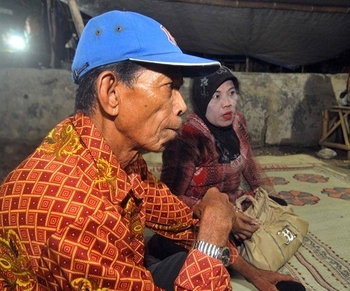 Sarimah and her partner for the evening, Wagiyo. |
He opens up fairly quickly. Wagiyo says this is his first visit to Gunung Kemukus. His wife died in 2007, and his joint business with family and friends selling rice and beans was flailing. "I heard from a friend that if you came here you'd get your fortune, so I thought I'd try it out," he says.
Wagiyo was approached by two younger women who offered themselves in exchange for money before he spotted Sarimah. ... The two went together to one of the small rooms for rent on the hill. Afterwards, Wagiyo slipped Sarimah 100,000 rupiah and bought her a cup of tea. He asked her to come back home and live with him on his farm.
Sarimah's not so sure about this. In a moment when Wagiyo isn't paying attention, she says she doubts his wife is really dead, and, miming her own throat being slit, says she's afraid of the fracas that would take place if the two ever met. Whether the two will meet again or not seems to be an open question. Since he seems taken with Sarimah, I ask Wagiyo if he'll be back in 35 days. "Insha'Allah."
(October 11, 2012) May 15, 2014 update: Rebecca Henschke provides a similar report, even quoting the same professor, "In Muslim Indonesia, throngs of people are seeking salvation at a shrine to anonymous sex," about Gunung Kemukus for Public Radio International.
Two British imams agree to marry girl, 12: The Sunday Times ran a sting and got two mosque leaders (Mohamed Kassamali of the Husaini Islamic Centre in Peterborough, Cambridgeshire, and Abdul Haque of the Shoreditch Mosque, East London) to officiate at a wedding with a girl not yet through puberty. (September 10, 2012)
Child brides in the West: Girls as young as 11 and 9 are fairly often married off to older men in London in Shari'a courts, reports the Iranian and Kurdish Women's Rights Organisation, as reported by the Islington Tribune. Dianna Nammi, director of IKWRO, explains more: although the girls are not legally married according to British law,
They are still expected to carry out their wifely duties, though, and that includes sleeping with their husband. They have to cook for them, wash their clothes, everything. They are still attending schools in Islington, struggling to do their primary school homework, and at the same time being practically raped by a middle-aged man regularly and being abused by their families. So they are a wife, but in a primary school uniform. The reason it doesn't get out is because they are too terrified to speak out, and also the control their families have over them is impossible to imagine if you're not going through it. The way it is covered up is so precise, almost unspeakable."
(January 27, 2012)
Afghan father says kill both young lovers: Halima Mohammedi and, Rafi Mohammed of Heart, both 17, met inside an ice cream factory and were caught riding in a car, presumably alone, were pulled out, interrogated, and nearly executed vigilante-style as adulterers. When the police rescued the couple, angering a mob of several hundred, it proceeded to riot for hours, setting fire to police cars and storming a police station, leaving one man dead and the lovers confined to separate wings of a juvenile prison. Jack Healy takes it from here in the New York Times:
Ms. Mohammedi's uncle visited her in jail to say she had shamed the family, and promised that they would kill her once she was released. Her father, an illiterate laborer who works in Iran, sorrowfully concurred. He cried during two visits to the jail, saying almost nothing to his daughter. Blood, he said, was perhaps the only way out. "What we would ask is that the government should kill both of them," said the father, Kher Mohammed.
In contrast,
the provincial council decided that Mr. Mohammed and Ms. Mohammedi deserved the government's protection because neither was engaged, and because each said they wanted to get married. "They are not criminals, even if they have committed sexual activities," said Abdul Zahir, the council's leader. But so far, their words have not freed either of the teenagers or lent them any long-term security. ...
They now spend the days at opposite ends of the same juvenile jail, out of each other's sight. Mr. Mohammed nurses the wounds still visible in his swollen face and blood-laced eyes, and Ms. Mohammedi has been going to classes and learning to tailor clothes. Both say they want to be together, but there are complications. Family members of the man killed in the riot sent word to Ms. Mohammedi that she bears the blame for his death. But they offered her an out: Marry one of their other sons, and her debt would be paid.
(July 30, 2011)
Israeli women cavorting on the beach.
Muslim men desiring Jewish women on Israeli beaches: From the early days of Zionism, the sexual freedom of Jewish women has disturbed and attracted the Muslim Palestinians living near them. One response has been for Hebrew-speaking Muslims to pretend they are Jews, especially on the beaches of Israel where the Israeli women's assets are particularly evident. So widespread has this deceit become that a Jewish group has come into existence to fight back. "The Organization for Prevention of Assimilation in the Holy Land," known as Lehava, has started a program "defending the daughters of Israel" by handing out leaflets on beaches in Ashdod, Ashkelon, Bat Yam, Caesarea and Eilat, suggesting they avoid the charms of Muslim men. Benzi Gopstein of Lehava explains:

Last year we discovered that there are many gentiles arriving at the beaches, but not in search of the sun or water. Due to the multiple complaints, we decided to promote a campaign at the start of the bathing season this year in order to prevent situations in which girls discover that the "Yossi" they are dating is actually "Yusuf". ... We turn to the girls with a plea: "There are enough good Jewish men you can go out with."
Comment: Israeli beaches offer a miniature example of the sexual tensions Muslim men experience. Calling Muslim females "dull dates," ignoring families and culture, they chase non-Muslim women. (July 17, 2011)
Campaign for polygamy in Jordan: David E. Miller reports in the Jerusalem Post on a new Jordanian organization, the Association to Advocate Polygamy, founded by Muhammad Hajaya, an agricultural engineer with three wives. It tackles the spinsterhood problem by agitating against dowries and raising money to pay for weddings. Government statistics show that 87,000 Jordanian women 30 years old and over are unmarried. (July 9, 2011)
Iranian authorities endorse gang rapes: In Khomeinishahr, near Isfahan, as a private party of 14 adults took place outside on May 24, the BBC reports, late in the evening
a gang of more than a dozen men armed with long knives entered the garden, locked some men in a room and tied others to trees. Female guests - including one said to have been heavily pregnant - were taken to an adjacent property and raped. One guest used a hidden mobile phone to call 110, the police emergency hotline. Most of the attackers had fled by the time officers arrived, reports said, but four were later arrested.
In the medium-sized town, word of the rapes spread like wildfire. ... With people angered by this silence and fearful about the security of local women, a huge protest was organised outside the courthouse via text messages. Yet the comments then made by state officials were to provoke even greater controversy.
Town leaders proceeded to blame the victims:
- Musa Salemi, the imam of Khomeinishahr, said in his Friday sermon that "Those who were raped were not praiseworthy. Only two out of the 14 were related. They had come to our town to party and provoked the others [the rapists] by their wine drinking and dancing."
- Hossein Yardoosti, a colonel in the Revolutionary Guards and police commander of Khomeinishahr, added: "I believe the raped women's families are to blame, because if they had proper clothing and if the sound of their music was not so loud, the rapist would not have imagined it as a depraved get-together." Reports indicated he might bring legal action against the rape victims for their behaviour.
(June 15, 2011)
$15,000 Reward for Men Who Marry Second Wife over 40: A Kuwaiti member of parliament, Faysal al-Duwaysan, intends to propose a law, reports Khabarni on June 11, 2011 (and made available by TranslatingJihad.com today) "which would grant a reward of up to $15,000 to the Kuwaiti man who marries a second wife. This would carry with it the stipulation that the women be over 40, widowed, or divorced." He explained that
This is the best solution to curb the "old maid" problem, and eliminate many of the societal problems which began to appear in society as a result of the aggravation of this phenomenon. The high rates [of "old maids"] make it imperative on everybody—including governmental and even non-governmental institutions—to move to confront the phenomenon which has become a threat. Especially since the numbers indicate there are tens of thousands of unmarried women, alongside a comparable number of men who resort to taking a non-Kuwaiti woman as a second wife. This indicates that marriage to foreign women is the most serious factor in the spread of the "old maid" phenomenon.
(June 14, 2011)
Muslim mothers in India honor kill daughters: The usual honor killing pattern has males killing females, but not always. I maintain a weblog on "'Honor Killings' of Muslim Males in the West" and now here are three women who colluded to murder two brides:
Two Muslim mothers in India were arrested and accused of killing their daughters for dishonoring their families for running off with Hindu men, authorities said. Newlyweds Zahida, 19, and Husna, 26, who were neighbors, were strangled on Wednesday night when they returned home after marrying men their mothers didn't approve of, cops said. The mothers allegedly helped each other choke their daughters. "We killed them because they brought shame to our community," Khatun, one of the mothers who uses one name, told the Indian Express newspaper after her arrest on Friday. "How could they elope with Hindus? They deserved to die. We have no remorse," she said. A third woman who allegedly helped the mothers was on the run, the Express reported.
(May 15, 2011)
Camp for "effeminate" schoolboys in Malaysia: The department of state education in the Malaysian state of Terengganu sent 57 schoolboys ages 13 to 17 with "effeminate tendencies" to a four-day camp that included religious lectures, visiting local mosques, and aerobics workouts. The goal? To make their behavior more masculine, reports Reuters. (April 21, 2011)
Females thrown into the sea: Boats making the perilous passage from North Africa to Europe are by definition dangerous for all on board, but especially so for the women. Le Figaro today quotes a Tunisian, Tarek, 20, about one voyage that began in mid-March in Kairouan: "Nous étions entassés à 150 dans un bateau prévu pour 60. Au cours du trajet pour Lampedusa, douze filles ont été jetées à la mer." In English: "We were packed in, 150 in a boat meant for 60. During the trip to Lampedusa [an Italian island], twelve girls were thrown into the sea." Comment: This incident gives gruesome meaning to "women and children first." (April 4, 2011)
Illegitimate babies murdered in Pakistan: The Edhi Foundation conservatively estimates that more than 1,000 infants—most of them girls—were killed or abandoned to die in Pakistani cities in 2010. Hasan Mansoor of Agence France-Presse explains why: "In the conservative Muslim nation, where the birth of children outside of marriage is condemned and adultery is a crime punishable by death under strict interpretations of Islamic law, infanticide is a crime on the rise." He also notes that crimes of infanticide are rarely prosecuted and quotes a lawyer: "The majority of police stations do not register cases of infanticide, let alone launch investigations into them." (January 17, 2011)
Saudi women sue their male guardians: As a 2008 Human Rights Watch report put it, women in Saudi Arabia are treated as "perpetual minors," kept under the thumb throughout their lives by one or other male guardian – grandfather, father, brother, cousin, husband, son, or even grandson. This means that women of all ages must usually obtain permission from the guardian (known as wali al-amr) to study, work, travel, marry, or undergo certain medical procedures.
But lately, Maggie Michael of the Associated Press writes, women are suing for their rights:
Year after year, the 42-year-old Saudi surgeon remains single, against her will. Her father keeps turning down marriage proposals, and her hefty salary keeps going directly to his bank account. The surgeon in the holy city of Medina knows her father, also her male guardian, is violating Islamic law by forcibly keeping her single, a practice known as adhl. So she has sued him in court, with questionable success.
Adhl cases reflect the many challenges facing single women in Saudi Arabia. But what has changed is that more women are now coming forward with their cases to the media and the law. Dozens of women have challenged their guardians in court over adhl, and one has even set up a Facebook group for victims of the practice. ...
Comment: With enough will, even a custom so deeply entrenched as the Saudi wali al-amr can be changed. (November 27, 2010)
"Pakistan media gripped by man marrying twice in one day": A Pakistani man, a herbal medicine practitioner, has married in a day's time the woman his family picked out for him and also the woman he's in love with, captivating the country in the process to the point that television stations provided live coverage of Azhar Haidri's two weddings.
At first he refused to marry the woman selected by his family since childhood because he loved someone else. ... Mr Haidri's love for 21-year-old Rumana Aslam - ahead of 28-year-old Humaira Qasim - at one point threatened to split his family apart. "I gave this offer that I will marry both of them," Mr Haidri, 23, told the Associated Press ahead of his first marriage to Ms Qasim on Sunday in the central Pakistani city of Multan. "Both the girls agreed."
(October 18, 2010)
Afghan girls dressed as boys to attend school: In a large-scale version of Yentl, families disguise their girl children as boys so that they can get educated, reports Jenny Nordberg for the New York Times.
There are no statistics about how many Afghan girls masquerade as boys. But when asked, Afghans of several generations can often tell a story of a female relative, friend, neighbor or co-worker who grew up disguised as a boy. To those who know, these children are often referred to as neither "daughter" nor "son" in conversation, but as bacha posh, which literally means "dressed up as a boy" in Dari.
Through dozens of interviews conducted over several months, where many people wanted to remain anonymous or to use only first names for fear of exposing their families, it was possible to trace a practice that has remained mostly obscured to outsiders. Yet it cuts across class, education, ethnicity and geography, and has endured even through Afghanistan's many wars and governments.
Afghan families have many reasons for pretending their girls are boys, including economic need, social pressure to have sons, and in some cases, a superstition that doing so can lead to the birth of a real boy. Lacking a son, the parents decide to make one up, usually by cutting the hair of a daughter and dressing her in typical Afghan men's clothing. There are no specific legal or religious proscriptions against the practice. In most cases, a return to womanhood takes place when the child enters puberty. The parents almost always make that decision.
(September 20, 2010)
Saudi women cash in on ban on bachelors: In Saudi Arabia, entrance to shopping malls, gated amusement parks, and other family destinations is restricted to married couples or families; single men cannot enter. To enforce this, the religious police (mutaween) keep a lookout for single males or unmarried couples, punishing infractors.
Diana Al-Jassem reports in the Arab News that enterprising women charging young men to pretend to be their wives so they can get access. The going rate is between SR10 and SR50 (US$3 to $13), depending on time and place. The recent summer and Eid holidays saw a particular surge in women generating money in this way. (September 19, 2010)
"Gang tried to sell girls' virginity to wealthy Arabs for £150,000": Charlotte Gill and David Wilkes of the Daily Mail report how three women and a man offered girls as young as thirteen for sexual services in London.
One of the women had arrived at the Jumeirah Carlton Hotel in Knightsbridge, central London, in a silver BMW to offer the gang's services in a handwritten letter to the owner in August last year. It read: "I have 12 girls ready from the age 14-20 years, who are living all over the UK, I have spent money on the preparation of this event such as a rented house for the girls and also all expenses needed."
Worried staff immediately alerted police who traced the car and telephone number given in the letter to an address in Wigan where Fatima Hagnegat, 24, lived with her husband, Rassoul Gholampour. Inquires revealed that another similar letter had been delivered to the hotel on an earlier date.
Detectives then exchanged messages with the gang under the guise of potential clients. One undercover officer, known as "Cameron," telephoned the mobile number provided in the letter to ask about hiring girls on behalf of a client. He spoke to Hagnegat's aunt, Marohkh Jamali, 41, who told him that she could arrange a party for four to five people that night if required. She stated that she could provide girls from Iran, England and Eastern Europe aged 14 and 20.
The officer arranged to meet Jamali who told him some of her girls were virgins and could be 'broken' by his client. She emailed him photographs of a number of girls and said she would bring up to five girls to London, including two 13-year-olds, and would expect £50,000 to £150,000 for each. The next day Jamali went to a different London hotel, in Bayswater, accompanied by Hagnegat and six girls, two of whom were aged 14 and 17. The other four were 18 or older. Officers swooped and arrested Jamali and Hagnegat.
The six victims, who had all been brought to London from the North-West of England and cannot be identified for legal reasons, were taken to a victims' centre. They later described how they had travelled from Wigan with the defendants on the understanding that they would be able to earn some money 'dancing' for a party of rich men. It was only later, on their arrival in London, that they were told they may be asked to have sex with the men.
The gang members, all jobless and Iranian, pleaded guilty to trafficking and prostitution offences at Harrow Crown Court yesterday.
(September 14, 2010)
Muslim patrons of Dutch brothel triple during Ramadan: The owner of a Dutch escort agency, Society Service, reports that her Muslim clientele shoots up from about 13 percent of the total to 40 percent during Ramadan, based on her analysis of names (such as a businessman from Egypt named Mohammed). Most of the Muslim clients, she adds, come from abroad. "I think that they plan their business trips to be in the Netherlands during Ramadan. Otherwise I can't explain the increase." (September 13, 2010)
Afghan couple stoned to death: This is the story of Khayyam, 25, and his lover Siddiqa, 19, as reported by Rod Nordland for the New York Times. Siddiqa was enaged to marry a relative of Khayyam's but refused him. Khayyam tried to persuade her family to let her marry him, but they refused, perhaps because Khayyam already had a wife and two young children. The couple then
eloped to Kunar Province, in eastern Afghanistan, staying with distant relatives, but family members persuaded them to return to their village, promising to allow them to marry. (Afghan men are legally allowed to marry up to four wives). Once back in Kunduz, however, they were seized by the Taliban, who convened local mullahs from surrounding villages for a religious court.
The lovers declared, "We love each other no matter what happens" as a Taliban mullah prepared to read out the court's judgment. They were found guilty of fornication and sentenced to death. Siddiqa was dressed in a burqa and the two of them were encircled by about two hundred males (no women) in the bazaar of Mullah Quli village, in Archi district, a remote corner of Kunduz Province close to Tajikistan.
Taliban members began the stoning, then villagers joined in, including Khayyam's father and brother, Siddiqa's brother, and other relatives. Siddiqa was killed first, then Khayyam. A crowd of onlookers who did not take part cheered them on in a festive atmosphere. "People were very happy seeing this," said Nadir Khan, 40, a local farmer and Taliban sympathizer, because the couple "did a bad thing."
The stoning found widespread support among Afghan religious authorities. For example, the head of the Ulema Council in Kunduz Province, Mawlawi Abdul Yaqub, deemed stoning to death an appropriate punishment for illegal sexual relations. (August 16, 2010)
Facebook campaign urges Muslim men to marry four wives: Some young Saudis started a Facebook group, "We Want Them Four," that advocates polygamy to end the problem of spinsterhood in their country. "Every Saudi and Arab man who is financially and physically able to marry more than one wife should not hesitate to do so in order to end spinsterhood among our women and help cap the high marriage costs that have deterred many young men from getting married." (July 6, 2010)
"1 homme, 4 femmes, 46 enfants": That's the title of an article by Mathieu Deslandes in Le Journal du Dimanche; "1 man, 4 wives, 46 children." The article tells about this Muslim family from Malii living in Bobigny, a northeastern suburb of Paris, and how the man could stop working because the government stipend for 40 children comes to €6,157 (= US$8,456) a month, and that's not even counting housing aid. The article goes into some detail how the local social worker is trying to help the women establish their own residences. (June 12, 2010)
Afghan child brides beaten for fleeing husbands: Rod Nordland and Alissa J. Rubin tell how Khadija Rasoul, 13, and Basgol Sakhi, 14, from the village of Gardan-i-Top, in the Dulina district of Ghor Province, central Afghanistan,
had every reason to expect the law would be on their side when a policeman at a checkpoint stopped the bus they were in. Disguised in boys' clothes, the girls, ages 13 and 14, had been fleeing for two days along rutted roads and over mountain passes to escape their illegal, forced marriages to much older men, and now they had made it to relatively liberal Herat Province. Instead, the police officer spotted them as girls, ignored their pleas and promptly sent them back to their remote village in Ghor Province.
There they were publicly and viciously flogged for daring to run away from their husbands. Their tormentors, who videotaped the abuse, were not the Taliban, but local mullahs and the former warlord, now a pro-government figure who largely rules the district where the girls live. Neither girl flinched visibly at the beatings, and afterward both walked away with their heads unbowed.
The article provides ample detail on the beatings, including a video of what took place, and ends with the denouement:
In some ways, the two girls from Ghor were among the luckier child brides. After the floggings, the mullah declared them divorced and returned them to their own families. Two years earlier, in nearby Murhab district, two girls who had been sold into marriage to the same family fled after being abused, according to a report by the Human Rights Commission. But they lost their way, were captured and forcibly returned. Their fathers — one the village mullah — took them up the mountain and killed them.
(May 30, 2010)
Palestinian husband chokes wife because pregnant with girl: An unnamed man in Nasiriyah, a village north of Nablus on the West Bank, was arrested on charges of having strangled his pregnant wife to death after an ultrasound test revealed a female fetus. Never mind that the couple already has three boys and a girl – the father insisted on another son. Relatives indicated the husband was envious of his brother, who has nine sons. (May 13, 2010)
Sun-tanned women risk arrest in Tehran: Tehran's police chief, Brig. Hossien Sajedinia, has boldly proclaimed how he will hold the line against feminine immodesty:
The public expects us to act firmly and swiftly if we see any social misbehaviour by women, and men, who defy our Islamic values. In some areas of north Tehran we can see many suntanned women and young girls who look like walking mannequins. We are not going to tolerate this situation and will first warn those found in this manner and then arrest and imprison them.
(April 24, 2010)
Yemeni theologian leads fight against law banning child brides: Sheik Abdul-Majid al-Zindani, Yemen's most influential 'alim, has vowed to gather a million signatures on a petition to protest a law raising the marriage age for girls to 17, saying that this step "threatens our culture and society and spreads immorality." According to a 2009 report by Yemen's Ministry of Social Affairs, a quarter of all females marry before age 15. According to the Associated Press, "It is widely expected that the government will raise the marriage age to deflect international pressure, but will not enforce legislation. Impoverished Yemenis are widely expected to ignore the law." (April 24, 2010)
Woman held for beating husband: That headline could take anyplace in the world, but the story comes from Mecca and the pattern of Muslim matrimony, with its giant age differences (see below, "Wife, 10, returned to husband, 80") give it a special Muslim salience:
Police here are investigating a 43-year-old woman charged with beating up her 61-year-old husband, sending him to hospital, a local daily reported on Thursday. Police say the man claimed he was attacked in his sleep and that his wife has a history of being abusive. The wife was arrested and transferred for investigation and possible prosecution.
Comment: A large year age difference is might appeal to a man looking for an attractive and fertile woman, but it also implies that, at a certain point, the woman is physically more powerful than him. Her beating him up, as in this case, becomes a more likely option. (March 26, 2010)
Man pays dowry for his "wife" – a female goat: This took place in 2006, so it's a bit late, but still worth noting:
a Sudanese man was forced to take a goat as his "wife", after he was caught having sex with the animal. The village council of elders ordered the man to pay a dowry of 15,000 Sudanese dinars ($50) to the goat's owner who had surprised him with his goat. The elders said the man should not be taken to the police, but rather pay a dowry for the goat because he used it as his wife.
(March 13, 2010)
Homosexuality rampant in Afghanistan but denied: An unclassified study by AnnaMaria Cardinalli, working for a "Human Terrain Team" research unit attached to the Marines in southern Afghanistan finds, Fox News reports, that "an entire region in the country is coping with a sexual identity crisis." The study, Pashtun Sexuality, "details how homosexual behavior is unusually common among men in the large ethnic group known as Pashtuns—though they seem to be in complete denial about it." According to the Fox News paraphrase:
Pashtun men commonly have sex with other men, admire other men physically, have sexual relationships with boys and shun women both socially and sexually—yet they completely reject the label of "homosexual." ...
The report details the bizarre interactions a U.S. Army medic and her colleagues had with Afghan men in the southern province of Kandahar. In one instance, a group of local male interpreters had contracted gonorrhea anally but refused to believe they could have contracted it sexually—"because they were not homosexuals." Apparently, according to the report, Pashtun men interpret the Islamic prohibition on homosexuality to mean they cannot "love" another man—but that doesn't mean they can't use men for "sexual gratification."
The group of interpreters who had contracted gonorrhea joked in the camp that they actually got the disease by "mixing green and black tea." But since they refused to heed the medics' warnings, many of them re-contracted the disease after receiving treatment.
The U.S. army medic also told members of the research unit that she and her colleagues had to explain to a local man how to get his wife pregnant. The report said: "When it was explained to him what was necessary, he reacted with disgust and asked, 'How could one feel desire to be with a woman, who God has made unclean, when one could be with a man, who is clean? Surely this must be wrong.'" ...
The report also detailed a disturbing practice in which older "men of status" keep young boys on hand for sexual relationships. One of the country's favorite sayings, the report said, is "women are for children, boys are for pleasure." The report concluded that the widespread homosexual behavior stems from several factors, including the "severe segregation" of women in the society and the "prohibitive" cost of marriage.
(January 28, 2010) Apr. 20, 2010 update: For a report on one aspect of this phenomenon, the bacha bazi or boys sold for sex, see the PBS report today, "The Dancing Boys of Afghanistan." Aug. 29, 2010 update: More details are found in "Afghanistan's dirty little secret" by Joel Brinkley. Excerpts:
Western forces fighting in southern Afghanistan had a problem. Too often, soldiers on patrol passed an older man walking hand-in-hand with a pretty young boy. Their behavior suggested he was not the boy's father. Then, British soldiers found that young Afghan men were actually trying to "touch and fondle them," military investigator AnnaMaria Cardinalli told me. "The soldiers didn't understand."
All of this was so disconcerting that the Defense Department hired Cardinalli, a social scientist, to examine this mystery. Her report, "Pashtun Sexuality," startled not even one Afghan. But Western forces were shocked - and repulsed.
For centuries, Afghan men have taken boys, roughly 9 to 15 years old, as lovers. Some research suggests that half the Pashtun tribal members in Kandahar and other southern towns are bacha baz, the term for an older man with a boy lover. Literally it means "boy player." The men like to boast about it.
"Having a boy has become a custom for us," Enayatullah, a 42-year-old in Baghlan province, told a Reuters reporter. "Whoever wants to show off should have a boy."
Baghlan province is in the northeast, but Afghans say pedophilia is most prevalent among Pashtun men in the south. ... In Kandahar, population about 500,000, and other towns, dance parties are a popular, often weekly, pastime. Young boys dress up as girls, wearing makeup and bells on their feet, and dance for a dozen or more leering middle-aged men who throw money at them and then take them home. A recent State Department report called "dancing boys" a "widespread, culturally sanctioned form of male rape." ...
Sociologists and anthropologists say the problem results from perverse interpretation of Islamic law. Women are simply unapproachable. Afghan men cannot talk to an unrelated woman until after proposing marriage. Before then, they can't even look at a woman, except perhaps her feet. Otherwise she is covered, head to ankle. "How can you fall in love if you can't see her face," 29-year-old Mohammed Daud told reporters. "We can see the boys, so we can tell which are beautiful."
Even after marriage, many men keep their boys, suggesting a loveless life at home. A favored Afghan expression goes: "Women are for children, boys are for pleasure." Fundamentalist imams, exaggerating a biblical passage on menstruation, teach that women are "unclean" and therefore distasteful. ...
As one boy, in tow of a man he called "my lord," told the Reuters reporter: "Once I grow up, I will be an owner, and I will have my own boys."
Sep. 7, 2010 update: Two anthropologists, M. Jamil Hanifi & Maximilian C. Forte, take up the gauntlet laid down by Brinkley, accusing him of "a fair amount of pedophilia, homophobia, and Islamophobia, all in a short space." Oct. 16, 2010 update: More on the problem by Poul Hill in the Danish newspaper, Berlingske Tidende.
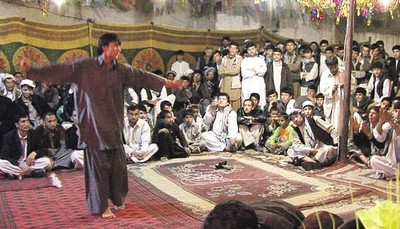 A party with dancing boys (bacha bazi). |
Raped woman miscarries, may get 100 lashes: Philippine television reports that a 35-year-old Filipina worker in Saudi Arabia, raped by a co-worker, languishing in Hafr Al-Baten prison due to her out-of-wedlock pregnancy, has suffered a miscarriage and now fears a hundred lashes for having an "illicit affair" before she will be freed. (January 20, 2010)
Wife, 10, returned to husband, 80: A Saudi father returned his 10-year-old daughter to her 80-year-old husband after finding her hiding at her aunt's home for about ten days. The husband accused the aunt of meddling in his affairs: "My marriage is not against the Shari'a. It included the [proper] elements of acceptance and response by the father of the bride." The husband added that he had first been engaged to the girl's elder sister, but she wanted to continue with her education; "In light of this, her father offered his younger daughter. I was allowed to have a look at her according to Shari'a and found her acceptable." (August 26, 2009)
Ali Mazen Abdul Jawad may pay heavily for his bragging about his sex exploits.
Saudi sex braggart in danger of capital punishment: Ali Mazen Abdul Jawad, 32 and a divorced father of four, appears to be quite the ladies' man. The Saudi Airlines employee who lives in Jidda, Saudi Arabia, appeared in a five-minute segment on July 15 on "Bold Red Line" (أحمر بالخط العريض), a weekly program on the Lebanese Broadcasting Corporation, boasting of his sexual conquests. Donna Abu-Nasr of the Associated Press describes the program, which begins with him talking about the first time he had sex at age 14.

Then he leads viewers into his bedroom, dominated by red accessories. Sitting cross-legged on a red bedcover, Abdul-Jawad ... says "everything happens in this room." Another shot shows Abdul-Jawad, who is dressed in a red shirt and red slippers and sports a stylish goatee, holding up blurred sex toys, a sex manual and a bottle he took from a box. "It's used for women who do not have sexual desire," he says.
The segment then shows him greeting three male friends at the door of his apartment, located in the western seaport of Jiddah. The four, who have all now been detained by Saudi authorities, then briefly discuss what turns them on and how much "comfort" they get from sex. "One million percent," says Abdul-Jawad.
Finally, he is shown sitting on his bed, saying that while he doesn't care where he has sex, sometimes he would like to have a "paranormal" experience. "You may ask me, 'Where?'" he says. "I may tell you, 'I wish in an airplane.'"
The segment ends with Abdul Jawad in his car, off for an evening's cruising.
For this indiscretion, Abdul Jawad and two friends were arrested in Jidda on July 31 for the crime of hiraba, the Shar'i offense of waging unlawful warfare (in speech or action) against the state and society. It can lead to execution. If he is charged only with the crime of publicizing vice, however, he will not face the death penalty. (August 6, 2009) Aug. 8, 2009 update: Without specifically referring to Abdul Jawad, the imam of the Grand Mosque in Mecca, Salih bin Muhammad at-Talib, used his Friday sermon to denounce "people whose eyes are dazzled and their hearts captured by their enemy's culture, speaking against and behaving contrary to our cultural values" and accusing them of treason against their own country. "They accept unquestioningly all the good and evil values of Western culture, which prompt them to discredit and deride their own values, traditions, literature and arts." He went on to decry unnamed international organizations that collect evidence to be used against Saudi Arabia and suggested that some Saudis aid these foreign provocateurs. "Their witnesses are some writers amidst us and their evidence are the writings of some of us." Oct. 7, 2009 update: Abdul Jawad got off with the relatively light punishment of 1,000 lashes, 5 years in jail, followed by 5 years without travel or talking to the media. His lawyer, Sulaiman al-Jumeii, plans to appeal the court's ruling and is confident the sentence against his client will be revoked. According to al-Jumeii, the other three men who appeared on the show got 300 lashes each and 2 years in prison. Oct. 25, 2009 update: Rozanna al-Yami, 22 and a Saudi subject, was charged with involvement in the offending television show (helping prepare it, advertise it) and sentenced to 60 lashes. The judge said he handed down the sentence "as a deterrent." To which Yami replied, "I am too frustrated and upset to appeal the sentence." Oct. 26, 2009 update: King Abdullah pardoned Yami and she will not undergo the sentence of 60 lashes, in part due to widespread media attention internationally.
Palestinian terrorist prisoners smuggle out sperm: Palestinian websites claim that six terrorist prisoners in Israeli jails have managed, through the agency of relatives, to get their sperm to their wives, who have impregnated themselves with it, according to Yedi'ot Aharonot. "The Hasam organization, which cares for Palestinians prisoners, says the prisoners in question come from the Gaza Strip and the West Bank. According to Mufak Hamid, head of the organization's PR division, the sperm was smuggled in the presence of witnesses who are relatives of the couples."
The paper goes on:
A number of websites have praised the initiative, defining it as "a war of provocation against the occupier," but not everyone is pleased with it. One of those who opposes the move is Dr. Yunis Al-Astal, a member of the Palestinian researchers' association, who says that "there is no guarantee the sperm will reach its destination, and this whole matter is infected with social and moral corruption." According to al-Astal, "The Jews can perform acts of deceit with the sperm, and the wife may have a thousand doubts."
(August 4, 2009)
Sanctioned rape of Iranian virgins before their execution: An unnamed member of Iran's paramilitary Basij, currently married with children, explained to a Jerusalem Post reporter that he joined the Basij at 16 years when his mother took him "to a Basiji station and begged them to take me under their wing because I had no one and nothing foreseeable in my future. My father was martyred during the war in Iraq and she did not want me to get hooked on drugs and become a street thug. I had no choice." Then came a description of his role raping young girls:
He said he had been a highly regarded member of the force, and had so "impressed my superiors" that, at 18, "I was given the 'honor' to temporarily marry young girls before they were sentenced to death." In the Islamic Republic it is illegal to execute a young woman, regardless of her crime, if she is a virgin, he explained. Therefore a "wedding" ceremony is conducted the night before the execution: The young girl is forced to have sexual intercourse with a prison guard - essentially raped by her "husband."
"I regret that, even though the marriages were legal," he said. Why the regret, if the marriages were "legal?"
"Because," he went on, "I could tell that the girls were more afraid of their 'wedding' night than of the execution that awaited them in the morning. And they would always fight back, so we would have to put sleeping pills in their food. By morning the girls would have an empty expression; it seemed like they were ready or wanted to die. I remember hearing them cry and scream after [the rape] was over," he said. "I will never forget how this one girl clawed at her own face and neck with her finger nails afterwards. She had deep scratches all over her."
(July 19, 2009)
Sexually aggressive Saudi females: Ibtisam Sheqdar provides interesting documentation in an Arab News story, datelined Mecca no less, "Workplace harassment: Women turn the tables," but the evidence hardly fulfills the title's premise of women as perpetrators and men as victims. Rather, they describe sexually aggressive females, something difficult enough for most people to imagine when the women in question are burqa'ed.
Start with Muhammad Naif, a young Saudi who works at a store, who tells how a woman entered the shore and, before leaving, asked for his telephone number.
"I gave her the shop's card, which had a landline number on it. She then asked me to write my name on the back, which I did. She then left," said Naif, adding that the woman began ringing him at work everyday. "She would ask to talk to me saying she had something urgent and important to say. She kept asking me for my mobile phone number, but I politely declined. She would ring me everyday for five days in a row," he said. "On the fifth day, she called and asked me to come out of the shop because she was waiting for me outside. I refused. She asked if I was afraid and I said yes. After that, she began to come in front of the shop and stood there, looking at me. I did not pay her any attention. I was not quite sure what she wanted. Maybe she wanted to play around and I was not ready for that."
Second, Saad Hamza, who works at a call center:
"One day, a woman customer called and asked for a certain service. I told her that this service could be done through the automatic telephone system. She quickly answered, 'What if I gave you a kiss?' I was taken aback," he said. "I told her that I wasn't interested and advised her to fear God. Another woman called and, while I was helping her, she began singing. I told her I was still on the line so that she would stop singing. She said she knew and asked for my mobile number. I told her that we do not give our private numbers to customers. She then read out her number and said she would be waiting for my call."
Third, Khaled Hussain, who works in human resources:
He says that women often contact him looking for jobs, even though there is a special department that deals with women applicants. "One day, a lady called me on my mobile. It was 12.30 a.m. I wondered how she got hold of my
I had no choice but to switch off my phone," he added. "She called the next day at 2 p.m. and started to talk about how attractive I was and how lucky my wife was. I ended the conversation and stopped answering her calls. She waited for several days and called me again to tell me she was well connected and offered to provide me with any type of assistance I needed from government departments. She asked me to send her my photo and promised to send hers. She then spoke words that I cannot repeat. I switched off the phone and changed the SIM."
The head of the psychological department at King Adul Aziz Hospital in Mecca, Tarik Albar, sees these as "isolated incidents involving women suffering from mental problems. There are some hysterical women who love being ostentatious. They sometimes use a lot of makeup to draw attention to themselves." The chairman of the Commission for the Promotion of Virtue and Prevention of Vice in Mecca, Ahmed bin Jasim Al-Ghamdi, acknowledged receipt of men complaining of being harassed by women.
Comment: To the extent these stories are not just examples of male bravado, Muslim assumptions about females as sexual predators explains them; for more on this surprising topic, see my article, "Female Desire and Islamic Trauma." An excerpt:
Muslims generally believe female desire to be so much greater than the male equivalent that the woman is viewed as the hunter and the man as her passive victim. If believers feel little distress about sex acts as such, they are obsessed with the dangers posed by women. So strong are her needs thought to be, she ends up representing the forces of unreason and disorder. A woman's rampant desires and irresistible attractiveness gives her a power over men that even rivals God's. She must be contained, for her unbridled sexuality poses a direct danger to the social order.
(July 5, 2009)
Rejected Iraqi Suitors Bomb Women's Families: Rod Nordland in the New York Times summarizes a new Iraqi pattern of failed ardor:
Boy meets girl. They exchange glances and text messages, the limit of respectable courting [in Iraq]. Then boy asks girl's father for her hand. Dad turns him down. Boy goes to girl's house and plants a bomb out front. The authorities call it a "love I.E.D.," or improvised explosive device, and it is not just an isolated case. Capt. Nabil Abdul Hussein of the Iraqi national police said that six had exploded in the Dora neighborhood of Baghdad alone in the past year. "These guys, they face any problem with their girlfriends, family, anyone, and they're making this kind of I.E.D.," Captain Hussein said. There have been no reported deaths or injuries from the devices used in this way, in Dora or elsewhere. "Usually they're putting them in front of the doors of their houses, not to kill, but to scare them," Captain Hussein said.
Nordland gives the case history of Omar Abdul Hussein, 18, known by the nickname of Cisco, a former supporter of Al Qaeda in Mesopotamia living in Dora: "Cisco was rejected by his girlfriend's father three times, and then one day she called to tell him that her father was bringing another suitor over to meet her. Cisco planted a bomb by their garden wall and set it off. Since he lived just next door, it was a short manhunt. Cisco was tried and convicted of terrorism." (May 30, 2009)
Mother in UK locks up three sons' wives "like slaves or dogs for 13 years": Preston Crown Court in England heard that Naseebah Bibi, 62, locked up her three daughters-in-law, Tazeem Akhtar, Nagina Akhtar and Nisbah Akhtar, and treated them as slaves for up to thirteen years, beating and slapping them if they disobeyed, threatening to break their legs and denying them food. Rather than live with their husbands, Bibi's sons Nahim, Fahim and Nadeem, the three women worked for Bibi at cooking, cleaning, and sewing.
 Naseebah Bibi, pictured outside Preston Crown Court, is accused of keeping her three sons' three wives as slaves. |
Speaking of Nagina Akhtar. Boyd said: "As soon as she came to this country, she was ordered by Mrs Bibi to spend the day sewing on an industrial sewing machine. She sewed all day, every day. She sewed for money, but she didn't see any of the money."
As for Tazeem Akhtar, Boyd said: 'She came expecting to live and have children with her husband, something she had dreamed of for some years. Her dream was doomed. She did not know that Nahim already had a partner, a white lady, and had two children. He had effectively no intention of living as her husband. He effectively had his own life and she only discovered that on the first day she arrived." Instead, "She was simply treated like a slave. She would get up 6am and was ordered to do all the house work, to clean the floors and windows and she even had to do the washing in cold water by hand, even though there was an electric washing machine. She did try to use the washing once but she was beaten by Mrs Bibi. She would be beaten by being slapped in the face, hit with a slipper on the arms and legs and had her hair pulled."
And Nisbah Akhtar: "When she arrived she had the expectation of being husband and wife and she would have a rosy future,' said Boyd. 'But on her arrival she was shunned by her husband and the same pattern of abuse began."
Comment: This takes to an extreme the Muslim pattern whereby a wife becomes something of a servant to her mother-in-law. (For more on this, see Fatima Mernissi's brilliant analysis, Beyond the Veil.) (April 1. 2009)
Father gets 6 months, 40 lashes for marrying off daughter twice: In another only-in-Saudi story, Al-Watan newspaper reports about a father in Qasim province with a 20-year-old daughter. He decided last year to marry her to a civil servant as the man's second wife. The marriage was not consummated and the father says he heard that the husband had divorced his daughter. So, after three months, he married her off to a second man, this one as a first marriage. (Following?) Her second marriage was consummated and she is now three months pregnant. But the first husband still considers himself married to her, so he filed a lawsuit against the father and daughter. The judge annulled the marriage to the first husband, ordered the wife to return his dowry, and legalized the second marriage contract. Most dramatically, he sentenced the father to 6 months in jail and 40 lashes. (April 5, 2009)
Women told: "You have dishonored your family, please kill yourself": As the Turkish authorities crack down on honor killings with long jail terms, men are requesting their women-folk to commit suicide and thus spare them years of incarceration. What might be called "honor suicides" are linked to reforms to the penal code in 2005 which mandated life sentences for honor killers. (Previously, killers often received a reduced sentences.) The law prompted a spate of female suicides, reports Ramita Navai in the Independent. (March 27, 2009)
Afghan president favors law that "legalises rape within marriage": As elections in Afghanistan loom in August, President Hamid Karzai appears to be looking for Islamist votes by supporting a law, article 132 of which states that women must obey their husband's sexual demands and that a man can expect to have sex with his wife at least "once every four nights" when traveling, unless she is ill. The final document is not yet published but it also appears to forbid wives from leaving home without their husbands' permission, to grant custody of children to fathers and grandfathers only, and to approve child marriages. According to the United Nations Development Fund for Women (UNIFEM), "Article 132 legalises the rape of a wife by her husband." (March 22, 2009) Aug. 16, 2009 update: The BBC reports that the bill, only slightly modified from its initial terms, has passed and become law. It also indicates that husbands may withhold food from wives who refuse their sexual favors.
Wet-nursing breaks up marriages: Readers may remember getting a good laugh two years ago when Izzat Atiya of Egypt's Al-Azhar University came up with a hair-brained way for men and women to work together by having the women feed their male colleagues "directly from her breast" at least five times. This act, his fatwa announced, would accord with a hadith and create maternal-child relations between the two, thus precluding any sexual activity between them and permitting them to be alone together at work. "Breast feeding an adult puts an end to the problem of the private meeting, and does not ban marriage. A woman at work can take off the veil or reveal her hair in front of someone whom she breastfed."
Not only was Atiya hilarious, but he was also wrong, at least according to the Hanbali school of jurisprudence practiced in Saudi Arabia, which rules that two persons breast fed by the same woman are prohbitied from marrying each other. This prohibition has obvious dangers, which an article in the Arab News today explores in a provocatively titled article by Nadeen Ibrahim, "Make sure your wife is not your sister!"
Islamic law prohibits marriage with one's wet nurse (for men), her husband (for women), her biological children and any nonbiological children she breast-fed. All such individuals are described as the person's mahram. Since there is no official system of documenting the names and identities of children who have been breast-fed by a woman, some young men and women sometimes end up accidentally marrying someone suckled by their own wet nurse. This can cause difficulties when couples find out later in life. If they have children, then things can be an even bigger problem.
Ibrahim then offers two examples of this problem, one of a couple married for seven years before discovering they were brother and sister. Fortunately, they had no children, so they divorced and remarried. According to Ibrahim, the woman of the couple "does not regret separating, as she did not really love her ex-husband in the way one loves their spouse."
The other example involves a couple married for 30 years with nine children before discovering they were foster siblings. Explains the wife, Umm Abdul Aziz: "It happened out of the blue. An elderly man came to my husband one day and told him that we had been suckled by the same woman. He even knew people who knew of this and could testify as witnesses. We were greatly shocked and deeply saddened." To avoid wrenching changes, she and her husband kept the matter a secret, continued living together, but now as brother and sister.
To solve this problem in the future, the article quotes a social worker, Fatima Muhammad Al-Suwaisi, urging that careful records be kept of who breast-fed whom. She also adds a sociological note: "Earlier, we used to live in small communities where people knew each other well. With the rapid growth in population and people often traveling from where they were born, it has become difficult for one to know one's foster brothers and sisters." (March 22, 2009)
May 31, 2014 update: The grand mufti of Saudi Arabia, Abdulaziz Al Ash-sheikh, has approved the mandatory divorce of an unnamed couple discovered to have been breastfed by the same woman as infants. That the couple had been married 25 years and raised 7 children did not stop the proceedings.
Parents threaten to kill teenage daughter unless she has sex with her husband: I introduced this weblog entry by noting that "The deepest differences between Muslims and Westerners concern not politics but sexuality" and here is a perfect case making that point, reported by Deutsche Presse Agentur:
Mohammed Ould Abdallahi and his wife Hawa Mint Cheikh emigrated from Mauritania to Puerto Real in southern Spain in the late 1980s, where they bore three children. Ould Abdallahi speaks hardly any Spanish and is almost illiterate. When his daughter Selamha Bint Mohammed turned 14 in 2006, he accepted for her the marriage proposal of her cousin Mokhtar Salem, then already more than 40 years old, and the couple proceeded to get married that year in Nouakchott, the Mauritanian capital.
Selamha informed a Spanish court last week that she was coerced into this marriage, that her father threatened to stone her unless she married Salem and had sexual relations with him. "He said he would throw the first stone," Selamha recounted.
The family then returned to Puerto Real, minus Salem, who only turned up on a visit in 2007. When he appeared, Selamha refused to resume sexual relations with him. In response, she told the court, "my parents told me they would kill me, burn me or slit my throat." At this point, Selamha turned for safety to a Spanish female friend.
The friend took Selamha for a medical check-up and the friend's family encouraged Selamha to report her parents and husband to the authorities, which she did. The police immediately detained the parents and husband, deprived the parents of custodianship over Selamha, and ordered the parents to keep a distance of 500 meters from Selamha.
The parents they face up to 17 years in prison for coercion, domestic violence and humiliating treatment. The husband faces up to 10 years for repeated sexual aggression. The trial is currently underway and prompting very different responses among Spaniards and Mauritanians.
Spanish internet commentators were practically unanimous in praising the girl's courage and in condemning Mauritanian customs. Marriages such as Selamha's represented a "medievalism which became outdated in Europe centuries ago," one commentator said. The case demonstrates "the failure of policies defending multiculturalism, because of the guilt complex we drag along in the West and because of permissiveness towards unacceptable behaviours," another blogger wrote.
Many Mauritanians, on the other hand, see the West as trying to impose its secular customs on Muslims. Some even suspect that Selamha's Spanish friends would like her parents to be jailed in order to adopt her and to "place her in a Christian home," as one young Mauritanian wrote in an internet forum. Imams preaching at mosques have commented on the case, urging the Mauritanian government to interfere on behalf of Mohammed Ould Abdallahi's family. A group of Mauritanian lawyers and senators representing emigrants also contacted the Spanish embassy in Nouakchott, El Pais reported. Even in the West, girls of Selamha's age were having sex, the newspaper Le Quotidien de Nouakchott pointed out. "If our judiciary cannot jail a Spaniard who drinks alcohol in our country, the Spaniards cannot judge alleged social offences" which can only be evaluated in the Mauritanian context, the newspaper Le Renovateur said.
(March 12, 2009) Mar. 30, 2009 update: The sentences have come down: 17 years for the mother, 13.5 yeas for the husband, and 1.5 years for the father, plus a €15,000 fine on the parents, a restraining order on the mother during her entire prison sentence, and on the father for four years.
40 lashes, 4 months in prison, deportation for 75-year-old widow for "mingling" with nephew: Khamisa Sawadi, 75 and the Syrian widow of a Saudi man, asked two 24-year-old men in April 2008 to bring her five loaves of bread, reports the Saudi newspaper Al-Watan. One of them, Fahd al-Anzi, as was the nephew of her late husband, the other his friend and business partner, Hadiyan bin Zein. They delivered the bread ent to Sawadi's home in the city of al-Chamil, north of Riyadh.
The religious police (the Commission for the Promotion of Virtue and Prevention of Vice) then arrested the three on the basis of "citizen information" from al-Anzi's father, who accused Sawadi of corruption, on the grounds that they are not immediate relatives. Sawadi testified that she had breast-fed Anzi when he was a baby (which, in Islamic law, establishes a family bond) and considered al-Anzi as her son, but to no avail; the court denied her claim, citing a lack of evidence.
On March 3, a court found all three guilty and sentenced them to prison terms and lashes. Sawadi, in addition, will be deported after serving her term. The verdict noted that because Sawadi "doesn't have a husband and because she is not a Saudi, conviction of the defendants of illegal mingling has been confirmed." (March 9, 2009) May 21, 2009 update: An appeals court reversed the judgement against Sawadi.
"Boys will be boys" defense of rape by female lawyer: Fatima Al Hawaj, a female defense lawyer in Bahrain, is representing three young men, ages 19, 20 and 21, accused of the abduction and gang rape of a 24-year-old Filpina last September. Driving a rental car, the men allegedly followed her as she walked home from work at a hotel in Manama, grabbed her by the hands, dragged her into their car, drove her to an isolated area in Askar, gang raped her, stole her mobile phone and purse (which contained cash), and dumped her in the middle of the desert. The Filipina subsequently identified her abductors' car' rape test results turned up positive for the defendants' DNA.
Hawaj defended the actions of her three clients yesterday before the High Criminal Court by arguing they should be acquitted because "minors' often commit crimes without criminal intent. "It is general knowledge that youngsters commit crimes for the fun of it and not with the intention to harm others and I request the court to take that into consideration and clear my clients of the charges." (March 4, 2009)
Pleasure-marriage contract with a 9-year-old girl: Rami 'Aleiq, the former head of the Hizbullah Students Union at the American University in Beirut, gave an interview about himself to Rotana Music TV on August 25, 2008, and which MEMRI has today made available. In it, the interviewer quotes 'Aleiq's book:
When I went on trips, I used to go secretly with several young friends to the Al-Marja neighborhood in Damascus. We would go to a hotel in order to have sex with prostitutes for 500 Syrian liras per half hour. ... None of us would make physical contact with the girl he chose before signing a formal pleasure-marriage contract with her.
Rami 'Aleiq, former Hizbullah student leader and patron of 9-year-old prostitutes.
The interviewer then asks: "Isn't marriage meant to be out of pure intentions? Weren't you conning God this way?" 'Aleiq replies: "You're right. Pleasure-marriage means conning God, as well as ourselves. I am against this way of relating to sex and to women. ... This is something that still goes on. It is wrong."

The interviewer asks if 'Aleiq was "an observant Shiite Muslim from Hizbullah?" and 'Aleiq nods in agreement.
The interviewer asks: "How did you ever dare to sign a pleasure-marriage contract with a nine-year-old girl?" and 'Aleiq replies: "In our culture, in order to be able to touch a girl or a woman, there must be a contract of pleasure-marriage."
The interviewer notes: "We are talking about a nine-year-old girl ...," prompting 'Aleiq to justify his actions:
Sure. In Islam, and this is what we were taught, a girl is mature from the age of nine. This is true with regard to Sunnis as well as Shiites. You are focusing on Shia Islam, because I am a Shiite, but according to religious jurisprudence, a girl is mature at the age of nine. This is where we got this idea. I was a child, and so was she, so I was not allowed to touch her, if I didn't form with her the kind of relation that permitted this.
Comments: (1) The idea that a female is sexually mature at the age of nine goes back to Muhammad and 'A'isha. (2) It's bad enough to marry off a girl of nine but to prostitute her is unspeakable. (3) 'Aleiq's misbehavior fits a well-worn pattern, one I briefly explored at "Islamists - not who they say they are" and to which I hope to return. (March 3, 2009)
Mansour and Noha (then 2 years old) al-Timani.
Couple forced to divorce because of husband's "inferior" tribal lineage: The Koran informs Muslims at 49:13, "Verily the most honored among you in the sight of God is the most righteous of you," but Islamic law also includes the doctrine of kafa'a, the idea that a groom must be socially suitable to his bride, an expectation that goes back to the Arabian tribal society from which Islam emerged. According to the Encyclopaedia of Islam, 2nd edition, kafa'a "designates equivalence of social status, fortune and profession ... as well as parity of birth, which should exsit between husband and wife, in default of which the marriage is considered ill-matched and, in consequence, liable to break-up."
Even today, kafa'a rears its ugly head, especially in Arabia itself. Perhaps the best-known case concerns Mansour and Fatima al-Timani, a couple with two children who found themselves forcibly divorced because Fatima's two half brothers decided Mansour was socially unworthy of her. The half-brothers then sued to nullify the marriage, claiming her husband had hidden his inferior tribal lineage. They won a judgment on July 20, 2005.
By that time, the couple had been married for over three years and Fatima was pregnant with the couple's second child. Nevertheless, their marriage had been voided and so the couple could not longer live together. The police evacuated Fatima from their joint home and gave her three choices: live with her half-brothers, move to a women's shelter, or go to prison. She initially chose prison, seeing that as the only way to go beyond her brothers' reach, moving there with her two children.
When the Riyadh Appeals Court confirmed the coerced divorce, Fatima left the prison for a women's shelter. Soon after, her mother come out publicly on the half-brothers' side and Fatima began a hunger strike.
Today marks her younger child, Suleiman's, third birthday. An article on the case notes the costs of the divorce, beyond the obvious ones: "Fatima said she cannot take Suleiman to hospital when he is sick. His name is not included in the family ID card she has. Her husband's ID has also expired and he is unable to renew it because of their pending case." (March 2, 2009)
Gang-rape victim sentenced to 100 lashes for adultery: A sketchy report by Adnan Shabrawi in the Saudi Gazette tells of an unmarried 23-year-old Saudi woman, apparently a resident of Jeddah, who accepted a ride from a man (remember, females may not drive in the kingdom). He proceeded to abduct her to a house to the eastern part of the city where he was joined by four of his buddies; together, the five of them sexually assaulted her through the night.
The rape led to her conceiving a child. At eight weeks' pregnancy, the woman went to the King Fahad Armed Forces Hospital for an abortion. She there "confessed" to what happened – the news report does not explain the circumstances – was arrested and brought before a judge at the District Court in Jeddah. The judge found her guilty of (1) adultery and (2) seeking an abortion. He sentenced her to a year in jail and 100 lashes – with the latter punishment only to take place after she delivers the baby. (February 8, 2009)
Samira Jassim, sponsor of systematic rapes of Iraqi women on behalf of Islamist organizations.
Creating female suicide bombers through systematic rape: From Iraq comes news of the televised prison confession of Samira Ahmed Jassim al-Azzawi (usually called Samira Jassim or Samira Jassam), a shopkeeper born in 1958 and the mother of four, telling about her alleged role in recruiting more than 80 young Iraqi women as suicide bombers on behalf of Ansar al-Sunna, 28 of whom actually went on to carry out attacks.
Her method of recruitment? Organizing their rape in order to exploit the deep shame associated with rape in Muslim society in order to push the victims to forfeit their lives as suicide bombers, thereby somewhat redeeming their lost honor.
The Daily Mail quotes Jassim: "I was able to persuade them to become martyrs. Many of the women were broken, depressed, especially those who were raped." The paper goes on to explain that "Jassim's role was to manipulate these rape victims - persuading them they would be better off dead. And once the women had volunteered to become suicide bombers, she delivered them back to insurgents ready for death."
Al-Jazeera quotes Jassim telling about one specific victim, Amal, a teacher who had problems with her husband and his family:
I met Amal and we stayed together for more than two weeks. I talked to her until I convinced her she was in a bad situation - as she had been treated badly by her husband and brothers. She was mentally exhausted. I then took her to see my contacts, then received her back from them at the same delivery place. This is where she then blew herself up".
The New York Times focuses on an August 2007 suicide bombing that killed 12:
Jassim recounted the fate of a woman she called only Um Huda, whom she had led to a neighborhood bank that served as her rendezvous point. "When I was talking to her, she was not answering or looking at me," Ms. Jassim said. "She was mumbling verses of the Koran." "I got her to the bank and left her there," she went on, unemotionally. "She detonated herself at a police station in Muqdadiya."
The Times of London provides more details about the modus operandi of Umm al-Mu'minin, "the Mother of the Believers,":
Jassim is heard in the video apparently confessing to training a female bomber who attacked a police station in Diyala. "I was introduced to her, I began talking to her," she said. She had to talk to one elderly woman several times before persuading her to blow herself up at a bus station, she added. ... US officials have said that recruiters often pick on vulnerable women whose husbands have been killed in the violence that consumed Iraq since the invasion. Some even marry the woman and then convert her into a suicide bomber.
Jassim's arrest is no small matter, for female suicide bombers have been a major tactic for al-Qaeda, Ansar al-Sunnah, and other terrorist groups in Iraq to get through the security forces. Checkpoints are typically run by male guards and social imperatives prevent them from frisking women, permitting the latter to carry out operations, especially as their long black robes offer plenty of space to conceal explosives.
Jassim faces the death penalty if found guilty. (February 6, 2009) Feb. 6, 2015 update: A search finds no news about her trial or sentence.
Male blackmail of female in Saudi Arabia: When the ancient Saudi practice of veiling women meets the contemporary use of camera-equipped mobile phones, a curious by-product has emerged, that of young men threatening to go public with pictures of young women. As Fatima Sidiya documents, a rash of such cases have occurred in the last six months.
- "Police in Al-Ahsa recently arrested a man in his 20s who blackmailed a 24-year-old woman into giving him SR250,000. The man threatened to publicize photographs of the woman. On arrest, police found SR20,000 [$67,000] in his possession and found that the woman had also bought him expensive watches and aftershave that cost a total of more than SR50,000, according to Al-Watan newspaper."
- Then there was "a case involving a 20-year-old man who blackmailed an 18-year-old girl in Makkah by threatening to publish her photographs on the Internet. The girl sold her jewelry and paid the man SR5,000. A few months later he demanded SR3,000 from her and that she goes out with him."
- "Likewise, a woman in Tabuk remained in constant turmoil for five years at the hands of a worker who threatened to publicize her photographs. In Riyadh, a woman handed a man SR800,000 over 14 years before seeking the commission's help."
This situation arises, as Sidiya cautiously explains, because, pre-marital relations of any sort with the opposite gender "are something frowned upon," so the exchange of photographs or love letters with a male "might cause immense problems to a woman if her family, fiancé or husband were to find out. As a result, some men take advantage and blackmail women into giving them cash or forcing them to have sex."
The problem has reached such proportions – including forty cases recorded in Makkah alone in 2008 – that King Abdullah set up a committee to solve the problem. (December 25, 2008)
Saudi 8-year-old girl must await puberty to divorce: In contrast to Nojoud Muhammed Nasser, the Yemeni girl who marched into court and won a divorce (see below on her), an unnamed Saudi the same age living in Unayzah was not granted the right to divorce. Here's how it happened, according to her lawyer, Abdullah Jtili, and reported by Agence France-Presse:
The girl's father, apparently facing financial difficulties, agreed in August 2008 to marry his daughter to a 58-year-old man for an advance dowry of SAR30,000 (US$8,000). Soon after the father and the groom signed of the marriage contract, which stipulated that the marriage would be consummated when the girl turned 18, her divorced mother began proceedings to have it annulled. In response, says laywer Jtili, "The judge [today] dismissed the [mother's] plea because she does not have the right to file such a case, and ordered that the plea should be filed by the girl herself when she reaches puberty." Jtili noted that "She doesn't know yet that she has been married," though four months have passed since the contract was signed. Jtili plans to appeal the verdict. (December 21, 2008)
Jordanian women agree to being beaten: A survey conducted for unnamed United Nations agencies and including nearly 15,000 Jordanian families and 11,000 married women, aged mostly between 15 to 49 years old, found that around 20 percent of the women approve being beaten by their husbands to be disciplined. (November 26 2008)
Indonesian Muslim imam charged for sex with a 12-year-old wife: Pujiono Cahyo Widianto, 43, imam, owner and head of an Islamic boarding school in Semarang, Java, conducted a contest in which his 26-year-old first wife, Pujis, and some of his followers served as judges to pick his second wife. According to The Jakarta Post, Pujiano married the winner, 12-year-old Lutfiana Ulfa Puji, in August and proceeded to have sexual relations with her. Pujiono reportedly has declared an intention to marry two yet younger girls, 7 and 9.
Lutfiana's parents admit they married their off because of financial difficulties, being unable to send her to school. They hoped the marriage to the rich Pujiono would improve their economic situation. The parents maintain the marriage is valid according to Islam; but it is not registered with the state.
Indeed, modernity has starkly intervened in the case. Hadi Supeno, secretary of the Indonesian Child Protection Commission (KPAI) is planning to report Lutfiana's parents. Pujiono, and Pujis to the police for a criminal investigation. All of them could be charged under the 2002 Law on Child Protection for forcing, swindling and/or trading a minor to have sexual relations. If found guilty, they would face a maximum sentence of 15 years in jail and a fine of $30,000. Additionally, those involved may have violated the 1974 Marriage Law, which requires that a person be 16 years old to marry. Finally, Pujiono will have to undergo psychological testing to see if he should be dealt with as a pedophile. (October 28, 2008)
Male salesmen at Saudi lingerie shops: Sawt al-Mar'a, a Saudi women's organization, has started a boycott campaign against lingerie stores, hoping to pressure the owners to replace their salesmen with sales women. Says the campaign's leader, Reem As'ad, an economics professor at Dar Al-Hekma College in Jeddah:
We urge every man and woman to help our privacy from being violated by men to whom we are obliged to buy our intimate clothing items. It's the most irritating experience so far to women. ... It's really strange that Saudi Arabia is the only country where you see men selling women's lingerie. Women walk around covered from head to toe, and yet they have to discuss the size and material of their undergarments with strange men. Isn't this odd?
Reem As'ad wants Saudi women to be able to buy lingerie from female clerks.
The group has labor law on its side, for it calls for women to replace men in women's lingerie."We only want to activate a law that was passed two years ago," notes As'ad. An unnamed source in the Labor Ministry explained that religious elements who oppose the employment of women have delayed implementation: "The ban comes from a strict interpretation of the Islamic principle that women should not mix with men outside their immediate family." (October 15, 2008) Jan. 18, 2009 update: "Women's campaign for right to sell lingerie fails," reports Najah Alosaimi in the Arab News, despite support from the Jeddah Chamber of Commerce and Industry as well as colleges and training institutes. The "Ban Men from Selling Lingerie" group "sent letters to leading lingerie shop owners stating the importance of complying with the Labor Ministry's guidelines to employ saleswomen, along with the signatures we collected online over the last four months," recounts its organizer, Reem As'ad. "But we haven't received any response." Letters to lingerie stores threatening a boycott did not work: "Even that wasn't enough for them to understand our feelings when we buy lingerie from men."
The reasoning behind men selling bras and panties is complex, Alosaimi explains:
Hiring saleswomen is difficult despite the Ministry of Labor's approval. This is due to conflicting views on the subject between the ministry and the religious establishment. Saudi Arabia's Grand Mufti Sheikh Abdul Aziz Al-Asheikh recently said, "Women are entrusted to us, we should not involve them in matters far from their nature." However, the Commission for the Promotion of Virtue and the Prevention of Vice announced that it was not against the idea of saleswomen in lingerie shops as long as they work in women-only malls and do not come into contact with men.
 The Nayomi (Na'umi) lingerie stores hire saleswomen. |
Humaid Diab, sales manger of Nayomi lingerie shop, says recruiting saleswomen is not something new. "Eleven years ago, much before the regulation that restricts men from selling lingerie to women was passed in 2006, we had a women-only lingerie shop called Donya," he said. ... He added that his clothing chain has 14 women-only branches across the Kingdom. "They attract a lot of women even in cities, such as Madinah, Abha and Najran, which are considered conservative," he said. "Women prefer to shop from our branches because they are run by women." Following Donya's success, other stores followed suit. Naomy opened a lingerie store at Al-Basateen shopping mall two months ago. Adorned in black abayas, three saleswomen sell women's clothing there.
Sarah Sahel, regional recruiting manager at Nayomi, talked about the impact of hiring women. "Shops that have women staff attract more buyers," she said, adding that customers are not offended when they see women selling lingerie. "It's the opposite! It's even more comfortable for men who take their wives or daughters shopping," she said. Sahel said such shops are successful in business terms. "Lingerie is a women-only matter and only women can really give advice on the issue," she said. "Hiring saleswomen make it more comfortable for women to try clothes on inside the shop or even leave their telephone numbers in case of a sale or the arrival of new stocks ... they are also willing to participate in questionnaires," she said, adding that "this rarely happens when the sales representatives are men."
Mar. 25, 2009 update: A group of about fifty Saudi women launched a campaign yesterday in Jiddah to boycott lingerie stores with male clerks and shop only at the country's few women-only lingerie stores, reports the Associated Press. Jan. 13, 2012 update: Nearly three years later, the shift to lingerie saleswomen has been made, opening up economic opportunities for Saudi females – and perhaps increase the sales of lingerie. Feb. 13, 2013 update: So fast have things moved that the Commission for the Promotion of Virtue and Prevention of Vice, Saudi Arabia's morality police, will in a few days enforce a ban on men working in lingerie shops. The reasoning has partly to do with women's privacy and partly with giving them opportunities for employment. Nov. 17, 2013 update: "Curtains have come down on 500 lingerie shops in the Kingdom for violating recent government orders mandating feminization and Saudization of businesses selling women's undergarments and accessories," reports the Arab News. Dec. 23, 2013 update: Katherine Zoepf goes into this topic in detail, also looking at its implications, in "Letter from Riyadh: Shopgirls, The art of selling lingerie" in the New Yorker.
June 23, 2015 update: In "Lifting the Veil: How Working Women Are Remaking Saudi Arabia," Juliane von Mittelstaedt and Samiha Shafy explain the unexpected importance of the lingerie revolt, actually calling it a "revolution":
Four years ago, female shop assistants were few and far between. Most people working in stores were men from overseas—from the Philippines, Bangladesh and Malaysia. Foreigners account for one third of the population in Saudi Arabia, working primarily as drivers, waiters, housekeepers or salespeople for clothes and cosmetics—and even lingerie. In a country that insists on segregation of the sexes, women had to buy lingerie from men.
"Once I had to give a shop assistant my bra size," says [shoe saleswoman Hanin] Alamri. "He told me I had it wrong. I was deeply embarrassed." Trying anything on was out of the question. There are no changing rooms in stores in Saudi Arabia. So Alamri did what all women there have to do - she picked up a random bra, paid and left. And got used to badly-fitting underwear.
But women decided they'd had enough. In 2012, Saudi Arabia began enforcing a law that allows only females to work in lingerie stores. Gradually, women were also granted the right to sell abayas, make-up, handbags and shoes. Children's toys. Clothes. Slowly but surely, men were banished from these realms.
Female participation in the workforce, however, brought with it a host of new problems. How could women get to work, when they're not allowed to drive? Who was going to look after their children? What happens if they're expecting? More laws have subsequently been passed, from a right to ten-weeks of paid parental leave, to a right to work part-time and a right to childcare support. A revolution started by lingerie. Only in Saudi Arabia.
 A Nigerian man, Mohammed Bello Abubakar, 84, has 86 wives, but probably not for long. |
The Islamic authorities in his country, however, are not pleased. The Jamatu Nasril Islam (JNI) has told him to choose four of them, divorce the other 82, and repent for his sins within three days. Failing this, it will sentence him to death. In response, Abubakar defiantly challenged the JNI on the grounds that the Koran prescribes no punishment for a man taking more than four wives. "To my understanding the Koran does not place a limit and it is up to what your own power, your own endowment and ability allows. God did not say what the punishment should be for a man who has more than four wives, but he was specific about the punishment for fornication and adultery." (August 21, 2008) Sep. 16, 2008 update: Police arrested Abubakar on orders Niger State's Islamic court, charged with "infringing on Islamic laws."
Saudi marriage officiant permits one-year-old girls to be married: Ahmad Al-Mu'bi told LBC TV on June 19, 2008 (click here to view the clip on MEMRI TV) that
Marriage is actually two things: First we are talking about the marriage contract itself. This is one thing, while consummating the marriage - having sex with the wife for the first time - is another thing. There is no minimal age for entering marriage. You can have a marriage contract even with a one-year-old girl, not to mention a girl of nine, seven, or eight. This is merely a contract [indicating] consent. The guardian in such a case must be the father, because the father's opinion is obligatory. Thus, the girl becomes a wife. ... But is the girl ready for sex or not? What is the appropriate age for having sex for the first time? ... The Prophet Muhammad is the model we follow. He took 'Aisha to be his wife when she was six, but he had sex with her only when she was nine.
(June 26, 2008)
Saudi imam details heavenly sexual delights: Omar Al-Sweilem, a Saudi imam, extols in near-pornographic detail on Saudi television the delights that await the faithful (men) when they find the "black-eyed virgin with her black hair and white face" in heaven. He paraphrases the Sufi sheikh, Harith Al-Muhasibi (c. 781-857):
What hair! What a chest! What a mouth! What cheeks! What a figure! What breasts! What thighs! What legs! What whiteness! What softness! Without any creams – no Nivea, no Vaseline. No nothing! [Ibn Al-Muhasibi] said that faces would be soft that day. Even your own face will be soft without any powder or makeup.
You yourself will be soft, so how soft will a black-eyed virgin be, when she comes to you so tall and with her beautiful face, her black hair and white face – praised be He who created night and day. Just feel her palm, Sheikh! He said: How soft will a fingertip be, after being softened in paradise for thousands of years! There is no god but Allah.
He told us that if you entered one of the palaces, you would find 10 black-eyed virgins sprawled on musk cushions. "Where is Abu Khaled?" "Here, he has arrived!" When they see you, they will get up and run to you. Lucky is the one who gets to put her thumb in your hand. When they get hold of you, they will push you onto your back, on the musk cushions. They will push you onto your back, Jamal! Allah Akbar! I wish this on all people present here.
He said that one of them would place her mouth on yours. Do whatever you want. Another one would press her cheek against yours, yet another would press her chest against yours, and the others would await their turn. There is no god but Allah.
He told us that one black-eyed virgin would give you a glass of wine. Wine in Paradise is a reward for your good deeds. The wine of this world is destructive, but not the wine of the world to come.
(April 16, 2008)
 Nojoud Muhammed Nasser, 8, went to court by herself in Yemen. |
My father beat me and told me that I must marry this man, and if I did not, I would be raped and no law and no sheikh in this country would help me. I refused but I couldn't stop the marriage. I asked and begged my mother, father, and aunt to help me to get divorced. They answered, "We can do nothing. If you want you can go to court by yourself." So this is what I have done.
Nojoud complained about her husband's behavior.
He used to do bad things to me, and I had no idea as to what a marriage is. I would run from one room to another in order to escape, but in the end he would catch me and beat me and then continued to do what he wanted. I cried so much but no one listened to me. One day I ran away from him and came to the court and talked to them. ... Whenever I wanted to play in the yard he beat me and asked me to go to the bedroom with him. This lasted for two months. He was too tough with me, and whenever I asked him for mercy, he beat me and slapped me and then used me. I just want to have a respectful life and divorce him.
 Nojoud's husband, Faez Ali Thamer (left), and father, Muhammed Nasser (right), attend her hearing |
No charges have brought against either her father, who was later released due to health problems, or the husband, who remains in jail pending further investigation.
Thamer is unrepentant but willing to be flexible: "Yes, I was intimate with her, but I have done nothing wrong, as she is my wife and I have the right and no one can stop me. But if the judge or other people insist that I divorce her, I will do it, it's ok."
Shatha Ali Nasser, a lawyer in the Supreme Court notes that Yemeni civil law states that "no girl or boy can get married before the age of 15" but that a 1998 amendment permits parents to arrange a marriage contract between their children below the age of 15. The husband may not have sexual relations with a young wife until she is physically mature, but the situation invites abuses. Nasser notes that Nojoud's predicament is not unique but she is the first young girl to venture into court by herself. Meanwhile, Nojoud's maternal uncle, Shu'ee Salem Attabi'ee, has become her guardian and she will be placed in Dar Al-Rahama, an NGO for children. (April 9, 2008) Apr. 17, 2008 update: The AFP, BBC, and AP offer additional details on the case. June 11, 2008 update: Nojoud won her divorce. June 29, 2008 update: Another Yemeni girl, Arwa Abdu Muhammad Ali, 9, left her husband's house and took refuge in a hospital, where she complained of being beaten and sexually abused, making her the second child bride to come forward in less than a month and turning her into a something of a celebrity. Aug. 14, 2008 update: Putting Nojoud's and Arwa's circumstances into perspective, the Yemen Times reports that, in some parts of the country, the average marriage age for girls is ten. Oct. 1, 2010 update: CNN tells the story of "Reem al Numeri ... 14-years-old and recently divorced. She was 11 when she says her father forced her to marry a cousin more than twice her age."
Sign on woman's clothing store window: "Just in: Abaya with openings for breastfeeding."
If a woman breastfeeds an adult male, she can be alone with them: In a ruling that has inspired much hilarity, Izzat Atiyya, head of the Hadith Department at Al-Azhar University, Cairo, recently issued a fatwa suggesting that to get around the problem of an unrelated man and woman who work together unsupervised, something forbidden by the Shari'a, the woman can breastfeed the man because this instantly turns him into a mahram, or someone with whom sex is forbidden, making it fine for them to be in private together. Responding to the howls of laughter, Al-Azhar University appointed a committee whose decision led to Atiyya's suspension from his position. (May 25, 2007) July 28, 2010 update: One might think that Atiyya's ignominious fate would deter other Islamic scholars from retracing his steps – but no. 'Abd Al-Muhsin Al-'Obikan, an intrepid advisor to the Saudi Ministry of Justice, issued a fatwa allowing the breastfeeding of adults. This fatwa also prompted wide derision; one columnist noted how fear of gender-mixing leads the ulema to encourage lewd behavior. But, unlike Attiya, 'Obikan stood his ground.
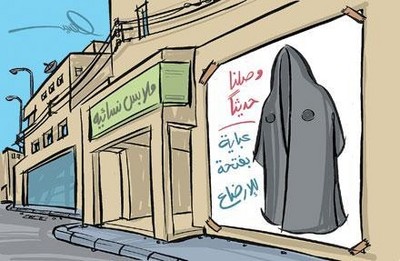
Sleep talking forces couple to divorce: Muslim authorities in India ordered a couple married for eleven years with three children to separate after the man uttered three times in his sleep the formulaic word in the Shari'a for divorce, talaq. When word of the sleep talk reached the ulema, they issued a fatwa telling the couple to live apart and for the woman to marry another man before she can go back to her original husband. (March 28, 2006)
Force-feeding Muslim girls: I review the phenomenon on gavage (force-feeding) among Muslim families in a weblog entry, "The Middle East Explodes with Obesity." One extract from a Wall Street Journal Europe article about 8-year-old girl in the western Sahara, Jidat Mint Ethmane, who
says she was required to consume four liters of milk in the morning, plus couscous. She ate milk and porridge for lunch. She was awoken at midnight and given several more pints of milk, followed by a prebreakfast feeding at 6 a.m. If she threw up, she says, her mother forced her to eat the vomit. ... If she balked at the feedings, her mother squeezed her toes between two wooden sticks until the pain was unbearable. ... Local officials say some women are so fat they can barely move. In [a Mauritanian] survey, 15% of the women said their skin split as a result of overeating. One-fifth of women said one of their toes or fingers were broken to make them eat.
(December 29, 2004)


