
The niqab and burqa both should be banned on security grounds, because one cannot allow faceless and bodyless persons walking the streets, driving cars, and otherwise making use of public spaces; the dangers are too great. This blog focuses on specific dangers, especially in the West (where reporting is better), of the niqab, burqa, and other Islamic coverings as a disguise for criminal and terrorist purposes.
Methodological note: I have not made a systematic study of this topic but collected incidents as I encounter them in the course of my reading. In other words, I make no claim to completeness. There are surely many more incidents than I have recorded.
Bibliographic note: I have elsewhere discussed other problems of the niqab and burqa, for example, their negative health implications. For a full listing, see "Bibliography – My Writings on Burqas, Niqabs, Jilbabs, Chadors, Hijabs, and other Islamic Coverings."
Ottoman prohibition of the burqa: A reader points out that the Ottoman sultan gave the example of a burqa'ed man committing a robbery to ban the sheet-like apparel in April 1892. (November 19, 2012)
Amin al-Husseini escaped Palestine: Tipped off in July 1937 that the British police were coming to arrest him, the vile mufti of Jerusalem first took sanctuary on the Temple Mount for three months, then escaped Mandatory Palestine in October 1937 by putting on a woman's covering and sliding down a rope in the dark. He fled successfully to Lebanon where he resumed his pro-Nazi activities.
Iraqi irregulars in Deir Yassin: Troops from Iraq disguised themselves as women to enter the Palestinian town in early 1948.
Nuri al-Said failed to escape the revolution: Iraq's dominant politician during the period of the Hashemite monarchy tried to flee dressed in women's clothing in July 1958 but, the story goes, his shoes gave him away and he was shot.
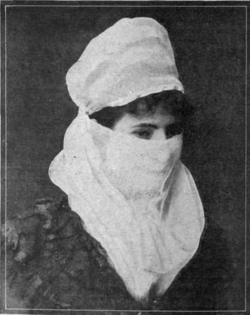
An historic yashmak.
Mesmerising yashmak thieves: This is perhaps the oddest incident of all. (The Yashmak is a Turkish covering; in modern times, it involves a light face covering that leaves only the eyes visible.) I quote here from the "British Muslims Monthly Survey," which got this incident from the Chingford Guardian of October 8, 1998:
Two thefts in Chingford and Walthamstow have been blamed on "mesmeric Muslims." At an off-licence in Walthamstow, two women wearing yashmaks with two children, asked for a bottle of Bacardi and sweets. They gave the owner of the shop a £50 note, which he changed. They then said they did not want the drink and asked for their money back. The owner of the shop said his mind went blank and he gave them the £50 note and an additional £10 note. He said: "I was just frozen and had no idea where I was. I have never known anything like that in my 16 years in the business. There was some sort of spell on me." Later the same day, in Chingford, a similar event took place at a music shop where the owner returned the £50 note plus an additional £20 note.
(October 1998)
Jewelry theft in London: Two robbers, male and female, stole £200,000 worth of jewelry from the exclusive Ramot on Sloane Street in Knightsbridge by wearing burqas into the store. The robbers then flung open their garments to reveal guns, threatened the staff, took their keys to the display cabinets, locked the staff in a back room, and made off in a black Mercedes Benz getaway car with what Scotland Yard called "unique" gems. (March 7, 2002)
Attacking a church: Two assailants in burqas threw a grenade among worshippers at a Christmas Day service on in the village of Chianwala, northwest of Lahore, killing three and wounding thirteen. (December 25, 2002)
Niqab as an accessory to abduction in the United States: Timothy Egan tells about the strange abduction of Elizabeth Smart, 14, in "In Plain Sight, a Kidnapped Girl Behind a Veil." Brian D. Mitchell, 49, flaunted Smart in public but kept her in a niqab-like garment that hid her for nine months from one of the most intense-person cases ever conducted.
With a veiled Elizabeth Smart and his wife in tow, Mr. Mitchell showed up at a downtown block party here, a grocery store, a restaurant, even living for about a week just one block from the Salt Lake City police headquarters, numerous witnesses say.
Throughout much of last summer [i.e., 2002], while the police and volunteers were looking day and night for Elizabeth after her kidnapping, it turned out she was moving among them in the open, dressed in the most flamboyant of outfits, and at times even camped just three-and-a-half miles from the Smart home. Mr. Mitchell was stopped by the police several times, and later arrested in San Diego on a burglary charge - all while still holding Elizabeth captive, the authorities said. ...
Late last summer, the police say, Mr. Mitchell was moving all around Salt Lake City. At the block party in early September, other people approached the three and asked about the small, veiled girl. "I went up to Mitchell and asked, 'How come she can't even look at people?' " said Ron Lewis, 37, a banquet crew leader who was at the party. "I said, 'What's up with a religion that won't even let women speak?' " said Mr. Lewis, who told his story to the police today. "Her eyes were all I saw of Elizabeth," Mr. Lewis said. He said at times, Mr. Mitchell and his wife held Elizabeth's hand.
(March 14, 2003) Nov. 17, 2010 update: At the Smart trial, evidence came out how a detective nearly rescued her – except for an exaggerated deference to Islamist ways:
Mitchell began to speak of going to California for the winter, and in August they walked to the library for maps. Someone called the police, saying Elizabeth Smart might be at the library. The caller said he thought he recognized her eyes.
Former Salt Lake City homicide detective Jon Richey was sent to investigate. Although he considered the lead "a long shot," he asked, repeatedly, to lift the young woman's veil. But Mitchell said it violated their religious beliefs for anyone but the young woman's husband to see her face.
Richey testified that it would have violated her civil rights to lift the veil if the story about her religious beliefs was true. And Mitchell's calm demeanor didn't set off any alarms for him. He said that when he learned about six months later that the girl he'd tried to question was Smart, it left him "traumatized."
"I don't see anything else I could have done," Richey told reporters after his testimony. "It's difficult for me, but I live with that, and there's nothing I would have done differently."
Smart testified that as the detective left, "I felt like hope was walking out the door." She added, "I was so mad at myself. Mad at myself for not taking the chance. I felt like it was so close. I felt terrible that the detective could just walk away."
Comment: With all he knows seven years later, that the detective still does not see that he could have done otherwise instills profound sadness and pessimism in this observer.
"Disguised gunmen try to free terror leader": For details of how three Islamist terrorists tried to spring their boss from a prison hospital by dressing as women in abayas, see my weblog entry, "Saudi 'Counterterrorism' Efforts Fail Again." (June 9, 2004)
Burqa'ed commandos capture burqa'ed Al-Qaeda fugitive: On the plus side, a group of Pakistani commandoes disguised itself as women to wait out a ranking Al-Qaeda operative, Abu Faraj al-Libbi. And why were they in burqas? Tim McGirk of Time explains: "U.S. and Pakistani intelligence had received a tip that a suspected al-Qaeda operative would be traveling to [the town of] Mardan disguised as a burqa-clad woman. Because any plainclothesmen seen grabbing a woman would attract a hostile mob, the commandos had donned female garb and accosted the suspect as his motorcycle crossed a graveyard." (May. 8, 2005)
Afghan suicide bombers hides under burqa: Five Afghan soldiers were killed and four wounded when a suicide bomber, whom the police think was a Taliban member, disguised himself as a woman and sat in the backseat of a car, then set off a bomb hidden under his burqa at an army checkpoint in Khost province of eastern Afghanistan. According to Mohammed Ayub, the regional police chief, "The bomber probably wanted to go into Khost city for a suicide attack there, but panicked and blew himself up when the soldiers started checking." (February 2, 2006)
Al-Qaeda leadership in Iraq: Abu Mousab al-Zarqawi, the leader of al-Qaeda in Iraq, eluded Western forces over a three-year period through wiliness. In the description of Bill Powell and Scott MacLeod of Time, "al-Zarqawi was a maddeningly elusive target—a master of disguise who could pass as a woman in a burqa one day, an Iraqi policeman the next." (June 11, 2006)
Palestinian gunmen escape Israeli forces in Gaza: The IDF suspected that Palestinian gunmen dressed up as women to escape a 19-hour standoff with the IDF that tried to dislodge them from a mosque where they were hiding. A report by Sa'id Ghazali in The Independent provides more details about women injured while taking burqas to the gunmen:
Lying in a hospital bed, covered from head toe in a black cloak, Asma Hamad, 23, said that she and two relatives were wounded while serving as human shields for dozens of fighters, who had taken refuge in neighbouring houses. The women were summoned by phone calls and local radio stations to rush to the area of the 700-year-old al-Nasr mosque.
"We went immediately to the streets," Mrs Hamad said. "Some of us carried food, some brought traditional women's cloaks and head covers to help the fighters. The army immediately shot at us. I was hit in my left leg." ... One woman told Maan, an independent Palestinian news agency, that she smuggled women's clothing into the al-Nasr mosque, where the gunmen were holed up , and helped them escape in disguise.
(November 4, 2006)
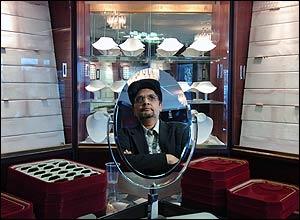 Abdul Rasheed Khalid, owner of Zaibi Jewellers, in Brampton, poses with empty display cases. He was bound and hit several times during a robbery on Nov. 17, the latest in a series of Toronto-area jewelry store heists. |
Abdul Rasheed Khalid was alone in his Brampton jewellery store filling the display cases with yellow gold rings and necklaces when two people, one wearing a head-to-toe black burqa, appeared outside his locked door.
"Salamu alaikum," the 58-year-old store owner said after pushing the entry buzzer, believing them to be a Muslim couple. There was no reply, and seconds later the pair — both males — forced him at gunpoint to the back office where he was bound with duct tape and hit several times. Then his store was cleaned out.
"Keep quiet, keep quiet, close your eyes," they said, while emptying the red velvet trays into duffel bags carried by an accomplice. Khalid caught a glimpse of the crooks. He thinks they were Pakistani or Indian.
Last Friday's daylight robbery has other South Asian jewellers across the GTA on edge, fearful they'll be next. The thieves didn't seem to care that Zaibi Jewellers is in the same strip mall as a storefront Peel Region police station at McLaughlin Rd. and Ray Lawson Blvd.
(November 21, 2006)
Mustaf Jama, Britain's most wanted fugitive, apparently fled the country for his native Somalia by donning the niqab.
Murder suspect flees UK: It's not been confirmed, but a reliable source indicates that Mustaf Jama, 26, one of Britain's "most wanted" criminals for having murdered Police Constable Sharon Beshenivsky, 38, in November 2005, fled the country during the last week of 2005 and returned to his native Somalia. The picture of Britain's most wanted man, with 21 criminal convictions, had been circulated to every police force, port and airport in the country. He got through by disguising himself as a Muslim woman. Specifically, he adopted his sister's identity, using her passport and by wearing a niqab. Turns out, security personnel at London's Heathrow Airport made no attempt to match his face with her passport picture, even though the airport was on a heightened state of alert after the 7/7 terrorist attack. Indeed, the Times (London) writes that "British immigration officers rarely carry out a visual check to match a passport photograph with a departing female passenger's veiled face." It also adds that, in October 2006, "a male suspect in a major anti-terrorist investigation evaded capture in Britain for several days by dressing in a burka. He was eventually arrested and is awaiting trial." (For more on that case, see "Suspect in terror hunt used veil to evade arrest.") (December 20, 2006)
Jewelry theft in India: After closed circuit television cameras in jewelry stores in Pune, India (about 170 km from Bombai), revealed that burqa'ed customers had perpetrated three recent thefts of jewelry, each valued at over $8,500, the Pune Jewelers Association has applied to the police chief of Maharashtra State for permission to exclude anyone with a covered face (regardless of religious affiliation) from their shops.
Association president Fattechand Ranka explained: "Because of the burqa the police could not identify their faces. Anyone could be masquerading under a burqa, even a man." He explained that the PJA has videos of women stealing jewelry but they could do nothing about it because the faces are obscured. "We could only see their eyes because the veil covered the rest of their faces."
For his part, Pune police commissioner D. N. Jadhav has rejected the ban, for fear it would cause Hindu-Muslim problems, and suggested instead that if the jewelry shop owners "are really concerned about security, they can appoint saleswomen and women security guards in their shops." And the PJA did back down, with Rankha announcing its withdrawing the proposed ban out of concern for religious sensibilities.
Naseem Siddiqui, chairman of Maharashtra State Minorities Commission, hailed the retreat. "The burqa is an integral part of Muslim religion and asking women to not wear it while shopping for jewellery will not be acceptable to the community." But Javed Anand, general secretary of the Muslims for Secular Democracy, was sympathetic to the jewelers. "There is a valid point here and we must see it for what it is." (December 29, 2006)
Police chief assassinated in India: Manzoor Ahmed, police chief of Pampore, Kashmir, was killed when a suspected Islamist posed as woman wearing a face covering. The subsequent gunbattle left one civilian dead and two constables wounded. (December 30, 2006)
Philadelphia bank: The report in the Philadelphia Inquirer is not explicit, so it's not clear if a niqab is involved, but one suspects so, for how else would "Muslim clothing" and eyeglasses disguise a successful bank robber:
A woman robbed a Center City bank yesterday and fled with an undisclosed amount of cash, police said. The robber, dressed in Muslim clothing and wearing a pair of silver eyeglasses, walked into the Wachovia Bank branch at Broad and Walnut Streets about 2:10 p.m. and gave a teller a demand note, police said. The robber escaped after receiving the cash, police said.
(January 6, 2007)
The six accused July 21, 2007 bombers. Yassin Omar (seen here without his burqa) is on the lower left.
Bank robbers in London: "You don't have to be Jewish to love Levy's Rye Bread" and you don't have to be Muslim to misuise the niqab. Anthony Roberts, 22, and Nicholas Bidar, 19, stole Muslim clothes from Regent's Park mosque in June 2006 and put them on to conceal their identities for a bank robbery later that day in Kilburn, north London. They waited in the banking hall before rushing guards as they made cash deliveries and collections, then sped away in a waiting car. The pair of thieves pleaded guilty to three counts of theft (including a previous robbery three weeks earlier) and the Kingston crown court in south-west London sentenced them to four and three years in prison, respectively. (February 10, 2007)
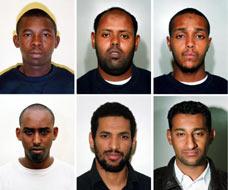
UK Terrorism suspect escapes: Closed-circuit television captured Yassin Omar, 26, of north London, on two occasions wearing a burqa. Omar is one of the six accused July 21, 2005 would-be bombers (he allegedly tried to set off a hydrogen peroxide bomb at Warren Street Underground station). The first time was on the day of the attempted bombings, when Omar (in the Daily Telegraph description) "dressed from head to toe in a black burka and carrying a brown handbag" is seen walking to Golders Green coach station and getting off a bus hours later at Digbeth, Birmingham. (Click here for the actual CCTV footage.)
The second time, he fled London under a burqa a day after the failed attacks. As the Times (London) account puts it:
The 6ft 2in (188cm) figure of Yassin Omar, dressed from head to toe in a black burka, could be seen with a white handbag over his left arm as he made his way with a woman to a London coach station. Mr Omar boarded the 6.20pm National Express service to the Midlands, Woolwich Crown Court was told. Three hours later the bus arrived in Birmingham and he disembarked. He sat on a bench and waited until a red Nissan Sunny car pulled up, Max Hill, a junior prosecutor, said. He then got in and was driven away.
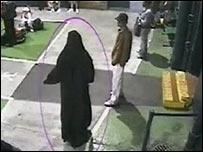 Yassin Omar, in burqa disguise, fleeing from the police. |
Afghanistan terrorist wears burqa: Afghan soldiers captured Mullah Mahmood, a Taliban leader and expert bomb-maker, as he tried to flee a massive NATO security operation dressed in a burqa. "Alert [Afghan] soldiers at this checkpoint spotted the oddity and quickly arrested him," explained a NATO press release. (Mar. 7, 2007)
Pakistani assassin: A male gunman wearing a burqa shot dead Masroor Alam, 35, a Sunni Islamist involved in several cases of sectarian killings, near his home in the remote tribal town of Dera Ismail Khan, north-west Pakistan, then fled on a motorbike. (Mar. 9, 2007)
Somalia threats: The niqab presents a whole different level of threat in Somalia, reports Reuters' Guled Mohamed in "Somali forces ban, burn Muslim women's veils," where the Western-backed government has cracked down on women's coverings in the capital, Mogadishu, to prevent the Islamist Courts insurgents from disguising themselves and then attacking.
"Every policeman and government soldier has orders to confiscate veils from veiled women," senior police officer Ali Nur told Reuters, saying various recent attacks had been carried out by people in disguise. "Some of the remnants of the Islamic Courts have been caught wearing veils. During the war, these remnants, pretending to be women, killed so many government troops." Somalis are generally moderate Muslims and most women traditionally cover their heads but not faces. Officials say some suicide attacks have been carried out by men disguised under full face-veils, known as indhasharer in Somali.
A Reuters witness saw several veiled women running away from police on Wednesday. Near the main Tarbuunka Square, a Somali woman was seen removing her face covering before approaching a government checkpoint where one soldier clutched several of the black veils, which cover the face and leave only the eyes visible. Mogadishu residents said government troops and police had been forcibly removing veils and publicly destroying them. "Yesterday, so many veils were burnt by the police," said taxi driver Abdullahi Mohamed.
(May 9, 2007)
Another Philadelphia bank: Five months later, a Wachovia Bank branch in Philadelphia is again held up by a woman in Muslim garb, though this time in the Juniata Park part of town.
A robber dressed in Muslim female clothing stole $700 from a bank yesterday in North Philadelphia. ... police said they were looking for a woman wearing gold-rim glasses in this case. The thief passed a note to a teller at the Wachovia Bank branch on the 1200 block of East Hunting Park Avenue in the Juniata Park section about 11:35 a.m. and fled on foot
(June 5, 2007)
Fatah leader tries to escape Hamas: The Jerusalem Post's Khaled Abu Toameh tells the horrifying story of Jamal Abu Jadian, a top Fatah commander and a sworn enemy of Hamas who tried to avoid the Hamas steamroller in Gaza. He fled his home in the northern Gaza in the evening of June 12 "dressed as a woman to avoid dozens of Hamas militiamen who had attacked it. He and several members of his family and bodyguards were lightly wounded. But when Abu Jadian arrived at a hospital a few hundred meters away from his house, he was discovered by a group of Hamas gunmen, who took turns shooting him in the head with automatic rifles. 'They literally blew his head off with more than 40 bullets,' said a doctor at Kamal Udwan Hospital." (June 12, 2007)
Bosnian bank robbed: Two Men entered a Union bank in the Bosnian capital of Sarajevo wearing niqabs. They trained their guns on the bank's customers, made those customers lie on the floor, and proceeded to empty the tills, making off with about $40,000. "Everything happened in a moment. Two persons in black niqabs came into the bank. I thought they were ladies," bank customer Mehmedalija Komarac was quoted. (July 3, 2007)
The Pakistani press ran front-page pictures of Maulana Mohammad Abdul Aziz in his usual appearance and as disrobed trying to flee the Lal Masjid complex in a burqa.
Head of the Lal Masjid in Islamabad tries to escape: The two brothers who run the large Lal Masjid complex (also known as the Red Mosque) in Islamabad, capital city of Pakistan, have led an insurrection through which they hope to topple the government of their country. Holed up in the complex, surrounded by some ten thousand soldiers, one of the two brothers, Maulana Mohammad Abdul Aziz Ghazi, 46, tried to escape by joining a group of some twenty women permitted to leave. He donned a full black burqa, even wearing gloves and high heels. Also, he was the only one of the group who stayed quiet.
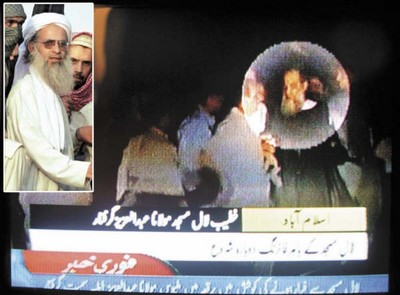
What happened next is a matter of dispute. One account has a female police officer searching his body, then yelling out, "This is not a woman." Another account has a male security officer pouncing on the mysterious figure and, "as he grabbed her, the burqa came off and his beard fell out. He asked the man who he was and he said 'I am Maulana Abdul Aziz'." A third account quotes a security official saying that Abdul Aziz was picked out because of his "unusual demeanour," As he put it: "The rest of the girls looked like girls, but he was taller and had a pot belly."
Government officials had a good laugh at Maulana Abdul Aziz's expense. Deputy information minister Tariq Azeem noted: "After all the things he has said and all the oaths he took from his students that they should embrace martyrdom with him, look at this man." (July 4, 2007) Dec. 19, 2014 update: Seven years later, Maulana Abdul Aziz is still ridiculed for his burqa shenanigans. "Run, burqa, run" read a recent sign protesting the Lal Masjid's extremism.
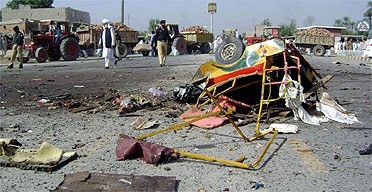 The site of a suicide bombing in Bannu, Pakistan. |
Suspected Iraqi insurgent disguised as pregnant woman: The Multi-National Force in Iraq has posted a bulletin today indicating that several men were detained "during an air assault mission along the Euphrates River, Aug. 20. One of the men detained was dressed as a pregnant woman ... in an attempt to avoid capture." (August 21, 2007)
Three men carrying explosives in Afghanistan: Itar-Tass relies on IRNA to report that a Russian citizen ("Andrei") and two Afghans were found in Paktia province, Afghanistan carrying about 500 kilograms of explosives in their automobile and were arrested as a suspected associates of terrorists; "all three men were wearing women's clothes." (August 28, 2007) Oct. 30, 2007 update: David Rohde provides a more detailed account of this incident in the New York Times:
Afghan police officers working a highway checkpoint near here noticed something odd recently about a passenger in a red pickup truck. Though covered head to toe in a burqa, the traditional veil worn by Afghan women, she was unusually tall. When the police asked her questions, she refused to answer. When the veil was eventually removed, the police found not a woman at all, but Andre Vladimirovich Bataloff, a 27-year-old man from Siberia with a flowing red beard, pasty skin and piercing blue eyes. Inside the truck was 1,000 pounds of explosives. Afghan and American officials say the Siberian intended to be a suicide bomber, one of several hundred foreign militants who have gravitated to the region to fight alongside the Taliban this year, the largest influx since 2001.
Bomber kills 15 in Pakistan: A burqa-wearing suicide bomber of undetermined sex has killed at least 15 people and injuring 22 at a crowded police checkpoint in Bannu, near the North Waziristan tribal region, about 110 miles south of Peshawar. The bomber was apparently in a rickshaw and set it off while being examined this morning. (October 1, 2007)
Burqa used to rob North Carolina bank: The People's Bank in Hiddenite, N.C. (population: 6,000) was robbed on October 16 by a person in a burgundy burqa at 3:45 p.m. who showed the teller a large semi-automatic handgun, demanded and received money, and fled in a burgundy sport utility vehicle. Police are unsure whether to look for a man or a woman; a close look at the bank video, visible on the WSOC-TV website, reveals it pretty clearly to be a female. The television report also gives some reactions from Hiddenite residents, unused to seeing burqas, much less on robbers. (October 17, 2007)
"Niqabs and Burqas as Impediments to Health": I started a weblog entry on this topic today. (October 29, 2007)
Gerald Daniel Blanchard, ace Canadian thief: In an account of a career criminal's bank robberies and either heists, the National Post story recounts how
Police tapped his phones and last November, intercepted a conversation between Blanchard and a man only known as The Boss. The Boss, a London-based man who had ostensibly employed Blanchard, ordered the Canadian and his crew to immediately fly to Cairo, Egypt and steal money from bank machines using counterfeit credit cards. Blanchard and his associates spent 10 days in Egypt. Dressed in burkas to avoid detection from surveillance cameras, they stole several hundred thousand dollars. They stopped in England to give The Boss his cut. Blanchard cleared $65,000. The court heard yesterday that Blanchard knew that his employer used the money to fuel terrorism.
Woman blows self up at Pakistan army checkpoint: A woman in burqa carrying a basket over her head, thought to be an Afghan in her 30s, blew herself in Peshawar as she approached a checkpost, presumably on behalf of the Taliban. She was the only casualty. (December 4, 2007)
Woman with bomb under burqa caught in Afghanistan: Afghan intelligence agents in Jalalabad detained a woman, 55, hiding a bomb under her burqa. She had been followed from Kunar after a tip-off before her arrest. An official in Kunar's intelligence department explained that "She was carrying the suicide waistcoat for the Taleban." (December 24, 2007)
Friends Jewellers in Cape Hill, Smethwick, West Midlands, robbed by a burqa'ed thief and his accomplices.
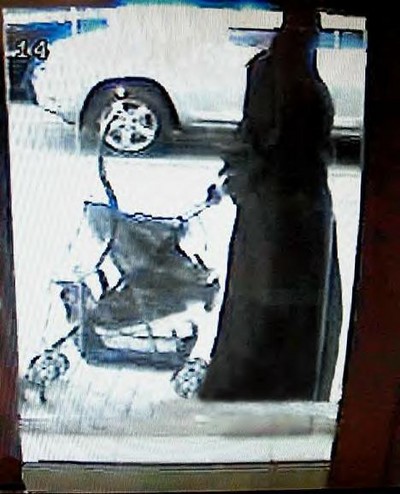
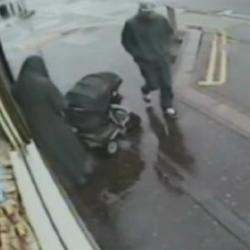
Armed men rob British jewelry store: A 6-foot, 6-inch Asian man disguised himself on March 19 as a Muslim woman, put on a burqa, pushed an empty children's carriage, buzzing for entry at Raj Kumar's "Friends Jewellers" in Cape Hill, Smethwick, West Midlands. There was something not quite right about the height and appearance of this person, but the baby carriage persuaded staff to release the lock. On entry, he pulled out a gun and four other Asian men, their faces covered with ski masks, used their hammers to break into the store. They sprayed Kumar, his brother and the store's two security guards with pepper spray, attacked the owners, then broke into display cabinets, took £200,000 worth of 24-carat gold jewelry, and fled in two cars.
Kumar recounted the attack to the press. His mother who first spotted the burqa'ed figure just after 1 p.m..
We have buzzer entry and he was trying to get my mum to let him in. She thought he looked too tall to be a woman but he had this pushchair with him. When she opened the door these men ran in from behind and used hammers to smash through the next door. It took them about five goes to get through the glass. ... They got us all in the face [with pepper spray]. One of them threw a claw hammer at me and they hit my brother's arm - he's got a big cut down it. We think this gang have raided other jewellery shops so we tried to prepare for something like this, but when it happened we just froze. We thought they had guns.
The 6'6" burqa'ed male thief outside Friends Jewellers, as the security camera caught him.
Almost as distressing as the robbery were the inane comments on it by two city councilors, both of whom seem to think this robbery was the first of its type. Keith Davies said: "I am a member of the police authority and I will be asking if this kind if think has happened before. ... It's the first time I have heard of anything like this. It calls up a lot of questions about how we deal with crime. I would hate to think there could be challenges on women walking round the streets in burkhas. It is really unusual." Mohammed Rouf added: "I am really shocked. It seems they are trying to come up with new ideas to rob people. This is bad for the community and I am shocked that they would go this far just to steal."
For pictures from the security camera, see the sequence at the Daily Mail's coverage. I reproduce one here. (March 22, 2008
Armed man threatens British security guard: A man "dressed in black and wearing a face covering believed to be a burka" threatened a Securicor security driver outside a supermarket in Birmingham on March 14 with what is thought to be a firearm wrapped in a black plastic bag. The driver got into his van and shut the sliding door, trapping the weapon in the door before the attacker could spring it, and ran off to the passenger seat of a nearby parked car. The police issued a statement: "Due to the similar circumstances, officers are exploring possible links with the robbery that took place at Friends Jewellers last week." (March 22, 2008)
Al-Qaeda suspect in four murders caught in habaya in Mauritania: Marouf Ould Haiba is one of four suspected Al-Qaeda terrorists accused of ambushing and killing four French family members as they picnicked on Dec. 24, 2007, alongside a road near the town of Aleg, 155 miles south of Nouakchott. He was caught today in a taxi in the capital Nouakchott while disguised as a woman. Government spokesman Hindou Mint Hainina said that "He was disguised as a woman and was carrying a weapon under his dress. He had been trailed by the police for several days and is currently being questioned in Nouakchott's central police station." Police spokesman Mohamed Abdallahi Ould Adda called him a "dangerous member of Al-Qaeda." According to the police, when caught, Haiba was wearing habaya, a black robed garment that covers the head and entire body with just a slit for the eyes. (April 10, 2008)
Philadelphia real estate leasing office: Two men, dressed like Muslim women, pulled off an armed robbery today of a real estate management company in southwest Philadelphia, carjacked a van, and escaped in the van, only to abandon it and flee on foot. But an employee of the real estate company both pursued them and alerted the police. When the police caught up with the robbers, one of them, Abraham Boley, 20, pointed a gun at Police Lt. Frank Vanore who shot him in the arm. The robber is listed in stable condition. (May 1, 2008) Sergeant Stephen Liczbinski of the Philadelphia Police Department, killed by a man with a AK-47 and wearing a burqa.
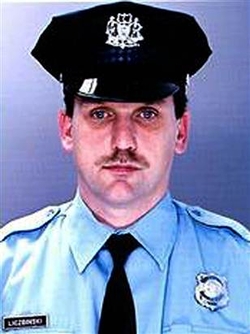
Philadelphia bank, police officer killed: What is it about Philadelphia, burqas, and robberies? Here is the fourth incidence I am aware of, more than any other Western city:
Two men robbed the Bank of American branch inside the ShopRite in the Port Richmond section in the late morning today, then fled. When Police Sergeant Stephen Liczbinski, 40, confronted them about 15 minutes later, they shot him three times with an AK-47 and he died soon after. Other police officers chased the two men and killed one of them, Howard Cain. The police also searched a wooded area for another man and a woman connected to the bank robbery. According to an Associated Press report, "The man was described as black, stocky and wearing a white hospital mask. He had shoulder-length dreadlocks, but Little said officers cautioned that that could be wig. The woman, whose race was not known, was dressed in a head-to-toe light brown robe." Another report described the woman wearing "Muslim-type garb."
Comment: There is no reason to assume that the person in burqa is actually a woman. (May 3, 2008) May 5, 2008 update: Indeed, that person was a man. Here are more details of the crime: Two of the robbers, Howard Cain and Eric DeShawn Floyd,
donned Muslim women's clothes - a hijab covering their heads; long dresses, called an abaya; and face veils, called nik-ab - to prevent detection," while Lavon Warner wore a dreadlock wig and dust mask." Then, the trio marched into the bank, and Sgt. Liczbinski responded to the bank robbery alarm at 11:26 a.m. The trio hopped in a blue Jeep Liberty. Hearing flash information about the Jeep, Liczbinski chased the vehicle, which stopped twice before hitting a pole. Cain jumped out and fired the high-powered SKS assault rifle five times at the officer, hitting his left trunk and leaving him in a pool of blood, at Schiller and Almond streets.
Howard Cain of Philadelphia, who disguised himself in a niqab to rob a bank.
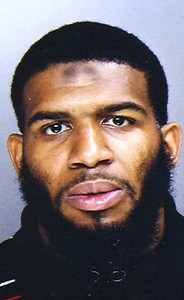
May 6, 2008 update: Cain is a Muslim and perhaps Floyd too.
Police patrol attacked in western Afghanistan: A suicide bomber in burqa attacked a police patrol in the Dilaram district of Farah province. Striking in a crowded market, he killed at least 12 people (7 police, 5 civilians) and wounded 27 others (11 police and 16 civilians). The Taliban claimed responsibility for the attack and named the perpetrator as Mullah Khalid. (May 15, 2008)
Police patrol attacked in southern Afghanistan: "Burqa-shrouded suicide bomber shot by Afghan police in Helmand," reads the The Times (London) report:
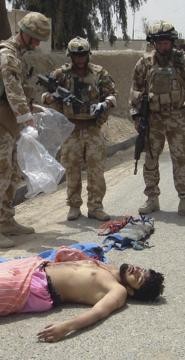
The suicide bomb belt lies beside the body of the man shot in Lashkar Gar in Southern Helmand today. Among the trail of clothes around him is the women's burqa with which he had disguised himself as he set out, explosives strapped to his chest, towards the police compound that was his target. "He was shot in the forehead after he ignored warning shots and was killed on the spot," said Hussain Andiwal, provincial police chief. "When we took off his burqa we found he was a man with a suicide vest tied around his body." "It was an 18 volt battery concealed under his clothes," said a spokesman for ISAF, the International Security Assistance Force.
British soldiers beside the body of a dead Afghan suicide bomber shot in Lashkar Gar in Southern Helmand while wearing a burqa; note the suicide bomb belt near the corpse.
When Private Daniel Gamble, one of the regiment's small number of Pashtu speakers, approached him to ask him what he was doing, the man reached under his cloak and detonated a concealed explosive vest, killing Private Gamble instantly and fatally wounding two other members of the patrol. On this occasion, however, the Afghan officers guarding the compound shot the man after he refused to freeze and instead started running towards the building, according to Mr Andiwal. The explosives were never successfully detonated and there were no other casualties.
Criminal accessory in the UK: The niqab now helps aggressive teenagers in London hide from the law, reports the Daily Mail:
Two youths were seen wearing niqab-style face masks and wielding a sword after a 14-year-old boy was stabbed, locals have claimed. One was heard to say 'I'm going to kill him' as the pair walked calmly down a residential street chatting at about midday yesterday. The schoolboy was knifed in the chest just yards away at 5pm on Tuesday. He collapsed in a pool of blood in front of drinkers outside a pub as they enjoyed an after work pint. A terrified local, who saw the sword-wielding teens but did not want to be named, said: "I saw two boys wearing Muslim women's headgear but normal clothes otherwise and you could see only their eyes. One of them was carrying a sword with a huge blade over a foot long which looked like something you would use to gut a lamb. I saw them and my heart was gone. I've never been so terrified. Although I could only see their eyes I could see their hands as well and they were two black boys, tall, probably about six feet and I would guess they were 16 or 17 years old."
(June 18, 2008) June 19, 2008 update: The text at the Daily Mail has been changed; for the full original version, see a comment on this website, "Boy, 14, fights for life after being stabbed in football game row by sword wielding youths wearing niqabs."
Dutch pickpockets don head covering robes of Muslim women: Dutch police report a 'sharp increase' of Bulgarian or Romanian pickpockets who are dressing up as pious Muslimas and going after marks in nearly all the marketplaces of Rotterdam. (June 27, 2008)
Attack on a governor in Iraq: Iraqi insurgents deployed a man dressed as a woman – presumably in burqa or niqab – in a failed assassination attempt on a provincial governor, Raad Rashid al-Tamimi of Diyala province. Tamimi escaped unharmed but at least one other person was killed and several were wounded. (Aug. 13, 2008)
Shi'i pilgrims in Iraq: Twin suicide bombings by burqa'ed women killed 22 and wounded at least 73 Shi'i pilgrims in Iskandariyah, Iraq, as the pilgrims made their way to Karbala, the police chief of Babil province, General Fade Reza, noted that the government does not have enough female police to search the pilgrims. "During the day it is possible to identify them but at night it is more difficult. Because of the burqa, sometimes you cannot even tell if they are men or women." (Aug. 14, 2008)
Attack car in Bahrain: The Bahraini Ministry of Interior reports that men wearing abayas attacked three Bahraini nationals with Molotov cocktails as they were traveling traveling in a private car on a highway, "smashing the windows and setting the front seat alight." The statement the incident as an "act of terrorism." (Oct. 2, 2008)
U.S. Troops kill Taliban commander disguised in a burqa: During large-scale gun battles and airstrikes by NATO and Afghan forces, killing 53 terrorists, a U.S. team surrounded a house yesterday in Ghazni Province and ordered everyone out. Six women and 12 children left the building, but one of the women turned out to be Haji Yakub, a Taliban commander wanted for directing roadside bomb and suicide attacks. He attacked the soldiers and was killed. (Nov. 29, 2008)
Burqa'ed woman has role in Mumbai terrorist assault: The attack in Mumbai that left nearly 200 dead and traumatized the city included a hidden woman, according to Damien McElroy of the Daily Telegraph:
Investigators said that an urgent alert had been issued to officers to find the woman referred to by Azam Amir Qasab [the only surviving terrorist] as "sister." Eyewitnesses had seen Qasab buying dried fruit with the burqa-wearing woman near Mumbai's main train just minutes before the attack was launched. Residents near the Cama hospital, which was attacked by Qasab and a partner Abu Dera Ismail Khan, had said a woman helped Qasab after the attack on the station. A shopkeeper also insisted at least one woman had accompanied the pair.
"The man started firing towards the hospital immediately after entering," said one eyewitness. "Moments before, the woman, in a salwar kameez underneath her burqa, had even tried to enter the hospital by climbing a water pipe. As the man continued firing, the woman, who wasn't armed, knocked on one of the houses. They then asked the family for water." While Qasab and his fellow gunman were cornered in a police ambush, the woman got away.
"Banks and Stores Push Back Against Head Coverings" is the name of my new weblog entry that looks at the response by banks, jewelry stores, and other retail services to the assault by "women" in head coverings. (January 15, 2009)
Woman steals jewelry across Europe: A woman wearing a hijab has over a 10-year period repeatedly conned jewelers in Germany, Switzerland and France of a million or more euros. She poses as a wealthy Persian Gulf client, then replaces their real gems with faked ones. (February 3, 2009)
Jewelry store in Glasgow robbed: Two Asian men, around 5' 10" to 6' tall, wearing burqas and sunglasses, and carrying handbags, robbed ATAA Jewellers in Glasgow around 4 p.m. on April 4. The robbers threatened the staff with guns and after escaping threw their Muslima clothing away. No one was injured but two female members of store staff were taken by ambulance an infirmary as a precaution.
Hanzala Malik, a Glasgow councillor in whose district the attack took place, said that "If retailers are uncomfortable about customers coming into secured premises and dressed in burkhas, they are perfectly within their rights to deny entry. Banks don't allow people wearing helmets into their premises. ... in this day and age if you want to wear that dress and expect to be served, I don't think you should feel hurt if you are not." (April 6, 2009) Apr. 27, 2009 update: Wasting no time, the Muslim owners of ATAA Jewellers have taken steps to ban niqabs from their store.
Attacks in Afghanistan: A ramping up of burqa terrorism from eastern Afghanistan:
Six suicide bombers in wigs and burkas and armed with rifles and suicide vests tried to enter government buildings in Gardez, in Paktia province, but were shot dead before reaching their targets, authorities said. "At 10:50 am (0620 GMT)... six suicide attackers armed with Kalashnikovs, grenade-launchers and suicide vests arrived near the intelligence office in a Corolla car," the Afghan National Directorate for Security (NDS) intelligence agency said in a statement. The attackers "dressed as women, wearing wigs and burkas, walked towards the guards at the NDS gates, pretending to submit an application paper. One of the guards realised the man was armed, he opened fire... and killed one of the men," it said. Two more attackers were killed as agents manning the gates opened fire, it said, adding that one of the bombers managed to set off his explosives, killing two agents.
A later report indicates that a total of 12 people were killed and 22 injured in an attack by about 15 burqa'ed male suicide attackers. The Afghan government sees this "commando-style" raid as a new Taliban tactic. (July 22, 2009)
170 crimes in Jordan in 2 years: The situation in Jordan appears to be worse by an order of magnitude than anywhere else – or is it just that the reporting is better? From an article by Suha Philip Ma'ayeh, "Crime wave by men wearing the khimar" (khimar is a head covering for Muslim women that reaches about the waist; it may or may not be combined with a partial or full face covering):
In the past two years, police have dealt with 170 crimes committed by 50 people who wore concealing Islamic clothing to hide their identities, according to police officials.
Police are still looking for two men who were wearing the niqab when they opened fire on policemen in a western Amman neighbourhood in July and escaped. It was not clear if they were militants or robbers. Last year, two niqab-wearing men were arrested after robbing Société Générale Bank in Amman at gunpoint and taking US$37,000 (Dh1360,000).
" ... it is evident that the number of criminal cases where the niqab is used has increased," Jamal Bdour, the director of the Criminal Investigations Department at the Public Security Department, told a press conference in July. Public cautions by the police regarding the niqab and khimar have triggered a debate in the country over how to tackle the use of the garments in crimes, with some calling for them to be restricted or even banned.
Mohannad Mubaydeen, a columnist with the daily Al-Ghad, angered religious pundits in a column last month titled "Corruption under the niqab." "The issue is not the philosophy of the niqab nor its legitimacy, but it lies with how it has become invested in malpractices that lead to disastrous results," he wrote. "Has it become a safety tool to conceal any act that is above the law and public morality?"
Imad Hajjaj, the country's leading cartoonist, joined in, publishing a controversial cartoon in Al-Ghad depicting Abu Mahjoob, a famous Jordanian cartoon character, and his big-bellied friend, Abu Mohammed. Both were disguised in niqabs, making a list of the things they can evade, from police and money lenders to swine flu and social kisses from men.
Comment: How interesting were Jordanian authorities to ban the niqab ahead of governments in Western states. (August 3. 2009)
A rash of armed robberies in the UK: The Daily Mail reports on three recent robberies involving men in burqas:
On July 7, a man in black burqa entered First Choice Travel in Broadwalk, Dunstable, threatened two female workers with a knife, stole cash, and escaped through the back door.
On August 16, a man in black burqa entered the Thomson travel agency on George Street in Luton, threatened female staff with a knife, and stole a large amount of cash.
A burqa'ed man and two accomplices witih covered faces, armed with a handgun and an axe, burst into Michael Jones Jewellers on the High Street in Banbury, Oxfordshire, at about 2:20 p.m. yesterday, threatened four members of staff, and stole Rolex, Cartier and Breitling watches worth about £150,000. A fourth accomplice drove them off in a black Audi.
Police have released CCTV footage of the first two, similar incidents, but the height and build of the burqa'ed thieves appear to be different. (August 26, 2009)
"Niqabs and Burqas –The Veiled Threat Continues": I wrote up new developments over the past two years in this column today. (September 2, 2009)
Attempted mega-terrorism in Pakistan: The Pakistani police prevented an attack by three gunmen wearing burqas on an oil storage facility in Karachi. The trio attempted to enter the high-security facility late on Sept. 14; when stopped by security guards, they opened fire, killing one guard, then escaped, leaving behind their burqas, purses and hand grenades. "We suspect they wanted to carry out a big terrorist attack which our prompt police action thwarted," said Police Chief Waseem Ahmed. On Tuesday, the police arrested four male suspects, thought connected to the Taliban, and found more burqas, purses, and weapons. (September 15, 2009)
Failed bank robbery in Philadelphia suburb: The police report on an attempted bank robbery at the Bank of America branch, 3100 Garrett Road, Drexel Hill. Let Police Superintendent Michael Chitwood tell what happened:
A person approached the counter in full Muslim garb, and gave a note to the teller and a bag. The note said, "fill up the bag with money. No dye pack and no GPS." The woman says she's not a teller and doesn't have any money. She handed back the note and the bag and the person ran out the door.
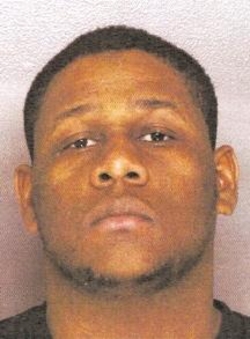 Raheem X. White, 22, indicted for a burqa bank robbery. |
Attempted post office robber in England: Two slim, Asian male robbers dressed in burqas attacled a post office in Bradford, England, pistol-whipped the manager and struck him on the head with the butt of a handgun when he could not open a safe, then fled empty-handed when a customer looked through a window. Detective Inspector Steve Snow called the attack planned and called the thieves "determined individuals who were prepared to use violence in order to steal from innocent members of the public." (November 28, 2009)
Hotel bombing in Somalia: A male suicide bomber managed to gain access to the Shamu Hotel in Mogadishu that was hosting a graduation ceremony for Banadir University attended by government officials by dressed as a woman in full abaya and veil, killing at least 19, including three Somali cabinet ministers and two journalists. (December 3, 2009)
Bank robbery in France: The staff of a post office in Athis Mons, just south of Paris permitted two burqa'ed men into the banking section of the office. They threw off the coverings, one of them pulled out a handgun concealed beneath the Islamic garb, and they took about €4,500 from staff and customers.
Comment: This robbery comes at a delicate moment, when the French government seeks to ban the burqa in public spaces, and could help tip the balance in favor of such a prohibition. (February 7, 2010)
Accessory to a street robbery: The Australian Associated Press reports on a two-step robbery in the Miranda section of Sydney, Australia: It began when a 35-year-old man working as a distributor of cash to jewellery businesses withdrew a large amount of cash at a shopping center.
While making the withdrawal, he noticed two men who appeared to be following him around the shopping centre. He returned to his vehicle in the car park when one of the men approached him and told him his tyre was going flat. The man became suspicious and drove away to change his tyre in a nearby street before driving to a shopping centre in Hurstville. There, he was approached by a man wearing a full black burqa, [threatened with a pistol], ... and sunglasses and told to hand over the cash, police said today in a statement.
The Sydney Morning Herald ran a poll along with this story, asking "Where do you stand on the wearing of the burqa in public in Australia?" The final tally showed 19 percent in favor of allowing the burqa in public and 81 percent for prohibiting it, with 10,140 votes counted – a decisive margin that would probably be replicated throughout the West. (May 6, 2010)
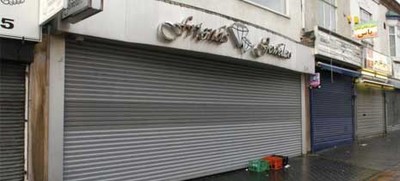
Another jewelery store robbery: In the second male burqa'ed robbery of the day, a man turned up under cover at Capri Jewellers in Bury, England, north of Manchester. The Manchester Evening News tells what happened:
Security staff thought the raider was a woman who had come to browse on her own and pressed a security button to allow him into the store. But moments after the door was opened three other masked men, one of them carrying a shotgun, barged their way inside. Police said the gang stole a large amount of jewellery, including bangles, rings and lockets, before they escaped towards Alfred Street in a waiting car, believed to be a silver Toyota Yaris. ... The gang of four men, all described as Asian, left behind two canvass holdalls branded "Wei Bao." Det Sgt Chris Jameson, of Bury CID [Criminal Investigation Department], said: "The store has very tight security so the ruse used to gain entry shows a level of detailed planning."
For further details, see the Bury Times account. (May 6, 2010)
A third robbery of a travel agency in the Dunstable region: For the third time in less than a year, a burqa'ed knifeman attacked a travel agency, this time the Thomson Travel in Dunstable, Bedfordshire, on May 8. The attaacker, believed to be of mixed race, carried a square black bag with a long shoulder strap and wore black plimsolls; his burqa was described as black with a silver or grey floral design pattern. He threatened two female members of the staff and forced one of them to fill his bag with a large amount of money from an office and the cash register before escaping through the front entrance.
For more on the similar robberies last summer, see the August 26, 2009, entry. Detectives are unsure if the three incidents are related. "The pattern the offenders have followed is strikingly similar. They walk in, dressed in a burka, approach members of staff quite calmly by knifepoint. They leave the shop very calmly and walk off." That said, the robbers appear to be of different sizes. (May 12, 2010)
Two males, one German, arrested in Pakistan wearing burqa: It's not clear what trouble the trio was intending, but they were caught at a security checkpost on the border between North Waziristan and Bannu city being driven in car. man, A German, said to be in his mid-20s, was with two tribesmen, one of whom also wore a burqa, and a girl – the idea being to pretend they made up a family. A senior police officer in Bannu thought the German might have links with terrorists. (June 22, 2010)
Man wearing burqa robs Maryland bank: The Associated Press reports from Silver Spring, a suburb of Washington, D.C., that
Montgomery County police said a man wearing a burqa robbed a bank in Silver Spring. Police said the man who robbed a TD Bank branch on Briggs Chaney Road about 4:20 p.m. Tuesday was wearing a "long black burqa over his face." He also wore jeans and tan boots. Authorities said the man showed a gun and demanded money. He took an undetermined amount of money and fled. Police said the man spoke with what they described as "a Middle Eastern accent." They say a silver car, possibly a Chevrolet, was seen leaving the scene.
(August 11, 2010)
Burqa'ed man a murder suspect in Canada: Police are searching for Mohamud Abukar Haji, 27, of Windsor, Canada on a first-degree murder charge in connection with the Dec. 22, 2007 death of Luis Acosta-Escobar, dead of gunshot wounds near a Windsor nightclub. Const. Wendy Drummond mentioned reports that Haji has donned a burqa. (August 11, 2010)
Man in burqa peeps in ladies room of Saudi mosque: What better way for a male to see women in various stages of undress than to put on a burqa and linger in a public toilet – and in a country where all the women are covered? Here's a news item from today's Arab News, "Drunk freak in drag horrifies women," datelined Taif, Saudi Arabia:
A drunken weirdo was caught in Saudi drag trying to sneak a peak of women in a ladies bathroom of a mosque... during Ramadan at that! According to a report in Saturday's Shams newspaper, the man dressed in a woman's full abayya wasn't even suspected of being a lecherous peeping tom; he was so intoxicated that he lifted the veil himself, revealing to horrified ladies a full mustache above a drunken grin. Amid the chaos that ensued, the high freak attempted to flee, but perhaps his motor skills weren't up to par: he was tackled by some nearby heroes and handed over to police.
(September 5, 2010)
Phyllis Chesler argues in favor of a burqa ban.
Phyllis Chesler on "Ban the Burqa? The Argument in Favor": A leading feminist author asks (in a 5,600-word essay in the Middle East Quarterly, Fall 2010, pp. 33-45) whether other Western states should "follow the Belgian and French examples and ban the full Islamic body and face-covering veil—or more specifically, the burqa and the niqab? In other words, should the West ban any and all clothing which obliterates one's identity?" In reply, Chesler notes the process of unveiling that took place in Muslim-majority countries during the intra-war period, then surveys what political and religious leaders in the Muslim world have to say on the topic, followed by views of Muslim women.
Resurgent Islamists, she documents, are increasingly exerting family, social, and political pressure on Muslim women to cover up: "Muslim women are increasingly not given a free choice about wearing the veil, and those who resist are beaten, threatened with death, arrested, flogged, jailed, or murdered for honor by their own families, by vigilante groups, or by the state." Chesler then reviews European debates legally restricting Islamic dress starting in France in 2004 and concludes with a rational for banning these outfits, noting that they hide the wearer's gender, isolate and sensory deprive them, jeopardize their health, facilitate acts of violence and lawlessness, and demoralize and frighten those exposed to them. Calling the burqa "a flagrant violation of women's most basic human rights," she appeals to Western governments to follow their Muslim counterparts and ban these articles of clothing. (September 21, 2010)
Elizabeth Smart hidden in a niqab: Brian Mitchell kidnapped 14-year-old Elizabeth Smart at knife-point in her Utah bedroom in 2002 and for nine months kept Elizabeth her as sex slave; his trial is finally underway. Phyllis Chesler reminds us that his success at eluding one of the largest manhunts in American history resulted in part from his encasing her in a niqab. Smart took the stand and explained, as Chesler narrates:
Only weeks after her kidnapping, a long-bearded Mitchell and his small hostage were in a Salt Lake City library. A detective–one among many who were searching for Smart—stopped them and asked Elizabeth to lift her veil. However, Mitchell told the police officer that no man other than her husband had the "religious right" to see his "wife's" face.
Yes: Brian Crazy-as-a-fox Mitchell had insisted that Smart, like his 57-year-old wife Wanda Barzee, wear face veils. Both women remained silent and veiled, dressed in disturbingly outlandish white "Biblical" robes just as Mitchell did. In the library, Mitchell remained obstinate. The detective was the one who finally backed down. The moment the police officer walked away was the moment when Elizabeth gave up all hope. Mitchell had already threatened to kill her and her parents if she ever revealed her identity.
Chesler notes that "absolutely no one thought a veiled girl or woman was that unusual or that the state, or private individuals, had the right to question a man whose women are veiled" and concludes that, "based on the Smart case alone, we should not allow women to be veiled in public. That much—that little—we can do." (November 15, 2010)
Niqab'ed woman accuses policeman: When an Australian highway patrol officer, Sergeant Paul Kearney, stopped a Muslim woman, Carnita Matthews, 46, because of an irregularity in her license plates and had her take a Random Breath Test, she claimed he stopped her because she was wearing a niqab and accused him of being "a racist." A video taken from the policeman's car shows her saying, "You look at me and see me wearing this and you couldn't handle it. All cops are racist." Matthews then drove to the local police station and signed a Statutory Declaration complaining of improper treatment by Kearney, including his forcibly trying to remove her face veil to verify her license picture.
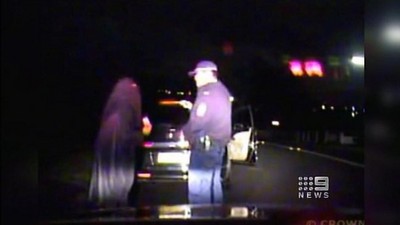 A still from the police video showing Carnita Matthews and Sergeant Paul Kearney. |
When it turned out that a video of the incident showed the officer had behaved properly, and that her complaint was false, Matthews then went on to claim she was the victim of mistaken identity, that it was not her who had signed the Statutory Declaration at the police station but another niqab-clad woman.
Magistrate Robert Rabbidge tossed Matthews' (1) allegations that Kearney was racist and (2) dismissed her claim that someone else signed her declaration, noting that the signature on the declaration was almost identical to the one on her driver's license. Describing her actions as "both deliberate and malicious," Rabbidge sentenced her to six months in jail for making a false complaint against a police officer.
Comment: While a lesser problem than criminality or terrorism, this whole unfortunate sequence of events, ending in a mother of seven spending a half year in jail, would likely never have taken place except for the gratuitous tensions caused by a niqab. (November 19, 2010) June 21, 2011 update: In an astonishing denouement to this incident, Matthews avoided jail because her identity could not be proven. Silver lining: as a result of this travesty, the police may gain the legal right to require a person to show his face,, even if the person gives religious or cultural grounds not to do so. July 5, 2011 update: Silver lining quickly established: From now on, police officers in New South Wales may order removal of face coverings in any potential criminal situation, the result of a new law passed in response to the Matthews case. NSW premier Barry O'Farrell, explained why he signed the legislation: "I don't care whether a person is wearing a motorcycle helmet, a burqa, niqab, face veil or anything else, the police should be allowed to require those people to make their identification clear. I have every respect for various religions and beliefs but when it comes to enforcing the law the police should be given adequate powers to make a clear identification." Western Australia is expected to follow NSW with similar legislation. Jan. 23, 2012 update: In a final denouement to this case, Matthews lost her case to have over A$10,000 in court costs reimbursed by the taxpayer.
Singapore terror prisoner escapes, disguises self as woman: Mas Selamat Kastari of Jemaah Islamiyah's Singapore branch, who is accused of planning to hijack an airplane and crash it, escaped from a Singapore jail on Feb. 27, 2008, through a bathroom window and then put on what an Associated Press report calls "women's cosmetics and clothing" to keep from being re-arrested. That probably means a burqa or niqab. (November 22, 2010)
Jewelery story robbery in Bury, England: In a northern suburb of Manchester at about 4.30 pm on Nov. 22 at the Jadee Jewellers store on Rochdale Road,
A gang led by a man dressed in traditional Islamic attire stole thousands of pounds worth of jewellery during a raid. ... The man approached the shop dressed in a burka and hijab and believing he was friendly and a legitimate customer, the owner opened the shop door. At this point, four other members of the gang burst through the open door brandishing a silver metal hammer and a baseball bat, while the man in the Islamic clothing produced a machete. The men smashed numerous glass display cabinets and stole thousands of pounds worth of 22ct gold jewellery, including necklaces, bracelets and earrings.
(November 29, 2010)
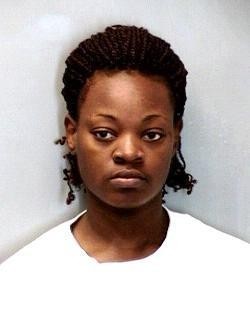 Lashawanda Jones, accused of robbing two banks in burqa. |
Comment: That two TD Banks were robbed in October and one in August (see the Aug. 10, 2010 entry) suggests that TD Bank might enforce an-anti-covering policy such as is the case in other banks like Citizen's, PNC and M&I, as I document at "Institutions Push Back Against Head Coverings."
Hook-handed British Islamist Abu Hamza.
Smuggling a SIM card into British prison: Chayme Hamza, 26, daughter-in-law of hook-handed Abu Hamza al-Masri, in Belmarsh Prison on charges of soliciting to murder and other charges, attempted to smuggle a mobile telephone SIM card in a mobile telephone in the coin pocket of her jeans beneath her burqa. (December 22, 2010) May 23, 2012 update: Having gone through the inspection procedure before, Hamza must have been "well aware" of the ban on SIM cards in prison, noted Mr Justice Openshaw in Blackfriars Crown Court as he sentenced her to 12 months in prison.
Violent attack in Saudi Arabia: Saudi Press Agency quotes a Ministry of Interior spokesman that "during a routine patrol checking of a passenger car carrying a man and a woman at Al-Muthallath check point at Wadi Al-Dawasser Province in the Kingdom of Saudi Arabia today and following the request of their identification cards, the man disguised in the uniform of women stepped out of the car and fired at the duty security men at the site who dealt with the case accordingly, killing him and arresting the other." (December 24, 2010)
Burqa'ed suicide bomber kills 41 in Pakistan: In what may be the largest death toll to date, Pakistan's first female suicide bomber approached a security checkpoint as United Nations officials distributed aid in Khar, Bajaur Agency, to over a thousand diplaced people. She first hurled a hand grenade, then detonated an explosive-laden vest. A senior tribal administration official, Sohail Khan, announced that "At least 41 people are dead and more than 60 wounded in the suicide bombing." (December 25, 2010)
Male in burqa opens fire on Saudi police: The Saudi interior ministry announced that a man "disguised in women's clothes" was killed after he opened fire on security forces." It identified him as "a Saudi wanted for belonging to the deviant group [i.e., Al-Qaeda] and his involvement in criminal activities." (December 27, 2010)
Bank robbery in Ottawa: A man wearing a blue robe and a head scarf in the style of a Muslim woman went to the Bank of Nova Scotia at Pinecrest Mall about noon on Dec. 30. His mouth and nose concealed, he handed a note to a teller demanding money in what was clearly a male voice. The teller did as instructed and the robber fled the bank on foot. According to a report in the Ottawa Citizen,
Police described the suspect as male with dark skin, dark eyes and bushy eyebrows, standing about five-foot-10 with a slim build. He was wearing what police described as a dark blue hijab with designs around the head and neck and a long, dark-blue robe. The suspect spoke English with a slight accent.
More interesting yet,
Acting Sgt. Anthony Skinner of the Ottawa police robbery unit estimated Friday that over the past six months, there have been upwards of five similar incidents in the city. Skinner said a meeting will be held early next week to compile and compare information, and to try to determine if the robberies are related. ...
[Sgt. Mark] Myers said that since the summer, there have been a handful of other robberies in Ottawa involving male suspects using Muslim women's religious garments as disguises.
(December 31, 2010)
TD Bank robbed repeatedly by niqab'ed thieves: David Rusin notes the streak of niqab-assisted robberies at TD Bank, noting that the accused thief was caught only when she left her niqab at home. He asks if this string of attacks was coincidence.
Islamist Watch spoke with TD's public relations chief, Rebecca Acevedo ([email protected] or 856-470-3201), to alert her to this trend and ascertain whether the bank's policies are making it a soft target. Though understandably reluctant to discuss detailed security measures, she did offer an intriguing clue as to why her institution might be attracting burqa bandits. When informed of signs posted by many other banks ordering clients not to wear hats, hoods, or sunglasses — much to the chagrin of CAIR — Acevedo stated that TD Bank branches have never put up anything comparable. This suggests that greater permissiveness toward head and face coverings has contributed to the crimes outlined above.
Some deny the problem, but criminals concealed by the strictest Islamic garb present a growing threat. IW urges readers to contact their own banks and ask what is being done to counter it.
(January 21, 2011)
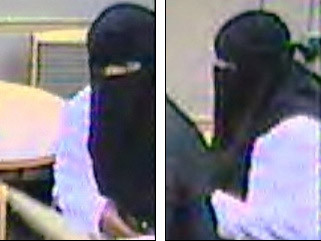 An unknown male thief in niqab held up a Sovereign Bank in Philadelphia on Feb. 1, 2011. |
"Efforts to Ban the Burqa Go Well Beyond France" by David J. Rusin notes campaigns in Australia, Belgium, Canada, Germany, Italy, the Netherlands, Spain, and Switzerland. Where, one wonders, are the Americans? (Apr. 20, 2011)
"Muslims for Burqa Bans": It's not just non-Muslims who mind and fear burqas in the West, but Muslims too, David J. Rusin documents today. (May 13, 2011)
Ninth robbery attempt in the Philadelphia area: A niqab'ed man attempted to rob a Sovereign Bank on Mount Ephraim Avenue in Woodlynne, N.J. at approximately 12:10 p.m. He gave the teller a note saying he had a gun. When the teller called 9-1-1, the man ran away. (June 14, 2011)
 Somalia's interior minister Abdi Shakur Sheikh Hassan. |
"Islamic Movement of Uzbekistan Leader Captured Wearing Burka": So reads an International Security Assistance Force Joint Command-Afghanistan press release from Kabul:
A combined Afghan and coalition security force captured a senior Islamic Movement of Uzbekistan leader and two associates during a nighttime security operation in Kunduz district, Kunduz province, yesterday. The leader, who also supported the Taliban network, was responsible for planning attacks against the Afghan National Police. He also facilitated suicide bomb operations and coordinated attacks against other Afghan security forces. The Afghan-led security force, following several tips, located the leader at a compound in the district. The leader attempted to disguise himself as a female by wearing a burka. ... In the last two months there have been several instances of targeted males wearing burkas in attempts to disguise themselves in order not to be caught by Afghan-led forces.
(June 28, 2011)
"Female bombers hit Pakistan police at blast site": The Associated Press reports from Peshawar that a "burqa-clad female suicide bomber attacked police at the scene of an earlier explosion in northwestern Pakistan on Thursday, twin strikes that killed five people and broke a relative lull in [Islamist] violence."
Specifics: "two women approached police guarding [a just-bombed] area. One of the females threw a grenade, then was able to partially detonate her suicide vest, said Shafqat Malik, a police officer with the bomb disposal unit. She appeared to be 16 or 17 years old, he said. "I thought the girl was pregnant as she was walking slowly with another woman. As I tried to push people away, suddenly a blast took place," said police officer Himayat Ullah, who was wounded in the attack. (August 19, 2011)
Three Taliban in burqas attack British cultural center in Kabul: "Five Taliban attackers laid siege to a in the Afghan capital on Friday during an hours-long assault on the 92nd anniversary of Afghanistan's independence from British rule. A suicide bomber in a car blew himself up at the gates of the British Council in Kabul before dawn, and another car packed with explosives detonated moments later while four attackers, three of them men clad in the burqa headcovering worn by Afghan women, stormed the compound, police said. A ministry of interior spokesman said at least 16 people were wounded in the attack." (August 19, 2011)
Serial bank robbers in Philadelphia: Two suspects described by CBS News as "black, having a thin build, 5'10" tall, with black Muslim-like garments covering their heads and bodies" are being sought for five Philadelphia-area bank robberies, the tenth through fourteenth in that city, between December 23, 2011 and April 4, 2012:
- MoreBank in the 400 block of W. Cheltenham Ave. on December 23, 2011
- 3rd Federal in the 6000 block of Roosevelt Blvd. on January 6, 2012
- MoreBank in the 400 block of W. Cheltenham Ave. on March 14, 2012
- Sovereign Bank in the 8000 block of Stenton Ave. on March 20, 2012
- Wells Fargo in the 700 block of Adams Ave. on April 4, 2012
See the Philadelphia Police Department webpage on this team, complete with photographs and links to surveillance videos. (April 6, 2012) Apr. 13, 2012 update: The same duo pulled off yet another robbery:
- Wells Fargo in the 700 block of Adams Ave. on April 13, 2012
Totting up the statistics, this is Philadelphia's fifteenth bank robbery since January 2007, which makes for roughly one bank robbery attempt with a niqab or burqa every 15 weeks. Four were committed by a woman, 3 by a man, and 8 by two men.
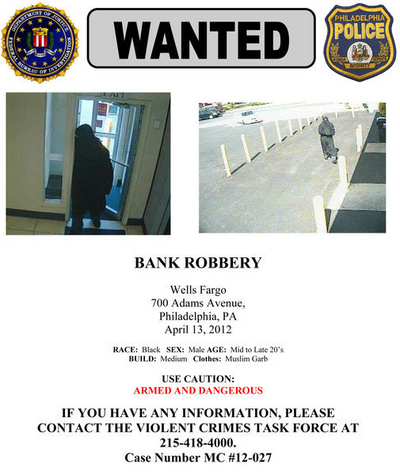 This wanted document from the Philadelphia Police Department contains images from surveillance video of a robbery suspect at a Wells Fargo bank. |
(April 19, 2012) Apr. 25, 2012 update: This rash of burqa or niqab bank robberies has prompted a Philadelphia organization representing dozens of Muslim congregations to offer a $20,000 reward for information leading to the criminals' arrests.
Sharif Wynn wore Islamic covering on his way to shoot Michael Turner.
Philadelphia barber killed by man in "Muslim garb": It's not clear from the news account what Sharif Wynn, 27, was wearing, but perhaps a burqa or niqab, when he entered the barbershop of Michael Turner, 35, near the 69th Street Terminal and, according to the Philadelphia Inquirer account, "announced a holdup, and ordered the patrons to lie on the floor and empty the contents of their wallets. The gunman then approached the barber and shot him in the temple. Wynn was caught and charged with murder. Police speculated about a love triangle gone bad. (April 19, 2012) Apr. 20, 2012 update: Police have confirmed the love triangle thesis. The Delco Times reports:
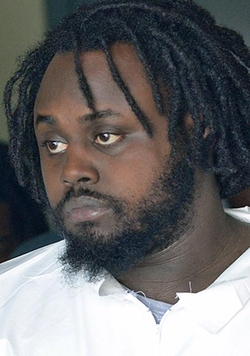
"He told us he went into the shop basically to shake him up because Turner was harassing him and his girlfriend, Turner's ex," Police Superintendent Michael Chitwood said. "He comes in armed with a 9-mm semiautomatic. He says while Turner was leaning over to pick up money, the gun went off and he ran out of the barber shop. "We don't believe it was an accident. He held the gun right to his temple and pulls the trigger."
June 12, 2012 update: Wynn was arraigned on charges of first-, second- and third-degree murder, as well as on multiple robbery, assault and firearms charges.
Attack on resort hotel near Kabul: Here's the New York Times account, datelined Qargha Lake, Afghanistan:
A minivan pulled up to the entryway of the Spozhmai Hotel just before midnight on Thursday, and what appeared to be seven Afghan women in characteristic head-to-toe blue burqas piled out. Throwing off the burqas, the women turned out to be male insurgents, bristling with weapons and wearing bulky suicide vests packed with explosives. They raced into the hotel, crowded with hundreds of Afghans enjoying the lakeside coolness of a summer evening — one of few places in the Kabul area where families and young people can go for a night out.
"Where are the prostitutes?" the intruders demanded as they shot their way through the hotel restaurant, according to accounts by the police and survivors. The attackers shot the manager and three unarmed hotel guards, who would be among at least 20 people the attackers managed to kill before their own deaths, mostly by suicide, finished the raid. There were no prostitutes, as it turned out, and apparently no foreign guests, which Taliban spokesmen later said that the group had been targeting.
One of the guests who managed to escape, Shah Mohammed, 25, said the seven attackers divided up. Some stalked the restaurant inside the building; others went to the rooftop terrace, with its splendid view of the lake and the barren mountains behind it, and others out to the garden between the hotel and the lakeshore, where many of the diners were seated.
Going from one table to another, they shot any male they could find at point-blank range, but appeared to spare women and children, witnesses and officials said. Hundreds of guests fled and some were evacuated in the early hours of the raid by Afghan security forces, and 45 holed up in the hotel grounds and were held as hostages until the police took control Friday morning. ... As ambulances arrived Friday morning to take away the dead — the police said there were only 10 wounded — surviving family members, mainly women, screamed, wailed and begged to ride along with the victims.
(June 22, 2012)
Burqa'ed robber pushing stroller into the Manchester-area jewelry store.
Burqa'ed robber with stroller helps rob Manchester jeweler: A robber dressed as a Muslim mother took part robbing a jewelry store in the suburb of Rusholme near Manchester, England. Darren Heath provides details (and see the original posting for many pictures from the security video): "The gang struck Choice Jewellers on Wilmslow Road just after 11.30am when a man wearing a burka and pushing a pram tricked staff into opening security doors before letting in his accomplices. Terrified staff inside then let off a booby trap as the men, all wearing balaclavas, started smashing up the store and taking merchandise." (July 3, 2012)
Wear a niqab to buy alcohol: Here's a delicious twist and yet another danger posed by the burqa & niqab: David Menzies of Canada's Sun Network had a 14-year-old boy go into three Toronto-area Liquor Control Board of Ontario (LCBO) stores, that is, government-run liquor stores, and buy some hooch while fully covered except for the eyes. Guess what? The boy scored 3 out of 3 purchases. Menzies titled this segment of his show, "How to buy alcohol when underage - wear a burka." He noted the LCBO's emphasis on its socially responsible role and read out its regulations requiring that clerks make sure a customer looks over 25 years of age or must ask for an identification, regulations flouted in all three cases. He even read out an instruction to clerks that in the case of niqabs and burqas, they should deal with customers in a "culturally sensitive" manner.
Comments: (1) Obviously, a niqab'ed person, even if he's a young boy, is a danger zone and the clerks don't want trouble. (2) Isn't a niqabi in a liquor store in itself a pretty good sign that something's amiss? (3) Well done, Islamist lobbies! (July 24, 2012)
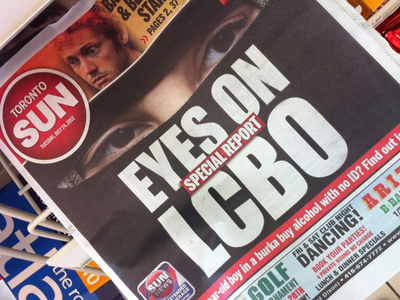 The Toronto Sun newspaper picked up on the Sun television story. |
"My Burqa Debate with Martha Nussbaum": That's the title of a short piece I published today, where I challenge Nussbaum's airy dismissal of burqas serving as accessories to terrorism and point out that this has happened over and over again. Even when made aware of these facts, she insists she is not aware of them and will stick to her position. (November 21, 2012)
Philadelphia girl, 5, abducted from school, then found: Nailla Robinson, 5, was abducted by an unknown person wearing a black niqab from her classroom about 8:50 a.m. at Bryant Elementary School, then found the next morning by a passer-by in a nearby park in Upper Darby under bleachers.
The girl's mother, Latifah Rashid, (who also wears Islamic garb, facilitating the fraud) explained how the niqabi told her teacher that she was Nailla's mother, "and that she was taking her out to breakfast." Surveillance video shows the niqabi taking Nailla through the school and then leaving its premises. This abduction could only take place because the school staff ignored all the rules, according to a Fox News report:
The kidnapper had talked her way past a hall monitor and took the girl from her class, violating every security procedure the district had put in place. A district official says a visitor is supposed to sign in at the front desk and show photo ID. If they're picking up a child, their name must be on a list provided by a parent. Only then will the child be escorted from his or her classroom. "A student should never be released to an adult from a classroom," Philadelphia School District Spokesman Fernando Gallard told Fox 29. "The release should only occur at the main office."
Naila Robinson, 5, abducted by a niqabi from her Philadelphia school classroom.

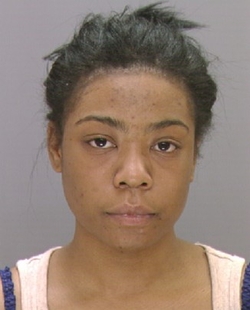 Christina Regusters, 19, without niqab, arrested for the abduction and rape of a 5-year-old girl. |
Feb. 15, 2013 update: The police have brought charges against Christina Regusters, 19, the 6200 block of Walton Avenue, for the abduction and rape of Robinson. Regusters is an employee at Heaven's Little Angels, an after-school daycare program a block away from Bryant which Robinson attended. The police say Regusters had contact with her prior to the abduction. The charges are criminal conspiracy, aggravated assault, kidnapping, rape, involuntary deviant sexual intercourse, contact with a minor, unlawful restraint, false imprisonment, interference with the custody of a child, concealing the whereabouts of a child, indecent assault, simple assault, corruption of minors and recklessly endangering another person. According to the Associated Press, "Investigators believe the suspect and victim then walked a few blocks to a home where a man was waiting." Feb. 16, 2013 update: According to a close friend, Regusters is not a practicing Muslim: she "always wore her hair out in a pony tail" and "never wore Muslim garb." Aug. 25, 2014 update: The Regusters trial has begun. From a Philadelphia Inquirer report:
Regusters' attorney, W. Fred Harrison Jr., told the Common Pleas Court jury that the girl could have been sexually assaulted by any of several relatives who lived with Regusters. ...
Lisa Jones, who worked in the Bryant office, testified how the woman in Muslim garb came into the school that morning and had to be told to sign the school register. Jones, however, said she could not identify the woman's signature but did not ask for identification. Although district policy required school staff to check IDs of anyone coming into the building, Jones testified that the practice at Bryant at the time was not to check IDs. When Harrison asked why the policy was not followed, Jones replied, "There was no particular reason."
Reginald Littlejohn, a former special education teacher then in his eighth day as a substitute teacher in the girl's kindergarten class, testified the woman in Muslim garb appeared with the child at his desk and said she would leave school as soon as she finished breakfast. Littlejohn said the girl left with the woman without apparent fear or reluctance. When Gillum asked why Littlejohn did not verify the woman's story with the school office, he said everything seemed normal: "I didn't see the need."
Jackson, the police officer, said he was called at 3:38 p.m. about a pupil missing from the school at 6001 Cedar Ave. As the school day was ending, he said, an employee of Heaven's Little Angels, an after-school program the girl attended a block away on South 60th Street, arrived to pick her up. Bryant staff realized she had been taken.
Nineteen hours later, a pedestrian walking to work at a park in nearby Upper Darby heard a child calling for help and discovered the girl under a sliding board. Though the girl had been anally and vaginally raped with an object and needed surgery to repair injuries, she helped police retrace her kidnapper's steps, recognizing the Walton Avenue house where she said she was held.
O'Brien told the jury in that the evidence - the victim's testimony; surveillance video of the abduction; Regusters' DNA on the victim's shirt and Internet searches about child sex assaults on Regusters' personal computer - all point to the former Silver Spring, Md., woman as the one who kidnapped and assaulted the girl. "Why? Why would a 19-year-old female do this?" O'Brien asked the jury. "That may be the unanswered question."
Sep. 12, 2014 update: Regusters was convicted on all six charges: aggravated assault; involuntary deviant intercourse of a child involving serious bodily injury; kidnap to facilitate a felony; unlawful contact with a minor involving sexual offenses; unlawful restraint of a minor with a risk of a bodily injury; and concealment of the whereabouts of a child. NBC News explains what happened in new detail: Regusters stands
accused of leading the girl to a nearby home, putting her in a laundry bag and carrying her up into her bedroom. There, prosecutors say, Regusters blindfolded and stripped the girl, put her under a bed and sexually abused her with a sharp object. The entire ordeal lasted 19 hours, prosecutors say. The girl was then dumped in an Upper Darby, Pennsylvania, playground wearing only a T-shirt. She was later found by a passer-by. ... Regusters' DNA was found on the girl's shirt, and images of child porn were found on the computer in the woman's bedroom, detectives testified.
Nov. 24, 2014 update: A federal judge ruled on Nov. 20 that Robinson can bring a civil lawsuit for more than $150,000 in damages against the School District of Philadelphia, the School Reform Commission and the substitute teacher on duty when she was kidnapped.
Naomi Oni before being attacked with acid by a niqabi.
Niqabi throws acid in the face of a British woman: Naomi Oni, 20, was returning home from her job at Victoria's Secret on Dec. 30 after midnight, talking on the phone while walking to Dagenham, East London, when a niqab-wearing person threw acid in her face, deeply scarring her face and nearly blinding her. She tells how she saw the niqabi and felt a "splash" on her face: "It burned and I screamed out. I started running and screaming, holding my face, all the way home. I didn't look back. I was hysterical. Luckily my godmother, who is a pharmacist, was at home with my mum and she helped me and kept dipping my face in water and trying to calm me down until the police and ambulance got there." Of course, that the attacker was nearly completely covered makes discovering that person's identity all the more difficult. (February 1, 2013) Jan. 7, 2014 update: Mary Konye, a friend of Naomi Oni's since grade school, stands accused of splashing the acid in Oni's face and then, in a gruesome twist, pretending to sympathize with her plight: "OMG, can't believe it" ran her text message the next day. Comment: That Konye and Oni knew each other so well made the use of a niqab as accessory all the more necessary. Were these garments banned from the streets of London, this is a crime that very well would not have occurred.

"Philadelphia's Burqa Crisis." Inspired by the Nailla Robinson case, I wrote up the rash of burqa-related crimes in the city where I live and drew some conclusions. (February 21, 2013)
Male niqabi robs Maryland liquor store: I can't improve on the account provided by WMAR television about the man now in police custody after an armed robbery and police chase on Apr. 19:
Police say around 3 p.m. Harford County Sheriff's deputies were called to Third Base Liquors on South Fountain Green Road in Bel Air for a report of a robbery. When officers arrived witnesses told them a man wearing a burqa covering his entire face except for his eyes entered the store and asked the clerk about beer. Police say the man altered his voice to sound like a woman and chose a case of beer. As the clerk leaned over to pick up the beer the fake lady flashed a gun and announced a hold up. The clerk gave the burqa-wearing female impersonator an undisclosed amount of cash and the robber left the store and jumped into a white SUV.
Police say an alert passerby noticed something strange, copied down the tag number and reported it to authorities. A short time later police saw the SUV on Rt. 40 at Rt. 755 in Edgewood and attempted to stop it. As the Divine wannabe fled west on Rt. 40, he clipped a car and lost control. The man was critically injured and taken to Shock Trauma for treatment. The driver has not yet been identified and detectives are investigating if this robbery was connected to an armed robbery that had occurred earlier today in the 2400 block of Churchville Road in Bel Air. Witnesses in that case also reported a white SUV as a suspect vehicle.
So, there could be two robberies here. (April 20, 2013)
"Boston Bombing Lesson: Ban Niqabs and Burqas": I note that the Tsarnaev brothers would have gotten away if their appearances had been hidden and suggest that future non-suicide bombers will wear niqabs and burqas, then conclude by urging their ban before more lives are lost. (April 21, 2013)
Bank robbed in Lyon: Two burqa'ed robbers stole €170,000 from a safe in a bank in central France. (Mar. 14, 2013)
Pharmacy robbed in Perth: A woman in a pink burqa joined with two man, one in a black dress and the other in a dark brown jumper, held up a pharmacy in the Beldridge Shopping Centre in Beldon, Australia, stealing drugs from shelves and a safe. (June 3, 2013)
The scene in Selfridges after the watch robbery.
A "smash-and-grab" watches theft in London: Six men wearing burqas and armed with axes robbed a Selfridges department store in Oxford Street by smashing glass cabinets and stealing expensive watches. Two suspects were arrested when they fell off their moped and alert members of the public noticed that a bag fell off with watches falling out of it and detained them from fleeing. (June 7, 2013) July 3, 2015 update: Nine gang members were convicted today of the Selfridges burqa assault as well as nine other attacks on jewelry stores, netting 142 expensive watches and causing millions of pounds of damage. Five of them sentenced were, in the aggregate, to 58 years in jail. (Seems too short a time to me.) It appears that none of the nine are Muslim; indeed, Mohamed Hussein, a law student was working in a pizza restaurant, became the hero of the Selfridges attack for having tackled one of the thieves and restraining him until police arrived.
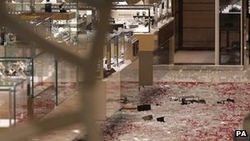
Bank robbery in Lancashire, England: A man in a burqa robbed a Barclays bank on Market Street in the Bacup area of Lancashire on July 8 in the afternoon. He went to a cashier and demanded money, which he received and fled. He is described as white, around 5ft. 9in. tall, of medium build. He wore white sneakers and carried a white, plastic Co-Op bag. (July 9, 2013)
Attempted robbery with niqab in California: A female with olive complexion and heavy eye makeup, wearing a maroon-colored niqab and light shoes, about 5 feet 6 inches tall, in her late 20s to early 30s, tried to rob a Wells Fargo Bank in National City, just south of San Diego around 6 p.m. on Aug. 1. According to FBI Special Agent Darrell Foxworth, "the woman entered the bank and stood in the teller line until summoned by a teller. Upon arriving at the teller counter, the woman presented a demand note." When no money was forthcoming, she fled the bank. (August 2, 2013) Sep. 30, 2013 update: Elysia Maria Roiz, 30, was arrested in Mexico and extradited to the United States for this attempted robbery, and is being held on $100,000 bail. Nov. 10, 2013 update: Roiz explained that she put on a niqab to rob the Wells Fargo Bank out of desperation for money to support her 2-year-old special needs son. She then added an interesting commentary on the use of the niqab: "I know in other countries they've outlawed it, because of people, mostly men hiding firearms inside burqas, and I don't think it was fair of me to exploit that, but what better costume, you know what I mean?" She then called for the niqab to be outlawed on feminist grounds: "I don't want to be disrespectful, but I mean, that stuff is so oppressive, like I mean, we fought a lot in the 70s, women did, so that kind of stuff didn't happen, doesn't happen." Comments: (1) What "better costume" indeed? The niqab is the perfect accessory to crime or terrorism. (2) Feminist logic seems a bit superfluous when banks are under attack.
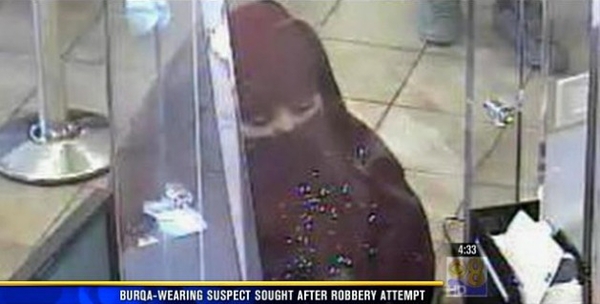 Security video from the Wells Fargo Bank in National City showing the would be niqabi theft. |
Safwat Hegazy arrested fleeing Egypt: In the highest profile capture of a prominent Islamist since July 2007 (when Maulana Mohammad Abdul Aziz Ghazi tried to escape the Lal Masjid in Islamabad, Pakistan; see above), Egyptian forces captured the prominent Muslim Brotherhood preacher Safwat Hegazy in Siwa Oasis as he tried to flee to Libya while disguised in women's clothing, including a burqa. He faces charges of incitement to committing acts of violence, as well as attempted murder. (August 21, 2013)
Burqa enables a suicide bombing in Afghanistan: Joe Shute of the Daily Telegraph (London) recalls a video he saw in 2012 in Helmand Province, Afghanistan:
The woman in a full-length burka walked calmly into the drab government office. She moved close to the desk behind which an administrator was shuffling his papers. Others queued around her. Suddenly, without warning, she detonated the suicide vest she was wearing. The explosion flashed a brilliant white on the grainy CCTV before the cameras cut out, obliterating everything – and everyone – in the room.
Mohamed arriving the mosque in Western clothes.
British terror suspect escapes in burqa: Mohammed Ahmed Mohamed is a Somali immigrant, 27 years old, 5 feet and 8 inches tall, of medium build. He is believed to have received terrorist training in Somalia, fought on for Al-Shabab, an Islamist terror group there, helped a UK-based network supporting terrorist activities in Somalia, and planned an attack on Western interests in east Africa. As a result, he is under what's known in the UK as a "Terrorism Prevention and Investigation Measure" (TPIM) notice that requires daily reporting to the authorities, staying overnight at a specified address, wearing a GPS tag, and agreeing to restrictions on travel, association, funding, and communications.
Two days ago, about 10 a.m. on Nov. 1, Mohamed went wearing Western-style clothing to the An-Noor Masjid and Community Centre in Church Road, Acton, west London, where he was seen as late as 3:15 p.m. in those clothes.
 Mohamed leaving the mosque in a burqa. |
The Guardian newspaper reports on the authorities's response:
Scotland Yard's counter-terrorism command launched inquiries to trace Mohamed following his disappearance. His photograph and details were circulated nationally and ports and borders were notified. Following a police request, an anonymity order imposed by a court was also lifted on Saturday to allow for an appeal for help from the public in tracing him. "Anyone who sees Mr Mohamed or knows of his whereabouts should not approach him, but call 999 immediately," the police said. "If anyone has other information which they think could be relevant to police efforts to trace Mr Mohamed they should contact the confidential anti-terrorist hotline on 0800 789 321."
Comments: (1) This incident does nothing to contradict my impression that British law enforcement is a semi-joke. (2) How many criminals and terrorists will rely on the burqa as accessory before Western authorities ban this foul and dangerous article of clothing? (3) Curiosly, just as this news came out, Ken Clarke, a former justice secretary (and now minister without portfolio) condemned the burqa for courtroom testimony ("I don't think a witness should be allowed to give evidence from behind a veil"), but then added that people should be allowed to "wear what the devil they like in public." (November 3, 2013)
Nov. 7, 2013 update: Here's an only-in-Britain twist. Not only has Mohamed sued the UK Government over his two-month detention in a Somaliland jail in 2011 for having been "unlawfully detained, tortured and mistreated," with a reasonable chance to be handsomely compensated by the British taxpayer, but Conservative MP Dominic Raab used this lawsuit as the basis to appeal to the terror suspect to turn himself in: "If Mr Mohamed wants to use the Human Rights Act to sue the Government then he should give himself up and make his case in court." Jan. 27, 2014 update: Compounding the only-in-Britain nature of the Mohamed escape, while Mohamed remains on the lam, his taxpayer-funded lawyer has initiated a court case are appealing the TPIM. Oct. 11, 2018 update: Mohammed Ahmed Mohamed, now 32, is believed to have been (the Times of London reports)
one of five men shot dead by al-Shabaab after being convicted at a special court in Somalia. The terrorist group claimed he had admitted giving information to British intelligence services about al-Shabaab supporters living in the UK. ... According to residents, the men were tied to poles and shot by a firing squad shortly after a self-proclaimed judge sentenced them to death. They were all accused of spying for American, British and Somali intelligence.
And if you're curious about the British justice system:
A case against him for tampering with his electronic tag had been dropped hours before his escape. In 2014 Mohamed, a Somali-born British citizen, won an appeal against control orders imposed on him, despite him being a fugitive. A year later his arrest warrant was dropped.
Woman in pink outfit robs Maryland bank: It's not exactly a niqab – the color pink gives that away – but a woman who robbed a Capital One Bank in Landover, Maryland, on Dec. 2 did cover herself except for the eyes and a portion of the nose.
She passed a note to the bank teller demanding cash and made away with an undisclosed amount of money. The suspect is a black female in her late 20s, between 5 feet 8 inches and 5 feet 11 inches tall. She was wearing a pink head wrap and pink coat while carrying a pink cell phone with her at the time of the robbery.
(December 3, 2013) Dec 30, 2013 update: What appears to be the same robber struck again.
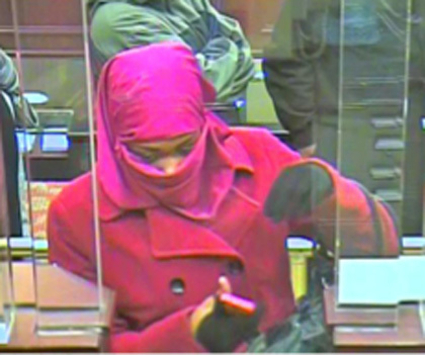 Security photograph from the Capital One Bank. |
Bank ATM robbery in India: Two thieves dressed in burqas avoided making their identities known on the CCTV at an ATM in Mumbai and made off with nearly Rs 1,600,000, equivalent to US$25,700. They opened the machine's vault, where cash is stored, using the security password, prompting the police to suspect an inside job – making the burqa covering all the more important. (December 16, 2013)
Niqabis distract, child steals jewels in Saudi Arabia: Niqab-wearers keep finding new ways to aggress. Here is a new one (go to the Daily Mail site for pictures and video): CCTV from a jewelry store in Saudi Arabia shows what appear to be a mother and her accomplice, both wearing niqabs, keeping the sales clerk busy showing them various items. Meanwhile, a small girl sneaks under the counter to the area where jewelery is stored, returning moments later with money later valued at 500,000 Saudi riyals, or about US$133,000. The girl then goes up to her mother and appears to put her booty into a handbag. The trio then left the store without having raised suspicions.
Comment: While any thief could have pulled off this trick exploiting a child, only ones with their faces covered knew they could get away with it. Thus, this robbery ranks as another where the niqab proved critical for the success of the operation. (December 27, 2013)
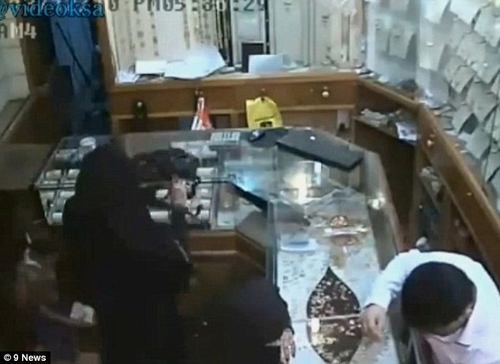 Note the child at the left, holding papers and putting them into the niqabi's handbag. The store clerk is at right. |
Robber in pink again strikes Maryland bank: What appears to be the same pink-garbed female robber who held up a Capital One Bank on Dec. 2 in Landover, Maryland, has struck again, this time against a Capital One Bank on Dec. 27 in Chillum, Maryland. "The woman passed a note demanding cash to a teller, who complied in fear for her own safety, police say. The suspect got away with an undisclosed amount of money. ... The suspect is described as a black female in her late 20s, approximately 5'8"-5'11". In both cases, she wore a pink head wrap, a pink coat, and was holding a pink cell phone." (December 30, 2013)
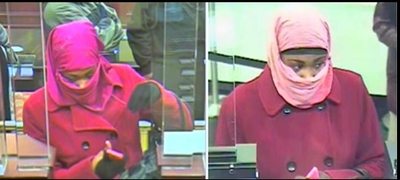 The Dec. 2 pink Maryland bank robber at left, the Dec.27 one at right. |
Gun store in the Philadelphia area: Two teenagers, 15 and 17, dressed in burqas, pulled a gun on Joe Galiano in his store, Suburban Armory, a gun shop outside of Philadelphia. Galiano, who carries.45-caliber pistol on his hip, fired at the would-be robbers, prompting them to flee the store. As the Philadelphia Inquirer account puts it, "One hopped onto a SEPTA bus and tried unsuccessfully to hide in the back, the other was apprehended behind a trolley stop. Muslim clothing and other evidence was found between the scene and the trolley stop. ... Charges pending include robbery, possession of an instrument of crime and drug possession." (January 2, 2014)
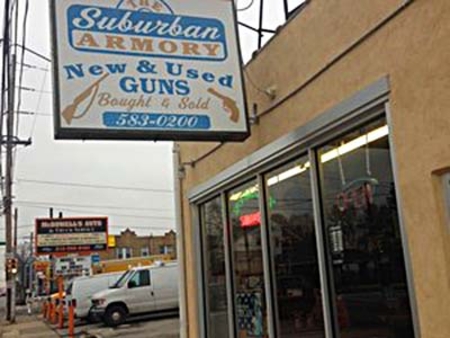 Suburban Armory - not the smartest move to try to hold it up, even with a burqa. |
Jabhat al-Nusra figure caught in a niqab: An unconfirmed tweet states "#Syria-n army arrested a prince of Jabhat Al-nusra disguised as a woman," along with a series of pictures of the made-up male. (January 10, 2014)
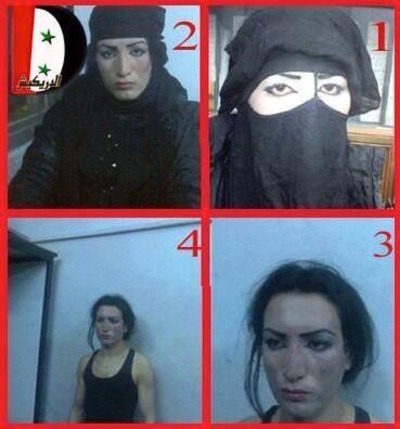
Kidnapping in Camden, New Jersey: Police in Camden (across the Delaware River from Philadelphia) are searching for two black males, 5'10" to 6'0" who dressed in niqabs on Jan. 21, entered the Zoujati Salon, brandished a weapon, abducted a lone female employee, forced her into a large trash can inside the store, covered it and moved it outside to the (cold) sidewalk, then fled in a stolen Chevrolet Express 1500 cargo van to Philadelphia. (January 23, 2014)
Three sisters attack fourth sister's lesbian lover: It's not exactly a bank robbery, but Atfah Ditta, 32, one of three sisters who physically attacked yet another sister's female lover, wore a niqab during the operation. (January 24, 2014)
Canadian husband puts on burqa to honor kill wife: Abdul Malik Rustam,30, pleaded guilty on Valentine's Day to second-degree murder and admitted he put on a burqa and wedge shoes when he killed his wife, Shaher Bano Shahdady, 21, after she told him she wanted a divorce on July 22, 2011. The two had had an arranged marriage in their native Pakistan in 2008.
According to Tarek Fatah of the Muslim Canadian Congress, the burqa enabled Rustam "to gain access into the home. Had it not been for the burka, she would not have let him gain entry at 1 in the morning and would still be alive today." (February 24, 2014) Mar. 5, 2014 update: Rustam pleaded guilty to a second-degree murder charge and was sentenced to life in jail.
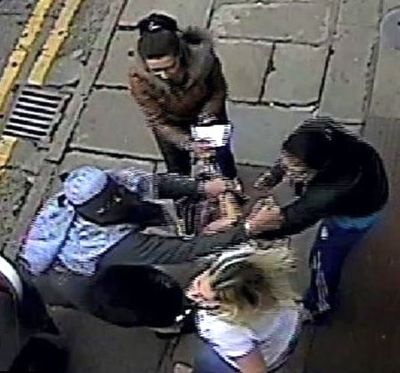 The Ditta sisters fighting with Sarah Harrison (in white shirt). |
Scottish ring of thieves adopts burqas: The notorious shoplifting team of Annette Daniel, 52, and Jean McGovern, 47 are suspected of using burqas to hide their identities. This is the latest attempt to hide themselves after using wigs, scarves, and other props. As one security source put it: "There has been at least one case reported where two suspected shoplifters were wearing burqas. We strongly suspect it was this gang. Their faces are known to every experienced store detective in Britain. They frequently raid the dressing-up box, so a burqa would be a logical extension of that." (March 16, 2014)
Four Taliban attackers in Kabul: Four of the Taliban members who attacked Afghanistan's Independent Election Commission compound today, injuring two police officers, wore burqas. None survived the assault. (March 29, 2014)
Store robbery in northwest Philadelphia: The Philadelphia tally grows to 17 incidents in 7 years: Two men, thin black males about 20 years old and over 6 feet tall, one of them dressed in Muslim-like covering outfit, robbed a Family Dollar store at 1925 W. Allegheny Ave. in the Glenwood area of Philadelphia around 9 p.m. on July 6. They at first pretended to shop when the one in Muslim clothing, according to Philly.com,
suddenly walked up to the checkout counter and leveled a handgun at the employees, police said. He grabbed a clerk by the back of her neck and forced her to open the cash registers and store safe. All the while, his alleged accomplice stood at the front of the counter, acting as a lookout, police said. The suspects allegedly stole $4,500, then forced the store employees and customers into a stock room before fleeing on foot. The men were last seen running east on Allegheny Avenue.
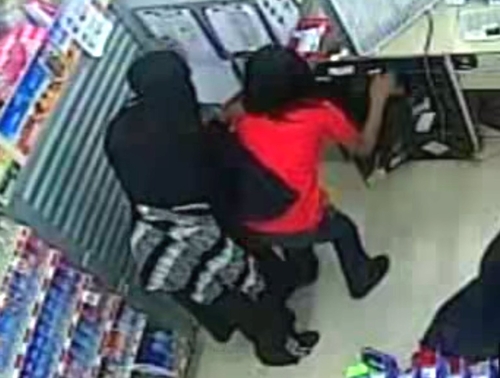 The thief forces a female employee to open the safe. Note the thief's outfit. |
(July 8, 2014)
Hamas fighters dress up as women: Janis Mackey Frayer of Canada's CTV television network tweeted from Gaza that "Inside Shejaiyya we also saw several #Hamas gunmen. One passed dressed in a woman's headscarf... tip of a gun poked out from under cloak." (July 20, 2014)
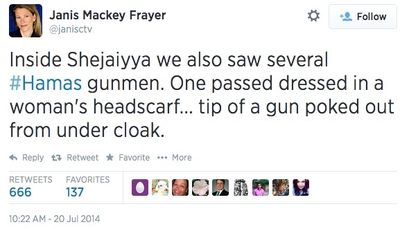
Four suicide bombings in northern Nigeria by covered women: A series of suicide bombings carried out by young women carrying explosives under their body coverings, presumably on behalf of Boko Haram, has wracked northern Nigeria, Agence France-Presse reports. Four such attacks by teenagers took place in July, leaving at least 9 dead and dozens injured. The worst of them, a blast at Kano State Polytechnic on July 30 killed 6 and injured 20. Another took place at an upscale shopping mall. AFP goes on:
A security source involved in forensic analysis of the Kano blasts noted:
"From our preliminary findings, all the female suicide bombers were between 14 and 16 years which gives an idea of the age group of the bombers," the source said. "We believe the explosives were remotely detonated which means the girls were sent under duress. So, people should be wary of young women who look nervous or fidgety in a crowd."
There's a new fear of young women wearing what the Nigerians call hijabs but are large coverings that fall beyond the waist.
 Examples of what are called hijabs in Nigeria. |
A male resident of Kano, Bala Dawud, explains:
"I shudder with fear when I find myself next to a young woman in hijab because she could be a suicide bomber," he added. He recalled how a crowd which queued up at a cash machine melted away when a hijab-wearing woman joined the queue and asked if it was working. "As soon as she was told yes, she pulled out her mobile phone and called someone, telling him she had found a machine dispensing cash and before you knew it the whole crowd dispersed, leaving the woman alone," Dawud said. Women wearing niqab, which covers the whole face except the eyes, draw even more suspicion, said resident Samaila Abdussalam.
Adama Habibu, 21, confirms: "Wherever a young woman in hijab goes people keep their distance from her out of fear she could be a suicide bomber."
As a side note, pious Muslim women have responded to this rash of attacks by choosing not to wear their traditional religious dress. Hajara Musa, 17, explains: "I no longer wear my hijab because people now see any young woman in hijab as a potential suicide bomber because of the recent incidents. I now put on my shawl [headscarf] when I go out pending the time the city gets over the trauma of this frightening trend." She told of being barred from a shopping mall dressed in a hijab, even though she agreed to be frisked. "I was turned away because of my hijab, which I found very disturbing." (August 13, 2014)
Man in burqa robs bank in Illinois: Gildardo Lopez Jr., 31, an ATM technician at the Chase Bank in La Grange, Illinois, walked to the ATM machines late at night on Aug. 14 wearing a black burqa and left 15 minutes later with $168,174 in cash. After his escape, both he and his getaway driver Douglas Pineda, 31, waiting for him in a Toyota Sienna minivan a block from the bank, were arrested. The two roommates both live in Chicago. To make matters worse, Lopez reportedly worked as an ATM technician at Chase while Pineda worked as a Transportation Security Administration airport screener. (August 16, 2014)
Bank robbery in New Jersey: A masked man held up the Susquehanna Bank on Market Street in Camden, New Jersey, bank just after 10:30 a.m. on Sep. 16 by passing a note to the bank teller demanding cash, then fleeing on a silver BMX bicycle. (September 18, 2014)
Another bank robbery in New Jersey: Days later, another niqab-like outfitted robber held up a New Jersey bank in the morning and fled on a BMX bicycle (this time a blue one). The attack took place about 10 a.m. on Sep. 23 at the Audubon Savings Bank in Audubon. He wore gray pants and white sneaker. (September 26, 2014)
Burqas as accessories of smuggling gold into India: Yesterday, the Air Intelligence Unit (AIU) of Indian airport customs found gold on four women concealed in their burqas.
- A Mauritius national coming from Kuala Lumpur: gold worth Rs 49.71 lakh (about US$80.000).
- A woman coming from Dubai: gold bars worth Rs 99.52 lakh carried by her and her husband.
- A woman coming from Dammam: gold worth Rs 78.33 lakh.
- Another woman coming from Dammam: 9 gold bars worth Rs 27.56 lakh.
The day before, two Madagascar women arriving from Nairobi carried gold bars worth over Rs 200 lakh.
This plague of burqa smuggling fits into a pattern of sharply increased gold smuggling during 2014, which amounted to almost nine times more than that of 2013; Kiran Kumar, deputy commissioner of AIU, deemed the reliance on burqas "a new trend." (October 26, 2014)
ISIS fighter: According to a tweet, an ISIS fighter tried to escape under a burqa but was caught by Iraqi Kurdish forces. (November 14, 2014)
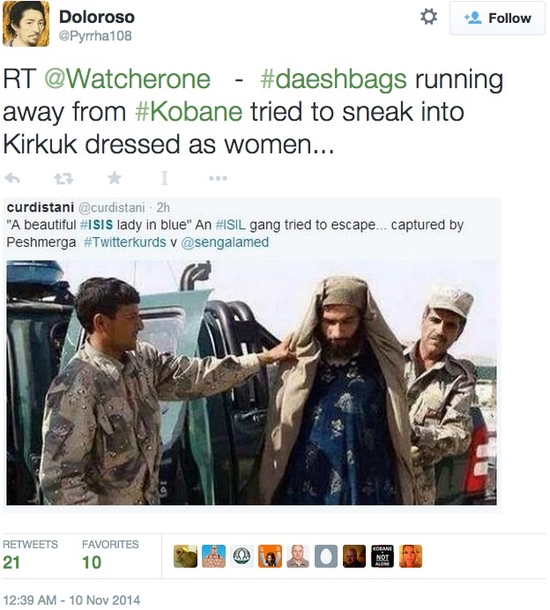
Jewelery store in Toronto: Two men wore burqas in the course of their Oct. 14 armed robbery of Mona-Clara Jewellers, stealing C$500,000 in jewelry. The Toronto Sun reports:
The bandits entered the store around 11 a.m., and took control of the two employees. One thug, armed with a handgun, forced a worker to open the display case. The thieves stuffed bags with jewelry and fled within five minutes. ... The gun-toting bandit is described as black and roughly 5-foot-11. The second man is described as 6-foot-3.
The National Post tells more about the robbery itself:
Edmond Bakos, the owner of the York Mills-Leslie Street-area Mona-Clara Jewellers, said he didn't think twice about the people who walked into his store on Oct. 14 until one them produced a handgun and demanded jewellery in a distinctly masculine voice. "Three seconds after they walked in, they pulled out a gun and said, 'It's a holdup.'"
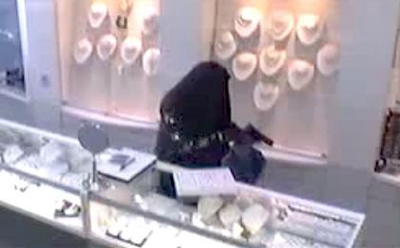 The gun-toting burqa thief scooping up jewelery in a Toronto store. |
Also of interest are the comments by Holdup squad Staff-Insp. Mike Earl: "This is the first jewelry store robbery that I have seen where they're dressed up in burkas," while not ruling out the possibility that other thieves had used burqas in prior, unsolved robberies. "It's another way of disguising yourself. You know, we've seen balaclavas and ski masks, and we've seen scarves and bandanas. It's just another way of disguising yourself to try to prevent identification during a robbery." He also noted that a ski mask would stand out in mid-October, but not a burqa: "I think that would be a common enough site anywhere in the GTA [Greater Toronto Area]. It didn't draw anybody's attention at that point in time."
Comments: (1) This incident reeks of innocence – both on the part of the jewelery shop owner and the police inspector. In all likelihood, burqa innocence is now history in Toronto. (2) Perhaps if they were aware of this blog, the owner and inspector would have been better prepared. (November 19, 2014)
Murder in a toilet stall: Ibolya Ryan, a Romanian-born 37-year-old American kindergarten teacher and mother of 11-year-old twin boys, was stabbed to death with a knife on Dec. 1 by a burqa-clad woman who awaited a kafir to attack in the toilets of the Boutik Mall on Reem Island in Abu Dhabi, UAE. Taken for treatment at a hospital, she died later from her injuries. The police are trying to determine the motive for the attack as well as the identity of the perpetrator, who fled the scene in a niqab and black gloves.
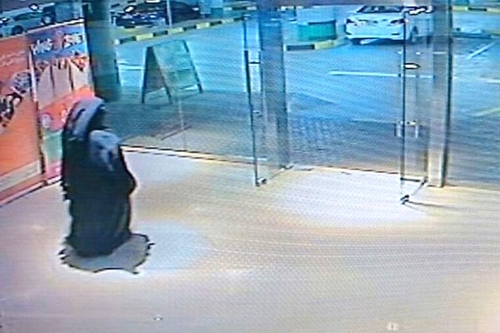 An image from the security image at the Boutik Mall, thought to be the murderer of Ibolya Ryan. |
On the bright side, a debate has emerged in the UAE about banning the burqa. (December 4, 2014)
 Ibolya Ryan, murdered by a burqaqi in Abu Dhabi. |
June 29, 2015 update: An Abu Dhabi court found Alaa Al Hashemi, 30, an Emirati subject and mother of six, guilty of murdering Ryan and it sentenced her to death by firing squad. In addition, Al Hashemi was convicted of making a bomb (that did not explode) with which she tried to blow up an apartment belonging to an Egyptian-American doctor; of using an online account to spread information ridiculing and harming Abu Dhabi; and of sending money to Al Qaeda in Yemen. July 13, 2015 update: Hashemi was executed today by firing squad. Dec. 1, 2015 update: I happen to be staying in the Sun Tower Building above the Boutik Mall and on this, the first anniversary of Ryan's murder, I commemorated it in a small way by taking a picture of the bathroom where she was attacked.
 The scene of the crime. |
Looter in Berkeley, California: Protests in Berkeley against grand jury rulings in the police-related deaths of Michael Brown and Eric Garner turned violent when two demonstrators smashed the window of a RadioShack franshise, after which looters descended on the store. At least one of them, identified in the caption as a male, dressed in a niqab-like get-up as he made off with stolen goods. (December 8, 2014)
Bank robber in Ohio: A burqa-wearing man with a gun held up a branch of Fifth Third Bank in Woodlawn, Ohio, yesterday. Assistant Chief Aaron Tillman reconts: "It was reported that the individual entered into the bank and was in the back of the bank area where only employees are authorized to be and demanded money and brandished a weapon." Although covered, witnesses got a look at the suspect, said to be African-American, 6 feet tall, and slender with a facial tattoo. (December 10, 2014)
Attack on Istanbul police station: A female suicide bomber killed one police officer and injured another in the Sultan Ahmet district of Istanbul. The BBC recounts:
The woman spoke English with "a thick accent", but her nationality and identity remained unknown, Istanbul governor Vasip Sahin told Turkish TV. No group has yet said it was behind the attack, the second on police in a week. ... Mr Sahin said the woman, dressed in a niqab, entered the police station and told officers she had lost her wallet before detonating the bomb.
It is thought she belongs to the Marxist DHKP-C Group. (January 6, 2015)
Niqabi bank robber in England: A niqab-clad male, 5ft 10ins and stocky, carrying a white handbag and wearing sunglasses, tried to rob a NatWest bank, Oadby in Leicestershire, England. He threatened the staff and ordered them to hand over cash but they activated a security alarm and he fled empty-handed. Witnesses think he was carrying a gun. (January 16, 2015)
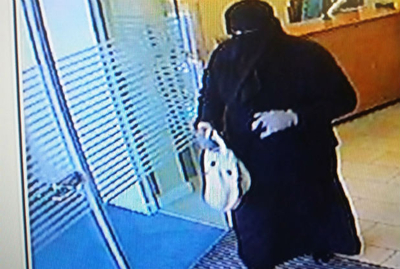 Another picture of a niqabi robber holding up a bank, this time in Oadby, England. |
Four burqa thieves executed in KSA: Saudi authorities beheaded four men in the eastern town of Qatif after finding them guilty of putting on burqas to impersonate women in order to lure male victims, then rob and kill them. (February 5, 2015)
Boko Haram militiamen dress as women to escape detection: The news report from Media World does not explicitly mention niqabs or burqas on the Nigerian totalitarians but these articles of clothing must be what's referred to:
Beard-wearing militants belonging to West Africa's brutal Boko Haram Islamic terror organisation have been dressing as women in a hopeless attempt at avoiding the attention of security officials. Nigerian defence forces liberating the town of Baga from jihadi control yesterday set up a cordon around the suburbs to help them catch any Boko Haram militants who had been unable to escape. The security workers were shocked to come across several fleeing fighters trying to pass themselves off as females by putting on layers of colourful women's clothing – despite the fact they had refused to shave their thick jihadi beards.
(February 24, 2015)
Honor killing in Toronto: Abdul Malik Rustam killed his wife Bano Shahdady, 20, on July 22, 2011, by wearing a niqab, thereby tricking her to let him into her Toronto apartment, where he proceeded to strangle her. From the account by John Goddard, "She dumped the Niqab, and her Husband. He came back wearing a Niqab and killed her":
Rustam arrived at her building "planning to cause her harm," [Judge John McMahon of the Ontario Superior Court of Justice] said. "Security video showed him dressed in a full [niqab], only his eyes showing, and wearing female white wedge shoes."
Rustam got off at the sixth floor. Still wearing the [niqab], he tilted up the security camera pointing at his estranged wife's door and knocked. Bano let him in. Within minutes the downstairs neighbour, who was awake texting, heard furniture scraping the floor and muffled screams, as though the screamer had a hand over the mouth. After 30 minutes the noises stopped.
The autopsy showed cuts and bruises around the face, neck, clavicle and upper back. Whether Rustam strangled her with a scarf, or a soft belt, or while wearing gloves, or with his bare hands could not determined. He left the body on the bathroom floor and his two-year-old son screaming in the living room. The strangulation had taken place in front of him. On his way out Rustam broke a heel and had to carry the shoes, still wearing the [niqab]. "He did not panic," the judge said.
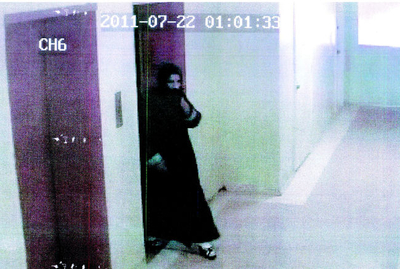 A security camera captured Abdul Malik Rustam in a niqab on his way to murder his wife. |
The judge noted that the victim's father, an Islamist and member of Tablighi Jamaat, forgave Rustam and pleaded for mercy in court on his behalf. As is, Rustam was sentenced to a mere life in prison with the chance of parole after 17 years. (March 7, 2015)
Filipina dons burqa to rob a money-changer in Abu Dhabi: The announcer calls the thief a woman but the appearance looks masculine. In any case, a migrant worker thought that a burqa would enable a blatant robbery. (March 15, 2015)
High-class thieves in London: Ironically, Arab tourists shopping the exclusive precincts of Oxford Street, Regent Street, and Bond Street find themselves preyed on by fake-Muslims in burqas. Vice reports:
Two Chilean women were arrested and charged after wearing burkas to rob wealthy Arab tourists filing out of Park Lane and Mayfair. "Generally, security guards and shop staff don't question middle-aged women in Islamic clothing," says [PC Darren] Bond. "It allows them to get close and then drop the edges of their garment over your bag and just take it away. The two women we caught were working alongside two or three males who were on a separate scam, but constantly passing information to each other. We apprehended the women with a bag containing €130,000 and £20,000, then gold and diamond jewellery."
(April 1, 2015)
Saudi man harasses women in a mosque toilet: An unnamed man in his 30s covered himself in an abaya and went into the toilet of the Jaarana Mosque in Mecca where he "behaved oddly." Police arrested him after watching him take off the feminine clothing in his nearby car. (April 19, 2015)
Suicide bombing in Saudi mosque: A male ISIS suicide bomber, Abu Jandal al-Jazrawi, reportedly dressed in a burqa, blew up a car outside the women's entrance of the Shi'i Imam Hussein mosque in Dammam, Saudi Arabia, during peak attendance at Friday noon prayers, killing four in addition to himself. (May 29, 2015)
"Burqa-clad white man" leaves bomb in Watford, England: A man dressed in full-length, Islamic-style black robes with a niqab covering his face was arrested in Watford after police blew up a suspicious item outside a hotel. A curfew was imposed on the entire city center. (June 18, 2015)
Explosion in Chad market kills 15, injures 80: A man dressed in a burqa blew himself up in the main market of N'Djamena, the capital of Chad today. Boko Haram is the suspected group behind this atrocity. Police spokesman Paul Manga said "The suicide bomber was a man disguised as a woman. He tried to enter the market when he was intercepted by police. That is when he detonated the bomb." Ironically, the Chad authorities had just banned the burqa in June 2015 on security grounds. (July 11, 2015)
5 bank robberies in Philadelphia: Law enforcement has announced four niqab-assisted bank robberies in northeast Philadelphia, all by the same 5'5" to 5'7" black woman, all in just over one month:
June 9: Santander Bank on Bustleton Avenue.
June 16: PNC Bank on Academy Road.
July 7: Citizens Bank on Red Lion Road.
July 9: Citizens Bank at 10650 Bustleton Avenue.
July 16: Citizens Bank, 11000 Roosevelt Blvd. (inside a Shoprite grocery store).
How do they know this is a woman? Philadelphia FBI spokesperson J.J. Klaver notes that "We've had incidents in the past where we've had men wearing full burqas. But in this case, they've heard her speak, and we're confident this is actually a woman." These mark Philadelphia's 18th to 22nd attacks. (July 17, 2015)
Bank robbery in Brooklyn: A black female weighing around 115 pounds and 5'4" tall wearing an Islamic-style headscarf robbed the Santander Bank in Windsor Terrace on Sep. 29, making off with about $7,000. (August 31, 2015)
Bank robbery in Cleveland: A man believed to be in his 20s, about 150 pounds, entered a U.S. Bank in the suburb of Euclid wearing a niqab and glasses, gave a teller a note demanding cash, fled with the money and entered a silver sedan. (August 31, 2015)
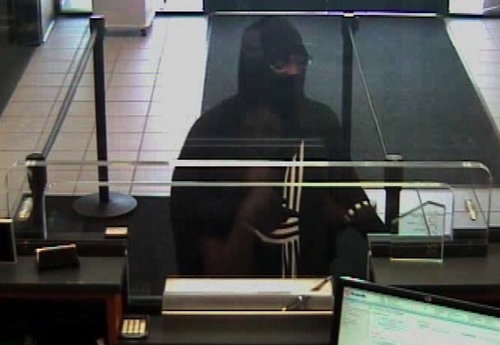 A robber in niqab in action at the U.S. Bank near Cleveland, Ohio. |
Shi'ite mosque in Sanaa, Yemen: Details are sketchy but up to 25 Shiite worshippers performing the Eid al-Adha prayers were killed today when an ISIS suicide bomber wearing a niqab or burqa blew himself up at the Balili Mosque outside the Yemeni capital's the old city. (September 24, 2015)
Lebanese fighter in disguise: From the Hezbollah newspaper in English:
Lebanese Army intelligence arrested an "important" suspect in north Lebanon allegedly linked to detained extremist Sheikh Khaled Hoblos and fugitive Shadi al-Mawlawi, according to the state-run National News Agency. Ahmad al-Kasha, apparently disguised in women's clothing at the time of his arrest Wednesday morning, was apprehended at a checkpoint in Madfoun, in north Lebanon's Batroun district, the NNA report said.
(September 24, 2015)
Two men attack Cape Town train station: Two men in burqas fired shots in Cape Town, South Africa, then one fled and the other turned the gun on himself. The police cannot explain the motive. (October 13, 2015)
ISIS members fleeing Syria to Turkey: Russia's entry into the Syrian civil war has prompted many ISIS members to shave their beards and don niqabs in the effort to pass as women and take refuge in Turkey. (October 19, 2015)
Shi'ite mosque in Pakistan: According to initial reports, the suicide bomber who entered the Imambargah Mosque in Balochistan Province in southwestern Pakistan was wearing a burqa. Police said 11 died and 18 were wounded. (October 22, 2015)
Women dress as men in Nigeria: Here's the opposite, a woman dressing as a man to carry out a violent attack, details from the New York Times:
Two female suicide bombers detonated explosives Wednesday morning in an attack on a mosque in northeastern Nigeria, killing 24 people and wounding 18. The first blast tore through the mosque, and the second occurred near the building a few minutes later in Ummarari, a village outside Maiduguri, the capital of Borno State and a longtime target of the militant Islamic group Boko Haram. ... at least one of the bombers was dressed as a man, probably to gain better access to the crowds inside the mosque, where women are not allowed in some areas.
(March 16, 2016)
Indonesian child killer escapes jail disguised as woman: Anwar bin Kim An, who raped and murdered a 12-year-old schoolgirl, escaped a life sentence in jail by putting on what Agence France-Presse calls a "woman's Muslim veil" and dancing out of the jail. That he also put on lipstick suggests he did not use a niqab or burqa, but the clothing must have been quite enveloping for him to get away with the deed. The Jakarta police spokesman acknowledged that there are no security checks for female visitors to the jail, unlike for male visitors.
AFO adds that "in 2012, a terror convict escaped from a high-security jail by wearing a full-length Muslim burqa." (July 13, 2016)
Entire Manchester, Eng. criminal gang of ten wore burqas: The Times of London (requires subscription) reports the jail sentences of a gang that had carried out ten armed raids on jewelry shops and supermarkets over a period of a year from June 2015. It stole, for example, £206,000 worth of gems and £76,000 in cash from an Aldi. At the Aldi, it attacked a bystander, Mark Cooper, with a machete when he tried to stop the robbery, doing serious injury to him.
Judging by the nine names of gang members that are public — Christopher Ryder, Michael Gabriel. Nyron Brown, Nicholas Fox, Caine Williams, Christian Edwards, Paul Smith, Gary Sullivan, and Sean Heyes – these are non-Muslim males exploiting an outfit normally worn by Muslim females.
Comment: A gang of ten! Criminals innovate and the niqab-burqa combination offer them a host of new opportunities to do damage. (May 9, 2017)
Iraqi army bans niqabs & burqas in Mosul: ISIS relies so heavily on full-body coverings as accessories to attacking its enemies that the Iraqi authorities have temporarily banned them. (June 1, 2017)
Disguise to lure a boy and rape, kill him: A Pakistani worker living in Abu Dhabi put on a niqab to lure an 11-year old boy, Azan Majid Janjua, in to the roof of his residential building, where the cross-dressing man raped and strangled him with a rope. Janjua had gone missing on May 30 as he returned from a mosque where he has participated in late-afternoon prayers. Air-conditioning technicians found his body on the building's rooftop the next morning.
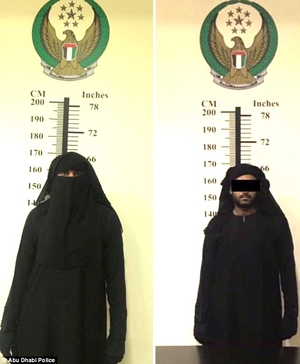 The accused perpetrator, with and without his niqab. |
Comment: Strange that a woman lured a female child (in Philadelphia) for sex and now a man a male child (in Abu Dhabi) for sex, both using a niqab as an accessory. (June 6, 2017)
Women force way into apartment, attack occupants: Two women wearing burqas, forced their way inside an apartment in Manchester, England, where they proceeded to attack two other women, 19 and 20 years old, with two knives and a hammer. The one has knife wounds to her left arm and armpit. The other has cuts on her arms and a deep knife wound on her torso. Both were taken to a hospital and are in stable condition. Police arrested a 25-year-old woman on suspicion of attempted murder and a 27-year-old man on suspicion of assisting an offender. (June 22, 2017)
14 dead in Iraqi displaced persons camp: A male suicide bomber wearing women's clothing, presumably a niqab or burqa, infiltrated a camp for displaced persons in western Anbar, Iraq, Initial reports at least 14 dead and 10 injured. (July 2, 2017)
Cartoon:
(July 29, 2017)
Antifa hoodlums in Berkeley: As a reminder that face coverings do not need to be Islamic in nature to cause security problems, here's an excerpt from the Washington Post, "Black-clad antifa members attack peaceful right-wing demonstrators in Berkeley":
Their faces hidden behind black bandannas and hoodies, about 100 anarchists and antifa— "anti-fascist" — members barreled into a protest Sunday afternoon in Berkeley's Martin Luther King Jr. Civic Center Park.
Jumping over plastic and concrete barriers, the group melted into a larger crowd of around 2,000 that had marched peacefully throughout the sunny afternoon for a "Rally Against Hate" gathering.
Shortly after, violence began to flare. A pepper-spray-wielding Trump supporter was smacked to the ground with homemade shields. Another was attacked by five black-clad antifa members, each windmilling kicks and punches into a man desperately trying to protect himself. A conservative group leader retreated for safety behind a line of riot police as marchers chucked water bottles, shot off pepper spray and screamed, "Fascist go home!" All told, the Associated Press reported at least five individuals were attacked.
(August 28, 2017)
Notorious Islamist escapes in Lebanon: Shadi Mawlawi fled to Syria from a "Palestine refugee" camp in Lebanon and, says a source, "There is a ninety-percent chance that he left after changing his appearance or dressing as a woman." (October 26, 2017)
Attack on an agriculture college in Pakistan: Pakistani Taliban gunmen disguised in burqas arrived in auto-rickshaws, then stormed the Agriculture Training Institute in Peshawar, killing at least 9 and wounding 35 in an attack that lasted two hours. (December 1, 2017)
Attempted robbery, abduction, and murder in Leicester, England, jewelry store: CCTV images show Ramniklal Jogiya, 74 and weeks away from retirement, being abducted by three men in burqas. His body was found seven miles from the store, Vama Collections on Belgrave Road in Leicester, the next day. Three men have been arrested. (January 27, 2018)
Bank robbery goes awry: A burqa-clad criminal in sun glasses tried but failed to rob a bankin Vienna. (July 14, 2018)
Attack on Shiite mosque in Afghanistan: Two heavily armed men disguised in burqas attacked a Shiite mosque in Gardez, Afghanistan during Friday prayers, killing at least 20 and wounding at least 81. Comment: This may be the highest-ever toll from a single burqa/niqab attack. (August 3, 2018)
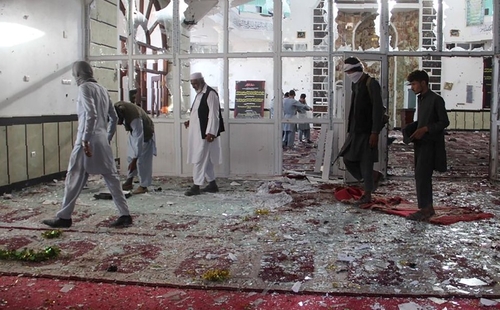 Inspecting and cleaning up after burqa'ed suicide attackers struck during Friday prayers in Gardez. |
Burqas do not fool the French authorities: French police caught the notorious criminal Rédoine Faïd after three months on the run, as well as his brother Rachid, north of Paris despite their wearing burqas. Here's the crucial part:
French prosecutor François Molins revealed that police had been monitoring mobile phones used by the gang that took part in the jailbreak and had tracked down a young woman in Creil, where Faïd grew up. Last weekend, the woman "let into her car a person dressed in a burqa whose figure suggested he might be a man."
Late on Tuesday night, [Oct. 2,] that person then got out of the car and entered the young woman's flat, followed shortly afterwards by another person also in a burqa. Police immediately suspected the pair in the burqas were Rédoine Faïd and his brother Rachid.
At 04:20 (02:20 GMT) on Wednesday, dozens of France's BRI police stormed the flat and arrested the two brothers and two others, including a nephew and the 28-year-old flat owner. Another nephew and two other suspects were detained elsewhere.
Pictures have emerged of the fugitive sitting dazed on a bed, surrounded by police and wearing what appears to be a nightshirt. An Uzi sub-machine gun lay on the floor.
Comment: Do the police have some ultra-sophisticated machinery that allows them to see through clothing at a distance? Or, being French, can they just sense a man from a woman? (October 3, 2018)
Luxury store in New York City: A burqa'd thief, thought to be male, yesterday stole $800,000 worth – one necklace and two watches – from the Piaget store in Hudson Yards, Manhattan. Comment: Either the reporting has worsened or niqab- and burqa-related criminality has declined of late, this being the first entry in 15 months (February 24, 2020) Mar. 13, 2020 update: Good work, NYPD. Patrick Preville has been arrested for the heist, as has his wife Ernestine.
Spreads COVID-19: An Indonesian man infected with COVID-19 decided he wanted to fly Citilink from Jakarta to Ternate in North Maluku province. How to do it? "D.W." bought the plane ticket under his wife's name, carried her negative test result, brought a fake identity card, donned a niqab, and pretended to be her. Unwisely, however, he ditched the niqab on a trip to the toilet, was noticed by a flight attendant, and was arrested upon landing. Police made him take a COVID-19 test, which came back positive. He must self-isolate at home pending legal charges. (July 22, 2021)
Female niqabi robs bank in Philadelphia: And made off with $4,000 from a Wells Fargo branch at 2005 Market Street in downtown Philadelphia, just four blocks from the Middle East Forum office. This marks Philadelphia's 23rd attack. (November 27, 2021)
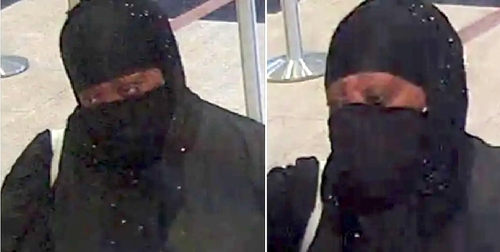 The Wells Fargo thief. |
19-year-old boy harasses girls: Fulfilling the male teenage fantasy of approaching girls with their defenses down, Mohammad Sohail of Najibabad, India, had the bright idea of donning a burqa, "roaming around an educational institute," and sitting "beside girls in buses to molest them" (according to a local news report). Some of his victims complained, the police caught him, and to their shock found a male under the burqa. (March 13, 2022)
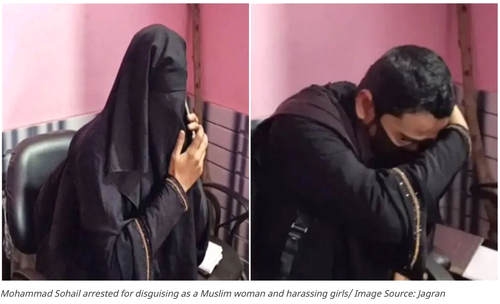 Mohammad Sohail in burqa and revealed. |
Book and response: Raphael Cohen-Almagor responded to this blog in his book, The Republic, Secularism and Security: France versus the Burqa and the Niqab. And I replied to him at "The Case for Banning Burqas and Niqabs." (April 23, 2022)
Liquor store: A burqa-wearing jihadi dropped a bomb through a porthole window at a newly-opened liquor store in Srinagar, India, injuring three employees and killing one. (May 17, 2022)
Grocery store: A woman in full Islamic robe but with her face showing was caught stealing a large stock of items from as Asda store in the United Kingdom. The video of her debauching the loot ends with her pulling up her clothing, revealing her legs and underwear. (January 9, 2024)
Grocery store: Coincidence? Another woman in full Islamic robe was caught stealing food, this time chocolate bars from a Lidl store in the United Kingdom. (January 13, 2024)
"Face Masks Are Now Against the Law in Parts of Long Island": Ironically, though, it's not about burqas and niqabs but about anti-Israel keffiyehs. (August 14, 2024)
"Ban Face Masks: Our Safety Requires It" writes Phyllis Chesler. (August 31, 2024)
"Labour now has no choice but to ban the burka": Michael Deacon, a columnist for the Daily Telegraph (London) argues that the implementation of facial recognition technology to help catch criminals on police watchlists in the United Kingdom requires the banning of burqas. Because there is no chance of that happening, Deacon concludes that "the facial recognition technology is almost certainly pointless."


