
It has become increasingly clear that the establishment of diplomatic relations with Israel by Arab states with Jerusalem does not equate to accepting Zionism, which is to say, accepting that Israel is a state created by Jews as a homeland for Jews. This weblog entry pursues that theme, focusing on two topics: Israeli insistence on being recognized as the Jewish state and Arab responses to this demand.
I have written several articles on this topic:
- "Accept Israel as the Jewish State?" Jerusalem Post, Nov. 29, 2007.
- "Accepting Israel as the Jewish State[: Public Opinion in Four Arab Countries]," National Review Online, May 11, 2010
- "Obama to Palestinians: Accept the Jewish State," Washington Times, March 26, 2013.
This long weblog entry has several parts:
I: A review of the idea of the Jewish state in key historical documents, 1896-1948
II: Contradictory documents from Yasir Arafat, 1964-2004
III: George W. Bush, Sharon, and Olmert, 2003-08
IV: Obama, Netanyahu, and Abbas, Round One, 2008-12
V: Obama, Netanyahu, and Abbas, Round Two, 2013-14
VI: Netanyahu submits a the Jewish state as a Basic Law
Part I: A review of the idea of the Jewish state in key historical documents, 1896-1948:
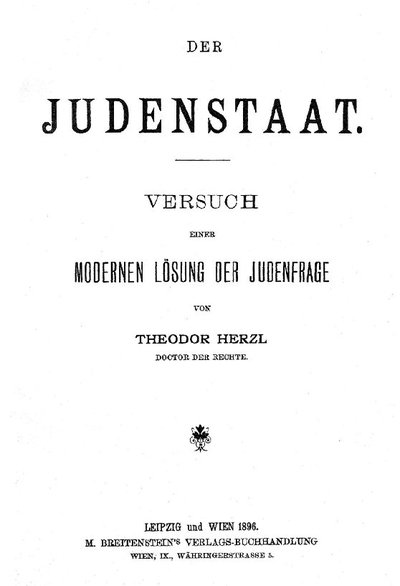
1896: Theodor Herzl's publication of Der Judenstaat ("The Jewish State") is widely considered the foundational event of modern Zionism.
1917: The British government adopted the Zionist goal when the Balfour Declaration which views with favor the creation of "a national home for the Jewish people."
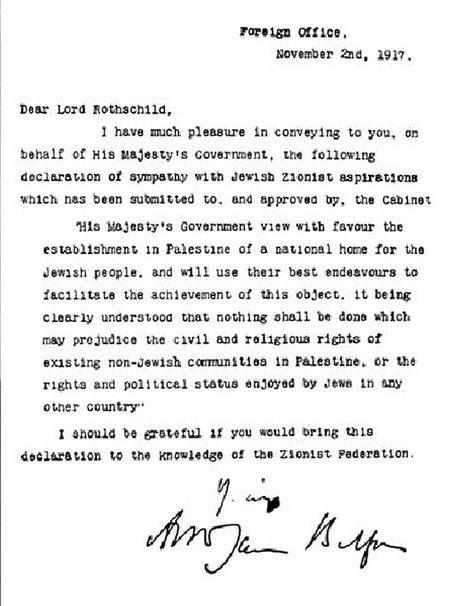 The Balfour Declaration. |
Feb. 1920: Winston Churchill: "there should be created in our own lifetime by the banks of the Jordan a Jewish State."
Apr. 1920: The governments of Britain, France, Italy, and Japan endorsed the British mandate for Palestine and also the Balfour Declaration at the San Remo conference:
The Mandatory will be responsible for putting into effect the declaration originally made on November 8, 1917, by the British Government, and adopted by the other Allied Powers, in favour of the establishment in Palestine of a national home for the Jewish people.
July 1922: The League of Nations further confirmed the British Mandate and the Balfour Declaration.
1937: Lloyd George, British prime minister when the Balfour Declaration was issued, clarified that its purpose was the establishment of a Jewish state:
it was contemplated that, when the time arrived for according representative institutions to Palestine, if the Jews had meanwhile responded to the opportunities afforded them ... by the idea of a national home, and had become a definite majority of the inhabitants, then Palestine would thus become a Jewish commonwealth.
July 1937: The Peel Commission:
1. "if the experiment of establishing a Jewish National Home succeeded and a sufficient number of Jews went to Palestine, the National Home might develop in course of time into a Jewish State."
2. The Commission recommended the partition of Mandatory Palestine in part because "Partition enables the Jews in the fullest sense to call their National Home their own; for it converts it into a Jewish State."
June 1939: Jan Smuts, a member of the Imperial War Cabinet when the Balfour Declaration was published, said of Palestine that he could see "in generations to come a great Jewish state rising there once more."
May 11, 1942: The Extraordinary Zionist Conference held at the Biltmore Hotel in New York City issued an influential joint statement known as the Biltmore Program. It went beyond prior circumlocutions to demand that "Palestine be established as a Jewish Commonwealth."
Nov. 29, 1947: U.N. General Assembly resolution 181, the one partitioning the British Mandate of Palestine into two, uses the term Jewish state 27 times in its text and 3 times in the footnotes. For example:
Independent Arab and Jewish States and the Special International Regime for the City of Jerusalem, set forth in Part III of this Plan, shall come into existence in Palestine two months after the evacuation of the armed forces of the mandatory Power has been completed but in any case not later than 1 October 1948.
Note that the other part of Palestine was to become an "Arab State" - not a Muslim state. Thus did the Israel's founding document divide the territory into the followers of a religion and speakers of a language.
Also in 1947: Ernest Bevin, UK foreign secretary stated that, "For the Jews, the essential point of principle is the creation of a sovereign Jewish state."
May 14, 1948: (1)The Declaration of the Establishment of the State of Israel mentions Jewish state 5 times, most importantly in the operational passage "we ... hereby declare the establishment of a Jewish state in Eretz-Israel, to be known as the State of Israel." (By way of background, proposed names for the new state included Jewish State, Zion, Judea, Yehuda, Ever (from "Ivri" or Hebrew), Land of Israel, and Israel; but Ben-Gurion favored Israel and that carried the day.)
(2) President Harry Truman had decided to recognize the Jewish State and requested a formal request for recognition of statehood. Because the name of this state had, just hours before the declaration of independence, not yet been decided ("Judea" and "Zion" were possibilities), the representative of the Jewish Agency in the United States, Eliahu Epstein, submitted the request to Truman without mentioning the new polity's name, using instead the United Nations' name for this territory, the "Jewish State":
I have the honor to notify you that the Jewish State has been proclaimed as an independent republic ... and that a provisional government has been charged to assume the rights and duties of government for preserving law and order within the boundaries of the Jewish State, for defending the state against external aggression, and for discharging the obligations of the Jewish State to the other nations of the world in accordance with international law. ... I have been authorized to by the provisional government of the new state to tender this message and to express the hope that your government will recognize and will welcome the Jewish State into the community of nations.
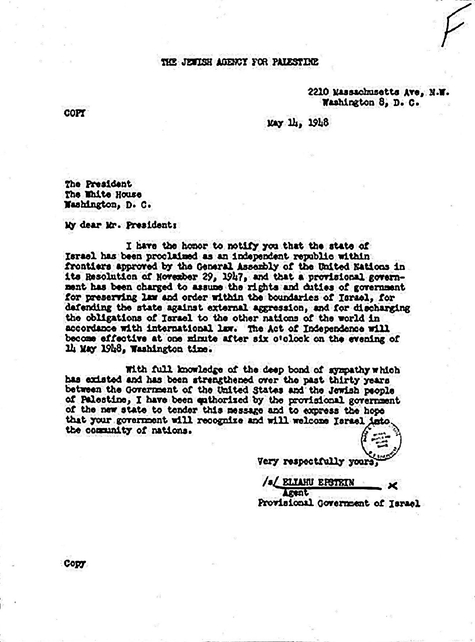
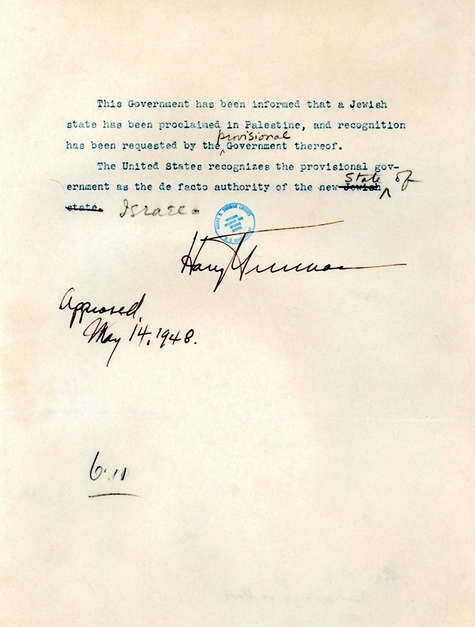
(3) The typed document prepared for Truman used the dummy "Jewish state" term – which the president, who had heard the new state's name by then, proceeded to scratch out in favor of Israel.
This Government has been informed that a Jewish state has been proclaimed in Palestine, and recognition has been requested by the provisional Government thereof. The United States recognizes the provision government as the de facto authority of the new State of Israel.
Comments: (1) Israel's being a "Jewish state" is not just a recent whim but the legal reason for this polity coming into existence. It has become contentious lately because Israel's enemies have figured they can accept Israel but really mean by it Palestine. So the Israelis have added the Jewish state element as part of the mix.
(2) Until about 2006, the concept of Jewish state was discussed mainly among thinkers about the nature of Israel and how it lives up to Jewish ideals. For example, see two essays by Daniel J. Elazar, "Israel as a Jewish State" (1990) and "Jewish Values in the Jewish State" (1996).
Part II: Contradictory documents from Yasir Arafat, 1964-2004:
1964: The Palestine National Charter (also known as the PLO Covenant), Article 20 attempts totally to negate the above:
The Balfour Declaration, the Palestine Mandate, and everything that has been based on them, are deemed null and void. Claims of historical or religious ties of Jews with Palestine are incompatible with the facts of history and the conception of what constitutes statehood. Judaism, being a religion, is not an independent nationality. Nor do Jews constitute a single nation with an identity of their own; they are citizens of the states to which they belong.
While Arafat in the 1990s made a feint toward rescinding this document, it remains in effect so. Indeed, this article represents a major stumbling block to the acceptance of Israel as a Jewish state.
Nov. 15, 1988: In his declaration of a Palestinian state, Yasir Arafat mentioned "UN General Assembly Resolution 181 (1947), which partitioned Palestine into two states, one Arab, one Jewish."
Dec. 8, 1988: Yasir Arafat clarified that declaration of a Palestinian state, saying that "We accept two states, the Palestine state and the Jewish state of Israel."
Mar. 7 and 25, 2003: The so-called "Constitution of the State of Palestine," third draft, dated March 7, 2003, and revised on March 25, 2003, contains two paragraphs of note:
Article 2. Palestine is part of the Arab nation. The state of Palestine abides by the charter of the League of Arab States. The Palestinian people are part of the Arab and Islamic nations. Arab unity is a goal, the Palestinian people hopes to achieve.
Article 5. Arabic and Islam are the official Palestinian language and religion. Christianity and all other monotheistic religions shall be equally revered and respected. The Constitution guarantees equality in rights and duties to all citizens irrespective of their religious belief.
Comment: So, Israel is not be a Jewish state but "Palestine" is a Muslim state? Not only is that inconsistent, but it contradicts the 1947 U.N. partition resolution.
June 18, 2004: Yasir Arafat told Ha'aretz in an interview that he "definitely" understands that Israel must preserve its character as a Jewish state.
Ha'aretz: You understand that Israel has to keep being a Jewish state?
Yasir Arafat: "Definitely."
Ha'aretz: Definitely.
Yasir Arafat: "Definitely, I told them we had accepted openly and officially in '88 in our PNC ..."
Part III: George W. Bush, Sharon, and Olmert, 2003-08:
1985: An amendment to Israel's Basic Law excludes from the parliament anyone who negates "the existence of the State of Israel as a Jewish and democratic state."
May 25, 2003: The Government of Israel headed by Ariel Sharon appended 14 reservations in the course of accepting George W. Bush's proposed Road Map on May 25. No. 6 was:
In connection to both the introductory statements and the final settlement, declared references must be made to Israel's right to exist as a Jewish state and to the waiver of any right of return for Palestinian refugees to the State of Israel.
Dec. 1, 2003: "The Geneva Accord: A Model Israeli-Palestinian Peace Agreement" primarily prepared by Yossi Beilin representing Israel and Yasser Abed Rabbo for the Palestinians, states that "The parties recognize Palestine and Israel as the homelands of their respective peoples."
Mar. 15, 2007: Henri Lowi, a "Not In My Name" speaker explained to a Toronto audience "Why Israeli Anti-Zionists do NOT "recognize the right of the State of Israel to exist as a Jewish state":
we have had our fill of states whose raison d'etre is to preserve ethnic superiority and domination. One does not have to refer to the late unlamented "Aryan state". Within recent memory, we had white-supremacist Rhodesia and apartheid South Africa. Whatever limits there are to analogies from and to these white supremacist regimes, we have learned that states that define themselves with reference to the domination of one ethnic group cannot claim legitimacy.
Apr. 13, 2007: A telephone poll of a representative sample of adult Israeli Jews asks this question:
Recently a law was proposed according to which every candidate for the Knesset must commit that he recognizes the existence of the State of Israel as a Jewish State. Are you for or against the proposed law?
In reply, 72 percent favored the law, and 18 percent were against it. The poll has a statistical error of +/- 4.4, was carried out by Teleseker, and published in Ma'ariv. Comment: Such numbers provide an important political basis for the Government of Israel taking up this matter.
Nov. 11, 2007: In a path-breaking announcement, Israeli prime minister Ehud Olmert announced that the forthcoming Annapolis talks would not proceed unless the Palestinians recognize Israel as a Jewish state: "I do not intend to compromise in any way over the issue of the Jewish state. This will be a condition for our recognition of a Palestinian state."
Nov. 12, 2007: Olmert reiterated these points a day later, describing the "recognition of Israel as a state for the Jewish people" as the "launching point for all negotiations. We won't have an argument with anyone in the world over the fact that Israel is a state of the Jewish people." The Palestinian leadership, he noted, must "want to make peace with Israel as a Jewish state."
Nov. 13, 2007: (1) The Palestinian leadership has responded quickly and unequivocally to Olmert's demand:
- The Higher Arab Monitoring Committee in Nazareth unanimously called on the Palestinian Authority not to recognize Israel as a Jewish state.
- Salam Fayad, Palestinian Authority "prime minister": "Israel can define itself as it likes, but the Palestinians will not recognize it as a Jewish state."
- Yasser Abed Rabbo, secretary general of the Palestinian Liberation Organization's executive committee: "This issue is not on the table; it is raised for internal [Israeli] consumption."
- Ahmad Qurei, chief Palestinian negotiator: "This [demand] is absolutely refused."
- Saeb Erekat, head of the PLO Negotiations Department: "The Palestinians will never acknowledge Israel's Jewish identity. ... There is no country in the world where religious and national identities are intertwined."
(2) According to the so-called Palestine Papers, a data dump published by Al Jazeera of leaked documents internal Palestinian Authority notes from a decade of negotiations with Israel, Tzipi Livni demanded recognition of the Jewish state on behalf of the Ehud Olmert government. She declared that the goal of negotiations is
Each state constituting the homeland for its people and the fulfillment of their national aspirations and self determination in their own territory. Israel the state of the Jewish people – and I would like to emphasize the meaning of "its people" is the Jewish people – with Jerusalem the united and undivided capital of Israel and of the Jewish people for 3007 years... The whole idea of the conflict is ... the establishment of the Jewish state. ... Even having a Jewish state – it doesn?t say anything about your demands. ... Without it, why should we create a Palestinian state? ... the ultimate goal is constituting the homeland for the Jewish people and the Palestinian people respectively, and the fulfillment of their national aspirations and self determination in their own territory.
(3) Also according to Al-Jazeera, the Palestinian Negotiations Support Unit sent a memorandum with "preliminary advice" to the negotiators under the title "Precondition of Recognizing Israel as a 'Jewish State'," in which it listed the implications of the term and advised them to reject the demand. It begins by noting the novelty of this demand:
The recognition of Israel as a "Jewish state" was never a precondition to any of the previous negotiations between the parties. All agreements signed between the PLO and Israel thus far did not include such reference and the recognition of Israel as a "Jewish state" was never accepted as a precondition to signing those agreements.
The memo then lists implications, to which I have added numbers:
(1) recognition of Israel as a "Jewish State" would in fact negate the right of return for Palestinian refugees, in principle and practice prior to agreement following negotiations.
(2) recognizing Israel as a Jewish State without having agreed that borders of that state, would strengthen the Zionist movement argument that Jewish have a right of self determination over all of historic Palestine, including Jerusalem and its holy sites.
(3) Recognizing Israel as a "Jewish State" would be an explicit recognition of Israel's demographic objections to the right of return. This would make it legally and practically harder to insist on recognition in principle for the right of return and negotiating the implementation of that right with Israel.
(4) Recognizing Israel as a "Jewish State" would amount to recognition of an inherently discriminatory characterization of the state of Israel against its Palestinian population, which constitutes approximately 20% of the population, and other non-Jewish populations in Israel, unless that recognition is accompanied by agreement on what it means to be Jewish.
(5) As a matter of international law, the characterization of the state of Israel is an internal matter. From the point of international law and treaty law suffice it to say that Israel, in an agreed border, will be recognized as a sovereign state.
The memo then goes on to make the curious point that
Israel was accepted to the UN as a state and not a Jewish state just like China was admitted to the UN as state and not a communist state and just like Egypt is a member of the UN as a state and not a Muslim state.
In fact, as noted above, the United Nations resolution mentions Jewish state thirty times. At that moment, the Zionist movement had not yet settled on a name for the Jewish state, so this analysis is topsy-turvy. The memo anticipates this factual correction and offers a tortured argument in response:
As regards to the argument that the UN partition plan (UNGA RES 181) envisaged a Jewish state and an Arab state, that resolution should be read in its entirety and in light of its own rational. Namely, the partition plan did not allow for population transfer and drew a boundary based on demographic considerations that is markedly different as a border than what is being discussed today.
The memo concludes:
For all of the above reasons, it is advised not to recognize Israel as a Jewish state. Any treaty or agreement should, if at all, recognize Israel as a state. If Israel insists then, a fall back position could be developed. For instance, it may be possible to recognize Israel as a state for its peoples or alternatively Israel as the realization of the right of self determination of the Israeli people. Other alternative language would be to base recognition of the Jewish character of Israel in line with Resolution 181 with all of its parts. These alternatives can be further developed upon request. It is important not to define the Israeli people by religious or other terms.
Nov. 16, 2007: A follow-up memo from the NSU, "Talking Points on Recognition of Jewish State," offers a "Recommended Approach" to this topic:
We recommend that the Palestinian negotiators maintain their position not to recognize or otherwise characterize the state of Israel as "Jewish". Any recognition of Israel within a treaty or agreement should be limited to recognizing it as a sovereign state. It should not recognize Israel as a "Jewish state", "state for the Jewish people", "homeland for the Jewish people" or any similar characterization. (Footnote: There are other formulations for recognition that may be less damaging to Palestinians interests. The NSU can provide such language in the event that the Palestinian team decides to engage on the matter.)
In response to Israeli demands for recognition of Israel as a Jewish state and/or as a state of the Jewish people, the Palestinian negotiations team should refuse to engage on the issue and assert that the traditional terms of reference of the peace process and existing agreements serve as the basis of peace. These terms of reference and agreements do not contemplate Palestinian recognition of Israel as a Jewish state as a basis for peace or at all. They are based on the model of two sovereign states living side-by-side in peace and security and a just settlement of the refugee issue (Resolution 242, 338, [194] and Road Map). In addition, the Jewish state as currently constituted formally discriminates against the non-Jewish population. Palestinians cannot recognize a situation which violates basic norms of international law.
If Israel insists on recognition of the demographic character of its state, then the Palestinian team may insist that the whole status of Mandate Palestine should be opened for discussion because the demand to base the agreement on two ethnically-defined national entities subverts the traditional terms of reference. The Israeli approach is closer to Resolution 181, which called for the partition of Palestine into two national units.
The memo then provides talking points that set out arguments for refusing to recognize the Jewish state. Some of them:
- At the start of the process, both parties agreed that there would be no preconditions imposed by either of the parties prior to negotiations. The recognition of Israel as a "Jewish state" was never a part of any of the previous negotiations between the parties. Continuing to insist on it now will be seen as imposing yet another obstacle to peace.
- Israel is globally recognized, including by the PLO, as a sovereign state. Your statehood is not in doubt. It is our statehood and the end of occupation and conflict that need to be resolved in our talks.
- No peace treaty concluded with Israel characterizes the state as "Jewish".
- There is no state practice of recognizing the demographic character of states. What you are asking for is out of line with how states behave.
- The US, and other states, recognized the State of Israel, not the Jewish State.
- Defining Israel as a Jewish state is exclusionist and means that Jewish citizens of Israel and Jews world wide which are not even citizens in Israel are entitled to privileges that are denied to non-Jewish citizens, including the indigenous Palestinian population (e.g., land ownership and access).
- Who is defined as a "Jew" in Israel has been the subject of fierce debate inside Israel since its inception. This debate is not only limited to Palestinian citizens of Israel but includes other non-Jewish groups. There is also a debate between secular and orthodox Jews as to what this definition actually entails. We do not want to enter into this debate.
- The proposed approach of two national homelands would take us back to Resolution 181. 181 drew a boundary talking into account demographic considerations (e.g., where the majority of Jews were residing in the country) that is markedly different than the border that is being contemplated today. If Israel wishes to revisit this issue, then the status of Historic Palestine as a whole will have to be renegotiated.
Nov. 29, 2007: (1) I discuss this issue's new prominence today, on the 60th anniversary of the U.N. partition resolution, in a column titled "Accept Israel as the Jewish State?"
(2) Benjamin Netanyahu, Israel's opposition leader, commemorated 60 years since the passage on November 29, 1947, of the United Nations resolution recognizing a Jewish state. He discussed Arab reluctance to accept Israel: "Since [1947], we have made peace with Egypt and Jordan, but the obstacle to widening the circle of peace remains what it has always been: the refusal of Israel's enemies to recognize the Jewish State in any borders. Our enemies do not want an Arab state next to Israel. They want an Arab state instead of Israel."
Dec. 1, 2007: Mahmoud Abbas added his voice to those who reject Israel as a Jewish state.
From a historical perspective, there are two states: Israel and Palestine. In Israel, there are Jews and others living there. This we are willing to recognize, nothing else.
Comment: Abbas appears willing to recognize that there is a state called Israel that includes Jews in its population, but insists that its nature is undefined.
Dec. 13, 2007: (1) Ha'aretz today published details of a 26-page document dating from February 2001,signed by Gilad Sher, bureau chief to then prime minister Ehud Barak, titled, "The Status of the Diplomatic Process with the Palestinians Points to Update the Incoming Prime Minister." As this heading implies, it reviewed the negotiations so that Ariel Sharon would know the state of play on taking office.
Among the differences between the two parties was this: "a disagreement among the Palestinians with regard to formal recognition of the State of Israel as a Jewish state."
Comment: This document reminds us that the Jewish state issue did not appear out of nowhere in 2007.
(2) Kenneth W. Stein of Emory University provides some context for the current debate in "Annapolis: Precedents and Transactions, But No Transformations":
For years it was widely held that Sadat's November 1977 visit to Jerusalem broke the psychological barrier between the Arab and Israeli peoples. Having the leader of the most populous Arab state stand before the Israeli parliament in front of a picture of Theodore Herzl and proclaim that "the October War will be the last war" was indeed unprecedented. But neither Sadat, nor American diplomats and Arab leaders undertook to alter basic Arab attitudes toward Israel. In the peace treaties which Israel signed with both Egypt (1979) and Jordan (1994), there is no mention of recognition of Israel as a Jewish state.
At Annapolis, by contrast, US President George W. Bush publicly emphasized that the "US would maintain its commitment to the security of Israel as a Jewish state,... [and] to Israel as a homeland for the Jewish people." Similarly Israeli Prime Minister Ehud Olmert declared that the negotiations should conclude with "two states for two peoples, a peace-seeking Palestinian state, a viable, strong, democratic and terror-free state for the Palestinian people; and the state of Israel, Jewish and democratic, living in security and free from the threat of terrorism, the national home of the Jewish people. "
By contrast, at both Annapolis and the subsequent donor's conference, Chairman of the PLO and President of the Palestinian Authority Mahmud Abbas shied away from making a similar statement. Instead, he focused on the Palestinian core demands, achieving "freedom, independence, getting rid of the occupation, establishing the state of independent Palestine within the 1967 borders and guaranteeing the rights of our people's refugees in accordance with resolution 194." To be sure, he categorized Annapolis as "a turning point in a very dangerous and old conflict." However, saying that Annapolis was a turning point and making it so are light years apart.
On November 29, 2007, exactly sixty years after the UN voted to partition Palestine into Arab and Jewish states, the Saudi Arabian paper al-Watan noted that the "Jewishness of the state of Israel will in fact provide the fuel for an eternal conflict between the Arabs and Moslems on the one hand, and the state of Israel on the other."
For many in the Arab and Moslem world and elsewhere, when Israel is recognized as a Jewish state, then Palestinians will no longer sustain the dream of living in portions of what was Israel prior to the 1967 June war. Recognizing Israel as a Jewish state would mean surrendering a core element in Palestinian national identity; it would mean essentially ending the Arab-Israeli conflict without a complete victory by the Arab side. It would mark an underlying and fundamental transformation, one that has obviously not yet occurred. Hamas refuses unequivocally to abandon that core element. Similarly, Abbas endorses the core. Unlike Hamas but like Sadat, at least thus far, Abbas believes that he can recognize Israel's legitimacy without accepting its Jewish essence.
 Latin Patriarch Michel Sabbah. |
Jan. 1, 2008: (1) Ehud Omert, Israel's prime minister, replied thus when asked about the views of Mahmoud Abbas on Israel being the Jewish state:
My impression is that he wants peace with Israel, and accepts Israel as Israel defines itself. If you ask him to say that he sees Israel as a Jewish state, he will not say that. But if you ask me whether in his soul he accepts Israel, as Israel defines itself, I think he does. That is not insignificant. It is perhaps not enough, but it is not insignificant.
To remind, a month earlier Abbas publicly had this to say on the subject: "From a historical perspective, there are two states: Israel and Palestine. In Israel, there are Jews and others living there. This we are willing to recognize, nothing else."
Comment: Olmert clearly knows more than we on the outside about the way Abbas thinks, so I defer to him there. But, that hardly matters for, as I wrote back in 1993 (in "Both Sides of Their Mouths[: Arab Leaders' Private vs. Public Statements]"), "Public pronouncements count more than confidential revelations." Here's why:
they predict [an Arab politician's] actions better than private communications. Murmurings from his ear to yours might well reflect a politician's personal views, but the rhetoric is more operational. ... Were the views expressed in tête-à-têtes with Western officials operational, the Arab-Israeli conflict would have been resolved long ago.
This pattern, by the way, has an interesting implication:
Insiders attach great value to exclusive and confidential one-to-one conversations with leaders. To understand Middle East politics, however, one is better off reading newspapers and listening to radio broadcasts than talking to politicians in private. Privileged information tends to mislead; what the masses hear counts. This rule of thumb helps explain why distant observers more often get the point than do on-the-spot diplomats and journalists.
Abbas and Olmert provide a textbook example of this phenomenon.
(2) Sari Nusseibeh, professor of philosophy at Al-Quds University in Jerusalem (and someone I knew as a graduate student in the 1970s) has sent a letter to a number of people, including myself, in which he offers his views on accepting Israel as the Jewish state:
My view, which goes along with the Ayalon-Nusseibeh document ... is that (1) we already recognized Israel as a Jewish State by recognizing UN Resolution 181 [of November 29, 1947, the one that created Israel]; and, (2) that whether Israel is Jewish (or Martian) is not/should not be an issue for us: what is and should be an issue (for us) is whether Arab minority rights (culturally and individually) would be safeguarded in the State which we are being asked formally to recognize.
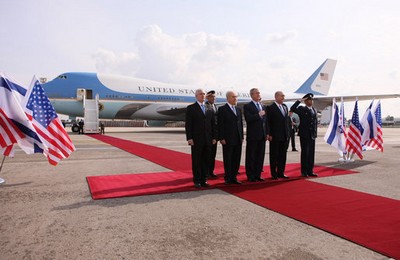 George W. Bush on arrival at Ben-Gurion International Airport in Tel Aviv. |
The United States and Israel are strong allies. The source of that strength is a shared belief in the power of human freedom. Our people have built two great democracies under difficult circumstances. We built free economies to unleash the potential of our people. And the alliance between our two nations helps guarantee Israel's security as a Jewish state.
As the Associated Press's White House reporter, Terence Hunt, noted: "Bush has referred to Israel as a Jewish state in the past but the reference—here in the region—had special significance." It also has special significance given the Palestinian rejection of this term over the past two months.
Feb. 28, 2008: Mahmood Abbas reiterated his unwillingness to recognize Israel as a Jewish state in an interview yesterday in Ad-Dustur, as translated by Palestinian Media Watch:
The Palestinian President emphasized his rejection of what is described as the Jewishness of the state [of Israel], and said: "We rejected this proposal at the Annapolis conference last November in the USA, and the conference was almost aborted because of it."
Part IV: Obama, Netanyahu, and Abbas, Round One, 2008-12
May 12, 2008: Democratic presidential candidate Barack Obama told an interviewer that
the idea of a secure Jewish state is a fundamentally just idea, and a necessary idea, given not only world history but the active existence of anti-Semitism, the potential vulnerability that the Jewish people could still experience. ...
the fundamental premise of Israel and the need to preserve a Jewish state that is secure is, I think, a just idea and one that should be supported here in the United States and around the world.
Apr. 16, 2009: Olmert's gone and Binyamin Netanyahu, his successor as Israeli prime minister, is raising the issue anew, telling U.S. envoy George Mitchell today Palestinian recognition of Israel as a Jewish state must precede negotiations over a Palestinian state. An unnamed "senior official in Netanyahu's office" quoted the prime minister telling Mitchell that "Israel expects the Palestinians to first recognize Israel as a Jewish state before talking about two states for two peoples." A second unnamed Israeli official said Netanyahu sees Palestinian acceptance of Israel as a Jewish state as "a crucial element in moving forward with the political dialogue."
Apr. 17, 2009: Responding to Netanyahu, Palestinian Authority spokesman Nabil Abu Rudaineh called his words a "provocation" that could have a "poisonous effect" on the region and accused the new Israeli government of placing obstacles before the two-state solution.
Apr. 19, 2009: (1) The demand for recognition of Israel as a Jewish state is, apparently, rejected by George Mitchell, the U.S. envoy. So writes Akiva Eldar in a Ha'aretz article, "U.S.: Palestinians need not recognize Israel as Jewish state before talks."
Prime Minister Benjamin Netanyahu's demand that the Palestinians recognize Israel as the state of the Jewish people as a condition for renewing peace talks is unacceptable to the United States, the State Department said during special envoy George Mitchell's visits over the weekend to Ramallah and Cairo.
(2) Eldar also reports that
Defense Minister and Labor Party leader Ehud Barak has not spoken publicly on the issue, his associates said Saturday he is obligated to the party platform, which supports the establishment of a Palestinian state. The platform does not mention Palestinian recognition of Israel as the state of the Jewish people as a precondition for establishing a Palestinian state.
(3) The Intelligence and Terrorism Information Center at the Israel Intelligence Heritage & Commemoration Center published today a survey of Palestinian responses, past and present, to the Israeli demand that the state's Jewish nature be recognized. For example, Saeb Erekat, chief PLO negotiator, said on April 16 that "what Netanyahu is demanding now – that we recognize Israel 's religious background – is unacceptable."
Apr. 20, 2009: The Israeli prime minister's media advisor issued this statement today:
Prime Minister Benjamin Netanyahu is insistent in his approach that recognition of Israel as the national state of the Jewish people is a matter of substance and principle that enjoys wide recognition in the country and around the world, without which it will not be possible to advance the diplomatic process and reach a peace settlement. However, the Prime Minister has never set this as a pre-condition for the opening of negotiations and dialogue with the Palestinians.
Comment: A true correction or a backtracking? If the former, the Ha'aretz story that opened this subject on April 16 was wrong; if the latter, it appears Netanyahu is playing both sides of the issue.
Later in the day, Netanyahu made this statement to his cabinet:
We insist that the Palestinians - in any diplomatic settlement with us - will recognize the State of Israel as the national state of the Jewish people. ... there is no doubt that we are being asked to recognize the Palestinian state as the national state for the Palestinian people but there is doubt and not just doubt, it is clear from the quick check that we carried out that the Palestinians have no intention of recognizing the national state of the Jewish People. Of course, this is completely unacceptable. ... there is no doubt that we insist that they recognize the State of Israel as the national state of the Jewish People. We have never conditioned the start and existence of talks on advance agreement about this but neither can we see progress on a future settlement without their agreement to this condition. Therefore, not only have we not backtracked from it, we stand behind it strongly and I think that in this regard, we reflect a very broad consensus, not only around this table but among the entire nation, a great part of the nation, and rightly so.
Apr. 27, 2009: Israel's foreign ministry weighed in today with a statement on this subject that does not address the question of when the Jewish nature of Israel needs to be recognized:
The recognition of Israel as the sovereign state of the Jewish people is an essential and necessary step in the historic process of reconciliation between Israel and the Palestinians. The more the Palestinians assimilate this fundamental and substantive fact, the sooner the peace between the two nations will progress toward fruition.
May 4, 2009: Mahmoud Abbas, the head of the Palestinian Authority, puts his views just as bluntly, also on April 27:
The "Jewish state." What is a "Jewish state?" We call it the "State of Israel." You can call yourselves whatever you want. But I will not accept it. And I say this on a live broadcast. ... It's not my job to define it, to provide a definition for the state and what it contains. You can call yourselves the Zionist Republic, the Hebrew, the National, the Socialist [Republic] call it whatever you like. I don't care.
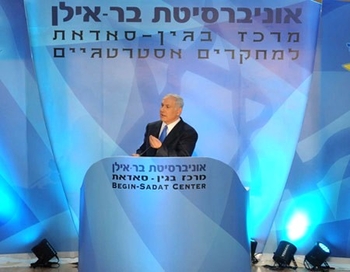 Israeli prime minister Binyamin Netanyahu at Bar-Ilan University on June14, 2009. |
June 14, 2009: Netanyahu gave a major speech today, for the first time accepting the two-state solution (a Palestinian state along side an Israeli one). In return, he made several demands, pre-eminent among them being Palestinian recognition of Israel as the Jewish state. First, he set up the background:
In 1947, when the United Nations proposed the partition plan of a Jewish state and an Arab state, the entire Arab world rejected the resolution. The Jewish community, by contrast, welcomed it by dancing and rejoicing. The Arabs rejected any Jewish state, in any borders.
Then, to the present:
Territorial withdrawals have not lessened the hatred, and to our regret, Palestinian moderates are not yet ready to say the simple words: Israel is the nation-state of the Jewish people, and it will stay that way.
Achieving peace will require courage and candor from both sides, and not only from the Israeli side. The Palestinian leadership must arise and say: "Enough of this conflict. We recognize the right of the Jewish people to a state of their own in this land, and we are prepared to live beside you in true peace."
I am yearning for that moment, for when Palestinian leaders say those words to our people and to their people, then a path will be opened to resolving all the problems between our peoples, no matter how complex they may be. Therefore, a fundamental prerequisite for ending the conflict is a public, binding and unequivocal Palestinian recognition of Israel as the nation state of the Jewish people. To vest this declaration with practical meaning, there must also be a clear understanding that the Palestinian refugee problem will be resolved outside Israel's borders. For it is clear that any demand for resettling Palestinian refugees within Israel undermines Israel's continued existence as the state of the Jewish people. ...
our right to build our sovereign state here, in the land of Israel, arises from one simple fact: this is the homeland of the Jewish people, this is where our identity was forged. ... Palestinians must clearly and unambiguously recognize Israel as the state of the Jewish people.
He concludes:
If we receive this guarantee regarding demilitirization and Israel's security needs, and if the Palestinians recognize Israel as the State of the Jewish people, then we will be ready in a future peace agreement to reach a solution where a demilitarized Palestinian state exists alongside the Jewish state.
July 5, 2009: For discussion of a parallel topic, see my weblog, "Salam Fayyad Says Yes to Jews Living in a Palestinian State."
July 28, 2009: In an article titled "A Jewish and Non-Legitimate State." Mordechai Kedar concludes today that
Recognition of Israel as a legitimate Jewish nation-state has no hope or chance as long as Islam perceives itself – and itself alone – as "the true religion with Allah."
Aug. 10, 2009: The political editor of WAFA, the official Palestinian Authority news agency, published an article on July 27 (and reported by Palestinian Media Watch today) arguing that a Jewish state threatens all of humanity. Excerpts:
The Jewish State, or People, or Land is a synonym of the black nightmare of Racism. ... The Jewish State is clear in its objectives, even implementation and application. It means eliminating 20 per cent of the Jewish entity's citizens; Arabs and Palestinians. It probably means forcing them out; transferring them. ...
A Jewish state endangers not only Palestinians, but also the Arab World, and the global security. It is a call for legitimizing a racist entity, built on pure ethnic and theocratic criteria. They apparently think that they are a race, and they want a racist state!
All of this doesn't end with the Palestinian issue; it becomes a general [international] matter, which raises the question: Will the present international system, with its modernity and development, and after banishing the racist entities, allow the development of a theocratic regime, successor of racist regimes that have disappeared, where anyone who does not recognize it cannot live there?"
Aug. 11, 2009: The Sixth General Assembly of the Fatah Movement, meeting in Bethlehem: "There must be absolute opposition, from which there will be no withdrawal, to recognizing Israel as a 'Jewish state' in order to protect the refugees' rights and the rights of our people on the other side of the Green Line."
Aug. 18, 2009: "Did Netanyahu drop demand for recognition of Israel as 'Jewish state'?" asks Akiva Eldar in Ha'aretz and the answer is unclear. He begins by noting the absence of mention of "the Jewish people" in an important statement by Binyamin Netanyahu on August 16. Promising not to repeat Ariel Sharon's mistake of unilateral withdrawal in 2005, Eldar recounts, Netanyahu said
his government would strive to arrive at bilateral agreements that will include two basic elements that were missing in the case of the evacuation of Gaza. In second place: "Security arrangements, the honoring and enforcement of which will be ensured." And in first place: "The genuine recognition of the state of Israel." And thereafter: "If there is a turn towards peace by the more moderate Palestinians, we will insist on the following components: Recognition and genuine demilitarization will find expression in, and be integral parts of, the peace arrangements."
"Genuine recognition of the state of Israel?" Check. "Recognition and genuine demilitarization?" Check. "The state of the Jewish people?" Nope. This is also documented in the spokesman's statement on the prime minister's bureau Web site.
Nir Hefetz, Netanyahu's media advisor, says that no special significance should be attributed to the fact that "the Jewish people" is absent from the prime minister's remarks. The boss is continuing to insist that the Palestinians recognize Israel as the state of the Jewish people. His heart filled with sorrow when it it was brought to his attention that the matter was missing from his remarks at the government meeting.
However, "the Jewish people" may not have simply slipped the prime minister's mind for no reason. Foreign diplomats have reported to their capitals that people in the prime minister's bureau had phoned some of their colleagues to draw their attention to the striking absence from the statement. Leaders in those capitals, among them U.S. President Barack Obama, were able to note that Netanyahu had removed one of the major stumbling blocks in the path to negotiations in the Israeli-Palestinian track.
Sep. 8, 2009: Mahmoud Abbas has reiterated his rejection of Palestinian recognition of Israel as a Jewish state. "We're not talking about a Jewish state and we won't talk about one. For us, there is the state of Israel and we won't recognize Israel as a Jewish state. I told them that this is their business and that they are free to call themselves whatever they want. But [I told them] you can't expect us to accept this." Abbas added that raising this issue amounts to "stripping" Israeli-Arabs of their rights and turn them into illegal citizens.
Sep. 23, 2009: Addressing the United Nations today, Barack Obama called for the re-launch of Palestinian-Israeli negotiations
that address the permanent-status issues: security for Israelis and Palestinians; borders, refugees and Jerusalem. The goal is clear: two states living side by side in peace and security - a Jewish State of Israel, with true security for all Israelis; and a viable, independent Palestinian state with contiguous territory that ends the occupation that began in 1967, and realizes the potential of the Palestinian people.
Mar. 4, 2010: In "The Prerequisite for Peace in the Middle East: Arab Recognition of the Legitimacy of Israel," out today from the Begin-Sadat Center for Strategic Studies, Kenneth J. Bialkin emphasizes the centrality of this topic, concluding that
The US should lead the international community to correct a long-term injustice: Arab lack of respect for the legitimacy of the State of Israel and for the historical contributions and rights of the Jewish people. This is the most important prerequisite for peace.
May 10, 2010: I provide survey information today of Arab opinion on the idea of Jewish state at "Accepting Israel as the Jewish State." Highlights:
26 percent of Egyptians and 9 percent of urban Saudi subjects answered (in November 2009) in the affirmative, as did 9 percent of Jordanians and 5 percent of Lebanese (in April 2010). ...
weighting these responses by the size of their populations (respectively, 79, 29, 6, and 4 million) translates into an overall average of 20 percent acceptance of Israel's Jewishness – neatly confirming the existing percentage. Although 20 percent constitutes a small minority, its consistency over time and place offers encouragement.
May 27, 2010: U.S. Secretary of State Hillary Clinton used the phrase "Jewish state" twice in remarks today:
If Israel is to remain a democratic Jewish state, then they have to come to grips with their own Arab citizens as well. And if they're going to remain a secure, democratic Jewish state, they've got to come to grips with the technology that is advancing as we speak that will make every part of Israel less secure unless they have some kind of resolution.
June 10, 2010: JTA reports that Mahmoud Abbas met yesterday "with an array of the national Jewish leadership under the auspices of the Center for Middle East Peace" and told them what they came to hear:
Jewish leaders also pressed him on reaching out to Israelis to reassure them of Palestinian intentions. On that score, Abbas said he recognized the ancient Jewish claims to Israel, and recognized west Jerusalem as Israel's capital, adding that the Palestinians had an equal claim to eastern Jerusalem as their capital.
Comment: Let's wait for Abbas to say this in Arabic in Ramallah.
Sep. 1, 2010: Joshua Teitelbaum, principal research fellow at the Jerusalem Center for Public Affairs, argues that "The recognition of the right of the Jewish people to their ancestral homeland is not a new idea. It actually has long historical roots which, unfortunately, have been forgotten in much of the public discourse on the Arab-Israeli conflict." He then provides some of that background in "Israel as the Nation-State of the Jewish People: From the San Remo Conference (1920) to the Netanyahu-Abbas Talks." The most novel part concerns developments in the complex diplomacy of the immediate post-World War I period.
The significance of what transpired at [the conference of] San Remo on April 24-25, 1920, has not always received the attention it deserves, for in a sense, it was at San Remo that Israel was born. ... The San Remo language gave detailed content to the general provisions regarding the mandate system as formulated in Article 22 of the Covenant of the League of Nations [which recognized the mandate system of "tutelage"]. The operative paragraph reads:
"The mandatory power will be responsible for putting into effect the declaration originally made on the 8th [2nd] November, 1917, by the British Government, and adopted by the other Allied Powers, in favour of the establishment in Palestine of a national home for the Jewish people, it being clearly understood that nothing shall be done which may prejudice the civil and religious rights of existing non-Jewish communities in Palestine, or the rights and political status enjoyed by Jews in any other country."
He then interprets this document:
The language with respect to Palestine adopted at San Remo is remarkable for several reasons. First, it established recognition by the Great Powers of the principle of Jewish national self-determination. As such, it was a triumph for Zionism, which saw a national solution to the problem of the Jews, as opposed to other proposed solutions, such as assimilation. It recognized the existence of the Jews as more than individuals who subscribed to a certain religion - Judaism - but rather as a corporate group deserving of national expression, in this case in the form of a national home. And this home was to be in Palestine, the ancient homeland of the Jews. Interestingly, the rights of the Arabs ("non-Jewish communities") in Palestine did not include national, but only civil and religious rights.
The language is a verbatim repetition of the Balfour Declaration, with one significant change. Whereas in the Balfour Declaration, Great Britain promised to "use their best endeavours to facilitate" a Jewish national home in Palestine, at San Remo this became an operative obligation. As the mandatory power, Britain was directly charged with "putting [the Balfour Declaration] into effect."
This document had great significance:
The language agreed upon at San Remo was, as Lord Curzon put it, "the Magna Carta of the Zionists." It was clear at the time that the term "national home" really meant a state. Back in 1917, three months after his declaration was issued, Lord Balfour confessed: "My personal hope is that the Jews will make good in Palestine and eventually found a Jewish state." U.S. intelligence recommendations drafted for President Wilson at the 1919 Paris Peace Conference had the same impression: "It will be the policy of the League of Nations to recognize Palestine as a Jewish State as soon as it is a Jewish state in fact."
Note the multiple mentions of the "Jewish state" in the above paragraph. These agreements have lasting import:
The League of Nations Mandate for Palestine is a key document that underscores the international legitimacy of the right of Jewish self-determination in the Land of Israel, or Palestine. According to Howard Grief, this can be seen in the three "recitals" occurring in the Preamble. ... perhaps the most important recital in the Preamble recalls and notes that "recognition has thereby been given to the historical connection of the Jewish people with Palestine"; it further stresses that this was "grounds for reconstituting their national home in that country."
Teitelbaum ends this account noting the irony of what transpired:
It should be clear from the above that Jewish self-determination was part of a process that ended up decolonizing the Middle East, if not entirely by design. This effort led to Jewish as well as Arab independence. Repeated recent associations of Israel with colonialism - an ahistorical canard that erases the millennia-long association of Jews with the Land of Israel as an indigenous people - ignores the benefit (even if ironic) that Zionism actually brought to the Arabs through the process of decolonization.
Oct. 5, 2010: Yaacov Lozowick, Israel's chief archivist, writes in his book Right to Exist: A Moral Defense of Israel's Wars, p. 268 how the Israeli demand that the Palestinians recognize Israel as the Jewish state was first inserted into negotiations by Israeli leftists:
In July 2001, 9 months into the Jerusalem Intifada and four months into the government of Ariel Sharon, a group of some two dozen intellectuals from both sides convened to build a bridge over the ruins of peace. ... Their idea was simple: to agree on a joint declaration calling on the warring factions to desist from their insanity and return to negotiations. The peaceniks would join hands, and with their moral authority embarrass the politicians back to sanity.
The Palestinians were willing to join in stating that there should be two independent states alongside one another, but the Israelis, alerted by the fiascos of Camp David and Taba to a nuance they had previously overlooked, demanded that the statement clearly say that Israel would be a Jewish State and Palestine an Arab one. The Palestinians refused. Jews, they said, are a religion, not a nationality, and neither need nor deserve their own state. They were welcome to live in Israel, but the Palestinian refugees would come back, and perhaps she would cease to be a Jewish State.
Oct. 6, 2010: Mahmoud Abbas changes his tune when speaking to American Jewish leaders assembled in Washington, writes Natasha Mozgovaya in Ha'aretz: "I would never deny [the] Jewish right to the land of Israel."
Oct. 7, 2010: Prime Minister Netanyahu yesterday added the phrase "a Jewish and democratic state" to the loyalty oath taken by those aspiring to become Israeli citizens: "I promise to honor the laws of the State." He explained his purpose:
The State of Israel the national state of the Jewish People. This principle guides Government policy, both foreign and domestic, and is a foundation of Israeli law. This principle finds expression in the phrase "a Jewish and democratic State." It is fitting that this principle should also appear in the loyalty oath taken by those seeking to become naturalized Israeli citizens. Israel is the Jewish national state in its nature, Government, symbols, holidays and language, and it is proper that it be so in its citizenship law as well. Israel is a democratic state that gives full civil equality to all its citizens. We uphold this in our foreign and domestic policy, and in the peace negotiations.
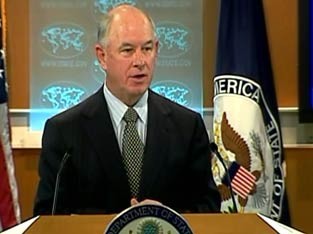
Oct. 12, 2010: It's comical when a spokesman does not know what to say about an issue. An illustration of this came today when the State Department spokesman, Philip J. Crowley, was asked "Is the U.S. want[ing] the Palestinians to recognize Israel as a Jewish state?" Here, as officially transcribed, is the unedited reply:
We have, you know, recognized the—the special nature of the Israeli state. It is a state for the Jewish people. It is a state for other citizens of other faiths as well.
But, you know, this is the aspiration of the—you know, what Prime Minister Netanyahu said yesterday is in essence, you know, the—the—a core demand of the Israeli government, which we support, is a recognition that Israel is a part of the region, acceptance by the region of the existence of the state of Israel as the homeland of the Jewish people. And that is what they want to see through this negotiation.
Philip J. Crowley hacks away at U.S. policy toward the "Jewish state" issue.
We understand, you know, this aspiration. And the prime minister was talking yesterday about the fact that, you know, just as they aspire to a state, you know, for the Jewish people in the Middle East, they understand the aspirations of the Palestinian people for a state of their own now.
So the prime minister has put forward his ideas on what he believes his people need to hear so that they can—they can make the commitment that we're seeking to stay in this process and to reach a successful conclusion.
This is not—this is not a one-way street; it is a two-way street. You know, the prime minister is offering something and asking for something. It is perfectly within the rights of the Palestinian Authority and President Abbas to say, you know, "There's something I need and there's something I'm willing to give."
This is—this is the essence of the negotiation that is ongoing and the essence of the negotiation that we want to see continue.
Nov. 28, 2010: The Fatah Revolutionary Council concluded its fifth convention in Ramallah with a stout refusal to recognize Israel as a Jewish state: "The council affirms its rejection of the so-called Jewish state or any other formula that could achieve this goal. The council also renews its refusal for the establishment of any racist state based on religion in accordance with international law and human rights conventions."
Dec. 16, 2010: According to a poll of 600 Arab citizens of Israel conducted by the University of Maryland and the Saban Center for Middle East Policy,
Almost 50% of Israeli Arabs said they would not accept Israel as a Jewish state "under any conditions." Another 32% said they would accept Israel as Jewish only if a PA state were established.
Feb. 1, 2011: Tal Becker has written the first study of this topic in English, The Claim for Recognition of Israel as a Jewish State: A Reassessment, a 26-page analysis with appendices, for the Washington Institute for Near East Policy. He comes down squarely demanding Palestinian recognition of Israel as a Jewish state:
obfuscating or circumventing the recognition issue will be seen by many as failing to draw the parties toward the genuine and permanent reconciliation that a two-state solution aspires to represent, and may fail to attract the public support, particularly on the Israeli side, necessary to make an agreement politically feasible.
Mar. 23, 2011: The spring 2011 issue of the Journal of Palestine Studies contains an article by Raef Zreik, "Why the Jewish State Now?" that presents, from Palestinian Authority point of view, the reasons for the new Israeli emphasis on a Jewish state. Needless to say, they differ from the reasons offered by me.
Apr. 19, 2011: Prime Minister Netanyahu has reiterated that
the core of the conflict has always been the persistent refusal of the Palestinian leadership to recognize the Jewish state in any borders. That is why this conflict raged for nearly 50 years before 1967, before there was a single settlement in the West Bank. ... Why don't the Palestinians do something so simple as recognizing the Jewish state? After all, we are prepared to recognize a Palestinian state. Why can't they reciprocate if they really want peace?
May 19, 2011: In a major speech on the Middle East, "Remarks by the President on the Middle East and North Africa," Barack Obama referred twice to a "Jewish state."
- "The dream of a Jewish and democratic state cannot be fulfilled with permanent occupation."
- "a lasting peace will involve two states for two peoples: Israel as a Jewish state and the homeland for the Jewish people, and the state of Palestine as the homeland for the Palestinian people."
May 22, 2011: In a second major speech in three days, this one focused on Israel, "Remarks by the President at the AIPAC Policy Conference 2011," Obama used the term "Jewish state" no less than five times:
- "as the nation that recognized the State of Israel moments after its independence, we have a profound commitment to its survival as a strong, secure homeland for the Jewish people."
- "the number of Palestinians living west of the Jordan River is growing rapidly and fundamentally reshaping the demographic realities of both Israel and the Palestinian Territories. This will make it harder and harder -- without a peace deal -- to maintain Israel as both a Jewish state and a democratic state."
- "The ultimate goal is two states for two people: Israel as a Jewish state and the homeland for the Jewish people and the State of Palestine as the homeland for the Palestinian people."
- "Ultimately, it is the right and the responsibility of the Israeli government to make the hard choices that are necessary to protect a Jewish and democratic state for which so many generations have sacrificed."
- "a genuine peace is the only path that will ultimately provide for a peaceful Palestine as the homeland of the Palestinian people and a Jewish state of Israel as the homeland of the Jewish people."
May 23, 2011: (1) In his speech to AIPAC, Israeli prime minister Binyamin Netanyahu put great emphasis on the need for Palestinian acceptance of Israel as a Jewish state:
We want peace because we know the blessings peace could bring - what it could bring to us and to our Palestinian neighbors. But if we hope to advance peace with the Palestinians, then it's time that we admitted another truth. This conflict has raged for nearly a century because the Palestinians refuse to end it. They refuse to accept the Jewish state. Now, this is what this conflict has always been about. There are many issues linked to this conflict that must be resolved between Israelis and Palestinians. We can, we must, resolve them. But I repeat: We can only make peace with the Palestinians if they're prepared to make peace with the Jewish State.
(2) The Palestinian Authority again rejected recognition of Israel as a Jewish state. The Associated Press reports Nabil Shaath saying that Palestinian recognition of Israel's right to exist, without any reference to its character, should suffice: "We recognize Israel as a state. It's a recognition of a state to a state."

May 25, 2011: A poll of American Jews by Luntz Global on behalf of the Committee for Accuracy in Middle East Reporting in America (CAMERA) finds that 90 percent of respondents find Palestinian recognition of Israel as a Jewish state to be "necessary" for a peace agreement to follow.
May 30, 2011: Moshe Ya'alon, Israel's deputy prime minister and minister for strategic affairs, picked up on Netanyahu's mention of the Jewish state and placed great emphasis on it in an oped for Yedi'ot Aharonot. Excerpts:
The key sentence in the prime minister's speech before Congress made it clear that the main reason for the failure of all attempts to secure Israel-Palestinian peace is the Palestinian refusal to recognize Israel as a Jewish State; that is, to recognize the Jewish people's right to maintain a Jewish nation-state, the State of Israel, on the land of its forefathers.
Israel's Palestinian dialogue partner in peace talks is the PLO; all members of this umbrella organization, including Fatah, reject Israel's right to exist, while accepting it (because of the IDF's military power) on the condition that it would be an entity that lacks an ethnic identity – that is, that it will not be the Jewish people's nation-state. ...
The heart of the conflict with the Palestinians is existential and not just territorial, as proven by Nakba Day events and as the prime minister made clear in his speech. As far as the Palestinians are concerned, the occupation started in 1948 and not in 1967. Hence, Palestinian recognition of Israel as the Jewish people's nation-state is a required condition for viable peace with the Palestinians.
June 23, 2011: The the Journal of Palestine Studies, edited by Rashid Khalidi, cannot get enough of this topic. The spring 2011 issue ran an article on "Why the Jewish State Now?" and now the summer issue published Ahmad Samih Khalidi's "Why Can't the Palestinians Recognize the Jewish State?" It presents "the moral and practical reasons" why they "cannot accede to this demand, or even accept Israel's self-definition as a matter of exclusive Israeli concern."
July 13, 2011: Nabil Shaath is unequivocal in rejecting the Jewish state concept:
[The French initiative] reshaped the issue of the "Jewish state" into a formula that is also unacceptable to us – two states for two peoples. They can describe Israel itself as a state for two peoples, but we will be a state for one people. The story of "two states for two peoples" means that there will be a Jewish people over there and a Palestinian people here. We will never accept this – not as part of the French initiative and not as part of the American initiative. We will not sacrifice the 1.5 million Palestinians with Israeli citizenship who live within the 1948 borders, and we will never agree to a clause preventing the Palestinian refugees from returning to their country. We will not accept this.
Aug. 3, 2011: Avi Dichter of the Kadima Party found 39 co-sponsors for a 14-clause bill titled "Basic Law: Israel as the Nation State of the Jewish People" to enshrine the Jewish state concept into Israel's version of a constitution and validate the state's Jewish practices.
Aug. 28, 2011: Mahmoud Abbas told the powers to back off: "Don't order us to recognize a Jewish state. We won't accept it."
Sep. 2, 2011: Hassan Jabareen, founder and general director of Adalah, an Israeli-Arab organization explains today "Why Palestinians can't recognize a 'Jewish state'."
For the Palestinians to recognize Israel as a Jewish state is to declare their surrender, meaning, to waive their group dignity by negating their historical narrative and national identity. ... we would accept the rationale of the [Jewish] Law of Return, and as a result, we would waive our right to return, even in principle.
Sep. 30, 2011: Sari Nusseibeh sent a letter in 2008 I quote above claiming that " we already recognized Israel as a Jewish State by recognizing UN Resolution 181 [of 1947]." Fine, but today he explains "Why Israel can't be a 'Jewish State'" for aljazeera.com, arguing that "the idea of a 'Jewish State' is logically and morally problematic because of its legal, religious, historical and social implications."
- What about ethnic Jews who are atheists?
- The modern nation-state is a temporal and civic institution that cannot be religiously homogenous. Anyway, 20 per cent of the Israeli population is Muslim, Christian, Druze or Baha'i.
- It implies that Israel is, or should be, either a theocracy or an apartheid state or both, ending Israel's democracy.
- It disenfranchises Palestinians while enfranchising Jews living outside Israel.
- 7 million Palestinians in the diaspora would give up their rights to repatriation or compensation.
- It ignores the fact that "Jerusalem is as holy to 2.2 billion Christians and 1.6 billion Muslims, as it is to 15-20 million Jews worldwide."
- The Bible's "sword verses" mean that Palestinians justifiably feel "a little trepidation" as regards what a "Jewish State" means for them, so "recognition of Israel as a 'Jewish State' in Israel is not the same as, say, recognition of Greece today as a "Christian State."
Nusesibeh offers advice to Israelis: "ask instead that Palestinians recognise Israel (proper) as a civil, democratic, and pluralistic state whose official religion is Judaism, and whose majority is Jewish," calling this "a reasonable demand."
Comment: Make up your mind, Sari, did the Palestinians accept a Jewish state in 1947 or are you resisting this idea now?
Oct. 11, 2011: Efraim Karsh, my colleague at the Middle East Forum, replies to Nusseibeh today in the Jerusalem Post, noting that "the supposedly moderate president of al-Quds University goes to great lengths to explain why Jews, unlike any other nation on earth, are undeserving of statehood."
Nusseibeh claims that a Jewish state must by definition be either a theocracy or an apartheid state, and that its Jewish nature opens the door to legally reducing its substantial non-Jewish minority ... "to second-class citizens (or perhaps even stripping them of their citizenship and other rights)." This ... flies in the face of Israel's 63-year history, where Arabs have enjoyed full equality before the law, and have been endowed with the full spectrum of democratic rights – including the right to vote for and serve in all state institutions.
In fact, from the designation of Arabic as an official language, to the recognition of non-Jewish religious holidays as legal resting days for their respective communities, to the granting of educational, cultural, judicial, and religious autonomy, Arabs in Israel enjoy more formal prerogatives than ethnic minorities anywhere in the democratic world. ...
instead of insisting on being accepted for what it has been for 63 years, or what the UN partition resolution envisaged it to be, Israel should shed its Jewish identity and become "a civil, democratic, and pluralistic state whose official religion is Judaism" like many of its Arab neighbors which have Islam as their official religion "but grant equal civil rights to all citizens."
This of course is the complete inverse of the truth.
The Jewish state is a civil, democratic and pluralistic society, something that none of its Arab neighbors can stake a claim to. On the contrary, precisely because Islam is enshrined as state religion throughout the Middle East, the non-Muslim minorities have been denied "equal civil rights" and have instead been reduced to the historic dhimmi status whereby they can at best enjoy certain religious freedoms in return for a distinctly inferior existence, and at worst suffer from systematic persecution and oppression.
And this is the "one-state paradigm" offered by Nusseibeh to Israel's Jewish citizens.
Oct. 23, 2011: Abbas told an interviewer on Egypt's Dream2 TV:
let me make something clear about the story of the "Jewish state." They started talking to me about the "Jewish state" only two years ago, discussing it with me at every opportunity, every forum I went to – Jewish or non-Jewish – asking: "What do you think about the 'Jewish state'?"
I've said it before, and I'll say it again: I will never recognize the Jewishness of the state, or a "Jewish state."
Comment: Four years ago, not two years ago. Why can't Palestinian leaders tell the truth about even the simplest things?
Nov. 1, 2011: In an important 9-page article, "The Problem Is Palestinian Rejectionism: Why the PA Must Recognize a Jewish State," Yosef Kuperwasser and Shalom Lipner, both high-ranking officials in the Israeli government, argue in Foreign Affairs that
The Palestinian refusal to recognize Israel as a Jewish state stands at the root of the struggle and behind every so-called core issue, from determining borders to resolving the dispute over Palestinian refugees. Genuine reconciliation can be achieved, then, only once the Palestinians come to terms with Israel's existence as a Jewish state.
Feb. 13, 2012: In an major statement, addressing Arab League foreign ministers, Mahmoud Abbas restated the position that Palestinians will not recognize Israel as a Jewish state while adding two new elements, as reported by Israel Hayom: "were the Palestinians to agree to this requirement, Palestinian refugees would not be allowed to return to Israel as part of a future agreement, and some million and a half Arab citizens of Israel would have little say in shaping the country's affairs." Actually, Abbas used stronger language than this report suggests, stating that recognition of Israel as a Jewish state would render its Arab citizens "worthless" (la-qima).
Feb. 27, 2012: Well, one prominent Israeli takes the Palestinian side on this issue; former Mossad head Efraim Halevy says that any agreement signed with Israel is tantamount to recognition, meaning the government need not insist on Palestinians overtly recognizing Israel as a Jewish state. "Our Jewishness does not depend on [those who reject this]."
Dec. 6, 2012: German Chancellor Angela Merkel: "We on the German side ... would like to see a Jewish state – Israel – and a Palestinian state."
Part V: Obama, Netanyahu, and Abbas, Round Two
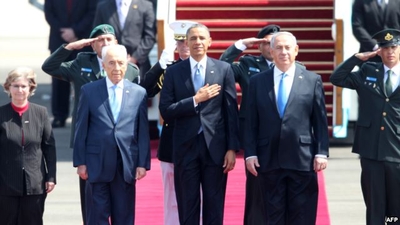
Mar. 20, 2013: (1) On arriving in Israel, Barack Obama said:
More than 3,000 years ago, the Jewish people lived here, tended the land here, prayed to God here. And after centuries of exile and persecution, unparalleled in the history of man, the founding of the Jewish State of Israel was a rebirth, a redemption unlike any in history. Today, the sons of Abraham and the daughters of Sarah are fulfilling the dream of the ages — to be "masters of their own fate" in "their own sovereign state."
Comments: This is a particularly emotional statement about Israel as the Jewish state; compare it to George W. Bush's remarks on landing in Israel on Jan. 9, 2008, quoted above: "the alliance between our two nations helps guarantee Israel's security as a Jewish state."
(2) Ron DeSantis (Republican of Florida) today introduced "The Palestinian Accountability Act" which cuts the nearly $500 million yearly in U.S. aid to the Palestinian Authority until it, among other steps, formally "recognizes Israel's right to exist as a Jewish state." The bill's cosponsors include three other Republicans: Steve King (Iowa), Sam Johnson (Texas), and Joe Pitts (Pennsylvania).
Mar. 21, 2013: Obama twice mentioned "Jewish state" in his major public address while in Israel, posted at the White House website as "President Obama Speaks to the People of Israel." The first was somewhat routine:
You live in a neighborhood where many of your neighbors have rejected the right of your nation to exist. Your grandparents had to risk their lives and all that they had to make a place for themselves in this world. Your parents lived through war after war to ensure the survival of the Jewish state.
The second was quite extraordinary because it came in one of the key passages of the speech and for the first time established a U.S. government demand for Palestinian acceptance of Israel as a Jewish state:
Palestinians must recognize that Israel will be a Jewish state and that Israelis have the right to insist upon their security. Israelis must recognize that continued settlement activity is counterproductive to the cause of peace, and that an independent Palestine must be viable with real borders that have to be drawn.
Comments:
(1) This statement is not entirely new, as Obama endorsed the Jewish state idea before. He did so as a candidate for president on May 12, 2008 (see above): "the fundamental premise of Israel and the need to preserve a Jewish state that is secure is, I think, a just idea and one that should be supported here in the United States and around the world." Again, at the United Nations on Sep. 23, 2009: "The goal is clear: two states living side by side in peace and security - a Jewish State of Israel, with true security for all Israelis; and a viable, independent Palestinian state with contiguous territory that ends the occupation that began in 1967, and realizes the potential of the Palestinian people." In May 2011, Obama mentioned Israel as a Jewish state no less than seven times in two speeches, including three statements similar to the one today:
- "a lasting peace will involve two states for two peoples: Israel as a Jewish state and the homeland for the Jewish people, and the state of Palestine as the homeland for the Palestinian people."
- "The ultimate goal is two states for two people: Israel as a Jewish state and the homeland for the Jewish people and the State of Palestine as the homeland for the Palestinian people."
- "a genuine peace is the only path that will ultimately provide for a peaceful Palestine as the homeland of the Palestinian people and a Jewish state of Israel as the homeland of the Jewish people."
Finally, Obama mentioned the Jewish state again only yesterday, on his arrival in Israel. Also, U.S. Secretary of State Hillary Clinton used the term on May 27, 2010.
(2) But neither Obama nor any other American official ever before required the Palestinians to recognize Israel as a Jewish state. This breaks important new ground.
(3) Until now, the Obama administration had shied away from endorsing the need for Palestinians having to accept Israel as a Jewish state. George Mitchell, Obama's first special envoy to the Middle East, indicated this on Apr. 19, 2009. The State Department spokesman avoided the question as best he could on Oct. 12, 2010.
Mar. 26, 2013: I make the Jewish state issue the topic of a column at "Obama to Palestinians: Accept the Jewish State."
May 2, 2013: Israeli prime minister Binyamin Netanyahu said yesterday that "The Israeli-Palestinian conflict isn't about territory, but rather the very existence of a Jewish state," once again putting the emphasis on recognition of the "Jewish state" aspect.
June 12, 2013: Speaking in Poland, Netanyahu refuted the idea that he is requiring recognition of Israel as the Jewish state as a prerequisite for negotiations:
My goal is to see a historic compromise that ends the conflict between Israelis and Palestinians once and for all. This will entail a demilitarized Palestinian state that recognizes the Jewish state, with iron clad security arrangements for Israel – recognition, security, demilitarization. I believe that these are the elements for peace. I don't pose them as preconditions for negotiations. I look forward to enter those negotiations without preconditions without delay.
July 8, 2013: Amir Fuchs writes in "An Anti-Zionist Law" that the June 2013 bill of Yariv Levin and Ayelet Shaked proposing a Basic Law to establish Israel's Jewish character "seeks to bring about nothing short of a revolution in the nature of the State of Israel" but is anti-democratic and undermines the foundations of Zionism.
July 20, 2013: U.S. Secretary of State John Kerry has announced an Israeli and Palestinian Authority agreement to meet for talks on the very odd basis that he would send out invitations giving each side what it specifically most wants without implying that the other side concedes the point. What the Israelis want is recognition of Israel as a Jewish state. Here is how the New York Times puts it:
The formula Mr. Kerry negotiated, officials said, involves the United States' making a declaration about the borders and settlements, and recognition of Israel as a Jewish state, that Mr. Netanyahu and President Mahmoud Abbas of the Palestinian Authority can distance themselves from while still negotiating.
Comment: More than anything else, this priority formalizes the importance of the Jewish state concept to the current government. It also symbolizes, given wall-to-wall Palestinian opposition to this concession, the near-impossibility of those negotiations achieving anything.
 Aug. 12, 2013: One prominent Israeli institution rejects the "Jewish state" formulation, at least for mixed company. That would be the Peres Center for Peace, which nixed a theatrical play for children, Snow Ball, because of a line in it stating that "the state of Israel is the national home of all Jews." A letter from Dvir Zivan, manager of the Peres Center's Sports Department, explained:
We would be happy to bring all the Jewish children to the play, but there is a problem. We do not do activities intended for one nationality only. It is hard for us to bring Palestinian children to a play that uses the words "Jewish state." Unfortunately, we will be unable to cooperate on this venture.
The director of Snow Ball, Roy Horovitz responded: "It's sad to discover that in a center that carries the name of the president of the state of Israel, there are those who believe that identifying Israel as the Jewish state is a problematic statement that is not part of the consensus."
Aug. 20, 2013: Israeli prime minister Binyamin Netanyahu, at a press conference with U.N. Secretary General Ban Ki-moon: "We have to get to the root cause of the [Arab-Israeli] problem and the root cause was and remains the persistent refusal to recognize the Jewish State in any boundary. It doesn't have to do with the settlements – that's an issue that has to be resolved, but this is not the reason that we have a continual conflict."
Oct. 1, 2013: Lahav Harkov, parliamentary reporter for the Jerusalem Post, looks at the Jewish state concept in Israeli law and finds that it "surprisingly tenuous." She writes in "Making the Jewish State a 'Jewish State'
Its collection of 11 Basic Laws, which were intended as a blueprint for an eventual constitution, contains no definition of Israel as a Jewish state. ... At the moment, in fact, there are no laws truly cementing Israel's status as a Jewish state.
And while Israel "has prospered for almost 65 years without a law declaring it a Jewish state," she finds the time has come:
today, the absence of a legal architecture ensuring Jewish statehood is also a potential threat to the Zionist project itself. With campaigns to delegitimize Israel on the rise both inside and outside the country, and with a surging trend of anti-Zionist and post-Zionist thought among the Israeli left, the idea of fashioning and passing a Jewish state law has become a matter of urgency to many. For Israel to thrive uniquely as a Jewish democracy, its institutions and laws must ensure that its democratic nature is never brought into irresolvable conflict with its Jewish identity. And without a Jewish-state law, Israel's unfortunately overactive judiciary could issue decisions that would chip away at the country's Jewish character. The prospect of such a crisis is all too real.
Harkov provides an example of this danger, the 2000 Kaadan case, when "the Israeli Supreme Court ruled that an Arab family must be permitted to live in Katzir, a cooperative town, even though the government had leased the land on which Katzir was built to the Jewish Agency, a private organization that is not an arm of the government and is designed, by its very definition, to aid Jewish people."
She then details the 2011 effort by Avi Dichter of the Kadima Party to pass a bill titled "Basic Law: Israel as the Nation State of the Jewish People" that declared, among other articles:
the State of Israel is the national home of the Jewish People where they realize their aspiration for self-determination according to their cultural and historical legacy.
and
the right to national self-determination in the State of Israel is unique to the Jewish People.
That bill came under criticism from the Left, which focused on the status of the Arabic language, and it ultimately failed. In June 2013, Knesset members Ruth Calderon and the trio of Yariv Levin, Ayelet Shaked, and Robert Ilatov each submitted bills. Harkov expresses doubts about the Calderon one and endorses that of the trio. But Justice Minister Tzipi Livni vetoed the bill in late June. Realizing her vulnerability on this score, Livni in August appointed Ruth Gavison of Hebrew University, to try her hand at a new bill. The results are now awaited.
Oct. 6, 2013: In a speech at a conference commemorating the 20th anniversary of the Begin-Sadat Center for Strategic Studies (known as BESA; coincidentally, I am also addressing this conference), Binyamin Netanyahu talked at length on the need for Palestinians to recognize Israel as the Jewish state. The text, as translated from Hebrew by the Ministry of Foreign Affairs:
when they are asked ... are you ready finally to recognize the Jewish state? They answer: "We are prepared to recognize the Israeli people; we are ready to recognize Israel." I say, that is not the question I am asking: "Are you prepared to recognize the Jewish state, the nation state of the Jewish people?" And the answer so far has been "No." Why not? ... Why are you not willing to recognize the Jewish state?
We are willing to recognize your nation state, and that is at great cost – it involves territories, our ancestral lands, which is not insignificant. And I say this as well – this is a very difficult thing. But you need to make a series of concessions too and the first concession is to give up your dream of the right of return. We will not be satisfied with recognition of the Israeli people or of some kind of binational state which will later be flooded by refugees.
This is the nation state of the Jewish people. If they want, Jews immigrate to this country. Palestinian Arabs, if they want, will go there[, to the Palestinian state]. Recognize the Jewish state. As long as you refuse to do so, there will never be peace. Recognize our right to live here in our own sovereign state, our nation state – only then will peace be possible.
Oct. 9, 2013: Finance Minister Yair Lapid disagrees with the demand that Palestinians recognize Israel as a Jewish state. "I don't feel we need a declaration from the Palestinians that they recognize Israel as a Jewish state," Lapid said. "My father didn't come to Haifa from the Budapest ghetto in order to get recognition from Abu Mazen [Palestinian Authority President Mahmoud Abbas]. The whole concept, to me, of the State of Israel is that we recognize ourselves, that after 2,000 years of being dependent on other people, we are now independent and we make our own rules."
Comment: This statement recalls what Menachem Begin said about not needing Arab acceptance of Israel, something I documented sympathetically but critically at "Israel Does Not Need Palestinian Recognition?"
Oct. 13, 2013: Ben Cohen of JNS.com endorses the demand for recognition of the Jewish state:
however much we might appreciate Lapid's healthy dismissal of the opinions of those who deny the legitimacy of Jewish national aspirations, it is precisely because of those same aspirations that his argument is dangerously flawed.
When you study what others call the Israeli-Palestinian conflict, and what I prefer to call the Palestinian war against Israel's legitimacy, it should be painfully apparent that it is the intangible aspects of this long dispute that have confounded a final agreement, and not the tangible ones.
What I mean is this: if this dispute were solely about sharing a territory, equitable distribution of water rights, common security arrangements, and so forth, we might well have arrived at a resolution by now. ... what nags in the context of the Israeli-Palestinian conflict is the rejection by the Palestinian side of the entire Zionist enterprise. Regardless of whether they are sitting at the table with Israeli negotiators, or gallivanting around the U.N. demanding unilateral recognition, the essential Palestinian message has, for more than a century, been that the Jews really have no right to be here in the first place. ...
Netanyahu's unwavering stance on the need for Palestinian recognition of Israel's Jewish character should be welcomed as a gesture of peace, not an excuse to perpetuate the status quo. Peace is only possible if the Palestinians revise the historical narrative that currently leads them to denigrate Israel as the "Zionist entity."
Oct. 14, 2013: The distinguished Israeli diplomat Zalman Shoval responds to Lapid, arguing against negotiations with the Palestinians unless they recognize Israel as the Jewish state. Excerpts:
The real reason that Palestinians deny the national Jewish identity of Israel stems from Arab and Muslim unwillingness, in principle, to recognize the existence of a Jewish nation (distinct from the religion). If the Jews do not comprise a nation, then they are undeserving of their own nation state, they conclude. ...
In other words, Arab Muslims say they are ready to recognize the state of Israel, albeit reluctantly, as a temporary refuge for the Jews that live here, but they are not willing to recognize the permanence of this entity.
Also, delegitimizing Israel or recognizing the Holocaust exclusively as an argument for the establishment of the Jewish state while ignoring Jewish history and the Zionist enterprise—whether out of good intentions or maliciously—runs parallel with the Palestinian strategy of characterizing the Jewish state as a temporary, Crusader state. ...
When Prime Minister Benjamin Netanyahu said that the Palestinians needed to recognize Israel as the national state of the Jewish people, he did not do it to thwart peace talks. He said it to ensure that any peace achieved through negotiations is a lasting peace, not just a phase in the piecemeal destruction of Israel. Whoever actually wants to give peace a chance should, rather than speaking in phrases or seeking favor with some external party, stand behind Netanyahu's fundamental principle: Recognize and ye shall receive—fail to recognize, end up with nothing.
Oct. 25, 2013: A former Palestinian negotiator, Nabeel Kassis, argues today "Why Palestinians Should Not Recognize Israel as Jewish State." He presents this Israeli demand as over the top:
Putting demands on the Palestinians that are tantamount to asking them to accept Zionist credos cannot be taken seriously. A case in point is the demand that the Palestinians recognize Israel as a Jewish state. Despite the fact that the Palestine Liberation Organization has recognized the state of Israel for more than 20 years — with no reciprocal recognition by Israel of the state of Palestine — Prime Minister Benjamin Netanyahu has now added the issue of recognition of Israel as a "Jewish state" as a precondition for any agreement. He is the first Israeli prime minister to make such a demand, and it has largely been recognized for what it is — an attempt to undermine the negotiations and ensure that no agreement is reached.
Factual correction: As any reader of this blog knows, it was Ehud Olmert, not Binyamin Netanyahu, who made that demand.
this demand is discriminatory in that it concedes to all Jews, exclusively, an innate right to be in Palestine, whereupon Palestinians who live in Palestine do so only by permission of "the Jewish state" and not as an innate right. In fact, by recognizing Israel as a Jewish state, Palestinians would be stating that their presence in Palestine has been illegitimate all along. Of course, this is out of the question, and Palestinians cannot accept it. ...
Because Palestinians cannot and will not undermine their own cause, they cannot and should not recognize Israel except as a state of its people, and its people are not all Jews. In fact, 25% of the current population of Israel is non-Jewish. This is another reason why the Palestinians cannot recognize Israel as a Jewish state, but also why whoever calls for such should be called to task.
Kassis then ambitiously tries to explain away the founding document of Israel's existence:
Some may argue that UN General Assembly Resolution 181 of 1947, the Partition Plan, called for the establishment of a Jewish state and an Arab state. This, however, was a different sort of state than the one that Netanyahu wants recognized. Resolution 181 on partition with economic union sought to resolve communal strife. Thus, the United Nations decided to create two separate states for the Palestinians — one for Palestinian Jews (and not exclusively Jewish in terms of its inhabitants) and one for Arab Palestinians (which would have included a small Jewish community). What Netanyahu is insisting on today is very different, so it is disingenuous to use Resolution 181 as the basis for legitimizing this demand. Indeed, a state for Palestinian Jews is not the same as a state for the Jews of the world.
He ends on the offense:
Instead of asking Palestinians to recognize Israel as a Jewish state, it is Israel that should be called upon to recognize the state of Palestine and to withdraw completely from all the territory that it occupied with the force of arms in 1967. This would be a more meaningful demand from those interested in the success of the present negotiations.
Nov. 10, 2013: Yossi Beilin, a leading leftist, admits to a change of mind on this issue and now insists on Palestinian recognition of the Jewish state:
Until recently, I was among those trying to convince Israeli decision makers to give up on the demand that Palestinians recognize Israel as a Jewish state, both because Israel has been and will continue to be a Jewish state without Palestinian recognition, and because Israel never made such demands when signing peace treaties with other neighbors, like Egypt and Jordan.
I've changed my mind. I believe Israeli leaders will be willing to pay a high price in exchange for such recognition and therefore a deal is possible that solves both the settler evacuation problem and Israel's desire to be recognized as a "Jewish State."
Israeli leaders worry that if Palestinians refuse to recognize Israel as a Jewish state, they will continue to claim entitlement to the "right of return," for refugees, which could flood Israel with non-Jews, making Jews a minority in their state. The Palestinians insist on a resolution to the refugee problem before granting any such recognition.
Nov. 28, 2013: German responsibility toward Israel as a Jewish state is contained in the coalition agreement between Merkel's Christian Democratic party and the Social Democratic party? The exact wording:
Wir bekennen uns zu der besonderen Verantwortung Deutschlands gegenüber Israel als jüdischem und demokratischem Staat und dessen Sicherheit.
We recognize Germany's special responsibility toward Israel as a Jewish and democratic state, and to its security.
Dec. 13, 2013: Palestinian Authority unwillingness to recognize Israel as a Jewish state could mess up the U.S.-sponsored negotiations with Israel. Agence France Press reports that Mahmoud Abbas gave Secretary of State John Kerry a letter detailing "Palestinian red lines," with an emphasis on the PA's "refusal to recognize Israel as a Jewish state."
Dec. 16, 2013: The strategist Efraim Inbar responds today to the above news about Abbas rejecting Kerry's proposals by putting the Palestinian reluctance to recognize Israel as a Jewish state into context:
This "red line" is not just about semantics, but the essence of the conflict. The Palestinian position amounts to denying the Jews the right to establish their state in their homeland. It also indicates without any doubt that the Palestinians, despite the conventional wisdom, are not ripe for reaching a historic compromise with Zionism, the Jewish national revival movement. A stable peace based on mutual recognition and ending all demands is not in the cards. The weak PA seems to accept partition of Mandatory Palestine into two states (perhaps in accordance with the stages approach championed by the Palestine Liberation Organization), but it still refrains from accepting the legitimacy of the Zionist enterprise.
Inbar then makes an important point about the Palestinian insistence on words:
Despite the image of untrustworthiness, Palestinians give great importance to the language used in the documents they are asked to sign. Yasser Arafat, generally viewed by most Israelis as an accomplished liar, refused to sign an agreement in 2000 that included a clause about an end to all demands. For him the conflict could end only by the eventual demise of Israel. Similarly, Abbas cannot bring himself to put his signature to a document which says that the Jews have returned to their homeland.
He does expect change any time soon:
Discussing Jewish rights to the Land of Israel is not conceivable in the current intra-Palestinian deliberations. Not even the so-called Palestinian moderates are calling for a debate among the Palestinians on whether to recognize the right of self-determination of the Jews in their historic homeland. Polls of Palestinians do not ask whether Israel should be recognized as a Jewish state.
Inbar notes that "It was a mistake not to insist on recognition of Israel being a Jewish state in the negotiations with the Palestinians in the 1990s" and offers another reason for this lapse: "Palestinians are different than Egyptians or Jordanians that were not required to accept Israel as a Jewish state. They have no claims to Palestine, while it is the Palestinians and the Israelis who fight for the same piece of land."
Jan. 4, 2014: Saeb Erekat has revealed the contents of a letter Mahmoud Abbas sent Barack Obama on Dec. 8, 2013, reports Avi Issacharoff, in which he laid down four preconditions in negotiations with Israel that "he would not be able to accept as a Palestinian, as a people, as the PLO." "Firstly, we will not be able to accept Israel as a Jewish state." The other three concern Jerusalem, Israeli security forces in the West Bank, and the "right of return."
Comment: (1) Putting the Jewish state issue first again underscores the Palestinians's refusal to countenance this Israeli demand. In brief, they want to keep open the goal of turning Israel into a Muslim state. (2) If these demands be accurate portrayal of the Palestinian Authority's position, they doom the current John-Kerry-sponsored round of diplomacy.
Jan. 7, 2014: Avi Issacharoff reports in the Times of Israel that John Kerry reportedly is
exploring the possibility of altering language in the 2002 Arab Peace Initiative to include recognition of Israel as a Jewish State. ... The changed language, which would insert a key Israeli demand into the 2002 Saudi-drafted Arab Peace Initiative, would also include the stipulation that Israel's Arab citizens not be affected by recognition of Israel as a Jewish state. The initiative's current language calls for the Arab world to offer comprehensive peace with Israel in exchange for a full pullout from all territories it captured in the 1967 Mideast war.
Jan. 10, 2014: (1) State Department spokeswoman Jen Psaki has denied reports that Kerry has asked the kings of Jordan and Saudi Arabia to agree to alter the "Arab League peace initiative" of 2002 to recognize Israel as a Jewish state, thereby easing the way for Palestinians to do the same: "It would not be accurate to say there was an attempt to change the Arab Peace Initiative."
Asked if the Obama administration wants Arab recognition of Israel as a Jewish state, she replied, "We want to see them support, which they've indicated they would, a final-status agreement between the parties. What is included in there is not yet determined." Psaki refused to answer whether Kerry has pressed the Palestinians to recognize Israel as a Jewish state.
Jonathan D. Halevi comments on the Abbas speech of three days ago: he "is determined in his rejection of the request to recognize Israel as a Jewish state, and his position is directly connected to the Palestinian position toward the refugees, regarding which he has distanced himself and all the Palestinian institutions from any authority to reach any decisions involving what the Palestinians call 'the right of return'."
(2) The Palestinian Authority foreign affairs director, Riyad Al-Maliki, reports that, at a fifth meeting between John Kerry and Arab League's Arab Peace Initiative Follow-up Committee, the foreign ministers told him that they refuse to accept Israel as a Jewish state. The meeting took place on Jan. 12 at the residence of the American ambassador in Paris and included nine Arab ministers. According to Maliki: "A clear and unified Arab and Palestinian position was presented rejecting the recognition of Israel as a Jewish state. The American secretary heard this position from me and from other Arab foreign ministers."
Jan. 14, 2014: Gilead Ini counters the Palestinian arguments in "Talking points against 'Jewish state' fall short." He also notes that the rest of the world talks about "Two states for two peoples," but not the Palestinians and their allies, who only talk about "Two states."
Jan. 15, 2014: The Egyptian newspaper Al-Ahram has published one "Ahmed Al-Sayed from Gaza" who makes these points against Israel's demand to be recognized as the Jewish state:
Palestinians, both government and opposition, have dug in their heels, and they are not making a secret of their shock that this condition — which was never part of any Arab-Israeli talks in the past — has been brought to the negotiating table. ...
This is not a question of semantics, as the Palestinians point out. If they recognise the Jewishness of the State of Israel, then their entire struggle for their lost land would be de-legitimised. Some say that it may give the Israelis the right to demand reparations from Arab countries, not vice versa.
Recognising the Jewishness of Israel will mean that Palestinian refugees will lose their right to return. Israeli Arabs, now totalling 1.7 million, will be at risk of extradition, as Mohamed Ashtiya, a Fatah Central Committee member, pointed out. "No Palestinian can recognise Israel as a Jewish state. This whole thing is a religious claim with political implications," he remarked. ... The Palestinians, he added, are not prepared to abandon the Muslim and Christian interpretation of the Bible in favour of Israel's views.
Muslim interpretation of the Bible? That's a new one.
Al-Sayed also reports some news: according to Palestinian sources, when Kerry visited Jordan and Saudi Arabia, he "tried to convince officials in both countries of the Jewishness of Israel."
Comment: "The Jewish State of Israel" is a formulation rarely used by politicians; Barack Obama, perhaps surprisingly, is the one who has used it repeatedly, as can be seen by a search through this page.
Jan. 16, 2014: Netanyahu spoke to Canada's CTV News about Israel's Arab citizens:
We're not asking them to change their religion and they have full civic rights. Arab citizens of Israel serve in the Knesset, our parliament, they serve in the government, they serve on the Supreme Court. It's full civic equality. But what we say is that this state, with its flag, with its symbols, its national holidays and the ability to accept Jews from around the world - that's the nation-state of the Jewish people, with full civic rights to those who are non-Jews.
He then explained the centrality of the Jewish state issue, calling it "perhaps the pivot to the whole debate":
when we say we want peace, what we want is really for our Palestinian neighbours to have a demilitarized state next to us that recognizes the Jewish State. We're willing to recognize their state, the Palestinian state. But we ask them to recognize the Jewish state. The last thing we want to do is just walk out and have them use that, the Palestinian state to attack what remains of Israel. So I think this is perhaps the pivot to the whole debate... will the Palestinians, as part of peace, recognize the Jewish state as Israel is willing to recognize the Palestinian state. I hope they do. If they do, it'll afford a better future for us and their children.
Jan. 20, 2014: On a single day, reports came out on prominent figures who made important and diametrically opposite statements on the Jewish state issue.
(1) Traian Basescu, the president of Romanian, replied in an interview two days before a visit to Israel that "we'll always support the idea that if the Israelis want to be declared as a Jewish state, they must be recognized [as such]."
 Canadian prime minister Stephen Harper addresses the Knesset. |
- "support today for the Jewish State of Israel is more than a moral imperative. "It is also a matter of strategic importance, also a matter of our own, long-term interests."
- "we either stand up for our values and our interests here in Israel, stand up for the existence of a free, democratic and distinctively Jewish state, or the retreat of our values and our interests in the world will begin."
- "we share with Israel a sincere hope that the Palestinian people and their leaders will choose a viable, democratic Palestinian state, committed to living peacefully alongside the Jewish State of Israel."
- "Canada finds it deplorable that some in the international community still question the legitimacy of the existence of the State of Israel. Our view that Israel's right to exist as a Jewish state is absolute and non-negotiable."
- "I understand that in the world of diplomacy, with one, solitary, Jewish state and scores of others, it is all too easy to go along to get along and single out Israel. But such going along to get along, is not a balanced approach, nor a sophisticated one. It is just, quite simply, weak and wrong."
- "People who would never say they hate and blame the Jews for their own failings or the problems of the world, instead declare their hatred of Israel and blame the only Jewish state for the problems of the Middle East."
- "criticism of Israeli government policy is not in and of itself necessarily anti-Semitic. But what else can we call criticism that selectively condemns only the Jewish state and effectively denies its right to exist, to defend itself while systematically ignoring or excusing the violence and oppression all around it?"
Comment: There is no head of government anywhere in the world who stands up for Israel as does Stephen Harper. Arguably, there has never has been one.
 Riyad Al-Maliki, the so-called Palestinian foreign minister. |
(3) Riyad Al-Maliki, the so-called Palestinian foreign minister, is unequivocal about never recognizing Israel as the Jewish state. Answering a question about what has been achieved in the Kerry round of negotiations, Maliki replies:
what is new is that at the latest round of negotiations the Israeli prime minister added additional conditions that have complicated things, such as recognizing the Jewish nature of the state. This had never been raised before during Israel's presence in the Jordan Valley. ... Israel has asked us to recognize the Jewish identity of the state. I do not see any solution to this issue because it is something we will never accept.
Asked which issue is the most intractable in the negotiations, Maliki replied:
the issue of recognizing the Jewish nature of the Israeli state. This is a sharply contentious issue. It would be dangerous to recognize this because this would mean our acceptance of the dissolution of our own history and ties and our historic right to Palestine. This is something that we will never accept under any circumstances. Acceptance of this would also raise fears about the fate of the 1.8 million Palestinians living in Israel. They are already second-class citizens, so how will they be affected by the Judaization of the state? This also raises questions about the [Palestinian] refugees and the right of return. So this is something that we absolutely cannot accept.
Comments: (1) Unless the Israelis or Palestinians are bluffing, which seems highly unlikely, the Jewish-state issue looks to be a deal-breaker. (2) It is remarkable how quickly this has risen from insignificance to centrality since 2007.
(4) Nabil Shaath, Fatah's commissioner for external relations, told members of the foreign press on Jan. 16, reports Amira Hass of Ha'aretz today, that
Mr. Netanyahu can really go with pride to his people and say – "You see? I tricked those damn Palestinians and now instead of talking about refugees, and a capital in East Jerusalem, and full withdrawal to the borders of 1967, and rights in water and their security requirements as well as ours, I now convinced the world that the agenda is composed of two items and two items only: recognition of the Jewish character of the state and recognizing the security needs of Israel in the Jordan valley." These are the two issues that are occupying most of the time of Mr. Kerry and the press and international community.
Hass paraphrases Shaath on the background to the demand for recognition of Israel's Jewish character: it
was not included in past talks, official and otherwise, or in any of the signed documents and agreements between the two sides. This demand was also never raised with the Jordanians or Egyptians when those peace accords were forged.
In particular, Oslo's Declaration of Principles does not mention the Jewish state. Nor did Netanyahu raise the issue during his first term as prime minister, 1996-99. It was first brought up in 2010, claims Shaath. (That is utter nonsense: see the entries above starting with the one of Nov. 11, 2007.)
Shaath also harks back to the racial purity argument, ignoring the many statements by Palestinian leaders that no Jews will be allowed in a Palestinian state:
No country in Europe today has a totality of exclusive race or exclusive ethnic origin or religion or past," said Shaath. "It would be very embarrassing for a Jewish American today to see us recognize the United States as a WASP state, or a white state, or an Anglo-Saxon, Christian state.
He also gave other reasons for the refusal to recognize Israel's Jewish nature:
At the least, such a demand implies the marginalization as a second-class citizen of anyone who is not a Jew. It could pave the way for legally sanctioned discrimination against any citizen who is not a Jew, and it essentially asks the PLO to abandon the Palestinian citizens of Israel to an unknown fate of abuse and discrimination. Recognizing Israel's Jewishness would require the Palestinians to erase their narrative – their history and that of the country as experienced by them. As has been explained in the media, the demand for the recognition of Israel's Jewishness entails the demand that the Palestinians cede the right of return.
Jan. 21, 2014: At a press conference with visiting Canadian Prime Minister Stephen Harper, Netanyahu stated: "To have genuine peace between us and the Palestinians, there must be a Palestinian acceptance finally of a nation state for the Jewish people. If the Palestinians expect me and my people to recognize a nation state for the Palestinian people, surely we can expect them to recognize a nation state for the Jewish people. After all, we've only been here four millennia.."
Jan. 22, 2014: (1) Israel's President Shimon Peres publicly does not contradict his prime minister's position that the Palestinians must recognize Israel as a Jewish state; his own formulation is that Israel is a Jewish country. In private conversations with diplomatic and political officials, however, Israel Hayom reports, he calls Netanyahu's insistence on this an impediment to peace and insists it is possible to reach an agreement with the Palestinians without this demand.
(2) In a commentary at Israel Hayom on Peres' remarks, Dan Margalit argues that fringe leftists "have focused their efforts on countering Israel's opening gambits in the peace talks with the Palestinians. Their immediate goal is to erode Prime Minister Benjamin Netanyahu's insistence on having the Palestinians accept Israel as a Jewish state." Margalit focuses his ire on Peres, calling his dissent on the Jewish state issue "just scandalous."
He then plays out the implications of Arab acceptance of this demand: By agreeing to the phrase "Jewish state"
the Arabs would essentially agree to make no further claims. They will have withdrawn their demand for the "right of return" for Palestinians whose families left Israel-proper after 1947. So what's wrong in making that demand? Is there anything delusional about it?
Margalit draws an analogy:
When a Palestinian state is founded, Israel might claim that the new entity is just an autonomous region that lies west of the Jordan River and is controlled by the Arabs of the Land of Israel. So here is where the solution lies: Israel will not be called a Jewish state; Palestine will be just one of the districts of the Land of Israel where Arabic happens to be the official language.
Also:
If the Palestinians insist on having an Arabs-only state, Israel has every right to preserve its predominantly Jewish identity. The Palestinian rejectionism should set off many alarm bells.
(3) Lars Faaborg-Andersen, the European Union's ambassador to Israel, says of this issue:
I don't think we have any clear position on that because we're not 100% sure what is meant by this concept of a Jewish state. If, as Prime Minister Netanyahu said the other day, according to the press, it's a state in which Jews and Arabs and Druze are living [together with full equal rights] — I think this is Israel as we know [it] now. So if you're asking why we're not supporting that [demand for recognition of Israel as a Jewish state], it's mostly because... it's not really clear what is meant.
Asked why the EU does not take a position on an issue the Israeli side considers a prerequisite to any peace agreement, Faaborg-Andersen replied: "All I can say is that this is for the parties to discuss. And I'm not a party to these [Israeli-Palestinian peace] talks."
Raphael Ahren, a Times of Israel reporter, goes on:
Faaborg-Andersen appeared to suggest that as long as Israel doesn't attempt to change the country's current demographic makeup, with full civil rights to all its citizens regardless of their religion or ethnic background, a recognition of Israel as a Jewish state was rather harmless. However, he refused to confirm this interpretation of his comments or offer further comment on this issue.
After the briefing, Faaborg-Andersen's spokesperson clarified in a statement that, "The EU has not pronounced a position on the question of recognition of Israel as a Jewish state among other reasons because we're not sure about the implications of this on other final status issues. Therefore, we think that this is an issue to be discussed between the parties."
Jan. 23, 2014: (1) National camp parliamentarians criticized Peres for his Jewish state statements.
- Homefront Defense Minister Gilad Erdan (Likud): "The demand for a Jewish state is meant to ensure that this will be an end to the conflict and that the Palestinians will not make any more demands after the agreement. It is unfortunate that Peres has yet again expressed policy that makes progress in the negotiations harder to achieve. We have a prime minister who was elected by the people and I do not understand why the president is interfering in diplomatic matters all the time."
- Strategic Affairs, Intelligence and International Relations Minister Yuval Steinitz (Likud): "Every negotiation for peace starts with mutual recognition. [The Palestinians] still haven't recognized the existence of the Jewish people and its right to a state of its own. That's the heart of the conflict. As long as the Palestinians do not recognize us as a Jewish state, there will not be peace, it will be a joke."
Deputy Minister Tzipi Hotovely (Likud): "His disregard for the consistent refusal of the Palestinians to recognize Israel as a Jewish state is sticking his head in the sand, ignoring the true face of the enemy."
(2) Columnist Nadav Shragai explains the logic of the Palestinian refusal to accept the Jewish state formulation:
The Palestinians have invented a new nation—the "Israeli nation." They are prepared to recognize the right of the "Israeli nation" to exist in peace and security as a state, as long as it is not a Jewish state. That is the Palestinian version of "a state for all its citizens," in which the Jewish and national identity of the State of Israel is completely obscured. Even when the Palestinians grit their teeth and talk about "two states for two peoples," they are not talking about states for a Palestinian nation and a Jewish nation, but for a Palestinian nation and an Israeli nation.
The "Israeli nation" conceit has a serious purpose:
This delusion allows the Palestinians to continue declaring that they will establish a state on the pieces of land in the Palestinian territories that "will be released," without giving up on the continued hope and effort to establish a Palestinian state on the remaining pieces of land, on all the territory in Israel, instead of Israel.
If that sounds familiar, it is:
This used to be called the "Phased Plan." The path to achieving it includes the actualization of the "right" of return. The Palestinians have not given up on that either. So they continue to talk, to give speeches, preaching and promising that the day will come when they will return to the "settlements"—Jaffa, Lod, Haifa and Acre.
There is no limit to their territorial ambition:
The Palestinians are not keeping their right to self-determination within the 1947 lines or the 1967 borders, but they are actively striving toward realizing that right on all the lands of the State of Israel, or as they call it, Palestine. That is why they cannot recognize a Jewish state.
Shragai ends with a ringing endorsement for the Jewish state demand, bringing things up to date with the remarks by Peres:
From the Palestinian perspective, the presence of the Jewish people in Israel is temporary, passing, as passersby do. If we do not demand from them to recognize our permanent presence here, to recognize our connection to this land as the Jewish nation, a demand that implies the limiting of their right to self-determination to certain defined lines, we will fall into the same traps that Peres fell into in the past.
(3) Reuven Berko, an Israeli specialist on the Middle East, agrees with Shragai:
Peace is struck by fostering trust and removing any misgivings. In that respect, the problem lies with PA President Mahmoud Abbas, our address for the demand that the Palestinians recognize Israel as a "Jewish" state. ...
Abbas and his ilk are well aware that recognizing Israel as the Jewish homeland means the de facto forfeiture of their demand for the "right of return," and means the end of the conflict and their immediate end. That is not why the Palestinians are meeting with Justice Minister Tzipi Livni. ...
The truth is that the agenda prompted by Abbas and his people has nothing to do with the "two states for two peoples" vision, but rather it includes their ultimate demand for the right of return to Israel, annihilating the Jewish majority in it and establishing Palestine "from river to sea." This is why Abbas neither wants nor has the ability to recognize Israel as the Jewish homeland.
Berko also makes a point others have missed:
Abbas must also contend with an "Islamic problem." Should he recognize Israel as the Jewish homeland, he would be abiding by the Quran's edict deeming the land of Israel as the people of Israel—the chosen people—and their inheritance by divine right. It would mandate that the Muslims recognize us as the heirs of the land specified in the Quran, and as Islam's holy book makes no mention of the Palestinians, it would bring about the "end of the conflict." ...
a Palestinian recognition of Israel as the Jewish homeland would spell the end of the conflict. This is a perfectly reasonable demand, which is a must for the sake of peace, and it cannot be set aside.
Jan. 24, 2014: (1) Shlomo Cesana, diplomatic correspondent for Israel Hayom, argues that the Israeli insistence on Palestinians recognition of Israel as the Jewish state is vital because it cuts to the root cause of conflict.
This week, Netanyahu told his two guests—Romanian President Traian Basescu and Canadian Prime Minister Stephen Harper—that he had had the opportunity to ask Palestinian Authority President Mahmoud Abbas whether the Palestinians would recognize a Jewish state. "That is when they start to stammer," said Netanyahu, describing Abbas' response. Then he provided an interpretation:
"That is the root of the conflict, and that is the key to its resolution. The root of the conflict is not the settlements. The root of the conflict is not and has never been the lack of a Palestinian state. The root of the conflict is the consistent refusal to accept the existence of an independent nation state for the Jewish people. True peace requires that the Palestinians finally recognize Israel as the state of the Jewish people."
The prime minister then explains the logic of pressing for a statement accepting Israel as the Jewish state: "This statement is not for us. Rather, it is vital in clarifying their true intentions. Do they want real peace, or do they want to continue with the plan of stages?" Cesana then fleshes out the recent news about Peres on this topic:
when it became clear that President Shimon Peres opposed Netanyahu's position, the anger toward Peres in Netanyahu's bureau was real. The president made his statements during a meeting he holds on occasion with ministers and Knesset members from several factions. Peres explained that Netanyahu's insistence was "unnecessary," as he put it, and that it could sabotage the peace talks. One of the high-ranking people who met with Peres said that he even described as an "odd demand."
Peres explained during the same meeting that "the State of Israel was defined as a Jewish state by its own self, in the Scroll of Independence," and added, "The only thing that will determine whether it remains a Jewish state is assuring its Jewish majority." Peres' position aligns with that of Finance Minister Yair Lapid, the head of Yesh Atid. In an interview about a month ago, Lapid described the insistence on demanding recognition as a Jewish state as "nonsense."
Should the Palestinian Authority actually do as the prime minister wishes, he will respond generously:
If the Palestinians give up their demand for the return of the Palestinian refugees or recognize Israel as a Jewish state, Netanyahu will be willing to say as early as the framework agreement that the talks will be based on the 1967 borders with land swaps that will include the settlement blocs.
(2) Ofir Akunis, a deputy minister at the Prime Minister's Office, draws conclusions for Palestinian refusal to recognize Israel as the Jewish issue:
The Palestinians' insistent refusal to recognize Israel as the Jewish people's rightful homeland exposes the most sensitive nerve in the Israeli-Palestinian conflict. This is not a territorial dispute, but rather one that focuses on the very essence and existence of the State of Israel. ... This means that the flawed "two states for two peoples" formula is not applicable. The Palestinians themselves denounce it, and in this case—they only reinforce the perception that forming a Palestinian state in Judea and Samaria would be a mistake. ...
The Palestinian themselves have stated that they have no interest in the two-state formula. They aspire for a Palestinian state "free of Jews" in Judea and Samaria, as Abbas had put it and another state in the Gaza Strip, which will also be "Jew-free" and has already become a terrorist base that threatens half of Israel's territory. They want another state alongside those two, in sovereign Israel, which will not be the Jewish state but a binational state. In other words, the Palestinians do not want two states for two people, but three states for one people—the Palestinian people. That is the core of the conflict.
Jan. 27, 2014: P. David Hornik reviews this topic at "Abbas Says No to Israel as a Jewish State" at FrontPageMag.com.
Jan. 29, 2014: (1) Obama mentioned the Jewish state in his most high-profile speech of the year, the State of the Union address to congress:
American diplomacy is supporting Israelis and Palestinians as they engage in difficult but necessary talks to end the conflict there; to achieve dignity and an independent state for Palestinians, and lasting peace and security for the State of Israel – a Jewish state that knows America will always be at their side.
(2) Netanyahu said that recognition of Israel as the Jewish state lies at the "root of the conflict," as it predates settlements and other issues being negotiated about. "The conflict isn't about territories, or about settlements, or even about a Palestinian state. The Zionist movement agreed to recognize a Palestinian state. The conflict is about the Jewish state."
Feb. 2, 2014: (1) Abbas said recognizing Israel as a Jewish state is "out of the question" and gave a miscellany of reasons for this conclusion in an interview with the New York Times.
On recognition of Israel as a Jewish state, Mr. Abbas said, "This is out of the question," noting that Jordan and Egypt were not asked to do so when they signed peace treaties with Israel. He presented a 28-page packet he has been distributing widely that included a 1948 letter signed by President Harry Truman in which "Jewish state" was crossed out and replaced by "State of Israel"; statements by Israel's founding prime minister, David Ben-Gurion; and a paper on Edwin Montagu, a Jewish member of the British cabinet who opposed the 1917 Balfour Declaration supporting a "national home for the Jewish people" in Palestine.
(2) The Palestinian Authority's chief negotiator, Saeb Erekat, told his Israeli counterpart, Tzipi Livni, that Palestinians cannot accept Israel as the Jewish state because they lived in the region before the Jews. "When you say, 'Accept Israel as a Jewish state,' you are asking me to change my narrative."
(3) The Jerusalem Center for Public Affairs has taken the chief Palestinians negotiator to task in "Erekat Is Wrong: The Jewish Presence in the Land Dates Back for Millennia."
Erekat claimed that his ancestors were the real descendants of the Canaanites and lived in the area for "5,500 years before Joshua Bin-Nun." In effect, Erekat was promoting the well-known Palestinian narrative that they are the native population, while the Jews are latecomers who only arrived in the last hundred years. Since the Muslim Arab conquest of Palestine occurred only in 634CE, the credibility of this Palestinian claim is questionable, to say the least. At the same time, there is documented proof of a Jewish presence in the land dating back millennia. ... the Jewish presence in the land can be documented as dating back for millennia, while the politically-motivated claims made up by Palestinian leaders in an attempt to refute the long-standing history of the Jews in the region lack any such proof.

Feb. 3, 2014: The great and brave Ali Salim, an Egyptian intellectual (also spelled Ali Salem; on him, see here), writes in "Why the Palestinians Refuse to Recognize Israel as a Jewish State" at the Gatestone Institute:
 Ali Salem, the Egyptian playwright, wears his 2008 Civil Courage Prize. |
High-ranking PA figures claim that the Jews do not have religious or historical claims to the Holy Land. The Jews took the land by force, they say, and therefore want to reinforce their tenuous link to it by having the Palestinians recognize the State of Israel as the Jewish national state. The real reason for their refusal to recognize Israel as a Jewish country, however, is that the rais [chief], President Mahmoud Abbas, the man who claims to be the leader of the Palestinian people, has never abandoned the demand for the return of the Palestinians to "Palestine," that is, the entire State of Israel, so that it might be destroyed.
The Palestinian rais also interferes personally in the affairs of the sovereign State of Israel, especially in matters concerning Israeli Arabs. As part of the negotiations brokered by U.S. Secretary of State John Kerry, Abbas demanded the release of Palestinian terrorist operatives holding Israeli citizenship. He claimed he refused to recognize the State of Israel as a Jewish state because he felt responsible for the rights of the 20% of Israeli citizens who were Palestinian Arabs. ...
what President Mahmoud Abbas is really planning to establish is a Palestinian state between the Jordan River and the Mediterranean Sea, by flooding the State of Israel with Muslim Palestinians as part of the so-called "return" of the Palestinian refugees. He does not want an Israel next door to the Palestinian state, and therefore refuses to recognize it as the national homeland of the Jews.
Palestinians realize that as soon as they "recognize Israel as a Jewish state, their claims and the demand for all of the land of Palestine, from the Jordan River to the Mediterranean Sea will no longer be considered legitimate." Further, "Recognition would also give Israel Islamic legitimacy." Salim then adds his own concerns:
I worry that the Palestinians are irresponsible and gambling with their fate and with their children's future. Instead of recognizing Israel as the Jewish state as part of a package deal of mutual recognition leading to a life a peace, they are trying to force the world unilaterally to recognize a Palestinian state. The danger is that when the Israelis realize that the Palestinians manipulators do not have any real intention of forging a peace agreement, Israel will withdraw from territories it does not want to rule, as it did in the Gaza Strip. The Palestinians will receive far less from Israel than they could have achieved through dialogue, and will spend the rest of their days living as bad neighbors in a state of hopeless, eternal conflict.
He also explains why this demand is important to Israelis:
For the Jews, Palestinian recognition of the State of Israel as the national homeland of the Jews means the end of the conflict. They want to be sure that a Palestinian state bordering on Israel is the Palestinians' final demand and that they accept the fact of Israel's existence. They want to be sure the Palestinians will not try to use force or subterfuge to change the Jewish majority in Israel. They want to be sure no attempt will be made to force Israel to accept the return of the grandchildren and great grandchildren of Palestinian refugees who have already been settled in the neighboring countries and should remain there with their Arab brothers even after the regimes have stabilized in the wake of the Arab Spring. The end of the Israeli-Palestinian conflict basically means mutual recognition.
And then to a rousing conclusion:
If I were an Israeli, I would insist on Palestinian recognition of the State of Israel as the homeland of the Jewish People. This Palestinian recognition would make it accepted as a religious duty for the entire Islamic nation to make peace with Israel, and make it possible for an independent, flourishing Palestinian state to be established on Israel's eastern border.
Feb. 4, 2014: (1) Netanyahu has again spoken on this issue, responding to an interview Abbas gave and published two days earlier. He knows, Netanyahu said, "that there will not be an agreement without recognition of the nation state of the Jewish people." Indeed, it would be "absurd" to expect Israel to recognize a state for Palestinians without reciprocal recognition. "Let's see if the same international actors who until now have put pressure on Israel will make clear to the Palestinian Authority what exactly will be the consequences for the Palestinians if there is no agreement. Because, unless the Palestinians understand that they will pay a price if the talks fail, they will prefer to not continue the talks."
(2) Jordanian foreign minister Nasser Judeh has added his country's views to the mix: "With regards to the rumors surrounding the Jewish state, Jordan's consistent position – aligned in this regard with the Palestinian position – is that this formula and this proposal [forwarded by John Kerry] is unacceptable."
(3) A poll by the Israel Democracy Institute and Tel Aviv University asks "In your opinion, to what extent is it important or not important that, in a framework agreement with the Palestinians, they recognize Israel as the state of the Jewish people?" The results are clear: 77 percent of Israeli Jews replied it is important and only 21 percent said it is not. All sides of the political spectrum support this idea; curiously it has more support in the center than on the right:
- 77 percent: Identify themselves on the right
- 84 percent: Identify themselves as centrists
- 63 percent: Identify themselves as on the left
Asked why recognition is important, the 77 percent gave three major responses:
- 41 percent: It recognizes the basic principle of Zionism
- 29 percent: It helps Israel counter a demand that it become a "state of all its citizens"
- 19 percent It compensates for Israel recognizing the Palestinian state as the state of the Palestinian people
Feb. 10, 2014: (1) Surprisingly, Isaac Hertog, leader of Israel's Labor Party, has demanded Palestinian recognition of Israel as Jewish state: "The demand that the permanent agreement include Palestinian recognition of Israel as the nation-state of the Jewish people is justified, and I support it." Even more surprisingly, he believes Kerry "will find a formula which will bring the Palestinians to recognize a Jewish state."
But he does not think this should be a pre-condition for negotiations, as he explained in a follow-up interview with Akiva Eldar:
in the permanent agreement itself, it's legitimate to include the definition of Israel as the nation-state of the Jewish people, and of Palestine as the state of the Palestinian people. This is exactly how it's defined in the Geneva agreement and stems directly from UN Resolution 181 of Nov. 29, 1947. Nonetheless, I think it's wrong to demand this as a condition for negotiations, and Bibi made a serious mistake on this issue in the past. ... I'm in favor of a creative formula which doesn't condition acceptance of the document of principles on Palestinian recognition of a Jewish state, but you should know that a nation-state is a unique thing that requires a ratifying statement.
Matti Steinberg, a Middle East scholar who served as adviser on Palestinian affairs to four Shin Bet directors, predicts that the the Palestinians "will not accede to the demand to recognize Israel as a Jewish state, and Israel's insistence will destroy the option of a diplomatic solution," further reports Eldar. Steinberg also recalls that in 1998, "with the [alleged, D.P.] abrogation of all the articles of the Palestinian National Charter that contradicted the Oslo Accords, the Palestine Liberation Organization removed the article rejecting Judaism as a national movement entitled to a state."
Additionally, Steinberg notes that
the Israeli Supreme Court in October [2013] rejected the existence of an Israeli nationhood distinct from the Jewish identity of the State of Israel. It determined that from its inception, Israel was "immersed" in Jewish content. In other words, "the State of Israel" is the same as saying "a Jewish state," so there's no need to elaborate. In addition, in the 2002 Arab Peace Initiative, which offers Israel peace and normalization in return for a withdrawal to the 1967 borders (with agreed-upon border changes, or land swaps, as was later added to the initiative), there's no mention of recognizing Israel as a Jewish state.
(2) Fatah leader Nabil Shaath told a press conference in Gaza, as paraphrased by a Palestinian news report, that Abbas "will not agree to recognize Israel as a Jewish state." Comment: This drumbeat of insistence makes recognition of Israel as a Jewish state ever more remote.
(3) Israel's Ministerial Committee on Legislation approved a bill yesterday amending the national education law to require teaching the that Israel is the Jewish state. The member who initiated this change, Shimon Ohayon of Likud-Beytenu, explained: "There is public agreement that there are attempts to diminish the special connection of the Jewish people to our land. Therefore, education of the younger generation must be intensified." However, several ministers including Education Minister Shai Piron of Yesh Atid, oppose the wording of the amendment.
Also of note: former Prime Minister Ehud Olmert hinted in an interview Mahmoud Abbas would recognize Israel as the Jewish state. Comment: That would shock me.
Feb. 12, 2014: Former Mossad chief Meir Dagan said, according to a paraphrase of a talk he gave in Tel Aviv, that "he did not understand the Israeli demand that the Palestinians recognize Israel as a Jewish state. He questioned why Israel was seeking recognition from an entity that does not yet exist. Dagan characterized the issue as a political one, not a fundamental one."
Feb. 14, 2014: (1) Raphael Ahren offers an important analysis of this topic today at "The key to Mideast peace, neglected by the world" in the Times of Israel.
He starts by quoting Netanyahu at a Tel Aviv conference in January: "Our first and most unshakable demand is recognition. I would say that this is the first foundation for peace between us and the Palestinians."
Ahren then goes back in history to note that the "no recognition of Israel" of 1967's Khartoum resolution has evolved into "no recognition of Israel as a Jewish state" even as Netanyahu has made this recognition a non-negotiable precondition to an agreement. Despite this emphasis, Ahren finds, "Netanyahu's demand for recognition as a Jewish state hasn't really been seriously discussed by world leaders, and the international community doesn't seem sure about how to deal with this issue." Symbolic of this,
Over the last two years or so, I have asked foreign ministers, diplomats and other senior officials from many different countries what they think about pressuring the Palestinians into recognizing Israel as a Jewish state. Few were able or willing to express a clear, principled stance on the issue, either in favor or against.
He mentions Lars Faaborg-Andersen (cited above) and the president of the European Parliament, Martin Schulz:
It's a "delicate and complicated" issue, he said, refusing to make a definite statement. "I will not interfere, as a representative of a European institution, in this debate. Not to escape from your question — I think that this is first of all not my duty, being here, to interfere."
Ahrens finds that
Many officials, especially European ones, are caught off guard when asked whether they support the demand for Palestinian recognition of Israel as a Jewish state. This is mainly because their respective governments have never formulated a position on so nebulous an issue. They ... haven't bothered to think about the legitimacy of Israel's desire to be recognized as a Jewish state. ... Concern for Israel's Arab minority is the most widely quoted reason why Western political and civil rights groups view Netanyahu's demand with skepticism.
He quotes American diplomat Dennis Ross explaining why the demand for recognition has arised in Israel's negotiations with the Palestinians, and not with the Egyptians and Jordanians:
The difference is that these are two national movements competing for the same space. ... At the end of the day, Israel as Jewish state is another way of having everyone in the region accept the legitimacy of Israel's presence. And that's a sine qua non for peace and reconciliation. So I think it is essential.
(2) Former Dutch foreign minister Uri Rosenthal: "I don't think that after all, on the Palestinian side, this would be a nonnegotiable obstacle." Abbas "could easily say" that Israel is a Jewish state; he does not because he is "holding on to an high-priced bargaining chip in the negotiations."
Feb. 19, 2014: (1) The U.S.ambassador to Israel, Dan Shapiro, indicated to Israel Radio today that Kerry's "framework" will include recognition by the Palestinians of Israel as the Jewish state.
It's too early to know what compromises and concessions both sides will make. But we do believe ... that Israel deserves recognition as a Jewish state. That has always been U.S. policy – that Israel is a Jewish state and should remain a Jewish state. That will be one of the elements of the framework we're working on. ...
I assume that under the framework that we're currently preparing – that we'll see that recognition of Israel as a Jewish state, as the nation state of the Jewish people. And in the end, we'll need to know that this is the end of the conflict, and that's one way of verifying ... that everyone in the region and all of [Israel's] neighbors will accept that there is a nation state of the Jewish people here, in the Jewish homeland.
(2) State Department Spokesperson Mary Harf said: "I believe the president has said many times that we support Israel as a Jewish state. ...The U.S. will not relinquish its commitment to the security of Israel and our support for its existence as a Jewish state."
Feb. 20, 2014: (1) Hanan Ashrawi of the PLO has this to say:
I remember the days when we were told, "All you need is to get the PLO to recognize Israel, and recognize Israel's right to exist in safe and secure boundaries." The Jewishness of the state of Israel . this is a new addition. We are working to establish a pluralistic, democratic, inclusive state in Palestine. Not an exclusive state based on religion, ethnicity or whatever.
(2) In an essay, "The meaning of Israel as the state of the Jewish people," signed by Minister of Foreign Affairs Avigdor Lieberman, he states that "The core of the [Arab-Israeli] conflict remains the Palestinian refusal to accept the existence of Israel as the nation state of the Jewish people." More:
A true and lasting peace will only be possible if the Palestinians recognize Israel as the homeland of the Jewish people alongside the recognition of the Palestinian state as the homeland of the Palestinian people. Resolution of the conflict will come via two states for two peoples, living side by side in peace and security. ...
Each nation has the right to define its state in the manner of its choosing. Just as Egypt defines itself as the Arab Republic of Egypt, and Greece as the Hellenic Republic, so too, Israel defines itself as the Jewish State.
Recalling the incident of Harry Truman striking out the words "Jewish State" and replacing them with "Israel" in his statement of recognition, Lieberman concludes that "the concept of a Jewish state is far older than its name. It is not Israel that was to become a Jewish state, but a Jewish state that was to be called Israel."
(3) Dan Perry of the Associated Press surveys views in "Israeli demand sparks 'Jewish state' debate." He notes that "A broad-based group of Israelis plans to lobby the Knesset to declare the country, for the first time, a Jewish state by law" and quotes Zvi Hauser, Netanyahu's former Cabinet secretary, regretting that no law formally declares Israel to be the Jewish state: "The Jewish people is not just a religion. It is also a national group that has a right to self-actualization."
Some unlikely Israelis support the Jewish state idea.
- Avraham Diskin, an academic and self-professed lifelong dove, insists on recognition from the Palestinians: "This is the minimal test to show that their face is to peace."
- Ha'aretz columnist Ari Shavit writes approvingly that "The deal on the table is clear: A Jewish state in exchange for the 1967 borders."
In contrast, Mustafa Barghouti, a prominent Palestinian legislator, rejects the demand: "Judaism is a religion like Islam and Christianity. Israel is a state, a nationality that represents all the groups and ethnicities in Israel - including the Palestinians."
Feb. 23, 2014: The Kohelet Policy Forum, whose mission is "to secure the future of Israel as the nation-state of the Jewish People," held a conference today on "Israel's identity as the Jewish nation state, as a matter of law." Co-chaired by former Cabinet Secretary Zvi Hauser and former Likud minister Michael Eitan, the goal of the event is to promote a government bill in parliament legally to make Israel as Jewish state. Hauser explained:
At a time when Israel is trying to get the Palestinians to recognize Israel as the Jewish state, we should practice what we preach and do the same, It is in poor taste to make such a demand of the Palestinians when Israel itself has yet to anchor the issue as a Basic Law. Naturally, such legislation would not infringe on anyone's civil or human rights, including the Arab sector. As someone who once worked closely with the prime minister, I know he has made this issue one of the core issues of the peace talks.
Feb. 25, 2014: (1) Germany's Chancellor Angela Merkel has endorsed the Jewish state formulation: "We in the federal government support a two-state solution – a Palestinian state and a Jewish state of Israel."
Netanyahu responded to Merkel by thanking her for
making clear that the Palestinians who ask us to recognize a Palestinian state have to reciprocate by recognizing the Jewish state. Because without Palestinian recognition of Israel as the nation-state of the Jewish people, there can be no real reconciliation because the conflict cannot end without the Palestinians basically giving up all national claims to the Jewish state. This is the idea of the two nation-states: they have a nation-state for the Palestinian people, we have a nation-state for the Jewish people and there are no more claims.
(2) The Dialogue polling firm carried out a survey of 534 adult Israelis on February 24-25 (statistical error +/- 4.4 percent) asking, "If there is an agreement on all other points but the Palestinians are not prepared to recognize Israel as a Jewish State should Israel sign the peace agreement?"
No: 65 percent
Yes: 27 percent
Don't know: 8 percent
Mar. 2, 2014: Responding to a remark by Ziad Abu Ein of Fatah that some Arab countries would recognize the "Jewishness of Israel" if the Palestinian Authority led the way, Hamas spokesman Husam Badran noted that nothing justifies the PA's recognition of the "Jewishness of the occupation state."
Mar. 3, 2014: (1) Mohammad Sheik of the Palestinian Authority reiterated his organization's opposition to recognizing Israel as the Jewish state: "There will be no (recognition of) a Jewish state."
(2) In joint remarks at the White House, Obama said: "It's my belief that ultimately it is still possible to create two states, a Jewish state of Israel and a state of Palestine in which people are living side by side in peace and security." Netanyahu replied:
Mr. President, you rightly said that Israel, the Jewish state, is the realization of the Jewish people's self-determination in our ancestral homeland. So the Palestinians expect us to recognize a Palestinian state for the Palestinian people, a nation state for the Palestinian people. I think it's about time they recognize a nation state for the Jewish people. We've only been there for 4,000 years. ...
And we've learned from our history—Jewish history, but I think from general history—that the best way to guarantee peace is to be strong. And that's what the people of Israel expect me to do—to stand strong against criticism, against pressure, stand strong to secure the future of the one and only Jewish state.
(3) Speaking at AIPAC, Kerry said, "Any peace agreement must also guarantee Israel's identity as a Jewish homeland."
Mar. 4, 2014: From Netanyahu's speech to the AIPAC conference
As prime minister as Israel, I will do whatever I must do to defend the Jewish state of Israel. ...Just as Israel is prepared to recognize a Palestinian state, the Palestinians must be prepared to recognize a Jewish state. President Abbas, recognize the Jewish state, and in doing so, you would be telling your people, the Palestinians, that while we might have a territorial dispute, the right of the Jewish people to a state of their own is beyond dispute.
You would be telling Palestinians to abandon the fantasy of flooding Israel with refugees, or amputating parts of the Negev and the Galilee. In recognizing the Jewish state, you would finally making clear that you are truly prepared to end the conflict. So recognize the Jewish state. No excuses, no delays, it's time. ...
I will never gamble with the security of the one and only Jewish state. ...
Today the singling out of the Jewish people has turned into the singling out of the Jewish state.
Mar. 6, 2014: (1) Abbas on television: "What we do not want to accept is the 'Jewish state.' We shall never agree to recognize the Jewish state."
(2) Ali Jarbawi, a former Palestinian Authority official, writes in "Defining the Jewish State" that the Israeli demand for Palestinian recognition of the Jewish state is new:
This demand did not exist in past talks; in fact, it didn't exist until the thought occurred to Prime Minister Benjamin Netanyahu, most likely because he was looking for a way to sabotage the peace process, which he could then blame on the Palestinians while continuing to usurp our land. It has become both an Israeli precondition of sitting at the negotiating table, and a demand taken up by the American side, which has begun to pressure the Palestinians into accepting it.
Comment: The many examples here, and especially those from the Annapolis Conference in 2007 show the inaccuracy of this statement.
Mar. 7, 2014: Abbas replied to Netanyahu, saying, "They are pressing and saying, 'no peace without the Jewish state.' There is no way. We will not accept."
Mar. 8, 2014: Israeli Gen.(Res) Shlomo Gazit, as translated by IMRA, answers the question why the Palestinians refuse to recognize Israel as a Jewish state:
the principal and real reason is that the Palestinians have not lost hope that Israel will perish and disappear in the future, and as Arafat said in a conversation with me, "do not deny me the right to dream. Just as the Jews pray 'Next year in Jerusalem,' the Palestinians have the right to dream of Haifa, Jaffa and Beersheba."
Finally, Abbas today represents only one component of all the Palestinian people. He does not represent the residents of the Gaza Strip and does not represent the refugees in the diaspora. Even in the West Bank he only represents the Fatah movement. The voicing of such a public declaration, and in Arabic, would be like declaring a death sentence on himself.
Mar. 9, 2014: (1) Arab foreign ministers, meeting as the Council of the Arab League "emphasizes its rejection of recognizing Israel as a 'Jewish state'."
(2) Abbas told Palestinian officials "We will not recognize Israel as a Jewish state. I recognize Israel just as they recognized the Palestine Liberation Organization. Israeli pressure does not concern me. Let them continue to say that there will be no peace without recognition of Israel as the state of the Jewish people."
(3) Jen Psaki, the U.S. State Department spokeswoman, said that "The American position is clear, Israel is a Jewish state. However, we do not see a need that both sides recognize this position as part of the final agreement."
Mar. 11, 2014: Fatah's Revolutionary Council, meeting in Ramallah, unanimously endorsed Abbas' refusal to recognize Israel as the Jewish state. As a senior Fatah official told Agence France Press, "President Abbas has reaffirmed his refusal to recognize the Jewishness of the State of Israel and council members stood up to hail this decision."
Mar. 13, 2014: Speaking to the Israeli parliament, the Knesset, British Prime Minister David Cameron said "Israel is and will always be the homeland for the Jewish people; that is what the State of Israel was and is all about."
Mar. 14, 2014: (1) Speaking to Congress, Kerry said of the Israeli demand for Palestinian recognition of a Jewish state, "I think its a mistake for some people to be raising it again and again as the critical decider of their attitude toward the possibility of a state and peace." According to an Israel Hayom summary of his testimony,
Kerry further noted that in U.N. Resolution 181, which called for the partition of Mandatory Palestine, the phrase "Jewish state" is used dozens of times. Kerry added that former Palestinian Authority President Yasser Arafat recognized Israel's right to exist as a Jewish state.
Comment: Kerry knows the current Israeli position better than I do, but less than a year ago, on June 12, 2013, Netanyahu said of this and other Israeli demands, "I don't pose them as preconditions for negotiations." His historical points about 181 and Arafat are correct.
(2) Tom Wilson comments at Commentary about the Kerry testimony, finding that he
caved to Arab pressure and turned against Israel's primary requirement that the Palestinians recognize Israel as a Jewish state as part of an end to the conflict. ... Once again the administration is trying to set the bar for an agreement so incredibly low that even the intransigent Palestinians can be slipped over it, whether they wish to be or not.
Kerry's reasoning on this point was as shoddy as ever. He explained that since international law already confirmed Israel's status as a Jewish state, there was no need for the Palestinians to give their recognition to this fact. Yet this is an unbelievable proposition. If Israel's status as a Jewish state is mandated by international law, which it most certainly is, then it is hardly any great ask to require that any emerging Palestinian state comply with international law and recognize this fact. A meaningful end to the conflict clearly requires that the Palestinians confirm a cessation of any further claims against Israel, by accepting that they will no longer attempt to extinguish the Jewish state either by trying to flood it with the descendants of Arab refugees or by continuously demanding further territory.
Mar. 15, 2014: Israel's Defense Minister Moshe Ya'alon said:
I've discovered this conflict is about the entire Palestine, they don't recognize our right to exist here. ... it is impossible to make an agreement without there being recognition on the other side of our right to exist as the national homeland of the Jewish people. ... Abu Mazen is a partner that receives but not a partner that gives. He's not a partner for a final accord that ends with the recognition of the State of Israel.
Mar. 16, 2014: (1) Dror Eydar of Israel Hayom writes convincingly that the Jewish state debate is about Israel's very right to exist.
opposing recognition of Israel as the national home of the Jewish people is more important to the Palestinians than land, since this is the true heart of the conflict, rather than the other territorial nonsense that the Left has been selling for years. It's not about territory and not about settlements and not about refugee rights, not at all.
The hundred-year-old argument is about the Jewish people's right to an independent home in the Land of Israel. Not only the Palestinians—no Arab state recognizes our right as Jews to any part of the region. They obscure the issue and talk about "recognizing Israel," since the desire is to perpetuate the conflict even after a diplomatic treaty is signed, when the false claim will be that the Arab minority in Israel is suffering under "apartheid" and should have autonomy, since they belong to the Palestinian people who have been here since the dawn of creation. ... There will be no end to the conflict without recognition of a Jewish state. ...
Here, Mr. Kerry, is the rationale for the Palestinian refusal to recognize a Jewish state: They will continue to demand that refugees return even after a deal is signed and turn the parts of Israel around the Green Line into a binational state. Abbas and Palestinian negotiator Saeb Erekat both voted in favor of the plan. ...
The insistence upon recognition of a Jewish state isn't meant for us. We don't need recognition from Ramallah. The call to recognize Israel as a Jewish state is intended to block the PLO's progressive tactic in which each territory it receives serves as the base for the next demand.
And not recognition in empty words, but a requirement that this recognition make its way into the Palestinian school studies and media. As of now, the state of Israel doesn't exist in the PA.
So the Israeli insistence on recognition is non-negotiable. Without this, it is better to maintain the status quo. The so-called threat that without a diplomatic deal Israel's situation will worsen has been made for a hundred years already. Don't try to scare us. We've managed all right so far.
(2) Palestinian officials say that Abbas, on visiting Obama tomorrow, will reject Israeli demands officially to acknowledge Israel as a Jewish state. "If Netanyahu thinks we will become pro-Zionist he is very much mistaken," Hanan Ashrawi, a member of the PLO Executive Committee, told Ha'aretz. "The question the Israelis need to ask themselves is whether they are interested in eliminating the two-state solution and willing to take responsibility for the ramifications of this policy."
(3) Responding to Kerry's statement that Arafat "confirmed that he agreed it would be a Jewish state" in 1988 and in 2004, an unnamed Palestinian official explained how in fact Arafat did not do this: "It is not accurate in terms of his formulation and the political situation. You can't take things out of context. Arafat never agreed to give up the right of return or the national principles of the Palestinian people."
(4) Jackson Diehl of the Washington Post writes today in "Obama's Middle East fallacy":
The "Jewish state" question is hard for many non-Israelis to understand: Who cares what Arabs call Israel, so long as they accept it? But for Netanyahu and his followers, the question is essential. Arab leaders have never conceded that a non-Arab state can hold a permanent place in the Middle East, they say. Until they do so, there will be no real peace, because Palestinians will keep pressing to weaken and eventually eliminate Israel's Jewish majority.
Mar. 17, 2014: (1) Khaled Abu Toameh tells about a music video, "The Palestinian People's Message to Kerry," by Qassem Najjar, posted on social media. Abu Toameh explains that,
While heaping praise on Abbas, the singer mocks Kerry and accuses him of presenting a "Zionist plan" with the intention of eliminating the Palestinian cause. ... The Palestinian Authority has endorsed the anti-Kerry song by allowing many of its news websites to publish it. A senior Palestinian Authority official in Ramallah explained that the new song is "100% accurate and honestly sums up the whole Palestinian position toward peace."
Najjar is hoping that the song's message will reach Kerry and Obama before they meet with Abbas in Washington. He wants Washington to understand that even if Abbas is forced—under U.S. pressure and threats—to make concessions, the Palestinians will not "relinquish their rights."
Najjar denounces the demand for recognizing Israel as a Jewish state and calls it "racist."
(2) Alan Baker, the Israeli legal expert, writes in "Arafat and the Jewish State: Setting the Record Straight" to downplay the significance of Arafat's statements in response to Kerry's comments on March 13.
It would appear that ... Secretary Kerry has either been ill-advised or is deliberately engaged in an effort to neutralize the "Jewish State" issue in the current negotiations between Israel and the Palestinians. He is doing so by attempting to determine that the question of Palestinian support for a Jewish state was already resolved by PLO leader Yasser Arafat in 1988, and is therefore redundant and unnecessary. ...
However, despite the willingness of Kerry and others to view this as retroactive evidence of Palestinian acceptance of Israel as a Jewish state, the truth is just the opposite: the U.S. administration that then labored to persuade Arafat to meet the initial goal of recognizing Israel's right to exist did not believe that Arafat's words at that time satisfied even this lesser demand.
The 1988 statement of Yasser Arafat relied upon by Kerry does not come close to meeting the bar of the current requirement – of Israel, the United States, the United Kingdom, Germany and many others within the international community – for the Palestinians to recognize Israel as the nation-state of the Jewish People.
Baker then provides background on the Arafat statement:
In the last quarter of 1988, an intense effort was undertaken by then Swedish Foreign Minister Sten Anderson to facilitate the opening of a diplomatic dialogue between the PLO and the United States. ... Anderson's efforts were one of the factors behind Arafat's decision to issue a Palestinian declaration of independence at the Palestinian National Council (PNC) meeting in Algiers on 15 November 1988.
Significantly, Arafat did not issue a clear declaration recognizing Israel as a Jewish state, but only summarized the language of UN General Assembly Resolution 181, which he employed simply to provide a legal basis for the Palestinian state. The U.S. government concluded that Arafat's statement did not meet Washington's demand that the PLO unequivocally recognize the State of Israel, and thus no dialogue was launched between the United States and the PLO at that time.
A further, widely publicized meeting was arranged in Stockholm by Swedish Foreign Minister Anderson with selected U.S. Jewish leaders, at which Arafat issued another statement, intended to gain American consent to open an official dialogue.
This was rejected yet again by the United States, and at a special UN General Assembly session convened to address the Palestinian issue Arafat failed yet again to utter the language required by the U.S. Only after inordinate pressure exerted on him did he then begrudgingly issue a statement approximating what the U.S. had sought. Even the descriptive characterization of Resolution 181 was not repeated in the final version issued by Arafat.
Baker then concludes from this history that "Kerry's attempt to represent these events as proof that the Palestinian leadership has already recognized Israel as the Jewish state is a clear distortion of the historical record."
Mar. 18, 2014: (1) At the White House, Abbas said:
since 1988 and into 1993, we have been extending our hands to our Israeli neighbors so that we can reach a fair and lasting peace to this problem. Since 1988, we have recognized international legitimacy resolutions and this was a very courageous step on the part of the Palestinian leadership. And in 1993, we recognized the State of Israel.
(2) Nabil Shaath of the Fatah Central Committee is quoted in Times of Israel saying that Israel's decision to raise early in the negotiations the Jewish state issue gives Palestinians the impression that Jerusalem is trying to undermine the negotiations. Contrarily, had the Israeli waited, it could have been settled:
Had this come at the end, after having resolved all these issues, it would have become an issue that we could settle by simply asking practical questions... and if we get the right answers it could have been resolved then. But now, it's very suspicious. ... We will study it and we will ask practical questions... and if these questions are answered correctly, we will think about it.
(3) Ma'an News quotes Shaath quickly denying the above offer, telling Ma'an that his quotes were misinterpreted:
"There was discussion Monday with a delegation of Harvard University students about the Palestinian attitude toward recognition of Israel as a Jewish state," Shaath said. He added that he told Harvard students that the Palestinians remained adamant to refuse even to discuss this issue because such recognition means "justifying the forcible occupation of Palestine."
In addition, Shaath says he told the students that recognition of Israel as a Jewish state would "endanger" the Palestinian residents of Israel who make up 21 percent of the population. It will also "endanger" the right of return of Palestinian refugees, he said.
During the discussion, a Jewish student asked whether the Palestinians would recognize Israel as a Jewish state if Israel agreed to recognize a Palestinian state with Jerusalem as its capital as well as the right of return and all Palestinian rights. Shaath answered that "if Israel recognizes and puts into effect all our rights, we will discuss your suggestion but our answer will be negative because we oppose a Jewish state just as we oppose Palestine as a state for Muslims or Christians only."
Mar. 19, 2014: Dror Eydar writes in an opinion piece in Israel Hayom, "The right to a Jewish nation":
The demand to recognize the Jewish state is not caprice. It marks the core, the root of the conflict over the 20th century: Do the Jews have a right as a nation to a part of this land? If there's no recognition of Israel as the nation-state of the Jewish people, the conflict will persist even after the ratification of an overdue "peace deal." If Israel is not the country of the Jewish people, indeed Jews have no right to any of its territory. The Israelis are marauders, colonialists, even within Israel's narrow boundaries. ...
A democratic, Jewish state will be defined as racist ethnocentrism (Haaretz already refers to Israel this way), and voices around the world calling to transform Israel into "a state of all its nationalities" and remove official Jewish characteristics from the public sphere will gain traction. ... the national right in Israel belongs to one nation alone, and it is the only country that belongs to this people the world over: the Jews. Recognizing that is an extremely important condition for concluding this conflict and putting an end to further demands. It is a litmus test for testing the integrity of Palestinian intentions. Refusing to recognize this should signal the catalyst propelling this conflict's existence. It is not about territory, but our legitimate existence as the Jewish nation in our land.
Mar. 20, 2014: Martin Sherman writes in the Jerusalem Post that "withholding recognition of Israel as the Jewish state is not tactical posturing by the Palestinians, but strategic positioning. By refusing such recognition, the Palestinians preserve for themselves the rationale for continuing to press for the 'right-of-return' for millions of Palestinian Arabs into a 'non-Jewish' Israel."
Mar. 21, 2014: J Street supports the Palestinian Authority's refusal to recognize Israel as a Jewish state. Executive Director Jeremy Ben-Ami wrote to "keep moving forward, both [Netanyahu and Abbas] now need to give a little." For Netanyahu, this means dropping the insistence that Abbas recognize Israel as a Jewish State because "it is simply unrealistic and unreasonable to expect any Palestinian leader to consent" to this demand.
Mar. 22, 2014: Israel's Channel 2 reports that Abbas on a visit to Washington rejected Netanyahu's demand for Palestinian recognition of Israel as the Jewish state.
Mar. 24, 2014: According to the often-unreliable Palestinian Public Opinion Poll, 32 percent of Palestinians would accept John Kerry's Framework Agreement if it includes a request to recognize Israel as the Jewish state and 62 percent would reject it on this basis.
Mar. 25, 2014: (1) The 25th Arab League summit in Kuwait has endorsed a draft statement that includes a "categorical rejection" of the demand for recognition of Israel as a Jewish state and rejects "all pressures exerted on the Palestinian leadership" to force it to agree to that.
(2) Responding to Israel's demand that the Palestinians recognize it as a Jewish state, former U.S. president Jimmy Carter commented:
I don't see how the Palestinians or the Arab world can accept that premise, that Israel is an exclusively Jewish state. This has never been put forward in any of the negotiations in which I was involved as president, or any president, before [Benjamin] Netanyahu became prime minister this time. And now it has been put into the forefront of consideration. Israel can claim, "We are a Jewish state." I don't think the Arab countries will contradict that Jewish statement. But to force the Arab people to say that all the Arab people that they have in Israel have to be Jews, I think that's going too far.
Count the amateur's inaccuracies: No one said exclusively Jewish. Olmert brought it up before Netanyahu. The Arab states vehemently contradict that statement. No one said Arabs in Israel have to be Jews.
(3) CAMERA published an excellent analysis by Ricki Hollander, "Why Israel Insists on Palestinian Recognition of a Jewish State." She emphasizes "the need for any final peace agreement to include formal and official acceptance by the Palestinians of an eternal Jewish nation-state alongside a Palestinian one."
Mar. 26, 2014: (1) Addressing the Arab League, Abbas rejected even discussing recognition of Israel as a Jewish state: "Recognition of a Jewish state is a condition that we absolutely refuse to discuss." Further, he presented this as a ploy: "Israel has not missed an opportunity to derail US peace efforts, including raising new demands, such as the demand for recognition as a Jewish state."
(2) A "Kuwait Declaration," the summit's final statement, express "our total rejection of the call to consider Israel as a Jewish state."
(3) An unnamed senior Israeli official accused Abbas of shutting down diplomacy:
President Abbas's stubborn refusal to discuss mutual recognition between two nation-states stands in stark contrast with Prime Minister Netanyahu's willingness to recognize a Palestinian state and his agreement that all of the core issues can be raised in the talks."
This position "could well torpedo the peace process," noting that Abbas "boasted that he refuses to even discuss recognizing the Jewish state, once again parading rejectionism as virtue."
Apr. 3, 2014: C. Jacob compares Abbas' statements on the Jewish state issue to Palestinians and to Israelis:
To Palestinian audiences, he presented a total objection, while to Israeli youths he claimed that if the UN decided that Israel were a Jewish state, then the PA would obey that decision.
Apr. 7, 2014: Yaacov Amidror, a former Israeli national security advisor, writes in "Recognition of Jewish Israel is Critical for Palestinians" that the Palestinians must
understand that the endgame of talks is to create a Jewish state of Israel alongside the Arab Palestinian state. We don't mean an amorphous, undefined "Israel," as the PLO recognized in 1993, but a clearly defined Jewish country on the other side of the border from the Palestinian state. If it is easier for our adversaries to swallow, another formulation of this might be that Israel is "the nation state of the Jewish people."
He argues that "Israel would not be the main beneficiary of such a statement" but rather the Palestinians would be.
Palestinian leaders and lay people alike must begin to come to terms with this reality, primarily by speaking about it in public and beginning to educate their younger generation based on this.
That's because the Jewish state topic goes to the heart of the conflict:
the diplomatic process is not about "land for peace." It is not about the 1967 borders, but about unpacking the conflict between Israel and Palestinians going back to 1948. Thus, if an accord between Israel and the Palestinians does not include Palestinian recognition of Israel as the nation state of the Jews – such an accord will not be worth the paper it is written on. ...
It is essential that a peace deal, if one is signed, will include full Palestinian recognition that traditional Palestinian claims vis-à-vis 1948 Israel are closed, forever. Such a declaration will surely be difficult.
What about Palestinian insistence that this is a new Israeli demand intended to sabotage a peace deal
That is not true. Yitzhak Rabin understood the importance of this issue. That is why he demanded the amendment of clauses in the PLO Charter. Former Prime Minister Barak understood it again at Camp David when he offered to sign a deal with Yasser Arafat provided the latter accepted that the deal ended all Palestinian claims ("finality of conflict"). Both leaders well understood that the amorphous, undefined PLO "recognition" of Israel in 1993 was not enough, because it left room for Palestinian leaders to entertain the thought that the two-states-for-two-peoples formula could actually be reworked to create two-states-for-one-people.
Apr. 10, 2014: Both British prime minister David Cameron and Opposition Leader Ed Millibrand call Israel "a homeland for the Jewish people" but do not use the Jewish state formulation.
Part VI: Netanyahu submits a the Jewish state as a Basic Law
May 1, 2014: Perhaps following Amidror's suggestion, Netanyahu softened his language – using "national state of the Jewish people" and "Jewish national state" while making the major announcement of his plan to pass a basic law on this issue:
One of my main missions as Prime Minister of Israel is to bolster the status of the State of Israel as the national state of our people. To this end, it is my intention to submit a basic law to the Knesset that would provide a constitutional anchor for Israel's status as the national state of the Jewish people. I believe that the most basic component in our life as a nation will receive constitutional status similar to the other main components that are the foundation of our state, as determined in the basic laws. ...
I find it astonishing that among those who call on Israel to make concessions in Judea and Samaria due to the self-evident desire to avoid a binational state, there are those who oppose defining the State of Israel as the national state of the Jewish People. One cannot favor the establishment of a Palestinian national state in order to maintain the Jewish character of the State of Israel and – at the same time – oppose recognizing that the State of Israel is the national state of the Jewish people.
Comment: Perhaps third time lucky, as previous bills promoting Israel's Jewish nature in 2011 and 2013 wilted.
May 2, 2014: (1) Responses to Netanyahu's basic law proposal came in pretty much as expected:
Justice Minister Tzipi Livni: "I will not allow [the state's] democratic values to be weakened and to bow to Jewish [values] -- that is the essence of the Declaration of Independence and the basis of our existence. I have opposed these initiatives in the past and I will do so even if the proposal is coming from the prime minister."
Opposition Leader Isaac Herzog (Labor): "Labor completely supports a Jewish and democratic Israel. Unfortunately, the political destruction coming from Netanyahu's school will cause us to lose the Jewish majority and to turn Israel into a binational state. This sad fact cannot be hidden behind any law."
Housing Minister Uri Ariel: "We will work to move [the law] forward quickly, in the current Knesset session.
Coalition Chairman Yariv Levin: "This is a historic decision that will return Israel to the Zionist path after years of ongoing attacks from the justice system on the basic principles upon which the state was founded."
(2) Asked why the Palestinians adamantly refuse to recognize Israel as a Jewish state, former U.S. negotiator Martin Indyk throws up his hands, then brings them down on the wrong answer:
We couldn't understand why it bothered him so much. For us, the Americans, the Jewish identity of Israel is obvious. We wanted to believe that for the Palestinians this was a tactical move - they wanted to get something [in return] and that's why they were saying "no."
He also blamed the Israelis for a ploy:
The more Israel hardened its demands, the more the Palestinian refusal deepened. Israel made this into a huge deal - a position that wouldn't change under any circumstances. The Palestinians came to the conclusion that Israel was pulling a nasty trick on them. They suspected there was an effort to get from them approval of the Zionist narrative.
May 4, 2014: Journalist Ben Caspit interprets Netanyahu's surprise basic law initiative through a purely political lens.
May 7, 2014: (1) Obama has also toned down his language, saying today that "It's up to us to speak out against rhetoric that threatens the existence of a Jewish homeland."
(2) Ha'aretz and Press TV purposefully distorted Netanyahu's words from saying Israel's is the Jews' only home to Israel is home only to Jews.
May 8, 2014: Netanyahu called the Palestinians refusal to recognize Israel as the national homeland of the Jewish people the core of the conflict:
It is not continuing because of the settlements, because of the territories—it exists and continues because of the ongoing refusal to recognize Israel as the national home of the Jewish people.
He then reiterated his plan for the basic law change:
I intend to put forward legislation on this topic—Israel as a Jewish and democratic state—so that there will be no doubts and also no room for people to make claims about the anthem, the Law of Return or the national land, or any of the other elements that make up our national being.
Netanyahu put it similarly in another discussion:
Our basic demand is that the Palestinians recognize Israel as a Jewish state," he said. "Recently, [Abbas] has said that he is not even willing to discuss recognition of Israel as a Jewish state, and then he went and signed a deal with the terrorist organization Hamas.
May 13, 2014: The New York Times gave Colin Shindler of the University of London space to denounce the basic law initiative as a "p.r. stunt."
He begins by asking why, if this is so important, has no one gotten around to it earlier?
Menachem Begin, did not make the 1979 Camp David agreement with Egypt conditional on recognition of Israel as a Jewish state. Nor did Yitzhak Rabin, the Labor Party prime minister who signed the peace accord with Jordan in 1994. Mr. Netanyahu himself did not advocate recognition of Israel as "a Jewish state" during his first period of office between 1996 and 1999. Why now?
His answer: "This demand appears to be more a subtle weapon in Mr. Netanyahu's public relations arsenal rather than a genuine declaration of belief in the Zionist experiment."
Of course, this cynical interpretation misses the important evolution in both Israel and on the Palestinian side.
May 15, 2014: Netanyahu replies to "Nakba Day": "We will pass the nationality law that makes it clear to the entire world that Israel is the state of the Jewish People."
May 26, 2014: Israel's President Shimon Peres thanked the visiting Pope Francis for his diplomatic efforts:
I believe that your visit and call for peace will echo through the region and contribute to revitalizing the efforts to complete the peace process between us and the Palestinians, based on two states living in peace — a Jewish state, Israel, and an Arab state, Palestine.
May 28, 2014: Erel Segal argues in favor the basic law in Al-Monitor, of all places. He notes "the multiple contradictions" of the criticisms:
On the one hand, it's claimed that the law is not needed. A law that is all just an empty declaration over facts that are already known. On the other hand, it's argued that this law would discriminate against the Arab citizens of the State of Israel.
He explains the need for a basic law on the basis of "the obstinate Palestinian objection to recognize Israel as the Jewish nation-state." As for the point that it's just words:
Why not ask the Palestinians why they insist on something that supposedly is merely "semantic"? Why aren't they willing to recognize the Jewish nation-state and ensnare Netanyahu in a trap he ostensibly laid? And what is really the problem?
It's important because "the refusal to recognize the State of Israel as the Jewish nation-state means the continuation of the conflict."
June 12, 2014 (although the issue of Fathom is dated "Spring 2014," it only just appeared): Manual Hassassian, Palestinian "ambassador" to the United Kingdom, and Raphael Cohen-Almagor, founder and director of the Middle East Study Group at the University of Hull, co-authored an article that calls for "Mutual recognition – Israel shall recognise the State of Palestine. Palestine shall recognise the Jewish State of Israel."
June 14, 2014: After the Fathom article received wide media coverage, Hassassian backed down, saying
the article was written by Professor Rafi Almagor not by himself. ... The PLO recognizes the State of Israel and not the Jewish State. He strongly opposes the recognition of a Jewish State. ... the final draft of this article was not seen by the Ambassador and was directly sent to Fathom.
Comment: Woe to Palestinians who get out of line.
Nov. 4, 2014: Kobi Michael of the Institute for National Security Studies looks at "The Palestinian Refusal to Recognize the Right of the Jewish People to Self-Determination." He agrees with the importance of this issue:
Despite the many circuitous explanations offered by Palestinian leaders on the subject, the Palestinian refusal to recognize the right to self-determination when it comes to Israel as the state of the Jewish people constitutes a denial of the Jewish people's existence.
He points out Israel's weak international support on this issue:
Over the past few years, Israel's demand for recognition of the State of Israel as the nation state of the Jewish people has been backed by American presidents and other leaders within the international community. Such support, however, has not been accompanied by substantive pressure on the Palestinian leadership to modify its position.
The Palestinian leadership "has used a single voice to articulate a uniform explanation" based on the three principles: Recognition of the State of Israel as a Jewish state
a. Is tantamount to forfeiting the Palestinian right of return.
b. Is tantamount to denial of the native rights of Israel's Palestinian citizens.
c. Means changing the Palestinian narrative and accepting the Israeli narrative – in other words, coming to terms with what has consistently been derided as the historic sin and injustice of the establishment of the Jewish state.
Michael asks the Palestinians: If they
regard the right to self-determination as a critical condition and a natural right, how can they deny the same natural right to the Jewish people? It is surprising (or perhaps not) that no other party within the UN or the international community has posed this question to the Palestinians. The Palestinian demand to actualize their right to self-determination has been accepted as self-evident, and no one has thought to question the need of such recognition. ... The time has come to pose this fundamental question to the Palestinians and hear their reasons for the lack of reciprocity.
Nov. 16, 2014: Netanyahu announced the basic law legislation:
The Jewish aspect of the state finds expression in its being the one and only national state of the Jewish People, with a flag, national anthem and the right of the Jewish People to come here. The balance between these two facets is necessary, both to balance our judicial system, which certainly recognizes the democratic aspect, and now needs to also recognize the aspect of our being the national state of the Jewish people.
Today we will move forward on the nationality law that is designed to bring this balance. It will yet undergo many changes and discussions, but we will make it clear that the State of Israel is the national state of the Jewish People, while providing for equal rights – and ensuring equal rights – for all its citizens.
Coalition chairman Ze'ev Elkin (Likud) submitted "Basic Law: Israel as the Nation-State of the Jewish People" to the Ministerial Committee for Legislation for approval ahead of taking it to parliament. It states that
the State of Israel is the national home of the Jewish People in which it realizes its hope for self-determination according to its traditional and historic heritage [and] the right to national self-determination in the State of Israel is unique to the Jewish People.
Elkin explained in the bill's abstract:
Despite the wide consensus among the Israeli public about the nature of the Israel as the Jewish homeland, the issue of declaring Israel the nation-state of the Jewish people has never been anchored in our Basic Laws.
The bill is expected to win ministerial approval and be submitted to parliament within weeks.
Nov. 17, 2014: Justice Minister Tzipi Livni found a way to block the Jewish state bill from a vote by the Ministerial Committee for Legislation; Netanyahu responded that he would submit the bill for debate at the next full cabinet meeting.
Nov. 22, 2014: Attorney General Yehuda Weinstein opposes the Elkin bill, writing that it contains "significant changes in the founding principles of constitutional law as anchored in the Declaration of Independence and in the basic laws of the Knesset, which can flatten the democratic character of the state."
Nov. 23, 2014: (1) Netanyahu made a formal statement ahead of submitting the Elkin bill to the cabinet:
Today, I will submit to the Cabinet the nationality law and the principles that I believe need to guide this legislation. The State of Israel is the national state of the Jewish People. It has equal individual rights for every citizen and we insist on this. But only the Jewish People have national rights: A flag, anthem, the right of every Jew to immigrate to the country, and other national symbols. These are granted only to our people, in its one and only state.
I hear from people who say 'Who needs this law? We've managed without it for 66 years.' And I ask: Who needed Basic Law: Human Dignity and Liberty? We managed without it for 45 years. But both are necessary. Israel is a Jewish and democratic state. There are those who would like the democratic to prevail over the Jewish and there are those who would like the Jewish to prevail over the democratic. And in the principles of the law that I will submit today both of these values are equal and both must be considered to the same degree.
This law is also needed now for another reason: There are many who are challenging Israel's character as the national state of the Jewish people. The Palestinians refuse to recognize this and there is also opposition from within. There are those – including those who deny our national rights – who would like to establish autonomy in the Galilee and the Negev. Neither do I understand those who are calling for two states for two peoples but who also oppose anchoring this in law. They are pleased to recognize a Palestinian national state but strongly oppose a Jewish national state.
On the eve of last Independence Day, I stood in the hall where the Declaration of Independence was signed in Tel Aviv and I promised to submit this legislation to the Cabinet and I am doing so today. I have not softened it and I have not changed anything. I have submitted the principles of the law that I believe in, the same principles that appear in the Declaration of Independence, the same principles that I absorbed in the Zionist sprit from my father, who absorbed them from Zeev Jabotinsky and from Binyamin Zeev Herzl.
(2) In a raucous meeting, the Jerusalem Post reports, the cabinet
authorized three versions of the "Basic Law: Israel as the Nation-State of the Jewish People" with 15 votes in favor and six opposed. ... Netanyahu's version of the legislation is very similar to the Elkin and Levin-Shaked-Ilatov initiatives, in that they focus on Israel as the site of self-determination for the Jewish people, but it avoids some of the more controversial articles of the private member bills, such as the status of Arabic or settlement construction.
In contrast, the Times of Israel (correctly) reports the vote was 14-6 (one Likud minister was absent).
Voting against the proposal were the five cabinet ministers from the centrist Yesh Atid party — Finance Minister Yair Lapid, Education Minister Shai Piron, Science Minister Yaakov Peri, Health Minister Yael German, and Welfare Minister Meir Cohen — as well as Justice Minister Tzipi Livni (Hatnua).
The votes in favor included all Likud, Yisrael Beytenu and Jewish Home ministers, except for Culture and Sports Minister Limor Livnat (Likud), who was not present.
(3) Tempers flared:
the discussion before the vote was marked by shouting and raucous arguing that could be heard from outside the closed-door meeting. Sources in the meeting said Netanyahu said this is not a time for weakness and hypocrisy, and Finance Minister Yair Lapid replied that not everyone who disagrees with the prime minister is weak. "If you had behaved differently, then we would not have gotten to this situation," Netanyahu said to Justice Minister Tzipi Livni. "You didn't act like this when it came to other bills."
Livni replied:
"Let's talk about the elephant in the room. You want us" – Hatnua and Yesh Atid – "to vote against this so you can fire us," Livni said. Netanyahu banged on the table and said "it cannot be that Arabs can live in Jewish towns, but Jews can't live in Arab towns. A country within a country is developing."
To which others had much to say:
Construction Minister Uri Ariel accused Livni of trying to sabotage the "Jewish state bill," calling it a step in the right direction that will ensure the High Court doesn't interpret the law differently than the lawmakers intended, as there is a continued erosion of Israel's Jewish identity.
Science, Technology and Space Minister Ya'acov Peri, a vocal opponent of the bill, said it reminded him of Israel's greatest enemies that have Shari'a law, while Education Minister Shai Piron told the prime minister he does not decide who is nationalist and who is not.
After the ministers approved the bill, Economy Minister Naftali Bennett pointed out that the vote was in keeping with coalition agreements. In addition, Bennett posited that the "Jewish state bill" will "save the residents of south Tel Aviv from infiltrators," because the High Court will have to keep it in mind when ruling on the legality of laws to curb illegal migration and not only Basic Law: Human Dignity and Liberty.
Before the meeting, Lapid said while he is not against the concept of a "Jewish state bill," Netanyahu's version is "terrible and badly written, meant only for his needs in the Likud primary [in January]." According to Lapid, first prime minister David Ben-Gurion, first Likud prime minister Menachem Begin and Likud ideological forebear Ze'ev Jabotinsky would have all opposed the measure.
Lapid recounted speaking with the family of Zidan Sayef, the Border Police officer who was killed defending Jewish worshippers in the Jerusalem synagogue massacre last week. "What will we tell them, that [Sayef] is a second-rate citizen?" he asked.
(4) Non-cabinet members also had plenty of opinions:
Opposition leader Isaac Herzog (Labor) compared the "Jewish state bill" to holding a cabinet meeting on the Temple Mount, saying it is provocative, irresponsible and unnecessary at a sensitive time. "If the Independence Scroll was enough when we were only 600,000 people, why is it not enough for Netanyahu today?" Herzog asked. "Only a prime minister lacking in self-confidence, without a vision and a plan, needs laws that deal with the obvious that will not improve any Israeli citizens' lives."
Knesset Immigration, Absorption and Diaspora Committee chairman Yoel Razbozov said the bill is discriminatory against those with Jewish ancestry who fell under the Law of Return, but are not Jewish. "I will do everything so the current version of the bill does not pass," he stated. "For years, the half-million non-Jewish immigrants and their families were discriminated against in the State of Israel, because they cannot get married like everyone else, be buried like everyone else and live in the Jewish State like everyone else. The Government of Israel should not ignore them and should not authorize the 'Jewish state bill' until an appropriate wording is found."
MK Ahmed Tibi (UAL-Ta'al) said the bill continues the alienation of the Arab public and the rejection of their rights as a minority native to the land. According to Tibi, Israel is now "officially an ethnocentric country that persecutes its minority and discriminates against it using a Basic Law. We will bring this to every international platform, including the UN."
MK Dov Hanin (Hadash) said instead of fighting discrimination against Israeli-Arabs, he is passing a law perpetuating it. "Instead of lending a hand in dialogue with Arab citizens of Israel, Netanyahu chose to provoke and add fuel to the fire. Instead of working toward historic reconciliation with the Palestinian people, Netanyahu is blocking any progress toward an agreement. Instead of building a future of life and equality, Netanyahu is leading to conflict and tragedy," Hanin stated.
Dan Meridor, a major Likud figure and former justice minister, came out against the bill:
The current bill is completely superfluous. Who will benefit from a law saying that the state is the nation state of the Jewish people? Of course that is what it is. We and our parents devoted our entire lives to building this country for the Jewish people.
You can't have a law that sets down the state's obligation to promote the heritage and culture of the majority and not the minority. Doesn't the minority have a right, like Jews anywhere else in the world have the right?
Meridor accused the ministers of promoting "bills that have no purpose other than short-term political gain and create unnecessary complications both on the international and the internal level. You can't mess around with the constitution for political ends." He appealed to the bill's proponents: "Therefore, if it isn't too late to invoke reason – let it go, set it aside, it's pointless."
(5) Yoram Hazony of the Herzl Institute (and author of a 2000 book arguing against post-Zionism titled The Jewish State: The Struggle for Israel's Soul) explains why he favors formally recognizing Israel as a Jewish state:
On the face of it, Israel should not need a Jewish State Law. Until recently, Israel's status as the state of the Jewish people had never been seriously been questioned. The idea of Israel as a "Jewish State" has a continuous history going back to Theodor Herzl, father of modern Zionism, who had given this title to his 1896 tract calling for Jewish national independence. In proposals subsequently submitted to the British government, Herzl asked the empire's assistance in establishing a territory "which shall be Jewish in character," "founded under laws and regulations adopted for the well-being of the Jewish people," with a Jewish name and a Jewish flag.
This concept was later incorporated into British and UN proposals for the establishment of a Jewish State in Palestine, culminating in the partition plan adopted by the UN in 1947. Among Jews, support for such a state became virtually universal during the Holocaust — as it became clear that neither the United States nor Britain would act to save the Jews of Europe. (In fact, Britain used force to prevent Jews from escaping to Palestine throughout the war.) In 1948, Israel's Declaration of Independence, drafted under David Ben-Gurion, used the term "Jewish State" repeatedly. Much Israeli legislation, including the Law of Return offering automatic citizenship to Jews of all lands, was based on Herzl's view of Israel's purpose, which was embraced alongside a firm commitment to equal civil rights for non-Jewish citizens.
Hazony then shows how this fit well into a larger European context:
The idea of a nation-state devoted to the well-being of a particular people was not, of course, unique to Israel. Movements for national self-determination had been known in Europe at least since Dutch independence in 1581, and had gradually led to the independence of additional conquered peoples, from Greece and Italy to Poland and Ireland. Giving eloquent voice to this movement, John Stuart Mill's "On Representative Government" (1861) urged national self-determination as the most prudent organizing principle for the international order, arguing that only states with a high degree of linguistic and cultural homogeneity share sufficient common interests to become democracies: Multi-ethnic states would necessarily be tyrannies, he wrote, because only oppression can keep the radically conflicting interests of the different peoples of the state at bay. Woodrow Wilson placed this principle at the center of his proposals for reconstruction after World War I. At the time, Herzl's proposal of establishing a Jewish State fit in perfectly.
But then the mood changed, with negative consequences for Israel:
history has not been kind to the idea of national self-determination. Beginning in the 1960s, Western elites turned sharply against national particularism of any kind (at least as far as first-world nations are concerned), citing Nazi Germany as proof that drawing national and religious distinctions is the root of virtually all political evil. In Europe, the result has been the attempt to dismantle the system of independent nation-states and replace it with a European Union. In the US as well, an aversion to drawing national or religious distinctions for any purpose is now felt across a variety of issues, from immigration to national security.
This new disdain for the principle of national self-determination has proved devastating for Israel. Both in America and Europe, the movement to brand Zionism a form of racism continues to gather steam.
Israelis were hardly immune to this shift:
In Israel, too, "post-Zionism" became the buzzword of fashionable opinion in the 1990s. In this context, Israel's Chief Justice declared the country's Jewish character to be "in tension" with democracy, and the Court embarked on a series of decisions aimed at gradually eroding Israel's legal status as a Jewish State. This process reached a climax in the 2000 Ka'adan decision, which declared policies by the Israeli government and the Jewish Agency to be illegal if not in conformity with the principle of equality.
This erosion had major potential implications and these explain the urgency now felt to pass a basic law:
the disappearance of Jewish national self-determination from the Court's list of the legitimate aims of Israeli policy called into question many of the most basic aims for which the state had been founded. Would it soon be illegal to send Israel's security services to protect Jewish communities in other countries? To maintain a Law of Return offering automatic citizenship to Jews from other lands? To teach Judaism in the public schools? These and similar concerns are what stand behind Netanyahu's present "Jewish State Law" — whose purpose is to re-establish the previous status quo on issues of Jewish national self-determination.
Hazony then goes on to argue that the "Herzlian political model has been a dramatic success" that can teach something to the neighbors' "multi-national" model: think Syria, which forces together the Alawi, Druze, Kurd, Assyrian Christian and Sunni Arab peoples, "willfully ignoring national and religious boundaries, as well as the vocal demands by some of these peoples to be granted independent states of their own."
(6) For an analysis of the approved Jewish state bills, see here.
Nov. 24, 2014: (1) For many more details of yesterday's cabinet meeting, see here.
(2) The heads of two parties, Finance Ministe Yair Lapid (Yesh Atid) and Justice Minister Tzipi Livni (Hatnua) have stated that stressed they will vote against the Jewish state law in its present form, even if this means that Netanyahu fires them and the coalition government breaks up, leading to new elections. Livni stated:
This law will not pass because we are not ready and I am not prepared to be a fig leaf for something so problematic. And if it goes [to a vote, as had originally been scheduled,] on Wednesday, I will not let it pass and will not compromise regarding its wording. The prime minister will have to decide whether he will fire ministers in his government and topple his coalition over their opposition to a law that goes against a Jewish and democratic Israel. If he wants elections over this, no problem.
Netanyahu, wearied by his ministers' rebelliousness, seems ready to take her up on the dare.
(3) For an argument by Uri Heitner in favor of the bill, see here.
(4) For why Haviv Rettig Gur finds the whole dispute a "kerfuffle," see here.
(5) For an analysis by Dror Eydar of bill opponents' reasoning, see here.
Nov. 25, 2014: (1) Netanyahu responded to critics claiming that Jewish state law would be anti-democratic:
Israel is the nation state of the Jewish people. Israel is an exemplary democratic country – that is the way it was and the way it will be. A country that anchors personal equal rights for each of its citizens.
While the country's democratic character is ensured, its being the nation-state of the Jewish people is not.
And for that reason we will anchor in law the national rights of the Jewish people, alongside with assurances of the personal rights of each citizen. That combination is what is important, and what I will promote in the principles of this law. We will continue to do this to make clear the fact that Israel is a Jewish democratic state.
(2) Palestinian responses: Hamas warned that the Jewish state bill "sets off alarm bells for Palestinians, Arabs and Muslims about Zionist ambitions in the region, to employ ideological, religious Zionist myths in order to gain control over the entire Arab region, steal its resources and humiliate its people." It is "a dangerous development aimed at changing historic realities on the ground" that could lead to a "religious war."
The mufti of Jerusalem, Mohamed Hussein, said the bill "exposes Israel's racist face and could ignite a religious war."
(3) State Department spokesman Jeff Rathke reiterated the Obama administration position that "Israel is a Jewish and democratic state in which all citizens should enjoy equal rights," adding that the U.S. government expects Israel to preserve its "commitment to democratic principles," no matter the "shape and final outcome." He expressed a hope that U.S. government would "continue" to align with US views which remain "unchanged."
This statement prompted a sarcastic response from Coalition Chairman Zeev Elkin:
I want to thank our allies in the U.S. State Department for making time in their busy schedule of preventing an Iranian nuclear bomb and confronting radical Islam to focus their attention on the most pressing issue in the Middle East and the entire world for that matter: teaching the Israeli public a little bit about democracy.
More seriously, he approved the U.S. model:
I would actually be happy if they encouraged us to adopt, in our little country, the American norm, where, every morning, students pledge allegiance to the state flag at every school, and at many schools, at least once a week, the national anthem is sung. When this democratic American custom is adopted in east Jerusalem, in Tayibe and in Wadi Ara, then we will truly have a foundation for a joint debate on the necessity of the [Jewish] nationality bill."
(4) For an argument by Gabi Avital in favor of the bill, see here.
Nov. 26, 2014: (1) More reactions: Israel's President Reuven Rivlin opposes the bill:
What is the point of the Jewish state bill? Doesn't promoting this bill effectively cast doubt on the success of the Zionist enterprise? Doesn't this bill in fact prompt us to look for contradictions between the country's Jewish character and its democratic nature? The hierarchical approach stating 'Jewish' comes before 'democratic' misses the greatness and depth of the Declaration of Independence that sought to bind these two components inextricably together.
Abbas says the bill "poses an obstacle on the road to peace."
A New York Times editorial titled "Israel narrows its democracy" states:
It is heartbreaking to see the Israeli cabinet approve a contentious bill that would officially define Israel as the nation-state of the Jewish people, reserving "national rights" only for Jews.
(2) For an intramural media skirmish by Dror Eydar, see here.
(3) A report on American Jewry:
The American Jewish community has remained largely on the sidelines during the acrimonious debate surrounding the cabinet's approval of the "Jewish state bill" on Sunday, although several prominent leaders have expressed reservations over how it would affect Israel's social fabric.
Nov. 27, 2014: (1) Netanyahu addressed parliamentarians:
I understand why Hamas opposes the Jewish state bill, but I don't understand why some of my closest friends oppose it. I am opposed to a binational state. I want a Jewish nation-state that provides equal rights to its non-Jewish citizens. Anyone who advocates the idea of two states for two peoples and opposes the Jewish state bill is contradicting themselves: The Palestinians deserve a nation-state of their own and our state will be binational."
I am determined to bring my version of the Jewish state bill to a vote in order to ensure the existence and the future of the Jewish people in their land. It will prevent efforts to alter the national anthem; it will thwart any attempt to flood Israel with Palestinian refugees; it will block anyone who wants to establish Arab autonomies in the Galilee and the Negev."
Israel guarantees equal individual rights without prejudice on the basis of religion, race or sex. Israel is the national home of the Jewish people, and only the Jewish people. This combination of the Jews' national rights and every citizen's individual rights is present in every founding document that accompanied the establishment of the State of Israel.
(2) Dan Margalit looks at the politics of the Jewish state bill crisis here.
(3) Aaron Lerner points to dozens of "discriminatory" laws that Adalah, the Arab organization, wants the Israeli Supreme Court to void – and which the Jewish state bill would protect.
(4) Shimon Peres slammed the Jewish state bill, saying it "will damage the country both at home and abroad and it will erode the democratic principles of the State of Israel."
Nov. 29, 2014: Netanyahu temporarily avoided a coalition crisis by not presenting a tougher version of the Jewish state bill but will present a softer version of the bill, first to the cabinet and then to the parliament.
Nov. 30, 2014: Netanyahu answered threats from Livni and Lapid to break up the coalition by saying he's ready for elections:
There are important missions ahead of us. In order to carry them out, we need government stability and sound management. Unfortunately, this is not what's happening. Lately, almost not a day goes by without diktats, or threats, or threats to resign or ultimatums of all sorts. I hope that we can restore sound management. It is what the public expects of us. Only in this way, can we run the state. And if not, we'll draw the necessary conclusions.
Dec. 1, 2014: Druze and Circassian leaders held an emergency meeting to discuss the Jewish state bill and issued a joint statement strongly opposing the bill.
Dec. 2, 2014: Netanyahu and Lapid met in a last-ditch effort to salvage the governing coalition but failed. The Jewish state bill was one element of their breakdown in communications and the collapse of the government. With this, the most intense engagement yet on the Jewish state issue comes to an end.
Part VII: Back to obscurity
Dec. 5, 2014: (1) Avi Dichter, the author of a previous Jewish state bill in August 2011, reviews the changes in the intervening years.
(2) Mahmoud Abbas gave three reasons for his rejection of the Jewish state:
We cannot recognize a Jewish state. We will stand against this enterprise, not out of obstinacy, but because it contradicts our interests. The first to suffer from this law would be the 1.5 million Arabs who would be no longer belong to Israel, due to their religion. The first to protest this law were the Druze. ...
There is another reason. [Israel] will not allow the return of refugees. There are six million refugees who wish to return and, by the way, I am one of them. We need to find creative solutions because we cannot close the door to those who wish to return.
Israel aspires to a Jewish state, and ISIS aspires to an Islamic state, and here we are, suspended between Jewish extremism and Islamic extremism. [ISIS leader] Abu Bakr Al-Baghdadi will have an excuse to establish an Islamic state after the Jewish state law is approved. This is another matter from which we and everyone else suffer.
Dec. 8, 2014: Mark Regev, Netanyahu's spokesman responded to the Abbas statement:
The Palestinian leadership does the Palestinian people no service when they cultivate impossible fantasies. It's high time the Palestinian leadership abandon these sort of maximalist positions which make reaching a peace agreement more difficult.
Dec. 9, 2014: In the first of two installments, "The legitimacy of Israel's nation-state bill: comparative constitutionalism," Eugene Kontorovich looks at the Jewish state bill in the context of Europe. He begins by noting that the draft legislation being considered has been called "extreme and undemocratic." He replies that "These objections do not hold water.' Reason #1:
the law is far from unusual by Western standards: it actually does far less to recognize Jewish nationhood or religion than provisions common in other democratic constitutions. ...
The nation state bills mostly constitutionalize the national anthem, symbols, holidays, and so forth. There is nothing racist, or even unusual, about having national or religious character reflected in constitutional commitments. ... Seven EU states have constitutional "nationhood" provisions, which typically speak of the state as being the national home and locus of self-determination for the country's majority ethnic group. ...
For example, the Latvian constitution opens by invoking the "unwavering will of the Latvian nation to have its own State and its inalienable right of self-determination in order to guarantee the existence and development of the Latvian nation, its language and culture throughout the centuries." It continues by defining Latvian "identify" as "shaped by Latvian and Liv traditions, Latvian folk wisdom, the Latvian language, universal human and Christian values."
On the matter of language:
Then there is language. Israel has Hebrew, the majority language, and Arabic as its official languages – and new bill does not change that. This is very unusual. Most multi-ethnic, multi–lingual EU states give official status only to the language of the majority group. Spain's constitution, for example, makes Castilian Spanish the sole official national language and requires all citizens to know it, even if their mother tongue is Basque or Catalan.
On the matter of religion:
Contrary to common conception, Judaism is not the official religion of Israel, the world's only Jewish state. (It has no official religion, but all religious groups get funding from the government). Nothing in the proposed bills establishes a religion.
In this respect, Israel is far more liberal than the numerous European countries with an official religion. According to a study by the Pew Research Center, seven European countries (from Iceland to Greece) have constitutionally-enshrined official religions, despite large Moslem minorities, to say nothing of atheists and other Christian denominations. Moreover, in five European countries the head of state must actually belong to the official religion. In Israel, by contrast, the president certainly be a non-Jew, and indeed a Druze has been one (on an acting basis).
It is noteworthy that most of the European constitutions affirming a particular national heritage are both recent and involve nations with sizable ethnic minorities. It is hard to understand why what works for them should be so widely denounced when it comes to Israel.
Dec. 10, 2014: In the second installment, "The legitimacy of Israel's nation-state bill: diplomatic considerations," Eugene Kontorovich looks at the Jewish state bill in the context of Israel's diplomatic situation, specifically the status of Jerusalem and the West Bank.
The major argument by proponents of territorial withdrawal (including President Obama and Sec. Kerry) is that despite the serious security risks, Israel must retreat in order to maintain a "Jewish state." Indeed, even foreign leaders, like President Obama and Secretary Kerry have both justified their pressure on Israel by invoking the preservation of the Israel's Jewish identity. Thus supporters of Israel leaving the West Bank believe having a Jewish state is worth security risks, surrendering historical homeland and religious sites, and expelling over 100,000 Jews.
That suggests a Jewish state is not merely a legitimate thing, but one that is worth a great deal. Yet the same voices calling for Israel to undertake dangerous diplomatic concessions in the name of preserving the state's Jewish identity balk at legislation declaring that the state in fact is what they claim they want it to remain.
Kontorovich goes on to note that the Palestinians
not only refuse to acknowledge the Jewish character of the State of Israel, they also demand an absolutely Arab character to the Palestinian state. This is seen rhetorically in their constitution, the Palestinian National Charter, which opens with the declaration "Palestine is the homeland of the Arab Palestinian people; it is an indivisible part of the Arab homeland, and the Palestinian people are an integral part of the Arab nation." It is seen also in, the Palestinian's minimum demand that their new state be born without any Jews, without an ethnic minority.
He concludes:
the criticisms of Israel's proposed law encompass multiple levels of hypocrisy. Israel cannot define itself as a Jewish state except by expelling Jewish settlers; it must uphold principles of equality but will not be treated equally with other Western nations.
Dec. 11, 2014: For a typically inaccurate Arab report on the Jewish state bill, see Al-Ahram's "Redefining nationhood."
Dec. 17, 2014: The French government included a reference to Palestinian recognition of Israel as a Jewish state in a U.N. Security Council resolution and then, under PLO pressure, dropped it.
Apr. 4, 2015: Months of quiet on this issue, finally interrupted by Mahmoud Abbas reiterating that, in the words of a Times of Israel report, "while Palestinians recognize Israel as a sovereign state, they would not recognize it as a Jewish one."
May 5, 2015: (1) Yisrael Beytenu leader Avigdor Liberman noted, in the midst of coalition-building negotiations, that "The Jewish-state bill was so important in the last Knesset – suddenly no one is talking about it." Indeed, the quiet is deafening.
(2) An article in Al-Monitor by Julian Pacquet about Marco Rubio states that "America's Arab allies are holding their breath as the Senate leadership ponders whether to cast aside a demand that Iran recognize the 'Jewish State' of Israel as a precondition for a nuclear deal." But this is a misstatement; Rubio wants Tehran to recognize Israel as a state, not necessarily a Jewish state.
Sep. 17, 2015: In one of the more bizarre statements about the Jewish state issue, Mahmoud Abbas declared that "If Israel wants to be a Jewish state, it provides legitimacy to ISIS and others who seek to establish an Islamic state in Syria, Egypt, and Gaza."
Oct. 23, 2015: Avi Dichter, a Likud MP, has reopened the Jewish state issue by presenting a bill, similar to the one he offered in 2011, to the Ministerial Committee on Legislation legally to define the State of Israel as the nation-state of the Jewish people. Israel Hayom reports:
"This bill has undergone years of work, including during the time when I wasn't an MK, and its language has been adapted and made more flexible. Now, when everyone can hear, loud and clear, how the Arabs are maligning Israel, saying that Israel may not even belong to the Jews, I think this bill is more relevant than ever."
Prime Minister Benjamin Netanyahu has been closely involved in formulating the most recent draft of the bill, Dichter said, adding that he believes the bill has a good chance of passing its Knesset readings. ...
"The bill stipulates the State of Israel's link to the Jewish people's right of self-determination, meaning Israel cannot be the nation-state of any other people. This is a bill in the spirit of the Israeli Declaration of Independence, and just in case anyone has forgotten, the Declaration of Independence includes the words 'Jewish state' but not the word 'democratic,' so if this bill is anti-Zionist, so is the Declaration of Independence."
Dichter stressed that the bill "clearly defines the rights of minorities, including freedom of worship. It sets Hebrew as the official language, and gives special status to Arabic. It also deals with the preservation of holy sites."
Oct. 25, 2015: Dichter was assured his bill would be presented to the Ministerial Committee on Legislation for a vote today but Netanyahu at the last moment ordered it dropped from the agenda because of disagreement over it among coalition parties. Put more prettily, the Likud Party announced yesterday that
the prime minister is promoting the bill as per the coalition agreement, which stipulates that 'a team comprising all the coalition factions will put together an agreement on the wording of the Jewish state bill. The bill that will be put forward will be presented as a bill by the entire government rather than a private initiative by one Knesset member or another, which goes against the coalition agreement.
Dichter vowed to redouble his efforts to have the bill passed. An associate of his responded angrily to the decision to delay.
The prime minister issued instructions almost a year ago to establish a team that will write [this] Basic Law. Netanyahu decided on principles according to which the law would be authored. Dichter's bill is in line with the prime minister's principles. Removing it from the agenda of the Ministerial Committee for Legislation without any clear decision on putting together a team dedicated to the Jewish state bill will be a blow to the nationalist camp and everyone who wants Israel to be recognized as the nation-state of the Jews.
To which Avigdor Lieberman added: "This is more proof that this is a government that is masquerading as a nationalist government."
The Times of Israel notes that,
After his reelection in March, Netanyahu vowed that his new government would pass a softened version of the bill. However, Finance Minister Moshe Kahlon, who chairs the coalition party Kulanu, has expressed opposition to it. According to reports, it was Kahlon's resistance that forced Netanyahu to take the legislation off the agenda of the Ministerial Committee for Legislation for the time being.
Nov. 11, 2015: Netanyahu perhaps tried to make up for the Dichter fumble with a strong assertion of the Jewish state issue:
the reason that there isn't peace between Israelis and Palestinians is the persistent Palestinian refusal to recognize the Jewish state in any boundary. ... when we meet a leader who actually is willing to recognize finally the Jewish state, we will have peace, and that is the first requirement, the most essential requirement. I remain committed to a vision of two states for two peoples where a demilitarized Palestinian state recognizes the Jewish state, and Israel will continue to work for peace in the hope that what is not achievable today might be achievable tomorrow.
Dec. 7, 2015: Netanyahu reiterated this point today:
It is because the Palestinians have not been willing to cross the emotional and conceptual bridge of a state next to Israel, not one instead of Israel. The only workable solution is not a unitary state, but a demilitarized Palestinian state that recognizes the Jewish state. ... They refuse to recognize a nation-state for the Jewish people in any boundary. That was and remains the core issue.
Dec. 16, 2015: Arik Rudnitzky of Tel Aviv University begins an essay on "Arab Minority in Israel: Denouncing the idea of a Jewish State?" with a recent quote from a Palestinian Islamist that "if Balfour had given his promise, then Allah ... has given a stronger promise." Rudnitzky points out that this Islamist "does not accept the very notion of a Jewish state." This fits, he notes, into a larger pattern:
in recent years, Arab political and public figures [in Israel] have often denounced Israel's characterization as a "Jewish State." This denunciation is even greater when stipulated by Israel as a necessary condition for resolving the Israeli-Palestinian conflict. Similar criticism is voiced by most of the Arab intellectual and political elite in response to initiatives that would enshrine Israel as a Jewish nation-state in Israeli law.
He finds two levels of rejection, pragmatic and ideological. On the pragmatic level,
opposition derives from the Arab citizens' collective experience since Israel's founding. In their eyes, the inequality between Jews and Arabs, manifested in discriminatory allocation of resources between the two sectors, stems from Israel's Jewish-Zionist character. In other words, they refuse to accept Israel's definition as a "Jewish State" for fear of further discrimination.
The ideological discourse, he finds, runs deeper and revolves around a fundamental question: "Do the Jews have a right to self-determination within Mandatory Palestine?" To this, each main ideological stream replies differently.
Nationalists "are the most vociferous opponents of the very idea of a Jewish state. Nationalists propose replacing the Jewish nation-state with a bi-national state," which they invoke "as a sacred value of historical justice and morality."
Arab-Jewish non-Zionists "grants de facto recognition of a Jewish state and Jewish self-determination" as part of its traditional platform. "Two States for Two Peoples."
Islamists generally "consider Jews a religious sect rather than a nation" but have developed two different views. The parliamentary faction holds that Muslims "can successfully thrive in non-Muslim countries," including Israel, and so accepts the two-state solution and is active in the parliament. The extra-parliamentary faction "almost completely ignores the state and its institutions—a complete unwillingness to accept Jewish sovereignty over land that is considered sacred to Islam."
Ordinary people have "generally accepted the State [of Israel]'s current definition as 'Jewish and democratic'." Slightly more than half of Israeli Arabs "accept the idea of a 'Jewish State' as a state with a Jewish majority, in which the Hebrew culture and public discourse are dominant, while 26 to 43 percent even tend to accept the state's Zionist character, manifested in Israel's absorption of new Jewish immigrants, being 'a state of the Jewish people'."
Rudnitzky concludes that "Israel's Arab citizens are [not] at peace with the idea of a Jewish state" but their attitude with regard to Israel's self-definition as a Jewish state is "complex, rather than uniform or coherent."
Jan. 16, 2016: Abbas Zaki, a member of the Fatah Central Committee, believes the U.S. government created ISIS as a way to build a Jewish state without any Palestinians in it:
ISIS is an American product, necessary for the establishment of an Islamic state in order to justify the existence of a Jewish state, in which there is no place for Palestinians.
Apr. 15, 2016: Khaled Abu Toameh notes that "In recent weeks, the PA president has once again reiterated his strong opposition to recognizing Israel as a Jewish state," prompting him to take up the issue. He finds that the Palestinian refusal to recognize Israel as a Jewish state "is a top-down attitude, communicated on a constant basis" by Mahmoud Abbas based on two arguments: "such a move would mean giving up the 'right of return' for millions" and "the continued denial of any historic Jewish connection to the land."
Fine, but what are real reasons why the Palestinians refuse to accept Israel as a Jewish state? He finds Abbas not helpful in answering this. PA chief negotiator Saeb Erekat is more instructive:
"We have already recognized Israel's existence on the 1948 borders of Occupied Palestine," Erekat explained. He added that he made it clear to former Israeli Foreign Minister Tipi Livni during a meeting in Munich that the Palestinians "won't change their history and religion and culture by recognizing Israel as a Jewish state."
Also instructive is an article, "Why Palestinians Refuse to Accept the Jewishness of the State of Israel," by a political scientist, Saniyeh Al-Husseini, that the Palestinian Authority's official news agency, WAFA, reprinted, "a definite sign that the Palestinian leadership endorses her views."
The article warns that "accepting the Jewishness of Israel means relinquishing all the Palestinian rights to the Palestinian lands, including the lands that were occupied in 1967." According to Al-Husseini, there are two main reasons that Palestinians are opposed to this demand. The first has to do with the "right of return" for Palestinian refugees to their former villages and homes inside Israel; the second is related to the status of Israel's Arab citizens.
Abu Toameh ponders the first reason: "the Palestinian Authority wants a Palestinian state next to Israel while at the same time flooding Israel with millions of refugees."
The second reason, that which concerns the Arab citizens of Israel, is similarly telling. According to Al-Husseini, Israel's ultimate goal, as "betrayed" by this demand, is to rid itself of its Arab citizens.
Dec. 29, 2016 update: Kerry's lugubrious swan song of a 75-minute speech about Israelis living on the West Bank prompted howls of displeasure from Palestinian Authority leaders at the prospect of having to recognize Israel as a Jewish state. Khaled Abu Toameh tweeted out details.
Part VIII: Revival, 2017
Jan. 3, 2017 update: The Jewish News Service's Rafael Medoff caught Hanan Ashrawi out in what is at best hypocrisy.
On Dec. 27, asked by Don Lemon on CNN whether Palestinians are willing "to recognize Israel as a Jewish state," Ashrawi replied, "If you want to give religion to states, that is against our principles. I don't recognize Islamic states, Christian states, Jewish states. A state is a state for all its citizens."
Of course, Ashrawi's statement conflicts with the PA's 2003 "Constitution of Palestine," Article 4 (1), which states that "Islam is the official religion in Palestine" and article 4 (2), which states that "The principles of Islamic sharia shall be the main source of legislation."
In response to a request by JNS.org for clarification, Ashrawi responded that Islam was made the official religion of "Palestine" only "for technical reasons—holidays, contractual issues, etc." She also asserted that the PA constitution "states that Islam is the official religion IN Palestine, which is quite different from saying that Palestine is an Islamic state." Ashrawi added that while Islamic sharia law is "the main source" of legislation for the PA, it is "not THE source of legislation."
In addition, Ashrawi's "Miftah: The Palestinian Initiative for the Promotion of Global Dialogue and Democracy," is largely funded by self-described Islamic states. Asked about this, when she rejects the concept of an Islamic state, Ashrawi replied, "If Arab states declare an official religion it doesn't mean that they set up religious states or exclusive systems."
To which, Dexter Van Zile of the Committee for Accuracy in Middle East Reporting in America (CAMERA) commented that Ashrawi is guilty of hypocrisy when she "condemns Israel for being a Jewish state while shilling for the establishment of yet another Islamic state."
Jan. 27, 2017 update: The PA rejected Netanyahu's demand for recognition of Israel as a Jewish State to resume talks, calling these conditions "insignificant and unworthy of a response." Its "Foreign Minister" Riyad Malki said: "These are onerous conditions; [Netanyahu] will not find a single Palestinian who will be ready to deal with them." The "interior ministry" added: "The unreasonable conditions set by Netanyahu have once again showed that he was neither looking for the resumption of talks nor seeking to establish peace with the Palestinians. On the contrary, his remarks reflect his aim to hamper any international effort to resume peace talks."
Mar. 2, 2017 update: Oded Forer, a Yisrael Beytenu member of parliament, has introduced a bill that would amend the Basic Law concerning the pledge lawmakers make on assuming office. Currently, lawmakers "pledge allegiance to the State of Israel." That would in the future be a pledge allegiance to "a Jewish and democratic State of Israel, in the spirit of the Declaration of Independence, and to maintain and respect all state symbols."
May 4, 2017 update: Avi Dichter, chairman of the parliament's Foreign Affairs and Defense Committee, introduced a bill that defines Israel as a Jewish state. The bill, "Basic Law: Israel as the Nation-State of the Jewish People," aims to "preserve Israel's status as the nation-state of the Jewish people by having its values as a Jewish and democratic state become an integral part of its basic laws." It resembles the bill introduced in 2014 except that the language was revised to make sure not to infringe the rights of minorities or undermine religious freedoms.
Dichter called the bill was "essential in light of the current state of affairs, with people both at home and abroad trying to deny the right of the Jewish people to have a national home in its homeland." Those people, he added, want to "roll back the recognition of the State of Israel as the nation-state of the Jewish people. Palestinians are now openly in favor of having the nation-state of the Jewish people wiped out. Israel, which has insisted that its adversaries recognize it as the state of the Jewish people and has justifiably asked its supporters around the world to support this demand, should not shy away from proudly claiming this identity through primary legislation."
Comment: After a quietude lasting several years, it is striking to have the Jewish state as part of Israel's Basic Law return as an issue. Will it meet with more success this time around?
May 7, 2017 update: The bill passed its first hurdle, the Ministerial Committee for Legislation, quickly and unanimously – not a small matter when one recalls how large an obstacle this committee has been in the past. Indeed, the acting committee chairman, Yariv Levin (Likud), commented on the need "to put an end to the foot dragging" and pass the bill. "We have been deliberating and trying to reach a decision on this bill for too long. It is not clear how this basic law hasn't been anchored down in legislation until now, when its sole aim is to uphold Israel's status as the state of the Jewish people. Today, the wait is over. The bill will be pushed forward and prepared as a government bill during the current Knesset session."
Critics were not pleased.
- The Israel Democracy Institute called the bill a "violation of the delicate balance in the legislation between the Jewish and democratic components."
- Meretz party leader Zehava Galon said "Even in its 'softened' version, the bill seeks to base the definition of the state as a Jewish state, not on the side of it being democratic, but at the expense thereof. Jews are given priority over the rest of Israel's citizens, and as a result, human rights, democracy, and the rights of the Arab minority in Israel are blatantly violated. ... The law is a declaration of war against the Arab citizens of Israel and against Israel as a democratic and civilized society."
- Joint List leader Ayman Odeh called the decision a "declaration of war" on Israel's Arab citizens. "Discrimination has received a legal stamp. The danger in this law in that it establishes two classes of citizen — Jewish and Arab."
- Erel Margalit, who hopes to lead the Zionist Union, characterized the bill was "reminiscent of dark periods" in history. "The Jewish State law is an effort to erode the only democracy in the Middle East."


