
In an article today, "Don't Bring That Booze into My Taxi," I take up the issue of hacks at the Minneapolis-St. Paul International Airport (MSP) and their unwillingness to transport passengers who visibly carry alcohol. Here are some additional points of interest that could not fit the column.
According to one commentator on my website, Wiley Freeman, the two-light solution is already dead, due to taxi industry disapproval. He writes: "It appears the taxi companies feared that taxi customers would boycott the Muslim taxis, identifiable by their lights. They also feared that customers would use other means of transportation."
Neither I nor anyone I queried has ever heard of cabbies in a Muslim-majority city raising an objection to carrying a passenger with liquor. Even Ibrahim Hooper of the Council on American Islamic Relations acknowledged that the cab drivers at Minneapolis-St. Paul International are the first he's heard objecting to carrying alcohol.
There are reasons to doubt that the drivers' understanding of the Koranic prohibition on alcohol makes sense. The ban on alcohol concerns its consumption, not its transportation. Mohammad Al-Hanooti, a specialist on Islamic law, states that "some Islamic scholars disagree altogether with the Minneapolis Muslim cabbies' interpretation of Islamic law." Al-Hanooti himself explicitly finds that "it is lawful for a Muslim driver to carry a passenger who has alcohol." He dismissed the cabbies' concerns: "They think it is unlawful because they carry this feeling from home, because they come from Muslim countries."
Ironically, Muslim drivers do not object to drunken passengers, just those who are evidently carrying alcohol in bottles.
I raised the prospect of Muslim drivers objecting to – and refusing to transport "women with exposed arms or hair, homosexuals, and unmarried couples." I could have mentioned transgendered individuals, but did not. Today, I learn that this issue has already arisen, not at MSP but in the city of Minneapolis, according to a news report from the local Fox affiliate. (For the article, click here; for the video, here.)
In her bright pink hat, Paula Hare has found herself waiting on her stoop a lot lately, for taxi cabs that never come. Not to avoid confusion, Paula even tells the taxi dispatcher she's transgendered. But on three occasions when the taxi actually showed up, she says Muslim drivers have refused to give her a lift. "This is more than just religion, it's flat out discrimination," Hare said. "And we've got laws against that in this state." The city of Minneapolis says she's right. Of the nearly 2,000 taxis in the Twin Cities metro, estimates are as many as half the drivers are recent immigrants – many Muslim.
The same item reports from MSP: "When FOX 9 stopped by the airport taxi lot to talk about the controversy, we got a near riot. No one said they would give us a ride with a bottle of wine, and they told us to go somewhere else."
Also, in a December 2005 incident, three homosexual men say that a Blue & White taxi driver threw them out of his car when returning from a bar in downtown Minneapolis. They exchanged a kiss in the cab – "It wasn't anything very intimate, just a peck on the cheek," at which point the driver started yelling and "making statements like he can't be surrounded by people like us—it was against his religion." He ranted at them, "Burn in hell," and "Go to hell," then ordered the passengers out. The identity and religion of the driver are not known; but everyone involved is assuming him to be a Muslim.
Back in 2000, the Council on American-Islamic Relations jumped in to the fray with its usual helpfulness. "There is a large group of Muslims out here," remarked Damon Drake, CAIR's local outreach director. "Now that the Muslims are here, they need to be accommodated." Building on this aggressive attitude, Drake suggested that passengers with alcohol be segregated from everyone else and be handled by "special call" drivers willing to transport alcohol who could jump the line to take them. In proposing this, CAIR not only sought state endorsement for the Muslim prohibition on alcohol but tried to shift the burden of being anomalous and exceptional – not the Muslim driver shunning liquor but the alcohol-consuming passenger.
Passengers reacted with displeasure to the Muslim aggressiveness: "They're really kind of imparting their religious views on the public," said Katie Patterson of McKinley, Texas, who suggested that the cabbies should perhaps "look for other work."
If anything, airline personnel seem to be even less pleased: Eva Buzek, a flight attendant, returned to Minneapolis from a trip to France and encountered five straight taxi drivers who refused to take her home because she was had two bottles of wine in her suitcase. Buzek, an immigrant from Poland, considered this un-American. "I came to this country and I didn't expect anybody to adjust to my needs. I don't want to impose my beliefs on anyone else. That's why I'm in this country, because of the freedom. What's going to be next? ... Do I have to cover my head?"
Non-Muslim taxi drivers at MSP would seem to dislike this situation the most. "To work out here is the choice of the driver," says one of them, Tim Swiler. "We're talking about the choice to run a business. If you choose not to transport alcohol, that's your choice. It's the same choice if you decide not to take someone with a cane or a limp, a toupee or a bad hat. Go to the back of the line."
Comment: The Minnesota taxi drivers remind me of Mahmoud Abdul-Rauf in 1996, when this professional basketball player refused to stand for the American national anthem before the start of games. As a Muslim, he said, he could not honor the American flag, which he described as a "symbol of oppression, of tyranny." Not surprisingly, the whole Islamist establishment opposed him, as his stance threatened to undermine their carefully constructed mock patriotism. In a similar way, the cabbies took a step whose implications smarter Muslims reject. (October 10, 2006)
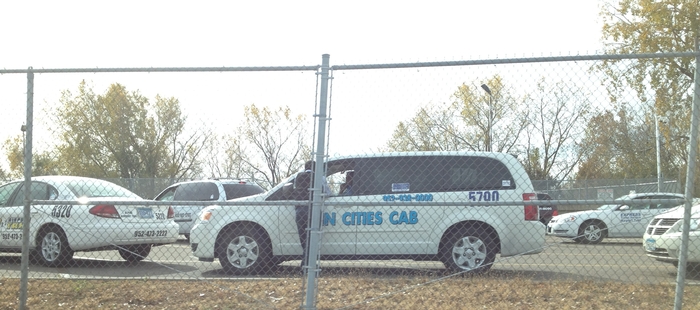 MSP airport drivers waiting their turn. |
Oct. 11, 2006 update: Other Muslim taxi drivers in Minnesota-St. Paul, reports USA Today, have told their dispatchers "not to call them to pick up passengers heading to liquor stores and bars."
Oct. 13, 2006 update: Here is a letter from Bert J. McKasy to a reader who sent in a copy of my article with a note protesting the two-light solution:
Hi XX,
Thanks for the newspaper article.
The two-light solution has been abandoned. We are still looking for a solution that will protect the needs of the traveling public while at the same time attempting to be as sensitive as we can to the Muslim community. Service is and should be the paramount concern.
Regards,
Bert
Oct. 16, 2006 update: I relate today how and why the MAC decided against the two-light scheme in "No Islamic Law in Minnesota, for Now."
Oct. 17, 2006 update: This note went out to my mailing list today:
Dear Reader:
I am grateful to the many of you who answered my request (at "Don't Bring That Booze into My Taxi") to send e-mails with your views about the two-colored taxi lights planned for the Minneapolis airport. As I noted yesterday (at "No Islamic Law in Minnesota, for Now"), your responses were key in the proposal being scrapped.
This unprecedented effort caught the attention of the publishers of the New Pamphleteer, a publishing company just launched with a series on the Hezbollah War. Adam Bellow, president and editorial director at the New Pamphleteer, believes that this successful letter campaign has enduring political and historic importance, so he has asked me to publish a selection of the e-mails. The pamphlets, which are 4" x 6" and average 60-80 pages, are published in association with Pajamas Media.
I will edit and introduce the pamphlet – but first, I need the text of letters sent to the Metropolitan Airports Commission. Could those of you who wrote in and who wish to be included in this compilation, please send two items to me (by hitting "reply" on this e-mail) and also to Adam Bellow, at publishme@pamphletguys.com:
A copy of your letter to MAC.
Confirmation in writing that you are in fact the author of this letter and that you grant permission for it to be reprinted. You can copy & paste the following paragraph:
By affixing my digital signature below (i.e., by typing in my full name) I attest that I am the author of the email submission attached to this letter. I hereby also grant rights to The New Pamphleteer to reprint the submission in print and electronic forms.
Yours sincerely,
Daniel Pipes
Oct. 19, 2006 update: Raoul Schmidiger posted a comment today concerning his experience with a taxi driver in Manama, Bahrain, in 2000:
The taxi driver took me to a liquor store (1 of 3 that existed). When I came back [carrying a six-pack of Heinecken] he told me: "I cannot take alcohol in my taxi." "I don't drink it!" I said. It did not help. I had to walk back to town center. Two hours walk at night. That was in Bahrain and I was the foreigner, so I adapted. For this to happen in the U.S is unacceptable.
Oct. 26, 2006 update: Katherine Kersten, a columnist for the Minneapolis Star Tribune, digs deeper today in "Airport taxi flap about alcohol has deeper significance" to find where the taxi flap originated. She starts by hanging out with the Somali taxi drivers at a Starbucks, where they make clear the ban on alcohol-totting passengers was not their own idea.
An animated circle of Somalis gathered when the question of the airport controversy was raised. "I was surprised and shocked when I heard it was an issue at the airport," said Faysal Omar. "Back in Somalia, there was never any problem with taking alcohol in a taxi." Jama Dirie said, "If a driver doesn't pick up everyone, he should get his license canceled and get kicked out of the airport." Two of the Somalis present defended the idea that Islam prohibits cabdrivers from transporting passengers with alcohol. An argument erupted. The consensus seemed to be that only a small number of Somalis object to transporting alcohol. It's a matter of personal opinion, not Islamic law, several men said.
Ahmed Samatar, described by Kersten as a nationally recognized expert on Somali society at Macalester College, confirms this consensus:
There is a general Islamic prohibition against drinking, but carrying alcohol for people in commercial enterprise has never been forbidden. There is no basis in Somali cultural practice or legal tradition for that. This is one of those new concoctions. It is being foisted on the Somali community by an inside or outside group. I do not know who.
To solve the mystery, Kersten went to the source:
When I asked Patrick Hogan, Metropolitan Airports Commission spokesman, for his explanation, he forwarded a fatwa, or religious edict, that the MAC had received. The fatwa proclaims that "Islamic jurisprudence" prohibits taxi drivers from carrying passengers with alcohol, "because it involves cooperating in sin according to the Islam." The fatwa, dated June 6, 2006, was issued by the "fatwa department" of the Muslim American Society, Minnesota chapter, and signed by society officials.
The society is mediating the conflict between the cab drivers and the MAC. That seems odd, since the society itself clearly has a stake in the controversy's outcome.
How did the MAC connect with the society? "The Minnesota Department of Human Rights recommended them to us to help us figure out how to handle this problem," Hogan said.
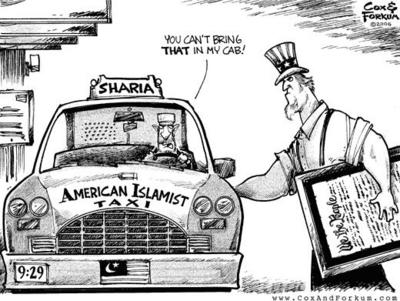 Cox & Forkum handle the taxi issue. |
MAS is an Arab group; we Somalis are African, not Arabs. MAS wants to polarize the world, create two camps. I think they are trying to hijack the Somali community for their Middle East agenda. They look for issues they can capitalize on, like religion, to rally the community around. The majority of Somalis oppose this, but they are vulnerable because of their [weak] social and economic situation.
Kersten then provides an excellent overview of the MAS, drawing on an important Chicago Tribune investigation from 2004 (the same one I used as the basis for my article, "The Islamic States of America?) and the 9/11 commission report. She contacted the local affiliate of the MAS and learned something about its ambitions:
Hassan Mohamud is vice president of the society's Minnesota chapter. The society is independent and has no connection with the Muslim Brotherhood, he said. The Minnesota chapter's website, however, states that the organization's roots lie in the Islamic revival movement that "brought the call of Islam to Muslim masses ... to reestablish Islam as a total way of life."
Mohamud says the society has three goals: to present the "real image" of Islam in American society, to preserve the identity of Muslims here and to "make that identity fit without having clashes between cultures and laws." He emphasizes, however, that Muslims must follow shari'a, or Islamic law, in every aspect of their lives. "There are two conflicting systems here—two ways of life—that want to live in the same place and respect each other," he says. The society aims to facilitate conciliation between the two.
Mohamud adds that Americans need to learn about Islamic law because the Muslim population here is growing. That's why the proposed two-tier system for airport cabdrivers is important, he says. It could become a national model for accommodating Islam in areas ranging from housing to contractual arrangements to the workplace. MAC officials will hold another meeting today about the airport controversy, and Mohamud says he will try to revive the two-tiered pilot project for taxis.
Kersten concludes: "Whatever the meeting's outcome, we now have reason to believe that the issue is only a prologue to a larger drama playing out in Minnesota and the United States." Precisely. Congratulations to Katherine Kersten for bringing to light this important information and for seeing its larger implications.
Oct. 27, 2006 update: The Muslim Brethren office in London states it has nothing to do with the taxi flap. Here is the key part of its press release, "MB Denies Involvement In The Somali Cab Drivers Controversy," written by Khaled Salam in New York, with bolding and italics as in the original.
The Muslim Brotherhood (MB) completely denied any involvement in the current dispute caused by a group of Somali Muslim cab drivers at the Minneapolis-St. Paul International Airport, U.S.A, who are refusing to pick up passengers carrying alcoholic beverages claiming that Islam prohibits them from driving passengers with Alcohol.
Dr. Mohamed Habib, the first Deputy Chairman of the Muslim Brotherhood, affirmed that Muslim Brotherhood has nothing to do whatsoever with what these Muslim cab drivers believe or view mistakenly as religious decree. Dr. Habib Said "Muslims must respect and comply with the laws and regulations of the countries they live in and be a good example for their fellow citizens" .
Several organizations and media outlets in the U.S, driven by their own hatred towards the Muslim Brotherhood, have been engaging in a smear campaign and trying disparately to link the Muslim Brotherhood to the current controversy, which the MB has nothing to do with.
These laughable and despicable reports have capitalized on the controversy they helped to create in the first place and frantically panicked about what they called "the Muslim Brotherhood project to islamize the U.S by imposing the Sharia Law on Americans", which is utterly ridiculous.
Muqtedar Khan, assistant professor at the University of Delaware.
Nov. 24, 2006 update: The unpredictable Muqtedar Khan has an impressive article today, "Imposing Islam on Americans," in the Daily Times of Pakistan, where he muses on the Minnesota taxi issue. (The square brackets are in the original publication.)
Imagine if you have just flown in from Baghdad after a long flight. You can't wait to get home, reconnect with your family, and share with your wife a glass of some exotic alcoholic drink that you purchased at Dubai airport [a Muslim country] to celebrate your return home alive from Iraq. It is 2.00 AM but your reunion is delayed because cab after cab, driven by Muslims, refuses to take you home once they spot you carrying alcohol.
Sounds crazy, but sadly it is true. As a Muslim I am both ashamed and shocked at this strange conduct of my coreligionists. In principle Islam does not advocate imposition of Islamic values on others; there are several injunctions in Islamic sources which make this clear. To cite only two; "Let there be no compulsion in religion" [Quran: 2:256] and "To us shall be accounted our deeds, and to you, your deeds. Let there be no contention between us and you: God will bring us all together — for with Him is all journey's end" [Quran, 42:15].
Khan then refutes the specific issue related to alcohol:
Islamic sources do forbid alcohol consumption unequivocally [Quran 2:219] and Prophet Muhammad (may peace and blessings be upon him), also forbid trade in alcohol [Bukhari 34:297, 8:449, 34:429]. But all these sources forbid selling and trading alcohol. Extending this ban to giving rides to tired travellers carrying alcohol for personal consumption requires an irrational and politically motivated leap that smells of mischief. Moderates and Muslims of goodwill should not stand for such thinly veiled attempts to sow discord.
Most Muslim scholars and most Muslims of Minnesota say the fatwa is without merit. And indeed many Muslim voices, present writer included, have already condemned and ridiculed this position. Even in Saudi Arabia, which is usually the champion when it comes to extremely narrow, irrational and intolerant interpretations of Islam, non-Muslims are allowed to consume alcohol, and even carry them on flights.
To his credit, Khan then generalizes from this specific incident:
The alcohol issue is not really the problem. It is just a tip of the iceberg. It raises a fundamental and critical issue: can Muslims who live in free and democratic societies, simultaneously demand freedom and tolerance for Islam while denying others the same. Can we, and should we, demand freedom to practice Islam and then turn around and use these same freedoms to impose anachronistic understandings of Islam on others.
What next? Will Muslim doctors working in ER refuse to administer to patients brought in from an accident site or with a heart attack because they have alcohol on their breath? Will Muslim doctors refuse to serve an HIV-positive patient because he or she is gay? Will Muslim fire fighters refuse to save people who are caught in a fire in a place that sells alcohol? Will Muslim cops refuse to protect women who do not wear Hijab [head scarf]? Will Muslim teachers refuse to educate children because their mothers do not wear the veil? All of the above would entail supporting sin according to popular Muslim beliefs.
This in turn leads him to a more general question – "Can Muslims live with those who do not share their beliefs?"
This is an important debate, especially for Muslim immigrants, who come to America with their religious baggage. Are we here to give our families a better life or are we here to convert America into an Afghanistan under the Taliban? Do we want to use American freedoms to learn about Islam and practice it in an intimidation-free environment, or use it to spread the disease of religious intolerance? Will Muslim presence in America strengthen or subvert it?
American Muslims have the opportunity to demonstrate that not only is Islam a religion for all times and all places but is not a threat or trial for others. We can prove that Muslims can live in harmony with non-Muslims and that the thesis of the clash of civilisations is bogus.
America, in spite of its faults, its limitations and even its sins and sinners, is easily the best place to live on earth. If you do not believe me, then ask the millions of Muslims desperate to leave their countries, their families and their societies to come to America.
The thing most precious about America is not its capitalist nature or its wealth; it is the first amendment. The ideal of freedom of religion and thought in America has allowed it to become a society that most people in the world aspire to emulate and live in. The principle of freedom of religion allows Muslims to practice Islam. In essence there can be no faith without freedom; it must therefore be guarded very jealously.
Returning to his opening example, Khan concludes that "At 2:00 AM in the morning, we cannot leave you hanging in the cold waiting to go home, it would be inhuman."
Feb. 6, 2007 update: The Metropolitan Airports Commission posted an announcement today: "Notice of Public Hearing on Taxicab Ordinance 102: Increasing Refusal of Service Penalties."
Feb. 13, 2007 update: A reader sent me a response received today from the Metropolitan Airports Commission:
From: EHermann@mspmac.org
Subject: [The taxi issue at MSP]
Date: February 13, 2007
To: XXThank you for your note regarding taxi service issues at Minneapolis-St. Paul International Airport.
The Metropolitan Airports Commission's focus is on ensuring all the airport's customers are well served by businesses operating at the airport.
Our taxi ordinance requires drivers to serve everyone unless they are significantly impaired by drugs or alcohol or pose a threat to the physical safety of the driver. In most cases the current penalty for refusing a customer is that the driver loses the fare opportunity and returns to the back of the taxi queue, sometimes waiting two to three hours for the next turn. However, that penalty has not proved sufficient to gain compliance by all taxi drivers.
For the past several months, the Metropolitan Airports Commission has worked with airport taxi industry representatives and with leaders from the Muslim American Society and the Somali Justice Advocacy League. The goal was to find a solution acceptable to everyone and transparent to the customer seeking airport taxi service. Unfortunately, those discussions have not resulted in a workable, voluntary, consensus-based solution. As a result, the Airports Commission is proposing stricter penalties for refusal of service: a 30-day suspension of a driver's airport taxi license for the first instance, and license revocation for a second instance.
A public hearing will begin at 2 p.m. on Tuesday, February 27, 2007, to solicit testimony from the public on the proposed increase in penalties. Hearing officers will likely break for dinner at 5 and return at 6 for additional testimony. The hearing will take place at the
Ramada Mall of America (formerly known as the Thunderbird Hotel)
2300 East American Boulevard
Bloomington, Minnesota.Anyone with an interest in the issue is welcome to provide verbal or written testimony at the hearing.
The public hearing record will remain open from the date of the hearing until 12 p.m., Friday, March 2, 2007 for people who want to provide written comments regarding the proposed ordinance change. Comments should be addressed to:
Landside Operations Department
Metropolitan Airports Commission
MSP International Airport/Lindbergh Terminal
4300 Glumack Drive
Suite LT-3129B
Saint Paul, MN 55111-3010.The Metropolitan Airports Commission board will consider input from the public in making a decision on any changes to our taxi ordinance and penalties.
Again, thank you for taking time to share your concerns on this issue. Feel free to visit our Web site, www.mspairport.com, for more information. Minneapolis-St. Paul International Airport has long been recognized as a leader in airport customer service. We are working to ensure cab service at the airport meets or exceeds our customers' expectations as well.
Comments: (1) It is heartwarming to see that MAC so clear-sightedly understands the issue and found its way to proposing stricter penalties for free-lance application of the Shari'a. (2) I urge readers to attend the meeting on February 27 and to write MAC by March 2.
Feb. 20, 2007 update: Building on the MAC statement quoted above, I sent this note out to my internet list today:
Dear Reader:
A further decision is due in the controversy over taxi drivers at the Minneapolis-St. Paul International Airport who refuse to transport passengers visibly carrying alcohol. The Metropolitan Airports Commission, which has jurisdiction over the drivers, invites the public's opinion; and I urge your involvement.
MAC has sent a notice (which I have posted in full on my website, at https://www.danielpipes.org/blog/679#meeting) that recounts developments since its decision in October 2006 to deny requests by drivers to distinguish between Shar'i-compliant and –noncompliant taxis. MAC writes:
For the past several months, the Metropolitan Airports Commission has worked with airport taxi industry representatives and with leaders from the Muslim American Society and the Somali Justice Advocacy League. The goal was to find a solution acceptable to everyone and transparent to the customer seeking airport taxi service. Unfortunately, those discussions have not resulted in a workable, voluntary, consensus-based solution. As a result, the Airports Commission is proposing stricter penalties for refusal of service: a 30-day suspension of a driver's airport taxi license for the first instance, and license revocation for a second instance.
Bravo to MAC. It is important that the drivers be sent a strong signal that they must obey the regulations. Were they allowed to boycott travelers with alcohol, I pointed out in "Don't Bring That Booze into My Taxi," that would intrude Islamic law "into a mundane commercial transaction in Minnesota" and could lead to the transport system as a whole being divided "between those Islamically observant and those not so."
I appealed to readers in October to urge MAC to impose penalties on those who insist on imposing Shar'i norms in Minnesota and to send a message that this practice is unacceptable. The barrage of e-mails and phone calls had the hoped-for effect. According to airport spokesman Patrick Hogan back then, "we've heard from Australia and England. It's really touched a nerve among a lot of people. The backlash, frankly, has been overwhelming. People are overwhelmingly against any kind of cultural accommodation."
Again now, I appeal to all those opposed to application of the Shari'a in the United States to make their views heard in Minnesota. You can do this in either of two ways.
In writing: MAC is asking for "input from the public" through Friday, March 2, 2007, before it makes a decision on the proposed increase in penalties. Written comments should be addressed to:
Landside Operations Department
Metropolitan Airports Commission
MSP International Airport/Lindbergh Terminal
4300 Glumack Drive
Suite LT-3129B
Saint Paul, MN 55111-3010.
In person: For those living in the Twin Cities area, MAC will hold a public hearing on Tuesday, February 27, 2007, at 2 p.m., to solicit testimony from the public via verbal or written testimony. The location will be at:
Ramada Mall of America (formerly, the Thunderbird Hotel)
2300 East American Boulevard
Bloomington, Minnesota
I thank you in advance.
Yours sincerely,
Daniel Pipes
Members of an audience, made up of many Muslim cab drivers, listen during a Metropolitan Airport Commission hearing on Feb. 27, 2007.
Feb. 27, 2007 update: MAC met today and listened to testimony on taxis and alcohol-bearing passengers. The Associated Press account stresses that "Muslim cabbies tell airport they won't bend in alcohol dispute," with examples of what the dozens of them who showed up for the hearing had to say.
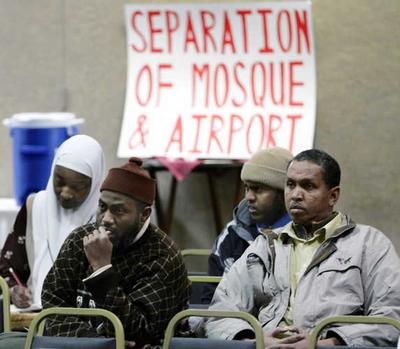
For Abdi Mohamed, it's not a question of whether he'll carry passengers with alcohol in his cab. The question is whether he'll get punished for refusing to do so. "I am Muslim. I'm not going to carry alcohol," Mohamed, a driver for Bloomington Cab, told a Metropolitan Airports Commission panel. …
Hassan Mohamud, a Muslim imam and adjunct law professor at William Mitchell College of Law, said the Muslim cab drivers are only trying to support their families, both here and in their strife-torn home country, and are being placed in an impossible situation. "If we pass this (policy) it means cutting off the lifelines of thousands of people," Mohamud said.
Airport director Steve Wareham said the policy should be viewed as a public safety issue. "Refusals of service can lead to customers wandering through lanes of traffic looking for another taxi," he said.
Abdifatah Abdi, who said he is counseling cabdrivers on legal issues related to the controversy, warned commissioners that instituting the penalty would set off a long legal battle. "This is a religious freedom issue, and it will not end here," Abdi said. "It will go to the courts, even the Supreme Court. The drivers will not relinquish their rights to be protected under American law."
Steve Wareham, the MSP airport director, said that tougher penalties are needed to ensure reliable cab service. "Our stance is first come, first served. The message is if you want to drive a taxicab at Minneapolis-St. Paul International Airport, you will serve all customers."
Douglas Bass assesses the meeting in his blog, "Metropolitan Airport Commission Public Hearing." He notes that the media was out in good force, with reporters from the Associated Press, the local Fox television station, the Minneapolis Star-Tribune and the St. Paul Pioneer-Press. Wareham announced that MAC had received 1,500 emails encouraging the stronger penalties. Arle Johnson, the director of airport ground transportation, told some stories and drew an apt conclusion:
There was someone who was refused a ride in two taxis, and when he got a ride in a third, one of first two refusing cabbies called the third cabbie on a cell phone, saying he might be carrying alcohol, which resulted in a severe questioning by the third cabbie. A Build-Your-Own teddy bear box was thought to have alcohol, and was the reason for a refusal. Johnson mentioned that this problem doesn't exist in other places in the Islamic world, and that no other US airports have this situation where cabbies are refusing passengers carrying alcohol. He mentioned that this situation cuts both ways. If some cabbies refuse passengers for various reasons, cab riders could start refusing cabbies for various reasons
Bass ponders what he witnessed:
This meeting started at 2:00, and was still going at 5:00 when I left. I grasp that the Metropolitan Airports Council is amassing ammunition to smack down the cabbies with these rule changes. I grasp that the cabbies and the Muslim activists have different agendas: the cabbies have a war going on with the MAC over various things, and the whole refusing-riders-with-alcohol thing is another front in their war with the MAC, while the Muslim activists are exploiting the various discontents of the cabbies for their own purposes. But the cabbies did not succeed today in portraying themselves as sympathetic victims wishing merely to practice their First Amendment rights.
Pat Hogan, the airport's spokesman, has indicated that the commission plans to vote on the proposal at its April meeting. If the new regulations are voted in, they would take effect on May 11, when taxicab permits are renewed.
Internet polls are not scientific, but it bears noting that the Minneapolis Star Tribune poll asking "Should taxi drivers be penalized for refusing fares?" finds 96 percent saying yes, they should be, 3 percent saying no, and 1 percent undecided. For those wishing to vote, click here.
Mar. 2, 2007 update: Hogan is quoted in a biographical sketch of me today in the Jewish Journal of Greater Los Angeles, saying he is "sure [I] helped bring attention to" the taxi issue.
Mar. 11, 2007 update: "Why here?" asks an interesting article by Emily Gurnon in the St. Paul Pioneer Press, noting that cabbies refusing to transport passengers with alcohol is unique in the United States to the Twin Cities.
Officials at several other airports — including in New York, Chicago, Los Angeles and San Francisco — said the issue has never been a problem. "That has not occurred once that we've heard of," said Michael Conway, director of public affairs for the Detroit Metropolitan Wayne County Airport. "If we were to have that problem, we would go to the company and say, 'Cab 435 refused a fare, and that's a violation of the contract.' "
Martin Mohamed of the Immigrant Credit Education and Financial Counseling Agency in Minneapolis has one explanation: "There is a group of orthodox Islamic groups who are using the Somali community. We have seen this all the time. They want to make their own political agenda here, using the Somali cabdrivers." Omar Jamal of the Somali Peace and Justice Center in St. Paul agrees: "The Twin Cities has become — more than any other city — the center of fanaticism and extremism as far as Somalis are concerned." Alcohol in cabs "is not an issue at all for most of the Somali community, but [some leaders] use that as a political platform" with the intend to raise money and gain influence.
In contrast, Abdirahman Omar Ahmed, imam at the Abuubakar Islamic Center in South Minneapolis, said to have the largest Somali membership in the area, offers a more benign explanation: "It's not for radical purposes. They are talking about their faith, nothing else." Ahmed had counseled the drivers not to carry alcohol and this opinion helped mold the edict subsequently pronounced by the Muslim American Society of Minnesota.
Gurnon also digs up a noteworthy aside. Saeed Fahia, executive director of the Confederation of Somali Community of Minnesota, Either way, worries the controversy will hurt Muslim employment. "I'm concerned that when I try to place a woman in a factory or a person on an assembly line, I worry that the employer will think: 'Oh, don't hire this person; they might want to change the rules of the work site.' You don't want that kind of baggage."
Comment: My take on "why Minneapolis-St. Paul?" is similar to that of Martin Mohamed and Omar Jamal; an ambitious and radical imam decided to exploit some pious and credulous taxi drivers.
Mar. 12, 2007 update: I have just completed a 5-day visit to Copenhagen, Denmark, and Malmö, Sweden, and to my considerable surprise, this issue of the Minnesota taxis came up in my public talks, in media interviews, and in private conversations. I don't know if it's the Scandinavian connection, but the issue clearly resonates beyond the American borders.
Apr. 16, 2007 update: MAC met today and decided by a 11-0 vote that, starting on May 11, to suspend the work license for 30 days when airport taxi drivers refuse to transport riders carrying alcohol. After a second offense, their work license will be revoked for two years. Commissioners deemed the change reasonable, practical and important for rider safety. "We are sending a message that if you want to drive a taxi at our airport you can't refuse our customers," said Steve Wareham, the operations manager of Minneapolis-St. Paul International Airport. A lawyer representing the Muslim drivers, Jeff Hassan, said they might appeal the decision to the Minnesota Supreme Court.
Along with its story, posted today in the late afternoon, the Minneapolis Star Tribune also posted an instant (i.e., non-scientific) poll asking "Should the commission pass the taxi proposal?" About five hours later, 4,265 readers voted in favor of the decision, 124 against, with 22 don't knows. That makes for an overwhelming a 97-3 ratio.
Comment: Whoever wishes to congratulate the Metropolitan Airports Commissioners can reach it at publicaffairs@mspmac.org.
Apr. 17, 2007 update: In an update to the story published yesterday, MAC's chairman, Jack Lanners, tells of an e-mail he received from a father taking a taxi home from the airport with two children. When the father casually mentioned that he had wine in his luggage, the driver refused to carry the liquor further, so the man and his kids were "deposited on the street somewhere in the dark of night." Lanners called this "a safety issue" and it appears to have influenced at least his vote.
June 12, 2007 update: Continuing with its new, reasonable approach, CAIR's Ahmed Rehab dismissed the taxi drivers' concerns by saying they depend on a "strict and rigid" interpretation of the Islamic law.
June 13, 2007 update: Well, the new rules have been implemented for a month now, without mishap.
The commission that runs the Minneapolis airports in May began enforcing a new policy allowing it to revoke the licenses of drivers who refuse to ferry passengers carrying alcohol—something that has happened to 4,854 travelers trying to get a cab at Minneapolis International Airport in the last five years. "The increased penalties appear to have brought drivers into compliance," airport spokesman Patrick Hogan said of the policy. … Hogan said the measure was implemented without incident.
Sep. 9, 2008 update: The Minnesota Court of Appeals ruled today against the Muslim cabbies who had hoped to stop the 30-days and 2-years punishments for refusing to transport alcohol-carrying passengers. In so doing, the appeals court agreed with a lower court's decision that the cab drivers do not suffer irreparable harm.
May 10, 2010 update: The problem was solved in Minnesota, only to turn up in Oxford, England, Emily Allen reports in the Oxford Mail:
Royal Cars, based in Cowley Road, were called to pick up Helen Russell from the Sainsbury's supermarket at the Westgate Shopping Centre, in central Oxford and drop her in Abingdon Road, at a friend's house. However, when the driver saw her shopping contained two cases of lager, he refused to take her claiming it was against his religion.
Royal Cars manager Niaz Mohammed said he was aware of the incident and that he had apologised to Mrs Russell, who was picked up and taken to her destination by another driver. He said it was not company policy to refuse customers carrying alcohol. Mrs Russell, who had to wait 20 minutes for another taxi, said she did not know what religion the driver belonged to, but the 49-year-old said she felt like she had offended him. … The teaching assistant, of Kingfisher Green, Greater Leys, said:
He said, 'I'm sorry, I can't take you because it's against my religion'. He was looking at the alcohol. "I thought, 'What difference does it make if I've got alcohol?' I just couldn't believe it. I'm a regular customer and never have I had this before. A lot of people I've spoken to about this say people shouldn't use religion as an excuse for anything. This country is going to pot. It's all about religion. … How can society allow this to happen? I just can't accept it.
The taxi company apologized for the inconvenience. Comment: Note how neither the reporter nor the passenger mention which religion.
Jan. 27, 2011 update: And now the problem rears its ugly head in Sheffield, England, reports Jerry Lawton in the Daily Star Sunday:
A Muslim taxi driver kicked a woman out of his cab because her shopping contained a 12-pack of lager. Alison Dawson had just climbed in with her son and six bags of shopping when the cabbie saw the beer and said: "You're not getting in with that." The stunned market stall holder was forced to haul her belongings out of the cab and across the rank to another taxi. She said: "The driver looked at the beer and said: 'You're not getting in this cab. You can go and get in another one.' I was panicking because my nine-year-old son Lukas was not very well and I wanted to get home quickly."
The 46-year-old furious mum, from Sheffield, has now complained to taxi licensing bosses. "I was absolutely gobsmacked," she said. "I'm sure he wouldn't let me in because of his faith and I had alcohol. I am not prejudiced but if he is a taxi driver he should do his job. I'm a strict vegetarian and work on a farm stall. I don't say I am refusing to serve sausages just because I don't eat them. I don't believe in any sort of discrimination. Does he stop people getting into his taxi when they have been in a pub?"


