
I have long argued that the presence of Jews living on the West Bank does not present a problem to a resolution of the Arab-Israeli conflict, for a true resolution would allow them to live peaceably in a Palestinian state. We'll know the conflict has ended, I have been saying since at least 2003, when the Jews of Hebron have no more need for security than the Arabs of Nazareth.
So, I read with considerable interest that Salam Fayyad, who calls himself the prime minister of the Palestinian Authority (a title I do not use, by the way), said roughly the same thing at a meeting of the Aspen Institute's Aspen Ideas Festival on July 4.
According to "Palestinian prime minister: Jews would be welcome in future state" by Brent Gardner-Smith in the Aspen Daily News, former CIA director James Woolsey noted that a million Arabs in Israel account for one-sixth of the Israeli population and that they "generally they enjoy the guarantees that Americans look for in the Bill of Rights." He went on to ask:
Now, if there is to be the rule of law in a Palestinian state, and if Jews want to live in someplace like Hebron, or anyplace else in a Palestinian state, for whatever reasons or historical attachments, why should they not be treated the same way Israeli Arabs are? That would be, there could be a sixth of the population consisting of them. They could vote for real representatives in a real Palestinian legislature, freedom of religion, freedom of speech, and most importantly, be able to go to the sleep at night without worrying someone is going to kick down the door and kill them.
 Salam Fayyad, "prime minister" of the Palestinian Authority. |
I'm not going to disagree with you. And I'm not someone who will say that they would or should be treated differently than Israeli Arabs are treated in Israel. In fact the kind of state that we want to have, that we aspire to have, is one that would definitely espouse high values of tolerance, co-existence, mutual respect and deference to all cultures, religions. No discrimination whatsoever, on any basis whatsoever. Jews to the extent they choose to stay and live in the state of Palestine will enjoy those rights and certainly will not enjoy any less rights than Israeli Arabs enjoy now in the state of Israel.
Gardner-Smith reports that the crowd "applauded enthusiastically" at this statement.
Comments: (1) I applaud it no less enthusiastically.
(2) But I would like Fayyad to say it not just in English in the rarified air of Aspen, Colorado, but also in Arabic in Ramallah.
(3) Still, this is an important statement and a standard to which to hold the Palestinian Authority.
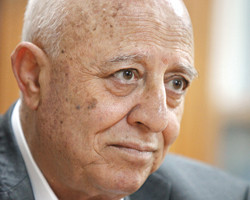
(4) This statement builds on an earlier one by Ahmed Qureia, who heads the Palestinian Authority negotiating team with Israel, published in Ha'aretz on June 30 in which, asked if he thought Israelis would agree to evacuate Ma'aleh Adumim's 35,000 residents, Qureia replied:
Condoleezza Rice told me she understood our position about Ariel but that Ma'aleh Adumim was a different matter. I told her, and Livni, that those residents of Ma'aleh Adumim or Ariel who would rather stay in their homes could live under Palestinian rule and law, just like the Israeli Arabs who live among you. They could hold Palestinian and Israeli nationalities. If they want it - welcome. Israeli settlements in the heart of the territories would be a recipe for problems.
Ahmed Qureia, head of the Palestinian Authority negotiating team with Israel.
It would seem that Americans get told a more generous version than to Israelis. But, to repeat, it's statements made to fellow Palestinians that count the most. (July 5, 2009)
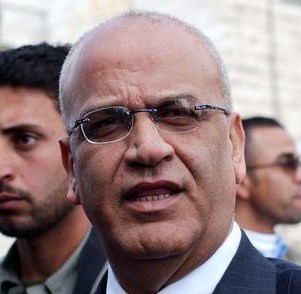
July 13, 2009 update: On June 25, just a few days earlier than Qureia, his colleague Saeb Erekat, head of the Palestinian Authority's negotiations department, said precisely the opposite in Arabic to the Jordanian newspaper Ad-Dustur (as translated today by MEMRI):
nobody should agree to Israeli settlers remaining in the Palestinian [state]. We must not compare a Palestinian [whose family] lived in Palestine [long] before Netanyahu or his forefathers arrived, and who is still living there, to a settler who is living on Palestinian soil [and maintaining his presence there through] coercion, oppression and unacceptable [use of] force. We must not talk of land swap before we establish our sovereignty in practice... Some say that we will [be willing to] grant the settlers citizenship. We reject [this idea] out of hand..."
Saeb Ereqat, head of the Palestinian Authority's negotiations department.
Comment: Fayyad and Qureia spoke in English to Americans and Israelis, while Erekat spoke in Arabic to Palestinians. Which of the three statements would you take the most seriously?
Aug. 1, 2009 update: Susan L. Rosenbluth provides context in the Jewish Voice and Opinion to these inconsistent statements, noting a poll by the Arab World for Research and Development (based in Ramallah and Gaza) of 1,200 Palestinians on June 12-14. AWRAD asked:
In his speech in Cairo on the 4th, President Obama said that Jerusalem should be (a secure and lasting home for Jews and Christians and Muslims." Do you agree or disagree with his statement?
37 percent of respondents agreed, 60 percent disagreed, and 3 percent did not know.
Rosenbluth then quotes an article on July 2 by Jonathan Dahoa-Halevi of the Jerusalem Center for Public Affairs, who points to the difference between Israeli and Palestinian goals, which have created "an inherent imbalance."
The Palestinians have won international recognition for their demand to establish a Palestinian state from which all Jews will be expelled. ... The international community has permitted the Palestinians what it tries to keep from Israel, that is, the Palestinians are within their rights to establish a country based on the religion of the majority of its citizens. ... Human rights champions in shining armor endlessly preach morality to Israel and demand a country for all its citizens while accepting the morality of establishing an apartheid, racist, Palestinian state which openly and proudly states its intention of being Judenrein.
No one contests the right of the Palestinians to a national state even if it is based on racism and it is liable to be an extremist theocracy like Iran, a foretaste of which can be seen in the Gaza Strip since the Hamas takeover. Even the government of Israel headed by Benjamin Netanyahu recognizes that right and demands that the Palestinian state be demilitarized, among other things.
The Palestinian problem, it is assumed, will be solved when the Palestinian state comes into being. The arrangement, lacking in political symmetry based on a genuine compromise, will leave the gates of conflict wide open and the demand for the "return" of millions of Palestinians, which would mean the expulsion of Jews to make room for the refugees, would raise again the wish for self determination of the Jews of Israel.
International politics will no longer have to deal with the "Palestinian problem," but rather, with the "Jewish problem" in Palestine.
Jan. 5, 2010 update: When Salam Fayyad told a crowd in Aspen, Colorado that when it comes to Jews on the West Bank, he believes in "high values of tolerance, co-existence, mutual respect and deference to all cultures, religions." Today, we learn of a different message coming from him while in the West Bank itself, as reported by a Palestinian news agency.
Before tossing goods made in Israeli settlements into a fire on Tuesday, Prime Minister Salam Fayyad affirmed the dedication of the Palestinian Authority to ridding local markets of the goods, and ridding the West Bank of the settlements entirely. ... In his speech, Fayyad explained the long-term destruction the settlement project has on Palestine, and the damage to the Palestinian national project of ending the occupation and establishing a Palestinian state.
Comment: Here is the real Fayyad, the one talking to constituents, not American liberals. He's about as two-faced as two-faced Yasir once was. The July Fayyad was a lie, the January one is real.
Dec. 25, 2010 update: If further proof of Fayyad's dissembling in Aspen were needed, here it is, as reported by the Associated Press:
Palestinian Authority President Mahmoud Abbas on Friday declared during a tour of Ramallah that in the future Palestinian state, "There will be no Israeli presence." He rejected the possibility of Israeli soldiers remaining stationed along the borders of the future state and also expressed opposition to the presence of settlers. "We are prepared to move toward peace based on international resolutions, the Road Map and 1967 borders, but when a Palestinian state is established it will be empty of any Israeli presence," said Abbas.
Dec. 27, 2010 update: Abbas has gone even further. Israel Heute reports his telling journalists in Ramallah:
Wir haben es bereits ganz offen gesagt, und dabei wird es bleiben: Wenn es einen palästinensischen Staat mit der Hauptstadt Jerusalem gibt, werden wir nicht akzeptieren, dass darin auch nur ein einziger Israeli lebt.
We have already said it very openly, and so will it stay: If there is a Palestinian state with Jerusalem its capital, we will not accept even one single Israeli living there.
June 10, 2011 update: Abbas is quoted telling an emergency session foreign ministers at the Arab League headquarters in Cairo in mid-May that "when an independent Palestinian state with Jerusalem as its capital is established, we won't allow the presence of one Israeli in it."
Aug. 11, 2011 update: Abbas told U.S. members of congress he wants seeking a Palestinian state empty of Jewish inhabitants.
Sep. 18, 2011 update: Asked by a reporter about the rights of minorities in a future Palestine, Maen Areikat, the PLO's "ambassador" to Washington replied: "After the experience of the last 44 years of military occupation and all the conflict and friction, I think it would be in the best interest of the two people to be separated."
Jan. 27, 2014 update: Saeb Erekat, the Palestinian Authority's top negotiator in the current round of diplomacy, reiterated the point: "Anyone who says he wants to keep the [Jewish] settlers in a Palestinian state is really saying he does not want a Palestinian state. No settler will be permitted to stay in a Palestinian state, not one, because the settlements are illegal and the presence of settlers on occupied lands is illegal."
Jan. 28, 2014 update: Shelly Yacimovich, former leader of the Labor Party, quoted Abbas telling her in May 2013 that he would not object to Jewish residents of the West Bank remaining and becoming citizens of a Palestinian state.
Feb. 6, 2014 update: For a discussion of the parallel debate within Israeli politics about the desirability of Jews living in a future State of Palestine, see my article today, "Jews Living in Palestine?"


