
Muslim lore has it that dogs, and especially their saliva, are impure, so pious Muslims often avoid the animals (though they are used for hunting, guarding, and guiding). In most circumstances, this repugnance does not present a problem in the West, but it can when seeing-eye dogs are involved, for they have legal rights of entry. Muslim taxi drivers refusing to allow the guide dogs into their cars is a recurring theme, one to be followed here.
Seeing-eye dogs present a problem to many Muslim taxi drivers.
July 1997: A New Orleans taxi driver, Mahmoud Awad, got so incensed at his passenger, Sandi Dewdney, trying to bring a dog into the cab that he physically yanked her out of it by the arm while yelling "No dog, No dog, Get out, get out." He harmed her broken wrist. To this, the Council on American-Islamic Relations (CAIR) replied by pointing out that "the saliva of dogs invalidates the ritual purity needed for prayer" and left it to the scholars of Islam to decide whether a guide dog should be allowed in a cab. The judge, after researching Islamic attitudes and finding no support for the driver's claims, called his behavior "a total disgrace." Awad pled guilty to battery and was sentenced to 120 days of community service at the Lighthouse for the Blind. Interesting that CAIR rushed to defend a Muslim behaving illegally.
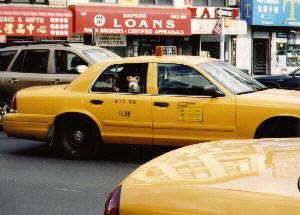
February 1999: Annie McEachrin, blind since birth, tried to get into Hassan Taher's cab in Cincinnati but he refused her dog entry. When McEachrin complained to the city, Taher noted that Islam holds dogs to be impure and CAIR came again to his defense, noting that "People from the Middle East especially, we have been indoctrinated with a kind of fear of dogs. The driver has a genuine fear and he acted in good faith. He's acted in accordance with his religious beliefs."
July 1999: Mary Otten, a blind American Muslim, published "Islam and the Rights of the Disabled" in The Minaret in which she gave several examples of Muslim cab drivers excluding service dogs:
an acquaintance ... had been refused service by taxi drivers on a number of occasions because he uses a guide dog, and these drivers told him their religion prohibited them from serving him, so long as he was accompanied by his dog.
I heard from a woman in a Washington D.C. suburb who stated that she is often unable to get any cab service at all, because a large percentage of the company's drivers are Muslims who refuse her service.
Another woman stated that when she wants a cab, she asks a sighted person to hail the cab as though it was that person who wanted the service, while she stands well back and away from them, so the taxi driver will not think it is she and her dog who actually require the ride.
a New York man ... said that things are so difficult in his area that he is actually considering not getting another guide dog when his current companion dies or is retired.
Then there is the man in North Carolina who was refused service by an airport cab, which refusal was upheld by the local airport authority on the grounds that religious freedom was more important than this man's civil rights.
Otten goes on to plead with her fellow Muslims to be more considerate:
I ask each of you who reads this article to put yourself in the position of the people I mentioned above and the many others whose stories are unknown to me or were not mentioned here. These people depend on their guide and service dogs to do a number of things, making it possible for the dog's owner to live a more independent life, to travel with greater confidence or to perform other tasks which would otherwise require the assistance of an attendant. ... I therefore hope that Muslim scholars and responsible community leaders will join together and make a very clear policy statement on this matter.
October 2000: Another taxi issue arose in Edmonton, Canada, when Khalid Habib Ahmad refused to allow Kelly Fair to take his guide dog into his cab, then claimed, without the necessary proof from an allergist to back him up, an allergy to dog hair. Ahmad also added that as a Muslim, taking a dog in his car conflicted with his religion. The case against Ahmad was dismissed because improperly filed.
July 2001: Lisa Fernandez starts her column in the San Jose Mercury News with the experience of Claude Everett, a blind resident of Oakland, California.
Everett, 47, said his "watershed moment" occurred in August, while he waited more than 45 minutes for a cab in downtown Oakland, only to be told by a dispatcher that he was probably denied service because of his dog. It took him two hours to get home that night by bus. Everett said he complained several times to Friendly Cab, but allegedly got no response. "I felt diminished and belittled," he said. "They did not treat me as they would have a sighted customer."
"Is the problem growing? Are you kidding me? It's out of control," Fernandez quotes Thom Ainsworth of San Rafael's Guide Dogs for the Blind, who is now handling at least half a dozen similar complaints around the United States.
May 2003: Edmonton was also where Doris Owen tried to enter a convenience store belonging to Mohammad Rafiq, a Pakistani who lived in Saudi Arabia for 25 years. Even after being informed by the police that Alberta's Blind Persons' Rights Act mandates guide dogs be allowed into all public places, Rafiq demurred. "This store is also my church, because I pray, I eat ... there, and my religion will not allow dogs to come in my store, or any animal." Owen testified in a January 2004 court hearing against Rafiq that he shouted at her and refused to listen to her discussing her legal rights. Addressing him, she said: "You got mad and angry and you started yelling, 'Get that dog out of here, get that dog out of here.' You didn't give me a chance ... [to explain] what a guide dog means to me, and it means a lot." Found guilty, Rafiq was sentenced to a three-month conditional discharge, "bearing in mind the concerns that Mr. Rafiq has, his cultural background."
Dec. 11, 2006 update: Hanne Beate Misund, 43, born blind and living in Oslo, gets around with her Labrador called Hippie. She recounts a recent experience: "A couple of weeks ago, I needed a taxi from the Central Station. When I got to the taxi queue, drivers began to argue over who would take me. No one would. I have repeatedly heard that they have locked the door and run away when I tried to get a taxi ride. This is both annoying and desperate."
Sverre Fuglerud of the National Blind Association reports that similar problems have been heard of in other Norwegian towns, such as Fredrikstad, Drammen, Stavanger, and Bergen. The association has relied on seeing individuals to document over 20 cases in which taxi drivers have driven right by a blind person with a guide dog.
Mar. 1, 2007 update: The seeing-eye dog issue came up in the course of the Minneapolis controversy of Muslim taxi drivers having to take travelers carrying liquor.
Airport director Steve Wareham said some drivers refuse to transport customers with service dogs. ... One after another, taxi drivers denied refusing to carry people with service dogs. Abdinoor Dolal, a taxi driver who said he's in favor of a penalty for "unauthorized fare refusals," said the service dog issue is thrown into the debate "tendentiously." More than 50 taxi drivers who attended the hearing clapped in support of Dolal when he offered a free ride to the 300 blind people with guide dogs who are expected to come to the Twin Cities for a convention in July. ...
Rebecca Kragnes, president of Minnesota Guide Dog Users, said blind people like her are facing "overt refusals" and "covert refusals." The first is when a driver blatantly refuses to carry animals. The latter, she said, is when a driver seamlessly bypasses a blind person with a dog. "Though both forms of refusals are bad, the latter is particularly frustrating for blind people and is hard to detect." she said.
Mar. 30, 2007 update: Minneapolis-St. Paul International Airport, scene of much disputation concerning Muslim taxi drivers, has also had a problem with seeing-eye dogs being refused into taxis. Airport spokesman Pat Hogan indicates three formal complaints have been made to the airport concerning guide dogs being refused rides. CAIR has figured out that there's no benefit in this particular fight and has jumped on the other side of this issue. Under its guidance, some 300 cabbies have volunteered to provide free rides to blind people and their guide dogs during a meeting of the National Federation of the Blind's Minnesota chapter on April 21, hoping thereby to improve their reputation. But Joyce Scanlan, president of the chapter, responded coolly to the offer, saying she would prefer the cabdrivers simply do their jobs. "We really are uncomfortable with that, with the offer of getting free rides. We don't think that solves anything. We believe the cabdrivers need to realize that the law says they will not turn down a blind person."
Apr. 2, 2007 update: Fjordman translates an article from Norway's Aftenposten that LittleGreenFootballs.com published.
Blind woman Gry Berg, accompanied by her guide dog, was denied entry into four taxis in the center of the city of Oslo, Norway, this March. Three of the drivers claimed that their unwillingness to accept her dog was due to allergy, while the fourth one simply locked the car doors and refused to give an explanation for why he wouldn't let Ms. Berg into his cab.
Andreas Strand, leader of the youth organization of The Norwegian Association of the Blind and Partially Sighted, reacts strongly to this treatment. "It makes it difficult for blind people to live a social life," he says. Strand claims that it has become an increasingly common problem that blind people accompanied by guide dogs are denied access to taxis, and has written a letter of complaint to the three companies whose drivers were involved in this particular incident.
Now, the police and the local transportation authorities will cooperate on punishing drivers who refuse to accept dogs into their cars. Director Odd Bratteberg of the Transportation Authority in Oslo warns that they will conduct random tests at taxi stands, and that drivers who refuse to accept passengers with dogs risk having their license revoked.
Apr. 20, 2007 update: Victor C. Harris, who is legally blind, writes me from Everett, Washington, about his experience with a seeing-eye dog. Harris has peripheral vision of 4 degrees and anyone with less than 20 degrees peripheral vision is blind; but he sees with 20/40 central acuity.
On December 1, 2004, Harris called a taxi to go home from the Everett CenterEvents. When he tried to get into a Yellow Cab, the driver refused to open the doors, only lowering his window to say he would get Harris another cab, as he did not carry dogs. Harris told him that he had a service animal and therefore could not legally be refused transportation. The driver nonetheless again would not let him in. When Harris asked for the driver's name and a card, the cabbie warned him to step away from the car and took off. Harris wrote down his For Hire number and contacted the police. After much toing-and-froing, nothing came of his complaint, except that Yellow Cab of Everett apologized and gave him two vouchers for local trips. The company specifically refused to dismiss the driver, saying that it preferred to train him rather than hire someone new.
May 24, 2007 update: In what appears to be a first in the Western world, Australia's New South Wales government has imposed a fine of up to A$1,100 should taxi drivers refuse service to passengers with seeing-eye dogs because of "religious" reasons, fear of dogs, or supposed allergies. In addition, Transport Minister John Watkins announced that all taxi drivers will "receive a session with a disability service advocate as part of their training."
Human Rights and Disability Discrimination Commissioner Graeme Innes, himself blind and reliant on a guide dog, said he is refused service on average once a month, including twice in two days recently. "He has been told on a number of occasions that it would be against a driver's religion to allow a dog in the cab," writes Heath Aston in Australia's Daily Telegraph. "He has also been refused by drivers claiming to be allergic to dogs and even scared of dogs. He has also been left clutching at air on busy Market St by one belligerent driver who told him he had to take the non-existent cab in front."
Vision Australia's head of policy and advocacy Michael Simpson concurred, saying that taxi drivers refuse to take guide dogs with "too much regularity," noting that the problem is worse in the Sydney area: "It is fair to say that the [Islamic] religion has made the problem worse in the metropolitan areas than regional areas, where I've found taxi drivers are generally excellent." Simpson, who is blind, told an anecdote of his and two blind companions being refused service at the airport. "We asked the driver for his accreditation number and he gave us the wrong one. It was only because an airline staff member had accompanied us that we got the right number and could properly complain about being refused." May 16, 2010 update: The New South Wales District Court fined this cabbie A$750 in March 2010.
May 24, 2007 update: Australia's Transport Minister John Watkins has elaborated further on his decision to fine errant hacks:
If you can't actually serve the customers in greatest need those - people with some form of disability - well, you shouldn't be in the job. I'm committed to doing something about this. It is an intolerable thing. I need to make the point very clear to the taxi industry and to taxi drivers. This is illegal, with a fine of up to $1100.
June 14, 2007 update: Sallahaddin Abdullah, 40, was fined £200 and ordered to pay £1,000 court costs in Cambridge, England, for abandoning Paul and Kerry Monaghan, plus their guide dogs, on the pavement outside Cambridge Railway Station. Abdullah may also lose his taxi license.
The married couple were stranded as they tried to make their way to Addenbrooke's Hospital for an appointment on August 15 last year. Abdullah told Cambridge Magistrates' Court: "Sorry, I sneeze; my religion" before taking another passenger from the queue and driving away. The court was told this was to imply he was allergic to dogs. The stunned couple, from North Walsham in Norfolk, are both registered blind, and Mrs Monaghan is also deaf. The next taxi driver at the rank picked up the couple and took a note of Abdullah's cab number so they could make a complaint.
Bruce Gilmour won a settlement from a Vancouver taxi company and got the regulations changed.
Aug. 16, 2007 update: When Behzad Saidy, a taxi driver in Vancouver, British Columbia, refused service to Bruce Gilmour, 49, and his seeing-eye dog (for details, see the Nov. 15, 2006 update, above), he did so on the grounds that he drove a no-pet cab. Saidy later explained that being a Muslim means he must not associate with dogs, on the basis that they are "unclean." He subsequently found an imam who stated on his behalf that "Islam holds some restrictions toward certain animals, including dogs."
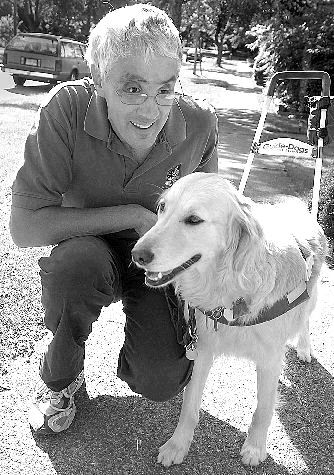
Gilmour, blind for 30 years, responded with a human rights complaint alleging discrimination. Three days before the provincial human rights tribunal hearing was to take place, however, Gilmour and Saidy's employer, North Shore Taxi, reached a C$2,500 settlement, which the tribunal then issued as an order.
The settlement says it balances "the rights of persons with seeing-eye dogs to obtain taxi service with the rights of Muslims to follow their religion" by establishing a policy that forbids any driver to refuse a fare from a blind person accompanied by a certified guide dog unless drivers (1) are allergic to dogs or (2) can establish that they have an "honest religious belief (Muslim) which precludes them from transporting certified guide dogs." In such cases, drivers must to give their name to the blind person, call the dispatcher, ask for "the next available cab," and stay with the blind person until that cab arrives. Not following these regulations one time means suspension for two shifts; a second violation could lead to termination of employment.
Comments: (1) "It's a landmark in my life," a happy Gilmour responded to the change in rules, but it is hard to see what he has achieved. Yes, blind passengers will not have to inform the dispatcher of their disability and he will wait with the reluctant driver by his side, but practically speaking, anyone wanting to make an appointment or a flight on time will have to inform the dispatcher that he's got a guide dog so as to avoid standing on the sidewalk for a half hour. The Shari'a would seem to rule in this instance.
(2) Gilmour indicated his intent to donate about a quarter of his monetary settlement to the Az-Zahraa Islamic Centre to thank its imam, Javed Jaffri, for researching the dog topic and offering to serve as his expert witness. According to Gilmour, Jaffri "spent long hours on this. He provided an unbiased interpretation of the Koran that indicated there is nothing saying that one must refuse service to another person because of the fear of contamination by a dog."
Aug. 21, 2007 update: Bill Jurek of Chicago remembers how the problem and his engagement with it started in about 1996:
he was working late at a radio station and needed a ride home. He and a friend stood outside on Michigan Avenue to hail a cab. But when the driver pulled up and learned about a third passenger, a guide dog, he refused. "I was leaning in the car to talk to him and he started driving away," Jurek recalled. ...
Six months later, Jurek got involved in an undercover program produced by NBC through his job as a newsman and announcer for the network. Acting as decoys, Jurek and another woman who worked with the Guild for the Blind stood outside with their guide dogs in tow to hail cabs. If a driver refused them a ride or passed them, one of the producers of the project would hail the same cab farther down the street. ...
That was about 10 years ago, not long after Jurek lost his sight in 1995 from a retina problem complicated by glaucoma. ... Since that time, Jurek said, the city has made strides to correct the problem. "I've seen an improvement where drivers are more inclined to take a guide dog." ... But according to Jurek, the suburbs are still cause for concern. That's because each municipality controls its own taxi cab licensing. There is no single licensing body like the city's Department of Consumer Services Public Vehicle Division.
Sep. 8, 2007 update: John Matthies, my colleague at Islamist Watch, comments on the Gilmour affair and did some research on dogs and Islamic ritual purity:
Cabdrivers have argued that dogs are "unclean," but there is little agreement on the subject. In our own time, clerics like the Iranian Hojatolislam Hassani have denounced the "moral depravity" of dog ownership, and demanded "the judiciary arrest of all dogs with long, medium or short legs—together with their long-legged owners." And last September, Saudi religious police banned dogs from the holy city of Mecca and neighboring Jeddah. But these are exceptional cases.
Early chroniclers of the Prophet's life and mission report that dogs, while "unclean," are not entirely off limits. Dogs may be kept for hunting, shepherding, and protection, for example. And legal scholars disagree among themselves as to whether the dog is (1) entirely pure, (2) entirely impure, or (3) pure as to fur and impure of saliva.
Ritual purity is the rub. According to the "impure" tradition, contact with dog saliva will invalidate ritual purity and nullify ablutions ("breaks" wudu') required for prayer or handling the Muslim holy book. This applies to the saliva of every canine, mongrel and "certified guide dog" alike.
But what is the worst that can happen if car and driver become contaminated with dog saliva? The answer is that the soiled spot of the clothes or car must be cleansed in ritual fashion (seven times in all, and once with dirt), and the person must apply partial ablutions (wudu') to the face and extremities.
Matthies concludes that "No one is bound to chauffeur the public for a living, and scrupulously observant drivers should not require a settlement or ruling to perform the function for which they were hired."
Sep. 12, 2007 update: "Cabbies see guide dogs and drive away, blind riders say" comes the news from Milwaukee, reported by Ellen Gabler. Blind people sometimes wait more than an hour or have to call the cab company repeatedly after taxis arrived, then sped off on seeing the guide dog. "I've had so many bad experiences," says one blind person, Steve Heesen.
In response, the National Federation of the Blind of Wisconsin has complained to Milwaukee County that some drivers of American United Taxi are avoiding blind passengers with guide dogs. It's particularly an issue because American United Taxi has a $1.25 million contract with the county's Transit Plus program to provide about 500 rides each day for people with disabilities. Gabler explains the company's policy:
When calling for a cab, passengers with guide dogs must notify American United that the animal is along for the ride. This helps drivers identify blind passengers in a crowd, and also allows drivers allergic to dogs to decline the job. Once a driver accepts an order, however, the driver must service it or wait an hour before picking up another ride.
The only drivers allowed not to pick up passengers with dogs are those with a doctor's note stating they are allergic to dogs. Of American United Taxi's 300 cab drivers, it turns out, only four have a medical excuse. As for Muslim drivers concerned about carrying dogs because their saliva is unclean, "Some of the drivers feel that if they touch a dog it is unholy," Red Christensen, general manager of American United Taxi notes.
Dec. 4, 2007 update: Remote Fort McMurray, Alberta (population: 65,000) has the same problem, Chuck Chiang reports in "Refused: Airport cabbies wouldn't take blind woman with guide dog, despite laws on her side." Diane Bergeron, a blind woman with a seeing-eye dog, landed at the airport two days ago and despite "a whole line of ten, 15 taxis waiting outside," she said, "not one would take me because of my dog." Eventually, a bystander took her to her hotel in town.
Nor was her plight unusual: Provincial and municipal laws to the contrary, blind Albertans with guide dogs face difficulties getting cabs. "It happens frequently, everywhere," said Ellie Shuster, spokeswoman for a national non-profit agency providing services to blind Canadians. She works for blind cab riders their rights, cab drivers to learn their obligations, and police officers the laws they must enforce.
Indeed, despite laws strictly forbidding the refusal of seeing-eye dogs, local cab companies take a relaxed attitude on the topic. "We can't make the drivers do it," said Ron MacNeill, owner of Sun Taxi, who advises passengers with guide dogs to call ahead. "You have to tell our dispatch and inform us what's going on." Mustapha Hemeid, the manager at Access Taxi, agrees: "Not every driver will [permit guide dogs]. But we do have optional drivers who can, and if you call ahead, we'll do it." Fort McMurray Airport's public relations manager, Sally Beaven, responds that the taxi companies' agreement with the airport requires that "they'll not refuse any fares. This shouldn't happen."
Asked about this situation, the Muslim Association of Canada notes that many Muslims regard dog saliva as unclean, which could cause some drivers to reject dogs in their cars. In addition, "Some people just don't feel comfortable around dogs."
Dec. 23, 2007 update: On a related note, the Al Falah mosque in Leicester, England, just became the first mosque in Britain to permit a seeing-eye dog enter. It is a retriever, chosen because it salivates less than other dogs. A kennel is being build for it outside the prayer hall of the mosque where it will wait for its owner, Mahomed Khatri, 17.
Feb. 6, 2008 update: The U.S. headquarters of CAIR realized a year ago (see the Mar. 30, 2007 update, above) that its anti-seeing-eye-dog efforts were doomed, so it switched sides on the issue. Today, its Canadian office came to the same conclusion. "CAIR-CAN Urges Accommodation for Blind Taxi Passengers" reads the press release. It quotes Jamal Badawi, CAIR-CAN Board Member and a "Canadian Islamic scholar," saying:
It is important to note that there is flexibility within Islamic teachings, and we should seek to implement opinions that are most consistent with our context, in conformity with Canadian law. Islam allows for dogs to be used by the visually impaired. Although dogs may be considered ritually unclean by some scholars, and so creating complications for daily worship, there are also opinions that consider dogs ritually pure. Surely, we can not impose any particular interpretation on anyone, but we should note that opinions exist that allow for flexibility and accommodation.
Feb. 7, 2008 update: Reporting from Ottawa on this issue turns up some contradictory evidence: On the one hand, just a week ago, a Muslim restaurant owner refused to serve a blind woman who entered the restaurant with her guide dog, telling her, "I'm not allowed." On the other hand, Yusef Al Mezel, for seven years president of the local taxi union, said that he has not once heard of a Muslim cab driver refusing a guide dog.
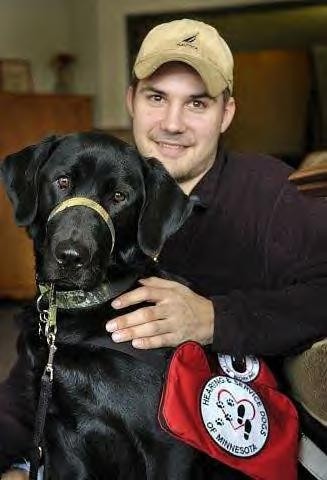 Tyler Hurd, a student at St. Cloud State University in Minnesota, with his service dog, Emmitt |
Feb. 9, 2008 update: Kaye Leslie, a Toronto-based manager of workplace diversity for Scotiabank, told a journalist how she and her dog Kirk
have been left in cold, dark locations by cab drivers who drove away or refused to stop when they saw Kirk. One time, Leslie says, she was actually getting into a cab when it took off, leaving "the door swinging against us."
May 12, 2008 update: Tyler Hurd, a 23-year-old junior at St. Cloud State University in Minnesota, left the school in late April because he says he feared for the safety of his service dog, a black Labrador named Emmitt trained to protect Hurd when he has seizures. The threat came from a Muslim student of Somali origins.
May 13, 2008 update: CAIR, newly wise to the service-dog problem (see Feb. 6, 2008 update, above), came out with a press release, "Muslim Group Supports Minn. Student's Right to Service Dog" that quotes the Minnesota office's communications director, Valerie Shirley: ""The moral and legal need to accommodate individuals using service dogs far outweighs the discomfort an individual Muslim might feel about coming into contact with a dog, which is one of God's creatures."
June 27, 2008 update: "Sniffer Dogs Offend Muslims" reports Tom Whitehead of Britain'sDaily Mirror. Complaints from Muslims contact with police sniffer dogs trained to spot terrorists at railway stations means, according to a Transport Department report, that in keeping with "cultural sensitivities," the animals will only touch passengers' bags, which is "more acceptable." To this, Tory MP Philip Davies responded negatively: "everyone should be treated equally in the face of the law and we cannot have people of different religious groups laying the law down. I hope the police will go about their business as they would do normally."
Also today, the Daily Mail reported quoted a British Transport Police spokesman indicating that nothing will change: "The legislation applies to everyone. It's not a case for exemptions. Officers will be sensitive where appropriate but obviously there are practical implications. These dogs do not have to be clawing and barking up at people. These are highly trained dogs that can pick up scents from distance. There doesn't always have to be physical contact." July 6, 2008 update: Britain's Association of Chief Police Officers has drawn up guidelines that police sniffer dogs wear bootees with rubber soles when searching the homes of Muslims. Originally intended just for mosques, they now are being applied to private homes. The association explains: "We are trying to ensure that police forces are aware of sensitivities that people can have with the dogs to make sure they are not going against any religious or cultural element within people's homes. It is being addressed and forces are working towards doing it."
July 1, 2008 update: "Muslims outraged at police advert featuring cute puppy sitting in policeman's hat" reads the headline and the text just gets more ridiculous:
A postcard featuring a cute puppy sitting in a policeman's hat advertising a Scottish police force's new telephone number has sparked outrage from Muslims. Tayside Police's new non-emergency phone number has prompted complaints from members of the Islamic community. The choice of image on the Tayside Police cards - a black dog sitting in a police officer's hat - has now been raised with Chief Constable John Vine.
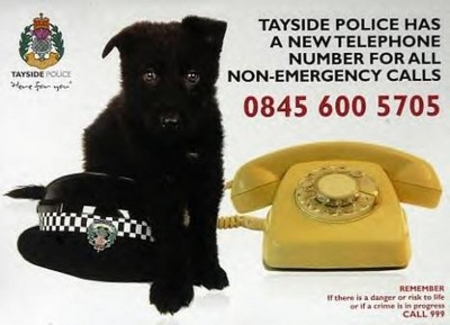 The notorious puppy advertisement from the Tayside police department in the UK. |
Some shopkeepers in Dundee refused to display the advertisement with the German Shepherd and city councilor Mohammed Asif said: 'My concern was that it's not welcomed by all communities, with the dog on the cards. It was probably a waste of resources going to these communities. They [the police] should have understood. Since then, the police have explained that it was an oversight on their part, and that if they'd seen it was going to cause upset they wouldn't have done it."
The chief constable, John Vine, assured everyone that the graphic was not intended to cause any offence.
July 17, 2008 update: Because some Muslim taxi drivers are refusing to carry passengers with guide dogs, Yellow Cab Company in Brisbane,
has been forced to sack drivers over their conduct towards passengers with assistance dogs. Bill Parker, general manager of the firm, said the behaviour would not be tolerated and penalties will be imposed if drivers disobeyed
Toni Forrest and William.
Oct. 9, 2008 update: Orlando Cars, a taxi company in Bolton, England, ended up in court for refusing to take Toni Forrest, 40, and her guide dog. It faced a fine of up to £1,000 but was cleared. Forrest explained:
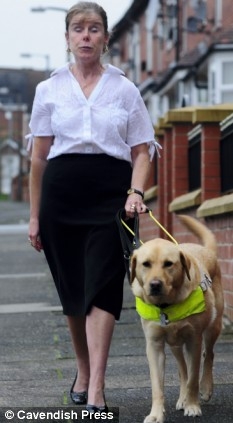
I phoned and booked a taxi and the operator just refused. They said: "We're not taking you as customers and drivers have been complaining about dog hair." I've never had a problem before, no one has complained to me. I had to get a black cab and it was more expensive. I felt quite upset and angry.
Nov. 11, 2008 update: A case from the United Kingdom, described in "Fine for taxi driver who told blind man: 'I can't take your guide dog, it's against my religion'," Ali Raza Roshanmoniri picked up Christopher Odell from a school where Odell volunteers, then refused to allow his dog into the car on the grounds that doing so would violate his religious beliefs. Cable Cars, the taxi company, sent another cab for Odell.
Because taxi drivers must carry guide dogs, unless they win an exemption on health grounds, Roshanmoniri handed the taxi licensing department a letter the next day from his doctor claiming that he has an allergy to animal hair. But a colleague of Odell's lodged a complaint with Broxtowe Borough Council, Notts. Roshanmoniri eventually pleaded guilty to transgressing the Disability Discrimination Act in Nottingham Magistrates Court which fined him £300, ordered him to pay £150 in costs and a £15 victim surcharge. Cable Cars suspended him.
Dec. 8, 2008 update: Emma Donnelly, 20 and almost totally blind since birth, tells what happened when she took her two-year-old Labrador retriever Yasmin to the Tandoori Nights Restaurant in Exeter, Devon.
I was out with a couple of friends and I had my guide dog which had only qualified just over a month before and was my first guide dog. We decided to go to an Indian restaurant but I did not even get in the door. A man came out and said Yasmin was a health and safety hazard. He said she was not allowed in even though I carry a special card from the environmental health department saying she is allowed into any premises because she is so highly trained and groomed. ... I felt really upset and disgusted. It is the first time I have been refused entry to any shop. Obviously I could not see for myself by my friends told me the restaurant was almost empty to it is not as if she would have been in anyone's way. We went on to another restaurant called the Chadni and they were very nice and welcomed us in. I have complained to the Guide Dogs for the Blind Association and to the disability rights people who say they will investigate.
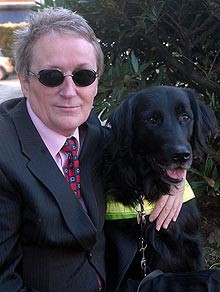 Alun Elder-Brown with his seeing-eye dog, Finn. |
Dec. 15, 2008 update: What is it about Indian restaurants in England? Alun Elder-Brown, 51, a recruitment executive who is blind, last week took his girlfriend and her five year-old daughter to the fashionable Kirthon Resturant in Tunbridge Wells, Kent, but never got in. Owner Amenur Abdussamad or his staff told Elder-Brown he could not bring his seeing-eye dog, Finn, inside. Elder-Brown showed his Institute of Environmental Health Officers card certifying that his dog should be allowed into any premises.
"They then said I could leave Finn tied up outside. I stayed calm but when they threatened to call police I left. ... It was humiliating and degrading, especially as there were a lot of people around me," he later said. "I was made to feel like a piece of dirt. They told me I couldn't come in because it was against their religious beliefs to have a dog in the restaurant."
Of course, the restaurant's actions went against the law and Elder-Brown is considering a lawsuit against the it.
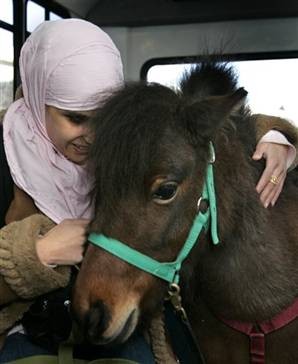 Mona Ramouni rides a bus to her job with Cali, her guide horse. |
May 14, 2010 update: Another restaurant saga, this time at Napolis Italian Restaurant in Altavista, Virginia: Christine Calabrese, 47 and legally blind, went to the restaurant on May 8 with her husband John and her service dog, Koji.
"They took our order for drinks. So I thought everything was fine," said Christine Calabrese. But they were soon asked to leave by the managers, Ahmed Ahmed and Fathy Morse. John Calabrese says he repeatedly explained the Americans with Disabilities Act, but without success. "He leaned over and said to me 'I know my business. That dog is not allowed,'" said Calabrese.
The Calabreses went outside and called police, who also called the Health Department to confirm that service dogs are allowed under state and federal law. "And advised them what the consequences would be and they still refused to allow the lady with the dog into the restaurant," said Deputy Chief Kenneth Walsh with the Altavista Police Department.
The couple and their dog were still turned away. Manager Fathy Morsy says he didn't know about the Americans with Disabilities Act and he says the Calabreses were being rude. "I say 'just leave it outside,' because the people were complaining ... they tell me 'no,'" said Fathy Morsy. "And he was talking with me, you know, it was not in a good way, you know."
Rude or not, Christine says hopes no other people with disabilities are treated the same way. "I would like to prevent this from happening again, that's my ultimate goal," said Christine Calabrese. "I always try to make things better for the next disabled person to come along."
The Calabreses say they don't plan to sue the restaurant. They will let the Justice Department decide whether to prosecute. The restaurant manager says he is sorry about what happened, knows the rules now, and the Calabreses are welcome back anytime.
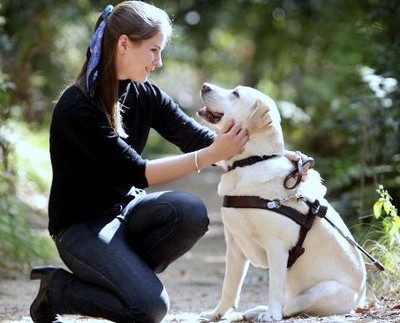 Sarah Eady with her seeing-eye dog Ally. |
I opened the door and he said "Can you sit in the back with the dog" and I told him the dog was trained to sit in the front. He said he didn't want the dog in the front and then he asked me to put Ally in the boot."
This incident follows a "Guide Dogs NSW" awareness campaign targeting cabbies with advertisements on the taxis themselves with the slogan "Any dog can chase a car, ours can catch a cab." In addition, taxi driver training courses include instruction on guidelines for carrying vision-impaired passengers. Despite, 35 percent of the blind report their guide dogs have been refused entry to a taxi in the past 12 months.
June 8, 2010 update: Nader Rohbani-Eivazi, 49, informed Janice Powers, 49, that she could not take her seeing-eye dog Wayne into his taxi in Wales. "Four people but no dog," he said, referring to her and three human companions. When she protested, he replied, "Take me to court," which she did. Magistrates fined Rohbani-Eivazi £200 for breaking disability laws, plus £215 for costs.
June 22, 2010 update: If taxis, why not buses? Judith Woods writes in the first person for the Daily Telegraph (London) about Daisy, a Manchester terrier and how, on two occasions last week, the dog was barred from London buses on religious grounds. In one case, as a friend of Woods took Daisy to the bus, .
As they tried to board the bus, the driver stopped her and told her that there was a Muslim lady on the bus who "might be upset by the dog." As she [the friend] attempted to remonstrate, the doors closed and the bus drew away. When a second bus arrived, she again made to embark, but was stopped again – this time because the driver said he was Muslim.
Ernest Dix with his seeing-eye dog, Blake.
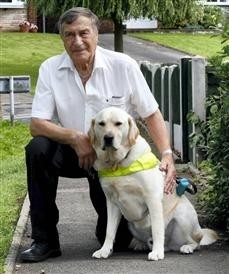
July 19, 2010 update: Britain's Daily Mail reports in "Muslim bus drivers refuse to let guide dogs on board" that bus and taxi drivers are ordering blind passengers off their vehicles "has become so widespread that the matter was raised in the House of Lords last week, prompting transport minister Norman Baker to warn that a religious objection was not a reason to eject a passenger with a well-behaved guide dog."
The article tells the story of George Herridge, 73, a retired hospital maintenance manager and cancer sufferer, who was "stunned" when twice told by bus drivers to get off because of his guide dog Andy, a black Labrador; in addition, he faced hostility at a hospital and in a supermarket.
on the first occasion two years ago, he got off at the request of a Muslim driver because some Muslim children on board were 'screaming' because of the dog. He found himself in a similar scenario in May last year, when a Muslim woman and her children became 'hysterical'. Mr Herridge this time refused the driver's request to alight. He complained to the bus company which launched an investigation. It later informed him the matter had been dealt with 'internally'.
Nov. 25, 2010 update: Doreen and Ernest Dix, an elderly blind couple living near Stafford, to the north of Birmingham, England, were turned away from a taxi in a commercial area because of Blake, their golden retriever-labrador. The driver, according to the Dixes, said he did not want the dog in his car.
Mrs. Dix, 71, recounted: "I can barely see, but saw the driver wave his hands and say 'no, no, no' as we approached his cab. We were both very upset and were made to feel really small, but just got the next taxi in the end." Mr. Dix, 82, was "appalled" by the driver's behavior: "I've been registered blind for 28 years and have never been discriminated against by a taxi driver before this. If he isn't willing to pick up certain people, then he shouldn't be in a queue of taxis earmarked for shoppers."
Apr. 1, 2011 update: A reader, Ed Leary, provides compelling personal testimony on taxi drivers in Washington, D.C. refusing blind riders with dogs. Please read his comment.
Apr. 19, 2011 update: As a sidebar, Time magazine reports that the authorities in Iran are preparing legislation to ban dogs as pets in that country on the grounds that they are "impure and dangerous animals."
Sean Dilley and Chipp.
Feb. 2, 2012 update: Sean Dilley, 29, and a freelance broadcaster and parliamentary lobby correspondent for talkSPORT, needed a ride for himself and his seeing-eye dog Chipp from the Letchworth Sports and Tennis Club to the Letchworth rail station in England. The usual happened, according to the Advertiser: :
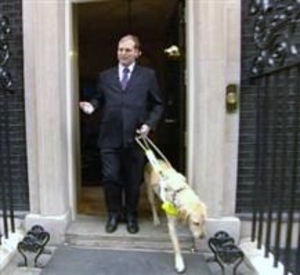
when the driver arrived shortly after 7pm to pick him up, he refused to let Sean and Chipp in the car. The driver turned up and said you are more than welcome but I'm not taking your dog," said Sean, who has been blind for 15 years. "He said it was because he was a Muslim. I was horrified. This sort of thing happens all the time and it's not acceptable." ... He called the taxi firm Gary's Taxis to complain but was told the driver was within his rights. But Sean believes that the driver was breaking disability discrimination law by refusing to take them and has reported the matter to North Herts Council, which licenses taxis in the district.
Apr. 2, 2012 update: A report from Columbus, Ohio, by Rick Reitzel of NBC4, reporting on an incident in May 2011:
Christopher Cooley and his service dog, Sam, were riding in Cooley's sister's vehicle when they stopped at the Valero gas station, at 2727 S. High St., for gas and coffee. Cooley said he and Sam went inside and the store owner, Demir Tahiraj, told Cooley to leave because pets are not allowed in the store. "He just kept screaming, 'No dogs! No dogs!' and I said, 'It's a working dog,'" Cooley said. He said he tried to show the owner Sam's identification showing he was a guide dog, not a pet. "He kept pointing at a sign on the door, which I could not read, that said, 'No pets allowed,'" Cooley said.
Cooley said he went back to the station to try and educate the owner on ADA and service dogs. "He threw the paperwork back in my face," Cooley said. Cooley and his attorney Avonte Campinha-Bacote filed a lawsuit in the United States District Court Southern District of Ohio against the Valero Energy Corporation for violations of the Americans with Disablities Act. ... The court records state Tahiraj came after Cooley, raised his fist as if to strike Cooley but instead grabbed him by the collar after Cooley's sister intervened. Tahiraj called the police, and Cooley said he dialed 911.
Apr. 14, 2012 update: A report from near Oldham, in the Greater Manchester area of England, by Martin Robinson in the Daily Mail:
A Muslim cab driver has been fired after he threw out a family carrying an unopened bottle of wine because he said 'it's against my religion.' Adrian Cartwright, 46, had hired the taxi to take his family out for dinner at an Indian restaurant near Oldham, Greater Manchester. But before they could make the five-minute journey the driver, in his 20s, spotted the bottle of white wine and promptly refused to take them. The family was turfed out onto the pavement and he drove off.
Cartwright then complained to the driver's employer Borough Taxis and
within half an hour he was sacked. The company's former chairman, Fazal Rahim, who has also driven for them for almost a quarter of a century, said the driver's attitude was unprofessional. 'I am a practising Muslim, like a lot of the drivers. This was not a decision based on race or religion, however, but about being a professional taxi driver.' ... The taxi company has apologised to Mr Cartwright and his family and explained why the cabbie must be sacked. 'We would like to apologise to Mr. Cartwright and his family for any upset or offence caused. Borough taxis would also like to inform customers past and present that we do not agree with the actions of the driver,' they said in a statement. 'As soon as the directors heard of the incident an emergency meeting was held and the driver was dismissed with immediate effect only 30 minutes after the incident occurred.'
Comment: This incident confirms my view that when it's the blind vs. the Islamists, Islamists lose.
July 16, 2012 update: Sue-Ann Levy, the Toronto Sun's City Hall columnist, who sees and has a pet dog, tells of an unpleasant experience at the city's Pearson airport:
Last Monday morning at 1:30 a.m. I came out of Pearson Airport with my dachsie Kishka in tow looking for a limo to drive us home. Kishka, as is the requirement whenever I fly to and from my home in Florida, was comfortably zipped up in his soft kennel. He was half-asleep at that hour - and so hidden away - that the first driver in line headed towards me to start loading my luggage. It was when he grabbed Kishka's kennel and realized a dog was in there that he turned around quickly and waved me away. The second driver, also a visible minority, said "No" the moment I approached him. The second driver - who works for McIntosh Limousine - refused to give me a reason for refusing me or his name. Thankfully, a third driver eventually pulled up. He had no issue transporting Kishka, who promptly fell asleep in his kennel the moment we hit the highway.
Looking into the matter, she found that problems like this occur "quite often not only at the airport but in Toronto proper. ... Gail Beck-Souter, general manager of Beck Taxi that operates about 900 cars in Toronto, confirms that if certain Muslims take a dog in their vehicle, they are required to go home and shower afterwards (before they pray)." She also found that the Greater Toronto Airports Authority (GTAA) which licenses the cabs and limos at Pearson has "bent over backwards to accommodate the religious demands" of the drivers.
McIntosh Limousine manager Anne Ruddy claimed the driver who turned me down, a gentleman from India, did so because he "doesn't have to" take dogs. But the driver would have to take Kishka if he was a service dog - that's the "law," she said. She denied Muslim drivers in their fleet would ever turn down dogs for religious reasons contending it has more to do with "them being scared" of dogs. Asked how she felt about a woman being denied a ride at 1:30 a.m., Ruddy said she "hates the idea" but they have to "abide by the GTAA rules" - they "don't have a choice." I had to laugh when I read the description of their drivers on the McIntosh website, most particularly this gem: "Our drivers have taken sensitivity training..."
Jan. 3, 2013 update: Two Malaysian muftis condone the blind relying on help dogs.
Juanda Jaya: "Using the services of guide dogs which are well trained is allowed in the religion, including the Syafie mazhab [Shafi'i madhhab], which is subscribed to by Muslims in the country. There is no issue on using service dogs for various purposes like hunting, guarding and as guiding dogs. ... People need to learn to differentiate between religion and culture in order to make decisions in their lives and to not follow blindly what others say about rulings in Islam."
Harussani Zakaria: "It is said in a hadith that the angels do not like the barking of dogs and will not enter a house in which a dog is kept. But that does not mean that we cannot keep them for certain purposes. "We are permitted to keep them, as long as they are not kept in the house, and we have to sertu [the act of washing the skin with water six times and with a mixture of water and earth once] if we touch them when they are wet."
May 13, 2013 update: Television station WUSA9 in Washington, D.C. did some undercover work with disabled passengers – blind with dogs or disabled with wheelchairs – and found that 20 out of 42 taxi drivers either blew right by these potential fares in favor of nearby able-bodied passengers or took them to the wrong location or charged an illegal extra fee. Comment: The service dog issue is apparently only part of a larger problem.
Mike Simmons and his guide dog.
Nov. 30, 2013 update: Mike Simmonds of Saskatoon, Saskatchewan, three times had problems with Comfort Cabs taking him and his service dog.
Simmonds said he was on his way to the airport two weeks ago when he was turned away by a driver who said a larger cab was needed. "I said, 'Here, the suitcase goes in the back or in the trunk and he's designed to go under my feet. We've got to get to the airport'." Simmonds said he could tell the driver was obviously uncomfortable, so he asked him if he had a problem with dogs. The driver replied that associating with dogs was against his religious beliefs.
It was the third time Simmonds was refused a ride that pushed him to file the human rights complaint. He had called ahead for a taxi to pick him and his dog, Graham, up at a bus stop. When the cab didn't show up, he called the dispatcher again. He said she told him she was having a hard time finding a cab for him because of the drivers' religious beliefs. Simmonds had to wait an additional 20 minutes outside for a taxi to come from across the city.
He has filed a complaint with the Saskatchewan Human Rights Commission.
Dec. 17, 2013 update: In the course of mediation between Simmons and Comfort Cabs, Ahmed Shoker of the Islamic Association of Saskatchewan sensibly explained that "If a person is blind and needs a dog, absolutely this person must be protected by the Islamic law. In my judgment, this individual who refused to give the ride, I think he just needed to be educated. But I think after education he has to be responsible." Less sensibly, Shoker blamed Muslim antagonism to dogs on Western powers using police dogs to discipline the Muslim colonized. "There is a connotation here that the dog is a weapon of those with colonial powers." Comment: That's ridiculous.
Sep. 8, 2014 update: Taxi incidents have become fewer, perhaps because word got out that service dogs trump aversions, even religious ones. Instead, the same issue has now come up in a Subway Restaurant in Paterson, New Jersey, where disabled veteran Richard Hunter was thrown out by the store's manager, Mitul Ahmed. This despite a sign on the door stating that "Service animals are welcome." Hunter quotes Ahmed telling him on arrival, "The dog is not allowed in here. Get the dog out of here," though it was clearly identified as a service animal. "I don't care," Ahmed is reported to have said. Hunter called the owner who told him, "I can refuse service to anyone I want."
Jan. 26, 2016 update: It was only a matter of time until an Uber or Lyft driver would get into the act. When Mojeh Adams Schaniel, 30 and pregnant, entered the Uber car belonging to Muhammad Qayyum, 23, on Jan. 21, he "yanked [the] passenger's service dog from her and slammed the pooch onto a Manhattan street" in the words of a New York Post news story. "I will not take your dog in my car," Qayyum told the woman, according to police report. Qayyum was subsequently arrested on charges of aggravated cruelty to animals and harming a service animal in the second-degree. "Any mistreatment of animals is abhorrent, and we do not tolerate violent behavior on the platform," Uber said.
This news builds on the federal civil rights suit filed in September 2014 by the California chapter of the National Federation of the Blind against Uber on the grounds that over 30 customers who called a car were refused a ride once the driver saw the service dog.
July 4, 2016 update: A taxi driver did not let a seeing-eye dog into his car in Leicester, England, explaining to the couple, Charles Bloch and Jessica Graham, "For me, it's about my religion," strongly suggesting he is Muslim.
Sep. 27, 2017 update: Anila Daulatzai, 46, noted two dogs on her Southwest Airlines flight before it took off and complained to the airline of life-threatening allergies. But she could produce no proof and so the captain, following policy, ordered her off the plane. Her resistance was captured on video and led to her arrest.
What makes the incident particularly notable is Daulatzai having been a visiting assistant professor of Women's Studies and Islamic Studies at Harvard University in 2014-15. She currently teaches at the Maryland Institute College of Art. At one point, she told the officer taking her off the plane, "I'm a professor. What are you doing?"
Nov. 6, 2017 update: Milissa Garside ordered an Uber ride in Boston but the unnamed driver refused to take her because she had a service dog. Her boyfriend Richard Welch, also legally blind, joined her in trying to convince him. Garside explained: "He rolled down his passenger-side, rear window and said that he didn't take dogs. We both explained to him that according to the law and Uber's policies he's required to take the guide dog."
Welch reached into the open window to unlock the door, but the driver rolled up the window and took off, dragging him. "He rolled up his window on my hand and proceed to jet to the intersection down the street here and dragged me for at least ten feet."
Uber responded to the incident: "We are sorry to hear about this disturbing report and we are reaching out to check on the rider's well-being. Drivers are expected to accommodate riders with service animals and comply with all accessibility laws." The company noted that Uber drivers must sign an agreement accepting to transport riders with service animals, then are reminded quarterly of that requirement.
May 1, 2019 update: Phyllis Chesler reports two incidents of dogs in New York City taxis:
The first incident took place in about 2012. The location was my home on Upper East Side of Manhattan. The time was a Saturday night. The car service was likely Skyline. My friend took her small service dog with her, got in the car, the driver had not seen the dog until she was seated, when he became very aggressive and angry. She refused to get out. He refused to move. And then, when she called me, I implored her, then ordered her, to get out, fearing a worsening scenario, which she did.
Two days ago, my brother, who is legally blind, and who has a service dog, visited me. He was leaving me in Midtown Manhattan at about 10:15pm at night. The car services was Skyline. I sat by his side and cautioned him to request a car with a driver who would accept a service dog, which he did. He then left me but soon called from downstairs to say that one Mahmoud refused to take him with the dog. My sightless brother, dog and all, was left on the street to call for another car. The driver was not apologetic. He was, rather, outraged, contemptuous, righteous.
Aug. 18, 2019 update: Emma R. provides some examples of the usual problem, this time from Austria.
Aug. 27, 2020s update: There's a debate in Egypt over dogs that could render the Western confrontation obsolete: see the Economist for more on "Are dogs acceptable pets, Muslim scholars ask? Egypt's Grand Mufti says they are. Others are dogmatically opposed."


