
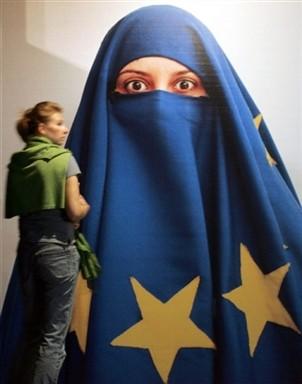
 A poster showed at an exhibition in Istanbul in October 2005 by Turkish artist Burak Delier, showing a woman wearing a niqab with the European Union symbol. |
Our story begins with a news item, "City to Pay Woman's Fine for Breach of Burka Ban," a title that neatly sums up the quandary of a newly assertive Europe.
The city council in Maaseik, Belgium on December 27, 2004 approved the so-called "burqa decision," criminalized the wearing of the burqa and the niqab (a face covering that covers the face up to the eyes) in its public places. Breach of the law carries a 125 fine.
Five women have been booked for this crime, one of whom, a young woman of Moroccan origin who wore a burqa, has now been found guilty and charged the fine. Ironically, in all five cases, the women are receiving social security payments – and these will pay for the fines.
Comment: I would be hard pressed to find a more apt illustration of the self-contradictory nature of European policy toward its Muslim minority. (August 25, 2005)
Aug. 30, 2005 update: The story gets more interesting. It turns out that the Maaseik woman not only refuses to pay the fine but also refuses to give her name or speak to the police or in any way cooperate with municipal authorities. And, it turns out, she is the wife of one Khalid Bouloudo, 30. A pastry chef in his civilian life, he is said to be the Belgian coordinator of the Groupe Islamique Combattant Marocain, an Islamist organization linked to both the 2003 Casablanca and 2004 Madrid bombings. In that capacity, Bouloudo just yesterday was accused in a Brussels court of aiding and abetting terrorists who carried off the Madrid attack.
Comment: In such circumstances, one can only wonder that his wife is making so much gratuitous trouble.
Oct. 14, 2005 update: The Utrecht City Council has voted to reduce benefits by 10 percent for unemployed women if (1) they refuse to take off their burqas and (2) that prevents them from finding a job. The council reached this decision after two Muslim women receiving 550 a month in unemployment benefits told announced that they had stopped going to job interviews because their burqas meant they had no success. A spokesman for the Dutch city noted that the problem is more one of principle than economics: "People get benefits when they are out of work but there is also an obligation to do everything to get a job. These women were educated, spoke good Dutch and had opportunities in the labour market." The city also noted that the official Equality Commission backed employers refusing positions to burqa-clad women, as seeing a person's face is essential to many jobs.
Oct. 16, 2005 update: "Holland fears killings over ban on burqa" reads the Sunday Times (London) headline. "Holland's Muslims have responded with outrage to government proposals to ban the burqa," it reads, "and there are fears that Rita Verdonk, the minister behind the move, will be added to a list of 'enemies of Islam' targeted for assassination."
Verdonk, minister of integration and immigration, noted in parliament that the "time of cosy tea-drinking" with Muslim groups is over and that a ban on burqas might be needed in some circumstances for the public safety. Her spokeswoman said that a ban "in certain circumstances seems quite sensible." Verdonk then initiated an investigation into whether Holland should prohibit the burqa.
The Times reporter, Matthew Campbell, notes the irony of this proposed legislation: "For a country that has legalised gay marriage, prostitution, euthanasia and cannabis, Holland seems in no mood for compromise when it comes to applying tough laws on immigration." If the legislation passes, the Netherlands would become the first European country to outlaw the body covering.
Apr. 21, 2006 update: Ahmed Aboutaleb, a member of the Dutch Labor Party (PvdA) and a Dutch citizen of Moroccan descent, has proposed legislation that would allow Amsterdam to end welfare payments to women whose wearing a burqa is the reason she can't find a job. "Nobody wants to hire someone with a burqa," Aboutaleb told the Dutch women's magazine Opzij. "In that case, I say: off with the burqa and apply for work. If you don't want to do that, that's fine, but you don't get a benefit payment." He added, in reference to a Muslim woman who refused to shake hands with men at work. "She has to realize that her behavior is building enormous obstacles for her in almost every situation. This woman must recognize that she is sidelining herself and that she runs the risk of being turned down for other jobs, too."
Apr. 29, 2006 update: The principal of a school in Tannenbusch, on the outskirts of Bonn, Germany, suspended two high school girls for two weeks when they insisted on wearing burqas to class after returning from the Easter recess, on the grounds that they were disturbing the peaceful running of the school. They are welcome to return once they shed the garb.
Sep. 8, 2006 update: An immigrant female Muslim teacher at Vader Rijn College in Utrecht, the Netherlands, has been fired for deciding, after a year on the job, that, for religious reasons, she could not shake hands with male colleagues. School director Bart Engbers explained his logic. "If she doesn't want to shake hands at home, fine. But everyone is welcome at this school. Discussion is great, but religious and political flag-waving must stay at home." Teachers, he said, have to set a good example. "We are preparing our boys and girls for the labour market. We all know how fragile the situation is for allochtone [non native Dutch] young people. Therefore it is good that they shake hands during a job interview. We believe that is important." Also, refusing to shake hands with men amounts to discrimination, he added.
Oct. 25, 2006 update: I offer my opinion on this issue at "An Unveiling: Separate, but Acceptable?"
Nov. 29, 2006 update: A British poll finds that only 33 percent of the public want the burqa banned, with 56 percent against such a measure.
Mar. 22, 2007 update: The director-general of elections in Quebec, Marcel Blanchet, has decided that Muslim women wearing the niqab or burqa may vote in elections without showing their faces. The decision goes against the electoral law, which requires voters to present photo-I.D. Covered women can avoid that by swearing they are who they say they are, or have an adult with them to verify their identity. Mar. 24, 2007 update: Blanchet has reversed himself and women wearing burqas must show their faces to identify themselves before casting their votes. As the National Post explains, "The move was made after rumours of disruptions to Monday's provincial vote and threats to his personal safety. After a protest movement mobilized on the Internet encouraging people to wear Darth Vader masks or paper bags over their heads when they head to the polls, Marcel Blanchet exercised his discretionary powers, ruling all Quebecers will have to show their face when they vote." Also noteworthy: "Security was also increased around Mr. Blanchet yesterday due to the tone of angry messages that deluged his office. Two bodyguards now accompany the chief electoral officer at all times."
June 22, 2009 update: Nicolas Sarkozy, the president of France, heightened the stakes by battling the burqa in a major address, delivered at Versailles, no less, to the parliament.
Le problème de la burka n'est pas un problème religieux. C'est un problème de liberté de la femme, c'est un problème de dignité de la femme. La burka, ce n'est pas un signe religieux, c'est un signe d'asservissement, c'est un signe d'abaissement. Je veux le dire solennellement, elle ne sera pas la bienvenue sur le territoire de la République française. Nous ne pouvons pas accepter dans notre pays des femmes prisonnières derrière un grillage, coupées de toute vie sociale, privées de toute identité. Ce n'est pas l'idée que la République française se fait de la dignité de la femme.
In English:
The problem of the burqa is not a religious problem. It is a problem concerning the freedom of women, the dignity of women. The burqa is not a religious symbol but a sign of subservience, of abasement. I want to say solemnly that it is not welcome on the territory of the French Republic. We can not accept in our country women who area prisoners behind a grill, cut off from all social life, deprived of any identity. This is not the the French Republic's idea about the dignity of women.

According to the Daily Telegraph, "The call won instant support from members of Mr Sarkozy's centre-Right government but was opposed by the Socialists, the main opposition party."
July 8, 2009 update: Losing no time, a French parliamentary task force opened hearings on banning the burqa.
At the first hearing, two academics described wearing the burka as a throwback to a form of archaic Islam and a type of cult-like behaviour, incompatible with modern France. Islam expert Abdennour Bidar called the full veil a "pathology of Islam" embraced by hardline Salafists who tell Muslim women to cover themselves as a way to "get back to their roots." "It's up to the republic to help Islam in our country choose its destiny and help French Muslims resist this pressure," said Bidar. "We must find ways to prevent the burka from spreading. Whether that would be a law or something else is not for me to say."
Anthropologist Dounia Bouzar said young women had in recent years taken to wearing the full veil after being indoctrinated by "gurus" who pervert Islam's teachings. "Even imams are having difficulties countering this type of message," she said, adding that there was nothing in the Koran that dictated to women that they must fully cover themselves. The niqab entered Islam's history a little more than 70 years ago while Islam dates back 14 centuries," noted Bouzar.
Bouzar suggested that the burqa not be banned on its own but as part of a general prohibition against concealing their identities. As such, it would apply equally to all citizens and not stigmatize Muslims.
The task force is scheduled to present its report at the end of January 2010. Jean-Francois Cope, leader of Sarkozy's UMP party in parliament, said in an interview that the burqa ban should not be put in place until after a period of "dialogue" lasting six to twelve months. "We must prohibit what should be prohibited but only after having explained why."
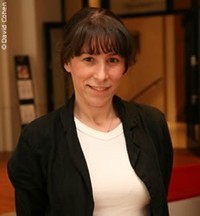
Fadela Amara, French minister for urban regeneration.
Aug. 15, 2009 update: Fadela Amara, a former women's rights campaigner and now minister for urban regeneration in France – and herself a Muslim, says she favors the burqa "not existing in my country" as a means to stop the spread of the "gangrene, the cancer of radical Islam which completely distorts the message of Islam."
The garment represents, she told the Financial Times, "not a piece of fabric but the political manipulation of a religion that enslaves women and disputes the principal of equality between men and women, one of the founding principles of our republic." It also represents "the oppression of women, their enslavement, their humiliation." In addition to sexual oppression and poverty, she asserts, Muslim women suffer "a third form of oppression - extreme religiosity." She holds that the "vast majority of Muslims" are against the burqa.
Eliminating the burqa helps women stand up to the extremists. "Those who have struggled for women's rights back home in their own countries - I'm thinking particularly of Algeria - we know what it represents and what the obscurantist political project is that lies behind it, to confiscate the most fundamental liberties."
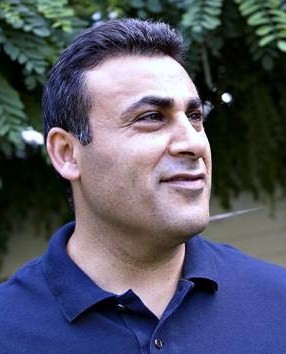
Naser Khader, integration spokesman for Denmark's Conservative Party.
Aug. 17, 2009 update: Naser Khader, a Muslim from Syria, participant in the Modern Muslims group, and integration spokesman for Denmark's Conservative Party, says the burqa is "un-Danish" and should be completely banned in public places: "We do not want to see burqas in Denmark." The head covering symbolizes the oppression of women and not Islamic. Rather, "The modern burqa was instituted by the Taliban when it came to power" and is "a symbol of the Taliban." The same would apply to the niqab but not to lesser forms of covering such as the hijab.
The Conservative Party won support of its ally in the government, the Danish People's Party, and also (surprisingly) the opposition Social Democrats. But the prime minister's Liberal Party rejected the idea, with one slight exception: "Burqas should not be permitted for people who work in the public sector," said the party's political spokesperson, Peter Christiansen. "But that's where we draw the line."
Comments: (1) How interesting that two major Muslim politicians, Amara in France and Khader in Denmark, have almost simultaneously come out with the same reasoning and policy prescription. Their resolve supports my view that Muslims must battle and ultimately defeat radical Islam, even in the West. (2) To those who claim no moderate Muslim exist, Amara and Khader are the unicorns who do exist.
Sep. 2, 2009 update: An internet poll of 1,545 people aged 18+ conducted by the French website oumma.com in July and August finds that:
86 percent of French Muslims oppose a ban on the burqa.
77 percent reject the idea that women who war the veil do so because they are coerced.
59 percent say that wearing the niqab or burqa is a Koranic injunction.
80 percent view the creation of a parliamentary commission on the burqa as a "stigmatization of Islam," 15 percent says it's "useless." and 5 percent call it "useful."
63 percent call the burqa a "cultural design of feminine modesty,", 14 percent say it's "sectarian," 9 percent deem it backward, and 4 percent see it as "oppression of woman."
54 percent say that the niqab or burqa is a "hallmark of religious commitment," 35 percent say it's a cultural practice, and 9 percent say it's a "demand of political nature"
Sep. 3, 2009 update: Belgium's Walloon Mouvement Reformiste will propose legislation to band the burqa nationally, reports Le Soir. The clothing is already prohibited in some municipalities.
Oct. 7, 2009 update: Two developments today: (1) Italy's Northern League party, a member of the ruling coalition, announced it is considering legislation to introduce a law to make wearing a burqa illegal in public places. (2) Canada's Muslim Canadian Congress is calling for a federal ban on wearing the burqa in public: "The burka has absolutely no place in Canada," said Farzana Hassan. "In Canada we recognize the equality of men and women. We want to recognize gender equality as an absolute. The burka marginalizes women."
Apr. 30, 2010 update: By an astonishingly unanimous vote, Belgium's lower house of parliament, the Chamber of Representatives, voted to ban the burqa in public places, the first such law in Western Europe. The unanimous vote comes against the background of Prime Minister Yves Leterme's government collapsing just a week earlier. The Senate must now vote on the bill. The law forbids appearance in public with one's face so covered that identification cannot be made. Violators face fines of $18 to $28 and prison terms of 1 to 7 days. It comes on top of two dozen jurisdictions in Belgium, including Brussels, having locally banned the burqa.
Nor are the Belgians alone: The French government plans to pass similar legislation by September and similar bills have been introduced in Italy and the Netherlands, where local jurisdictions have already imposed more-limited anti-veil measures. Leading politicians in Switzerland and Austria have suggested comparable legislation. Denmark's government has deemed the burqa contrary to Danish values but so few women wear it that no law was passed.
July 13, 2010 update: The lower house of the French parliament voted 335-1 to ban niqabs and burqas.
Nov. 8, 2010 update: U.S. Secretary of State Hillary Clinton had this to say during a stop in Australia:
"I know that in Pakistan, many of the men who are conducting suicide bombing missions arrive covered in a burqa. If you're a Pakistani police officer, respectful of the women of your culture and that's being abused and misused by the suicide terrorists, that causes a real dilemma. So if you are looking at other countries that are understandably nervous about extremist activity, like France and other European countries, I think it's a close question."
Mar. 4, 2013 update: In December 2010, the Catalan city of Lérida banned the burqa in public spaces; on Feb. 28, the Spanish Supreme Court (Tribunal Supremo), made public a 56-page ruling that overturns the ban as unconstitutional because it "constitutes a limitation to the fundamental right to the exercise of the freedom of religion, which is guaranteed by the Spanish Constitution."
July 1, 2014 update: The European Court of Human Rights in Strasbourg has upheld the French ban on niqabs and burqas. Responding to a case was brought by a 24-year-old French woman, who argued that the ban on wearing the veil in public violated her freedom of religion and expression,
The Court emphasised that respect for the conditions of "living together" was a legitimate aim for the measure at issue and that, particularly as the State had a lot of room for manoeuvre ("a wide margin of appreciation") as regards this general policy question on which there were significant differences of opinion, the ban imposed by the Law of 11 October 2010 did not breach the Convention.
The judges' decision is final - there is no right of appeal.
July 24, 2014 update: In the aftermath of the ECHR ruling in favor of the French ban on the burqa, competing groups of British Muslims are petititoning Downing Street against and for a burqa ban, hoping to get to 100,000 signatures which then requires the House of Commons to consider the appeal.
Jan. 18, 2016 update: British prime minister David Cameron supports legislation that bans burqas and niqabs in schools, courts and other British institutions, wanting "proper and sensible" rules in place.
The petition opposing a ban on burqas argues that "British women should have the free right to choose how they dress." As one leader explains, "How do you liberate women by criminalising their clothing?" They have the Department for Culture Media and Sport on their side: "Any restrictions on what a woman can wear in public would be out of keeping with British values and our nation's longstanding record of religious tolerance and gender equality."
The petition in favor of the ban calls it the burqa a "disturbing social trend." It goes on:
Many Muslims have been misled by bogus propaganda from fundamentalists that the burqa/niqab is integral to Islam. This is untrue. It is a tribal cloth that is pre-Islamic, non-Qur'anic and un-Muslim. Female public anonymity is an imported Saudi-Afghan fad. The burqa/niqab must be resisted for compelling theological, social, health, security, gender equity and patriarchal reasons so that Britain's traditional character is preserved. We must oppose this salvo from theological extremists seeking to impose their warped version of Islam.
Taj Hargey, imam at the Muslim Educational Centre of Oxford, launched the petition, calls the burqa an "ugly tribal contraption" and "alien cultural monstrosity."
In the past, only rightwing groups wanted to proscribe the burka and niqab. The difference now is that progressive and integrated Muslims are in the forefront of this extraordinary endeavour. If Britain's political establishment do not tackle and defeat Islamic religious fanaticism now, it will become impossible to do so when Muslims become a bigger proportion of British society.
Jan. 13, 2015 update: In "an effort to curb growing extremism," the authorities in Urumqi, the capital of Xinjiang, China's most heavily Muslim province and a city of 3.1 million, have banned the burqa. Their justification interestingly connects to Europe: "Burqas are not traditional dress for Uighur women, and wearing them in public places is banned in countries such as Belgium and France."
May 1, 2015 update: The government of Congo-Brazzaville has banned the burqa. According to the BBC, "A government spokesman said it was a secular country that respected all religions but added that some Muslim women had used the veil as a disguise in order to commit terrorist offences."
June 17, 2015 update: The nearby government of Chad has followed suit and gone further, entirely banning the burqa in the aftermath of two suicide bombings. The BBC reports:
The prime minister said the veil was used as a "camouflage" by militants and said the security forces will burn all full-face veils sold in markets. ... At a meeting with religious leaders, Prime Minister Kalzeube Pahimi Deubet said the ban applied everywhere, not only public places. He added that any clothing that covers everything but the eyes was a camouflage.
Aug. 3, 2015 update: The governments of Cameroon and Guinea have also banned the niqab, while the government of Gabon has indicated that anyone wearing this garb "will be subjected to a total inspection at police checkpoints."
Sep. 28, 2015 update: Walter Wobmann, the Swiss People's Party politician behind his country's 2009 ban on minarets, is now starting a campaign to ban the burqa by finding 100,000 signatures to bring the issue to referendum. He explained: "In our culture, you don't cover your face, you show it. That's our culture, that's our society. Veiling is a symbol of radical Islam, which we don't want here."
Nov. 23, 2015 update: The southernmost Swiss canton of Ticino has passed a law banning the burqa on pain of a fine between CHF100 and CHF 10,000 (the Swiss franc equals the U.S. dollar in value).
Apr. 9, 2016 update Egypt's Prime Minister Sherif Ismail has agreed to the "Ban the Burqa" lobby group's request to ban the burqa from state institutions, including universities.
Apr. 20, 2016 update: Authorities in Latvia have begun the process to ban burqas.
July 30, 2016 update: Jens Spahn, a leading politician of the ruling CDU party in Germany, has proposed a ban on the burqa, saying "I don't want ever in this country to encounter a burqa. In this sense I am a burqa-phobe."
Aug. 31, 2016 update: Polls conducted by YouGov on banning the burqa finds similar results in the United Kingdom and Germany but the opposite view in the United States.
In the UK, 57 percent favor banning the burqa and 25 percent oppose this measure. In Germany, 62 percent favor a ban and 27 oppose it. Americans turn this around, with 27 favoring a ban and 59 percent opposing it.
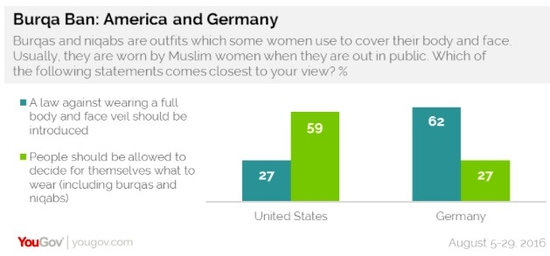
Comment: As is so often the case, Europeans lead Americans attitudinally by some years, maybe as much as a decade.
Sep. 6, 2016 update: I report today that "ISIS Imposes a Partial Ban on Burqas."
Sep. 9, 2016 update: UK's West Midlands Police does not see "any barriers" to its officers wearing burqas. The Muslim Association of Britain endorsed this move for office work but not for active policing.
Sep. 30, 2016 update: Bulgaria imposed a nation-wide ban on "clothing that partially or completely covers the face," including the burqa and niqab. Violaters could be fined from €100 to €750.
Nov. 16, 2016 update: Georgia state Rep. Jason Spencer (R) has introduced House Bill 3 to alter the language of Georgia's 1951 anti-masking law, to keep Ku Klux Klan members from committing anonymous racist violence while wearing white hoods, to include women. The law reads:
A person is guilty of a misdemeanor when he wears a mask, hood, or device by which any portion of the face is so hidden, concealed or covered as the conceal the identity of the wearer and is upon any public way or public property or upon the private property of another without the written permission of the owner or occupier of the property to do so.
Spencer wants to insert the words "or she" into the above law and add a new line to the current law: "For the purposes of this subsection, the phrase 'upon any public way or property' includes but is not limited to operating a motor vehicle upon any public street, road, or highway." It would also forbid wearing coverings in government ID photos. Nov. 17, 2016 update: Spencer withdrew his bill after it aroused national opposition.
Nov. 29, 2016 update: The Dutch parliament approved a ban on face coverings – burqas, ski-masks and helmets – "in specific situations where it is essential for people to be seen" in the words of Prime Minister Mark Rutte. That includes schools, hospitals and on public transport but not public streets in general. The fine for wearing such gear is up to €405.
Dec. 6, 2016 update: German chancellor Angela Merkel, speaking at a Christian Democratic Union (CDU) conference, called for a burqa ban wherever "legally possible" on the grounds that it is "not appropriate" for Germany. She received a boisterous round of applause.
Jan. 9, 2017 update: Morocco's Interior Ministry has distributed a letter demanding, on security grounds, that stores eliminate their inventory of burqas within 48 hours and that no more henceforth be manufactured.
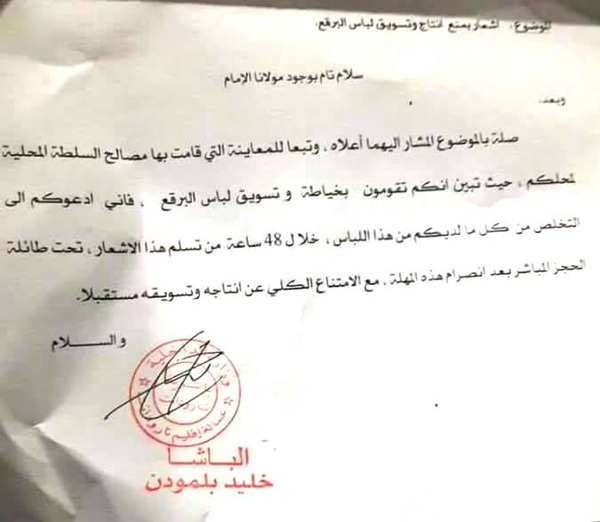 Letter from "Al-Basha" forbidding selling or manufacturing burqas in Morocco. |
Jan. 11, 2017 update: The government of Morocco has banned burqas.
Jan. 31, 2017 update: Austria has joined the growing list of European countries to ban burqas niqabs in courts and schools, with the possibility of banning headscarves for women employed in public services. What makes this case particularly interesting is the high-profile political role this issue plays. The Guardian explains:
The ban is part of a package of changes hammered out by the ruling Social Democratic party (SPÖ) and the centre-right Austrian People's party (ÖVP) to avert the collapse of their coalition government, which would have triggered snap elections. ...
The ban on the full-face veil is seen above all as a symbolic measure designed to avert pressure from the anti-immigration Freedom party (FPÖ), which is currently leading in the polls.
Feb. 11, 2017 update: Aymenn Jawad Tamimi, the Middle East Forum's Syria specialist writes me about a decision made by the local council for the Jarabulus area in north Aleppo countryside on the border with Turkey, a region under heavy Turkish influence. It bans the niqab for female teachers (as well as the traditional headdress for male teachers) in schools on security grounds. He notes claims the ban has been reversed.
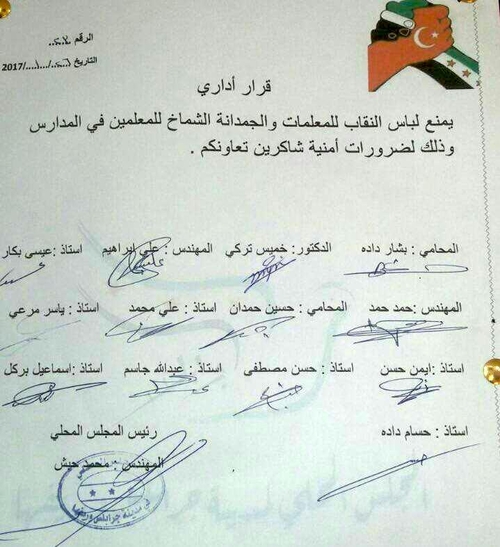 The decision to ban niqabs by the Jarabulus local council, dated Jan. 26, 2017/ |
Apr. 28, 2017 update: German lawmakers on Thursday have approved a partial ban on the burqa that applies to public servants – including election officials, military and judicial staff – while performing their duties. It allows for common-sense exceptions – health workers protecting themselves against infections or police officers concealing their identity.
May 17, 2017 update: Starting in October, Austria's government will ban burqas and niqabs in public places such as universities, public transportation and courthouses; infractions will carry €150 penalties.
Sep. 2, 2017 update: The government of Tajikistan has banned face veils; it's not clear what exactly that refers to.
Oct. 18, 2017 update: The Canadian province of Quebec passed legislation that requires recipients of public services, such as sitting for an exam or getting on a bus to uncover their faces. A recent poll showed 87 percent support for the regulation.
Premier Philippe Couillard justified on the grounds that "public services should be given and received with an open face. I speak to you, you speak to me. I see your face. You see mine. As simple as that." The mayor of Montreal, Denis Coderre, disagrees. "What does it mean? We have niqab police as bus drivers? Will we refuse to provide them services if they are freezing with their children?"
Jan. 7, 2018 update:: 77 percent of those polled in Switzerland support a ban on burqas while 69 percent want a ban on children wearing hijabs.
June 1, 2018 update: The Danish Parliament voted 75 to 30 on May 31 to ban Islamic full-body coverings in public spaces. Soeren Kern explains:
As of August 1, anyone found wearing a burka (which covers the entire face) or a niqab (which covers the entire face except for the eyes) in public in Denmark will be subject to a fine of 1,000 Danish kroner (€135; $157); repeat offenders could be fined 10,000 Danish kroner. In addition, anyone found to be requiring a person through force or threats to wear garments that cover the face could be fined or face up to two years in prison.
With this, Denmark became the sixth European country to enact a ban on burqas, following France, Belgium, the Netherlands, Bulgaria and Austria.
Oct. 18, 2018 update: As of today, niqabs and burqas may not be worn places of work in Algeria. The authorities cited security reasons for the decision.
Apr. 29, 2019 update: The murder of 258 persons on Easter Sunday in Sri Lanka has prompted President Maithripala Sirisena to use an emergency law to ban all face coverings "to ensure national security" and "public safety."
May 2, 2019 update: Following the slogan, "Let's follow the Islam in Kerala and not the Islam of the Middle East," the Muslim Education Society of Kerala will ban all face-covering attires in the academic year 2019-2020 at its more than 150 educational institutions. Instead, the dress code for females is the salwaar kameez.
July 5, 2019 update: After a double suicide bombing in Tunis on June 27 and another on July 2 (which may have been perpetrated by a jihadi in niqab – reports are unclear) Tunisia's government has banned the niqab in public buildings.
The Washington Post notes:
With Friday's order banning the garment, Tunisia joined a growing list of countries that have banned the niqab out of concern that full body coverings can hide weapons or explosive devices used to carry out terrorist attacks. Sri Lanka banned face coverings after deadly attacks on Easter earlier this year. Cameroon outlawed full-face veils in a northern region after two women wearing them blew themselves up and killed 13 people in 2015. And Algeria prohibited women from wearing the niqab at work in 2018.
Aug. 13, 2019 update: The city of Azaz in Aleppo province, Syria, has banned all face coverings, in the words of Said Akach, media director of its local council, to prevent "assassinations, crimes and thefts, not to mention car explosions, bombings and motorcycle explosions, that are targeting residential neighborhoods, crowded markets in Azaz and villages in the countryside."
In this, Azaz joins joins Jarablus, which banned face coverings in March.
Mar. 7, 2021 update: The Swiss voted today in a referendum to ban face coverings by a 51 to 49 percent.
Mar. 10, 2021 update: "Switzerland now joins Austria, Belgium, Bulgaria, Denmark, France, Germany, Italy, Latvia, the Netherlands and Sweden, all of which currently have full or partial bans on religious and non-religious face coverings." Soeren Kern presents the dynamics behind the Swiss ban today; it includes such ironies as prominent Muslims endorsing and the tourism industry fighting the new law.
Mar. 10, 2021 update: With Switzerland banning the burqa, Tarek Fatah counts 19 countries having done so "to some degree":
- Africa: Algeria, Cameroon, Chad, Congo Republic, Gabon, Morocco, Tunisia.
- Asia: China, Sri Lanka, Tajikistan, Uzbekistan.
- Europe: Austria, Belgium, Bulgaria, Denmark, France, Latvia, Netherlands, Switzerland.
Apr. 27, 2021 update: The Sri Lankan cabinet has endorsed making the emergency burqa ban permanent.
June 22, 2024 update: President Imomali Rahmon of Tajikistan has approved a bill that bans the use of headscarves, turbans, and all Islamic symbols deemed foreign to the country's culture.
June 6, 2025 update: The UK's Reform Party is moving in favor of a burqa ban.
July 17, 2025 update: There focus is not burqas or niqabs but leftist use of masks; still, Ilya Shapiro and Jesse Arm argue for banning face coverings in public to reduce crime.


