
David Landau, editor of Ha'aretz newspaper, said something to Secretary of State Condoleezza Rice that is raising eyebrows. After a dinner at the American ambassador's residence on Sep. 10, but only reported today, Landau offered his thoughts on the current situation. According to Gary Rosenblatt in New York's Jewish Week,
Landau, who was seated next to Rice, was said to have referred to Israel as a "failed state" politically, one in need of a U.S.-imposed settlement. He was said to have implored Rice to intervene, asserting that the Israeli government wanted "to be raped" and that it would be like a "wet dream" for him to see this happen.
 David Landau, editor of Ha'aretz newspaper. |
I did say that in general, Israel wants to be raped — I did use that word — by the U.S., and I myself have long felt Israel needed more vigorous U.S. intervention in the affairs of the Middle East.
Landau told Rosenblatt that he was pleased with his own statement, adding that he was later congratulated by several professors present who felt he "articulated what many Israelis feel."
Landau's plea for Washington to pressure Jerusalem was coarse and memorable, but it fit into a pattern going back at least a quarter century. Here is a brief account of comparable leftist efforts, culled from my co-authored piece with Mitchell Bard, "How Special is the U.S.-Israel Relationship?"
In 1982, Prime Minister Begin's critics appealed to the U.S. government for cuts in American aid as a means to change his policies on the West Bank. In 1988, four of Israel's best-known writers (Yehuda Amichai, Amos Elon, Amos Oz, and A. B. Yehoshua) published a statement calling on American Jews and "on all friends of Israel in the United States to speak up" about Israeli policies on the West Bank. More remarkably, they argued that "By their very silence, [American Jews] are massively intervening in Israeli politics." A leading Israeli newspaper published an opinion piece in 1992 that called continued pressure on Israel "the most important condition for advancing the entire [peace] process."
Comment: (1) This appeal to an outside agency to pressure their own government is profoundly undemocratic. (2) It is hard to imagine the intellectuals of any other state acting in like fashion. (December 26, 2007)
Dec. 27, 2007 update: Landau has provided a quote of his comment to Rice and some background for it, in speaking with the New York Sun:
"Israel, after 40 years of failing to resolve its problem of occupation," needed a push from America. "Rape it into resolving the problem," he told Ms. Rice. Some of the participants apparently did not like the comment, Mr. Landau said, and relayed it to one of Israel's leading television reporters, Ehud Yaari, who since then has aired the quote on Israeli TV without attribution, although Mr. Landau said he had never asked that his name be concealed. "I don't go back on what I said," he said, adding that he had published similar sentiments for decades. Even as a Jerusalem Post cub reporter in the 1970s, he said, he had pleaded with the then-undersecretary of state, Joseph Cisco, to "squeeze" Israel and the rest of the Middle East's warring parties, so they could achieve peace.
Jan. 9, 2008 update: Benny Elon, the nationalist politician and party leader, comments on the David Landau matter:
The problem in Israel is not that David Landau felt it necessary to betray his country and heritage to a diplomat from a foreign country. The problem is that with the exception of Makor Rishon, not one Hebrew media outlet reported this atrocity. This is a symptom of a greater problem in our country. ... The leftist media in Israel continues to reward coverage only to those pushing plans that will ultimately destroy our country.
Mar. 23, 2008 update: Writing in Ha'aretz, Gideon Levy acerbically notes in "With friends like these" that "The amount of support being shown for Israel these days is almost embarrassing. The parade of highly-placed foreign guests and the warm reception received by Israeli statesmen abroad have not been seen for quite some time." This blind friendship, he rues, "enables Israel to do whatever it wants." Fortunately, however, this wave of support, "is an illusion. Public opinion in most of the countries whose leaders are heaping all that praise upon us is not joining in." With relief, Levy announces that "Israel remains a state without approval, sometimes even outcast and despised. ... The current bout of official support for us is not genuine."
Feb. 6, 2009 update: M.J. Rosenberg is not an Israeli but he bears the august title of director of policy for the Washington-based Israel Policy Forum, in which capacity he spews venom against the Jewish state and anyone who dares support it (including yours truly). He's usually unworthy of attention, but his decree today, "Israel's Election: Not Our Problem," is so revealing of the leftist mindset that it bears brief quotation. His gravamen is that Barack Obama, not the Israeli electorate, should decide Israel's national security policy. The Israeli government, he writes,
is in no position to ignore the American government's wishes. That is especially true when the president is remarkably popular both in this country and throughout the world. No matter who heads Israel's next government, it is President Barack Obama who holds 51 cards in the deck.
Rosenberg then reviews U.S.-Israel relations to establish that American presidents more often get their way with Likud than with Labor or Kadima. He concludes that
Obama, Clinton, and Mitchell need to keep doing what they are doing, regardless of who wins [in Israel's elections on Feb. 10]. That is to push hard to re-start the diplomatic process with the goal of ending the occupation and achieving Israeli security and a viable, contiguous and independent Palestinian state. Determined American leadership can produce that result. If it can't, or won't, the fault will not lie with the new Israeli prime minister. It will be ours.
Comments:
(1) If this is the Israel Policy Forum, what shudders to think what the Palestine Policy Forum sounds like.
(2) To be fair, the right also calls on the U.S. government not to help Israel, as happened in July 2005, when American Friends for a Safe Israelissued an appeal to Congress not to fund Ariel Sharon's plans for unilateral withdrawal from Gaza ("We need clear answers to a lot of questions and until we get them , the Congress should ensure that the purse strings of the U.S. Treasury remain tightly shut").
Apr. 27, 2009 update: Two leftist groups, Peace Now and Ir Amim, called on Barack Obama to pressure Israel's prime minister Benjamin Netanyahu to halt Israeli building on the West Bank. An Ir Amim spokesman, Daniel Seidemann, explained that "The more time the international community and the Obama administration will require to generate a political process, the more adamant they need to be to save Israel from itself, because we are losing the two-state solution."
July 24, 2009 update: Landau claimed that his please-rape-Israel statement "articulated what many Israelis feel" but a poll of 526 adult Israeli Jews by the Maagar Mohot Survey Institute finds otherwise. To the question, "What do you think about Israelis who encourage foreign countries to apply pressure on Israel so that it will adopt the policies they advocate?' 61 percent answered in the negative, 4 percent positive, 26 percent said it depends in the situation, and 9 percent offered other replies.
Nov. 7, 2010 update: Back at it (see above), Gideon Levy writes in Ha'aretz, "Dear American Jews, if you love Israel - criticize it." His analysis includes such gems as:
- I read that your menu includes ... several discussions about the global delegitimization of Israel. Doubtless the speakers will tell you it's because of anti-Semitism. Don't believe them. There is anti-Semitism in the world, but not to the extent they will tell you. Nor is there any "delegitimization of Israel." There is only delegitimization of Israel's policy of force and occupation.
- If Israel is dear to you - and that is true of most of you - then be honest enough to criticize it as it deserves. Think about your personal friends.
- You, dear brothers and sisters, have enormous political power. Sometimes, I think it is too enormous: One day, it will blow up in your faces. But it is possible to use this power for something more than a despicable witch-hunt after every congressman who dares to criticize Israel. You have the power to influence your government to change Israel's behavior. And a government that does so will not be a government hostile to Israel.
- This time, for a change, demonstrate real concern for Israel: Criticize it as it deserves.
Aug. 5, 2011 update: The leader of the Israeli parliamentary opposition, Tzipi Livni, praises U.S. pressure on her own prime minister. Asked, "Do you think that American pressure on Netanyahu has been constructive?" she replied: "When Obama pushed Bibi, Bibi made some steps forward. The American pressure led those who don't believe that time is of the essence to a better understanding that there is no status quo option."
Comment: One wonders, were she elected prime minister, whether Livni would still welcome U.S. pressure, maybe from a Republican president?
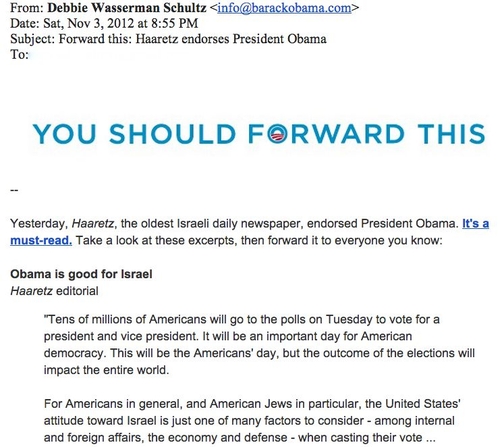
Nov. 2, 2012 update: An Ha'aretz editorial today, "Obama is good for Israel," effectively endorses the current president's re-election in four days.
And why so? Because "Obama continued this two-way track vis-a-vis Iran and the issue of Palestinian statehood. Under his pressure, Israel suspended for the first time - for a while - construction in the settlements. Relations between the two countries' armed forces have never been so close."
Note the approval of U.S. pressure on the Israeli government to do what the editors of Ha'aretz cannot convince their fellow citizens to do.
Nov. 3, 2012 update: On cue, Debbie Wasserman Schultz, chair of the Democratic National Committee, sent out the Ha'aretz editorial.
July 24, 2013 update: The European Union decision not to sign agreements with Israeli organizations and companies operating across the Green Line has met with delight on the Israeli left, Akiva Eldar informs us:
prominent intellectuals, senior academics and leading artists ... sent to Brussels their thanks and blessings for the new directive. Among the signatories of the petition are six Israel Prize laureates (Dani Karavan, David Tartakover, Shimon Sandbank, Zeev Sternhell, Yehoshua Kolodny and David Harel), as well as playwright Yehoshua Sobol, former Foreign Ministry Director-General Alon Liel, former Attorney General Michael Ben-Yair and former Israeli Ambassador to South Africa Ilan Baruch.
Oct. 17, 2014 update: Steven Plaut notes developments on Israeli campuses:
The Israeli Left, led by the tenured leftists, is willing to endorse pretty much anything that is harmful to its own country. It has been urging European countries to "recognize the state of Palestine." A petition was signed by dozens of Israel's most anti-Israel academics, plus some non-academic members of the Hamas Lobby. It was organized by Amiram Goldblum from the Hebrew University, a founder of the extremist anti-Israel "Peace Now" organization, and Alon Liel, an ex-diplomat who now teaches for some reason at Tel Aviv University.
Dec. 7, 2014 update: Some 800 Israelis signed a letter sent to European parliaments calling on them to recognize a Palestinian state. Their number includes 10 Israel Prize winners, 5 ex-ministers, 5 former diplomats, several former MPs, authors Amos Oz, David Grossman, and A.B. Yehoshua, and Nobel Prize laureate Daniel Kahneman.
The letter states: "Your initiative to recognize a Palestinian state will advance the peace prospects, and encourage Israelis and Palestinians to reach a resolution to the conflict." It calls for the establishment of a Palestinian state based on the 1967 borders, with "Israeli recognition of Palestine, and Palestinian recognition of Israel." It decries the "political deadlock and ongoing occupation and settlement, which leads to conflict with the Palestinians, and torpedoes any possibility of an agreement."
Sep. 30, 2015 update: The Left has pressured the Brazilian government, with likely success, to reject a proposed ambassador, Dani Dayan, on account of his living in the West Bank.
Sep. 15, 2016 update: 470 leading Israeli figures – prize winners, generals, government officials, professors, intellectuals, and artists – signed a "Save Israel, Stop Occupation" open letter urging world Jewry to challenge Israeli policy toward Palestinians.
We call upon Jews around the world to join with Israeli partners for coordinated action to end the occupation and build a new future, for the sake of the State of Israel and the generations to come. ... The prolonged occupation is inherently oppressive for Palestinians and fuels mutual bloodshed. It undermines the moral and democratic fabric of the State of Israel and hurts its standing in the community of nations.
July 17, 2023 update: Ehud Olmert, Israel's disgraced former prime minister, has resumed this theme, now against his long-time rival, Benjamin Netanyahu.
I call on the United States to make a new assessment of relations with Israel for all that this implies. I call on world leaders not to meet with Netanyahu. ... those who love the State of Israel must act against the government. There is no senator in the history of the United States who has a longer history of voting for Israel than Biden. Biden, if he loves Israel, must act against the government. He already said it, but he needs to give it an additional practical dimension. He needs to give a message about re-evaluating relations with Israel. About everything that is implied by that, including the things that are the focus of Israel's importance and attention. To make it clear to the violent group that supports Netanyahu what the price that the State of Israel will pay for its actions.
July 28, 2023 update: Three Israeli leftists - Ami Ayalon, Gilead Sher, and Orni Petruschka - pick up on this theme in an article in the Washington-based publication, The Hill, asking for "some help from our friends, first and foremost the United States. President Joe Biden," who they beseech to "show some tough love" to Netanyahu.
Aug. 1, 2023 update: Mika Almog, the granddaughter of Shimon Peres, posted a video with ten reasons why Joe Biden should not invite Netanyahu to the White House.
Sep. 9, 2023 update: Israel Hayom reports that
A group of over 3,500 Israeli academics, writers, artists, former diplomats and other public figures on Friday called on US President Joe Biden and UN General Secretary Antonio Guterres not to meet with Prime Minister Benjamin Netanyahu during the upcoming General Assembly summit in New York, over his government's controversial policies.
June 10, 2025 update: Former Israeli prime minister Ehud Olmert wants president Trump to tell Prime Minister Benjamin Netanyahu that "enough is enough," calling the war in Gaza as a "crime."


