Lavishing funds on Mahmoud Abbas and the Palestinian Authority to achieve peace has been a mainstay of Western, including Israeli, policy since Hamas seized Gaza in June. But this open spigot has counterproductive results and urgently must be stopped.
Some background: Paul Morro of the Congressional Research Service reports that, in 2006, the European Union and its member states gave US$815 million to the Palestinian Authority, while the United States sent it $468 million. When other donors are included, the total receipts come to about $1.5 billion.
The windfall keeps growing. President George W. Bush requested a $410 million supplement in October, beyond a $77 million donation earlier in the year. The State Department justifies this lordly sum on the grounds that it "supports a critical and immediate need to support a new Palestinian Authority (PA) government that both the U.S. and Israel view as a true ally for peace." At a recent hearing, Gary Ackerman, chairman of the House Subcommittee on the Middle East and South Asia, endorsed the supplemental donation.
Not content with spending taxpayer money, Secretary of State Condoleezza Rice launched a "U.S.-Palestinian Public Private Partnership" on Dec. 3, involving financial heavyweights such as Sandy Weill and Lester Crown, to fund, as Rice put it, "projects that reach young Palestinians directly, that prepare them for responsibilities of citizenship and leadership can have an enormous, positive impact."
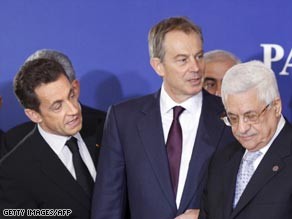 President Nicolas Sarkoxy of France (left), Middle East negotiatorTony Blair, and Palestinian leader Mahmoud Abbas at the Paris conference. |
Looking ahead, Abbas announced a goal to collect pledges of $5.8 billion in aid for a three-year period, 2008-10, at the "Donors' Conference for the Palestinian Authority" attended by over ninety states on Monday in Paris. (Using the best population estimate of 1.35 million Palestinians on the West Bank, this comes to a staggering amount of money: per capita, over $1,400 per year, or about what an Egyptian earns annually.) Endorsed by the Israeli government, Abbas won pledges for an astonishing $7.4 billion (or over $1,800 per capita per year) at the donors' conference.
Well, it's a bargain if it works, right? A few billion to end a dangerous, century-old conflict – it's actually a steal.
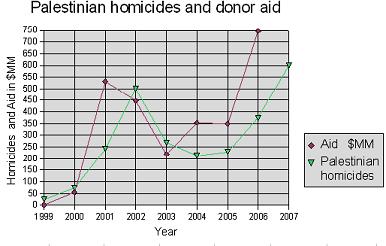
But innovative research by Steven Stotsky, a research analyst for the Committee for Accuracy in Middle East Reporting in America (CAMERA) finds that an influx of money to the Palestinians has had the opposite effect historically. Relying on World Bank, International Monetary Fund, and other official statistics, Stotsky compares two figures since 1999: budgetary support aid provided annually to the Palestinian Authority and the number of Palestinian homicides annually (including both criminal and terrorist activities, and both Israeli and Palestinian victims). Graphed together, the two figures show an uncanny echo:
The correlation is even clearer when the aid of one year is superimposed on the homicides of a year later:
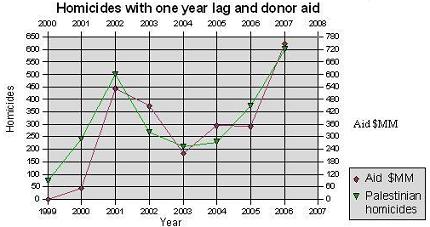
In brief, each $1.25 million or so of budgetary support aid translates into a death within the year. As Stotsky notes, "These statistics do not mean that foreign aid causes violence; but they do raise questions about the effectiveness of using foreign donations to promote moderation and combat terrorism."
The Palestinian record fits a broader pattern, as noted by Jean-Paul Azam and Alexandra Delacroix in a 2005 article, "Aid and the Delegated Fight Against Terrorism." They found "a pretty robust empirical result showing that the supply of terrorist activity by any country is positively correlated with the amount of foreign aid received by that country" – i.e., the more foreign aid, the more terrorism.
If these studies run exactly counter to the conventional supposition that poverty, unemployment, repression, "occupation," and malaise drive Palestinians to lethal violence, they do confirm my long-standing argument about Palestinian exhilaration being the problem. The better funded Palestinians are, the stronger they become, and the more inspired to take up arms.
A topsy-turvy understanding of war economics has prevailed in Israel since the Oslo negotiations began in 1993. Rather than deprive their Palestinian enemies of resources, Israelis have been following Shimon Peres's mystical musings, and especially his 1993 tome, The New Middle East, to empower them economically. As I wrote in 2001, this "is tantamount to sending the enemy resources while fighting is still under way – not a hugely bright idea."
Rather than further funding Palestinian bellicosity, Western states, starting with Israel, should cut off all funds to the Palestinian Authority.
--------------------------------------------------------------------------------
Dec. 19, 2007 update: The Peel Commission of 1936-37, formally known as the Palestine Royal Commission, included a sentence in its report that exactly anticipates this article by seventy years: "With almost mathematical precision the betterment of the economic situation in Palestine meant the deterioration of the political situation." In other words, this pattern is not exactly new.
Dec. 20, 2007 update: Using the Stotsky materials and extrapolating to include the $7.4 billion committed earlier this week, Hal M. Switkay comes up with an estimate of 4,600 Palestinian-caused deaths per year in the three years ahead:
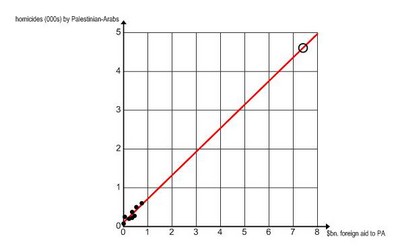 Extrapolation of Stotsky's analysis for $7.4 billion over three years. |
Switkay also provides commentary, noting for starters that there is one crucial missing ingredient in this analysis, the correlation coefficient, known as r.
One can run linear regressions on any two data sets with the same number of points, such as the average temperature each day in Lhasa, Tibet, versus the daily close of the Dow Jones Industrial Average, and there would be a linear relationship; only the relationship would be so weak as to be statistically insignificant. That would be indicated by r close to 0. On the other hand, as the linear relationship gets stronger, r approaches 1 or -1 (depending on whether the relation is direct or inverse).
While I don't have access to the original data, I estimated it from the graph and ran the numbers. In this case, r is roughly 0.88. That is a very strong correlation. How strong? The chances are less than 1 out of 200 that such a correlation would be observed among randomly chosen data. Put another way, r^2 represents the proportion of the variance in homicide rates that can be attributed to variance in foreign aid – in this case about 77%.
One must be cautious, as the authors are, and explain that correlation – even perfect correlation – does not imply causation. One must present a plausible explanation that could justify the claim of causation, and I have one. Most of the ignoramuses who opine or make policy regarding the Middle East and jihadists worldwide, believe that poverty causes war, just as poverty causes crime at home, and that terrorists must be given hope to stop their deadly rampage. However, we know that quite the opposite is true: poor people can choose to study hard, work hard, and lift themselves and their communities gradually out of poverty; crime causes poverty; terrorism causes poverty; and terrorists are given hope by the craven appeasement of the empty-headed Western intellectuals and politicians who come to bargain for their lives – at others' expense, of course. My theory is justified, I believe, by the strong relationship between foreign aid and homicides that occur one year later.
Based on the strong linear correlation between foreign aid to the Palestinian Authority and the number of homicides committed by Palestinian Arabs one year later, I have used extrapolation to predict the consequences of a promised $7.4 billion in aid to the Palestinian Arabs. Please understand that extrapolation is far less reliable than interpolation. Nevertheless, my model predicts approximately 4600 homicides can be expected within a year after the infusion of the pledged foreign aid. This is equivalent to the murder of some 215,000 Americans.
Dec. 30, 2007 update: For an exchange on the methodology of the Stotsky study, see the challenge from Basel Saleh, Asst. Professor of Economics, Radford University and Steven Stotsky's reply at "False Analysis."
June 21, 2008 update: For a fuller explanation by Steven Stotsky of his thesis, see "Does Foreign Aid Fuel Palestinian Violence?" Middle East Quarterly, Summer 2008, pp. 23-30.
Dec. 27, 2013 update: A review of the numbers six years later finds another perverse correlation: a surge in Palestinian terrorism as diplomatic negotiations take place. Alex Traiman writes for JNS.org:
Upsurges in Palestinian terrorism have often accompanied progress—and eventual breakdowns—in Israeli-Palestinian conflict negotiations over the past 20 years. The latest round of talks, brokered by U.S. Secretary of State John Kerry, is proving to be no different. ...
"Unfortunately and regrettably, it's quite typical to the junctures in which political decisions and painful compromises are expected to be taken by the negotiating parties," Gilead Sher, who served as chief of staff and policy coordinator to Israel's former prime minister and defense minister Ehud Barak, told JNS.org regarding the uptick in Palestinian terror. "Time and time again, we see the leash loosening for these kinds of acts, that typically characterize the Palestinian response to the kind of progress that seemingly is what is happening within the negotiating room," said Sher. ...
The rise in terrorism has stirred a heated debate among Israeli defense officials and parliamentarians about the need to continue pursuing U.S.-brokered Israeli-Palestinian conflict negotiations. Israeli Economy Minister Naftali Bennett, head of the Jewish Home Party, said, "Israel is continuing with the diplomatic process as though there's no terror, while the Palestinians are continuing with the terror as though there's no diplomatic process."
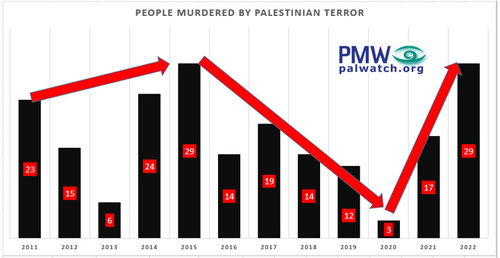
Mar. 13, 2023 update: Maurice Hirsch of Palestinian Media Watch has confirmed these results during the 12-year period 2011-22 in a study titled "US aid to the Palestinians increases violence and terror, not peace." Two graphs compellingly make the point. First, the murders by Palestinians of Israelis.
Then the amount in dollars of U.S. aid to the Palestinian Authority.
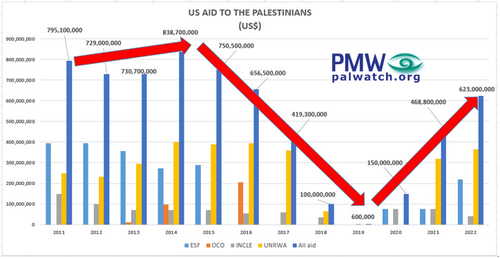
Hirsch concludes:
While the US support to the Palestinians, as represented inter alia by the US aid, should be, and is ostensibly, devoted to promoting peace, in practice the Palestinians see the unconditional US support as an opportunity to promote terror. While US aid to the Palestinians flows freely, Palestinian terrorists feel emboldened and murder Israelis. Only when the US demonstrates moral clarity and stops aid because the PA promotes terror, do the Palestinians understand that terror does not pay.


