
There's a contradiction brewing among Muslim political leaders on the question of creating a global law to respect religion.
On the one hand, the Muhammad cartoons and other episodes leave them intent to find a mechanism to suppress public anti-Islamic sentiments. As such laws cannot single out Islam exclusively for protection, they must include respect for religion in general. Here is one example of this wish, as expressed by Yemen's Prime Minister Ali Mohammed Mujawr in late February who, as reported by the Yemen Observer "called for an international law that criminalizes religious insults and enforces mutual respect of religions, calling on all rationalists in the West to avoid such negative acts [as printing the Muhammad cartoons]. ‘This can only increase the instability in relations among Islamic and Western nations'."
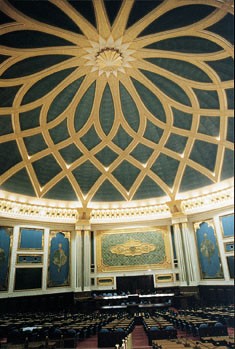 The grand hall of the Consultative Council in Riyadh, Saudi Arabia. |
Ah, but there's a problem with this "mutual respect of religions" idea, one which led the council overwhelmingly to vote down the resolution, 77-33. Critics pointed out that such a pact would recognize polytheistic religions, and that "would be unacceptable." One opponent, Khaleel Al Khaleel, explained his vote against on the grounds that it would create a dangerous precedent for Muslims. "Some consider Buddhism, Qadianism and Baha'ism as religions. Can we make it obligatory for Muslims to respect these faiths and avoid criticising them?" Another member, Talal Bakri, noted that "if we approve the resolution it will be make it obligatory to recognise some religions and will facilitate establishing places of worship for them in Muslim countries."
Comment: The idea of an international law banning blasphemy is just awful. How reassuring to know that the Saudi Consultative Council agrees, even if for its own parochial reasons. (March 19, 2008)
Mar. 27, 2008 update: The Saudis may have turned down a law to respect religion, but the United Nations Human Rights Council voted 21-10, with 14 abstentions, on March 27 to pass a resolution "Combating defamation of religions." The lengthy resolution mentions Islam and Muslims repeatedly but not other religions nor their adherents. (Sample clause: it notes "with deep concern the increasing trend in recent years of statements attacking religions, including Islam and Muslims, in human rights forums.") Its operational paragraphs include:
-
8. Urges States to take actions to prohibit the dissemination, including through political institutions and organizations, of racist and xenophobic ideas and material aimed at any religion or its followers that constitute incitement to racial and religious hatred, hostility or violence;
-
9. Also urges States to provide, within their respective legal and constitutional systems, adequate protection against acts of hatred, discrimination, intimidation and coercion resulting from the defamation of any religion, to take all possible measures to promote tolerance and respect for all religions and their value systems and to complement legal systems with intellectual and moral strategies to combat religious hatred and intolerance;
Mar. 28, 2008 update: The United Nations Human Rights Council adopted without a vote a resolution innocently named "Mandate of the Special Rapporteur on contemporary forms of racism, racial discrimination, xenophobia and related intolerance" on March 28. The resolution extends this special rapporteur's mandate, currently the Kenyan Ambeyi Ligabo, for three years
to gather, request, receive and exchange information and communications with all relevant sources, on all issues and alleged violations falling within the purview of his/her mandate, and to investigate and make concrete recommendations, to be implemented at the national, regional and international levels, with a view to preventing and eliminating all forms and manifestations of racism, racial discrimination, xenophobia and related intolerance.
The special rapporteur is told to focus, inter alia, on the following issues:
(a) Incidents of contemporary forms of racism and racial discrimination against Africans and people of African descent, Arabs, Asians and people of Asian descent, migrants, refugees, asylum-seekers, persons belonging to minorities and indigenous peoples, as well as other victims included in the Durban Declaration and Programme of Action;
(b) Situations where the persistent denial of individuals belonging to different racial and ethnic groups of their recognized human rights, as a result of racial discrimination, constitutes gross and systematic violations of human rights;
(c) The scourges of anti-Semitism, Christianophobia, Islamophobia in various parts of the world, and racist and violent movements based on racism and discriminatory ideas directed at Arab, African, Christian, Jewish, Muslim and other communities;
(d) Laws and policies glorifying all historic injustices and fuelling contemporary forms of racism, racial discrimination, xenophobia and related intolerance and underpinning the persistent and chronic inequalities faced by racial groups in various societies;
(e) The phenomenon of xenophobia;
(f) Best practices in the elimination of all forms and manifestations of racism, racial dissemination, xenophobia and related intolerance;
(g) Follow-up to the implementation of all relevant paragraphs of the Durban Declaration and Programme of Action and the promotion of the establishment of national, regional and international mechanisms to combat racism, racial discrimination, xenophobia and related intolerance;
(h) The role of human rights education in promoting tolerance and the elimination of racism, racial discrimination, xenophobia and related intolerance;
(i) Respect for cultural diversity as a means to prevent racism, racial discrimination, xenophobia and related intolerance;
(j) Incitement to all forms of hatred, taking into account article 20, paragraph 2, of the International Covenant on Civil and Political Rights, and instances of racially motivated hate speech, including the dissemination of ideas of racial superiority or that incite racial hatred, taking into account article 4 of the International Convention on the Elimination of All Forms of Racial Discrimination, article 19 of the International Covenant on Civil and Political Rights and general comment No. 15 of the Committee on the Elimination of All Forms of Racial Discrimination, which states that the prohibition of the dissemination of all ideas based upon racial superiority or hatred is compatible with the freedom of opinion and expression;
(k) The sharp increase in the number of political parties and movements, organizations and groups which adopt xenophobic platforms and incite hatred, taking into account the incompatibility of democracy with racism;
(l) Laws and policies glorifying or legitimizing historic injustices, including colonialism;
(m) The impact of some counter-terrorism measures on the rise of racism, racial discrimination, xenophobia and related intolerance, including the practice of racial profiling and profiling on the basis of any grounds of discrimination prohibited by international human rights law;
(n) Institutional racism and racial discrimination;
(o) The efficiency of the measures taken by Governments to remedy the situation of victims of racism, racial discrimination, xenophobia and related intolerance;
(p) Impunity for acts of racism, racial discrimination, xenophobia and related intolerance, and maximizing remedies for the victims of these violations;
Apr. 1, 2008 update: The U.S. government does not belong to the council, so could not vote against these resolutioins, but Warren W. Tichenor, U.S. ambassador to the U.N. in Geneva, took the floor at the Human Rights Council and denounced the second of them, above: "The resolution adopted attempts to legitimize the criminalization of expression." He noted that it seeks to impose "restrictions on individuals rather than to emphasize the duty and responsibility of governments to guarantee, uphold, promote and protect human rights." In contrast, European members of the council abstained on the vote.
June 8, 2008 update: The Pakistani government endorses this approach, according to an article by Tahir Niaz in the Daily Times, "Pakistan to ask EU to amend laws on freedom of expression."
Pakistan will ask the European Union countries to amend laws regarding freedom of expression in order to prevent offensive incidents such as the printing of blasphemous caricatures of Prophet Muhammad (Peace Be Upon Him) and the production of an anti-Islam film by a Dutch legislator, sources in the Interior Ministry told Daily Times on Saturday. They said that a six-member high-level delegation comprising officials from the Ministry of Interior, the Ministry of Foreign Affairs and the Ministry of Law would leave Islamabad on Sunday (today) for the EU headquarters in Brussels, Belgium and explain to the EU leadership the backlash against the blasphemous campaign in the name of freedom of expression.
The delegation, headed by an additional secretary of the Interior Ministry, will meet the leaders of the EU countries in a bid to convince them that the recent attack on the Danish Embassy in Pakistan could be a reaction against the blasphemous campaign, sources said. They said that the delegation would also tell the EU that if such acts against Islam are not controlled, more attacks on the EU diplomatic missions abroad could not be ruled out. Sources said that the delegation would also hold discussions on inter-religious harmony during its meetings with the EU leaders.
Comment: Note the implicit threat: "if such acts against Islam are not controlled, more attacks on the EU diplomatic missions abroad could not be ruled out." And note also the delightful conclusion on "inter-religious harmony" – that's the happy result of European appeasement.
June 19, 2008 update: More concessions at the United Nations Human Rights Council, following an NGO's linking Islam on June 16 to female genital mutilation and honor killings. The Egyptian, Pakistani, and Iranian governments angrily protested, leading council President Doru-Romulus Costea to issue a "presidential ruling" that religions require special protection because debates about faith are "very complex, very sensitive and very intense." Therefore, only religious scholars may discuss matters of faith. The ruling concerns just chamber debates, not findings by council experts.
Comment: This ruling means, in effect, as the Associated Press puts it, that "Muslim countries have won a battle to prevent Islam from being criticised during debates by the UN."
July 14, 2008 update: Ziya Meral puts these various initiatives into perspective in a Turkish Daily News article, "Defamation of Islam and denial of human rights abuses":
Something extremely important has been happening at the highest levels of international diplomacy and human rights mechanisms without much public attention. A series of resolutions, named "combating defamation of religions," have been passed at the U.N. General Assembly and the U.N. Human Rights Council for the last couple of years following intense lobbying by the Organization of Islamic Conference, or OIC. The resolution was first drafted as a stand against "defamation of Islam" and for obvious political reasons it has been adopted as "combating defamation of religions." However, the text still singles out Islam and seeks to protect Islam from any accusations of or association with human rights abuses.
What does the OIC intend by this? A close look "may prove that what the OIC is trying to do is not to protect Islam, but its own member states." In brief, "any criticism of governments and their immoral police and intelligence officers is portrayed, manipulated and represented as an attack on Islam." Meral provides an example:
if one condemns human rights abuses committed by the Saudi police, what is criticized is not Islam, but particular individuals who live in a certain location and time. In order to get rid of the "headache" created by human rights arguments, Saudi Arabia might declare that Islam is being attacked and defamed. In this way, Islam is instrumentalized to shield against the truth of moral failure of individuals.


