Which Muslims in the West support Islamism, which do not?
Those who have Al-Qaeda connections or deal in terrorism are relatively easy to classify, once they are found out. The state has ways to investigate and punish illegal activities. In September 2003, for example, Taysir Alony, a star reporter for the Al-Jazeera television network, was arrested in Spain on charges of belonging to Al-Qaeda.[1] In the United States, Abdurahman Alamoudi, "a well-heeled advocate who had represented American Muslims in White House meetings,"[2] was arrested on terrorism-related charges.
But what about individuals who apparently break no laws but promote an Islamist agenda in a legal fashion, sometimes from within the heart of the establishment? One case is that of the renowned Swiss-French intellectual Tariq Ramadan, hailed by some as a moderate—a man who has stayed within the law but is believed by some to have Al-Qaeda connections.[3] Another is Bashir Nafi, who teaches at the University of London but in February 2003 was indicted at a U.S. District Court in Florida as someone who "supported numerous violent terrorist activities associated with the Palestinian Islamic Jihad."[4]
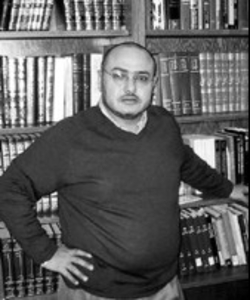 Abou El Fadl in an academic setting. |
- The Boston Globe: Abou El Fadl is "a moderate voice urging Muslims in the United States and elsewhere to speak out against radical elements of Islam."[6]
- The Jerusalem Post: one of the few Muslims who "take a stand despite the [personal] risks" in favor of a "pluralistic, tolerant and non-violent Islam."[7]
- Los Angeles Daily News: "a leading critic of Islamic radicalism."[8]
- Los Angeles Times: a "longtime champion of human rights."[9]
- National Review: "one of the most formidable weapons in the battle against Islamic fundamentalism."[10]
- The New Republic: a heroic moderate who announces, "There may need to be sacrificial lambs. I'm going to play this role and speak my conscience."[11]
To judge from Abou El Fadl's press, he is a path-breaking and fearless antidote to extremism. But there is a body of other evidence suggesting that he is something other than the "moderate voice" his admirers believe or hope him to be.
Wahhabi Menace
Abou El Fadl's signature issue, the one that has most established his reputation as a moderate, involves his outspoken opposition to the Saudi regime. But one can be an Islamist, and even a radical one, and also take a stand against Wahhabism. Ayatollah Khomeini, and indeed the entire school of Shi'ite radicalism, provides a dramatic example of this pattern. After a confrontation with Saudi security forces during the pilgrimage to Mecca in 1987, which left hundreds of Iranians dead, Khomeini raged against "these vile and ungodly Wahhabis, [who] are like daggers which have always pierced the heart of the Muslims from the back."[12]
Abou El Fadl, another such anti-Wahhabi Islamist, fits into an Egyptian tradition, currently called the "New Islamists," that is outspokenly critical of Wahhabism. Sheikh Muhammad al-Ghazali (1917-96), a leading New Islamist, remains one of Abou El Fadl's chief intellectual influences. Although Ghazali had earlier taken refuge in Saudi Arabia, he felt free to criticize the dominant interpretation of Islam there, especially as concerns women. He also wrote a book in 1989 that accused the Wahhabis of a fanaticism that harms the reputation of Islam. Raymond William Baker recounts how Ghazali "directly attacked Saudi religious scholars, whom he charged with mistaking the backward, inherited customs of the Arabian Peninsula for Islam and its revelation and then arrogantly seeking to impose their limited understanding on others."[13] The Muslim Public Affairs Council of Los Angeles, with which Abou El Fadl was once closely affiliated, has a generally New Islamist outlook; it explicitly "rejects many of the ideas espoused by the doctrine of Wahhabism."[14]
Despite Abou El Fadl's general antipathy toward Wahhabi and Saudis, he nevertheless has offered excuses for them. The Wahhabis, he says, "do not seek to dominate—to attain supremacy in the world ... They are more than happy living within the boundaries of Saudi Arabia."[15] This statement ignores the Saudi regime's policy since the 1960s of spending billions of dollars to spread the Wahhabi ideology abroad, precisely in an effort to dominate.[16] Abou El Fadl declares there has been "no examination" of the extent to which objectionable materials are found in Saudi-funded religious schools and mosques outside the kingdom, calling for congressional hearings to learn more about this.[17] But the U.S. government has already closed down several Saudi-funded institutions in the United States, such as the Institute of Islamic and Arabic Sciences in America.[18] As Stephen Schwartz, author of The Two Faces of Islam, notes, "There is no doubt about official Saudi funding of Wahhabism, and there is little or no need for further expenditure of federal funds holding hearings on it."[19]
Finally, Abou El Fadl has been known to place his talents at the service of Saudi-funded terrorists. In November 1995, for example, he provided sworn testimony in an "Affidavit in Support of Application for Bail" for Mousa Muhammed Abu Marzook, a top Hamas official, assuring the court that, "pursuant to Islamic law," Abu Marzook was obligated to abide by any bail agreement he would reach with the U.S. government.[20]
Shari'a Paramount
In common with other Islamists, Abou El Fadl wants Muslims to live by Islamic law (the Shari'a), the law that among other things endorses slavery, execution for apostasy, and the repression of women, and which treats non-Muslims as second-class citizens. "Shariah and Islam are inseparable," he has written, "and one cannot be without the other." In a revealing passage, he confesses that his "primary loyalty, after God, is to the Shariah."[21] Given that Islamic law is Abou El Fadl's academic specialty, this profound allegiance to its goals has great significance and provides a key to his outlook.
To make Islamic law more appealing, he blurs or conceals some of its unpleasant realities. Consider the sensitive issues of adultery, jihad, and relations with non-Muslims.
Adultery: A Nigerian woman, Amina Lawal, was convicted of adultery and sentenced to death by stoning in March 2002. When asked about this case by talk-show host Oprah Winfrey, Abou El Fadl replied that the Nigerian authorities had made a mistake because "The punishment for adultery is really a symbolic punishment. It's a punishment that is designed to make a point about how bad this crime is."[22] This is nonsense, for the punishment of adultery is brutal, deadly, and real. It has been applied repeatedly in recent years, notably in Iran and in Afghanistan under the Taliban. It is deceitful to pretend that Islamic law's hudud punishments (prescribed in the Qur'an) are merely symbolic.
Jihad: Abou El Fadl hides the historic meaning of this term (i.e., the expansion of Muslim-ruled territories primarily through the use of force) and instead variously defines it as "the struggle waged to cleanse oneself from the vices of the heart" or "to strive hard or struggle in pursuit of a just cause."[23] In a sleight of hand, he substitutes his own Qur'anic reading of this word, blithely discarding a millennium of interpretation by Muslim scholars and rulers.[24] Using his definition, he concludes that jihad is "a good thing." More ominously, he denounces those who "carelessly dump on jihad,"[25] accusing them of "prejudicial, dangerous talk" reminiscent (so he wrote) of Nazi preparations for the Holocaust.[26]
Jizya: Abou El Fadl treats in like fashion the jizya tax, a discriminatory and humiliating poll tax imposed exclusively on non-Muslims by their Muslim rulers. He renders it into something historically quite unrecognizable—"money collected by the Islamic polity from non-Muslims in return for the protection from the Islamic state."[27] Again, this is deception to excuse a discriminatory practice.
Andrew Bostom of Brown University concludes from a close reading of Abou El Fadl's work on jihad and jizya that his omission of evidence, "combined with an excessive reliance on sacralized, whitewashed historiography, refutes the prevailing notion that El Fadl is engaged in a sincere effort to instill fundamental change in Islam."[28]
Abou El Fadl's efforts on behalf of Shari'a go further. Serving as the academic reviewer for the "Origins of Islamic Law" unit put out by the Constitutional Rights Foundation, he is at least associated with, if not the author of, an analysis that forwards a new amendment to the U.S. Constitution, enabling Shari'a-like blasphemy laws to encroach on traditional U.S. notions of freedom of religion. The proposed amendment reads: "The First Amendment shall not be interpreted to protect blasphemous speech. States shall be free to enact anti-blasphemy laws as long as they prohibit offensive speech against all religions."[29]
Islamist Prejudices
Abou El Fadl harbors the Islamist's typical hostility toward the West, blaming it for whatever ails Islam and Muslims. Islamist terrorism, for example, he deems "part of the historical legacy of colonialism and not the legacy of Islamic law."[30] By holding that "Islamic civilization has been wiped out by an aggressive and racist European civilization,"[31] he in one swoop exculpates Muslims for everything they do.
Nor is the problem restricted to the colonial past. In the United States, he finds, the "demonization of Muslims is well-camouflaged"[32] and he cites unnamed and unspecified "plots and conspiracies" against Muslims.[33] Along with the Islamist organizations,[34] Abou El Fadl after 9/11 falsely issued alarmist predictions about "an explosion of hate crimes against Muslim and Arab Americans, both by police and by ordinary citizens."[35] (Federal Bureau of Investigation statistics showed 481 reported anti-Islamic hate crime incidents listed in 2001 and 155 in 2002; 2003 figures are not yet available.)[36]
Abou El Fadl, like all Islamists, objects to analyses of Islam that use such terms as "militant Islam," even calling use of this term "ideological ravings."[37] And like all Islamists, he relentlessly disparages true Muslim liberals and freethinkers such as Salman Rushdie and Taslima Nasrin for promoting what he calls "secular fundamentalism."[38] Ibn Warraq is (the pseudonym of) an ex-Muslim who has written scholarly works critical of the Qur'an, the life of Muhammad, and the Islamic religion. Asked about him, Abou El Fadl describes Ibn Warraq's work as nothing but propaganda and wrongly dismisses his work as derivative: "If you already know what Islamophobes and Orientalists believe, this author has nothing original to add."[39]
Along these same lines, Abou El Fadl shows the typical Islamist's bias against non-Muslims. In early 2003, shortly after President Bush appointed Noah Feldman, a New York University law professor, to serve as legal advisor to the Coalition Provisional Authority in Iraq, Abou El Fadl expressed rage to a Boston-area seminar on "Islam and Democracy" that a Jew should be selected for this task.[40]
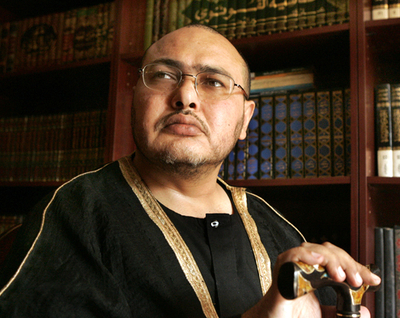 Abou El Fadl in his Bond villain outfit. |
Abou El Fadl promotes the standard Islamist line exonerating Muslims from responsibility for terrorism. He testified to the 9/11 commission in December 2003 that "Statistically, after the attacks of 9/11, Muslim and Arab terrorism was responsible for 2 percent of the sum total of terrorist incidents taking place in the United States."[41] This statement runs wildly contrary to common sense and every analysis. Specifically, Robert Leiken surveyed 212 suspected and convicted terrorists implicated in North America and Western Europe between the first World Trade Center bombing in 1993 and December 2003. He found that "86 percent were Muslim immigrants, the remainder being mainly converts [to Islam] (8 percent) and African American Muslims."[42]
Further to exonerate the American Muslim population, Abou El Fadl claimed before the commission that terrorists in most cases are "outsiders ... on the margins of American-Muslim society."[43] In fact, the record shows that in most cases of jihadi violence on U.S. soil, the terrorists come from within the bosom of the American Muslim community.[44]
Having dissociated Muslims from terrorism, Abou El Fadl then railed against U.S. counterterrorism measures. He characterized the overdue steps taken post-9/11 (such as the use of secret evidence and heightened surveillance) as the government having "turned against" American Muslims.[45]
Given his similarity of viewpoint with the Islamists, it comes as little surprise to find that Abou El Fadl maintains cordial relations with two of the most extreme Islamist institutions in the United States:
Holy Land Foundation: The Holy Land Foundation (HLF), an Islamic "charitable" organization, was closed down in December 2001 on grounds that it was collecting money "used to support the Hamas terror organization."[46] Abou El Fadl had contributed funds to it and publicly defended HLF, lauding its professional accountability and documentation.[47] In common with a bevy of Islamist groups, he portrayed its shuttering as evidence of "the systematic undermining of Muslim civil liberties" in the United States.[48]
Council on American-Islamic Relations: CAIR is the (Saudi-funded)[49] attack-dog of Islamist institutions in the United States, well known for intimidating those who disagree with it,[50] for apologizing for Osama bin Laden,[51] for employing three persons subsequently arrested on terrorism-related charges,[52] and for declaring its intent to make Islam "dominant" in the United States.[53] CAIR is criticized by other Muslim organizations, such as the Islamic Supreme Council of America[54] and MuslimWakeUp.com.[55]
But Abou El Fadl lavishes praise on CAIR's "civility and grace," appreciates its "important role," and thanks it "for setting an example" for all Muslims. He presents himself as thoroughly in tune with CAIR's sense of victimhood, its resentments against American society, and its goal of promoting militant Islam. "Our voice," he wrote to CAIR, "must be loud, resounding, and even deafening." He declares himself "in brotherhood" with CAIR, gushes over its "admirable work," and promotes it as a "shining example" of Muslim leadership. He requests CAIR's help on the basis that he and it share opponents; expresses a hope that CAIR's influence will spread on university campuses; and invokes blessings on it ("May God aid you in your efforts and amply reward you for standing in justice and truth").[56] Abou El Fadl even helps CAIR fundraising efforts.[57]
This is not to say that Abou El Fadl approves of everything American Islamist organizations do. His "biggest problem" with them, he has said, has to do with their lack of "intellectual grounding" in Islamic tradition. His criticism concerns their lack of sophistication and cultural depth, not their goals. He laments that
among American Muslim organizations, the intellectual and moral grounding—not just in the Islamic texts but in the pluralities of the Islamic tradition—is woefully, woefully absent. There has not been a serious movement among these organizations to create educational institutions that would attempt a critical understanding of the tradition they claim to represent. There are practically no such institutions, or even attempts to preserve the knowledge of Islamic law. These organizations remain activist, with a lot of energy but without direction.[58]
Islamist Nonetheless
Ultimately, Abou El Fadl is engaged in developing a more sophisticated way of presenting militant Islam. He is working toward the same goals as are more brazenly Islamist groups like CAIR, but he takes care to present his views in a more acceptable fashion.[59] In some cases, this leads to differences between him and them. As a fêted favorite of the establishment, he must distance himself from some of their particularly unacceptable positions (for example, he condemns suicide bombings against Israeli civilians). This is admittedly better than silence, but it hardly signals moderation. With rare exceptions, Khaled Abou El Fadl's differences with the overt Islamists are those of style, not substance.
Some Muslim observers have come to this same conclusion. Haroon Siddiqui of The Toronto Star writes that Abou El Fadl "does not fit the mould of a 'moderate' taking on 'militants.'"[60] Muqtedar Khan of the Brookings Institution finds it "scary" that Abou El Fadl wants the Shari'a to be central in Muslim life.[61]
The case of Abou El Fadl points to the challenge of how to discern Islamists who present themselves as moderates. This is still possible to do with Abou El Fadl, who has left a long paper trail; it is harder with those who keep their opinions to themselves.[62] In either case, the key is old-fashioned elbow grease: reading, listening, and watching. There is no substitute for research. It needs to be done by White House staffers, district attorneys, university search committees, journalists, Jewish defense agencies, and churches. Failing proper research, Islamists will push their way through Western institutions and ultimately subvert them.
[1] El Mundo (Madrid), Sept. 18, 2003.
[2] The Washington Post, Dec. 1, 2003.
[3] Le Parisien, Nov. 13, 2003.
[4] Attorney General, "Indictments," Feb. 20, 2003, at http://www.usdoj.gov/ag/speeches/2003/02202003pressconference.htm.
[5] For his self-description, see http://www.scholarofthehouse.org/abdrabelfad.html.
[6] The Boston Globe, Nov. 30, 2002.
[7] The Jerusalem Post, Sept. 13, 2002.
[8] Los Angeles Daily News, Aug. 14, 2003.
[9] Los Angeles Times, Aug. 14, 2003. It also praises his "unflinching scholarship" that breaks "intellectual ground with bold social critiques," Dec. 29, 2000.
[10] Rod Dreher, "Inside Islam: A Brave Muslim Speaks," National Review Online, Jan. 8, 2002, at http://www.nationalreview.com/dreher/dreher010802.shtml.
[11] Franklin Foer, "Moral Hazard," The New Republic, Nov. 18, 2002.
[12] Quoted in Martin Kramer, "Tragedy in Mecca," Orbis, Spring 1988, p. 245.
[13] Raymond William Baker, Islam without Fear: Egypt and the New Islamists (Cambridge: Harvard University Press, 2003), pp. 97-8.
[14] Muslim Public Affairs Council, A Review of U.S. Counterterrorism Policy (n.p, 2003), p. 5, fn. 13.
[15] "The Gil Elan Show," KKOL (1300 AM, Seattle), Dec. 22, 2002, on tape.
[16] Dore Gold, Hatred's Kingdom: How Saudi Arabia Supports the New Global Terrorism (Washington: Regnery, 2003), esp. chap. 8.
[17] The Wall Street Journal, Nov. 10, 2003.
[18] Ibid., Dec. 3, 2003.
[19] Ibid., Nov. 18, 2003.
[20] United States District Court, Southern District of New York, Nov. 16, 1995.
[21] "Dr. Abou El Fadl's Response to CAIR," July 20, 2002, at http://www.scholarofthehouse.org/drabelfadres.html.
[22] The Oprah Winfrey Show, Oct. 4, 2002, transcript.
[23] Khaled Abou El Fadl, The Place of Tolerance in Islam (Boston: Beacon Books, 2002), p. 19.
[24] Khaled Abou El Fadl, "Peaceful Jihad," in Michael Wolfe, ed., Taking Back Islam: American Muslims Reclaim Their Faith (n.p.: Rodale, 2002), pp. 37-8.
[25] Larry Witham, "Muslims See Wordplay as Swordplay in Terrorism War," The Washington Times, July 24, 2002.
[26] Zachary Block, "One Man's War on Terror," Brown Alumni Magazine Online, Nov./Dec. 2002, at http://www.brownalumnimagazine.com/storyDetail.cfm?ID=1806.
[27] Abou El Fadl, The Place of Tolerance, p. 21.
[28] Andrew G. Bostom, "Khaled Abou El Fadl: Reformer or Revisionist?" SecularIslam.com, May 2003, at http://www.secularislam.org/articles/bostom.htm.
[29] Constitutional Rights Foundation, "Blasphemy! Salman Rushdie and Freedom of Expression," at http://www.crf-usa.org/terror/rushdie.htm.
[30] Los Angeles Times, Aug. 22, 2002.
[31] "What Became of Tolerant Islam?" Los Angeles Times, Sept. 14, 2001.
[32] The Toronto Star, Nov. 24, 2002.
[33] "Dr. Abou El Fadl's Response to CAIR," July 20, 2002, at http://www.scholarofthehouse.org/drabelfadres.html.
[34] For example, the Council on American-Islamic Relations issued a pamphlet, Guilt by Association, in July 2003 that made these points at greater length.
[35] "What Became of Tolerant Islam?" Los Angeles Times, Sept. 14, 2001.
[36] CNN, "Hate Crimes Decrease in 2002," Nov. 12, 2003, at http://www.cnn.com/2003/LAW/11/12/hate.crimes.ap/.
[37] "'Human Rights' Must Include Tolerance," Los Angeles Times, Aug. 12, 1997.
[38] Los Angeles Times, Sept. 18, 1994.
[39] The Boston Globe, Aug. 17, 2003.
[40] Personal communication from Ray Freed, Dec. 2, 2003. Abou El Fadl did not reply to the author's repeated queries for comment on this matter. [Post-publication update: Oddly, while Abou El Fadl did not reply to these queries, he did post the second letter, without asking permission to do so, on his website. Done by a professor of law, this breach of privacy rights is particularly notable.]
[41] "Statement of Khaled Medhat Abou El Fadl to the National Commission on Terrorist Attacks upon the United States," Dec. 8, 2003, at http://www.9-11commission.gov/hearings/hearing6/witness_elfadl.htm. Abou El Fadl did not reply to the author's repeated queries for a source for the 2 percent figure.
[42] Robert S. Leiken, Bearers of Global Jihad? Immigration and National Security after 9/11 (Washington, D.C.: Nixon Center, 2004), p. 6.
[43] "Statement of Khaled Medhat Abou El Fadl," at http://www.9-11commission.gov/hearings/hearing6/witness_elfadl.htm.
[44] For a detailed look at this phenomenon, see the case of Rashid Baz, examined in Uriel Heilman, "Murder on the Brooklyn Bridge," Middle East Quarterly, Summer 2001, especially the section on "Community Support," pp. 29-37. Other cases that exemplify this pattern include these incidents: July 1980: an Iranian dissident killed in the Washington, D.C. area; Jan. 1990: an Egyptian freethinker killed in Tucson, Arizona; Nov. 1990: a Jewish leader killed in New York; Jan. 1993: two CIA staff killed outside agency headquarters in Langley, Virginia; Feb. 1993: 6 people killed at the World Trade Center; Feb. 1997: a Danish tourist killed on the Empire State building; July 2002: an employee and a traveler on El Al killed at Los Angeles International Airport; Aug. 2003: an American killed by his former Saudi friend in Houston.
[45] "Statement of Khaled Medhat Abou El Fadl," at http://www.9-11commission.gov/hearings/hearing6/witness_elfadl.htm.
[46] "Remarks by the President on Financial Fight against Terror," White House news release, Dec. 4, 2001, at http://www.whitehouse.gov/news/releases/2001/12/20011204-8.html.
[47] Los Angeles Times, Dec. 7, 2001.
[48] "Dr. Abou El Fadl's Response to CAIR," July 20, 2002, at http://www.scholarofthehouse.org/drabelfadres.html.
[49] Daniel Pipes, "CAIR's Saudi Masters," weblog entry, June 5, 2003, at https://www.danielpipes.org/blog/2003/07/cairs-saudi-masters.html.
[50] Daniel Pipes, "An American Rushdie?" The Jerusalem Post, July 4, 2001.
[51] Council on American-Islamic Relations-Southern California Action Alert, "CAIR Demands Removal of Billboard Stereotyping Muslims," Oct. 28, 1998.
[52] Daniel Pipes, "CAIR's Legal Tribulations," weblog entry, June 27, 2003, at https://www.danielpipes.org/blog/2003/06/cairs-legal-tribulations.html.
[53] Speech given by Omar M. Ahmad on July 2, 1998, reported in San Ramon Valley Herald, July 4, 1998.
[54] Jake Tapper, "Islam's Flawed Spokesmen," Salon.com, Sept. 26, 2001, at http://archive.salon.com/news/feature/2001/09/26/muslims/index2.html.
[55] Ahmed Nassef, "Listen to Muslim Silent Majority in US," The Christian Science Monitor, Apr. 21, 2004, at http://www.csmonitor.com/2004/0421/p09s02-coop.html.
[56] "Dr. Abou El Fadl's Response to CAIR," July 20, 2002, at http://www.scholarofthehouse.org/drabelfadres.html.
[57] Council on American-Islamic Relations, "Fundraising Dinner in the Defense Fund of Ahmad Adnan Chaudhry," press release, Feb. 10, 2001.
[58] Khaled Abou El Fadl, Sohail Hashmi, Qamar-ul Huda, and Zainab Al-Suwaij, "Islam and the Prospects for Democracy," Center Conversations, Ethics and Public Policy Center, Oct. 20, 2003, at http://www.eppc.org/publications/pubID.1938/pub_detail.asp.
[59] For a premier example of this, see his apologetic for Islam being democratic: Khaled Abou El Fadl, "Islam and the Challenge of Democracy," Boston Review, Apr.-May 2003, at http://bostonreview.net/BR28.2/abou.html. This issue of Boston Review has been reprinted as Khaled Abou El Fadl et al., Islam and the Challenge of Democracy (Princeton: Princeton University Press, 2004).
[60] The Toronto Star, Nov. 21, 2002.
[61] Muqtedar Khan, "The Priority of Politics," The Boston Review, Apr.-May, 2003, at http://www.ijtihad.org/bostonrev.htm.
[62] I have listed a series of questions that can help to discern moderates at "Do You Believe in Modernity?" The Jerusalem Post, Nov. 26, 2003.
June. 21, 2004 addenda: (1) Abou El Fadl has attacked an article I wrote on the historical Muhammad in 2001. For details, click here.
(2) In "Khaled Abou El Fadl's Disastrous Interview" I reported on an unwise interview Abou El Fadl gave in Arabic in 2003 which then came back to bite him in English.
(3) I wrote a civil e-mail to Abou El Fadl on Apr. 19, 2004, asking again about two factual matters in preparation for the above article. Not only did he not reply to any of my notes but he had the bad grace to post one of them on his website.
Feb, 4, 2005 update: More lack of caution by the professor at "Khaled Abou El Fadl Reveals His Islamist Outlook."
Aug, 27, 2006 update: Musings on a stealth Islamist's claims at "Who Wants Khaled Abou el Fadl Dead?"
Feb. 28, 2008 update: Poor Abou El Fadl. The article above has been an albatross around his neck (at the moment, it ranks #4 at the Google search engine, following just the UCLA website, Wikipedia, and his own website), impeding his once-brilliant career (where have all the puff pieces gone?). Our stealth Islamist responds by insulting me, even when I have nothing to do with the topic at hand. The result can be a bit sad, as can be seen in a news item today by Jonathan Gelbert, "Muslim Student Group Launches "Jihad" of Mixed Messages," that reports on a recent Abou El Fadl talk at Stanford University:
El-Fadl proceeded to slam Daniel Pipes and Ayaan Hirsi as "professional Islamophobes" who "know nothing about Islam." El-Fadl attacked Daniel Pipes an unnecessarily large number of times throughout his talk, appearing almost desperate to convince the audience that Pipes' statements about Islam (and, by extension, el-Fadl himself) are wholly incorrect at best and dangerous at worst.
Comments: (1) If I "know nothing about Islam," then why bother responding to me? (2) Abou El Fadl ranks up there with John Esposito in obsessively bringing me into his public talks.
May 21, 2020 update: Even 16 years and in Indonesian, this article continues to bother Abou El Fadl.
June 7, 2020 update: And I continue to have some fun at the professor's expense, this time at "Academic Malfeasance: Khaled Abou El Fadl on Judeo-Christian Values." Sneak preview: he blames Robert Spencer and me for coming up with the concept of Judeo-Christian values with which to exclude Muslims. (Never mind that the term long goes back to 1939 and so, predates us both.)
Oct. 19, 2020 update: Abou El Fadl's obsession with me continues unabated, this time in a khutba (sermon) on Oct. 16 to the Usuli Institute titled "The Prophet's Pulpit and French Islamophobia" in which he twice mentions me in an hour-long lecture:
41:52: The remarkable thing is that the president of this country [France] says things that are identical, word-for-word, what you would expect reading Daniel Pipes or Steven Emerson or Robert Spencer or Walid Phares or any of the Islamophobes that fill the United States and England. And the Muslim world is in complete silence.
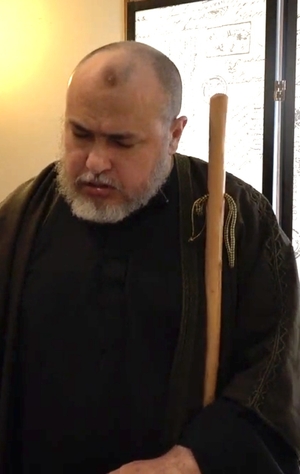
Khaled Abou El Fadl delivering a sermon in Los Angeles.
54:16: [The President of Egypt allegedly said to US leaders] don't be nice with these Islamist people. Don't trust them. Which happens to also mirror what the ambassador of the United Arab Emirates said repeatedly in Europe and in the US. Which happens to be exactly what Netanyahu says about Muslims in the West. Which happens to be identical to what Daniel Pipes and Steven Emerson and Robert Spencer have been saying about Muslims in the West for the past couple of decades. Look at this wonderful circle: Islamophobes, Muslim leaders in the United Arab Emirates, Saudi Arabia, and Egypt, the Mufti of Egypt, the head of one of the most racist and colonial governments, the French President – all in one bed.
Comments: (1) Abou El Fadl's prior reference to me, four months ago, ascribed Judeo-Christian values to Spencer and me. This time, we and a couple of friends seem to be controlling the leaders of four countries. What next? Maybe the persecution of Muslims in Xinjiang.
(2) On a lighter note, Khaled, what's with the just-in-from-the-desert get-up? David Swindle, who pointed this khutba out to me, notes its context: "Abou El Fadl's first sermon at Usuli focused on the idea that 'every podium is symbolically of the prophet,' and that anyone leading the mosque prayer should imitate Muhammad. Abou El Fadl resembles an actor who gets in costume to get into character."
Apr. 12, 2022 update: After so many years of neglect in the media, Abou El Fadl finally gets a new look by Andrew E. Harrod who reviews his outlook on Islamic law and concludes that "it is alarming that an advocate for the brutal laws of Sharia enjoys an endowed perch at one of the country's elite universities."
Aug. 19, 2022 update: Andrew E. Harrod takes another look at "Khaled Abou El Fadl's Problematic Pulpit."
Jan. 12, 2024 update: MEMRI reports that Abou El Fadl said
in a January 12, 2024 Friday sermon streamed live on the YouTube channel of the Usuli Institute that Indian Hindu nationalist are volunteering to fight alongside the Israeli army in Gaza "for the joy of killing Muslims." He claimed that some of the "worst massacres" committed against Palestinians were in fact carried out by such volunteers in preparation for the ethnic cleansing of Muslims in Kashmir. El Fadl further stated that Israel has broadcasted pornography on Palestinian TV channel, because studies show that pornography makes people less religious and "think of things like martyrdom less."
Feb. 16, 2024 update: Abou El Fadl responded to the MEMRI report by doubling down.
I have been the subject to, or the subject of, this past week or so, the deliberate effort to get me fired from my university. If not get me fired, to stain my reputation as a raving, insane antisemite, a Jew hater.
Of course, when you are saying, when you say about the professor of international law and the professor of the international human rights that they are nothing but a Jew hater, the implication is clear. It is that they are not, in any way, driven by the very nature of the evidence before them but they are driven by a pathological hatred that doesn't respond to reason and doesn't respond to evidence, it is just an irrational, unjustified, inexplicable. But all prejudice, and is unjustified and inexplicable hatred for the Jewish people. [They say] that the Jewish people are doing nothing wrong, they're just defending themselves. ...
They are livid because they know that I've touched upon a truth. ... the Israelis are indistinguishable from the Nazis who are responsible for the Holocaust.
Comment: Who now remembers how the gullible media portrayed Abou El Fadl (see above) as "a moderate voice," a "longtime champion of human rights," and so on?


