
This entry updates the central argument in "The Muslim Claim to Jerusalem," that "Politics, not religious sensibility, has fueled the Muslim attachment to Jerusalem for nearly fourteen centuries."
(For updates on related topics in that article, see "The Prophet's Night Journey; To Where?" and "Denying the Jewish Connection to Jerusalem.")
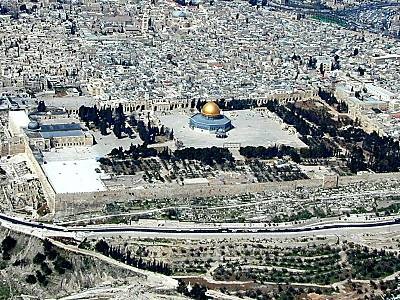 An aerial view of the Temple Mount. |
Sep. 1, 2001 addenda:
(1) The Arab states showed great reluctance to take control of Jerusalem back in November 1949; note the accompanying clipping from the Palestine Post of Nov. 20, 1949: ""The Arab delegations to the U.N. are drafting a detailed proposal for a permanent international regime for Jerusalem. ... It calls for placing Jerusalem under the effective and exclusive control of the U.N. to be administered by [the U.N.] without any competition or intervention." It makes for a striking contrast to the current wave of Muslim Zionism.
 An article from the "Palestine Post," Nov. 20, 1949. |
(2) In Islamic writings, Jerusalem is sometimes known as ula'l-qiblatayn wa-thalith al-haramayn, which translates into "first of the two qiblas and third of the two sacred places," where the qibla is the direction of Islamic prayer and the two sacred places are the mosques in Mecca and Medina.
(3) Baruch Kimmerling and Joel Migdal wrote in their 1993 book, The Palestinian People: A History:
The stream of foreign Christian pilgrims and growing Jewish presence during the nineteenth and early twentieth centuries similarly renewed the Muslim attachment to Jerusalem (as did the Israeli conquest of the walled part of the city in 1967), the struggle with the Jews, in particular, validating and strengthening its religious importance.
Nov. 18, 2001 update: Danny Rubinstein notes how Israeli Arabs have taken up the cause of Jerusalem because Muslims generally
cannot usually come to Al Aqsa, and the closure prevents even the 3 million Palestinians from the Gaza Strip and the West Bank from coming to Jerusalem. Those remaining, aside from the Arabs of Jerusalem, are the Israeli Muslims, and they have taken upon themselves the historic role of defending the Islamic holy places in the city. The Al Aqsa Association of Sheikh Raid Salah from Umm al-Fahm, the principal Muslim leader in Israel, has for years been carrying out the restoration and renovation in the mosques of the Temple Mount. Hundreds of Muslims from Israel come on the weekends to work as volunteers at the mosques. The Islamic Movement also funds some of the transportation of Israeli Arab worshipers to Al Aqsa.
Rubinstein also paraphrases three important observations by Yitzhak Reiter, editor of a recent book in Hebrew, The Sovereignty of God and Man - Sanctity and Political Centrality on the Temple Mount (Jerusalem Institute for Israel Studies):
since the beginning of Islam, the Temple Mount (al-Haram al-Sharif) has flourished during three periods, all of them times when control of Jerusalem passed into non-Muslim hands: the Crusader period, the British Mandate period, and the Israeli period after June 1967. ...
although the Islamic holy places in Jerusalem are only in third place in terms of religious importance (after Mecca and Medina, located in Saudi Arabia), politically, they are in first place. This fact has received particular emphasis during the past year, since the failure of the Camp David summit in July 2000.
During those talks, when the final status of Jerusalem and the Temple Mount was discussed between then Israeli prime minister Ehud Barak and PA Chairman Yasser Arafat and their associates, Israeli demands for sovereignty or some hold on the Temple Mount came up for the first time. Since then, Muslim spokesmen in general, and Palestinians in particular, have tried to deny any Jewish connection to the holy place.
May 15, 2002 update: In "Constructing a Counterfeit History of Jerusalem," I note burgeoning Palestinian attempts to deny any Jewish connection to Jerusalem.
June 21, 2002 update: The Scotsman informs us that the Al-Maktoun Institute for Arabic and Islamic Studies officially opened last month at the University of Abertay in Dundee. The institute has three research centres, one of which is "The Centre for Islamic Jerusalem Studies," said (unsurprisingly) to be the only institution in the world offering an M. Litt course in Islamic Jerusalem Studies.
Aug. 19, 2003 update: Ahmad Muhammad 'Arafa, a columnist for Al-Qahira, the Egyptian government weekly issued by the Ministry of Culture, questions the sanctity of Jerusalem in Islam.
Nov. 26, 2003 update: Ghazi Y. Khankan, executive director of CAIR's New York office, writes a public letter to George W. Bush today listing ten reasons "why Jerusalem and Palestine are of the utmost importance to 1.2 billion Muslims in the world." One of them, for example, is a hadith that "Jerusalem's area of Al-Aqsa Mosque and Masjid Al-Haram in Makkah will be connected together at the end of time."
May 18, 2004 update: In "Why Jerusalem is Not Holy to Muslims," Leah Bat-Chaim makes arguments similar to mine.
Apr. 19, 2004 update: In an article about a game show on Al-Manar, the Hizbullah television station, Neil MacFarquhar explains how "The Mission" differs from others of its genre:
Contestants from around the Arab world compete each Saturday night for cash and the chance to win a virtual trip to Jerusalem. To heighten the drama, points won by the finalists translate directly into steps toward the holy city that are flashed onto a map of the region. The show is a novel way for Hezbollah to promote its theme - that all Arab efforts should be concentrated on reconquering land lost to Israel, especially Jerusalem. "Any program at this television station must present the idea that the occupation of Palestine must end," said Ihab Abi Nassif, a 28-year-old high school physics teacher who is the show's host. "That is the core issue, which is why we work day and night to keep it vivid in people's minds." ...
"The Mission" follows a standard game show format, with contestants quizzed about history, literature, geography, science and the arts. But at least half the questions revolve around Palestinian or Islamic history, and at least one contestant is usually Palestinian. ... Some questions do focus on the men who carried out suicide operations. "The martyr Amar Hamoud was nicknamed 'The Sword of All Martyrs?' - true or false?" was one recent question. True. Mr. Abi Nassif, who never fails to address the subject of recapturing Jerusalem in his patter, went on to describe the man's exploits.
The prizes are not huge. Players who reach five million Lebanese pounds, or something over $3,000, earn the chance to double their winnings with one "golden question" worth the same amount. When the winner gains the 60 points necessary to reach Jerusalem, the song that is a staple of Hezbollah parades booms out. "Jerusalem is ours and we are coming to it," the chorus says in part.
Jun. 25, 2004 update: In The Qur'an, trans. by M.A.S. Abdel Haleem (Oxford: Oxford University Press, 2004), p. 175, the translator identifies "the furthest place of worship" in footnote b as "In Jerusalem."
Aug. 4, 2005 update: Jordanian Jerusalem: Holy Places and National Spaces by Kimberly Katz arrived today and it has plenty of material confirming my points above about the 1948-67 era. In particular, see these passages:
"Jerusalem was a source of contention for many Palestinians, who claimed that the Holy City was being discriminated against, while Amman, the capital city, received a disproportionate share of political, economic, and infrastructure attention." (p. 81)
Yusuf Hanna wrote in 1954 that while Israel had made Jerusalem its state capital, in Jordan "we reduced Jerusalem from a position of preeminence to its current place that does not rise above the rank of a village." (p. 85)
"Despite rhetoric to the contrary, the [Jordanian] government decided to relocate central ministries left from the mandate period to Amman at Jerusalem's expense. In a memo to the prime minister, Anwar Nusayba, member of parliament for the Jerusalem region, complained of discrimination toward the city." (p. 87).
Jan. 4, 2006 update: I dramatize today one of the implications of this article at "Offer: $1 million for Finding "Jerusalem" in the Koran."
Hassan Khader, founder of the "Al-Quds Encyclopedia."
June 6, 2006 update: "The Muslim use of Zion represents a more powerful force today than the Jewish love of Zion" concludes my article today, "Muslim Zionism," an edited verion of an award speech given in Jerusalem a week earlier.

Sep. 16, 2006 update: Ra'ad Salah, Israel's most radical Islamist leader, told 50,000 demonstrators at a rally yesterday in Umm al-Fahm that Israel's occupation of the Temple Mount will end soon and Jerusalem will becomne the capital of an Islamic state. For good measure, he added that former prime minister Ariel Sharon and current president Moshe Katsav (currently under investigation for alleged sexual misbehavior) are "paying the price" for the damage they did to Al-Aqsa Mosque.
 Ali Ünal, The Qur'an: with Annotated Interpretation in Modern English. |
Mar. 15, 2007 update: Re-reading J.J.G. Jansen's 1997 book, The Dual Nature of Islamic Fundamentalism, I note this passage on p. 133:
in early 1990, a Muslim Brotherhood veteran, Sheikh Muhammad al-Ghazali, declared that once the Jerusalem Aqsa mosque was lost it would be the turn of the Ka'ba [in Mecca].
May 21, 2007 update: New Saudi currency shows Al-Aqsa Mosque on one side of a note and the Dome of the Rock on the other.
May 29, 2007 update: Shmuel Katz today quotes a nice contrast by the British historian Christopher Sykes:
To the Muslims it is not Jerusalem, but a certain site in Jerusalem which is venerated ... the majestic Dome of the Rock. To a Muslim there is a profound difference between Jerusalem and Mecca and Medina. The latter are holy places containing holy sites. Apart from the hallowed rock, Jerusalem has no major Islamic significance.
Aug. 13, 2007 update: Quran: A Reformist Translation, translated and annotated by Edip Yuksel, Layth Saleh al-Shaiban, and Martha Schulte-Nafeh, offers a stunningly different translation of 17.1:
Glory be to the One who took His servant by night from the Restricted Temple to the most distant temple.
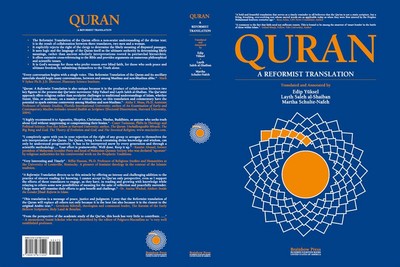 Quran: A Reformist Translation, translated and annotated by Edip Yuksel, Layth Saleh al-Shaiban, and Martha Schulte-Nafeh.. |
Comment: I am quoted in this Qur'an endorsing it as follows:
I am not a Qur'an scholar and therefore am not in a position to judge the accuracy of your translation, and especially not the revisionist understandings of some controversial ayats. But I can say that the effort you and your colleagues have undertaken is very much in keeping with my sense of the process of modernization that the Qur'an itself and the Islamic religion more broadly must undergo. As such, I salute your work and hope it will be published and extensively discussed both in the United States and abroad.
Oct. 12, 2007 update: Comes news that, in anticipation of the U.S.-sponsored Annapolis meeting, the "Palestinians Want Western Wall as Part of Any Settlement." Adnan al-Husseini, adviser to Palestinian Authority leader Mahmoud Abbas on religious affairs, says the PA wants "full control" over Jerusalem. "The Wailing Wall is a Muslim waqf [mortmain], and therefore cannot be abandoned."
Dec. 11, 2007 update: It's not clear when Harun Yahya (a pen name used by the Turkish writer, Adnan Oktar) wrote "Muslim Palestine," but it appears to date from late 2001. It offers the original argument that Jerusalem ought to be under Muslim control because, "In contrast to Jews and Christians, Muslims have made their regard for the sacredness of Palestine an opportunity to bring peace" to the city. Indeed, "peace and harmony lasted as long as Muslims ruled."
May 26, 2008 update: The third edition of Bernard Wasserstein, Divided Jerusalem: The Struggle for the Holy City (Yale University Press) has just arrived; chapter 5 contains a section on "Jerusalem Demoted" that provides detail at the Jordanian regime's efforts in the 1948-67 period to downplay the city's signficance: "During the nineteen years of Jordanian rule," Wasserstein writes, "Jerusalem's relative weight in the Jordanian polity was systematically reduced. ... The Arab sector of the city was a much-diminished rump." Various examples then follow. Oddly, the British government considered it within its jurisdiction to remonstrate with Amman over this issue. The consul-general in 1955 wrote his government:
we would be well advised to make it clear to the Jordanian Government ... that we are not prepared to allow them to treat the Old City of Jerusalem as though it were nothing more than a provincial townlet in Jordan, without history or importance."
Wasserstein notes that the Palestinian nationalist focus on Jerusalem was one reason for its neglect and demotion by the monarchy.
June 4, 2008 update: In a stunning exception to the usual hackneyed Palestinian/Islamist claims to Jerusalem, Al-Jazeera invited Bar Ilan University political scientist Mordechai Kedar to discuss the city. He pulled no punches, telling the show's host, Jimal Rian, that "This was our capital 3,000 years ago, and we were here when your forefathers were drinking wine, burying girls alive and worshipping pre-Muslim idols. This is our city and it will be our city forever." Arutz-7 recounts:
His reference to Muslims drinking wine, which is forbidden in Islam, infuriated the host. Rian wagged his finger in the air and said excitedly, "If you want to talk about history, you cannot erase Jerusalem from the Koran, and don't attack the Muslim religion if we want to continue talking." Dr. Kedar replied, "Jerusalem is not mentioned even once in the Koran. Jerusalem is a Jewish city." The Al Jazeera host responded by quoting a verse from the Koran in which he thought Jerusalem was mentioned by name, but stopped in the middle upon realizing that it only refers to "the farthest place." Dr. Kedar: "Jerusalem is not mentioned in the Koran even once. You can't rewrite the Koran on air on Al Jazeera."
The exchange can be seen on YouTube.
Aug. 14, 2008 update: Lela Gilbert of the Hudson Institute quotes Gabriel Barkay, a professor at Bar-Ilan University, on the origins of the exclusive Muslim claim to the Temple Mount, what she calls "Temple denial":
This denial of the historical, spiritual and archeological connections of the Jews to the Temple Mount is something new. There was always talk about the Temple of Solomon in Jerusalem - called the "praise of Jerusalem" – in Arabic literature, in Islamic literature. This new idea of Temple denial is due to the Arabic fear of Jewish aspirations connected to the Temple Mount. It is part of something I call the "cultural intifada."
Barkay traces the change back to the 1990s:
In the Washington, DC think tanks surrounding President Bill Clinton, it was understood that the Temple Mount was the crux of the problem of the Middle East conflict. These think tanks decided that if there could be "split sovereignty" on the Temple Mount, then split sovereignty could also be achieved over the entire land of Palestine.
So they suggested that in a future agreement, the Temple Mount would be split horizontally. That is to say that whatever is above ground, the part that includes the shrines of the Muslims, would be under Palestinian sovereignty. Whatever is underground, which would include the remnants of the Temple of the Jews, would be under Israeli sovereignty.
It's a brilliant idea, an excellent idea, but totally idiotic from a practical point of view. You cannot have a building standing with its foundations in another country. You cannot have a building with the infrastructure and the plumbing in another country. And you cannot have sovereignty on the subground without having accessibility to the subground, because the accessibility is from above ground. The whole thing was stupid.
Sep. 15, 2008 update: Following his Al-Jazeera appearance (see the June 4, 2008 update, above), Bar Ilan University's Mordechai Kedar has written an article, "The myth of al-Aqsa: Holiness of Jerusalem to Islam has always been politically motivated," in Yedi'ot Aharonot. His argument closely follows the once I have been making since 1997.
He begins by noting the small importance of Jerusalem to Muhammad after the qibla was changed to Mecca. Only in 682, when Ibn az-Zubayr rebelled against the Umayyad rulers in Damascus and conquered Mecca, did the Umayyad caliph, who needed an alternative site for the pilgrimage, settle on Jerusalem which was under his control. To justify this change, Koran 17.1 was reinterpreted to refer to Jerusalem.
Kedar then considers the difficulties with placing "al-masjid al-aqsa" in Jerusalem.
For one, the people of Mecca, who knew Muhammad well, did not believe this story. Only Abu Bakr, (later the first Calif,) believed him and thus was called al-Siddiq ("the believer".)
The second difficulty is that Islamic tradition tells us that al-Aqsa mosque is near Mecca on the Arabian Peninsula. This was unequivocally stated in "Kitab al-Maghazi," a book by the Muslim historian and geographer al-Waqidi. According to al-Waqidi, there were two "masjeds" (places of prayer) in al-Gi'irranah, a village between Mecca and Ta'if - one was "the closer mosque" (al-masjid al-adna) and the other was "the further mosque" (al-masjid al-aqsa,) and Muhammad would pray there when he went out of town.
This description by al-Waqidi which is supported by a chain of authorities (isnad) was not "convenient" for the Islamic propaganda of the 7th Century. In order to establish a basis for the awareness of the "holiness" of Jerusalem in Islam, the Califs of the Umayyad dynasty invented many "traditions" upholding the value of Jerusalem, which would justify pilgrimage to Jerusalem for the faithful Muslims. Thus was al-Masjid al-Aqsa "transported" to Jerusalem. It should be noted that Saladin also adopted the myth of al-Aqsa and those "traditions" in order to recruit and inflame the Muslim warriors against the Crusaders in the 12th Century.
Kedar then interprets current events in this light, seeing that Yasir Arafat "did exactly what the Califs of the Umayyad dynasty did 1300 years ago: He marshaled the holiness of Jerusalem to serve his political ends." Kedar argues that because "the holiness of Jerusalem to Islam has always been, and still is, no more than a politically motivated holiness," Muslim leaders are limited in what they can do. Indeed, one who showed flexibility on this issue "would be putting his political head on the block should he give it up."
The essay ends with two questions:
Must Judaism and Christianity defer to myths related in Islamic texts or envisioned in Mohammad's dreams, long after Jerusalem was established as the ancient, true center of these two religions, which preceded Islam? Should Israel give up on its capital just because some Muslims decided to recycle the political problems of the Umayyads 1250 years after the curtain came down on their role in history?
Nov. 2, 2008 update: For scholarly background on the historic Jewish connection to Jerusalem, see Rivkah Fishman-Duker's survey of ancient Greek and Roman pagan authors dating from the third century BCE to the third century CE, for all of whom "Jerusalem definitely was a Jewish city." The article is at "'Jerusalem: Capital of the Jews': The Jewish Identity of Jerusalem in Greek and Roman Sources," Jewish Political Studies Review 20:1-2 (Fall 2008): 119-40. The quotes in turn can be found at Menahem Stern, Greek and Latin Authors on Jews and Judaism (Jerusalem: Israel Academy of Sciences and Humanities, 1980).
Nov. 6, 2008 update: Ahmed Qurei, the Palestinian Authority official in charge of diplomacy with Israel, told a media briefing that the Temple Mount has nothing to do with Judaism, reports Aaron Klein in "Jewish Temples never existed, says top Palestinian negotiator: Official leading peace talks claims Israel trying to 'invent' historical Jerusalem link." Qurei, a supposed moderate, began by noting that "Israeli occupation authorities are trying to find a so-called Jewish historical connection" between Jerusalem and the Temple Mount, declaring that
all these attempts will fail. The [Temple Mount] is 100 percent Muslim. The world must be mobilized against all these Israeli attempts to change the symbols and signs of Jerusalem. There is nothing Jewish about Al Aqsa Mosque. There was no so-called Jewish Temple. It's imaginary. Jerusalem is 100 percent Muslim. The Arab world is called to interfere to stop the Israeli plans in Jerusalem, to stop the Israeli attempts to create a Jewish character to Jerusalem and Al Aqsa mosque. Also to the Old City, which is the first step in the war to defend Jerusalem and Al Aqsa. They are competing against time in order to create facts on ground in the surrounding the imaginary Temple.
Jan. 4, 2009 update: A 16-page 1925 booklet in English published by the "Supreme Moslem Council" and titled A Brief Guide to Al-Haram Al-Sharif, Jerusalem, contains passage that directly endorse the Jewish connection to the Temple Mount. First, on p. 4, the guide discusses the location of the Temple Mount:
The site is one of the oldest in the world. Its sanctity dates from the earliest (perhaps from pre-historic) times. Its identity with the site of Solomon's Temple is beyond dispute. This, too, is the spot, according to the universal belief, on which "David built there an alter unto the Lord, and offered burnt offerings and peace offerings."
Top of the front cover of "A Brief Guide to Al-Haram Al-Sharif, Jerusalem," from 1925
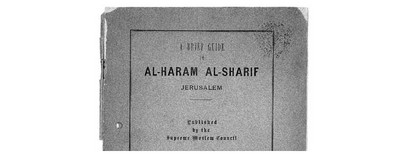
The quotation about David is footnoted to II Samuel 24:25. Second, on p. 16, the Brief Guide tells about the underground area known as Solomon's Stables:
This is a vast substerranean [sic] chamber ... Little is known for certain of the early history of the chamber itself. It dates probably as far back as the construction of Solomon's Temple. According to Josephus, it was in existence and was used as a place of refuge by the Jews at the time of the conquest of Jerusalem by Titus in 70 A.D.
Comment: This pamphlet builds on an extensive Islamic literature in Arabic about the Jewish Temple. For one example translated into English, see As-Suyuti's The History of the Temple of Jerusalem, translated by James Reynolds (London: A.J. Valpy, 1836).
 Jan. 22, 2009 update: Ibn Taymiya's anti-Jerusalem got an airing in my original article; I now learn that a key work of his on this subject, Qa'ida fi Ziyara Bayt al-Muqaddas, was published, with commentary, by Charles D. Matthews in "A Muslim Iconoclast (Ibn Taymīyyeh) on the 'Merits' of Jerusalem and Palestine," Journal of the American Oriental Society, 56 (1936), pp. 1-21.
Comment: Ibn Taymiya has been the single most important inspiration for modern Islamism, so it comes as a bit of a shock to read how, in the pre-Islamist days of 1936, Matthews could write that "It is reassuring for the future of the Islamic East that the spirit of Ibn Taymiyyeh in milder form has taken possession of many leaders of the people."
Apr. 24, 2009 update: Egypt's minister of awqaf (religious endowments), Muhammad Hamdi Zaqzuq, urges Muslims to go on pilgrimage to Jerusalem so as to reinforce the city's Muslim identity and assure its role as capital of a future Palestinian state. "Just as Muslims go on pilgrimage... to Mecca, they should also go to Jerusalem and to Al-Aqsa Mosque by the hundreds of thousands every year. We can show the whole world that Jerusalem is something that concerns all Muslims. ... I invite all Muslims... to go to Jerusalem, even with Israeli visas." If this proposition is followed through, he went on, "the whole world, and Israel, will have to accept this reality, which is that Jerusalem is for Muslims and they will not give up on it."
Zaqzuq acknowledged that he is exposing himself to virulent attacks on the grounds that he seeks normalization with Israel and that his proposal has so far been widely rejected.
July 1, 2009 update: In a report on a panel discussion of Jerusalem's disposition at the Center for American Progress in Washington, Hillel Fendel reports that two of the participants, Michael Bell, a former Canadian Ambassador to Jordan, Egypt and Israel, and Marshall Breger, a professor of law at Catholic University, think little of my argument about the Muslim claim to Jerusalem:
Both Breger and Bell dismissed the claims of those who challenge Islam's connection to the site. Breger agreed, but implied that current Islamic claims that Judaism's Holy Temple was never built there are totally unfounded, noting that the Waqf itself published literature some decades ago boasting that the Dome of the Rock is on the site of the Holy Temple. At that point, Bell said, "It's very important to realize that it's beside the point whether these belief systems are historically valid or not... It's not up to me to tell you whether your narrative is valid or not..."
Breger similarly said that the argument that Jerusalem is not so holy to Islam is "a silly one." He said, "It's true that when Jerusalem was not under Islamic control, such as during the Crusader period, the British Mandate and under Israeli control, there was more discussion about Jerusalem in Muslim sources... but it's silly to say that it's not so holy to Islam, because you have to accept a religion's definition of what is holy."
Comment: Silly? I wonder if Breger could provide a little more substance to his dismissive critique than to say we must accept as true whatever someone within a faith says about that faith.
July 30, 2009 update: The Ma'an news agency today published a news report, "Tension in Jerusalem as Israelis mark temple destruction," that lets slip where the ancient Jewish temple actually was located:
Thursday is the Jewish holy day of Tisha B'av (the ninth of the month of Av), which marks the destruction of the first and second temples, the ruins of which are believed to lie beneath the present-day Al-Aqsa Mosque and the golden Dome of the Rock Mosque.
Oct. 20, 2010 update: Hagai Mazuz and Harold Rhode review this general topic in "Is Jerusalem Sacred for Muslims?"
Nov. 30, 2010 update: The U.S. government has condemned Palestinian claims that the Western Wall has no significance for Jews, writes Natasha Mozgovaya in Ha'aretz:
Al-Mutawakil Taha, the Palestinian Authority' deputy minister of information, had said Wednesday that the wall, regarded as Judaism's holiest site, was part of an Islamic waqf, or religious endowment, and that only "Islamic tolerance" allowed Jews to pray there. His claims drew immediate anger in Israel, which on Tuesday was echoed by the U.S.
"We strongly condemn these comments and fully reject them as factually incorrect, insensitive and highly provocative," a U.S. State Department spokesman said. "We have repeatedly raised with the Palestinian Authority leadership the need to consistently combat all forms of de-legitimization of Israel including denying historic Jewish connections to the land."
The chairman of the U.S. House Committee on Foreign Affairs, Rep. Howard Berman (D-CA), also decried Taha's claim, calling it "provocative and inciteful". "I strongly condemn the [claim] that the Western Wall in the Old City of Jerusalem has no religious significance to Jews," Berman said. "President Abbas and Prime Minister Fayyad know the spiritual importance of the Western Wall to the global Jewish community," he said, calling on Abbas to denounce Taha's report and clarify that the remarks were not the official position of the Palestinian Authority. ... "To deny the Jewish connection to the Western Wall is to be deliberately provocative and inciteful, no less so than were one to deny the Palestinian connection to the Haram al-Sharif," Berman said.
Dec. 1, 2010 update: U.S. government engagement made the difference, as the Palestinian Authority took down Taha's outrageous remarks from its website. Which makes one wonder why Washington does not condemn this sort of nonsense more often.
Nov. 25, 2011 update: In the course of anti-Israel rally recorded on YouTube and focused on Jerusalem, a speaker announced that "Jerusalem is the heart of the Koran. Jerusalem is the heart of the Muslim world. Jerusalem is the heart of the Prophet's biography."
Dec. 28, 2013 update: In April 2009, noted above, Egypt's minister of religious endowments urged Muslims to go on pilgrimage to Jerusalem to reinforce the city's Muslim identity and its role as capital of a future Palestinian state. Today, the Jordanian minister of tourism, Nidal Qatamin, urged Muslims and Christians to visit Jerusalem, as WAFA paraphrased him, "to break the Israeli control over it and to show support for its Palestinian residents who are fighting Israeli plans to displace them."
Comment: These ministers may be focused on politics, but their urgings have religious implications.
Jan. 6, 2014 update: The Israeli journalist Pinhas Inbari published today a stunning short piece, "Multiplying Efforts to Undermine the Unique Status of Mecca in Islam" in which he discerns Syrian regime and broader Shi'i efforts to reduce the role of Mecca in Islam – an audacious if not crazy ambition. (Check the original for footnotes.)
When the revolt against Assad erupted in Syria, Saudi Arabia refused to recognize the Syrian government's authority regarding the Hajj (pilgrimage) to Mecca and transferred that authority to the Free Syrian Army. This aroused fury in Damascus, and Assad's Syria took retributive measures that indeed brought the conflict between Syria and the Hijaz (a region in western Saudi Arabia) back to the Ummayad period (661-750), during which the Hijaz did not recognize the Ummayads and the Syrian army of the Ummayads saw fit to assault with catapults the Kaaba, the holiest structure in Islam which is situated in the courtyard of the Great Mosque in Mecca.
All this was mentioned explicitly in an interview with the TV station of the Lebanese Christian leader Michel Aoun, who is associated with Hizbullah. On August 14, 2013, Fayez Shaker, head of the Syrian Ba'ath Party branch in Lebanon and a former Lebanese minister, said that if Mount Qasioun in Damascus were to be fired upon, Syria would blow up the Kaaba.
The relevance of Jerusalem in this context emerged clearly with the publication of emails from Assad's office that were intercepted by anonymous hackers. At the time, in December 2011, Assad was preparing for a major speech. Meanwhile, the Muslim Brotherhood faction that is loyal to Assad (yes, there is such a thing) was preparing a campaign for the "liberation of Al-Aqsa" under Assad's aegis.4 One of the themes discussed for Assad's speech was that Jerusalem, not Mecca, is the proper direction of prayer (qibla) in Islam. Although in the end the theme was not included in the speech, it is likely to crop up again at some point.
Inbari also points to other efforts to enhance Jerusalem at the expense of Mecca.
A little over a decade ago, the Islamic Movement in Israel, which is linked to the Muslim Brotherhood, undertook an initiative to import water from the Zamzam spring in Mecca and to pour it into ten cisterns on the Temple Mount. Presumably, its leaders hoped to elevate Jerusalem's holiness and, by doing so, increase the number of Muslim visitors to the Al-Aqsa Mosque. The initiative was thwarted. ...
Most surprisingly – or perhaps not – the undermining of Mecca's status as the prime pilgrimage site came from the Shiites in Iraq, allies of Assad. On December 23, 2013, the Iraqi-Shiite prime minister, Nouri al-Maliki, said the direction of prayer should be Karbala – the Iraqi city where the tomb of Mohammad's grandson, Hussein ibn Ali, is located – and not Mecca. Although this incensed the Sunnis, he did not retract his words.
He concludes that "the Shiite crescent is challenging the status of Mecca. The Iraqi Shiites favor Karbala as the Shiite holy city instead of Mecca, while the Assad regime touts Jerusalem." And then, as a bonus:
Al-Maliki's position is not, however, the only one among Iraqi Shiites. The Hizbullah Party of Iraq, which is the twin sister of Hizbullah in Lebanon, has sworn to wrest the holy places in the Hijaz from the Wahhabis and make them Shiite shrines. In the Sunni camp, as noted, the Muslim Brotherhood wants to make liberating Al-Aqsa the focus of the Arab turmoil with the ultimate goal of an Islamic caliphate, while the Salafis remain indifferent to this campaign.
Nov. 10, 2014 update: Mordechai Kedar of Bar-Ilan University offers an analysis today of "Why and When was the Myth of al-Aqsa Created? How did Jerusalem become so important to Muslims?" that tracks closely with my explanation in "The Muslim Claim to Jerusalem." Excerpts (slightly edited for style):
to establish a basis for the awareness of the "holiness" of Jerusalem in Islam, the Caliphs of the Umayyad dynasty invented many "traditions" [hadith] upholding the value of Jerusalem (known as fadha'il bayt al-Maqdis), which would justify pilgrimage to Jerusalem for the faithful Muslims. Thus was al-Masjid al-Aqsa "transported" to Jerusalem.
It should be noted that Saladin also adopted the myth of al-Aqsa and those "traditions" in order to recruit and inflame the Muslim warriors against the Crusaders in the 12th century. Another aim of the Islamization of Jerusalem was to undermine the legitimacy of the older religions, Judaism and Christianity, which consider Jerusalem to be a holy city. Islam is presented as the only legitimate religion, destined to replace the other two. ...
Since the holiness of Jerusalem to Islam has always been, and still is no more than a politically motivated holiness, any Palestinian Arab politician would be putting his political head on the block should he give it up.
June 5, 2016 update: If, as they say, imitation is the truest form of flattery, then a big thank you to Prof. Ephraim Herrara, author of "Jerusalem's true 'importance' in Islam," published in today's Israel Hayom. In it, he argues that "Jerusalem was noted for its importance in Islam ... when the city was ruled by non-Muslims."
Sep. 8, 2016 update: Khaled Abu Toameh reports on problems in new textbooks in schools under the rule of the Palestinian Authority. One of them concerns disregard for Jerusalem:
A map in one of the textbooks refers to the West Bank city of Ramallah as the "center of Palestine," while Jerusalem is referred to as a city that is located south of Ramallah. Critics argue that this terminology turns Ramallah, the headquarters of the Palestinian Authority leadership and government, into the de facto capital of the Palestinians. This, they add, undermines the Palestinian claim to Jerusalem as the capital of a future Palestinian state. "Why has Jerusalem been marginalized in the new textbooks?" critics asked. "This is indeed disgraceful!"
June 27, 2017 update: David M. Weinberg writes a striking passage in his article, "On the Future of Jerusalem": Arabs and Palestinians
don't really care about Jerusalem; they never have. In fact, they would consider it a triumph if Jerusalem were so wracked by conflict and poverty that it was ruined for 1,000 years – just as long as it would be lost to the Jews.
This is a stronger version of my argument that Jerusalem matters to Muslims most intensely when they do not control it, saying they prefer it ruined than under Jewish control. True? No, I think Weinberg goes too far. While Muslims generally hate Jerusalem as the capital of Israel, I don't believe they prefer it ruined.
Apr. 1, 2020 update: Thomas F. Madden notes the age-old pattern at "The Great Saracen" in First Things:
Before the Crusaders captured Jerusalem in 1099, it had been regarded by Muslims as a holy city, yet a distant third to Mecca and Medina. It was believed to be the site of Muhammad's Night Journey into the heavens. But the Christians' fierce devotion to Jerusalem elevated it in the Muslim consciousness, making it a natural focus for a jihad to remove the Crusaders.
June 4, 2020 update: Yitzhak Reiter and Dvir Dimant's Islam, Jews and the Temple Mount: The Rock of Our/Their Existence (Routledge, 2020)
presents the first comprehensive survey of the abundant early Islamic sources that recognize the historical Jewish bond to the Temple Mount (Masjid al-Aqsa) and Jerusalem. Analyzing these sources in light of the views of contemporary Muslim religious scholars, thinkers and writers, who – in the context of the Arab-Israeli conflict – deny any Jewish ties to the Temple Mount and promote the argument that no Jewish Temple ever stood on the Temple Mount.
The book describes how this process of denying Jewish ties to the site has become the cultural rationale for UNESCO decisions in recent years regarding holy sites in Jerusalem, Bethlehem and Hebron, which use Muslim Arabic terminology and overlook the Jewish (and Christian) history and sanctification of these sites. Denying the Jewish ties to the Temple Mount for political purposes inadvertently undermines the legitimacy of Islam's sanctification of Al-Aqsa and the Dome of the Rock as well as the credibility of the most important sources in Arabic, which constitute the classics of Islam and provide the foundation for its culture and identity.
Identifying and presenting the Jewish sources in the Bible, Babylonian Talmud and exegesis on which these Islamic traditions are based, this volume is a key resource for readers interested in Islam, Judaism, religion and political science and history in the Middle East.
Aug. 16, 2020 update: Nadav Shragai, "Ancient Muslim Texts Confirm the Jewish Temple in Jerusalem" adds many more proofs from Islamic sources for the Jewish connection.
July 19, 2022 update: The same pattern of indifference that applied to Jerusalem as a whole also applied to its most sacred precinct. Tom Nisani, founder of Beyadenu, explained this at 9:19-9:57 of "Israel is Losing on the Temple Mount; Why This Matters Supremely":
Until '67, the Temple Mount was a place that no one really cared about ... until the moment that Israel liberated Jerusalem and conquered the Temple Mount. Suddenly, the [Jordanian] Waqf became very active and started to make changes on the Temple Mount, including hiding rocks and many things that proved that there had been a [Jewish] temple on the mount.


