
I prefer not to respond to falsehoods about myself, as this both reduces time available to do my own work and requires me to go on the defensive; but, on occasion, it's necessary to correct the record. This tends to be when:
- The mistakes are factual.
- The critic is worthy of attention.
- The impact of the error might be significant.
That said, here goes:
The Palestinians "are a miserable people": For proof that the Washington Report on Middle East Affairs misquoted me when it ascribed to me the statement, "The Palestinians are a miserable people ... and they deserve to be" see my letter to the editor at https://www.danielpipes.org/cair.php#WRMEA. (October 1, 2001)
The Economist mangles Campus Watch: I wrote a letter to the Economist which it did not publish:
In "Why are conspiracy theories so popular?" (Dec. 19, 2002), your correspondent approvingly quotes a paragraph from my book Conspiracy, then adds this gratuitous sentence:
Mr. Pipes does good work in skewering anti-Jewish conspiracy theorists, but his recent founding of 'Campus Watch', a website devoted to 'outing' pro-Arab academics, emits a whiff of burning books."
"Outing" pro-Arab academics, burning books? Had The Economist bothered to visit Campus-Watch.org, it would find a mission statement there explaining that Campus Watch
monitors and critiques Middle East studies in North America, with an aim to improving them. The project mainly addresses five problems: analytical failures, the mixing of politics with scholarship, intolerance of alternative views, apologetics, and the abuse of power over students. Campus Watch fully respects the freedom of speech of those it debates while insisting on its own freedom to comment on their words and deeds.
This does not sound to me remotely like the Campus Watch of your correspondent's slightly fevered imagination.
(December 21, 2002)
Islam and democracy: An article appeared today "Islam and Democracy? – What a Strange Question!" by Mohammed Elmasry, professor of electrical and computer engineering at the University of Waterloo in Canada and national president of the Canadian Islamic Congress. Here is where I come into the picture:
Two high-profile groups these days maintain that Islam and democracy are incompatible.One is represented by western-hemisphere writers like Bernard Lewis and Daniel Pipes. In their view, since Islam is considered anti-democratic and since western-based experience correlates democracy with world peace, the only conclusion to be drawn is that most of the world's 1.3 billion Muslims are therefore a liability, an impediment to peace.If the Lewis and Pipes group were to ask me—an unlikely scenario—I would have to respond that theirs is a racist and dangerous ideology, based on twisted dogma and chopped logic.
My asking Elmasry for his opinion may be unlikely, but his asking me – or even reading me – is even less so. For the embarrassing fact is, I have addressed the question of Islam and democracy and have answered it quite differently from what Elmasry imagines I would say. Here is an example; in a PBS-sponsored debate in July 2003 on "Islam and Democracy," I wrote the following:
Muslims today groan under dictatorships, but one day could be model democrats. Further, Islam can be interpreted many ways, and there is nothing about it that immutably contradicts democracy.
Whoops. Maybe Mohammed Elmasry should go back to writing about electrical and computer engineering.
But the problem goes far beyond Elmasry. I find myself constantly being ascribed views that I don't hold and then insulted, as Elmasry does above, for holding those non-existent opinions. It's pretty annoying; I shall note these instances from time to time in this space. (January 22, 2004)
Muslims and violence: Robert Dickson Crane, a former advisor to Richard Nixon and perhaps the most prestigious of American Muslim converts, refers twice to me in a paper titled "From Clashing Civilizations To a Common Vision," presented last September.
Daniel Pipes, who says that all Muslims are inherently violent ...those areas that Daniel Pipes a decade earlier had dubbed the "ring of fire" all around the Muslim world
When I challenged Crane to show that I had ever made such a generalization about Muslims or used the phrase "ring of fire," he replied by calling the above paper "bogus" and explained that it had been stitched together by the conference coordinator "from a scrap copy" of his newest book. He called the result "an absolute hodgepodge" and wrote that the part referring to me, "was deleted entirely as unscholarly and detrimental to the rest of the book."
On the matter of the two specific items I had protested: About the first, he assured me the text will be amended when it appears in the book:
I will change the text of the new book to change the sentence, "Daniel Pipes, who says that all Muslims are inherently violent," to "all Islamists."
That is now exactly right.
About the "ring of fire" phrase, Crane conceded that I did not come up with this phrase in reference to the Muslim world but suggested Bernard Lewis coined it about 1990. That made me curious, so I did a little Internet research. I found no use of the term by Lewis, but I did find it in a quotation in an article by John Esposito. Esposito quotes someone he calls a "native-born American convert to Islam, Ivy League educated and a former government consultant" using "ring of fire" here:
Every informed Muslim would point to America's bizarre complicity in the genocidal destruction of Chechnya, its tacit support of India's incredibly brutal occupation of Kashmir, its passivity in the ethnic cleansing of Bosnia, and even America's insistence on zero casualties in stopping the ethnic cleansing of Kosovo. These are hot spots in the so-called "ring of fire" around the edge of the Muslim world, where Muslims are throwing off the shackles of old empires.
And who might the author of these words be? Why, none other than Robert Dickson Crane! Esposito references the above quote to Robert Crane, "Re-thinking America's Mission: The Role of Islam," American Journal of Islamic Social Sciences, (Fall/Winter), 2001.
So, Crane accused me of using a term that he himself coined. Pretty rich, no? When I pointed this out to him, he did not argue otherwise: "it certainly would appear that I invented both the term and you as its origin, which would make me the originator."
Trouble is, given how the Internet works, a number of websites have repeated this ascription of "ring of fire" to me, so it is now part of the immutable record. Thus does pseudo-scholarship come into existence and proliferate.(Febuary 5, 2004)
My altercation with Hussein Ibish: Details on this can be found at "Newsweek's 'Periscope' Gets It Wrong." (September 27, 2004)
Muslims and internment: I wrote an article, "Why the Japanese Internment Still Matters" and then clarified loose ends in a weblog, "The Japanese Internment, CAIR, and Me" (note especially the Dec. 29, 2004 update). In the latter, I made my views on the idea of interning Muslims completely clear: "I raised the subject of the Japanese internment because it 'still matters' in its influence on the U.S. public debate, and not because I advocate the internment of anyone today."
Nonetheless, various academics, journalists, and others (the most egregious example being the weblog of Juan Cole, where he states that I have "fond visions of rounding up Muslim Americans and putting them in concentration camps") have chosen to twist my words and write that I am calling for the internment of Muslims. As I write a plain English, I can only assume that they misstate my views out of denseness or malevolence.
So, I write here again: I am not calling for the internment of Muslims. I am calling for an ideological war on radical Islam and the understanding that Islamists are our enemy. I see anti-Islamist Muslims as critical to the war on radical Islam and far from wanting them interned, see their active participation as critical to winning the conflict.
And perhaps, in the hope of eliminating ambiguity, I should repeat here the policies suggested by Michelle Malkin and endorsed by me in my article:
especially in time of war, governments should take into account nationality, ethnicity, and religious affiliation in their homeland security policies and engage in what she calls "threat profiling." These steps may entail bothersome or offensive measures but, she argues, they are preferable to "being incinerated at your office desk by a flaming hijacked plane."
(December 31, 2004) July 19, 2005 update: I tell the story today, at "[The Canadian Islamic Congress:] An Islamist Apology," of how I won a retraction from the Canadian Islamic Congress for its inaccurate depiction of my position vis-à-vis the interning of Muslims.
Reappointment to the U.S. Institute of Peace? The Forward carries a decidedly strange piece about me today, "Bush Fails to Renominate Pipes to Institute of Peace." The writer, E.J. Kessler, labors under the illusion that someone recess appointed by the president is then normally re-appointed to that same position; and she finds something interesting in the fact that I was not reappointed. But this is hardly the case at all; so far as I know, not a single member of the USIP board has ever been renominated to the board. She is, in other words, making an issue out of what is simply standard practice.
Further, she quotes me saying, "My time there is finished," but fails to add that I expressed no interest to the Bush administration in being reappointed. I tried to be helpful at U.S. Institute of Peace but it is no secret that I had my frustrations there.
Finally, Kessler missed another detail: had I been Senate confirmed, my full appointment, as announced by the White House, would have gone to Jan. 19, 2005. In contrast, the recess appointment I actually had ended on Jan. 3, 2005, the day that the new session of Congress began. By my count, that's a total of 16 days difference, hardly enough to warrant Kessler's heaving and puffing. (January 14, 2005)
Dec. 1, 2005 update: As they say, "A lie can travel halfway around the world while the truth is putting on its shoes." Aslam Abdullah magnifies Kessler's error, writing that I was "removed" from the USIP board. Not so, I served out my complete term appointment. Oh, and Abdullah also makes two other mistakes in his few words about me. I was not "elected" as a USIP board member but appointed. I am not a "self-proclaimed Islam-hater" but neutral on the religion of Islam and a self-proclaimed hater of the totalitarian ideology of radical Islam. This last mistake is a bit puzzling, as I explained this distinction at some length at Abdullah's request in his own journal in 2000.
The End of Australian Jewry's Golden Age? Incompetent reporting by the Australian Jewish News prompted a letter to the editor from me. (Feb. 18, 2005)
Clash of civilizations? Not only has Thomas E. Woods Jr. written one of the worst histories of the United States in memory (the execrable Politically Incorrect Guide to American History) but he cannot get simple facts about me straight. Writing in that paragon of accuracy and insight, The American Conservative, he describes my vision of the future as one involving "ceaseless war" and a "clash of civilizations." But my work is dedicated precisely to winning the "war on terror," which I do not at all see as a permanent condition. Second, I have explicitly and frequently denounced the "clash of civilization" as inaccurate, both when the idea first surfaced and often since. Here, for example, is a paragraph from an article of mine for the BBC in September 2002:
Nor is this a clash of civilizations. Yes, Islamists seek a confrontation with the West, believing that their vision of Islam can achieve a global supremacy. Yet their violence against Westerners (and non-Muslims more generally) is complemented by an equally important Islamist enmity toward Muslims who disagree with their extremist outlook, as seen in the depredations of the Taliban regime in Afghanistan, as well as its counterparts in Bangladesh, Iran, and Sudan. This same pattern of targeting fellow Muslims is also apparent in countries where militant Islam has yet to take over (such as Algeria, Nigeria, Egypt, Lebanon, Turkey, and Indonesia). Militant Islam is an aggressive totalitarian ideology that hardly discriminates between those who disagree with it, Muslim or non-Muslim. The problem is not between civilizations but between different political views.
(Feb. 28, 2005)
Hassan Fouda and the Day: The Middle East and Islam are contentious subjects, and those who disagree with me often spin off into factual errors. I can't fight it all, but sometimes the mistakes are so egregious that I feel compelled to respond.
Such was the case with a malicious paragraph in a Connecticut paper, The Day, on July 24, 2005. The article, "The Real Double Standard On Islam," was by Hassan Fouda, a member of the notorious Al-Awda organization; in the one paragraph about me, Fouda managed to get four facts out of four wrong. I protested to the Day; to my pleasure (and Al-Awda's dismay), the Day published a correction which noted Fouda's "misleading statements and incorrect quotes," then proceeds to give the substance of my letter to set the record right. (Aug. 10, 2005)
The Vietnam War and me: In response to my article today, "Muhammad Ali v. George W. Bush," a Vanity Fair contributing nasty named James Wolcott (known to his friends as "Hurricane Jim,") wrote a blog attacking me and he gets personal, asking where I was during the Vietnam War.
And where, pray tell, was Pipes during the Vietnam war? According to a profile in The Nation, he was darkening Cambridge Square. "It was the height of the Vietnam War, and young people everywhere were rebelling—but not Pipes. In April of 1969, his sophomore year, antiwar activists took over the main administrative building at Harvard. The university called in the police. Pipes recalls students gathering in the football stadium to debate the crisis, which dominated campus life for weeks. Pipes's group was among the smallest: He backed Harvard's administration and like his father [Sovietologist Richard Pipes] firmly supported the Vietnam War." Pipes firmly supported the Vietnam War, but not enough to enlist or submit to the draft.
For the record: I was a sophomore in college in April 1969. In December 1969, the first military lottery was held and my birthday landed me with a #263, so I was not drafted. Had I been drafted, I would have fulfilled my obligations. Wolcott implies that I had an obligation to drop out of college and enlist because I supported American efforts to defend South Vietnam from communist tyranny. His logic leads to the absurd conclusion that anyone anywhere who supports a war must enlist to fight it. MSNBC's Joe Scarborough decries (in this month's Vanity Fair) what he calls Wolcott's "gutter reporting"; a reviewer of his latest book, Attack Poodles, condemns it a "vicious screed." And I denounce Wolcott's readiness to turn common sense on its head in order to make a partisan point. (Nov. 29, 2005)
Tikkun author ascribes me a made-up quote: Gil Anidjar wrote on p. 27 of the July/August 2005 issue of Tikkun:
Daniel Pipes pointed a threatening finger at the camera and warned teachers and scholars of Middle East Studies in no uncertain terms: "We are watching you. Your students, in your classrooms, are watching you."
I wrote on August 19 to Michael Lerner, the magazine's editor, "I have made a check of my records and of several data bases and find no such statement by me. Mr. Anidjar needs to provide documentation so I can see that I actually said this." Four months later, I have yet to hear back from the author or the editor. (Dec. 19, 2005)
My role in the Danish cartoon affair: There's a conspiracy theory developing about myself and Flemming Rose, the Jyllands-Posten cultural editor who published the famous twelve cartoons of the Muslim prophet. I'll begin with the conspiracy theory (but without providing links or even quotes, as I don't want to send readers to these crackpot websites), and then provide the facts.
The conspiracy theory: Rose came to Philadelphia in October 2004 to see me and we developed a close bond. Then, as a result of this visit, Rose decided to publish the cartoons.
The facts: Rose visited me in my office on October 25, 2004, when he interviewed me for a feature piece on me that he published on October 29 in Jyllands-Posten. The resulting article, "Truslen fra islamismen," can be found on my website, as can a translation of it into English, "The Threat of Islamism." It was a standard interview in which Rose inquired about my views on a variety of questions pertaining to radical Islam. It contains, for example, my signature statement, translated into Danish: "Hvis militant islam er problemet, så må modsætningen, moderat islam, være løsningen." Flemming Rose and I have not written, spoken, or seen each other since that one meeting. I had nothing to do with the decision to commission or publish the cartoons eleven months later and only learned of their existence from press coverage of them. (Feb. 6, 2006)
How important are anti-Islamist Muslims? Andrew Bostom and I both attended the Pim Fortuyn Memorial Conference on Islam in the Hague on February 17-19 but he apparently heard something different from what I said, at least as reported by Jerry Gordon at IsraPundit: "Dan Pipes, Bostom recounted, had to admit at the conference that his previous expectations about fostering progressive moderate Muslims may have been in error and that there are minimal numbers of the umma who would fight for internal reformation. or would be marginalized, at best."
For the record, I repeated at that conference what I have been saying for years, namely that moderate Muslims "are largely fractured, isolated, intimidated, and ineffectual." There is nothing new here. Further, I continue to see moderate Islam as the solution to radical Islam. (Feb. 20, 2006)
Joel Beinin lies about me: In an interview published in Egypt Today, Beinin states that I "could not get a permanent academic position, despite the fact that his father [allegedly] tried to engineer one for him at Harvard." This brief statement contains two major errors of fact.
- I did get a tenure-track position and turned it down, preferring to write than teach.
- My father had zero role in my being appointed to a teaching position at Harvard and he recused himself from any decisions concerning me. (Egypt Today itself signals its doubts about Beinin's accuracy by adding "allegedly" in square brackets.)
Comments: (1) By simply inventing biographical falsehoods about me, Beinin again reveals what a shoddy "scholar" he is.
(2) What relevance my career in the 1970s and early 1980s has to my current work is beyond me. Maybe Beinin's next history project should be to locate and publish my 6th-grade marks?
(3) Once Beinin raises the topic of my early career, how can I resist pointing out that Harvard's doctoral program in history turned him down but awarded me a Ph.D.?
(4) Beinin, like too many American academics, suffers from an advanced case of credentialitis, the disease that places more emphasis on qualifications than achievements. (Nov. 6, 2006)
Me a former CIA agent? That's what Ziauddin Sardar states in an article, "A new McCarthy era dawns in America," in the issue of the New Statesman dated today. He refers to me there as "Daniel Pipes, the former CIA agent who runs the website Campus Watch."
I don't know where he got this idea from but, for the record, I have never been a CIA agent. More precisely, I have never been an employee of the agency, though I have done the odd job for it, such as writing an analysis or giving a talk at headquarters.
That Sardar would write this about me reflects on the shoddiness of his research. (Nov. 13, 2006)
I promote the term "Islamofascism"? John Esposito writes in "Islamophobia" that "Neo-conservative columnists and talk show hosts (Daniel Pipes, Stephen Schwartz, Michael Savage, and Christopher Hitchens) and bloggers have used and promoted the use of Islamofascism."
John, you're a professor, which implies you are supposed to do a smidgen of research before bloviating. In fact, I have never used this term to describe radical Islam, much less promoted it, and in fact have explained in "'At War with Islamic Fascists'" why I find it misleading: "Few historic or philosophic connections exist between fascism and radical Islam. Fascism glorifies the state, emphasizes racial "purity," promotes social Darwinism, denigrates reason, exalts the will, and rejects organized religion – all outlooks anathema to Islamists."
In case anyone's interested in the terms I have used to describe this phenomenon, see my confession at "Coming to Terms: Militant Islam or Radical Islam?" (Nov. 6, 2006)
MEF feel-good billboards? Philip Weiss writes on the New York Observer website, in an article titled "Scott Ritter on 'My Good Friend,' Israel'," that "the Middle East Forum likes to put up feel-good billboards saying, Israel's interest is also the American interest."
As director of the Middle East Forum since its inception, I can categorically make two points:
- The Forum has put up only one billboard. I described it and provided a picture of it at "After the Internet ... Billboards?" It bears the Forum's slogan, "Promoting American Interests" and does not mention Israel.
- Beyond billboards, the Forum has never stated that American and Israeli interests are identical, a foolish and untenable position.
(Nov. 14, 2006)
Convincing the Palestinians of what? Nirvi Shah of the Miami Herald misreports in "Israel's existence is in peril, expert tells crowd at temple" what I said yesterday at Temple Dor Dorim in Weston, Florida. Shah paraphrases me thus: "Israel must convince the Palestinians that their quest for an independent homeland is futile." No, I say – and say often – that Israel must convince the Palestinians that their quest to destroy Israel is futile. Their quest for an independent homeland is fine with me. I am against their achieving it, however, until they give up trying to eliminate Israel. (Jan. 29, 2007)
U.S. internment, Iraqi civil war. In an unlikely one-two punch, two opeds on a single day (February 19) of a single Australian newspaper (Melbourne's Age) both mangle what I have written.
- Waleed Aly in "Hatred in a head count" distorts what I wrote at "Why the Japanese Internment Still Matters" and "Japanese Internment, CAIR, and Me."
- Amin Saikal in "Defusing the Middle East powder keg" distorts what I wrote at "Civil War in Iraq?"
I thank Colin Rubenstein, executive director of the Australia/Israel & Jewish Affairs Council, for correcting the record in an article in today's Age, "Moderates must not become apologists for radical Islam."
The furphy he [Waleed Aly] raises about supposed advocacy of "interning Muslims" by American scholar Dr Daniel Pipes, whom we have hosted, is a case in point. Pipes has been the subject of a scare campaign for years, instigated primarily by the terrorist-linked American group the Council on American Islamic Relations (CAIR). It seized on an article he wrote in 2004, arguing that the internment of Japanese-American citizens during World War II was unjustifiably making it unthinkable to put the proper focus on Islamist terrorists during the war on terror.
When critics tried to claim that this was a call for internment of Muslims, Pipes replied unequivocally, "I am not calling for the internment of Muslims. ... I see anti-Islamist Muslims as critical to the war on radical Islam and far from wanting them interned, see their active participation as critical to winning the conflict."
Coincidentally, yet another distortion of Pipes' work appeared on the same page as Aly's. Contrary to Amin Saikal's claim that Pipes advocates an Iraqi civil war as part of a strategy of "divide and rule", Pipes' stance is that only Iraqis can prevent a civil war in Iraq, but such an outcome would be a humanitarian rather than a strategic disaster.
Comment: For non-Aussies, The Australian Oxford Paperback Dictionary (1996) defines furphy as "n.(pl.furphies) 1 a false report or rumour. 2 an absurd story." (Feb. 26, 2007)
No experience in the Muslim world? The Los Angeles Times ran an oped that got my biography a little bit wrong, so I replied as follows:
Dear Editor:
William Dalrymple mentions me in "Jihad déjà vu" (May 13) where he calls me a practioner of "old-style Orientalism" who is "blissfully unencumbered by any experience of the Muslim world."
I happily accept the Orientalist charge. As I wrote when Edward Said thus described me, to be placed in the grand tradition of Silvestre de Sacy, Edward Lane, and Max Müller is a huge compliment.
But Dalrymple, who takes pride in his research capabilities, should have checked my resumé, conveniently posted on my website, where it states that I "spent six years studying abroad, including three years in Egypt." For his information, I also studied in Tunisia and Turkey, and traveled to most Muslim-majority countries.
To top it off, I am writing this reply from Istanbul, one of the Muslim world's largest cities. In two weeks I shall return to the Muslim world, for a visit to Libya. And so on.
This elementary mistake makes one mistrust the other facts in his oped.
Yours sincerely,
Daniel Pipes
(May 13, 2007) May 17, 2007 update: A slightly edited version of this letter appeared in the Los Angeles Times.
Ban Karen Armstrong's writings? Asked in connection with three of her books having been banned in Malaysia, whether this has happened elsewhere, Karen Armstrong responds: "There are people who would love to ban me, such as the neo-conservatives Daniel Pipes or Robert Spencer in the United States."
To which I have this to say: While I think that what Armstrong writes and says about Islam is dreadful (one of her books I described as "a scandalously apologetic and misleading account"), I also believe in the freedom of speech. Hence, I have never hinted that her books, or anyone else's for that matter, should be banned.
Spencer, for his part, replied to her thus: "You can't provide a scrap of evidence for the assertion that I would 'love' to 'ban' you. In fact, I want to debate you. And I am not the one who has turned down opportunities for this to happen, now, am I?"
In other words, what has happened is that I give her a bad review and Armstrong struck back by accusing me of wanting to ban her writings. This low and dishonest calumny fits neatly into Armstrong's vile record. (June 28, 2007)
Advocate racial profiling of Muslims? That's the charge against me by Michiko Kakutani, book reviewer for the New York Times, who describes me en-passant today as "a historian who defended the racial profiling of Muslims." There is just one problem with this know-nothing accusation: Muslims do not constitute a race, so they cannot be racially profiled.
Comment: What has gone wrong with the New York Times, why does it publish such obvious tripe? (October 26, 2007)
Want to deny American Muslims the vote? Juan Cole, who has threatened and defamed me, produces another error today in the Nation, where he refers to me as someone "who has questioned the wisdom of allowing American Muslims to vote." That's such utter and complete nonsense, I don't even know what he might be referring to. (November 19, 2007)
Calling who anti-Semitic? This response by me was published after an article by Steve Hochstadt came out in the History News Network.
To the Editor:
Steve Hochstadt, professor of history at Illinois College, wrote in an article on December 10 at HNN, "The Return of Antisemitism":
Ann Coulter and Daniel Pipes, one antisemitic and the other accusing everyone who does not support the most aggressive Israeli policies of being antisemitic, mention each other approvingly in their writings.
I wrote you that same day with two questions about this sentence.
1. I do not remember calling anyone antisemitic for not supporting what Mr. Hochstadt calls "the most aggressive Israeli policies." Could he document this statement?
2. Nor do I remember mentioning Ann Coulter approvingly. A search of my website finds I have mentioned her in passing twice, without comment, once in a quote and once in a list. Could Mr. Hochstadt also document this statement?
To which Mr. Hochstadt replied on December 11:
I will point out that the following quotation appears on his website in an article about Lee Harvey Oswald: "And whence comes the liberal rage that conservatives like Ann Coulter, Jeff Jacoby, Michelle Malkin, and the Media Research Center have extensively documented?" I don't think that Ann Coulter has done anything like document liberal rage, whatever that might be, but Pipes does, and that counts as mentioning her and her work approvingly. When you call up that article, or many other articles on Pipes' website, a large ad for Ann Coulter's articles appears on the left: "sign up to get Ann Coulter's articles delivered free."
Two points in reply: (1) Mr. Hochstadt may not think Coulter "has done anything like document liberal rage," but if he goes to the source of this quote on my website at "Lee Harvey Oswald's Malign Legacy," he will find a link from Ann Coulter's name that goes to chapter one, "Liberals Unhinged," of her book Slander: Liberal Lies About the American Right.
What Mr. Hochstadt "thinks" is less important, it seems to me, than that what Ms Coulter has actually published. And I also wonder how including her name in a list constitutes mentioning her favorably.
(2) If an ad for Ms Coulter's articles has appeared on my website, it results from one of those automatic processes that keys words on my website. I do not control such ads – and indeed, some are not to my liking.
Then, when I asked for Mr. Hochstadt's reply to the "antisemitic" challenge, you informed that he does not "have a specific answer about that other question."
Research is supposed to be a hallmark of the scholar. I fail to understand how a professional historian can make such rudimentary mistakes as these – winging it with wild statements without so much as checking the facts.
Yours sincerely,
Daniel Pipes
(December 11, 2007)
Correcting Richard Silverstein: I point out two mistakes in his latest screed in London's Guardian at "Richard Silverstein Shoots Himself in the Foot." (June 6, 2008)
Correcting Lawrence Davidson: In an article defending Middle East studies, Davidson says this about me:
Daniel Pipes created the website Campus Watch, on which he posted the names and positions of academics in the field of Middle East Studies whom he deemed hostile to Israel and "apologists for suicide bombing and militant Islam." He stated that Campus Watch is designed to "hover over the shoulders" of such professors "and remind them that their egregious statements" are being monitored and could "even cause them trouble when they try to win tenure or get a new job."
I do not recall making this statement about "hovering" and the search engines do not turn up. It appears that Davidson conjured it up from thin air. (June 21, 2008)
Two Middle East specialists successively mangle my words: I review the distortion-upon-distortion inflicted on my writing by the inept duo of Yahya Sadowski and Yakub Halabi in "The Problem with Middle East Studies: A Microscopic Investigation," in History News Network today. (July 14, 2008)
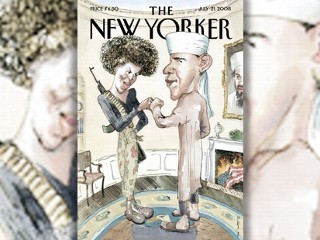
Obama is currently a Muslim? Ebrahim "Eboo" Patel, a Rhodes Scholar with a doctorate from Oxford University in the sociology of religion, as well as sometime CAIR emcee, writes on the ABC News website, in reference to the New Yorker cover of the Obamas in the Oval Office, that
There is a well-organized campaign under way to brand Barack Obama an extremist. Sean Hannity has made "stop the radical Barack Obama" a virtual chorus on his radio show. Claiming that Obama is secretly a Muslim -- a rumor that Daniel Pipes has nurtured through an essay on his Web site, and which about 13 percent of the country believes -- may be the quickest route to that goal.
Eboo Patel.
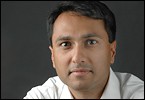
Sloppy, sloppy, Mr. Patel. First, I did not write about this topic in one essay on my Web site, but in three published articles. More important, here is a quote from each of those three articles on the topic of Obama and Islam, all of which contradict Patel's characterization of my position:
December 24, 2007: "'If I were a Muslim I would let you know,' Barack Obama has said, and I believe him. In fact, he is a practicing Christian, a member of the Trinity United Church of Christ. He is not now a Muslim."
January 7, 2008: "if Obama once was a Muslim, he is now what Islamic law calls a murtadd (apostate), an ex-Muslim converted to another religion who must be executed."
April 29, 2008: "Obama's having been born and raised a Muslim and having left the faith to become a Christian make him neither more nor less qualified to become president of the United States."
Comment: A Ph.D. from Oxford, writing for ABC News, cannot get rudimentary facts right? It appears that winging it from memory takes the place of research in certain precincts. (July 15, 2008) Jan. 30, 2009 update: Close to a half year later, Patel finally acknowledged his mistake on the same webpage where the original article appeared:
Author's Note: Daniel Pipes has complained that my op-ed piece was false in asserting that he "nurtured the rumor that Barack Obama is secretly a Muslim." For the record, it is true that Mr. Pipes has stated that he accepts that Obama is now a practicing Christian. In retrospect, I should have said that Pipes has nurtured rumors that Obama practiced Islam in his youth. -- Eboo Patel, Jan. 30, 2009
The New Yorker's July 21, 2008, cover, imagining the Obamas celebrating in the Oval Office.
My limited endorsement of Avigdor Lieberman: I wrote on April 2 in connection that the new Israeli foreign minister's maiden speech "leaves me elated" and that "I have had reservations about Lieberman and still do, but this speech has him off to a great start."
In an interview with Jim Besser of the New York Jewish Week on April 6, I reiterated this point, saying that my endorsement was specifically for that one speech, not for "Lieberman's entire career and his corpus of statements."
Unfortunately, the "not" got lost in transmission and Besser quoted me today in an article, "Lieberman Dilemma Deepens For Obama, Jewish Groups" as follows:
Daniel Pipes, president of the Middle East Forum, said he is "elated" by Lieberman's "entire career and his corpus of statements." But he added that Lieberman is an "aggressive politician who speaks candidly on a range of subjects. That is a concern many — myself included — feel."
I reiterate; the speech was my focus, not Avigdor Lieberman's whole career. (Also, for the record, I am director of the Middle East Forum, not its president.) (April 8, 2009)
The National Jewish Democratic Council's Mistake: I explain at "The National Jewish Democratic Council and Me" how Ira N. Forman confuses two things – my take on Obama's speech in Cairo and his policies toward Israel. (June 26, 2009)
I "lump all Islamists together"?: Fawaz Gerges complains in The National Interest about the formulation of U.S. government policy toward Muslims and writes that
academic Daniel Pipes and others—are partly to blame. Instead of adopting a more constructive approach—one that draws distinctions between the many faces of political Islam—they took the easier, reductionist approach of lumping all Islamists together.
Having founded Islamist Watch in 2007 precisely to distinguish non-violent Islamists from the violent types, as well as written frequently on this topic, one would think Gerges could note that I do emphasize distinctions between Islamists. But why let facts get in the way of an attack? (July 1, 2009)
Linda Sarsour Thinks My Name is PipeLineNews.org: I have some fun at the expense of a New York Islamist at "Popping Linda Sarsour's Balloon." (March 16, 2010)
I founded StandWithUs: Islam in the Eyes of the West: Images and Realities in an Age of Terror, edited by Tareq Y. Ismael and Andrew Rippin, argues that false myths "regarding potential links between Western Muslims, radical Islam and terrorism" have done much damage, including the "war on terror" and the 2003 invasion of Iraq. But the co-editors are so busy with grand theories that they let an obvious mistake get by:
Joel Kovel's Overcoming Zionism: Creating a Single Democratic State in Israel/Palestine, published by Pluto Press in the UK with distribution by the University of Michigan Press, was ... attacked. Founded by Daniel Pipes. the pro-Israeli StandWithUs organization launched a campaign against the University of Michigan Press, demanding that it halt distribution of the book.
I neither founded nor have done anything else with StandWithUs. (June 1, 2010)
Akbar Ahmed Stumbles. I respect Akbar Ahmed, currently a professor at American University, who stood by me during my nomination to the U.S. Institute of Peace board and whom I have listed as a moderate Muslim.
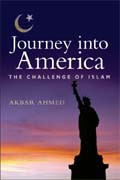 Akbar Ahmed's "Journey into America." |
But of greater personal concern is his small barrage of mistakes about me, akin to those made by vulgar Islamists and irresponsible left-wing bloggers.
- "We ... read the work of those authors, like Steve Emerson and Daniel Pipes, whose combined corpus conveys the impression that Islam is inherently a violent religion (p. 16)." Nonsense: I state that Islamism is inherently violent.
- "Debbie Schlussel, described by Najah as a 'Zionist lawyer in Detroit who was part of Daniel Pipes's network, which routinely attacks Muslims' (p. 249)." Two problems here: First, Schlussel is not part of any network of mine; to the contrary, I distance myself from her shrill and distasteful work. Second, I myself and no network associated with me "routinely attacks Muslims." We do routinely attack Islamists. Why is this distinction so hard to make? Granted that the author is quoting someone else here, but he does not indicate the quote to be inaccurate.
- The Islamic Circle of North America wants to show it "is not the terrorist organization depicted by Fox News and commentators like Steve Emerson and Daniel Pipes, who focus on lCNA's links to the Jamaat-i-Islami, which supports Hamas (p. 273)." It happens that ICNA is the American branch of Jamaat-i-Islami but I have never before made this point; the closest was an article in which I referred to Joe Kaufman's connecting ICNA with Hamas.
Professor Ahmed has an important voice, which makes it all the more regrettable that he made these gratuitous mistakes. Proper research would have obviated this mess. (June 15, 2010)
David Remnick Gets his Facts Wrong: Responding to Newt Gingrich's comment about Palestinians being an "invented people," the editor of the New Yorker brings up the topic of Joan Peters' 1984 book, From Time Immemorial: The Origins of the Arab-Jewish Conflict Over Palestine. He writes:
The book was thoroughly discredited by an Israeli historian,Yehoshua Porath, and many others who dismantled its pseudo-scholarship. Even some right-wing critics, like Daniel Pipes, who initially reviewed the book positively, later admitted that Peters's work was shoddy and "ignores inconvenient facts."
Remnick – whose magazine famously fact checks even minuteia – distorts my two separate assessments of the Peters book, from 1984 and 1986 by falsely contrasting them. According to him, I "initially reviewed the book positively" and "later admitted that Peters's work was shoddy and 'ignores inconvenient facts'." By this, Remnick implies that I enthused over the book until Porath and others corrected me.
Not so: the two assessments both agree on two points: that the book is terribly done but that it has a valid and important thesis. Thus, the 1984 review states that
the book suffers from chaotic presentation and an excess of partisanship, faults which seriously mar its impact. But they do not diminish the importance of the facts presented. Despite its drawbacks. From Time Immemorial contains a wealth of information, which is well worth the effort to uncover.
 Likewise, the 1986 letter to the editor states that
From Time Immemorial stands out as an appallingly crafted book. Granting all this, the fact remains that the book presents a thesis that neither Professor Porath nor any other reviewer has so far succeeded in refuting.
(December 11, 2011)
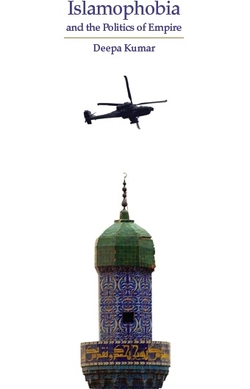
Confusing Islam and Islamism as the enemy: Deepa Kumar quotes me on p. 177 of Islamophobia and the Politics of Empire (Chicago: Haymarket, 2012) saying that "Like communism during the Cold War, Islam is a threat to the West." But I do not think this way; I only talk about Islamism, not Islam, as the enemy. I looked but find no such statement by me; I challenge Kumar to provide an authoritative reference to my saying or writing this. If she cannot do so, she owes me an apology. (July 1, 2012) Jan. 1, 2013 update: The mischievous attribution has now been quoted in a review by Sean Ledwith in The Arab World 360°. Mar. 22, 2013 update: It is now quoted by Ashley Smith in Dissident Voice.
My talk to the Muslim Committee Against Antisemitism: A sympathetic but inaccurate report by Farzana Hassan in the Toronto Sun, "Pipes is tolerated, Geller is not," relates information about a talk I gave and needs to be corrected.
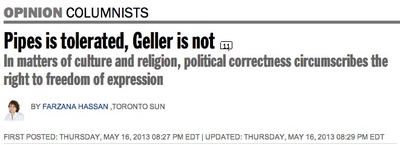
Specifically:
- "Pipes takes a conciliatory approach towards the fraying dynamics between Jewish and Muslim communities."
Only if by conciliatory the author means I hope that Muslims stop attacking Jews, this is correct.
- "He also appears sanguine about an Islamic reformation."
Not true. Over and over during my 1½ hour presentation I kept emphasizing that an Islamic reformation will require a huge amount of work, dedication, money, and organization. And even then, there is no assurance it will succeed.
- "He suggested it is Islamism, a political ideology, that inspires hatred of "the other," rather than Islam."
Not true. Islam has an inherently supremacist view of non-Muslims.
- "He said the religion of Islam itself is not inherently hostile to Jews,"
Not true. A sense of Muslim superiority over Jews goes back 1,400 years, to the very origins of Islam.
- "and Muslim anti-Semitism scarcely existed before the establishment of the state of Israel."
True in the technical sense that the tropes of Christian antisemitism, including the obsessive fear of and hostility toward Jews, goes back only two centuries and only came fully into its own after 1948.
- "He emphasized that while Islam has existed since the age of the prophet Mohammed, Islamism is a recent phenomenon"
Yes, it is a recent phenomenon.
- "and need not be considered an authentic expression of Islam."
Not true. It is an authentic expression of Islam as much as any other. Further, I do not judge what is true to Islam and what is not.
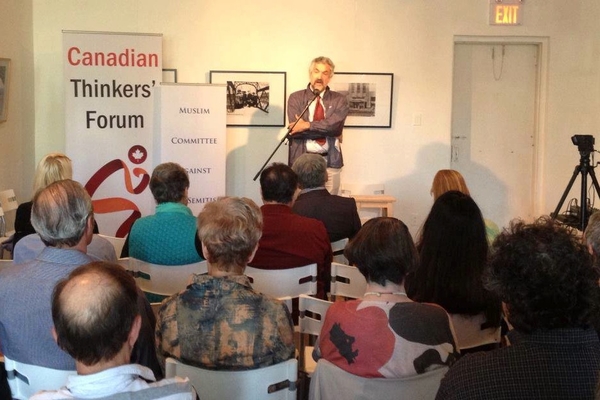 Daniel Pipes speaking for the Muslim Committee Against Antisemitism in Toronto on May 15, 2013. |
(May 16, 2013)
"Anti-Muslim polemicists such as ... Daniel Pipes": Yarden Mariuma of Columbia University has published "Taqiyya as Polemic, Law and Knowledge: Following an Islamic Legal Term through the Worlds of Islamic Scholars, Ethnographers, Polemicists and Military Men" in The Muslim World.
The abstract to the article refers to "recent anti-Muslim polemicists such as Robert Spencer or Daniel Pipes."
But the text of the article only refers to me once, in a footnote to a statement by Spencer: "Daniel Pipes, Warner MacKenzie, Ibn Warraq, Bat Ye'or, et al, all make these claims in many of their publications." That's in, no quotes, no proofs, no nothing.
In other words, I am prominently defamed in the abstract, but the text never substantiates its claim. Typical academic work. (January 1, 2014)
Obama's alleged pro-Islamist sympathies and world view: Does becoming a professor mean no longer having to read? Does it give one license to make things up? I ask because Stephen M. E. Marmura, assistant professor of sociology at St. Francis Xavier University in Canada. wrote in "Likely and Unlikely Stories: Conspiracy Theories in an Age of Propaganda," International Journal of Communication 8 (2014): 2377-2395 that
Daniel Pipes, head of the think tank Middle East Forum, is another frequent guest [on the Fox News Channel]. His website includes a lengthy discussion of Obama's Muslim upbringing and its influence on the President's allegedly pro-Islamist sympathies and world view.
But no, Prof. Marmura, that is not what I wrote. Allow me to quote from my 2012 discussion of "Obama's Muslim Childhood" in the Washington Times:
In conclusion, available evidence suggests that Obama was born and raised a Muslim and retained a Muslim identity until his late 20s. ... This is not to say that he was a practicing Muslim or that he remains a Muslim today, much less an Islamist, nor that his Muslim background significantly influences his political outlook (which, in fact, is typical of an American leftist).
Comment: This sort of mischeivious sloppiness gets applied to me over and over again (see here for a bibliography of examples about me personally and here for examples about Campus Watch). What's behind it? In this inquiring spirit, I ask Prof. Marmura: Why didn't you do research about my views? Are you not embarrassed by your mistake? What do you plan to do about rectifying it? (September 6, 2014) Oct. 6, 2014 update: I wrote Stephen Marmura on Sep. 6, inviting him to reply to my correction of his mistake. A month has passed and I have not heard from him, confirming that he is not only sloppy in his research but negligent when offered a chance to make amends.
I tried to get Joseph Massad fired from Columbia: Another inaccurate statement by another Middle East studies specialist. My note is self-explanatory:
Dear Professor Massad:
Your article today, "Academic civility and its discontents," in The Electronic Intifada includes this passage: "The non-official campaign against me had in fact started in June 2002, three months before the establishment of Campus Watch, when Daniel Pipes and Martin Kramer began to publish articles targeting me and calling for my dismissal from Columbia."
I checked the linked article of mine, "Extremists on Campus," and do not find a call for your dismissal from Columbia. Could you show me where else I might have made such a call? And if you cannot find such a citation, will you correct the record?
Yours sincerely,
Daniel Pipes
(October 9, 2014) Oct. 30, 2014 update: I sent this note twice again, at one-week intervals, on Oct. 16 and Oct. 23, but never heard from Massad. Wonder why.
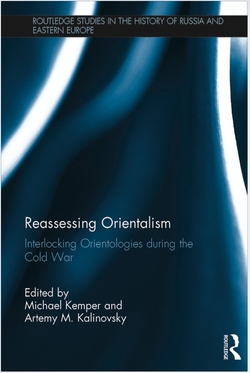 The enticingly named "Reassessing Orientalism: Interlocking Orientologies during the Cold War." |
I support the "clash of civilizations" idea: A new book of essays burdened with the title Reassessing Orientalism: Interlocking Orientologies during the Cold War (Abingdon, Oxon: Routledge, 2015) announces in the introduction, titled "Interlocking Orientologies in the Cold War era" and written by the co-editors, Michael Kemper and Artemy M. Kalinovsky, that
Scholars like Bernard Lewis in the United States have been called upon once again to "explain" the Middle East and the "Muslim world" to policymakers and the public. The support for regime change in the Middle East, a general projection of Muslim "backwardness," and the "clash of civilizations" that scholars like Lewis, Samuel Huntington, and Daniel Pipes espoused in their roles as public intellectuals has in turn invited a vigorous debate among other scholars.
Lewis did indeed coin the clash of civilizations term and Huntington wrote a celebrated article and book with this title, but I have always rejected the concept. Perhaps the highest profile instance of this came in 2007, when Ken Livingstone, then mayor of London, and I debated it. Right at the start of my opening statement, I asserted that "I reject the 'clash of civilization' argument." Could I be clearer?
And yet these academic dunces Kemper and Kalinovsky (professor of Eastern European studies and assistant professor of European studies, respectively, both at the University of Amsterdam) write eight years later that I support the clash of civilizations idea. What's wrong with today's so-called scholars? The internet makes research so easy – no more lumbering around stacks, chasing books that are on loan or lost – but they can't even be bothered to check their assertions. (February 21, 2015)
I suggest creating internment camps for U.S. Muslims: In a 2015 Ph.D. dissertation for the University of East London, "Muslim Identity, 'Neo-Islam' and the 1992-95 War in Bosnia And Herzegovina, S. Osmanovic writes on p. 55:
To protect the West from politically awakened but egregious Muslim masses, Daniel Pipes (2006) suggested creating internment camps for the US-based Muslims, such as those built for the Japanese during the World War Two.
Go to the bibliography and this is what's listed under my name:
Pipes, D. (2006) .'We need Muslim Internment Camps'. Middle Eastern Forum [online] Available from https://www.danielpipes.org/comments/47920 [Accessed 11.08.2007].
Click on the link and it takes you (obviously) to DanielPipes.org, not the Middle East Forum; and the post is not by me but by "Tyler" from Canada:
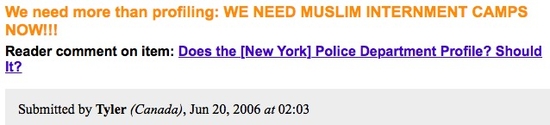
Comment: Isn't a Ph.D. dissertation supposed to be research based on a careful collation of the facts? Isn't it a slight problem when it contains two whoppers like this? What motivates a student to distort my views as S. Osmanovic has done here? Can one rely on him for anything? (July 23, 2015)
I am Süleyman Demirel? As part of my argument that Islamism does not result from poverty, I quoted the former president of Turkey saying the opposite in a 2003 book: "As long as there is poverty, inequality, injustice and repressive political systems; militant Islamic tendencies will grow in the world." But Sadaf Farooq, an assistant professor in the Department of Politics and IR at the International Islamic University in Islamabad, Pakistan, ascribed this quote to me in an article, "Global War on Terror and its Impact on National Harmony with Special Reference to Pakistan," American International Journal of Contemporary Research 5 (August 2015): 40.
The American Jewish Committee gave me an award? Hatem Bazian, an Islamist pretending to be a scholar, begins an article in Daily Sabah, an Erdoğan-propaganda rag pretending to be a newspaper, thus:
What do Islamophobic figures like Daniel Pipes, Steve Emerson, Wafa Sultan and Nonie Darwish have in common? Many answers come to mind, but not the one that I am seeking. The answer is that all of them are recipients of one award or another from the American Jewish Committee (AJC), which were conferred upon each of them precisely because of their strident Islamophobic discourse.
This is pure falsehood. The AJC never conferred "one award or another" on me, much less for my alleged "strident Islamophobic discourse." (Nor, for that matter, on Emerson, with whom I checked.) One wonders how Bazian came up with this lie: some dark part of the internet, some Palestinian rumor, or his own febrile imagination?
For the record, this pseudo-academic teaches "De-Constructing Islamophobia and Othering of Islam" under the auspices of Asian American and Asian Diaspora Studies in the Department of Ethnic Studies at the University of California-Berkeley. He is as good a one-man symbol for the decline of Middle East studies and more broadly the American university that one can unearth. (December 1, 2016)
Someone please inform Khaled Abou El Fadl about search engines: Abou El Fadl may be the "Omar and Azmeralda Alfi Distinguished Professor of Law at the UCLA School of Law" but he appears ignorant about the existence of internet search engines. I say that because he writes today: "Rumours are that both Pipes and [Yossef] Bodansky were students of Bernard Lewis."
How telling that he is content to traffic in rumors when the information he seeks (at least in my case) is so readily at hand. Had he bothered to put Lewis' and my names in a search engine, he would have found the very first result is my article of May 2016, "Bernard Lewis and Me," in which I stated that I never was Lewis' student. For a fancy named-chair postmodern professor, I guess, that's too much to ask. Here's one more example of a pseudo-intellectual at work. (January 18, 2017)
Nine Errors in Three Pages! An academic named Todd H. Green gets me so intensively wrong in his book, The Fear of Islam: An Introduction to Islamophobia in the West, that I felt compelled, in an article on History News Network, to point out his mistakes and draw some conclusions from them. (January 29, 2017)
Donations to Geert Wilders: Concerning Geert Wilders and the elections in the Netherlands tomorrow, the Pittsburgh Post-Gazette editorial board writes: "David Horowitz and Daniel Pipes are reported to have put some $150,000 of foundation money into his campaign."
Every single part of this statement is false. Let's count the mistakes.
- "David Horowitz and Daniel Pipes" are not a single entity. He heads the David Horowitz Freedom Center; I head the Middle East Forum. Each of our actions are unrelated to the other's.
- "are reported": Both Horowitz and I have repeatedly confirmed that we in some fashion have financially supported Wilders. Why the shyness?
- "to have put some $150,000": No, Horowitz has indicated he put in $150,000 while I said the Middle East Forum Education Fund contributed "six figures" of U.S. dollars. Sounds to me like the total comes to more than $150,000.
- "of foundation money": What foundation? Neither Horowitz nor I head a foundation.
- "into his campaign": I have made it clear in every interview that the MEFEF monies went to Wilders' lawyer when Wilders was under criminal indictment for his opinions. Here's one example: a New York Times story a week ago states that MEF "provided money in the 'six figures' to help pay legal bills in Mr. Wilders's trial over the film, but specifically to a legal fund, and has not provided political support." Can it be more clear that not a penny of our money went to Wilders personally, or his political party, nor his campaign?
It's bad enough that reporters often make mistakes – that's what editors are for. But there's no recourse when the editors themselves can't get the facts right. Shoddy journalism. (March 14, 2017)
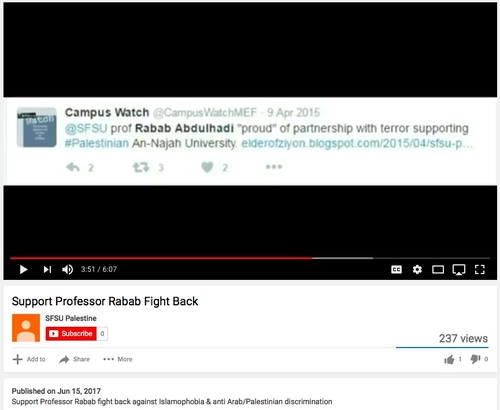
David Horowitz co-founded Campus Watch and the Middle East Forum: A 6-minute video titled "Support Professor Rabab Fight Back" (where Rabab is Rabab Abdulhadi, a particularly offensive professor at San Francisco State University) announces:
In the fall of 2016, Campus Watch and the Middle East Forum, created by Daniel Pipes and David Horowitz ... targeted professor Abdulhadi.
(June 15, 2017)
Hack Ha'aretz reporter gets basic facts wrong: Ha'aretz ran an article by Uri Misgav (in Hebrew) on the Israel Victory Project that devotes some lines to me. Just about everything Misgav writes concerning me is either distorted or wrong:
_________________
For example, the founder of the lobbies for decision, both American and Israeli, is Daniel Pipes. Mr. Pipes is a well-known figure in American ultra-Orthodox circles.
The Haredim have no idea who I am.
Among other things, he has accused President Obama of being a believing Muslim
No, I accept that he is a Christian and have written that repeatedly.
who, as a child, would visit his father regularly at the mosque.
No, I noted that he went occasionally with his step-father to the mosque.
He manages his struggle in the Palestinian consciousness from a safe distance in Philadelphia.
Stupid, cheap shot. I am an American foreign policy analyst. Where am I supposed to live, Botswana?
The motto: "Israel or Palestine can exist, but not both."
I said something like this back in the 1980s but not lately and it's certainly no motto of mine. I now accept the two-state solution in principle though skeptical it can happen for a very long time.
He also has a research institute to promote these ideas, called the Middle East Forum.
Gee, what a put-down.
This man does not limit his areas of expertise to the Jewish-Arab conflict.
Actually, that's not my central interest or expertise at all. Islam is.
It is the war of civilizations that stands before his eyes.
I have many times indicated I reject the clash of civilizations idea, most notably in my debate with Ken Livingstone.
"Western European societies are not ready for the massive migration of dark-skinned peoples who cook strange foods and do not exactly meet German hygiene standards," he said in the past,"
This is not my outlook but was a paraphrase of what French politicians were saying back in 1990. I explained this at length in a response to CAIR (search for "Chirac").
a spirit that can be seen to be consistent with Smotrich's
I assume this is a reference to Bezalel Smotrich of Israel's HaBayit HaYehudi party. I agree with some of his positions, not others. He's not the Israeli politician with whom I share the most similar views.
Comment: I usually point out academics' egregious mistakes, but this time it's a journalist. Whatever the profession, if they don't like your views, they freely and unembarrassedly say false things about you. (July 24, 2017)
Southern Poverty Law Center gets my motives wrong: In an undated and unsigned page on Pamela Geller, SPLC side-swipes me. Discussing efforts in 2007 to prevent the Kahlil Gibran International Academy from opening in New York City, it states:
The campaign was intended as an early stand in a planned nationwide movement to counteract the efforts of American Muslims to meld into American society, according to one of its leaders, prolific anti-radical Muslim polemicist Daniel Pipes.
What an absurdity! I am very glad for "American Muslims to meld into American society." I was against KGIA because I saw that its leadership espoused Islamist ideas, precisely those which would prevent such a melding. (August 25, 2017)
National Post kowtows to Islamists, slanders Middle East Forum: Here is the original letter I sent to the editor of Canada's National Post on Aug. 21:
In May, the National Post published an article by Sam Westrop of the Middle East Forum examining the extremism of Islamic Relief, a prominent Canadian charity. After receiving baseless complaints from Islamic Relief, the Post caved to pressure and bowdlerized his article by removing several factually-established accusations.
Now, in "Inside Rebel Media," your reporter Richard Warnica spuriously describes the Middle East Forum as a "right-wing think tank with a long history of hostility toward Islam," even though the Forum always distinguishes between the Islamic religion and Islamist ideology. We operate on the principle that radical Islam is the problem and moderate Islam is the solution. We also have a long history of cooperating with, employing, and financially supporting reform Muslims trying to free their faith from the grip of extremism.
The National Post has often endorsed the Forum's message, having published 160 of my articles between 1998 and 2016. Yet your editors flat-out refused to fix Warnica's error, writing us that the phrase above "is supported by fair comment," as though a legal defense justifies inaccuracy.
I cannot but wonder why you kowtow to Islamists but knowingly slander the Middle East Forum, including its Muslim colleagues.
Here is the expurgated letter the newspaper published today (and not online) under the title "Moderation the message":
Re: Rebel without applause, Richard Warnica, Aug 19
In "Inside Rebel Media," reporter Richard Warnica describes the Middle East Forum as a "right-wing think tank with a long history of hostility toward Islam." We operate on the principle that radical Islam is the problem and moderate Islam is the solution. We also have a long history of co-operating with, employing, and financially supporting reform Muslims trying to free their faith from the grip of extremism. The National Post has often endorsed the Forum's message, having published 160 of my articles between 1998 and 2016.
(August 26, 2017)


