Does the Bush administration really believe, as its leadership has kept repeating since right after 9/11, that Islam is a "religion of peace" not connected to the problem of terrorism? Plenty of indications suggested that it knew better, but year after year the official line remained the same. From the outside, it seemed that officialdom was engaged in active self-delusion.
In fact, things were better than they seemed, as David E. Kaplan establishes in an important investigation in U.S. News & World Report, based on over 100 interviews and the review of a dozen internal documents. Earlier arguments over the nature of the enemy – terrorism vs. radical Islam – have been resolved: America's highest officials widely agree that the country's "greatest ideological foe is a highly politicized form of radical Islam and that Washington and its allies cannot afford to stand by" as it gains in strength. To fight this ideology, the U.S. government now promotes a non-radical interpretation of Islam.
In "Hearts, Minds, and Dollars: In an Unseen Front in the War on Terrorism, America is Spending Millions to Change the Very Face of Islam," dated today, Kaplan explains that Washington recognizes it has a security interest not just within the Muslim world but within Islam. Therefore, it must engage in shaping the very religion of Islam. Washington has focused on the root causes of terrorism – not poverty or U.S. foreign policy, but a compelling political ideology.
A key document in reaching this conclusion was the National Strategy for Combating Terrorism, issued by the White House in February 2003, which served as the basis for the bolder, more detailed, Muslim World Outreach, completed in mid-2004 and now the authoritative guide. (A government discussion of this topic, dating from August 2004, is available online.) The U.S. government, being a secular and predominantly non-Muslim institution, faces many limitations in what is at base a religious dispute, so it turns to Muslim organizations that share its goals, including governments, foundations, and nonprofit groups.
The tactics for fighting radical Islam and promoting moderate Islam vary from one government department to another: it's covert operations at the CIA, psyops at the Pentagon, and public diplomacy at the State Department. Whatever the name and approach, the common element is to encourage the benign evolution of Islam. Toward this end, the U.S. government, Kaplan writes, "has embarked on a campaign of political warfare unmatched since the height of the Cold War." The goal is:
to influence not only Muslim societies but Islam itself...Although U.S. officials say they are wary of being drawn into a theological battle, many have concluded that America can no longer sit on the sidelines as radicals and moderates fight over the future of a politicized religion with over a billion followers. The result has been an extraordinary—and growing—effort to influence what officials describe as an Islamic reformation.
In at least two dozen countries, Kaplan writes:
Washington has quietly funded Islamic radio and TV shows, coursework in Muslim schools, Muslim think tanks, political workshops, or other programs that promote moderate Islam. Federal aid is going to restore mosques, save ancient Korans, even build Islamic schools...individual CIA stations overseas are making some gutsy and innovative moves. Among them: pouring money into neutralizing militant, anti-U.S. preachers and recruiters. "If you found out that Mullah Omar is on one street corner doing this, you set up Mullah Bradley on the other street corner to counter it," explains one recently retired official. In more-serious cases, he says, recruiters would be captured and "interrogated." Intelligence operatives have set up bogus jihad websites and targeted the Arab news media.
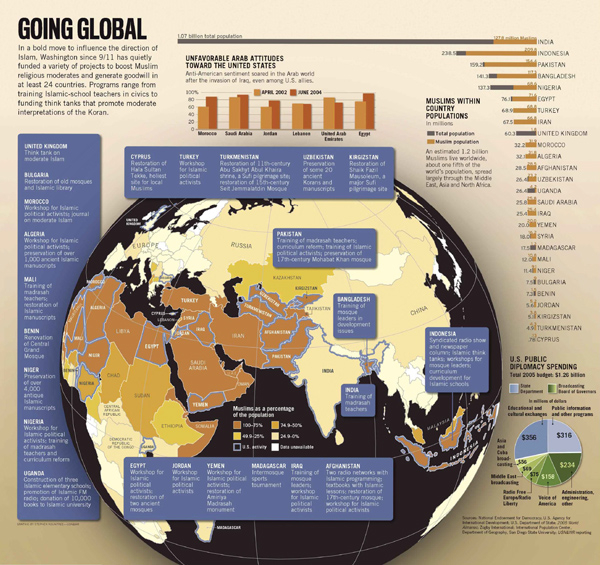 |
In all, various agencies of the U.S. government are active in this Islamic activity in at least 24 countries. Projects include:
the restoration of historic mosques in Egypt, Pakistan, and Turkmenistan. In Kirgizstan, embassy funding helped restore a major Sufi shrine. In Uzbekistan, money has gone to preserve antique Islamic manuscripts, including 20 Korans, some dating to the 11th century. In Bangladesh, USAID is training mosque leaders on development issues. In Madagascar, the embassy even sponsored an intermosque sports tournament. Also being funded: Islamic media of all sorts, from book translations to radio and TV in at least a half-dozen nations.
Madrassahs, or Islamic schools, are a particular concern, for these train the next generation of jihadis and terrorists. Washington deploys several tactics to counter their influence:
In Pakistan, U.S. funds go discreetly to third parties to train madrassah teachers to add practical subjects (math, science, and health) to their curriculum, as well as civics classes. A "model madrassah" program that may eventually include more than a thousand schools is also now underway.
In the Horn of Africa (defined by the Pentagon as Djibouti, Eritrea, Ethiopia, Kenya, Somalia, Sudan, and Yemen), the U.S. military finds out where Islamists plan to start a madrassah, then builds a public school in direct competition with it.
In Uganda, the U.S. embassy has signed three grant awards to fund the construction of three elementary-level madrassahs.
Kaplan quotes one American terrorism analyst saying, "We're in the madrassah business." But not all aid has an explicit Islamic theme. American money is partially funding a satellite version of the Sesame Street in Arabic stressing the need for religious tolerance.
Funds for the U.S. Agency for International Development (USAID) has nearly tripled, to more than $21 billion; and of this, more than half goes to the Muslim world. In addition to the familiar economic development programs, political projects involving Islamic groups, such as political training and media funding, are moving to the forefront. Spending on public diplomacy by the State Department has risen by nearly half since 9/11, to nearly $1.3 billion, with more expected. This largess has funded, among other programs, the Arabic-language Radio Sawa and Alhurra Television. Despite many complaints, Kaplan says they are showing signs of success. Plans ahead include making Alhurra available in Europe, and expanding programming in Persian and other key languages.
Comments:
1. Working to change how Muslims understand their religion, of course, raises some difficult implications. It is one thing to want to help moderate Muslims and quite another to locate them. As I noted in "Identifying Moderate Muslims," there is great confusion over who really is a moderate Muslim and the U.S. government so far has a terrible record in this regard. I sure hope those implementing the Muslim World Outreach agenda are engaging in the necessary research to get it right.
2. The possibility exists that U.S. taxpayer dollars funding Islamic media, schools, and mosques will beef up their capabilities, for influencing Islam and promoting Islam are easily melded, especially given the pro-Islamic attitudes of American political leaders. (For this reason I have criticized the building of a mosque in Iraq and madrassahs in Indonesia.) To promote Islam contravenes the First Amendment ("Congress shall make no law respecting an establishment of religion") and one constitutional expert, Herman Schwartz, deems the sponsorship of Islamic institutions to be "probably unconstitutional." This again points to the need for extreme care.
3. I heartily endorse the Muslim World Outreach approach; this is hardly surprising, for it closely aligns with my own recommendations. Here are excerpts from my January 2002 article, "Who Is the Enemy?":
The United States, an overwhelmingly non-Muslim country, obviously cannot fix the problems of the Muslim world. ... But outsiders, and the United States in particular, can critically help in precipitating the battle and in influencing its outcome. They can do so both by weakening the militant side and by helping the moderate one...Weakening militant Islam will require an imaginative and assertive policy, one tailored to the needs of each country.
But let us not delude ourselves. If the United States has over 100 million Islamist enemies (not to speak of an even larger number of Muslims who wish us ill on assorted other grounds), they cannot all be incapacitated. Instead, the goal must be to deter and contain them...That is where the moderate Muslims come in. If roughly half the population across the Muslim world hates America, the other half does not. Unfortunately, they are disarmed, in disarray, and nearly voiceless. But the United States does not need them for their power. It needs them for their ideas and for the legitimacy they confer, and in these respects their strengths exactly complement Washington's....
[T]he U.S. role is less to offer its own views than to help those Muslims with compatible views, especially on such issues as relations with non-Muslims, modernization, and the rights of women and minorities. This means helping moderates get their ideas out on U.S.-funded radio stations like the newly-created Radio Free Afghanistan and, as Paula Dobriansky, the Undersecretary of State for global affairs, has suggested, making sure that tolerant Islamic figures—scholars, imams, and others—are included in U.S.-funded academic- and cultural-exchange programs.
4. It is very good that David Kaplan has made available the outlines of Washington's efforts to fix Islam. This is a project too large for the government alone to work on; the body politic as a whole needs to argue it out.


