
I recently wrote a column on the separation of civilizations, "How the Cartoon Protests Harm Muslims," and here will follow the extent to which that trend is continuing or not.
One feature already discussed in this weblog is the issue of Muslims living apart, in "Permit Muslim-only Enclaves?"
Mar. 10, 2006 update: The UAE purchase of P&O Ports North America, giving it a major presence in U.S. ports, prompted such a populist backlash that the UAE company in question, Dubai Ports World, had to agree to sell off the U.S. holdings. The huge flap is expected to lead to a reduction of Arab investment in the United States and also is likely to lead to other consequences – not just a chill in trade with the Muslim world but also a reduction in other relations. For example, the Wall Street Journal ran a story today, "Donor Fallout From Port Flap," suggesting that "hard feelings" will prompt some Arab philanthropists and governments to reduce their contributions to U.S. nonprofits and government agencies.
Mar. 20, 2006 update: Evidence in the other direction comes in an article by Jeff Chu, "Coming Back to School," in Time Magazine. He reports that in 2005 the U.S. and Saudi governments agreed on a project by which, over the next four years, the Saudi authorities will pay for as many as 20,000 young Saudis to study in the United States. For its part, Washington "has pledged to speed visa processing for the students—while still running full background checks and in-person interviews at the consulate in Jidda." The program has already brought more than 6,600 Saudis to American campuses, thus raising their numbers above pre-9/11 levels.
Apr. 21, 2006 update: The Wall Street Journal provides specifics about the growing Muslim-American economic "chasm" in "Mideast Money Pinch" by Yasmine El-Rashidi.
U.S. visits by Saudi Arabians, for example, fell to 18,573 in 2004, the last year for which statistics are available, from 72,891 in 1999, Commerce Department figures show. That represents an especially pronounced drop in tourist dollars because Saudi visitors spend three times as much per person as any other group of U.S. tourists, $9,368 per trip to the U.S., the Commerce Department says. Visa hassles have affected export businesses, too, Arabs and Americans say, by placing a wall between U.S. companies and prospective clients who may turn to countries to which travel is easier.
Arab tourists, deterred in part by U.S. visa hassles, are flocking to other burgeoning tourist destinations close to home, such as Dubai in the United Arab Emirates, which offers resort hotels, theme parks and shopping malls patterned on U.S.-style attractions. Jay Rasulo, president of Walt Disney Parks and Resorts, has been outspoken about how the visa process deters tourists. Mr. Rasulo told a recent travel-industry gathering that U.S. share of international travel has dropped by double digits since 2000, to its all-time low, dropping by "about $20 billion a year." ...
In the health-care industry, immediately after Sept. 11, the number of Arab patients at high-end medical clinics such as the Cleveland Clinic and the Mayo Clinic immediately fell by 20% to 50%, say industry officials. The fallout hit more than the clinics. High-profile Arab patients often came to the U.S. for lengthy treatments along with large families and staffs. When former U.A.E. President Sheikh Zayed bin Sultan Al Nahyan traveled to Cleveland in 2000 for a kidney transplant, he and his entourage of hundreds stayed for four months. All needed to be fed, transported and housed during that time. ...
As for education, U.S. colleges and universities, once highly desirable destinations for wealthy Arabs, have seen a steep drop in Middle Eastern students, losing as much as $43 million a year. The consistently steepest decline comes from Saudi Arabia, which sent 14% fewer students to the U.S. last year, according to the International Institute of Education. Enrollment by students from Muslim nations in general has fallen steeply as well, evidence that Middle Easterners aren't alone in finding America a more forbidding destination since Sept. 11. ... Saudi Arabia's minister of higher education recently unveiled a "look east" strategy for education. An increasing number of students, he said, will be sent to China, India, Malaysia, Singapore and South Korea.
May 17, 2006 update: "US hospitals lose Saudi patients and income" reads the Boston Globe story written by Farah Stockman, confirming the pattern I have discerned.
Saudi Arabia has shut down a decade-old program that brought patients to the United States for medical treatment and paid for their care, a move that could translate into millions in lost annual income for Boston-area hospitals. Saudi diplomats say the growing US delays in granting visas to Saudi citizens, because of stricter rules imposed on visitors from the Middle East after the Sept. 11 attacks, were a major factor in the decision to halt the program in recent weeks. It was funded by a Saudi prince's charity. Two similar programs associated with the Saudi armed forces and the Ministry of Health will be sharply scaled back but will continue to bring some patients to US hospitals, the diplomats said.
This is part of a larger pattern of Saudis staying away from the United States since 9/11: "The number of "B" visas -- those issued for medical reasons, business, or tourism -- to Saudis plummeted from 56,912 in 2001 to 14,403 in 2002, according to the State Department. Last year, it rose to 22,621, after President Bush met with Crown Prince Abdullah -- who is now king -- at Bush's ranch in Texas and promised to ease the visa restrictions."
June 6, 2006 update: In the aftermath of an anti-terror raid in east London on June 2, which led to the arrest of Abul Koyair, 20, and the shooting and arrest of his brother, Mohammed Abdul Kahar, 23, a number of Muslims are rethinking their presence in Great Britain, according to Arifa Akbar in the Independent. Here are two excerpts from the article:
Saeed Butt, 49, who moved back to Pakistan with his children after the July bombings last year, said he was relieved he was no longer living in east London. His return to the Forest Gate area on holiday coincided with the police raid. "I came to this country four decades ago but left last year with my children who were born here because I felt, more and more, like we were being picked on. I didn't want my children brought up feeling unsafe. Now I feel that anyone can wake up in the night and have their house raided. The intelligence needs to be 100 per cent if they are going to do what they did on Friday," he said.
Mohammed Azhar, a Kashmiri Briton who owns a furniture shop metres from the police cordon on Lansdown Road, said people were now "terrified" of being mistaken for extremists. "People feel unsafe and are thinking, 'Ve should go', and these are people who have given a lot to this country. They have worked 12 hours a day, seven days a week. We are angry and we are scared. It' s a case of shooting first and asking questions later. It's day four and where's the evidence? They can say anyone is a terrorist," he said.
June 28, 2006 update: Michael Freund of the Jerusalem Post reports that U.S. non-immigrant visas to Saudi nationals in FY 2006 are double what they were in FY 2005. (The fiscal year runs October 1-September 30.) Here are the recent figures:
- 2001 - 83,761
- 2002 - 30,065
- 2003 - 23,254
- 2004 - 22,235
- 2005 - 22,521 (9,338 through June 10)
- 2006 - 18,683 (through June 10)
Amanda D. Rogers-Harper, a spokeswoman for the US State Department, commented on this increase: "We are pleased to see an increase in visa applicants at posts around the world, including Saudi Arabia," adding that this year's increase could be attributed to "a new student scholarship program funded by the government of Saudi Arabia, which encourages students to pursue their studies in the US. "We hope to see a continuation of this positive momentum."
July 11, 2006 update: By a show of hands on July 10, the Egypt parliament graciously but narrowly approved the acceptance of €60 milli in loans from the Danish taxpayer for such projects as providing drinking water, setting up an electricity-generation wind farm, and building grain silos. Opposition members insisted, however, that the hand count was inaccurate and opponents actually outnumbered supporters of accepting the Danish aid. One member of the ruling party member, Mustafa el-Katatny, explained his attitude: "I feel bitter in my heart towards Denmark but I accept the agreement if it is in Egypt's interest."
Aug. 5, 2006 update: The Sharif University of Technology Association has met every two years since 2000, bringing together alumni and professors of one of Iran's foremost technology institutions. To commemorate the hundredth anniversary of the 1906 earthquake, SATU chose the Hyatt Regency in Santa Clara this year, expecting about 650 people to show up. About 120 SATU of the approximately 300 Iranians who applied received U.S. entry visas from the consulate in Dubai, United Arab Emirates, and elsewhere (Washington has no diplomatic presence in Iran). But as many as 100 Iranian travelers were detained over the last week when on arrival in the United States, starting on July 25, when Kourosh Elahidoost was turned away (he says) "for reasons of national security."
Those denied entry had a choice: withdraw their applications and return to Iran, or contest the revocation and face a ban on a visa in the future. Most chose the first option, after spending the night in what they called "jail-like" conditions. Bureau of Consular Affairs spokeswoman Laura Tischler declined comment on the case, citing confidentiality. Visas "can be revoked at anytime, when there are indications of possibility of ineligibility for admission."
Aug. 16, 2006 update: The neologism "Muslim digital ghetto" refers to the fact that Muslims living in the West tune into their own television channels, as explained by the BBC's Torin Douglas. He quotes Navid Akhtar, a TV documentary maker:
there is definitely now a digital ghetto. People just don't watch CNN, they definitely don't watch mainstream TV, they don't watch the BBC, because for very little money you can get Pakistani TV and people have just tuned out. That includes members of my own family. Often when I make programmes and talk to people, they didn't watch them because they were too busy watching something on, say, the Islam Channel. People just aren't attuned to British ideas.
Douglas notes that
There are now almost 40 Asian TV channels available on the Sky satellite, ranging from entertainment channels such as Zee Music and B4U Movies to Star News, Al Jazeera and Abu Dhabi TV. Others can be picked up on different satellite systems on sale in areas such as Southall and Walthamstow. Some, like Zee Music, are free-to-air, others require a subscription. A few - including the Islam Channel - broadcast in English, but most are in other languages.
Douglas then cites data suggesting that the younger generation is more attuned to British media.
Aug. 28, 2006 update: Jacques Chirac, president of France, weighed in on this topic, in a much-noted speech. He was discussing Lebanon and then digressed: "Au-delà de ces affrontements se profile un danger majeur, celui du divorce entre les mondes, Orient contre Occident, islam contre chrétienté, riches contre pauvres." In English: "Beyond these conflicts lies a major danger – a divorce between worlds, East against West, Islam against Christianity, rich against poor."
Aug. 29, 2006 update: On the occasion of a bombing in the Turkish resort town of Antalya, killing 3 and wounding 20, the British Herald provides a list of terrorist attacks against Western tourists. Though far from complete (it does not include, for example, the attack on tourists in Djerba in 2002), it does make a point:
- April 2006 – Two Britons injured in blast which killed at least 24 people in three bomb attacks in Egypt.
- July 2005 – A bomb rips through a minibus in the western Turkish holiday resort of Kusadasi, killing at least five people, including a British woman and an Irish woman. Ten Britons among more than 60 killed when Sharm el Sheikh in Egypt rocked by three explosions.
- August 2004 – Five British tourists injured in bomb attack in Prague. Owners of local casino thought to be target of the bombing. Some 500 Britons among thousands of travellers and holidaymakers caught up in violence in Kathmandu as suspected Maoist rebels set off two powerful bombs.
- July 2003 – 13 people, including one British tourist, injured in bombing offensive by Eta, the Basque terror group, on Costa Blanca resorts of Benidorm and Alicante.
- October 2002 – 28 Britons among 202 people killed in Bali nightclub bombings. Police blamed Jemaah Islamiyah, a terror group linked with al Qaeda.
- November 1997 – Three Britons shot dead by Islamic militant gunmen along with 58 tourists and four Egyptians in Luxor.
The impact everywhere of terrorism against tourism is to separate civilizations. Here is a snippet from the Antalya coverage:
Antalya is a popular tourist resort, particularly with Russians, Germans and Israelis. Millions of foreigners flock to the long Turkish coastline each summer. Locals are concerned the £9.5bn tourist industry, a powerful motor of the Turkish economy, may be further damaged by the attacks, the latest in a string of bombings in the past year. There was little immediate impact on Turkish financial markets, but one hotel owner in Marmaris said cancellations had already started to flow in. Mesut Isik, who owns a photographic shop in Antalya, was pessimistic. "The tourists have already been few this season and from now on none will come. Shops have no option but to close."
Sep. 9, 2006 update: Anti-separation forces got a big boost (as did efforts to broaden Saudi influence in the United States) with the new educational exchange program brokered by President George W. Bush and Saudi King Abdullah. The program, paid for by the Saudi royal family, quintuples the number of Saudi students and scholars in the United States to 15,000 by the end of the 2006-07 academic year. When that number of students is reached, the kingdom will be have more students at American universities than either Mexico or Turkey. In a rare note of skepticism, Clark Kent Ervin, a former inspector general of the Department of Homeland Security, finds that proper safeguards are not yet in place effectively to check the background of all applicants.
Sep. 20, 2006 update: But will the Saudi students actually go to the United States? It's hard to turn down an all-expenses paid scholarship to a top university, but Saleh Fareed writes in the Saudi newspaper, Arab News, that this might be the case. As a result of Homaidan Al-Turki's being sentenced in Colorado to 27 years in prison for enslaving and raping his maid, Fareed writes, "Saudis are thinking twice before sending their children to study in America."
He provides some quotes and specifics:
- "Such discrimination and humiliation would discourage parents from even thinking about sending their children to study in the US," said Muhammad Al-Enezi, 39. Al-Enezi, a teacher at one of the largest high schools in Jeddah, said that many of his students who had been contemplating of studying in the US now showed no interest in heading there. "Most of them refuse to continue their college education in the US and they have the support of their parents. It's obvious that they've decided so after hearing about the mistreatment and intimidation suffered by other Saudi students in the US," he said.
- Jamal Al-Najjar, a government employee and father of two, urged the Saudi government to put pressure on the US administration to change its policy toward Saudi students. Al-Najjar hopes that Custodian of the Two Holy Mosques King Abdullah will interfere and bring a solution to the issue relating to Al-Homaidan, who was sentenced in the US under "false accusations." "I am not going to sacrifice my sons by sending them to the US as long as they keep mistreating our children and abusing them for no reasons. My two sons will be graduating this year from high school and I will never ever think of sending them to America," Al-Najjar said. "I know of many parents that have changed their plans and are sending their children to other destinations such as Malaysia, Australia, New Zealand and Canada. The US is not the right place for our children and I hope all parents do not think about sending their children to any part of the US," he added.
Fareed notes the large drop in Saudi students in the United States and then finds a Saudi student to explain why:
"This is because of the new political climate after Sept. 11, 2001, and the fact that Muslims in the US are facing many difficulties for mistakes that could be dealt in a less aggressive way," said 29-year-old Ahmed Al-Falih, who is currently studying at a university in the US Midwest. Speaking to Arab News by telephone, he described the situation of Saudi students as unsafe. "Many students feel scared. They expect the unexpected just like Al-Turki who has been accused of rape and other things that he did not do."
Meanwhile, a Saudi tourist returning from the United States recently expressed anger and frustration at mistreatment suffered at the hands of US authorities when he was detained for a couple of hours at the J.F. Kennedy Airport. "I thought things would have calmed down after all these years but the situation is still tense and Arabs are discriminated against and mistreated," said Mamdouh Al-Saeed, 24. Al-Saeed added that he would not feel comfortable going to the US for further education in the current climate.
Comment: If the mood is anything as presented here, one wonders which Saudis will take their lives in their hands and foray on to an American campus.
Sep. 24, 2006 update: In an unusual move, two Muslim countries, Tunisia and Egypt, have banned leading European newspapers because of articles critical of Islam. The September 19 edition of Le Figaro, containing an article by Robert Redeker, "Face aux intimidations islamistes, que doit faire le monde libre?" ("Confronted by Islamist intimidation, what should the free world do?") was confiscated in Tunisia on the grounds that it contained "offensive material about Islam." Both that issue of Le Figaro and the September 16 issue of the Frankfurter Allgemeine Zeitung were banned in Egypt, the latter due to an article by Egon Flaig, "Der Islam will die Welteroberung: Die Kriegsregeln sind flexibel, das Kriegsziel bleibt: Mohammeds kämpferische Religion" ("Islam wants world conquest: War rules are flexible, the war goal remains: Mohammed's warlike Religion"). Egypt's Information Minister Anas el-Feki issued a decree that . "They published articles which disparaged Islam and claimed that the Islamic religion was spread by the sword and that the Prophet ... was the prophet of evil."
Nov. 14, 2006 update: "Saudis return in record numbers to US universities" is the headline in the Saudi Gazette. Their total comes to 10,936 at 733 educational institutions, including 1,653 females. An additional 3,000 Saudi students are expected to arrive in early 2007, bringing the total to 14,000 students. The prior record was 10,440 in the academic year 1980/1981, according to the International Education Institution in New York. In September 2001, the number of Saudi students stood at 5,579. Their number dipped as low as 3,035 in the academic year 2004/2005. The current students' favorite states are California, Florida, Colorado, followed by Virginia. Gregory Gause III, Middle East studies professor at the University of Vermont commented (in a back-translation from Arabic) that "relations at the government level are strong but at the people's level there is a lot of mistrust and hatred. This scholarship program is a good step towards eradicating some of the mistrust and hatred."
June 2, 2007 update: Conde Nast International Chairman Jonathan Newhouse, approached by a UAE publishing company expressing interest in licensing an Arabic-language edition of Vogue, responded vehemently against the idea, according to a leak published in Emirates Daily. Quotes from the Newhouse letter:
Within the Arab world, or to be more accurate, the Muslim world, there is an element which accepts Western values. There is also a powerful fundamentalist, religious element which rejects Western values. This element rejects freedom of expression, equality for women and expression of sexuality, to name three values associated with our publication. And this militant element is capable of aggressive opposition, even violence, to attain its goals. At its most extreme, this militant element is capable of murder. ... Our company has no wish to impose its values on a society which does not fully share them. And we do not wish to provoke a strongly negative, even violent reaction. It isn't even worth it for a few million in licensing fees.
Newhouse added that the Middle East has
plenty of people . . . who would love to read Vogue. But unfortunately they live in the same general region as some of the most militant and violent elements. The UAE borders Saudi Arabia, home of bin Laden and most of the September 11 terrorists. And militant elements take offense at any Arabic-language magazine. This isn't Israel/Palestine, Iraq or Iran. It isn't a thorny problem which has to be solved. It is a problem I don't have to have. So I will simply avoid it by never entering the market. And I will sleep better at night.
Mar. 3, 2008 update: I look at another aspect of the separation of civilizations at "Islamic Hotels, Forwarding Islamic Law."
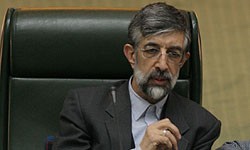
Speaker of the Iranian parliament Gholam Ali Haddad Adel.
Apr. 7, 2008 update: In the aftermath of the Geert Wilders film, Fitna, the speaker of the Iranian parliament, Gholam Ali Haddad Adel, wants Muslims to boycott trade with countries that allows insult to Islam, on the premise that Western countries will change their attitude toward Islam when their economic interests are affected.
Apr. 21, 2008 update: I document another aspect of this separation at "Mecca Mean Time?"
May 2, 2008 update: As a result of Dutch MP Geert Wilders's anti-Koran film, Fitna, a spontaneous Muslim boycott of goods from the Netherlands – including Doritos chips, Perrier Water, Nescafe and Buitoni Pasta – took place from April 10 to 25. Its extent in Saudi Arabia is unclear, reports Sarah Abdullah of Arab News, who visited six supermarket chains.
Attesting to low interest in the items on the boycott list among shoppers, many supermarkets had launched special promotion offers for these products, adding special gifts such as a box of free cereal, baby bowls and spoons. Other stores added Dutch items to a clearance bin and drastically marked down prices. One store said that instead of "punishing" the Netherlands, local retailers were feeling the brunt of the boycott by being stuck with goods customers refuse to buy. According to Saudi customs laws, traders are unable to return excess stock to manufacturers abroad.
Najat Dughaish, a shopper in Jeddah, said, "I think a majority of people were involved in protesting against Dutch products, while others were confused about which products to boycott." She added, "In my opinion, with or without the boycott, I believe the message is clear that people, no matter who they are, can't insult Islam and expect Muslims to do nothing about it. Muslims want to warn the world that they are an economic force to be reckoned with and that they are only asking for the respect of their religion."
May 11, 2008 update: There's also a boycott of Danish goods in effect in Saudi Arabia and other GCC countries, now focused on medical products. Several major healthcare providers have decided not to use prescription drugs from Denmark. Officials at hospitals and pharmacies say the boycott is spreading.
"To make the campaign more effective in order to have a daunting effect on Denmark's economy, we dispatched a letter to the Saudi Minister of Health, urging him to officially impose a ban on imports of Danish medicines," said one official from a leading healthcare provider in Riyadh, who insisted on remaining anonymous. Other officials participating in the campaign, who spoke also on condition of anonymity, said the call not to use prescription medicines from Denmark would put even more pressure on that country's economy than the public's boycott of foods, which started a few months ago.
Oct. 31, 2008 update: I discuss a new dimension of the separation of civilizations at "Muslims Traveling Apart."
Jan. 1, 2009 update: Muslims living in the West are increasingly marrying each other and creating an insulated social milieu. Take the case of Denmark, where Kristeligt Dagblad finds that
Second generation immigrants are marrying each other in Denmark like never before. Marriage with Danes is unacceptable in many communities. ... Just 1 in 20 women of Turkish background in Denmark married a Danish man in 2007. This means that some Turkish women don't dare follow their heart, thinks integration consultant Esma Birdi. She says that it seems as though even if a Turkish woman likes a Danish man, she knows almost instinctively that a marriage with him will cause big problems. Most women aren't strong enough to keep to their choice and they therefore forgo the Danish man in order to keep a religious and cultural fellowship with their family and community.
In the Turkish community hierarchy, marriages follow a clear pattern, says Esma Birdi, who is herself of Turkish background. For example, Turkish parents prefer that their daughter marry Turkish Muslims. If that doesn't happen, it will be with another Muslim. If that doesn't happen either, it can be a Danish man who converted to Islam. But while he goes all the way to convert, many Turkish communities will disapprove of it, she says.
May 6, 2009 update: Paradoxically, "Miss Beautiful Morals" points both to the Muslim world's integration in the world (the idea of a beauty contest for women, something utterly, utterly unknown traditionally) and its separation (morals?). Read about it in the Associated Press dispatch from Saudi Arabia by the talented Donna Abu-Nasr:
Sukaina al-Zayer is an unlikely beauty queen hopeful. She covers her face and body in black robes and an Islamic veil, so no one can tell what she looks like. She also admits she's a little on the plump side. But at Saudi Arabia's only beauty pageant, the judges don't care about a perfect figure or face. What they're looking for in the quest for "Miss Beautiful Morals" is the contestant who shows the most devotion and respect for her parents.
"The idea of the pageant is to measure the contestants' commitment to Islamic morals... It's an alternative to the calls for decadence in the other beauty contests that only take into account a woman's body and looks," said pageant founder Khadra al-Mubarak. "The winner won't necessarily be pretty," she added. "We care about the beauty of the soul and the morals."
So after the pageant opens Saturday, the nearly 200 contestants will spend the next 10 weeks attending classes and being quizzed on themes including "Discovering your inner strength," "The making of leaders" and "Mom, paradise is at your feet"—a saying attributed to Islam's Prophet Muhammad to underline that respect for parents is among the faith's most important tenets.
Pageant hopefuls will also spend a day at a country house with their mothers, where they will be observed by female judges and graded on how they interact with their mothers, al-Mubarak said. Since the pageant is not televised and no men are involved, contestants can take off the veils and black figure-hiding abayas they always wear in public.
May 21, 2010 update: The government of Pakistan banned three of the largest websites, Facebook, Twitter, and YouTube, out of concern that "blasphemous" materials would result from the "Everybody Draw Muhammad Day!" initiative of Molly Norris, a Seattle-based cartoonist. Yesterday was that day. May 25, 2010 update: Two pieces of news on this subject: (1) Mark Zuckerberg, the founder of Facebook has been charged by a Pakistani court under Pakistani penal code Section 295-C that says, "Use of derogatory remark etc, in respect of the Holy Prophet, whoever by words, either spoken or written, or by visible representation, or by any imputation, innuendo, or insinuation, directly or indirectly, defiles the sacred name of the Holy Prophet Muhammad (Peace Be Upon Him) shall be punished with death, or imprisonment for life, and shall also be liable for fine." (2) Another Pakistani court asked the Pakistan Telecommunication Authority to ban "blasphemous" websites such as Yahoo, MSN, Hotmail, Google, Amazon and Bing
May 24, 2010 update: It's not just American websites; Pakistanis are voting with their feet to stay away from the United States, according to an article in the Washington Post, "Many disillusioned Pakistanis look beyond U.S. for work, travel and education" by Tara Bahrampour and Pamela Constable.
A series of international terrorism incidents linked to Pakistanis, including a failed car bombing this month in Times Square, has prompted many Pakistanis who once had deep ties to the United States to look elsewhere for work, education and travel. It has also left some Pakistani Americans feeling uneasy in their adopted homeland.
The stress of living under suspicion has had a palpable effect, Pakistani American community leaders say. Travel agents say bookings between Pakistan and the United States are down, and U.S. visa applications for travel from Pakistan appear to be dwindling. ... Many Pakistanis say they do not want to travel to the United States anymore, whether to study, visit relatives or take once-desirable jobs. ... A dozen technology students in Islamabad and Rawalpindi who once would have given anything to work in the United States said they were instead seeking jobs in Britain, Australia, Canada or the United Arab Emirates.
Going to Britain, Australia, or Canada does not signal a fundamental shift, but the growing jihadi sentiments in Pakistan suggest those countries are more likely to follow the U.S. lead than the other way around.
Aug. 3, 2010 update: Belgium will have halal hotels in 2011 – no X-rated channels, no pork, but Korans and prayer rugs.
Aug. 12, 2010 update: MTV watch out, here comes 4Shbab.
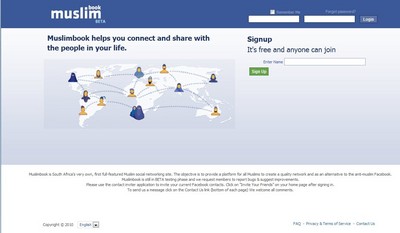 MuslimBook has more than a passing resemblance to FaceBook. |
Dec. 24, 2010 update: For those who find Facebook too wild and open, there's now an Islamic equivalent, MuslimBook. It closely replicates the FB look.
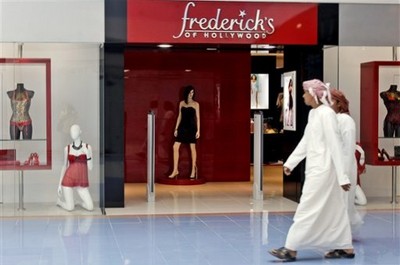 Two men admire lingerie at Frederick's of Hollywood in Abu Dhabi. |
The reasons for this globalism?
Retailers and restaurant chains that once shied away from overseas markets are being seduced by the region's deep-pocketed citizens and the growing track records of their Arab franchise partners, who take on many of the costs and much of the legwork that goes into transferring the brand abroad. ... The UAE has other advantages too. It boasts plenty of high-quality retail space and few of the deeply entrenched local brands that can put retailers off expanding into mature markets like Europe. The country's booming airlines have turned the Emirates into a global crossroads, funneling armies of guest workers - including Westerners - and millions of tourists into the country's shopping malls each year.
Jan. 24, 2012 update: A Muslim taxi service, anyone? That's what Selim Reid, 24, set up in Hamburg, Germany.

Sep. 20, 2012 update: It's one thing to develop one's own version of Facebook (see the May 21, 2010 update, above) and another to develop one's own internet, which is what the Iranian regime appears to be doing, according to a University of Pennsylvania study. It has two motives: to protect its military computers, especially those connected to the nuclear program, and to deny an alienated population free access to information.
Sep. 21, 2012 update: Reuters reports that "Iranian hackers have repeatedly attacked Bank of America Corp, JPMorgan Chase & Co and Citigroup Inc over the past year, as part of a broad cyber campaign targeting the United States," suggesting that Westerners are as interested in separating Internet networks from Iran as the other way around.
Sep. 23, 2012 update: The Iranian authorities have blocked Google.
Oct. 14, 2012 update: The Islamic Republic of Iran has created a biennial award, the "Great Prophet World Prize," to promote scientific inquiry by Muslims. It's the "Islamic Nobel Prize" for scientists.
Apr. 12, 2013 update: Mohammad Hassan Nami, Iran's minister for information and communications technology, has announced this week that his government is developing a 3D mapping service, what Nami called an "Islamic Google Earth," by August 2013. He dismissed the original Google Earth as a spy machine: "On the surface, Google Earth is providing a service to users, but in reality security and intelligence organizations are behind it in order to obtain information from other countries. ... We are developing this service with the Islamic views we have in Iran and we will put a kind of information on our website that would take people of the world towards reality ... Our values in Iran are the values of God and this would be the difference."
July 16, 2013 update: An "Islamic" version of the Cinderella fairy tale has appeared in Egypt, complete with hijab but lacking the fairies.
 An illustration to the Islamic rendering of the Cinderella story. |
May 16, 2014 update: The Kingdom of Saudi Arabia has suspended trade with the Netherlands, excluded Dutch companies from its market, and restricted Dutch subjects from its territory, according to a third-hand news account, and all this on account of Geert Wilders.
Dec. 19, 2015 update: The British government appears to be "rejecting Pakistani visa applicants in droves," according to a Pakistani report.
The United Kingdom is pursuing an unannounced policy of turning down visa applications of Pakistanis, becoming one of the top 'no-go' countries for the country's nationals. ... The British High Commission in Islamabad has turned down thousands of Pakistanis' visa applications this year, without citing any solid reasons and many on frivolous grounds which cannot be challenged at any forum.
Oct. 8, 2017 update: The mutual termination of issuing visas to each other's nationals by the U.S. and Turkish governments today is a giant step toward the separation of civilizations, as long as it lasts anyway.


