
Two recent developments prompt some reflections:
- The State Department took the unusual step of condemning the views of a member of the U.S. House of Representatives as "insulting and offensive"; and
- A subsidiary of the Disney Corporation fired a talk-show host.
In both cases, the trigger was the same – speaking about Islam.
I disagree with Congressman Tom Tancredo about keeping the option open to "take out" Mecca and with Michael Graham that "Islam is a terror organization." But I do think it vital that they and others be able to conduct a freewheeling discussion about the Koran, jihad, radical Islam, Islamist terrorism, and related topics, without fearing a reprimand from the U.S. government or a loss of their livelihood. (The same applies to another case I have previously discussed, publication of Craig Winn's Prophet of Doom: Islam's Terrorist Dogma, In Muhammad's Own Words.)
Americans are seriously discussing the nature of the enemy and how to defeat it. It is a confusing topic; for proof, look at how many differing ways George W. Bush has described the enemy, from "terrorists" to "evildoers" to "an ism" to "a fringe form of Islamic extremism" to "Islamic militants."
Especially at a time when establishment institutions are so timid or even deceptive, nothing can be off limits in this debate; and there must be no penalty for those who express their views. (August 22, 2005)
Dec. 4, 2006 update: A variant of this same debate has flared up over comments by Dennis Prager concerning Keith Ellison, representative-elect from Minnesota and the first-ever Muslim elected to congress. In a November 28 column, "America, Not Keith Ellison, decides what book a congressman takes his oath on," Prager argued that, were Ellison to take his oath of office on a Koran, "he will be doing more damage to the unity of America and to the value system that has formed this country than the terrorists of 9-11." Indeed, Prager argues, this step would "undermine American civilization."
Strong words, and ones that I happen to disagree with. I have no problem with an elected official taking the oath of office, real or symbolikc, on the scripture of his choice, Biblical or otherwise.
But, as with Tancredo, Graham, and Winn, whether I agree with Prager or not is not the point. He is a serious, deep, and original thinker who deserves the space to try out ideas dealing with the complex challenge posed by radical Islam – identifying the enemy, formulating a sound policy, then finding the best strategy and tactics to combat it. It is only through the open exchange of ideas, including wrong ideas, that we will advance in our understanding of the enemy and how to defeat it.
Therefore, for all our sakes, in addition to the legal right to freedom of speech guaranteed by the Constitution, Prager must be granted the political right to offer ideas without vilification or punishment. Not to grant him that is unacceptably to narrow the debate and harm the war effort.
Jan. 21, 2009 update: A Dutch appeals court has instructed the state prosecutor to charge Geert Wilders, head of the Party for Freedom (PVV) and a member of parliament, with hate speech for comparing Islam to Nazism. If convicted, he could be sentenced up to sixteen months in jail and have to pay about €10,000 in fines.
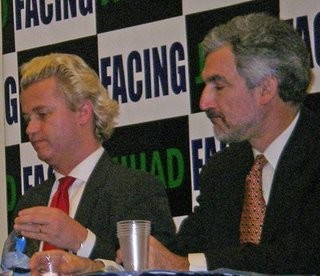 Geert Wilders and Daniel Pipes at the "Facing Jihad" conference in Jerusalem, Dec., 2008. |
The Legal Project of the Middle East Forum has just committed to Wilders to help him fight the Dutch government's attempt to jail him. We will help him raise funds, we will deploy LP's network of lawyers and other specialists, and we will bring our own expertise to bear on his case. To remind, the Legal Project, which I founded in 2007 and is staffed by Brooke M. Goldstein and Aaron Mayer, "aims to protect researchers and analysts who work on the topics of terrorism, terrorist funding, and radical Islam from lawsuits designed to silence their exercise of free speech." Jan. 22, 2009 update: For the Legal Project's analysis of the indictment yesterday, see "Death to Free Speech in the Netherlands." It concludes with this warning: "if Geert Wilders is tried and sentenced, it will establish the precedent Islamists have been striving for -- and one day, none of us will be free to speak out against them." Feb, 25, 2009 update: I reiterate these points in an article by Eric Fingerhut of JTA about the Legal Project's having co-sponsored Wilders at a fundraising event in the Boston area:
Daniel Pipes doesn't agree with Dutch politician Geert Wilders' view that the Koran should be banned. But he does believe Wilders should be able to publicly present that view. That's why the Middle East Forum's Legal Project is helping Wilders raise money for his legal defense and sponsored his appearance Wednesday evening at Ahavath Torah Congregation in a Boston suburb.
"I don't need to agree with him to see the importance of him making his arguments," said Pipes, the director of MEF, about Wilders. … Pipes said Wilders is an important figure who is part of the discussion about confronting and fighting radical Islam. "If our collective voice is impeded from speaking" or "shut down," said Pipes, then "the way is paved for radical Islam to move ahead." Pipes said he felt hate speech laws, which have also been used to prosecute Holocaust deniers in Europe, are a bad idea. "I believe in the First Amendment," he said.
Mar, 8, 2009 update: Here is Wilders' take on his and my disagreement, expressed in an interview with the Boston Globe's Jeff Jacoby:
Q: What do you say to scholars of Islam like Daniel Pipes, who argues that radical Islam is the problem and moderate Islam is the solution. Here's a quote: "Islam is subject to a number of interpretations. . . . The terroristic jihad against the West is one reading of Islam, but it is not the eternal essence of Islam." Why should one accept what Geert Wilders says about Islam, rather than someone like Pipes?
A: I respect Daniel Pipes, but I fully disagree. There is no moderate Islam. It's like the [prime minister] of Turkey, Mr. Erdogan, said himself recently: There is only one taste of Islam, and that is the taste of the Koran.
Q: But he's an Islamist. You would expect him to say that. What about anti-Islamist Muslims, Muslims who reject the radicals?
A: Listen, the Koran is seen by Muslims, unlike all the other religions, as the word of God that can never be criticized. If you criticize the Koran, you are a renegade, an apostate. There are people who are moderate and call themselves Muslim. But moderate Islam is totally nonexistent. It will never have an Enlightenment as happened with Christianity.
Q: Why not?
A: Because unlike the interpretations of other holy books, Muslims believe that the Koran is the word of God and can never be changed.
Q: Hold on—the New Testament today is the same New Testament as a thousand years ago. What's different is the way that book is read and understood. A thousand years ago, one could have said Christianity was a violent, militant religion; today one wouldn't.
A: Yes, there was a change in Christianity. It was possible because Christians don't believe that the Bible is literally the word of God—not like the Koran. If you really believe that [the Koran] is the word of God, it will never have room to change.
Q: But why couldn't there be a movement within Islam that would say, "Yes, the Koran says X, Y, and Z, and it has been interpreted violently by violent people, but we give it a different interpretation."
A: Then they are not Muslims anymore.
Q: How do you decide whether they are Muslims anymore?
A: I am not deciding. It's the Koran that's saying it..
Comments: (1) Wilders' argument echoes Pope Benedict XVI's, that Koran interpretation has no history. This argument is plain mistaken; see "Jihad through History" for the evolution of one key concept and see "[The Issue of Compulsion in Religion:] Islam is What Its Followers Make of It" for the range of understandings over time of a single Koranic phrase. (2) The last line, "It's the Koran that's saying" that more liberal interpretations of Islam are non-Islamic has no validity at all. (3) Despite these differences in outlook, the Legal Project that I founded in 2007 has to date raised funds well into the six figures (U.S.) to support Wilders' court costs to protect his right to speak his views. .


