
I used some statements by Orthodox Jewish leaders to speculate in "The Orthodox Future of Judaism" that Orthodoxy will become dominant again.
it is conceivable that the ratio will return to roughly where it was two centuries ago, with the Orthodox again constituting the great majority of Jews. Were that to happen, the non-Orthodox phenomenon could seem in retrospect merely an episode, an interesting, eventful, consequential, and yet doomed search for alternatives, suggesting that living by the law may be essential for maintaining a Jewish identity over the long term
A new study, "Young Jewish Adults in the United States Today: Harbingers of the American Jewish Community of Tomorrow?" released by the American Jewish Committee, confirms this trend. Looking at the 1.5 million American Jews ages 18-39, it found that Orthodox Jews comprise some 11 percent of the Jewish population; among 18-29 year-olds, that goes up to 16 percent. Among Jewish children, the percentage of Orthodox is probably even higher. Put differently, the percentage of Orthodox Jews aged 18-29 is nearly double that in the 30-39 age group.
The study is based on surveys by Ukeles Associates, the National Jewish Population Survey of 2000-01, and AJC's own surveys since 2000.
Steven Bayme, director of contemporary Jewish life at the AJC, which commissioned the study, commented that "Younger Orthodox adults are likely to play increasingly important roles in organized Jewish life given their commitments, numbers and fertility patterns." (April 27, 2006)
Dec. 27, 2006 update: Hillel Halkin confirms these points in "Trending Toward Orthodoxy," where he begins by discussing the loosening affiliation of American Jews. But shrinkage, he adds,
is only half of the story. The other half is the remarkable strengthening of Jewish education, religious observance, and creativity in that part of the American Jewish community that has chosen to remain strongly Jewish. Nor are these two seemingly opposed processes unrelated. On the contrary: As assimilation has claimed more and more American Jews, American Jews who wish to resist it have increasingly come to understand that the only way to do so is by putting more of an effort into being Jewish.
Assimilation and cultural renaissance are thus two sides of the same coin of American Jewish life, and all of the wordy arguments about what direction American Jewry is going in are largely a matter of which side of the coin one is looking at. The American Jewish community is rapidly polarizing into more and more assimilated Jews, on the one hand, and more and more Jewish Jews, on the other. The broad ethnic middle has fallen out of it.
This community has also become more Orthodox, both because Orthodox families have by far the highest Jewish birth rate — they are the only American Jews who are reproducing above replacement level — and because they have, again by far and away, the greatest success in retaining their children and preventing defections from the Jewish fold. Although they constitute today an estimated 10% of American Jewry, they comprise a third of its regular synagogue goers, 20% of its under-18 population, and barely 1% of its Jews who intermarry.
Moreover, as bitter as the divide between them and Reform and Conservative Jews may be over cultural issues, the intense allegiance of Orthodox Jews to a Jewish way of life is a model that Reform and Conservatism will increasingly have to follow if they are to survive. The real demographic story of American Jewish life may turn out to be its steady "Orthodoxization" in the years to come. Although this is something whose implications few American Jewish leaders or institutions have given much thought to, it is too clear a trend to ignore.
Aug. 1, 2007 update: "Three of four Jewish births in UK are haredi" finds University of Manchester historian Dr. Yaakov Wise. Jonny Paul writes in the Jerusalem Post that
Europe's haredi population is growing more rapidly than at any time since before WWII. Almost three out of every four British Jewish births, he says, are ultra-Orthodox, and the community now accounts for around 45,500, or 17 percent, of a total UK Jewish population of around 275,000. ... In Greater Manchester, approximately half of all Jewish children under five years old are haredi. The numbers are also growing in Greater London, where the ultra-Orthodox community now accounts for 18% of Jews, up from less than 10% in the early 1990s.
The same pattern holds for the US, Wise says. "In America, too, where the Jewish population is stable or declining, ultra-Orthodox Jewish numbers are growing rapidly. Prof. Joshua Comenetz at the University of Florida says the ultra-Orthodox population doubles every 20 years, which he says may make the Jewish community not only more religiously observant but more politically conservative."
Wise concludes from these statistics:
If current trends continue there is going to be a profound cultural and political change among British and American Jews, and it's already well on the way. This is in spite of demographic studies which show that the non-ultra-Orthodox Jewish population is flat or falling. My work, and that of Prof. Sergio Della Pergola [of the Hebrew University], reveal a similar picture in Israel. By the year 2020, the ultra-Orthodox population of Israel will double to one million and make up 17% of the total population. A recent Israeli Central Bureau of Statistics report also found that a third of all Jewish students will be studying at haredi schools by 2012, prompting emergency meetings at the Education Ministry.
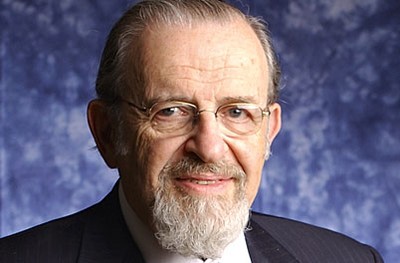
Norman Lamm, the chancellor of Yeshiva University in New York.
May 10, 2009 update: The chancellor of Yeshiva University, Rabbi Norman Lamm, predicts the demise of non-Orthodox Jewish denominations, reports Matthew Wagner for the Jerusalem Post. "With a heavy heart we will soon say kaddish on the Reform and Conservative Movements. The Conservatives are in a mood of despondency and pessimism. They are closing schools and in general shrinking. The Reform Movement may show a rise, because if you add goyim to Jews then you will do OK," a reference to Reform's policy, since 1983, of recognizing patrilineal descent. "Reform is out of the picture, because they never got into the picture, and the Conservatives are getting out of the picture. The future of American Jewry is in the hands of haredim and the modern Orthodox. We have to find ways of working together." He seeks outreach to Reform and Conservative Jews, "but not by watering down what we believe and not by demonizing them either."
June 19, 2012 update: Daniel Greenfield looks at "The Death of Jewish Liberalism" today, i.e., the growth of the Orthodox population. One excerpt:
74 percent of all Jewish children in the city [of New York] are Orthodox, a baby boom that will completely transform the city's Jewish population. And that means the transformation of the Jewish vote. Within another decade, New York City will have an Orthodox majority; within a generation that majority will be so decisive as to define its political orientation. The end of the New York Jewish liberal is here.
Nov. 25, 2013 update: The Middle East Forum's Alexander Joffe contemplates what the changing demographics will mean for pro-Israel lobbying:
in a few decades younger non-Orthodox and Modern Orthodox American Jews devoted to Israel will be greatly outnumbered by Haredi and Chassidic Jews. With a rapidly aging Jewish community and an already enormous communal infrastructure of social service organizations, schools, and cultural institutions, where will the money go? Given the low levels of secular education and work participation of Haredi and Chassidic Jews in America (and Israel), their charitable potential is suspect. Indeed, based on their current socio-economic status, who will continue to support them? Where will American Jewish financial support for Israel come from when the overall pie is shrinking and has many more demands placed on it? This is unknown.
Oct. 16, 2015 update: An Institute for Jewish Policy Research study, "Strictly Orthodox rising: What the demography of British Jews tells us about the future of the Jewish community," holds that more than half of British Jews by 2032 will be Haredi. It bases the prediction on demographics: Haredi Jewish women bear on average 6 children (the highest fertility rate of any group in the UK) and the population is increasing by 4.8 percent per year. In contrast, non-Haredi women have 1.98 children the community suffers a 0.3 percent annual decline. IJPR concludes that, pending some unexpected upheaval (such as mass aliyah to Israel), "the British Jewish population is undergoing a powerful compositional change" and it growing "more strictly religious" due to population changes.
Aug. 11, 2016 update: A study published by the Israel Democracy Institute and the Jerusalem Institute for Israel Studies projects that Israel's haredi (or ultra-orthodox, the black hats) will become the single largest religious group among Jews and grow larger than the Arab population by mid-century. Arutz Sheva summarizes the report:
While haredim made up just 9.9% of the Israeli population in 2009, ... by 2014 that figure had risen to 11.1%. ... By 2024, the study predicts, haredim will make up 14% of the Israeli population, rising to 19% by 2039, and 27% by 2059. At that point haredim will be a whopping 35% of the total Jewish population, outnumbering the secular, traditional, traditional-religious, and religious sectors.
As Arutz Sheva correctly notes, such a change "could radically alter Israeli politics, the Israeli economy, and the relationship between religion and state."
Dec. 20, 2016 update: A Pew Center Survey finds even more dramatic demographic changes among American Jews, as summarized by Arutz Sheva:
the Orthodox population is much younger. In the "grandparent" generation, those aged 56-73, only 5% are Orthodox. In the "parent" generation, aged 28-45, 15% are Orthodox. In the "child" generation, aged 0-17, 27% are being raised in Orthodox homes. In other words, over the course of 3 generations, the percentage of Orthodox among Jews in America has more than quintupled – from 5% to 27%.
June 9, 2017 update: A study by the Jewish People Policy Institute, "Raising Jewish Children: Research and Indications for Intervention," finds that non-Orthodox American Jewish families are in a tail-spin: "Considerable disturbing evidence points to deeply challenging trends in America's Jewish families – late marriage, intermarriage, reduced child-bearing and non-Jewish child-rearing." Arutz Sheva sums up the numbers:
In summing up the marital and parental status of American Jews, the JPPI study shows that among all non-Orthodox Jews in the 25-54 age group, just 15% were married to a Jewish spouse and had Jewish children. An additional 8% had a Jewish spouse but no children, 4% were single parents, 36% were single and had no children, 13% were intermarried and had Jewish children, 8% had non-Jewish children, and 17% were intermarried but had no children.
Dec. 28, 2017 update: Yisrael Eichler, a Haredi members of Knesset for the United Torah Judaism party, makes the same point in a much harsher way. Speaking in the context of an Israeli debate over the Supermarket Law, which prevents stores from operating on Shabbat, he stated:
There's a quiet Holocaust happening in the United States – assimilation. American Jewry assimilated because the parents were forced to work on Shabbat. Thus, millions of Jews were cut off. There will not be a trace of American Jewry. Only those that observe Shabbat and their descendants will remain Jewish.
Feb. 28, 2018 update: A delegation of forty American Orthodox Jewish leaders traveled to Israel to meet with politicians and flex their demographic muscles. Rabbi Shlome Werdiger, the delegation leader and chairman of the Board of Agudath Israel of America noted how the Reform community is disappearing and contrasted it with the Orthodox community: "If there are 40,000 Orthodox Jews in their 60s, today we have triple that number - 120,000 - in their 30s, and five times that number - 230,000 - children ages 0-9."
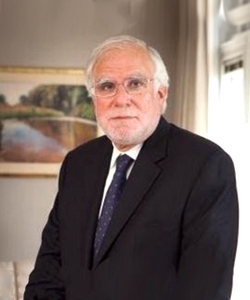
Columbia Law School professor emeritus Richard Stone.
May 26, 2019 update: Manfred Gerstenfeld writes in "The surprising future of American Orthodox Jewry" that not only have the Orthodox increased in number but they are much more "seriously observant." He quotes Richard Stone, a professor at Columbia Law School and a past chairman of the Conference of Presidents of Major American Jewish Organizations:
Most Jews who would have identified as Orthodox [in the 1950s] were not seriously observant. For many, Orthodoxy was more a social than a religious category. ... The vast majority of [their] children, even if they identified as Orthodox, were little different in actual practice from Jews who identified with the liberal denominations.
But then,
The influx of Holocaust refugees greatly strengthened the existing Orthodox infrastructure. Orthodox communities began to grow and to overcome the resistance to Orthodoxy that had prevailed in American-Jewish society. ... By the 1960's, there were critical masses of genuinely Orthodox Jews of many different stripes. ... Another important factor was the growing viability of the State of Israel, which inspired even those Jews who did not yet call themselves Zionists.
As a result,
By the 1970's being Orthodox was in no way an impediment to success in the professions or in the businesses that graduates of excellent secular institutions of higher learning tend to populate. Even more significantly, in the haredi Orthodox communities refugees and children of refugees began to accumulate serious wealth without the traditional educational profile. ... A dramatic result of the wealth accumulated in the haredi Orthodox community is that thousands of Jewish men study in yeshivas on a full-time basis for much longer periods than ever before.
On the other hand, among the non-Orthodox,
Those who seek to retain Jewish identification frequently define their Jewishness as an aspect of liberal political values and ethics. Even to those who accept this type of Jewish identity as legitimate, it seems difficult to project anything but decline in the non-Orthodox Jewish community. Consequently, it seems that Orthodoxy is on a path to dominating American Judaism.
This has many implications:
An Orthodox-dominated American-Jewish community will continue to be prominent in many secular fields of endeavor. On the other hand, Jewish prominence in certain areas, such as entertainment and popular culture, would likely diminish.
As for Israel,
Orthodox Jews have the financial resources, the sophistication and the motivation to play a substantial role in issues that are of genuine interest to them. My guess is that the pro-Israel lobby in America, though it will be Orthodox-dominated, will continue to be very effective.
Nov. 23, 2021 update: Israel's National Economic Council predicts that Haredi Jews will make up 3.8 million of 16 million Israelis in 2050, or nearly 24 percent of Israel's population, a near doubling from today's 12.6 percent.
Jan 3, 2022 update: In a masterful essay, "The Haredi Moment Has Arrived," Eli Spitzer points to the fact that the Haredim have a potential power in Jewish life that is theirs for the taking. But for them to do so means acquiring new skills and for non-Haredi Jews to understand the Haredim better. A few snippets:
The power of ḥaredi Judaism is rising; soon enough, sooner than they think, pan-Jewish organizations everywhere will find themselves caught up in [disputes with the Haredim]. How to resolve them will require a measure of understanding far beyond what liberal Jews—not to mention non-Jews—currently have. And that, in turn, will require a measure of access far beyond what ḥaredi Jews have heretofore offered. ...
The remorseless logic of demography thus conjures up a world where Ḥaredim, already moving from small- to large-minority status, will become pluralities, then bare majorities, and then, finally, the new mainstream. ... practically speaking it doesn't really matter whether Ḥaredim become majorities in 2050, in 2080, or never, because ... the tipping point of ḥaredi influence is already here. ... ḥaredi Jews, while still representing a small minority of Jews in the United States, are already able to mount, when they want to, the equivalent of the activist investor takeovers that happen so often in the business world.
The reason for this is that influence is a function not just of raw numbers but of numbers multiplied by commitment. And when it comes to specifically Jewish issues, it is the Ḥaredim who have all the commitment they need to punch well above their weight. ...
The current situation in which institutions purporting to represent American Jewry—like the Anti-Defamation League, AIPAC, B'nai B'rith, or the Jewish Federations of North America—have zero ḥaredi representation is not only potentially unsustainable in a decades-away future where Ḥaredim represent 20 percent of the Jewish population, it is already unsustainable right now. ... Any major Jewish organization that wants to continue to act for or on behalf of the Jewish people must, starting now, take into account the growing prominence of Ḥaredim or risk increasing irrelevance. ...
For decades, the almost uninterrupted presence in Israeli coalition governments of black-coated ministers has been looked at with bemusement by many Jews across the Atlantic as a sort of freakish outgrowth of the Israeli electoral system. But it is just this model of partial ḥaredi representation that will likely have to be replicated throughout the institutions of diaspora Jewry.
And much more.
June 17, 2022 update: Cathryn J. Prince reports for the Times of Israel: "As Reform and Conservative synagogue memberships decline nationwide, some synagogue boards are reaching out to Orthodox congregations, primarily those affiliated with the Chabad movement."


