[JP title: Insight into Bush's 'promising' Middle East]
Two events earlier this month summed up differing views of George W. Bush's Middle East record.
In one, Bush himself offered a valedictory speech, declaring that "the Middle East in 2008 is a freer, more hopeful, and more promising place than it was in 2001." In the other, an Iraqi journalist, Muntadar al-Zaidi, expressed disrespect and rejection by hurling shoes at Bush as the U.S. president spoke in Baghdad, yelling at him, "This is a farewell kiss! Dog! Dog!"
Ironically, Zaidi's very impudence confirmed Bush's point about greater freedom; would he have dared to throw shoes at Saddam Hussein?
While I like and think well of Bush, I have criticized his response to radical Islam since 2001, his Arab-Israeli policy since 2002, his Iraq policy since 2003, and his democracy policy since 2005. In both 2007 and 2008, I critiqued the shortcomings of his overall Middle East efforts.
Today, I take issue with his claim that the Middle East is more hopeful and more promising than in 2001. Count some of the ways things have degenerated:
- Iran has nearly built nuclear weapons and appears to be planning for a devastating electro-magnetic pulse attack on the United States.
- Pakistan is on its way to becoming a nuclear-armed, Islamist rogue state.
- The price of oil reached an all-time high, only to collapse due to a U.S.-led recession.
- Turkey went from being a stalwart ally to the most anti-American country in the world.
- Iraq remains an albatross (or a pair of shoes?) around the American neck, incurring expenses, fatalities, and with an immense potential for danger.
- Rejection of Israel's existence as a Jewish state has become more widespread and virulent.
- Russia has re-emerged as a hostile force in the region.
- Democracy efforts have collapsed (Egypt), increased Islamist influence (Lebanon), or paved the way for Islamists to attain power (Gaza).
- The doctrine of preemption has been discredited.
Bush's two successes, an Iraq without Saddam Hussein and a Libya without WMD, hardly balance out these failures.
Unsurprisingly, Bush's critics excoriate his Middle East record. Fine, but now that they are almost in the driver's seat; exactly how do they intend to fix America's Middle East policy?
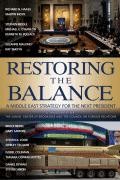 "Restoring the Balance" offers defeatist policy recommendations. |
This reader is struck by two major deficiencies. First, while the book covers six topics (the Arab-Israeli conflict, Iran, Iraq, counterterrorism, nuclear proliferation, and political and economic development), its specialists have almost nothing to say about Islamism, the most pressing ideological challenge of our time, nor about the Iranian nuclear buildup, the most urgent military danger of our time. They also manage to bypass such issues as Turkey, Saudi Arabia, Arab rejectionism of Israel, the Russian danger, and the transfer of wealth to energy-exporting states.
Second, the study offers defeatist policy recommendations. "Bring Hamas into the fold" advise Steven A. Cook and Shibley Telhami, arguing that the terrorist organization be included in a "Palestinian unity government" and be urged to accept the ill-fated Abdullah Plan of 2002. It is hard to imagine a single more counterproductive policy in the Arab-Israeli theater.
On the topic of Iran, Suzanne Maloney and Ray Takeyh dismiss both a U.S. strike against the Iranian nuclear infrastructure and the policy of containment. Instead, in a far-fetched "paradigm change," they urge engagement with Tehran, the acknowledgment of "certain unpalatable realities" (such as growing Iranian power), and crafting "a framework for the regulation" of Iranian influence.
As these examples suggest, a spirit of weakness and appeasement permeates Restoring the Balance. What happened to the promised robust promotion of American interests?
If one hopes the Obama administration will ignore such despairing pablum, one also fears that the Brookings-CFR mindset will dominate the next years. Should that be the case, Bush's record, however inadequate it looks today, would shine in comparison to his successor's.


