
Will Muslim populations in the West succeed in ending the tradition of one law for all, replacing it with the concept of "legal pluralism"? Here and there, official and unofficially, Islamic law, the Shari'a, is making advances. In Italy, for example, hudud punishments have included the cutting of limbs by vigilantes acting on behalf of unofficial qadis. Polygamous marriages are making headway in many countries.Muslim-only enclaves, no-go zones, and Shari'a jurisdiction (see below) are all appearing; they could eventually lead to Muslim autonomous zones, with profound implications for European life and culture.
Survey research has found considerable interest among British Muslims to the Shari'a into Britain. Here are the results of four different surveys in the period 2004-07:
- Back Shari'a courts to settle civil cases among Muslims, so long as penalties do not break the law: 61 percent.
- Support there being areas of Britain which are pre-dominantly Muslim and in which Shari'a Law is introduced: 40 percent.
- Prefer to live under Shari'a law: 30 percent.
- "If I could choose, I would prefer to live in Britain under Shari'a law rather than British law": 28 percent.
This is one of the most profound issues to face Western societies, for applying Shari'a is the ultimate Islamist goal and the surest way to transform the West into Dar al-Islam. I will address the topic here on an occasional basis, in reverse chronological order.
Theresa May orders review of Sharia courts: Concerns over Sharia courts operating a parallel system of justice, in particular one that discriminates against women, has prompted 150 women's organizations to urge the government to ban these courts and prompted Prime Minister May to order a look at them. (December 21 2015)
The first American Shar'i court? An "Islamic Tribunal" has opened its doors in Dallas, Texas, with four "judges": Imam Yusuf Z. Kavakci, Imam Moujahed Bakhach, Imam Zia ul Haque Sheikh, and Dr. Taher El-badawi. Its homepage states:
Similar religious tribunals have existed for decades in the American Jewish and American Christian faith communities to resolve disputes, most especially within families. These religious tribunals are optional arbitration vehicles that only conduct their work when requested to do so by both parties involved in a dispute, do not attempt to impose any belief system upon any individual and work in compliance with State of Texas and US law under the United States Constitution.
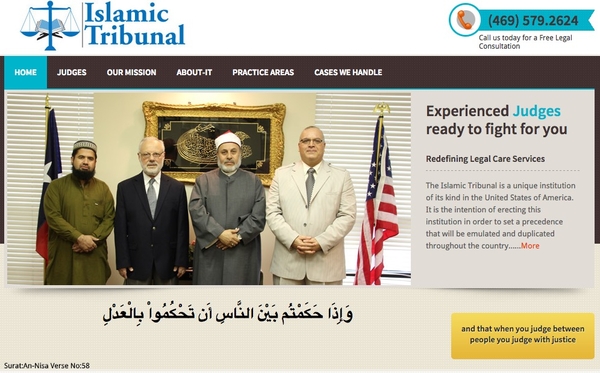 The homepage of the Dallas Islamic Tribune's website. |
(March 5, 2015)
Shari'a Police in German town: Soeren Kern reviews the emergence of a Salafi pseudo-police force in Wuppertal, a city in North Rhine-Westphalia, the state with the largest Muslim population in Germany, and how the authorities are talking tough but not doing anything. (September 8, 2014)
Attempt to cut off a hand in Philadelphia: Merv Mitchell, 37, said to be the amir of Masjid Ar-Razaqq Ul-Karim, a mosque in west Philadelphia, was arrested and charged with aggravated assault, criminal conspiracy, and related offenses for assaulting a mosque member. The Philadelphia Inquirer tells the story:
The attack happened after a prayer service Monday morning[, July 14]. Mitchell, also known as Mabul Shoatz, accused the 46-year-old mosque member of [stealing money from prayer jars]. The accused immediately denied it, but to no avail. Mitchell and the mosque's imam carried the accused down a flight of stairs to the backyard of the mosque, a converted house, where Mitchell also lives, [Lt. John] Walker said.
Merv Mitchell (aka Mabul Shoatz), accused of vigilante Islamic justice.
They put the victim's wrist on a log, and Mitchell "swung at his wrist, cut through his skin, and cut his tendons, but didn't make it all the way" because the blade was dull, Walker said. The victim was treated at Mercy Philadelphia Hospital and will require reconstructive surgery. ... Police found the machete during the search. Walker said police would obtain an arrest warrant for the imam, a 35-year-old man whose name was not released.
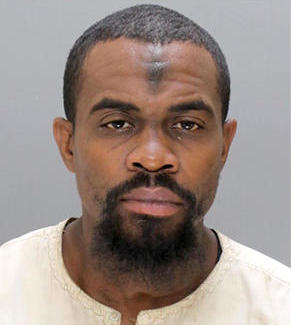
A little internet research suggests the imam's name is Muta Ali.
Comment: The city of burqa robberies now can boast a do-it-yourself example of huddud justice. In other words, why even bother with a Shar'i court when you can carry out vigilante Islamic justice? (July 19, 2014)
British wills: The Law Society, a British organization that represents itself as "here to help, protect and promote solicitors across England and Wales," issued instructions today on "Sharia succession rules," in other words, how to write a Shar'i compliant will. It contains such charming passages as this:
Certain principles of Sharia are different to English succession laws. For example, it is not possible to inherit under Sharia rules via a deceased relative. No distinction is made between children of different marriages, but illegitimate and adopted children are not Sharia heirs. The male heirs in most cases receive double the amount inherited by a female heir of the same class. Non-Muslims may not inherit at all, and only Muslim marriages are recognised.
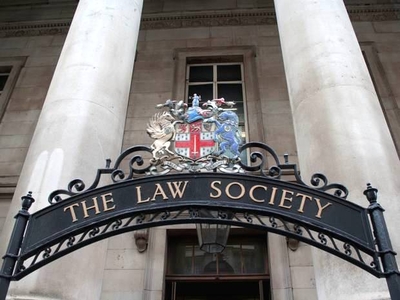
(March 13, 2014)
Mar. 23, 2014 update: The Law Society's document has provoked considerable controversy, reports the Independent:
Islamic law is to be effectively enshrined in the British legal system for the first time under guidelines for solicitors on drawing up "Sharia compliant" wills. ... Nicholas Fluck, president of The Law Society told the newspaper that the document, which would be recognised by Britain's courts, would promote "good practice" in applying Islamic principles in the British legal system.
But some lawyers have described the recommendations as "astonishing" and campaigners have warned that the move marks a step towards a "parallel legal system" for Britain's Muslim communities. Baroness Cox, a cross-bench peer leading a Parliamentary campaign to protect women from discrimination authorised on the basis of religion, including from unofficial Sharia courts in Britain, told the Sunday Telegraph it was a "deeply disturbing" development. ...
Keith Porteous Wood, executive director of the National Secular Society, told the Sunday Telegraph: "This guidance marks a further stage in the British legal establishment's undermining of democratically determined human rights-compliant law in favour of religious law from another era and another culture. British equality law is more comprehensive in scope and remedies than any elsewhere in the world. Instead of protecting it, The Law Society seems determined to sacrifice the progress made in the last 500 years."
Nov. 24, 2014 update: The Law Society has reversed itself and withdrawn the guidelines for "Sharia compliant" wills in response to complaints that doing so encourages discrimination against women and non-Muslims. Andrew Caplen, the society's president apologized: "Our practice note was intended to support members to better serve their clients as far as is allowed by the law of England and Wales. We reviewed the note in the light of criticism. We have withdrawn the note and we are sorry."
Nation of Islam wants own courts: Louis Farrakhan of the Nation of Islam demanded in the course of his keynote speech at the Saviours' Day convention that African-Americans should have their own court system, implying it would be an Islamic system. "Our people can't take much more. We have to have our own courts. You failed us." He advised looking for guidance to the Koran and Bible to set up the new courts.
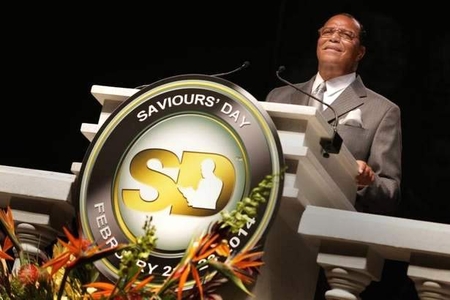 Louis Farrakhan at the Nation of Islam's annual gathering. |
(February 24, 2014)
The misogyny of British Shar'i courts exposed: Soeren Kern provides a useful summary of a BBC documentary, "Secrets of Britain's Sharia Courts," filmed clandestinely at several of the UK's 85 Shar'i courts, exposing the discrimination against women at these informal courts. Shown on BBC Panorama on April 8,
The undercover investigation proves what has long been suspected: namely, that Sharia courts, which operate in mosques and houses across Britain, routinely issue rulings on domestic and marital issues according to Islamic Sharia law that are at odds with British law. Although Sharia rulings are not legally binding, those subject to the rulings often feel obliged to obey them as a matter of religious belief, or because of pressure from family and community members to do so. The documentary contends that the Sharia courts ... are putting women at risk of violence from abusive husbands by pressuring them to stay in abusive marriages.
Kern then provides outrageous examples of decisions taken by the Islamic Sharia Council in Leyton and the Sharia Council of Dewsbury.
He also notes that Baroness Cox presented the Arbitration and Mediation Services (Equality) Bill in October 2012 in the House of Lords that would (1) limit the activities of Shar'i courts, (2) require them to uphold laws concerning women's rights and (3) make it a criminal offense (punishable by five years in prison) falsely to claim or imply that Shar'i courts have legal standing. (April 23, 2013)
Overview of Shar'i courts in Germany: Maximilian Popp writes for Der Spiegel about the dispensation of Islamic justice in Germany, starting with an important anecdote:
The men ambushed Fuat S. on the street, then locked him in a basement and tortured him. Fuat was later admitted to the hospital in Berlin's Neukölln district with gaping wounds, contusions and broken bones. Police took his statement concerning the attack the same night. Fuat S., a gambler and a recipient of "Hartz IV"—Germany's social welfare benefits for the long-term unemployed—gave a detailed statement. He'd conned an acquaintance, Mustafa O., out of €150,000 ($217,000) and the man was taking his revenge, Fuat said, together with his three brothers. They hit his hands, arms and knees with a hammer and threatened to shoot him.
The public prosecutor's office in Berlin initiated proceedings against Mustafa O., a Palestinian man who had come to their attention repeatedly for violent acts. Police had investigated him in a number of cases, and now prosecutors saw an opportunity to convict a dangerous repeat offender. But when the case began, Fuat S., the principle witness, unexpectedly withdrew his testimony. It was not Mustafa who had tortured him, he said, but an Albanian man he didn't know. Mustafa, he said, wasn't even in the basement at the time. This was clearly a lie, as police analysis of telephone data showed, but the judge was forced to acquit the defendant due to lack of evidence.
The decision, in fact, was reached by a different judge. According to police, the victim's and the perpetrator's families had met at a restaurant in the presence of an Islamic "justice of the peace," an arbitrator who mediates conflicts between Muslims. The two families had reached a compromise: Fuat would drop the charges, and in exchange be relieved of part of his debt. According to Bernhard Mix, the public prosecutor in charge of the case, Fuat's false testimony was part of a deal between the families. "It's difficult to establish the truth using legal means, when the perpetrator and the victim reach an agreement," he says.
This and other information comes from a new book on the topic:
Joachim Wagner, an author and television journalist of many years, has taken a closer look at the phenomenon in his book Richter ohne Gesetz ("Judges without Laws"). Reconstructing Mustafa O.'s case, he reaches the conclusion that "the Islamic parallel justice system is becoming a threat to the constitutional legal system."
Wagner stresses the informality of the system:
These justices of the peace don't wear robes. Their courtrooms are mosques or teahouses. They draw their authority not from the law, but from their standing within the community. Most of them are senior members of their families, or imams, and some even fly in from Turkey or Lebanon to resolve disputes. Muslims seek them out when families argue, when daughters take up with nonbelievers or when clans clash. They often trust these arbitrators more than they trust the state.
State staff worry about the implications:
The late juvenile court judge Kirsten Heisig drew attention to this problem a year ago: "The law is slipping out of our hands. It's moving to the streets, or into a parallel system where an imam or another representative of the Koran determines what must be done."
In Wagner's book, judges and prosecutors tell of threats toward public officials and systematic interference with witnesses. "We know we're being given a performance, but the courts are powerless," says Stephan Kuperion, a juvenile court judge in Berlin. Federal public prosecutor Jörn Hauschild warns, "It would be a terrible development if serious criminal offences in these circles could no longer be resolved. The legal system would be reduced to collecting victims."
We learn about one of these arbiters:
Hassan Allouche sits behind the wheel of his station wagon, steering the vehicle through Berlin's rush hour traffic with one hand, talking on his cell phone. Two Arabs have called on him for help in a rent dispute. He lights a cigarette and says, "People are afraid of the authorities. They trust me." Allouche came to Germany from Lebanon 37 years ago. He acts as a religious arbitrator, just as his great-grandfather did before him. People greet him on the streets of Berlin, shaking his hand or bowing. "He's kept us from a great deal of harm," one Turkish businessman says.
Allouche's brother was shot while trying to resolve a conflict, and since then he always wears a bulletproof vest when doing his work. He says he mediates 200 cases a year, often offers his own services and doesn't ask any payment, although he accepts gifts. "I do this for Germany and for Allah," he says.
The arbiters
operate in a gray area between conflict resolution and obstruction of justice. Allouche, for example, claims to work closely with authorities, but investigators suspect him of preventing witnesses from giving statements to the police. So far they've never been able to prove an obstruction of justice.
Although "Investigators do cooperate with Islamic arbitrators in a few exceptional cases," the problem remains:
If these arbitrators would limit themselves to containing conflicts, there would be no reason to object, says legal and Islamic studies expert Mathias Rohe in the Bavarian city of Erlangen. German law, after all, allows for arbitration. What Rohe finds unacceptable is the exertion of influence over criminal proceedings. "Criminal prosecution is a privilege of the state," he says.
Looking ahead, the problem is likely to continue:
Legal steps alone can't prevent a parallel Islamic justice system, not with so many immigrants from Muslim countries who insist on following values retained for centuries—such as the primacy of men and the unconditional struggle for one's own honor and that of the family. One problem is that they pass on these clichés to their children, so even third-generation members of immigrant families mistrust the German legal system.
"We need to promote our constitutional legal state starting in school," says Rohe, the Islamic studies expert. If German integration were in better shape, he believes, Islamic arbitrators would have been out of work long ago.
(September 1, 2011)
Overview of Shar'i courts in the U.K.: Jonathan Wynne-Jones reports for the Sunday Telegraph on the workings of a Shar'i court in Birmingham, England:
The council meets once a month at the Birmingham Central Mosque. Many of the cases relate to divorce and involve the husbands and wives entering the room separately to make their appeals. ...
While a husband is not required to go through official channels to gain a divorce – being able to achieve this merely by uttering the word "talaq" – Islamic law requires that the wife must persuade the judges to grant her a dissolution. ...
While these courts may be the cornerstone of many of Britain's Pakistani and Bangladeshi communities, there are growing concerns that they are creating a parallel legal system – and one that is developing completely unchecked.
He then reports on efforts at push back:
In an attempt to counter the proliferation of these courts, a Bill has been tabled in the House of Lords by Baroness Cox calling for Sharia courts to be outlawed where they conflict with the British legal system. ... "My Bill seeks to stop parallel legal, or quasi-legal, systems taking root in our nation," she says. "There is widespread concern that some tribunals applying Sharia are going well beyond their legal remit, and some rulings are being misrepresented as having the force of UK law. Cases of criminal law and family law are matters reserved for the English courts alone. I hope the Bill gets through, as I believe it is vital for securing the rights of women in this country. ... Muslim women who have a poor grasp of English or are unaware of their legal rights are likely to believe whatever their Sharia court tells them." ...
"Sharia courts are utterly opposed to equal rights and they discriminate against women," says Jim Fitzpatrick, the Labour MP for Poplar and Canning Town, an area with a population now dominated by Bangladeshi Muslims. Fitzpatrick recently chaired a debate in the House of Commons on Sharia. "I'm concerned that they are creating a cultural stranglehold over their communities and leading to the Islamification of our society," he says.
Court advocates have great ambitions:
campaigners hope to see all Sharia courts outlawed from this country. Although the courts currently have no jurisdiction in Britain, the Islamic Sharia Council makes clear that its ultimate goal is to have their laws recognised. It says on its website: "Though the Council is not yet legally recognised by the authorities in the UK, the fact that it is already established, and is gradually gaining ground among the Muslim community... are all preparatory steps towards the final goal of gaining the confidence of the host community in the soundness of the Islamic legal system."
Certain decisions made under Sharia are already enforceable in British courts through the 1996 Arbitration Act, which allows any form of agreement as long as both parties concur on the terms at the outset. This legal standing does not apply to the informal Sharia councils – but does apply to the Muslim arbitration tribunals that rule on commercial and civil disputes, a fact that is raising fears that they could begin to supplant the British court system. Set up in 2007 by Sheikh Faiz Siddiqi, a qualified commercial barrister, there are now seven Muslim arbitration tribunals across the country.
They have, surprisingly, found a non-Muslim clientele:
They are becoming popular with non-Muslims, too – who, Siddiqi claims, have made up around 15 per cent of their cases so far this year, compared to five per cent in 2009. "People see that they're efficient, cheap and informal and we get to a decision in a much more stress-free manner." In 2009, a non-Muslim took his Muslim business partner to a tribunal, arguing that they had an oral agreement over the profits in their car company. He was awarded £48,000 after the tribunal ruled that the Muslim partner had acted in a way that suggested a deal had been struck.
Earlier this year, another non-Muslim also found success by taking a dispute to the tribunal. He had been thrown out of his flat by his Muslim landlord after being accused of breaching the terms of his lease. The tribunal ruled that he had been treated unfairly and should be allowed to return to his property.
Sheikh Siddiqi says non-Muslims are using the tribunal system because they appreciate the weight that rulings under Sharia law carry in the Islamic world. "People are finding that the negative images evoked in the past about Sharia law being draconian are not accurate," he says. "Instead they're seeing that our tribunals are a cheaper and quicker method of resolving disagreement, and they're coming away with rulings that are fair."
(August 11, 2011)
Plea in Australia: Somali Community of Victoria president Abdurahman Osman is calling for Shar'i courts on the model of Koori courts as an alternative for Aboriginal offenders. (December 2, 2011)
Inquiry into British Shar'i law courts closed down: Score one for the Islamists in the United Kingdom. Steve Doughty and Neil Sears write in the Daily Mail that the Ministry of Justice closed down a probe into the shadowy courts when those courts refused to cooperate, leading to exectations that their influence will continue to grow.
The failure of the Government's investigation was disclosed to MPs by Justice Minister Jonathan Djanogly. He told Tory backbencher Kris Hopkins that before last year's general election his department acted to "commission an exploratory study of Sharia councils in England with respect to family law." Mr Djanogly said: "This identified a number of challenges to undertaking robust research in this area. The study was therefore limited and adds little to the evidence base. The findings cannot be regarded as a representative assessment of the operation of Sharia councils. Following expert peer review of the draft report, the Ministry of Justice decided not to publish the findings."
A further statement to the Mail made it clear the "challenges" researchers experienced boiled down to the Sharia courts failing to co-operate. The Ministry of Justice said: "The report was essentially an exploratory study which identified a number of challenges to undertaking more robust research. The challenges to undertaking more robust research were that the councils are generally run on a volunteer basis, were short staffed and very busy, so there were practical difficulties in speaking with respondents. There was also reluctance to discuss the private work of the councils and respondents were wary of the stereotypical ways in which their organisations were represented in the media."
(July 29, 2011)
Shari'a in a district of London: An anonymous "Daily Mail Reporter" offers examples of "Talibanesque thugs" (the term is Ghaffar Hussain's of the Quilliam Foundation) enforcing Islamic law in Tower Hamlets:
- "Stickers have been plastered on public walls stating: 'Gay free zone. Verily Allah is severe in punishment'."
- "Posters for H&M which feature women in bikinis and a racy poster for a Bollywood film have been defaced."
- "An Asian woman who works in a pharmacy in east London was told to dress more modestly and wear a veil or the shop would be boycotted. When she went to the media to talk about the abuse she suffered, a man later entered the pharmacy and told her: 'If you keep doing these things, we are going to kill you'. The 31-year-old, who is not a practising Muslim, said she has since been told to take holiday by the pharmacy owners and now fears she may lose her job. She said: 'Why should I wear a hijab or burqa? I haven't done anything wrong'."
- "Before Christmas posters appeared in the borough claiming the religious festival was 'evil'. The campaign's organiser was 27-year-old Abu Rumaysah, who once called for sharia law in Britain at a press conference held by hate preacher leader Anjem Choudary, the leader of banned militant group Islam4UK. Mr Rumaysah said: 'Christmas is a lie and as Muslims it is our duty to attack it. But our main attack is on the fruits of Christmas, things like alcohol abuse and promiscuity that increase during Christmas and all the other evils these lead to such as abortion, domestic violence and crime. We hope that out campaign will make people realise that Islam is the only way to avoid this and convert'."
(April 18, 2011)
Mohamadu Nawas.
Melbourne law firm adds adviser on Shari'a: Logie-Smith Lanyon, self described as a "mid-sized full service commercial law firm" has hired Mohamadu Nawas, a member of the Australian National Council of Imams as a consultant on Islamic law. According to an article by Barney Zwartz in the Age, Nawas "will work particularly on commercial contracts and disputes between Muslims, plus separation agreements, divorces, wills and pre-nuptial agreements." It will not involve criminal law. He insists his advice will be fully compatible with Australian law. "In other countries, sharia courts deal with these issues, but here we don't have this, so we are trying to promote sharia-compliance in advance." Nawas studied Islamic law in Sri Lanka and Malaysia. (May 10, 2010)
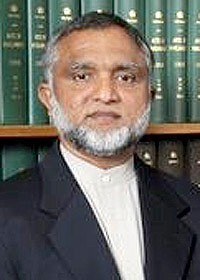
Louisiana says no to Shari'a: Without much notice, the Louisiana legislature took a landmark step vis-à-vis Shari'a. Rep. Ernest Wooton, a Republican, introduced legislation that, according to James Gill of the New Orleans Times-Picayune, "provides that no foreign law shall be applied here if it violates a right guaranteed by the American Constitution. ... The Louisiana Supreme Court has so far insisted that cases in America are settled according to American law, but the committee figured it was wise to commit future jurists to that sound principle. At least the bill does no harm." (April 28, 2010)
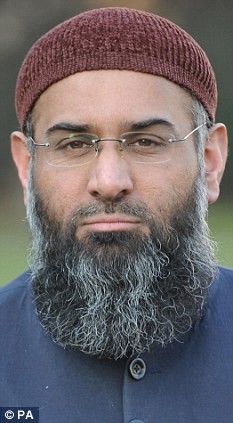 Anjem Choudary claims to have officiated at more than 1,800 off-the-books marriages. |
Shar'i court in Finland: A report in the Helsingin Sanomat, "Islamilaista oikeutta Helsingissä" (Islamic Justice in Helsinki) reports the advance of Shar'i courts in another European country. Excerpts, as translated by Kenneth Sikorski at Tundra Tabloid:
Friday afternoon Imam Abdirazak Sugulle Mohamed sighs in the rear room of the Helsinki Islamic Center. There are so many things to take care of. Sugulle tends the largest Muslim society in Finland. It includes nearly 1,600 members, most of whom are Somalis. ...
Helsinki Islamic Center manages a permanent arbitration panel, which includes Sugulle, a second imam and three other older community members, with a good knowledge of Islam. If necessary, they are asking for advice on religious issues familiar abroad. Mediation usually works like this: Either party to the conflict contacts the mosque, and he's invited to tell his own side of the story. Then the other party is invited to speak. When both have been consulted, they are called, together with the front panel, if necessary, many times."Sometimes mediation can take weeks, months."
Sugulle estimates that the mediators will meet an average of two times per week. In addition, issues are settled by the telephone. The don't get paid."This is done because of Allah, is part of the religious obligations." The panel mostly arbitrates between spouses. ... Sometimes the issues is relating to parent and child or between the financial conflicts."Who has the right to receive what, or who should pay for something."
Certain persons mediate in the community, but the plan is for a permanent four-person panel.Acting as an arbitrator, Mahammed Hussein, describes the process thus: "We report on what the Koran and the prophet will say what is right and what wrong, what is forbidden and what is ok. People know that if you do evil, it becomes a ruling of the Court." ... Mediators settle mostly cases in which Finnish law does not take a position.
(August 3, 2009)
A special UK police force for Muslims? Today Shar'i courts, tomorrow a separate police force. According to London's Daily Express, Muslim victims may be able to request their cases investigated by police from their own religion, particularly in cases of "honor killings," forced marriages, and other culturally sensitive matters.
In fact, in London, Sikh victims already have the right to ask for a Sikh officer to be involved in an investigation. As Palbinder Singh, chairman of the Metropolitan Police Sikh Association, explains: "I don't believe a white officer is ever going to be fully conversant with a Sikh." Chief Superintendant Joanna Young of the Metropolitan Police Criminal Justice Policy Unit, hopes this pattern will expand. Metropolitan Police Federation chairman Peter Smyth hopes not: "We're stretched thin enough already. Are Sikh officers going to have their rotas changed so there's always one on duty? It's political correctness gone mad. We talking about the creation of a separate force within a force." (July 23, 2009)
Non-Muslims use Shar'i courts: According to the UK's Muslim Arbitration Tribunal, 5 per cent of its cases, and at least 20 cases so far in 2009 involve non-Muslims who turn to Shar'i courts due to their less cumbersome and more informal ways. To which, Denis MacEoin remarked that this claim "raises all sorts of questions." Comment: And I say that I do not believe this statistic until it's been proven. (July 21, 2009)
85 Shar'i courts in the United Kingdom: According to a study released today, Sharia Law or "One Law For All"? by my colleague Denis MacEoin, with foreword by Neil Addison and published by Civitas, Britain hosts at least 85 Shar'i courts, most of them operating out of mosques. That makes 17 times more than the 5 such courts previously known of. (June 29 2009)
Muslim Arbitration Tribunal, UK: The Sunday Mercury's Jeannette Oldham reports that scholars and lawyers at Hijaz College Islamic University in Nuneaton, Warwickshire, near Birmingham, have set up what it terms "the UK's first official sharia law court." Called the Muslim Arbitration Tribunal, it has already applied the Shari'a, reports Oldham, "to decide the outcome of more than 100 civil disputes between Muslims across the UK since it opened its doors" in December 2007, meaning an annual rate of about 150 cases. Some particulars:
Cases already heard in Nuneaton include an inheritance dispute between three sisters and their two brothers, a divorce and a neighbour dispute. In the inheritance case the men were given double their sisters' inheritance. The divorce hearing ruled that a Somalian woman should be granted an Islamic khula (annulment) despite her husband's strong objections. And in the neighbourhood dispute the tribunal ruled that the losing party – a group of young Muslim graduates – should teach the winning party, who had young children. ... The court also has the power to order parties taking part to pay compensation to the winning party. The most it has handed out in a single case is £500,000, and the least £50. No criminal matters can be considered by sharia arbitrators and no corporal punishment can be imposed.
What makes the MAT different from unofficial sharia courts which exist all over the United Kingdom? That it has binding legal status: "Its proceedings," explains the Sunday Mercury, "are operating in tandem with the British legal system, and decisions challenged by the losing party will be upheld by a county court bailiff or high court sheriff." While the tribunal cannot force itself on anyone, once the parties agree to give it jurisdiction, English law binds them to abide by the court's decision. Divorce cases are the only exception to this rule, for the MAT may grant a Muslim woman an annulment regardless of a husband's wishes – so she can marry again. (September 7, 2008))
Sep. 14, 2008 update: Abul Taher of The Sunday Times (London) adds some additional information about the Muslim Arbitration Tribunal:
It is not a single court but a network of five Shar'i courts headquartered in Nuneaton with branches in London, Birmingham, Bradford and Manchester. Two more courts in Glasgow and Edinburgh are on the way.
They are classified as arbitration tribunals under a clause of the Arbitration Act 1996.
The courts began doing business in August 2007.
Working with the police, the tribunals have settled six cases of domestic violence between married couples.
They expect to deal with "smaller" criminal cases. .
"There are concerns that women who agree to go to tribunal courts are getting worse deals because Islamic law favours men. [The initiator of these courts, Faiz-ul-Aqtab] Siddiqi said that in a recent inheritance dispute handled by the court in Nuneaton, the estate of a Midlands man was divided between three daughters and two sons. The judges on the panel gave the sons twice as much as the daughters, in accordance with sharia. Had the family gone to a normal British court, the daughters would have got equal amounts. In the six cases of domestic violence, Siddiqi said the judges ordered the husbands to take anger management classes and mentoring from community elders. There was no further punishment. In each case, the women subsequently withdrew the complaints they had lodged with the police and the police stopped their investigations."
Dominic Grieve, the shadow home secretary, responded to this news with a statement: "If it is true that these tribunals are passing binding decisions in the areas of family and criminal law, I would like to know which courts are enforcing them because I would consider such action unlawful. British law is absolute and must remain so."
Inayat Bunglawala, assistant secretary-general of the Muslim Council of Britain, endorsed the move: "The MCB supports these tribunals. If the Jewish courts are allowed to flourish, so must the sharia ones."
The UK's Lord Chief Justice Lord Phillips.
Muslim leader calls for application of Shari'a in UK: Sarfraz Sarwar, 60, leader of the Basildon Islamic Centre, in Laindon, before it was burnt down in 2006, wants Shari'a, including public floggings in town centers, to be introduced in Britain. "If anybody is caught with a knife then give them ten lashes in the town centre. Sharia law is not controversial. It's a deterrent. Muslim countries don't have half the problems we have because Sharia law is there." (July 7, 2008)
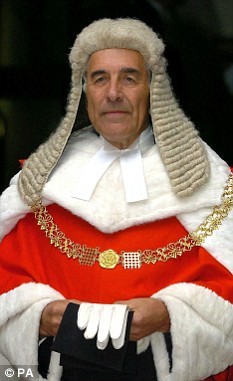
UK's most senior judge endorses Shari'a: Lord Chief Justice Lord Phillips, speaking at an East London mosque yesterday blessed Shari'a law for use among Muslims. Islamic legal principles, he said, could help deal with family issues and to regulate finance. (July 4, 2008)
Overview of British Shar'i Courts: Kim Murphy offers a sympathetic view of the UK's budding alternative legal structure today in "Islamic law plays a role in British legal system."
For British Muslims, many of whom have one foot in Piccadilly Circus and the other in Pakistan, Bangladesh or Somalia, the British legal system is available, as it is to all. But it is singularly impotent when it comes to civil issues such as marriage, divorce and other disputes whose dispensation in heaven is often perceived as more crucial than any ruling that might be handed down by an English judge in a horsehair wig. ... Sharia is quietly being applied every day in Britain, via Sharia councils that dispense Islamic civil justice in more than half a dozen mosques across the country.
The councils do not involve themselves in criminal law or any aspects of civil law in which they would be in direct conflict with British civil codes. The vast majority of their cases cover marriage and divorce. By consent of all parties, they may also arbitrate issues of property, child custody, housing and employment disputes, though their rulings are not binding unless submitted to the civilian courts.
According to Mohammed Siddique, described as a paralegal who advises the Sharia council in Dewsbury, in northern England, on the technicalities of British law, all is well: "It is known that English judges are willing to accept agreements like this that are reached in Sharia courts, as long as it has been put into proper form. It saves time and hassle for the court, and it shows that both parties are willing to compromise and reach some sort of agreement." Indeed, Murphy continues, "Government officials have raised no objections to the councils, which first emerged in 1982 in Birmingham, because they operate in cooperation with British civil law, and British courts still issue all necessary legal decrees."
Better yet, explains Suhaib Hasan, a judge on a North London Sharia council, the Sharia courts offer divorces that are cheaper and quicker than those available in the British courts. Further, courts like the one in Dewsbury offer services in Arabic, Gujarati, Urdu, and English. (June 20, 2008)
The Archbiship of Canterbury endorses Shari'a: I explain the statement and reactions to it in an article, "Britain's Encounter with Islamic Law." (Feb. 13, 2008)
The Sharee Council of Dewsbury, West Yorkshire: Paul Jeeves provides detailed information on one particular Shar'i court at "Now Muslims Get Their Own Laws in Britain," in the Daily Express today. Dewsbury's Sharee Council, he writes,
operates as a Muslim judiciary making decisions by which attendees must abide. ... Non-Muslims are excluded from the secretive court which is registered as a charity to receive British tax benefits. Although the court has no official legal standing, scales of justice adorn a sign outside a former pub building which has been converted by the Islamic Institute of Great Britain. ... The Madrasa – which is a former pub situated less than a mile from the one-time home of London bombing mastermind Khan – sits as a court every other weekend and hears up to 10 cases a day.
Four Muslim scholars, who have spent their life studying and preaching the Koran, sit in judgment on an array of cases alongside a Muslim solicitor whose role is to advise on the implications of their rulings in British law. The operation is headed by prominent scholar Sheikh Yaqub Munshi. Accounts for the Dewsbury court's parent company the Islamic Research Institute of Great Britain, show that it was registered in Dewsbury as a charity in 1996 with the ethos of promoting the advancement of Islamic religion and education in the United Kingdom. Charitable status allows the organisation to claim tax relief and apply for government grants and trustee funding. Between April 1999 and April 2004 its gross annual turnover rocketed from £2,500 to above £177,000. At the end of the last financial year it recorded total funds of £255,000 but it is not known if or how it charges for use of the service.
At the moment, the leaders insist they only deal with civil matters such as Muslim divorces, wedding dowries and asset sharing. But the secretive Muslim-only nature of the dealings will provoke fears that radical Sharia law could be allowed to spread across the Muslim population. The source said: "These courts take the law into their own hands and dish out punishment for bad behaviour. "I have not heard of physical punishments being used but those in the wrong are often ordered to pay compensation. Many who have no respect for British law are the most stringent observers of Sharia law."
Sheikh Yaqub admitted that introducing Sharia law into the UK has been his goal since moving to Britain from Pakistan in the 1960s. But he insisted its main aim is to help repressed women who are trapped in bad or violent marriages and who dare not use British law. He said: "Ever since I arrived here in the 1960s there has been a case of women being forced to get married, others forced to get married, but unhappy afterwards. Until now there was no organisation which could Islamically solve their problems." ... After the Sharia court has ruled in judgment, solicitors process matters officially through UK courts on their clients' behalf.
(April 30,2007)
German judge cites Koran: The husband beat his wife and even threatened to murder her. But because both are Muslims, Christa Datz-Winter, a German divorce court judge referred to the passage in the Koran that permits a husband to beat his wife."The exercise of the right to castigate does not fulfill the hardship criteria as defined by Paragraph 1565 [of German federal law]," the judge wrote; "to castigate" here is a euphemism for to beat. (March 21, 2007)
Yale Law School dean okays Shari'a: Harold Hongjiu Koh suggested in a speech that the Shari'a, among other foreign laws, could in certain circumstances be applied in the United States. A listener in the audience at the Yale Club of Greenwich summarized his remarks this way: "In your discussion of "global law" I recall at least one favorable reference to "Sharia", among other foreign laws that could, in an appropriate instance (according to you) govern a controversy in a federal or state court in the US." (March 21, 2007)
German scholar agreeable to Shari'a: Tehran's official Islamic Republic News Agency quotes Matthias Rohe, an expert on Islamic law as well as a judge at the court of appeals in Nuremberg, Germany, saying that parts of the Shari'a are quite applicable in Europe, for example those concerning prayer, fasting, and the building of mosques. He also gave the example of the mahr (brideprice) marriage law which would be acceptable under German family law. Muslims already live under Shari'a personal law, he noted, in two places in Europe – Bulgaria and the Greek province of Thrace.
We would accept that in other countries there are other set of rules which to some extent would contradict our ideas and our rules. ... But to a certain extent we are ready to accept these kind of differences and would apply the norms. When people cross the border, when they come to us we wouldn't destroy their family structures even if we wouldn't agree to this model because people are already relying on it.
(February 25, 2007)
Shar'i courts booming in the UK: Agence France-Presse reports that Muslims in increasing numbers are turning to about a dozen Islamic courts in the UK, mostly to resolve family disputes. The largest of them, the Islamic Sharia Council in Leyton, east London which, since its creation in 1982 has handled 7,000 divorce cases. As one of its founders, Mufti Barkatullah, explains, "We act as a religious court, which means deciding about their dispute and giving them written determination, based on Sharia, Islamic principles and jurisprudence." What is the relationship between this and the British laws? Barkatullah replies: "People who live in the United Kingdom undertake and abide by the law of the land, but they regard those laws as administrative law, not a divine law. The matters of marriage and divorce don't fall into the state domain. It is a religious matter." Even if a couple has registered a civil marriage or divorce, "their perception is that their religious duties and their religious relationships are not finalized."
Barkatullah suggests that the future belongs to his court, rather than the country's official system. "If the government doesn't take the political way, then the consumer will have the choice. If more and more people come to us rather than to a British court, we'll know their choice. That's what is happening." (February 17, 2008) Feb. 24, 2008 update: The Independent reports that the Leyton court has never heard a criminal case, plus that it has Charity Commission status.
Helping a wife divorce in Canada: Here's another argument in favor of adopting Islamic law, this one concerning a Lebanese family from Canada, as presented by Dene Moore of The Canadian Press, with names withheld. A Muslim man, 31, pleaded guilty to two counts of aggravated assault to avoid attempted murder charges. He stabbed his wife in the face and their infant daughter in the stomach in their Montreal apartment in February 2006. The Crown wants his refusal to grant his wife a Shari'a divorce to be considered an aggravating factor, this as a way to pressure him to divorce her. He testified that he will not divorce her in Canada: "The issue of the divorce will be decided over there," he told the judge, meaning Lebanon.
So, if only there were Shari'a in Canada, things would be fine.
That, say advocates, is the problem with the refusal to recognize Shariah law in the Canadian judicial system. Observant Muslim women, especially those who emigrated from Islamic countries, feel they have nowhere to turn, said Shahina Siddiqui, executive director of the Winnipeg-based Islamic Social Services Association. "Many, many times we see this," Siddiqui said. ... The woman earlier told the court she would like to return to her family in Lebanon but without the religious divorce and worries she could be forced to return to her husband or face charges of abducting her own daughter. "They had a religious marriage in Lebanon and if she returns she could have problems," Crown lawyer Sophie Lavergne told the judge.
(January 25, 2007)
Parallel Somali law courts in the UK: The BBC Radio 4 program "Law in Action" has raised the issue with the account of Aydarus Yusuf, 29, a Somali-born youth worker resident in the UK for 15 years. He says he is bound more by Somali law than its British counterpart. "Us Somalis, wherever we are in the world, we have our own law. It's not sharia, it's not religious — it's just a cultural thing." To help others of Somali origin retain this sensibility, he helps convene a gar, or unofficial Somali "court," in Woolwich, south-east London. Unlike its Jewish equivalent, the Beth Din, which deals only with civil matters, this court also deals with criminal ones.
For example, it considered the case of several young men arrested on suspicion of stabbing a fellow Somali teenager. The victim's family said the issue would be settled out of court, so the police released the suspects on bail. "When the suspects were released on bail by the police, we got the witnesses and families together for a hearing," says Aydarus. At the hearing, the elders ordered the assailants to compensate their victim. "All their uncles and their fathers were there. The accused men admitted their guilt and apologised. Their fathers and uncles agreed compensation." Scotland Yard admitted to ignorance about this case. A spokesman noted the police commonly do not proceed with assault cases when a victim decides not to press charges. In other cases, such as rape or murder, the victim's wishes count for less.
English law, it bears noting, permits resolution of disputes not based on English law, so long as both parties agree to the process and the decision is reasonable. At that point, it is enforceable by English law.
Some academics welcome "legal pluralism." Prakash Shah, of London's Queen Mary University, argues that "Tribunals like the Somali court could be more effective than the formal legal system in maintaining social harmony." In contrast, former judge Gerald Butler QC insists that "What they mustn't do – and this must never happen – is to stray into the field of criminal matters. That simply would never be acceptable." Islamic scholars also offer an alternate approach: adapting secular courts to apply Shari'a in such areas as family law and inheritance. Mohammed Shahid Raza notes the precedent: "When Britain was ruling India, there was a separate legal code for Muslims, organised and regulated by British experts of law."
Faizul Aqtab Siddiqi, a barrister and principal of Hijaz College Islamic University, predicts that there will be a formal network of Muslim courts within the decade. Patrick Sookhdeo, director of the Institute for the Study of Islam and Christianity, writes in Islam in Britain: The British Muslim Community in February 2005 that there already exists an "alternative parallel unofficial legal system" operating in the Muslim community, on a voluntary basis. Indeed, Shari'a courts operate in most larger cities.
Comment: The potential for splitting the UK judiciary into ethnic enclaves brings to mind the Mixed Courts of Egypt that existed from 1876 to 1949, with its fourteen capitulary powers all represented on the bench. (November 29, 2006)
Feb. 9, 2008 update: A Daily Mail article by Fiona Barton and Alex McBride, "A brutal beating and justice meted out in a humble back street cafe: How sharia law already operates in Britain," quotes Aydraus Hassan, 30, a member of the Isaaq, one of Somalia's four "noble" clans, a resident of Woolwich, and a youth worker in the Somali community, on the gar system; he seems to be the same person as Aydarus Yusuf quoted above.
When you have two kids fighting over stuff, they sometimes stab each other up or shoot. If that happens, the Somali community knows who it was straight away. The elders in the accused's family would call the victim's family and ask for a meeting. It is happening in Sheffield, Milton Keynes, Manchester, all over the country. It is very rare for families to call the police because they can come to an agreement within the community.
In addition, the Daily Mail found that parallel courts are also dispensing their own form of law in Dewsbury, Birmingham, and other towns where Britain's 43,000 Somali population and other Muslims live. The gar is typically convened in the early evening:
In the 10th century, we used to do this under a tree. But now we go to the victim's home or occasionally a restaurant for a meeting. It is a mark of respect that we go to them. The elders - the father and uncles and cousins of both victim and accused - discuss what happened. There are no arguments. The victim's family always accepts an apology from the family of the accused. Then, if there is any compensation to pay to the victim's family, they collect the money and pass it on. The money is paid by all the members of the accused's family - everyone pays a small amount so the father doesn't end up paying it all.
Aydraus argues that the system works well, even though, no matter how terrible the crime, cases always end with an apology and financial compensation for the victim. Those found guilty neither do not go to prison, nor is their crime registered. A violent criminal is free to potentially to engage in more violence. Aydraus insists that repeat offences do not occur: "If you do it again, you are banished. You cease to exist in the eyes of the community and you would bring shame on your family and the community." The gars offer, he says, a "civilised form of justice. ... It is not that we are against the law in this country, we are trying to save time and money for the country. This is how we have dealt with crime since the 10th century. This is something we can sort out for ourselves."
But, as the Daily Mail reporters note, the system
is far from civilised where women are concerned. They are excluded from hearing cases, and sexual crimes against them are rarely heard because if a daughter is raped, it is often considered best for the family to keep quiet about it. Under sharia law, a raped woman brings "aayib" ['ayb], or shame, to the family because losing virginity out of wedlock (under whatever circumstances) is one of the gravest sins in Islam. The Department for Constitutional Affairs is so concerned about evidence of sharia courts and their denigration of women in this country that it has put out a statement: "It is essential that the criminal justice system gives a voice to and supports the victims of crimes such as rape, harassment and intimidation."
Dutch electorate may vote in Shari'a: Dutch Justice Minister Piet Hein Donner says the Shari'a could be introduced in the Netherlands, if voted in democratically. "For me it is clear: if two-thirds of the Dutch population should want to introduce the Sharia tomorrow, then the possibility should exist. It would be a disgrace to say: 'That is not allowed!'." (September 13, 2006)


