
The lips, pens, or keyboards of Middle East studies specialists have endorsed the effectiveness of Campus Watch even as they criticize it. In this weblog entry, I keep tabs on examples for, as I like to say, there's no compliment so sincere as a backhanded one.
Laurie Brand, University of Southern California: The goal of Campus Watch, Canary Mission, "as well as some less well-known but shadowy groups ... is to label anyone who engages in criticism of Israel or Israeli policies as antisemitic or anti-American. There is basically no way that one can support Palestinian rights or engage in any Palestine solidarity work without risking their profiling you as antisemitic, a supportive of terrorism, doxing you, etc."
Comment: It's slightly pathetic that over twenty years after the founding of Campus Watch, a Middle East studies professor fails to understand its purposes and goals.
Michael Cooperson, UCLA professor of Arabic language and literature, at a memorial for Edward Said, addressing Campus Watch and Daniel Pipes: "Doesn't it bother you that practically everyone who has real familiarity with the languages, history and culture of the Middle East disagrees with you? Do you really want to set up a neo-McCarthyite inquisition to identify dissent? Is this the world you want to live in? Because if that world is achieved, if we remake America in the image of Stalin's Russia and Hussain's Iraq, you won't be safe for very long either." (January 7, 2004)
Sarah Gualtieri, University of Southern California, in an article on Syrian immigrants to the American South: "masquerading under the legitimate-sounding name of a Washington think tank, [political racism] produced a McCarthy-esque website, aimed at vilifying scholars the Middle East whose academic activity does not support a neoconservative agenda." (June 21, 2004)
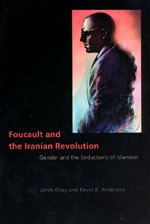
Janet Afary and Kevin B. Anderson, "Foucault and the Iranian Revolution: Gender and the Seductions of Islamism."
Janet Afary and Kevin B. Anderson, Purdue University: The co-authors of Foucault and the Iranian Revolution: Gender and the Seductions of Islamism (Chicago: University of Chicago, 2005) generally approve of Michel Foucault – but not his enthusiasm for the Iranian revolution. In an epilogue that looks at later leftist responses to Islamism, Afary and Anderson criticize Noam Chomsky and Howard Zinn for their benign attitudes toward the attacks on 9/11 and, on pp.169-70, they blame Campus Watch for this attitude not being more heavily criticized on the left:
Chomsky and Zinn refrained from expressions of admiration or support for the attacks themselves, seeming to regard them as understandable, but nonetheless criminal. This did not prevent crude attacks by right-wing groups like Campus Watch, which accused these critics, and university faculty generally, of supporting terrorism. Such McCarthyite tactics led many leftists and progressives to close ranks, making the needed critique of positions like those of Chomsky and Zinn harder to carry out.
Comment: Putting aside the "crude attack" on Campus Watch in this passage, let me attempt to parse its logic. Because Campus Watch criticized Middle East studies specialists for work that it found shoddy, irrelevant, dogmatic, and extremist, it is partly responsible for leftists not adequately condemning Al-Qaeda? That's a good one. If the fragile leftists had not been criticized by us they would have come down harder on the likes of Chomsky and Zinn? To which I ask: Why not also blame Campus Watch for the 2004 tsunami and Hurricane Katrina? (June 1, 2005)
miriam cooke, Duke University (yes, she spells her name with miniscule letters, in an act of majuscule pretention): In the conclusion to a lengthy August 2005 article mainly about Campus Watch, "Contesting campus watch: Middle East studies under fire," cooke writes:
Campus Watch is the Trojan horse whose warriors are already changing the rules of the game not only in Middle East studies but also in the US University as a whole. They threaten to undermine the very foundations of American education. Their project must be challenged.
Comment: This purple-prose declaration of Campus Watch's accomplishments is the most wonderfully extravagant backhanded compliment we can hope for. (August 1, 2005)
Zachary Lockman, New York University: As reported by Scott Jaschik at InsideHigherEd.com, Lockman began an annual meeting of the Middle East Studies Association in 2005 by bemoaning Middle East studies academics' limited role in public policy, then explained how bad things are:
Not only are Middle East scholars ignored, but they are attacked by "right wing crazies" who create Web sites to distort their work, scare off younger scholars from going into the field, and confuse the public, he said. While acknowledging that study of the Middle East is bound to be controversial, Lockman said that the current attacks on Middle East studies are "unprecedented" for the field.
(November 21, 2005)
Laura Bier, assistant professor of Middle East studies, Georgia Institute of Technology: I published "An Inadvertent Endorsement of Campus Watch," an exposé of and how she pseudonymously bemoaned the impact of Campus Watch on her and her colleagues' lives:
I think about the articles I won't write and the book I won't publish if I inadvertently take a wrong step and have to spend all of my time defending my integrity as a scholar and a teacher to the university administration. ... I talk all the time with untenured friends and colleagues about how our attempts to be cautious in the classroom too often translate into self-censorship.
Hatem Bazian, University of California at Berkeley: A blog entry today, "Aljazeera Hosts San Francisco Arab Americans," reports on an Al-Jazeera show:
Dr. Bazian spoke about the pressure faced by professors teaching Middle Eastern politics or history. He said he knew of students in his classroom who attended just so they could write down what he says, essentially spying on him, and transmitting that information to other private organizations. These include the infamous Campus Watch network which was founded by known Islamophobe Daniel Pipes as well as the likes of David Horowitz who recently authored a book entitled "The Professors: The 101 Most Dangerous Academics in America." Both the organization and the book are essentially are [sic] witch hunt against any academic that dares to provide a human side of the Middle East, more specifically the Israeli-Palestinian conflict. They want to "black list" these professors, ruin their reputation, and eventually remove them from their positions in some of the most prestigious universities in America. Taking their statements out of context, these Islamophobic pop stars are attempting to muffle dialogue at the most important institutions of our time: universities. Dr. Bazian openly discusses this intimidation and the students also provide their own accounts of such abuse.
(April 17, 2006)
Beshara Doumani, University of California at Berkeley: They must really be feeling the heat at Berkeley. The following oped, dated today, reports on a talk given April 5, comes from "Redefining Academic Freedom," in The Poly Post, the student paper at the California State Polytechnic, Pomona:
Beshara Doumani claimed that collegiate academic freedom is at risk. His point: politicians, not academics, are gaining the power to redefine academic freedom in universities. ... politicians, using Web sites and coalition campaigns claiming to fight for academic freedom are actually targeting liberal professors who question and criticize mainstream viewpoints. ...
Political organizations such as Campus Watch, an online project of the Middle East Forum, have also reverted to various methods of surveillance to keep tabs on "radical" professors. With a more defined agenda, specifically monitoring Middle Eastern studies, the group maintains and publishes dossiers on professors they feel are radical for providing dissenting opinions regarding our government's role in the Middle East.
Although Campus Watch claims its aim is to improve the state of Middle Eastern Studies, much of their research targets professors providing criticism of the Israeli movement in particular. Doumani is among those professors that Campus Watch is watching. ...
In the recent article, "Policing Thought after 9/11," published by the campus newspaper at UC Berkeley, Doumani said efforts are being made to privatize Middle Eastern studies and "establish think tanks that will provide for the press and government a ready stable of 'experts" who can shape knowledge about the Middle East." During the Campus Forum, Doumani made clear his thoughts that sites like Campus Watch are not really out to protect academic freedom at all but are instead "making charges of anti-Semitism when teachers criticize the Israeli movement. They're making it treasonous for professors to question the prevailing reasons."
For the record, I don't believe Campus Watch has called any professor antisemitic nor treasonous, though we do freely point out how many of them seek the destruction of Israel and are hostile to the United States. (April 17, 2006)
David Faris, University of Pennsylvania: A teaching assistant, he slurs Campus Watch, fantasizes about a "Campus Watch spy" (for the record, Campus Watch has never sent any student to keep track of an instructor), and generally testifies to the fear that Campus Watch inspires in a leftist's heart (for a sample of Faris' whacky views, see his analysis of George W. Bush under the edifying title, "Look at this pathetic blowhard").
At Penn, one of my semesters as a teaching assistant was deeply marred by an undergraduate Campus Watch spy who admitted on Day One that he was there only to monitor the professor. Not only did this monomaniacal and possibly disturbed student routinely and viciously interrupt lectures, but he made one of my discussion sections a living hell for the other students with his pedantic objections to every single piece of material that didn't portray Israeli history as all puppy dogs, rainbows and hugs. My evaluations were full of things like, "I would have really enjoyed this class if it wasn't for that one unbearable jerk. You know the one."
(January 10, 2007)
Anne Norton, University of Pennsylvania: In a review of what she calls Joseph Massad's "brilliant and scholarly work," Norton implicitly refers to the work of Campus Watch when she states that "Those who work in Middle Eastern studies know the temptation to self-censorship and the costs that too often attach to honest scholarship in this field." (May 31, 2007)
Lisa Anderson, professor of international relations at Columbia University, complains to Inside Higher Ed about Campus Watch and its allies:
Anderson just finished 10 years as dean of Columbia's School of International and Public Affairs, and the last few years of her tenure found her among the Middle Eastern studies scholars who were regularly criticized by some pro-Israel groups for alleged anti-Israel or anti-American bias. The attacks have "deeply damaged the research community," Anderson said.
Anderson said that young scholars of Middle Eastern literature or history (she stressed that she wasn't talking about those who study policy or the current political climate) are finding themselves "grilled" about their political views in job interviews, and in some cases losing job offers as a result of their answers. ...
Outside groups that are critical of those in Middle Eastern studies, she said, are shifting the way scholarship is evaluated. "People are reading work not for what it says, but for who it serves," she said.
(August 15, 2007)
Elliot Colla, associate professor of comparative literature at Brown University and a translator of contemporary Arabic literature, writes in "Academic Freedom And Middle East Studies" that
Undeniably, the careers of many of our colleagues [in Middle East studies] have been tragically affected by the coordinated slanders of monitoring groups such as Campus Watch.
(September 1, 2007)
Laurie King-Irani of the Electronic Intifada website joins her colleagues to build up the grand and terrible reputation of Campus Watch:
As for the banning and silencing of people in academe, it really exists and it really dampens public debate and discourse, and thus, harms the practice of effective citizenship. For those of you who don't know about it, check out Daniel Pipes' McCarthy-esque CampusWatch.org.
Once more, for the record: (1) Criticism does not equal censorship. (2) I am relentlessly criticized; why should I not have a right of reply? (3) Politicians, actors, athletes, and journalists are constantly assessed, why not Middle East studies specialists? (4) Campus Watch, a small research project, has nothing in common with Senator Joseph McCarthy's use of the state apparatus to bring down those he alleged to be communists. (October 16, 2007)
Saree Makdisi, professor of English and Comparative Literature at UCLA, in an oped titled "Academic freedom at risk on campus," accuses Campus Watch and like-minded institutions of plunging the American university into an orgy of crises.
Over the past few years, Israel's U.S. defenders have stepped up their campaign by establishing a network of institutions (such as Campus Watch, Stand With Us, the David Project, the Israel on Campus Coalition, and the disingenuously named Scholars for Peace in the Middle East) dedicated to the task of monitoring our campuses and bringing pressure to bear on those critical of Israeli policies. ... Outside interference by Israel's supporters has plunged one U.S. campus after another into crisis. They have introduced crudely political—rather than strictly academic or scholarly—criteria into hiring, promotion and other decisions at a number of universities, including Columbia, Yale, Wayne State, Barnard and DePaul. ... Our campuses are being poisoned by an atmosphere of surveillance and harassment. However, the disruption of academic freedom has grave implications beyond campus walls.
(October 16, 2007)
Marcy Newman, professor in the English Department at Boise State University, has an alarming assessment of Campus Watch in an article titled "Academic Freedom and Islam at Boise State":
There is a serious threat to education looming over American college campuses since September 11. This threat does not come from inside academic institutions themselves, but from right-wing fringe groups predominantly made up of Christian and Jewish Zionists who have made it their mission to censor speech on campus, in the classroom and in co-curricular activities - in addition to attempts made at intimidating faculty members who speak critically of U.S. foreign policy or who are critical of Israel. Such campaigns began with Daniel Pipes' Campus Watch.
Comment: Newman's fear of a "serious threat to education looming over American college campuses" is only one step shy of Miriam Cooke's alarm that Campus Watch threatens "to undermine the very foundations of American education." (October 18, 2007)
Seth Wessler, a research associate with the Applied Research Center in New York, wrote a long and inaccurate piece about the Khalil Gibran International Academy, "Silenced in the Classroom," that also manages inaccurately to credit Campus Watch with an accomplishment it cannot and does not claim: "Numerous professors have apparently lost their tenure bid as a result of Pipes and his cohorts." Of course, Wessler mentions no names. (November 1, 2008)
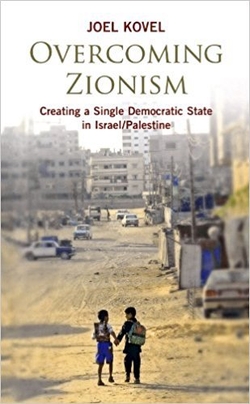 Joel Kovel was holder of the uniquely named Alger Hiss Chair of Social Studies at Bard College; trouble is, this splendid homage to a Soviet spy was non-tenured and his contract was not renewed soon after he published an absurdity of a book called Overcoming Zionism. While his colleagues dispute that there's a cause and effect here, Kovel himself assumed it had to do with his anti-Zionism and blamed Campus Watch and me for losing his job, as reported on a Turkish news site, Haber Vaktim:
This man (Daniel Pipes) attacks everyone who speaks out against Israel. One should not forget that Zionists are well-organized, they have the financial resources they need and they work so vigorously to protect Israel from criticism in academy. The reason is so simple: Israel tremendously needs American support and if criticism of that country were allowed, Israel, which is extremely famous for its violations of human rights, would lose a lot. in fact, if criticism of Israel were allowed, that state would have been destroyed eventually.
(April 7, 2009)
Gil Anidjar of Columbia University, writing in a volume titled Traces 5: Universities in Translation: The Mental Labor of Globalization (text available at Google Books), bewails that fact that Campus Watch's "most significant achievement - a remapping of the academic playing field and the elevation of existing walls - has already been completed." (January 1, 2010)
Tony Judt, university professor at New York University and specialist on European history, told the Polish journal Krytyka Polityczna in an interview:
If I were to advise a young researcher, I would advise him not to touch the topic [of the Palestinian-Israeli conflict] until he was tenured. Universities are vulnerable to the pressure of public policy makers, to the economic pressure from sponsors. Influential people in Washington, such as Daniel Pipes could easily destroy the career of a young man who expresses critical views on Israel and U.S. policy on the Middle East.
Comment: Funny, but I give that same advice but for the opposite reason that if you are sympathetic to Israel you won't get tenure. (August 8, 2010)
Alice Bach, Archbishop Hallinan Professor of Religious Studies at Case Western Reserve University, asking "Whose Land Is it Anyway?" in the Huffington Post.
How many professors will decide it's not worth the trouble to challenge the narratives of the well-organized Hillel, AIPAC, ZOA, Campus Watch, and other right-wing, pro-Israel groups that descend upon those who teach interpretations different from the Israeli hardline?
(November 29, 2010)
Akbar Ahmed and Lawrence Rosen, professor of Islamic studies at American University and of anthropology at Princeton University, respectively, write at "Academe's Obligation to Counter Anti-Muslim Sentiment":
Those who speak favorably of Islam come under fire from organizations like Campus Watch, which monitors what professors are saying and applies its substantial resources to challenging the reputations of those with whom it disagrees. This has created an ugly atmosphere on some campuses, as professors teaching courses on Islam may have to worry about how their remarks might be reported and how that may affect their careers.
(April 3, 2011)
Roger M.A. Allen, Arabic language specialist at the University of Pennsylvania, delivered his presidential address for the Middle East Studies Association in late 2010, titled it "A Translator's Tale" (not posted) and began with this anecdoate about himself:
When I was initially contacted about putting my name forward as a candidate for the presidency of MESA, I immediately responded, as I now recollect, "But I'm a literature scholar." That admittedly feeble attempt was instantly rebuffed by a vigorous assertion of the fact that literature is a significant field within this organization, but would I please not launch into a disquisition on any of the mu'allaqat, nor even of a novel by Naguib Mahfouz. Now, finding myself at the proverbial cross-roads, I decided to play what I thought would be my trump-card: "But I've only been cited on Campus Watch three times!" Yes, we know, came the response; that is pathetic, but you've still got some time. Just try a bit harder, can't you?
Comment: I first met Roger Allen in Cairo in the summer of 1971, just about 40 years ago. He seemed like a normal person then. (June 21, 2011)
Stephen Zunes, professor of politics and international studies at the University of San Francisco, worries about "The Legacy of 9/11 and the War on Intellectuals" and includes a tirade against Campus Watch:
He boasts how after 9/11 he "engaged in scores of interviews and wrote a number of widely circulated articles" in which he did not mince words "out of respect for those killed and their loved ones as well as my own deep-seated feelings of anger and horror." Sadly, however, he found himself, "along with scores of other Middle Eastern scholars, being attacked for supposedly defending terrorism. Within a few months, I found my dossier - along with seven other professors specializing in the Middle East - compiled by Campus Watch."
Specifically, his Campus Watch dossier accused him of believing that the United States "is almost entirely to blame for Sept. 11." Then the poor dear's troubles began:
Various manifestations of this Campus Watch claim that I had said that 9/11 was "our fault" soon made its way to Fox News, MSNBC, radio talk shows throughout the nation and even into my short biographical entry in Wikipedia.
Soon thereafter, a number of my speaking invitations were rescinded. For example, I received a last-minute cancellation of my scheduled presentation on international law at the Arizona Bar Association's annual convention, which had been scheduled six months earlier, following the director and his board of governors being told I was "anti-American." Even though none of them bothered to read my prepared remarks, they banned me from speaking on the grounds that their rules forbid presentations that were "ideological in nature."
Worse, Campus Watch raised "the concerns of parents over the kind of education their children were receiving in the hopes of getting nervous admissions officers and other administrators to silence us." As an example, he cites how,
in a nationally broadcast talk show on Fox News, host Sean Hannity claimed that Campus Watch was doing "American parents a favor" by citing "the extreme left-wing agenda like Mr. Zunes" so that parents, "when they're making decisions about whether or not to send their kids to Mr. Zunes' college like the University of San Francisco, they'll have at least some knowledge of where these people that will be educating their children are coming from."
Fortunately, having tenure at a growing university, Zunes was not worried for his own career, but he worries about others: "No doubt Middle Eastern scholars in a less secure situation, however, had to think twice about publicly raising questions about US policy in the region." (September 10. 2011)
Hugh Gusterson, an anthropologist at George Mason University, in an essay, "Iraq Had a Long Tradition as a Center of Higher Learning: How America's War Destroyed Iraq's Universities," first published on at the Bertrand Russell Tribunal website. After lamenting the current state of Iraqi universities, Gusterson concludes with a "Coda: American Universities and the 'War on Terror'":
I count as the more subtle and hidden costs of war scenarios such as these: ... the history department that decided not to hire the best person for the job, despite their teaching charisma and stellar publication record, because she had publicly criticized the American attack on Afghanistan and the Israeli occupation of the West Bank, and the chair feared getting on the wrong side of organizations like Campus Watch that have thrived in the atmosphere of ideological orthodoxy following 9/11.
(September 15, 2011)
Ihsan Yılmaz, columnist for Today's Zaman, the English-language newspaper of the Fethullah Gülen movement: In a bizarrely-titled article, "Homo Imam Hatipus or Homo Dindar Nesilus of Kemalo-Islamists," Yılmaz argues that the Erdoğan crowd is now forcing Turks into a very limited model – different from but identical in spirit to the one imposed by the Atatürkists between 1923 and 2002. In the midst of this sweeping analysis of Turkish history, Yılmaz mentions the Atatürkists' method of controlling the government and suddenly brings Campus Watch into the discussion:
This was a "Bureaucracy Watch" similar to Daniel Pipes' notorious Islamophobic "Campus Watch" but the Bureaucracy Watch operates on the basis of micro-level Foucauldian surveillance mechanisms and constant observation in society by employing the unequal gaze. Arguably, the whole public space becomes a Kemalist Panopticon as far as the bureaucrats are concerned.
Quite a statement, no? Translated, he is saying that the Atatürk regime kept the Turkish population in line by creating a prison-like situation in which it rewarded those who cooperated and punished those who did not. As for its direct agents in the Deep State, they suffered a cruel fate akin to that of Middle East studies specialists in North America, working under the lash of what Yılmaz dubs Bureaucracy Watch, the spiritual brother of my notorious Campus Watch.
Comments: (1) The excess of this assertion – that the model established by Campus Watch (founded, coincidentally, in 2002) dominated Turkish life for 80 years – rivals that of miriam cooke, who thinks (see above) that Campus Watch warriors "threaten to undermine the very foundations of American education."
(2) Campus Watch is not primarily about Islam so "Islamophobic," a deeply flawed neologism, has little relevance here. But that word has become the functional equivalent of "racist," to be hurled at anyone one disagrees with and wishes to delegitimate.
(3) For the full version of the Yılmaz opus, with an even longer and more bizarre title, see "Homo LASTus and Lausannian Muslim: Two Paradoxical Social-Engineering Projects to Construct the Best and the Good Citizen in the Kemalist Panopticon." (June 27, 2014)
Joel Beinin, who regales in the titles of Donald J. McLachlan Professor of History and Professor of Middle East History at Stanford University as well as having served as president of the Middle East Studies Association, concluded a lengthy treatise for an audience at a Stanford lecture featuring Steven Salaita about his "generation of Middle East scholars" by deploring CW's ascension in the "post-second intifada-9/11 environment." (March 30, 2015)
Rashid Khalidi, the vaunted Edward Said Professor of Modern Arab Studies at Columbia University and former president of MESA, has announced about Campus Watch's funding that it "is a massive campaign funded by very, very, very, very well endowed organizations." Comments: (1) Obviously, Khalidi has no idea about CW funding. (2) Once again, a decorated academic wheezes on without facts. (October 30, 2015)
Tony Hall, professor of Globalization Studies at University of Lethbridge in Alberta, Canada lists five organizations concerned with university malfeasance, and says of us that "Daniel Pipes' Campus Watch" is a "well-funded and deeply staffed intervention [that] invariably wreak[s] havoc on the principles of academic freedom and civil academic discourse on campus." Comment: It amuses me that employees of universities with multi-billion-dollar endowments talk about the riches of Campus Watch, which I can assure the curious, has far, far less than even one billion. (September 22, 2016)
California Scholars for Academic Freedom: Campus Watch "lists both faculty and students, threatening the latter with slanderous public information for use by prospective employers and the former with threats of violence." Whoops, this long and impressive group of "scholars" has mixed up Campus Watch with Canary Mission. (February 21, 2017)
Brian Leiter, writing in the Chronicle of Higher Education: Campus Watch devotes itself "with some regularity to policing faculty speech, and then presenting it – sometimes accurately, mostly inaccurately – in order to inflame public outrage and incite harassment of academics who expressed verboten views." (March 22, 2017)
Southern Poverty Law Center: Campus Watch is "widely accused of McCarthyism after publishing dossiers on college professors ... deemed "hostile" to America." (April 26, 2017)
Rabab Abdulhadi, Associate Professor of Ethnic Studies and Race and Resistance Studies and the Senior Scholar at the Arab and Muslim Ethnicities and Diasporas Studies at San Francisco State University: "I have dreaded opening up the email notifications ... since ... Campus Watch launched a Twitter campaign demanding that SFSU end its collaborative agreement with An-Najah National University in Palestine. ... Campus Watch is a right-wing and racist Zionist organization" (July 4, 2017)
Kim Jensen, "a Baltimore-based writer, poet, and educator who spends a great deal of time in historic Palestine," at Mondoweiss: Campus Watch is among the "Zionist organizations" responsible for an "increase in McCarthyist pressure" and is known for "shameless meddling in internal university proceedings. It is also "the most visible tip of a slander-industrial complex whose mission is to purge professors and students who challenge their own narrative." (July 6, 2017)
Ramzy Baroud, a columnist, writing in Al-Jazeera: Campus Watch is "a Big Brother type of organization aimed at intimidating teachers, scaring off students, and monitoring and reporting nonconformist educational institutions across the country." (August 15, 2017)
Washington Report on Middle East Affairs – Campus Watch engages in "relentless, bullying attacks." (Nov./Dec. 2017)
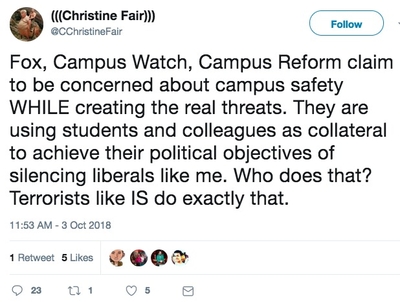
Christine Fair: The deranged left-wing Georgetown University professor first tweeted that the white male senators at the Brett Kavanaugh hearing all "deserve miserable deaths while feminists laugh as they take their last gasps. Bonus: we castrate their corpses and feed them to swine? Yes." Then she attacked Campus Watch as a terrorist organization similar to ISIS.
(October 3, 2018)
Benjamin Lee and Kim Knott: In an extraordinary statement, these two Lancaster University faculty members write in "More Grist to the Mill? Reciprocal Radicalisation and Reactions to Terrorism in the Far- Right Digital Milieu," Perspectives on Terrorism, June 2020, p. 115, that a "far-right space" has
given birth to 'campus watch', an initiative of the Middle East Forum, a thinktank linked to Daniel Pipes, which maintains lists of trustworthy and untrustworthy academics. ... Although [this and other] calls are not inherently violent, they feed into a well-established right-wing trope of the 'day of the rope', a point when scores will be settled against political opponents. This event [means the] mass murder of political opponents.
Comments: Campus Watch has inspired some pretty crazy responses – including that it "threatens to undermine the very foundations of American education" – but mass murder wins the prize for absurdity. (June 1, 2020)
James J. Zogby, the prominent Washington insider writes in "Palestinians: Victims of 'cancel culture'," that Campus Watch is responsible for the fact that "Arab Americans, myself included, were denied jobs, harassed, had speaking engagements cancelled and received threats of violence." (December 7, 2020)
Stephen Zunes tells how Campus Watch made his life difficult when it came into existence in 2001, but that he was secure in his position. However. "following the 9/11 attacks, Middle Eastern scholars in less secure situations had to think twice about publicly raising questions about U.S. policy in the region." (September 10, 2021)
Sarah Eltantawi, Fordham University associate professor of modern Islam and formerly MPAC communications director, announced, as reported by Andrew Harrod that the "Middle East Forum is at the center of the Islamophobia network," I am "probably one of the most notorious Islamophobes," and Campus Watch is a "blacklist site" that deals "always with misquotes."
Comment: The "Islamophobia" business is old hat. But Campus Watch always misquotes? I challenge Eltantawi to document, say, 100 misquotes. If she can, Campus Watch apologizes; if not, she apologizes. Deal? (August 26, 2021)
Dima Khalidi, daughter of Rashid Khalidi, founder and director of Palestine Legal: "Campus Watch, one of the first groups to create blacklists of professors who criticize Israel, may well have inspired newer right wing groups, like Professor Watchlist, a project of Turning Point USA that exposes professors who discriminate against conservative students."
Comment: Of course, she mischaracterizes the Campus Watch dossiers, but we'll take the compliment. (March 14, 2022)
Idriss J. Aberkane, a French-speaking Muslim with 850,000 subscribers on YouTube, connects Campus Watch and myself to the CIA's war in Iraq at 2:03 of "Pourquoi la CIA commet autant de crimes ?" (June 4, 2023)
Marc Lynch and Shibley Telhami, Middle East studies professors at George Washington University and the University of Maryland:
The policing of campus discourse around the Israeli-Palestinian conflict is nothing new, of course. There is a long history of external groups such as Campus Watch and Canary Mission mobilizing pressure on allegedly anti-Israeli professors. For years, campuses have repeatedly been disrupted by controversies, intense moments of polarization, clashes between students, and inadequate support from academic administrations for their faculty and pro-Palestinian student groups.
(December 5, 2023)
Shahid Hussein, Pakistani writer: "Groups such as Campus Watch exert control over university debates and campus discussions." (December 11, 2023)
Hamid Dabashi, Columbia University: "Soon after 9/11, a McCarthyite website called Campus Watch was created to dox, abuse and malign our names, in an apparent effort to frighten and silence us." (May 20, 2024)
Saeed Rahnema, a retired professor of political science and public policy at York University: "Campus Watch ... functions like a 'thought police' on Israeli-related discussions. (March 10, 2025)
Sarah Kendzior, a Ph.D. in anthropology:
Right-wing extremists like David Horowitz, the mentor of Stephen Miller, made lists of "dangerous" teachers, creating a culture of self-censorship and fear. He was joined by Islamophobic ideologues like Daniel Pipes, the creator of the spy group Campus Watch. I remember a Muslim professor at Indiana University joking, "His name is Daniel Pipes because he has pipes that reach into our classrooms so he can listen to our conversations." I remember the tremble behind his smile.
(October 18, 2025)


