
I wrote in 1984 that Left and Right hardly matter when it comes to the Arab-Israeli conflict:
The Middle East stands outside the great debate of American foreign policy since World War II - the disagreement over the danger posed by the U.S.S.R.... Political discussion there is dominated by an entirely different and wholly unrelated dichotomy - the Arab-Israeli dispute. Conservatism does not predispose an American to favor one side, nor does liberalism.
By 1992, however, a left-right split had already emerged, as I noted in an article that year, "Bush, Clinton, and the Jews: A Debate [with Martin Peretz]":
a fundamental shift of attitudes has taken place in the two parties, with the Republicans emerging as the champion of Jewish interests, including Israel. ... The Republican move toward a pro-Israel stand represents an evolving long-term commitment. Though far from unanimous, the direction is clear. The Democratic position, in contrast, shifts opportunistically. At this moment, to be sure, forces friendly to Israel can out-muscle the opposition. But watch out. Just as soon as isolationist impulses grow stronger or Arab-Americans get organized, the pro-Israel stand will evaporate as quickly as ice on a summer afternoon in the Negev.
I devoted a first article to this in 2000, "The friendly Republicans":
[A recent report indicates] "a significant partisan split" exists on Middle Eastern issues. Specifically, Republicans are "more hard-line and pro-Israel" than Democrats. This difference is very substantial, with Republicans three times more friendly to Israel than Democrats. Thus, in response to the question, "With regard to the Middle East, how do you feel the next president should relate to the region," 22 percent of Republicans said he should be pro-Israel, while only 7% of Democrats opted for this reply. (It also bears noting that among born-again Christians, the percentage on the pro-Israel side rises to 29%.)
In 2003, I speculated (in "Arabs and Jews Sorting Themselves Out Politically in the United States?") that Jews will eventually settle in the Republican party. Three years later, it's hardly news anymore that Republicans view Israel more favorably than do Democrats. But the Gallup Poll provides more detailed proof than ever before about the calibrations of American attitudes toward the Jewish state.
In an article titled "Republicans and Religious Americans Most Sympathetic to Israel," Frank Newport and Joseph Carroll establish its nearly linear quality from right to left. Here are replies to the question, "In the Middle East situation, are your sympathies more with the Israelis or more with the Palestinians?"
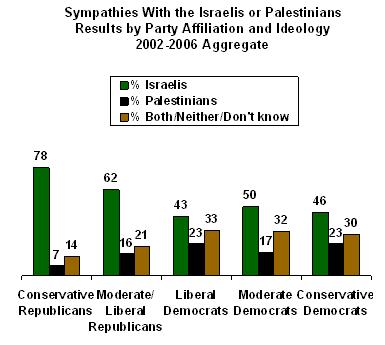 The Gallup Poll on ratios of favorable:unfavorable views of Israel. |
Overall, they found 72 percent of Republicans and 47 percent of Democrats sympathize more with Israelis than Palestinians. The trends become more dramatic once one teases out the sub-views; note the marked diminishment of support for Israel as one goes across the political spectrum, as measured by how many times more sympathy Israel gets:
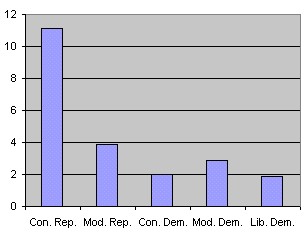
11.1 – Conservative Republicans
3.9 – Moderate/Liberal Republicans
2.0 – Conservative Democrats
2.9 – Moderate Democrats
1.9 – Liberal Democrats
With the exception of one irregularity (why are moderate Democrats more pro-Israel than conservative Democrats?) the pattern is consistent, even if the numbers fall off dramatically:
Comment: It is surprising – and heartening – to note that liberal Democrats still support Israel by a nearly 2-to-1 ratio. It sure doesn't seem that way. (March 27, 2006)
May 23, 2006 update: I build on this weblog today at "Democrats, Republicans, and Israel."
July 20, 2006 update: Richard Baehr draws some interesting conclusions about the differences between the two parties in response to the hostilities in Lebanon. He notes that the two parties "reflects some consensus, but also two very different views on the meaning of the conflict in this theatre, and more broadly, between the West and radical Islam." In more detail:
Both Democrats and Republicans have defended Israel's actions in protecting its borders against cross border attacks and stopping rockets fired by the terrorist group Hezbollah from southern Lebanon. ... Almost as if supplied by talking points by the DNC (as I am sure they were) Democrats on the various talk shows have quickly tried to change the subject from defending Israel (which may carry some risks with Muslim and Arab voters) to the "failed war in Iraq" and how the current conflicts in the Middle East are a result of the President's failure to engage in diplomacy in the Israeli-Palestinian conflict. Both Senators Chris Dodd and Joe Biden took this approach in their appearances on the talk shows. ...
Various Republicans on this week's talk shows, Newt Gingrich, John McCain, and George Allen among them, have provided the links among Israel's fight, our battles in Iraq and Afghanistan, India's fight with Islamic terrorists over Kashmir, and other Muslim-Western conflicts around the globe (find a conflict, and it's a good bet that it fits this pattern). Seeing a bigger picture, and accepting that war is sometimes the answer, is different than a philosophy that follows the dictum that the best policy is to always turn down the temperature and stop the fighting. Senator McCain said of the Iranian nuclear program that attempting to take out this program by military means would be a terrible thing, but not as bad as seeing Iran succeed in completing its program. This of course, is not a defense of bad wars, or unnecessary wars, or poorly conducted wars. ...
for many on the left, war, any war, is the ultimate evil, not tyranny, or Nazism, or Communism, or Islamic fascism. On that, their disagreement with the President and his party is profound. Scarier still, is the more hard line anti-Israel sentiment now floating freely on the hard left websites, such as dailykos. Some of the site's writers seem to feel about Israel the way Iran's President does. At every anti-Iraq war rally the past few years, anti-Israel signs have always been prominent. The two movements (anti-Iraq war, and anti-Israel) are now firmly linked on the left. It will be a fundamentally different Democratic Party that emerges if the netroots and the hard left take over. And no one can say they couldn't see it coming.
For now, the leadership of both major parties is standing firmly with Israel in this fight. But if the fight goes on very long, this coalition may fray a bit as some Democrats feel pressure from the left and hear the cooing sounds of UN peacekeepers and "peace," and get more nervous about civilian casualties and "disproportionate" responses, and fall for the bromides of the war is never the answer crowd.
Comment: I agree with Baehr's analysis and worry that today's cross-party agreement is fragile and perhaps temporary.
July 26, 2006 update: A NBC/WSJ survey carried out on July 21-24 by Hart/McInturff asked 1,010 Americans "In the Middle East situation, are your sympathies more with Israel or with the Arab nations?" With a +/- 3.1 percent margin of error, it found Israel ahead by a 7-1 ratio:
Israel - 57%
Arab nations - 9%
Both - 9%
Neither - 15%
Not sure - 10%
The breakdown by political party was not made public but the Republican Jewish Coalition has the figures and made them available to me:
Republicans:
Israel - 81%
Arab nations - 1%
Both - 3%
Neither - 8%
Not sure - 5%
Democrats:
Israel - 43%
Arab nations - 12%
Both - 13%
Neither - 18%
Not sure - 14%
Comments: (1) The contrast between the parties appears to be growing wider. (2) Beyond the obviously huge difference in ratios (81-1 v. 3.5-1), it bears noting how many more Republicans know their mind (82 percent) than do Democrats (55 percent). Turned around, Democrats are both less pro-Israel and more ambivalent.
Aug. 2, 2006 update: A Los Angeles Times/Bloomberg poll released today asks three questions pertaining to the current Hizbullah-Israel war, then breaks down responses by party, with Democrats in the first column and Republicans in the second.
As you may know, Israel has responded to rocket attacks from the Lebanese group, Hezbollah by bombing Beirut and other cities in Lebanon. Do you think Israel's actions are justified or not justified? (IF JUSTIFIED) Do you think Israel's response is excessively harsh or not?"
Justified, not excessively harsh 29 64
Justified, but excessively harsh 20 11
Unjustified 36 17
Don't know 15 8As you may know, the United States is a long-time ally of Israel. Which of the following statements comes closer to your view: "The United States should continue to align itself with Israel" or "The United States should adopt a more neutral posture" or "The United States should side more with the Arab countries"?
Continue to align with Israel 39 64
Adopt a more neutral posture 54 29
Should side more with Arab countries 2 1
Don't know 5 6As you may know, the United States has not called for an immediate ceasefire in Lebanon between Israel and Hezbollah, but has said that a ceasefire should wait until an international peacekeeping force can be assembled. What do you think? Should the U.S. call for an immediate ceasefire, or should the U.S. continue to work toward both sides accepting an international peacekeeping force, or should the U.S. not get involved in the fighting between Israel and Hezbollah?
U.S. call for an immediate ceasefire 17 9
U.S. work toward both sides
accepting international
peacekeeping force 39 56
U.S. not get involved in the
fighting between Israel and
Hezbollah 40 30
Don't know 4 5
Comment: To me the most interesting result is the "Continue to align with Israel" one. The same, massive 25-percent difference separates the parties, no matter how the question is asked, but the number in either party favoring the Arabs over Israel is trivial.
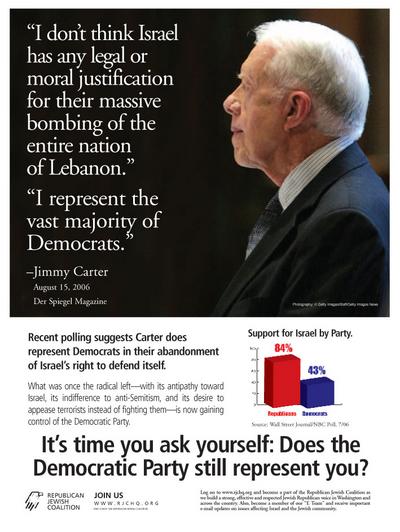 A Republican Jewish Coalition advertisement. |
- A quarter of Republicans and 54 percent of Democratic voters say Israel has gone too far in its campaign.
- 39 percent of Republicans and 27 percent of Democrats, with 17 percent and 14 percent unsure, respectively, say the bombing campaign is just right.
- 19 percent of Republicans and 5 percent of Democrats say the Israeli response to Hizbullah should be harsher.
The article, by Marc Caputo, also paraphrases Khaled Saffuri (whose name is misspelled as Khaled Suffari), Grover Norquist's associate, with the interesting observation that Arabs and Muslims "have found it almost impossible to make it into Republican circles ever since Sept. 11," a problem he blames on what he calls the "Fox News syndrome," In Saffuri's simplistic analysis, Republicans watch Fox "and it's like brainwashing."
Sep. 6, 2006 update: Republican Jewish Coalition Executive Director Matt Brooks notes the sort of evidence presented here and concludes: "We are seeing a disturbing trend in the Democratic Party today, one that the American Jewish community needs to take note of. Democrats are increasingly turning their backs on Israel, and have done so even in the midst of Israel's efforts to stop Hezbollah from bombing Israeli cities."
Sep. 21, 2006 update: According to Ed Lasky, in a lengthy analysis of the "The Democratic Party and the Jews" in the American Thinker:
Developments in the Democratic Party bode ill for the Jewish people and for the state of Israel – home of up to 40% of the world's remaining Jewish population. The rank and file of the Party has become increasingly anti-Semitic and support for Israel has noticeably fallen. Democratic Congressmen have reflected this trend in very visible ways: their votes and actions in Congress reveal that support for Israel has eroded in alarming ways. Furthermore, more than a few Democratic Congressman have openly made statements that are either clearly anti-Semitic or can be fairly construed to be at least, "anti-Semitic in effect, if not intent".
Supporting the contention that Democrats are more anti-Semitic than Republicans, survey research by the Institute for Jewish & Community Research in 2003 showed that 20 percent of Democrats view Jews as caring only about themselves and only 12 percent of Republicans hold such views (ICJR press release, January 14, 2003).
Jan. 1, 2007 update: Gabriel Schoenfeld of Commentary reviews the situation in "Jews, Muslims, and the Democrats" and comes to similar conclusions. With regard to representative-elect Keith Ellison, called "Louis Farrakhan's First Congressman," he writes:
Both the ease with which Ellison was able to glide through this controversy and the remarkable lack of discomfort his candidacy appeared to cause among his fellow Democrats point to the larger significance of his election. For the simple fact is that in certain respects he is not alone: the past decade or so has seen the formation of a group of 40 to 50 Democratic Congressmen who, in varying degrees of intensity, have felt free to express an uninhibited hostility toward the Jewish state.
Mar. 3, 2008 update: A Gallup poll of American attitudes toward various countries finds Israel at a stratospheric 5th, following only Canada, Great Britain, Germany, and Japan, with a 71 percent approval rating. Republicans clock in at 84 percent favorability and Democrats at 64 percent.
In contrast, the Palestinian Authority has the third lowest ranking, beating out only Iran and North Korea with 14 favorable (and 75 percent unfavorable).
Dec. 31, 2008 update: Israel's war on Hamas finds dramatic differences between Ds and Rs, according to the Rasmussen Reports:
Sixty-two percent (62%) of Republicans back Israel's decision to take military action against the Palestinians, but only half as many Democrats (31%) agree.
A majority of Democrats (55%) say Israel should have tried to find a diplomatic solution first, a view shared by just 27% of Republicans.
While 75% of Republicans say Israel is an ally of the United States, just 55% of Democrats agree.
Seven percent (7%) of Democrats say Israel is an enemy of America, but only one percent (1%) of Republicans say the same.
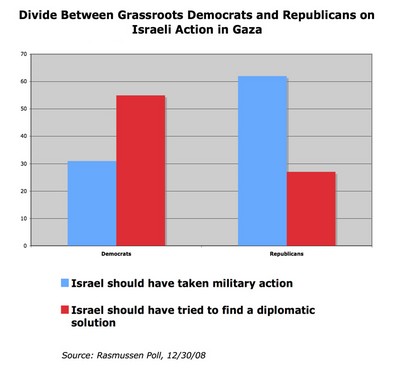 Rasmussen Reports poll on Democratic and Republican views of the Arab-Israeli conflict. |
Jan. 27, 2009 update: Sixty House members wrote a letter today to U.S. Secretary of State Hillary Clinton in which they "respectfully request that the State Department release emergency funds to UNRWA for reconstruction and humanitarian assistance" in Gaza. Interestingly, every one of the sixty is a Democrat, not one is a Republican. That amounts to nearly one-quarter of the House Democratic caucus. Also noteworthy: the list includes some of the most left-wing Democrats in the House such as Dennis Kucinich, Barbara Lee, and Maxine Waters.
Apr. 27, 2009 update: Caution is the word when the untrustworthy James Zogby writes up the unreliable polling of Zogby International, but for what they are worth, ZI's numbers track with other polls cited above.
"Which is more important to the United States, relations with Israel, the Arabs, or both?" Of voters for Obama, 7 percent say Israel, 17 percent say the Arabs, and 68 percent say both. Of voters for McCain, 46 percent say Israel, 3 percent the Arabs, and 48 percent say both.
The recent war in Gaza widened the gap in perception. Half of Obama supporters said that war made them less supportive of Israel and two-thirds of McCain voters said it made them more supportive of Israel.
What should policy be? Of voters for Obama, 10 percent say he should support Israel, 6 percent want support for the Palestinians, and 73 percent advocate that he "steer a middle course." Of McCain voters, 60 percent want the president to support Israel, an undisclosed number are for the Palestinians, and 22 percent want a balanced approach.
Engage with Hamas? Obama voters say yes by a 67-16 percent margin; McCain voters say no at a 79 percent rate.
Get tough with Israel? Of Obama voters, 80 percent yes but 73 percent of McCain voters say no.
A Palestinian right of return? Obama voters agree by 61-13 percent, while McCain voters disagree, 51-21 percent.
Jerusalem be divided and serve as the capital of two states, or remain under sole Israeli control? Obama voters prefer the former option while McCain voters "overwhelmingly" want Jerusalem to serve as the undivided capital of Israel.
Remove Jewish residents from the West Bank? A majority of Obama voters say yes, a majority of McCain voters say no.
Zogby concludes from these numbers that "traditional U.S. policy toward the Israeli-Palestinian conflict does not have bipartisan backing. In fact, as the two parties have evolved over the past thirty years, and as the issue itself has evolved – since Oslo – each of the two parties have moved in different directions." Reluctant as I am to ever agree with Zogby, I have written along these same lines many times and so must concur with his assessment.
May 1, 2009 update: This item is not about Israel but it bears on it: Survey research shows that Democrats blame Jews for the economic meltdown far more than do Republicans, report Neil Malhotra and Yotam Margalit in "Anti-Semitism and the economic crisis." They conducted a study of 2,768 American adults in which they explored "people's responses to the economic collapse and tried to determine how anti-Semitic sentiments might relate to the ongoing financial crisis." Their survey asked respondents "How much to blame were the Jews for the financial crisis?" and offered five replies: a great deal, a lot, a moderate amount, a little, not at all. They found that 24.6 percent of non-Jewish respondents blamed Jews a great deal, a lot, or a moderate amount.
Democrats were especially prone to blaming Jews: while 32 percent of Democrats accorded at least moderate blame, only 18.4 percent of Republicans did so (a statistically significant difference). This difference is somewhat surprising given the presumed higher degree of racial tolerance among liberals and the fact that Jews are a central part of the Democratic Party's electoral coalition. Are Democrats simply more likely to "blame everything" thus casting doubt on whether the anti-Jewish attitudes are real? Not at all. We also asked how much "individuals who took out loans and mortgages they could not afford" were to blame on the same five-point scale. In this case, Democrats were less likely than Republicans to assign moderate or greater blame.
June 13, 2009 updates: (1) William Kristol comments on the above results: "In a survey administered by (apparently) liberal academics, looking at attitudes not towards Israel or Likud but towads Jews per se – Democrats are almost twice as likely to be hostile to Jews than Republicans."
(2) Adam Hasner, majority leader of the Florida House of Representatives and Florida Jewish outreach chairman for the McCain Campaign in 2008, argues in an article today that "The Era of Bipartisan Support for Israel is Over." Excerpts:
The best days of Democrat support for Israel have now passed. The evidence is abundant and clear that the importance of Israel's existence and well-being has become secondary to the political idolatry of many Jewish-American Democrats. Furthermore, many Jewish voters who do have Israel's best interests among their priorities are too often duped by the maze of activists and institutions that use Jewish concepts and credentials to manipulate support for their liberal agenda. Despite all of the lofty pronouncements regarding respect for the America-Israel relationship, all species of partisan support are not equal.
Hasner then goes on to skewer the policies of Barack Obama vis-à-vis Israel.
June 15, 2009 update: A Greenberg Quinlan Rosner Research poll of covered 800 registered American voters conducted last week for The Israel Project found that 65 percent of self-identified Republicans support Israel and just 3 percent for the Palestinians; independents favor Israel over the Palestinians by 50 percent to 9 percent; and Democrats do so 38 percent to 9 percent.
Asked whether Israel's new government is committed to peace, 56 percent of Republicans answered in the affirmative, as did 49 percent of independents and 42 percent of Democrats.
Asked about Israel's right to "defensible borders," Republicans assented 64 to 12 percent, independents 58 to 20 percent, and Democrats 45 to 33 percent.
Jan. 26, 2010 update: 54 Democrats and not a single Republican signed a letter to Barack Obama initiated by Keith Ellison and Jim McDermott urging him to take steps in favor of Hamas-ruled Gaza and inimical to Israel's security interests. A host of anti-Israel groups also signed on. The letter asks that Obama "advocate for immediate improvements for Gaza in the following areas" and then lists ten ways to ease up on Hamas.
Feb. 19, 2010 update: A Gallup poll has both good and worrisome news for Israel. On the plus side, Israel has the fifth-highest "favorability" ratings of any country in the world (following Canada, Great Britain, Germany, and Japan). On the worrisome side, the largest partisan divide in attitudes involve Israel, a 27-percent point difference, with 80 percent Republicans seeing it favorably and just 53 percent of Democrats (still a majority, though) and also the Palestinian Authority, where 12 percent of Republicans are favorable versus 25 percent of Democrats. Curiously, with the slight exception of Pakistan (25 percent v. 24 percent), Israel is the only foreign country which Republicans see more favorably.
Mar. 25, 2010 updates: (1) Commissioned by one Zogby at the Arab American Institute, another Zogby at Zogby International asked American adults how to deal with the Arab-Israeli conflict and found that they are split. "Fifty percent of Americans agree the Obama Administration should steer a middle course in pursing peace in the Middle East" – meaning treat Arabs and Israelis alike, end the historic bond with Israel. "There is a strong divide on this question with 73% of Democrats agreeing that the President should steer a middle course while only 24% of Republicans hold the same opinion." That's a stunning difference, the largest of any question I have yet seen.
(2) The National Journal runs a weekly poll of conservative and liberals bloggers (in which I take part). This week's poll incuded a question on the U.S.-Israel relationship: "Assess the Obama administration's recent dealings with Israel." The answers provided were "Too tough," "About right," and "Too lenient." Seventeen bloggers on each of the left and right took part. Strikingly, 12 of the conservatives thought it "Too tough" and not a single liberal agreed.
For the record, I replied "Too tough" and added this comment: "Aficionados of Middle East history will recall the Algerian Dey's fly whisk incident of 1827."
Mar. 26, 2010 update: Four years ago, based on political trends, I wrote of my expectation that bipartisan U.S. support for Israel is coming to an end. Rather than the friendly argument over who is the better friend of Israel, Bill Clinton or George W. Bush, "a major shift [in policy will occur] whenever the White House changes hands from one party to the other."
That point appears to be upon us. Indicative of this almost unnoticed shift is a throw-away line by Janine Zacharia in the Washington Post where she notes that, given Binyamin Netanyahu's poor relations with the Obama administration, some Israelis expect he will "search for ways to buy time until the midterm U.S. elections in hopes that Obama would lose support and that more pro-Israel Republicans would be elected."
That an Israeli leader awaits one U.S. party to defeat the other marks the dawn of a new age, and not one favorable to his country. As I put it in 2006, "As the political consensus breaks, Israel will be the loser."
Mar. 31, 2010 update: 333 members of the House of Representatives signed the Hoyer-Cantor letter (dated Mar. 19) to the secretary of state reaffirming the U.S.-Israel alliance, meaning 102 members did not. Those 102 include 94 Democrats (including Speaker of the House Nancy Pelosi) and and 8 Republicans, a 12-to-1 ratio. .
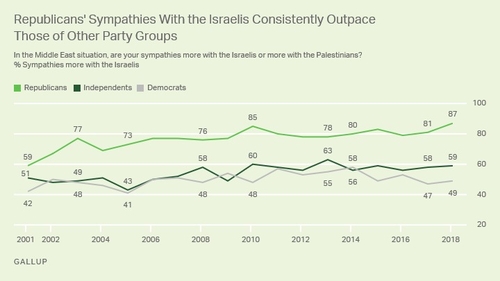
Apr. 11, 2010 update: Jeff Jacoby of the Boston Globe devotes his column today to this subject, "Support for Israel runs on party lines." He posts the graph below from Gallup, showing that party trends since 2001 have accentuated the already apparent difference between Republicans and Democrats. (Interesting to note that independents track the Republican outlook though less favorably to Israel.)
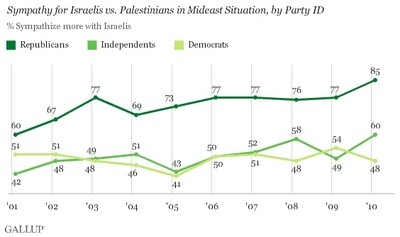 Gallup Poll: "Sympathy for Israelis vs. Palestinians in Mideast Situation, by Party ID." |
Jacoby concludes his essay:
Taken as a whole, America's identification with Israel is as stout as ever -- the "special relationship" between the two nations still runs deep. But the old political consensus that brought Republicans and Democrats together in support of the Middle East's only flourishing democracy is breaking down. Republican friendship for Israel has never been more rock-solid. Democratic friendship -- especially now, in the age of Obama -- is growing steadily less so.
Apr. 13, 2010 update: Just as the House letter supporting Israel had more Democratic holdouts than Repubican ones (see the Mar. 31, 2010 update above), so too with a similar Senate letter to the secretary of state. A total of 76 members signed it. The absent 24 included 20 Democrats and 4 Republicans, a 5-to-1 ratio. That's a striking imbalance but much less than the House ratio of 13 to 1.
June 8, 2010 update: Jennifer Rubin reports on a Rasmussen poll concerning the "Free Gaza" flotilla:
Yesterday, Rasmussen reported: "Forty-nine percent (49%) of U.S. voters believe pro-Palestinian activists on the Gaza-bound aid ships raided by Israeli forces are to blame for the deaths that resulted in the high-profile incident. A new Rasmussen Reports national telephone survey finds that just 19% of voters think the Israelis are to blame." That's pretty noteworthy and speaks well of average Americans' common sense and loyalty to Israel, right?
Well, sort of. Premium subscribers to Rasmussen get a further peek behind the numbers. It turns out that 49 percent overall think the Palestinian activists are to blame, but 65 percent of Republicans and only 37 percent of Democrats do. While only 19 percent overall blame Israel, that number goes to 26 percent among Democrats. Only 11 percent of Republicans finger Israel as primarily responsible.
June 10, 2010 update: Seventy-eight members of the U.S. House of Representatives wrote a "Dear Prime Minister Netanyahu" letter to express "steadfast support" for him and for Israel in its hour of need. Every one of them is not just a Republican but a member of the House Republican Study Committee, a conservative grouping. This contrasts with the Jan. 26, 2010, letter signed by 54 Democrats in support of Hamas.
Oct. 8, 2010 update: Reporting on a a survey of 1000 likely voters carried out on October 3-5 by McLaughlin and Associates for the Emergency Committee for Israel, William Kristol focuses on its Question 30: "Would you be more likely or less likely to vote for a candidate whom you perceive as pro-Israel?" He writes:
Among those intending to vote Republican this fall, 69 percent would be more likely to vote for a candidate who was pro-Israel, 15 percent would be less likely—a margin of 54 percent. On the other hand, among Democratic voters, the pro-Israel margin is only 7 percent—40 percent of Democratic voters are more likely to vote for a pro-Israel candidate, 33 percent are less likely. Conservatives (and Tea Party sympathizers) mirror Republicans; their pro-Israel margins are also over 50 percent. The margin among self-described liberals is only 5 percent. And while Fox News fans are very pro-Israel, by 73 percent to 16 percent, devotees of the New York Times are actually negative on Israel, by 30 percent to 35 percent.
The bottom line: The public is strongly pro-Israel. But the public consists basically of two groups. The GOP/conservative/Fox News-viewing part of the public is overwhelmingly pro-Israel. The Democratic/liberal/New York Times-reading part of America is... comme-ci, comme-ca.
Dec. 15, 2010 update: In a survey of 1,000 likely American voters nationwide conducted on December 9-10, Rasmussen Reports finds 57 percent see Israel as an American ally, 33 percent see it between ally and enemy, and and 5 percent see it as an enemy. Then this: "While 74% of GOP voters consider the Jewish nation an ally, only 45% of Democrats feel the same way."
Feb. 28, 2011 update: Gallup asked its annual question, "In the Middle East situation, are your sympathies more with the Israelis or more with the Palestinians?" and found in 2011 that Americans as a whole favor Israel 63 to 17 percent, or nearly 4-to-1. As usual, party affiliation makes a big difference (80 vs. 57 percent favorable to Israel). Oddly, though, the differences between independents and Democrats disappeared.
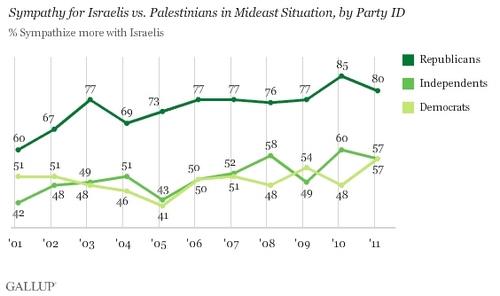
June 1, 2011 update: It turns out that the Republicans were more pro-Zionist in the U.S. presidential campaign of 1944, in part due to the efforts of Benzion Netanyahu, 34, and future father of Binyamin. Rafael Medoff provides details in a historical review, "From father to son, the Netanyahu legacy in Washington":
Much to the Jewish establishment's chagrin, Netanyahu actively cultivated relationships with Republican members of Congress and party leaders. For [Stephen] Wise, building friendly relations with FDR's political foes was inconceivable. For Netanyahu it was political common sense. Roosevelt had no incentive to address Jewish concerns if he believed Jewish votes were in his pocket. Only if there was a credible threat of Jews voting Republican would FDR see a reason to reconsider his cold policy toward Jewish refugees and Zionism.
In the months leading up to the June 1944 Republican National Convention, Netanyahu and his colleagues undertook what they called "a systematic campaign of enlightenment." They met repeatedly with former President Herbert Hoover, 1936 GOP presidential candidate Alf Landon and influential Republican members of Congress such as Rep. Clare Booth Luce (wife of the publisher of Time and Life). At a Revisionist dinner that spring, Luce said Great Britain's blockade of Jewish refugee ships bound for Palestine was to blame for the fact that "Jewish blood stains the blue Mediterranean red."
A young Benzion Netanyahu.
In their meetings, the Revisionists asked the Republicans to include a pro-Zionist plank in their 1944 platform. Neither party had ever formally endorsed the cause of Jewish statehood, but the GOP leaders clearly were sympathetic. On the eve of the convention, Luce called Netanyahu to say, only half joking, "I'm going now to do your work at the convention." Meanwhile, an additional lobbying effort was undertaken by Abba Hillel Silver, the activist Cleveland rabbi who in 1943 had been elevated to the co-chairmanship of the American Zionist movement alongside Wise. Silver, who enjoyed a close relationship with Sen. Robert Taft of Ohio, lobbied Taft and other leading Republicans on the platform issue.
The GOP's final platform not only endorsed Jewish statehood in Palestine, as Silver wanted, but also criticized Roosevelt, as Netanyahu wanted. It declared: "We condemn the failure of the President to insist that the mandatory of Palestine carry out the provisions of the Balfour Declaration and of the mandate while he pretends to support them." ...
The Republican Party's move had an important consequence: It compelled the Democrats to compete for Jewish support and treat the Jewish vote as if it were up for grabs. The Democratic National Convention in July 1944 for the first time endorsed "unrestricted Jewish immigration and colonization" of Palestine and the establishment of "a free and democratic Jewish commonwealth."

Medoff sees in this precedent that "support for Zionism, and later for Israel, would become a permanent part of American political culture. Every subsequent Republican and Democratic convention has adopted a plank supporting Israel."
Dec. 7, 2011 update: In a long and important analysis, Ben Smith of Politico looks at "Israel rift roils Democratic ranks," an look at how two of the "Democratic Party's core institutions are challenging a bipartisan consensus on Israel and Palestine that has dominated American foreign policy for more than a decade." Those two would be the Center for American Progress and Media Matters sporting foreign policy luminaries and anti-Israel obsessives such as Eli Clifton, Ali Gharib, Matt Duss, and M.J. Rosenberg.
Sep. 4, 2012 update: Joe Kennedy III, grandson of Robert Kennedy and front-runner candidate for the U.S. House of Representatives in 4th District of Massachusetts, said today "the capital of Israel is Tel Aviv" and asserted that this is U.S. policy "going back quite some time now."
Comment: Quite a contrast with his grandfather, who traveled to Palestine in 1948 and wrote up a remarkably informed newspaper report on his findings.
Oct. 17, 2012 update: David Brog of Christians United for Israel looks at a central aspect of this trend in a Middle East Quarterly article, "The Failure of the American Jewish Left," appearing in the Winter 2013 issue (yes, we get things done ahead of schedule at the Quarterly). He finds that
for the first time since 1948, one of America's two major parties has begun to abandon its commitment to Israel. This trend has less to do with the behavior of President Obama or other national party leaders than with the far more troubling phenomenon of changing opinions at the grassroots
Although the title specifically mentions the Jewish Left, other than one section of his analysis, Brog deals with the Left as a whole. He calls on pro-Israel liberals to take up the cudgels of the Jewish state.
Of everyone in the pro-Israel camp, it is Israel's liberal supporters who are best positioned to fight this battle. They are the ones who can most effectively defend Israel by invoking progressive principles to their progressive colleagues. But they are largely shrinking from the fight and are offering up the weakest of excuses for their failure. In the process, they are doing severe, possibly irreparable, damage to the U.S.-Israel relationship.
Oct. 18, 2012 update: Pew Research Center survey finds that 25 percent of Americans say that the level of U.S. government support for Israel is about right. Unpacking this number, 57 percent of conservative Republicans agree with this statement, as do 46 percent of Republicans in general, 24 percent of independents, and 9 percent of Democrats.
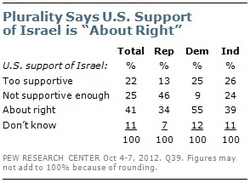 Views on adequacy of U.S. government support for Israel. |
Jan. 8, 2013 update: A Pew Research Center survey of American adults (not necessarily voters) conducted on Dec. 5-9, 2012, found partisan differences vis-à-vis the Arab-Israeli conflict greater than ever: 50 percent overall sympathize more with Israel, 10 percent more with the Palestinians. Of them:
70 percent of Republicans sympathize with more Israel, 2 percent more with the Palestinians. Of them, 75 percent of conservative Republicans sympathize more with Israel and 60 percent of moderate and liberal Republicans.
41 percent of Democrats sympathize more with Israel, 13 percent more with the Palestinians. Of them, 46 percent of conservative and moderate Democrats sympathize more with Israel and 33 percent of liberal Democrats.
Note the linear progression from conservative Republican to liberal Democrat.
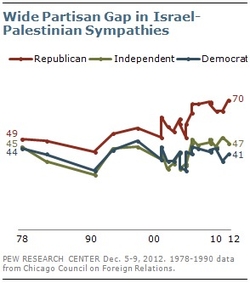 Wide gap between Republican & Democrats in Israeli-Palestinian sympathies. |
Looking at religion, Israel has the sympathy of 67 percent of white evangelical Protestants, 47 percent of white mainline Protestants, 47 percent of white Catholics, and 40 percent of the religiously unaffiliated.
As for age, Israel does well among those older and less well among the younger. Best are those 50 and older (58 percent), medium those 30-49 (46 percent), and worst among those 18-29 (38 percent).
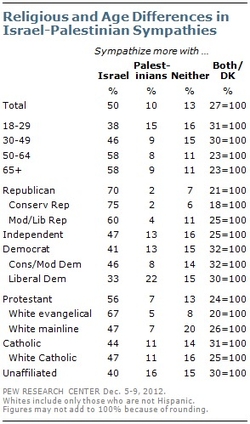 How religious and age differences affect sympathies vis-à-vis Israel and the Palestinians. |
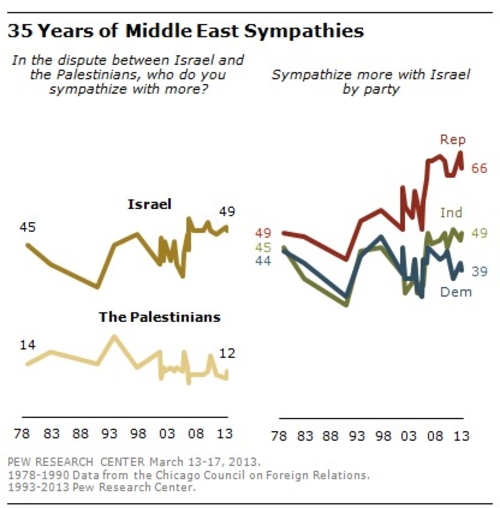
Looking at these numbers over time, Pew finds that "differences have widened as Republican support for Israel has grown and Democratic opinion has been more stable." Republicans now favor Israel with a 70 percent majority; that figure was 56 percent in 2002 and 49 percent in 1978. Democrats now weigh in at 41 percent, hardly differing from 2002 (37 percent) and 1978 (44 percent). Note how wide the partisan gap has grown, from a 5-point spread in 1978 (49 to 44) to a 29-point (70 to 41) today.
Feb. 14, 2013 update: Richard Baehr ponders the nomination of Chuck Hagel for U.S. secretary of defense and asks "Are we down to one pro-Israel party?" Some excerpts:
It is pretty clear at this point that on any matter of substance that impacts on the relationship between Israel and the U.S., the Democrats in the Senate and House will side with whatever choice is made by the president, as long as that president is Obama. ...
As the fundraising base of each party has expanded over the years (each presidential candidate raised over a billion dollars for the 2012 race, and total spending on House and Senate races were multiples of that level), the role of pro-Israel donors has shrunk. On the Democratic side, there are many prominent Jewish donors, but for almost all of them, support for Israel is a peripheral issue, not the primary reason they give to Democrats. The more important issues are abortion rights, gay rights, opposition to the so-called religious Right, and liberalism in general.
Baehr contrasts the situation to years past, when
liberal Jews were quite comfortable being seen as pro-Israel. That is no longer the case. Democratic members of Congress will be happy to cheer for Prime Minister Benjamin Netanyahu when he speaks to Congress, they will vote for foreign aid (and get a check mark for doing so from the American Israel Public Affairs Committee), and they will bask in the knowledge that with such minimal effort, they will have surpassed the very low bar required to get a passing grade on Israel, which still matters in order to keep a few of their supporters happy. These members of Congress can then go on to concentrate on the agenda that matters to liberal Democrats, for which Israel is not anywhere near the top of the list.
Note the sentence I bolded below, an explanation worthy of deep consideration both on this issue and the Islamist one:
Among liberal Jews, and Democrats in general, there is quiet support among some for Israel, especially among older voters, but the real activism is on the hard Left, and it is almost entirely hostile to Israel. The younger liberal Jews and Democrats are particularly unenthusiastic about Israel. Part of this is that many on the Left now see politics as war, and they want no part in any cause in which their political enemies on most issues are on the same side on that issue. Christian conservatives are strong supporters of Israel. The Left hates the Christian Right, mainly for its approach to social issues. Ergo, Israel is toxic, and not deserving of support.
The result is a support for Israel bordering on the nominal:
Democrats are well aware of how their party's base has changed and continues to change with regard to views towards Israel. Many elected Democrats prefer to keep a light foot in the pro-Israel camp, but will never do anything that involves taking any risk, such as challenging a Democratic president on a matter related to Israel. Cowardice rules.
At the AIPAC Policy Conference in Washington, just over two weeks from now, it will be business as usual. The organizers will work to insure exact balance in the number of Democrats and Republicans who speak to the conference attendees. They will read introductions of each elected official that are identical in length, and equally praiseworthy for their great service to preserving the U.S.-Israel relationship. But with each succeeding year, it becomes more difficult to not see that this is largely a charade. When push comes to shove, there is now only one political party, to use Obama's expression, that has Israel's back.
That reality is not a good thing for Israel. Cheapening what it means to be pro-Israel so that it can appear to be bipartisan is no different from practicing rampant grade inflation at colleges and high schools. When it comes to support for Israel, Congress is not like Garrison Keillor's Lake Wobegon, where all the members are just a little bit above average.
Feb. 27, 2013 update: Jennifer Rubin of the Washington Post got privileged access to cross-tabs on a recent NBC/Wall Street Journal poll and wrote up the results at "Democrats' Israel problem":
The poll asked if the United States should favor the Israelis, favor the Palestinians or treat both the same. Among Democrats, only 18 percent said favor the Israelis; 52 percent of Republicans picked Israel. The poll also asked for which side the respondent had more sympathy. Only 34 percent of Democrats picked Israel, while 67 percent of Republicans did.
Mar. 18, 2013 update: (1) A poll by Langer Research Associates for ABC News and the Washington Post finds the usual distribution across the U.S. political spectrum. Noteworthy (and troubling for Israel), however, is the proximity of independents to Democrats and their distance from Republicans (49, 51, and 73 percent, respectively).
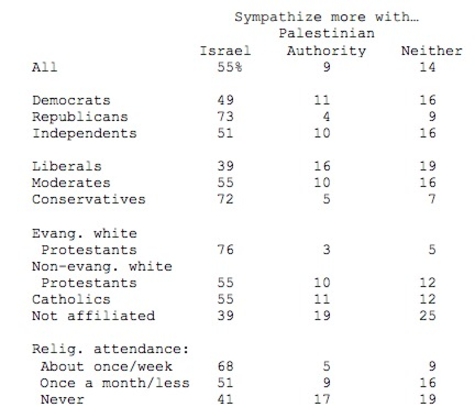 Results of a March 7-10 telephone poll done by Langer Research Associates. |
(2) Gallup published results of a February poll in which two questions also found the usual political distribution.
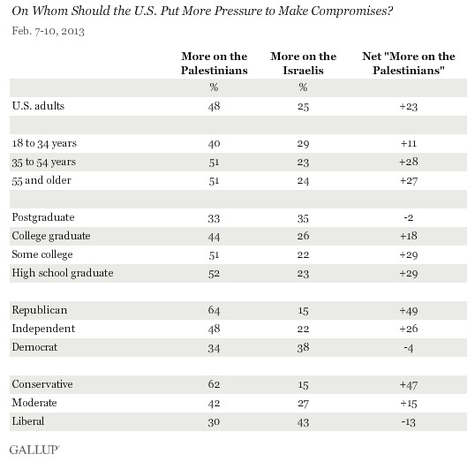 Gallup: On whom should the U.S. put more pressure to make compromises? |
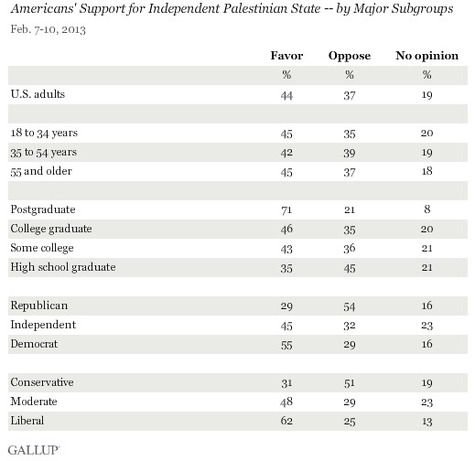 Gallup: American support for an independent Palestinian state. |
Mar. 19, 2013 update: (1) A CNN/ORC International poll finds 46 percent of Americans say Israel is an ally of the U.S. This divides into 63 percent of Republicans calling Israel an ally and 33 percent of Democrats.
(2) Pew Research Center reports on its poll conducted March 13-17 among 1,501 adults: The center
finds that 49% say they sympathize more with Israel, while just 12% sympathize more with the Palestinians and the same percentage (12%) volunteers that they sympathize with neither side.
Dating back to 1978, just prior to the peace agreement between Israel and Egypt, the public has consistently sympathized more with Israel than the Palestinians. But the partisan differences in sympathies are much wider today than they were 35 years ago.
In the current survey, 66% of Republicans say they sympathize more with Israel than the Palestinians, compared with 49% of independents and 39% of Democrats. In the 1978 survey, conducted by the Chicago Council on Foreign Relations, 49% of Republicans, 45% of independents and 44% of Democrats sympathized more with Israel than the Palestinians.
July 15, 2014 update: Sixteen months later, another Pew Research Center poll confirms existing trends. Of particular interest is that this poll was conducted among 1,805 adults on July 8-14 – in other words, in the middle of the a war between the Palestinian organization Hamas and Israel.
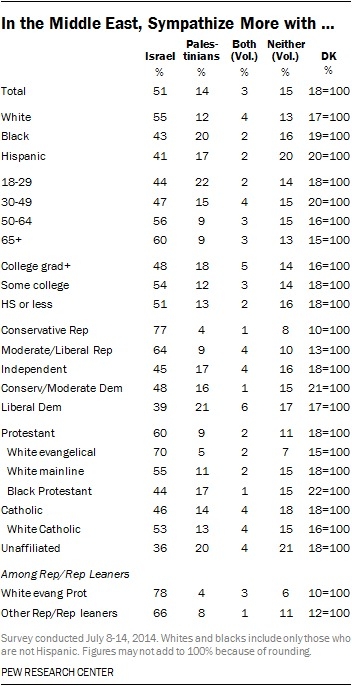 Current attitudes, divided by population group. |
On the basic sympathy question, 51 percent sympathize more with Israel and 14 percent with the Palestinians. This hardly differs from the March 2013 figures (above) of 49 and 12.
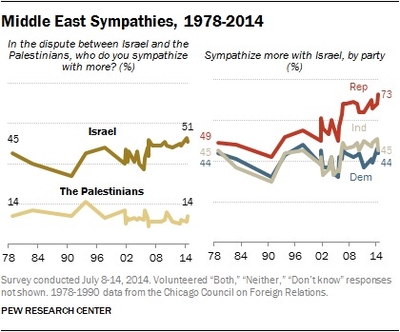 Historical attitudes. |
One small oddity – perhaps important for the future? - is that conservative/moderate Democrats weigh in more sympathetic to Israel (48 percent) than do Independents (45 percent), disrupting the usual linear progression from right to left. Likewise, the Independents are marginally more sympathetic to Palestinians (17 percent) than the conservative/moderate Democrats (16 percent).
July 21, 2014 update: A CNN poll conducted by ORC International on July 18-20, with 1,012 adult Americans questioned by telephone finds that 45 percent of Democrats, 56 percent of independents, and 73 percent among Republicans say that Israel's current military actions in Gaza are justified.
July 28, 2014 update: Pew is back with another report, this one looking in more detail at the Hamas-Israel war now taking place.
On the question "Who is most responsible for the current violence," 40 percent of American adults blame Hamas and 19 percent blame Israel. Democrats split 29-26 percent, Independents 42-20 percent, and Republicans 60-13 percent. In other words, the Ds blame Hamas by 3 percent, the Is by 22 and the Rs by 47 percent. Or: Is differ from Ds by 19 percent and from the Rs by 25 percent.
On the question "Israel's response to conflit with Hamas has ...," 25 percent of the total sample opines that Israel has gone too far and 15 percent not far enough. Democrats vote 35-9 percent, Independents 27-18 percent, and Republicans 16-19 percent. In other words, the Ds think Israel went too far by 26 percent, the Is by 9 and the Rs by -3 percent. Or: Is differ from Ds by 17 percent and from the Rs by 12 percent.
Comment: The differences are (1) nearly linear (with the Is roughly half-way between the parties) and (2) growing wider apart.
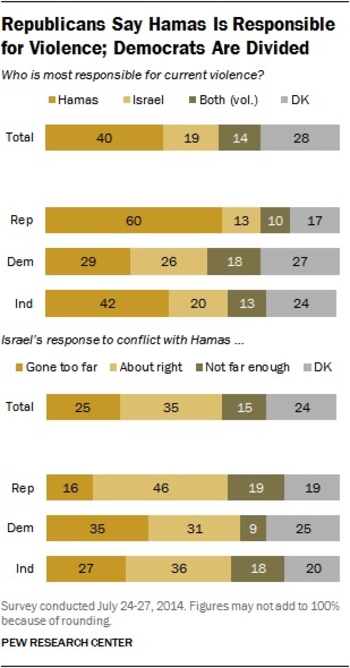 Pew's survey about party affiliations in views on the Hamas-Israel war. |
Aug. 1, 2014 update: Surveying 1,010 Americans for The Israel Project, Paragon Insights asked: "Thinking about the ongoing conflict between Israel and the Palestinians in the Middle East, please tell me whether, in general, you think America should be: a strong supporter of Israel, a supporter of Israel, a supporter of the Palestinians, or a strong supporter of the Palestinians?"
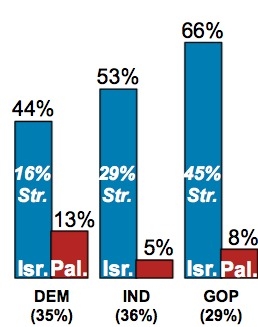 Paragon Insights poll conducted on July 21-22, 2014. |
In reply, the sample showed the usual near-linear result of support for Israel: 66 percent of Republicans, 53 percent of Independents, and 44 percent of Democrats.
Support for Palestinians came out less predictably: 8 percent of Republicans, 5 percent of Independents, and 13 percent of Democrats.
Aug. 5, 2014 update: I look at "How Church Attendance Affects American Attitudes toward Israel" today, based on 14 years of Gallup polls. One excerpt: "Political views matter more than religiosity: 'nonreligious Republicans are more likely to sympathize with Israelis than highly religious Democrats'."
Aug. 6, 2014 update: CBS News finds that 34 percent of Americans polled say Hamas is most to blame in the current Hamas-Israel conflict and 6 percent mostly blame on Israel. 54 percent of Republicans mainly blame Hamas, 32 percent of independents, and 24 percent of Democrats.
47 percent blame both sides equally. That number breaks down to 55 percent of Democrats, 48 percent of Independents, and 35 percent of Republicans.
Feb. 23, 2015 update: Gallup released an analysis of poll results, "Seven in 10 Americans Continue to View Israel Favorably," which includes a breakdown of Republicans and Democrats in a section titled "Republicans Nearly Unanimous in Support of Israel":
Republicans' support for the Jewish state has increased considerably, rising from 53% in 2000 to more than 80% since 2014 – with just 7% choosing the Palestinian Authority. A particularly large jump in GOP sympathy for Israel occurred in the first few years after 9/11 and at the start of the 2003 Iraq War.
Democrats' support for Israel has also risen since 2000, but not quite as sharply as Republicans'. Additionally, the percentage of Democrats sympathizing with Israel fell 10 points this year to 48%, possibly reflecting the tension between Obama and Netanyahu.
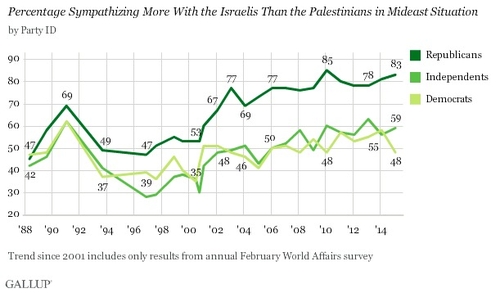 Republicans diverge increasingly from Democrats on views of Israel ... |
Feb. 24, 2015 update: The usual partisan difference shows up on another, related topic in the Gallup Poll: who favors creating a Palestinian state. 33 percent of conservatives, 48 percent of moderates, and 57 percent of liberals support this outcome. The against ledger reads, respectively, 52, 32, and 25 percent.
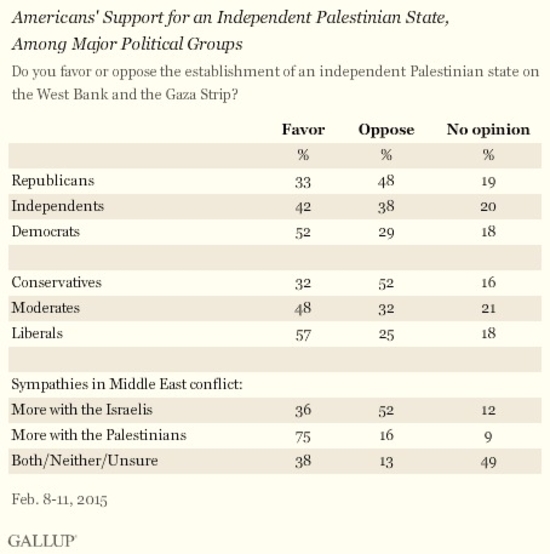 ... as do conservatives and liberals on the matter of a Palestinian state. |
Mar. 3, 2015 update: Every single member of Congress who has announced his absence when Binyamin Netanyahu speaks today about the Iran issue is a Democrat, not a single one is a Republican:
SENATE - 9 members
Vice President Joe Biden
Sen. Al Franken (Minn.)
Sen. Martin Heinrich (N.M.)
Sen. Tim Kaine (Va.)
Sen. Patrick Leahy (Vt.)
Sen. Bernie Sanders (I-Vt.)
Sen. Brian Schatz (Hawaii)
Sen. Elizabeth Warren (Mass.)
Sen. Sheldon Whitehouse (R.I.)
HOUSE - 48 members and 1 delegate
Rep. Karen Bass (Calif.)
Rep. Earl Blumenauer (Ore.)
Rep. Corrine Brown (Fla.)
Rep. G.K. Butterfield (N.C.)
Rep. Lois Capps (Calif.)
Rep. Andre Carson (Ind.)
Rep. Joaquin Castro (Texas)
Rep. Katherine Clark (Mass.)
Rep. William Lacy Clay (Mo.)
Rep. James Clyburn (S.C.)
Rep. Emanuel Cleaver (Mo.)
Rep. Steve Cohen (Tenn.)
Rep. Bonnie Watson Coleman (N.J.)
Rep. John Conyers (Mich.)
Rep. Elijah Cummings (Md.)
Rep. Danny Davis (Ill.)
Rep. Peter DeFazio (Ore.)
Rep. Diana DeGette (Colo.)
Rep. Lloyd Doggett (Texas)
Rep. Donna Edwards (Md.)
Rep. Chaka Fattah (Pa.)
Rep. Keith Ellison (Minn.)
Rep. Marcia Fudge (Ohio)
Rep. Raúl Grijalva (Ariz.)
Rep. Luis Gutiérrez (Ill.)
Del. Eleanor Holmes Norton (D.C.)
Rep. Eddie Bernice Johnson (Texas)
Rep. Marcy Kaptur (Ohio)
Rep. Rick Larsen (Wash.)
Rep. Barbara Lee (Calif.)
Rep. John Lewis (Ga.)
Rep. Dave Loebsack (Iowa)
Rep. Zoe Lofgren (Calif.)
Rep. Betty McCollum (Minn.)
Rep. Jim McDermott (Wash.)
Rep. Jim McGovern (Mass.)
Rep. Jerry McNerney (Calif.)
Rep. Gregory Meeks (N.Y.)
Rep. Gwen Moore (Wis.)
Rep. Beto O'Rourke (Texas)
Rep. Donald Payne (N.J.)
Rep. Chellie Pingree (Maine)
Rep. David Price (N.C.)
Rep. Cedric Richmond (La.)
Rep. Jan Schakowsky (Ill.)
Rep. Adam Smith (Wash.)
Rep. Bennie Thompson (Miss.)
Rep. Mike Thompson (Calif.)
Rep. John Yarmuth (Ky.)
Mar. 30, 2015 update: A Pew Research Center poll finds the usual, nearly linear division in support for Israel and the Palestinians. 83 percent of conservative Republicans support Israel a lot or some, as do 71 percent of moderate/liberal Republicans, 63 percent of Independents, 55 percent of conservative/moderate Democrats, and 60 percent of liberal Democrats (wondering if that last isn't a typo).
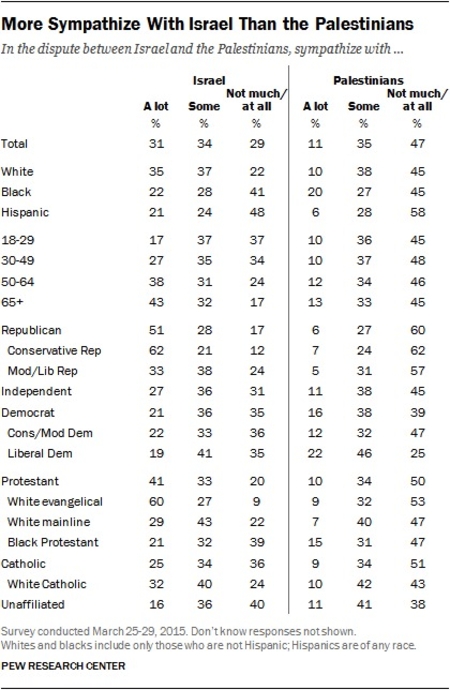
Apr. 15, 2015 update: A Bloomberg opinion survey written up by Margaret Talev finds that "Israel has become a deeply partisan issue for ordinary Americans as well as for politicians in Washington, a shift that may represent a watershed moment in foreign policy and carry implications for domestic politics after decades of general bipartisan consensus." Specifics:
- Republicans say the U.S. should support Israel even when its stances diverge with American interests by 67 percent to 30 percent; Independents agree by 48 percent to 44 percent; and Democrats say the opposite is true by a similar margin to the Republicans, arguing that the U.S. must pursue its own interests over Israel's.
- Republicans are more sympathetic to Israel's Prime Minister Binyamin Netanyahu than to Obama by 67 percent to 16 percent; Independents are more sympathetic to Obama than to Netanyahu by 44 percent to 37 percent; and Democrats are more sympathetic to Obama than to Netanyahu by 76 percent to 9 percent.
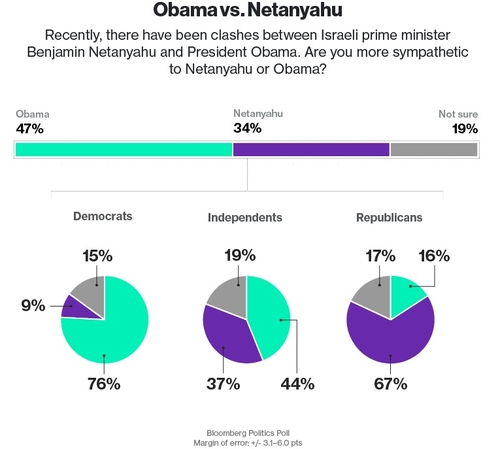
The article quotes J. Ann Selzer who oversaw the poll: "Israel is an emotionally charged issue, period. It's affecting a broader audience than the Jewish vote."
July 5, 2015 update: Survey research by Frank Luntz finds that a large gap between Democrats and Republicans on a wide variety of Israel-related issues. As reported by the Times of Israel:
- Asked about Israeli influence on US foreign policy, an overwhelming 76 percent of Democrats, as compared to 20 percent of Republicans, said Israel has "too much influence."
- Asked whether Israel is a racist country, 47 percent of Democrats agreed it is, as opposed to 13 percent of Republicans. Another 21 percent of Democrats didn't know or were neutral (as opposed to 12 percent of Republicans), and only 32 percent of Democrats disagreed when asked if Israel is a racist country, as opposed to 76 percent of Republicans. (Overall 32 percent of those polled said Israel is a racist country.)
- Asked whether Israel wants peace with its neighbors, while an overwhelming 88 percent of Republicans said it does, a far lower 48 percent of Democrats agreed. Another 21 percent of Democrats didn't know or were neutral (as compared to 7 percent of Republicans). And 31 percent of Democrats did not think Israel wants peace (as compared to 5 percent of Republicans).
- Asked whether they would be more likely to vote for a local politician who supported Israel and its right to defend itself, an overwhelming 76 percent of Republicans said yes, but only 18 percent of Democrats said yes. Meanwhile, only 7 percent of Republicans — but 32 percent of Democrats — said they would be less likely to support a local politician who backed Israel.
- Asked whether they would be more likely to vote for a local politician who criticized Israeli occupation and mistreatment of Palestinians, 45 percent of Democrats said yes, compared to just 6 percent of Republicans. Asked whether they would be less likely to vote for a local politician who criticized Israeli occupation and mistreatment of Palestinians, a whopping 75 percent of Republicans said yes, compared to just 23 percent of Democrats.
- Asked whether the US should support Israel or the Palestinians, a vast 90 percent of Republicans and a far lower 51 percent of Democrats said Israel. Another 8 percent of Republicans and 31 percent of Democrats were neutral. And 18 percent of Democrats said the Palestinians, compared to 2 percent of Republicans. Overall, 68 percent of those polled said the US should support Israel, and 10 percent said the US should support the Palestinians.
- Asked about which side they themselves support, 88 percent of Republicans and 46 percent of Democrats said they were "pro-Israeli" while 4 percent of Republicans and 27 percent of Democrats said they were "pro-Palestinian."
- Asked if settlements are an impediment to peace, 75 percent of Democrats and 25 percent of Republicans agreed.
Nov. 9, 2015 update: Dina Smeltz reviews the bidding at "Did Netanyahu's visit divide American opinion on Israel? These are the facts."
Nov. 15, 2015 update: The Chicago Council on Global Affairs asks the same question every few years, "Do you favor or oppose the establishment of an independent Palestinian state on the West Bank and Gaza?" The results over a 17-year period show Republicans negative, other than a brief shift under early George W. Bush, independents vaguely following the Republican pattern, and Democrats ever-more enthused.
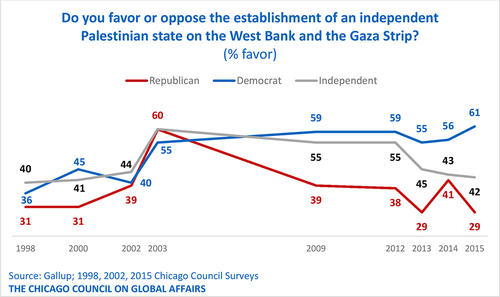 The Chicago Council on Global Affairs' historical review. |
Dec. 1, 2015 update: The December issue of Commentary magazine contains a pair of articles that build on the information presented here: "How the GOP Went Zionist" by Tevi Troy and "The Democratic Divorce from Israel" by Jonathan S. Tobin.
Feb. 29, 2016 update: Gallup finds a 26-point difference between Democrats and Republicans in a poll released today. The question is, as every year, "In the Middle East situation, are your sympathies more with the Israelis or more with the Palestinians?" In reply, 53 percent of Democrats, 56 percent of independents, and 79 percent of Republicans say Israelis. Overall, 62 percent say Israelis and 15 percent say Palestinians, for the usual 4-to-1 ratio.
May 6, 2016 update: A new Pew Research Center poll on American attitudes toward Israel and the Palestinians finds a 32-percent difference between Republicans (at 75 percent) and Democrats (at 43 percent). It also shows a near-linear progression from conservative to liberal, but with a kicker at the end of the spectrum:
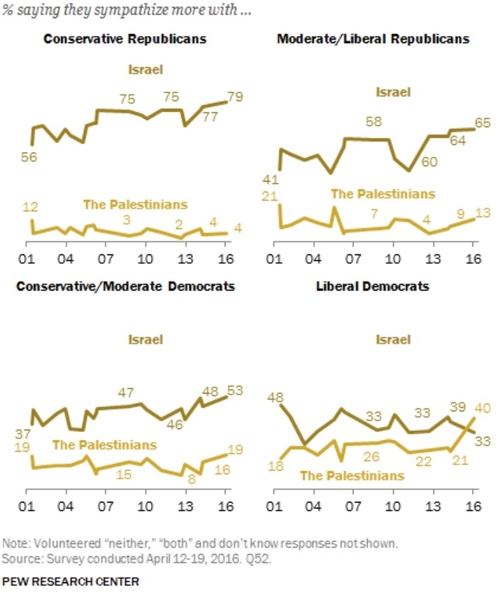

The differences on the pro-Israel side are 14-12-20; on the pro-Palestinian side 9-6-21.
Comments: (1) The R-D difference continues to grow.
(2) The anomaly here is the very large shift among liberal Democrats. Had they followed the usual progression, they would favor Israel by 40-33, and not the other way around.
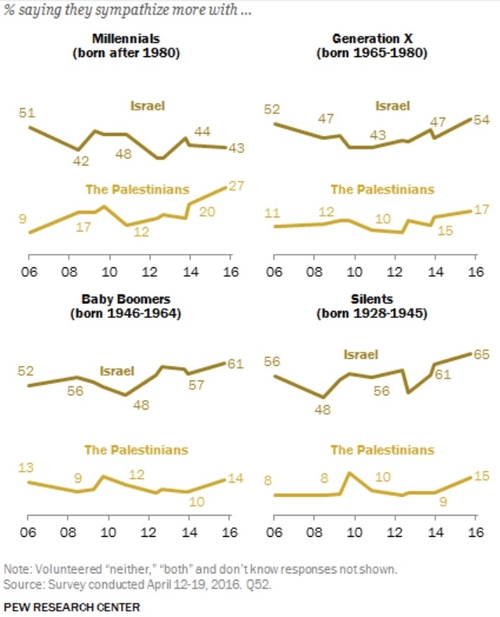
(3) Unrelated to the topic of this blog, which is political outlook, a parallel progression now exists among age groups:
June 1, 2016 update: In the conclusion to Trends in US Congressional Support for Israel, Amnon Cavari writes about what he calls "Congressional Dysergia" (dysergia is a medical term meaning "lack of harmonious action between the muscles concerned in executing any definite voluntary movement"):
while bipartisan support does continue, we find a recent lack of cooperation between the parties in expressing that support, a development we call Congressional Dysergia. The two parties agree on the grand strategy of American support for Israel, but have different views and act independently. Republican resolutions often take a hawkish approach towards the sensitive issues in the region; Democrats shy away from signing onto those resolutions. In contrast, we find just five "only Democrat" resolutions referring to Israel in recent Congresses — all of which focus on the peace process.
Aug. 27, 2016 update: Jeff Ballabon and Bruce Abramson compare the two parties' platforms and find there's "No contest: GOP is the pro-Israel party. Bipartisan support for the Jewish state is a fallacy: Republicans embrace Israel as an ally, Democrats do not."
Dec. 25, 2016 update: The American Public Opinion Toward Israel project at the Interdisciplinary Center Herzliya has graphed the change since 1967 to the standard Gallup question, "In the dispute between Israel and the Arab countries/Palestinians, which side do you sympathize with more?"
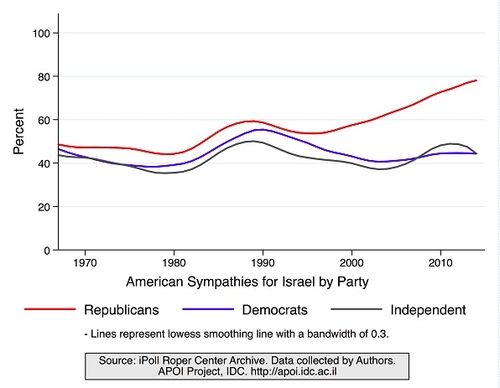
The three lines are closely aligned until the aftermath of Soviet collapse in about 1995, when Republicans became far more sympathetic to Israel while Democrats and Independents went down slightly, though within historic norms.
The real news over the past two decades, then, has been a major gain in conservative support for Israel, now approaching 80 percent.
Jan. 12, 2017 update: A Pew Research Center poll finds that Republican-Democratic divide in response to the question, "In the dispute between Israel and the Palestinians, who do you sympathize with more?" differs by 41 percent, or 74 to 33 which is more than 2-to-1 and more than ever before. Independents are roughly in the middle at 50 percent, but a bit closer to Democrats. (Pew's graph goes back to 1978 by relying for the early years on Chicago Council on Foreign Relations data.)
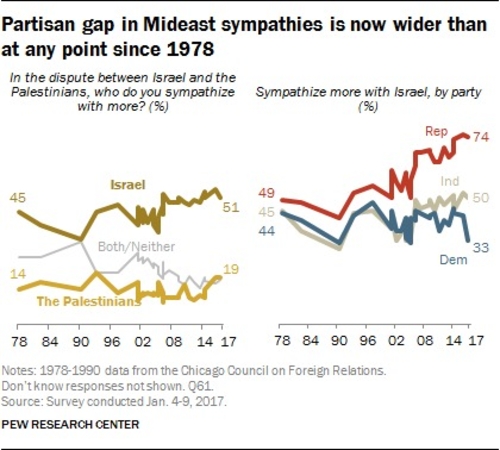
Jan. 5, 2017 update: The House of Representatives voted 342-80 to condemn the Obama administration's abstention on an anti-Israel U.N. Security Council vote last month (known as 2334). The Republicans voted 233-4 in favor of the resolution, with the 4 nays, led by Rep. Steve King (Republican of Iowa) not opposed to condemning the vote but opposed to two-state language in the resolution. On the other side, the Democrats voted 109-76 in favor of the resolution. In percent terms, Republicans voted effectively 100 percent for it, Democrats voted 59 percent in favor of it, a 41-percent gap.
Feb. 13, 2017 update: Gallup finds that 82 percent fo Republicans sympathize more with Israel than with the Palestinians, 57 percent of independents, and 47 percent of Democrats. Conversely, 6 percent of Republicans sympathize more with the Palestinians, 23 percent of independents, and 29 percentof Democrats.
Apr. 20, 2017 update: The University of Maryland published another in its series of polls on "American Attitudes on the Israeli-Palestinian Conflict" with Shibley Telhami and Stella Rouse as principal investigators. Asked "what role do you want the new Trump administration to play in mediating the Israeli-Palestinian conflict?" the usual R-I-D spread emerged, with Republicans wanting 22-to-1 a lean toward Israel, Independents wanting this 3.5-to-1, and Democrats wanting it 1.4-to-1.
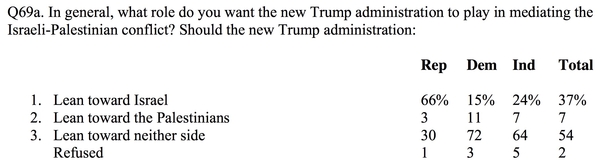 Results of the University of Maryland poll. |
Dec. 22, 2017 update: Asked about Trump's Dec. 6 decision to recognize Jerusalem as the capital of Israel and move the U.S. embassy there, CNN reports, 79 percent and 66 percent, respectively, of Republicans approve. In contrast, 71 percent of Democrats are opposed to both.
Should the U.S. government should remain neutral or take sides in the Palestinian-Israeli conflict? 78 percent of Democrats, 70 percent of independents, and 44 percent of Republicans call for neutrality. Among those who favor taking sides, Democrats support Israel 12-2 and Republicans do so 48-2, a whopping four times more.
Jan. 23, 2018 update: The Pew Research Center asked, "In the dispute between Israel and the Palestinians, who do you sympathize with more?" and got some striking answers: 79 percent of Republicans and 27 percent of Democrats sympathize more with Israel. In contrast, 6 percent of Republicans and 25 percent of Democrats sympathize more with the Palestinians.
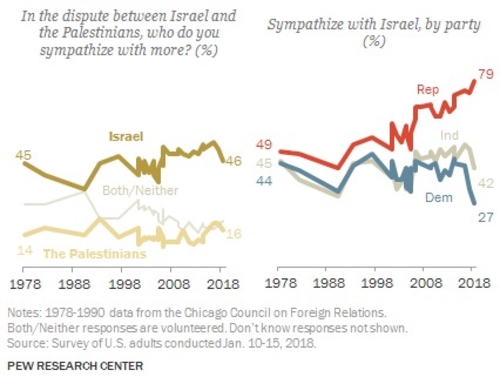
Comment: By leaps and bounds, this is the widest separation of the two parties. As nothing suggests a consensus, this trend will presumably continue.
Mar. 13, 2018 update: A Gallup poll asking the standard question, "In the Middle East situation, are your sympathies more with the Israelis or more with the Palestinians?" finds "Americans Remain Staunchly in Israel's Corner" with 64 and 19 percent replies, or nearly 3.5 to 1.
When it comes to political affiliation, Republicans reached a new high with 87 percent support, while Independents and Democrats have also increased, to 59 and 49 percent.
Apr. 24, 2019 update: Gallup finds that while the Republicans favor the Israeli government over the Palestinian Authority by a whopping 50 percent, Democrats favor Abbas over Netanyahu by 1 percent. (How I reached these numbers: 61-11 = 50, 26-27 = -1.) The latter is a remarkable result with vast implications for the future of U.S. relations with Israel.
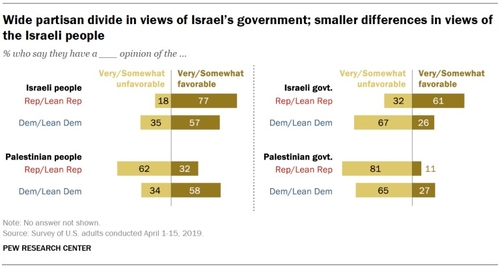
Also of note: Gallup has creatively asked new questions: whether Americans view favorably or unfavorably the Israeli and Palestinian people vs their governments. The result finds both Democrats and Republicans favor the Israeli people more than their government, but the difference is twice as big among Ds than Rs, 31 vs 16 percent. (57-26 = 31, 77-61 = 16.)
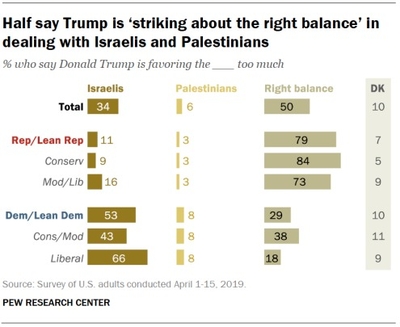
Unsurprisingly, reactions to Trump's policy vis-à-vis Israel and the Palestinians ranges from 84 percent support among conservative Republicans to 73 percent among moderate Republicans to 38 among moderate Democrats to 18 percent among liberal Democrats. This is the usual, nearly linear progression. Presumably, Independents would weigh in with around 55 percent, right in the middle of the two parties.
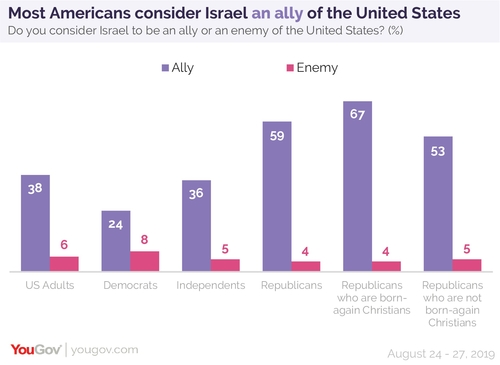
Aug. 30, 2019 update: An Economist/YouGov poll is aptly titled "When it comes to Israel, American views are partisan." Two graphs sum up the massive difference between Democrats and Republicans.
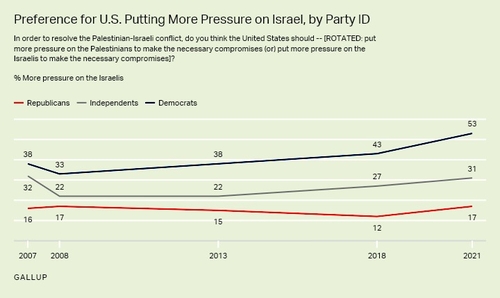
Mar. 19, 2021 update: Gallup asked Americans: "In order to resolve the Palestinian-Israeli conflict, do you think the United States should put more pressure on the Israelis to make the necessary compromises?" The answers since 2007 show a consistently appropriate 3 Democrats agreeing with this statement for every 2 Independents and 1 Republican.
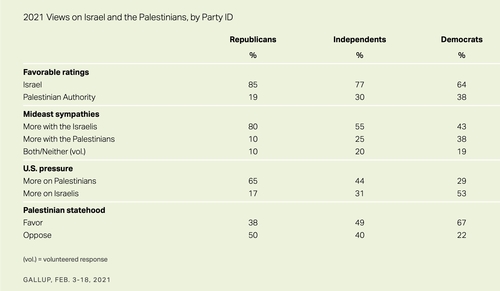
A snapshot of party identification on four questions pertaining to the Palestinian-Israeli conflict again finds a fair degree of consistency.
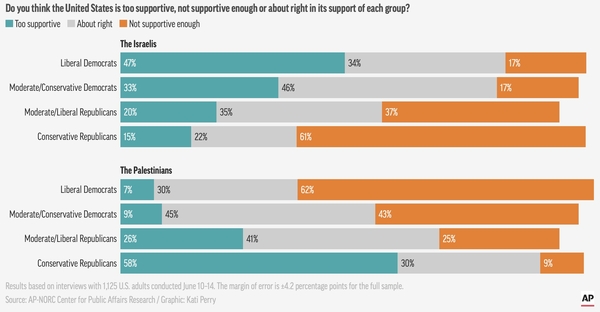
June 23, 2021 update: The Associated Press and the NORC Center for Public Affairs Research asked of an American sample, "Do you think the United States is too supportive, not supportive enough or about right in its support of each group?" referring to the Israelis and the Palestinians. The results confirm the usual pattern of views.
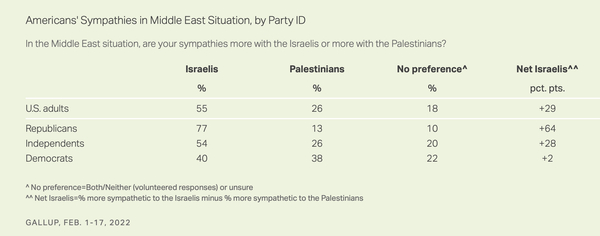
Mar. 17, 2022 update: Hewing to the usual pattern, Gallup finds Republicans twice as friendly to Israel than Democrats and Democrats three times friendlier to the Palestinians as Republicans. Of note: Democratic views of the two parties are just about even.
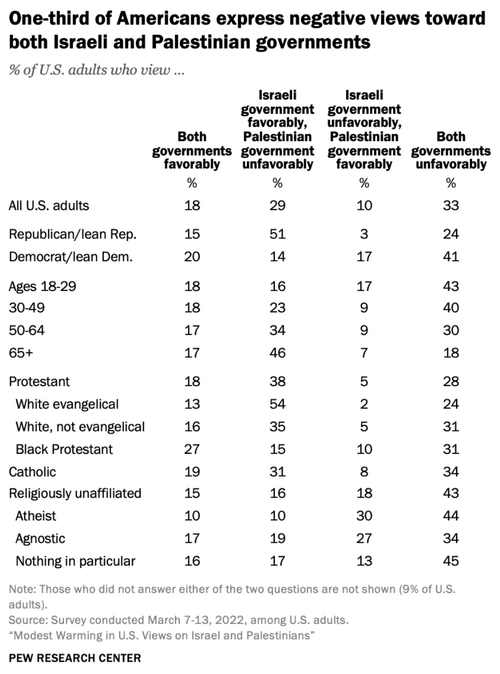
May 26, 2022 update: Pew Research Center finds a radical difference between Democrats and Republicans view of what it calls the Israeli and Palestinian governments, with Democrats slightly favoring the Palestinian (37 to 34 percent) and Republicans favorable to Israel by an almost 4-to-1 ratio (66 to 18 percent). Confusingly, the pollsters "did not define 'Palestinian government'," leaving it up to respondents to think of either the Palestinian Authority or Hamas.
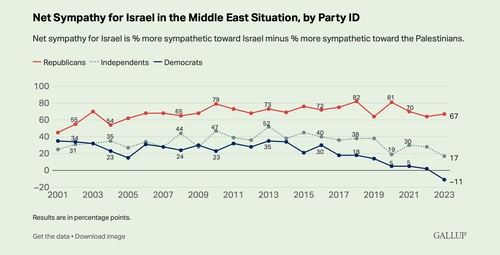
March 16, 2023 update: In a very important moment, Democrats now favor the Palestinians over Israel in the latest Gallup poll, and by a very significant 11 percent. Independents are also trending downwards.
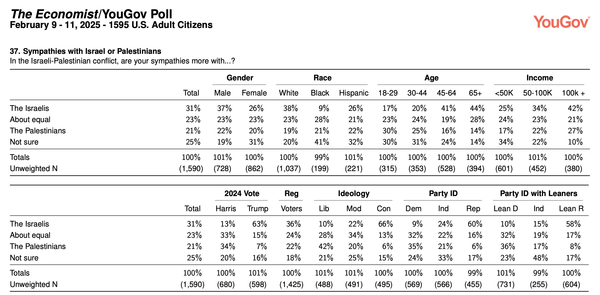
Feb. 12, 2025 update: In the first update for almost two years, YouGov finds a larger-than-ever difference between the parties. Asked "In the Israeli-Palestinian conflict, are your sympathies more with" Israel or Palestinians, Republicans favor Israel 60-to-6 percent while Democrats favor Palestinians 35-to-9 percent. The age differentials are almost as large with citizens over 65 favoring Israel 44-to-14 percent and those between 18 and 29 favoring the Palestinians 30-to-17 percent.
Feb. 24, 2025 update: Gallup finds a record-high difference - 50 percent - in views of Israel between Republicans and Democrats: 83 percent vs. 33 percent. Republicans have stayed constant but Democrats have soured on the Jewish state. Independents have also become much more negative.
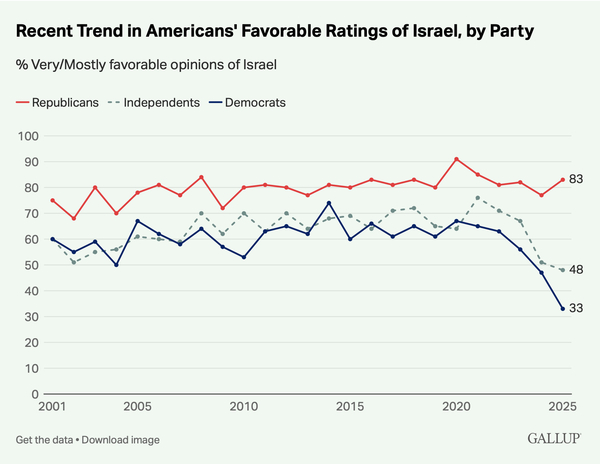 A wider chasm than ever between Rs and Ds vis-à-vis Israel. |
Jeffrey M. Jones of Gallup puts the overall negativity into perspective:
This year marks the first time any party group has had majority-level unfavorable ratings of Israel, with 60% of Democrats expressing that view. Forty-four percent of independents also have an unfavorable opinion of Israel.
Democrats' and independents' sagging views of Israel have pushed its favorability to 54% among all Americans, its lowest rating since January 2000, when it was also at 54%.
The last time Americans had worse opinions of Israel -- 48% favorable -- was in February 1992. The all-time low was 45% favorable (and 45% unfavorable) in 1989.
Apr. 8, 2025 update: The Pew Reseach Center finds that 13 percent of Republicans and Americans who lean Republican believe that "Donald Trump is favoring Israelis too much," whereas 50 percent of Democrats and those leaning Democratic believe this.
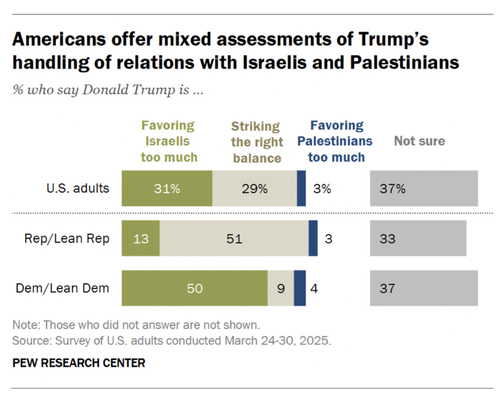
June 11, 2025 update: A Quinnipiac University National Poll asked U.S. voters "whether their sympathies lie more with the Israelis or more with the Palestinians based on what they know about the situation in the Middle East."
Republicans: 64-7 percent in favor of Israelis.
Independents: 38-30 percent.
Democrats: 12-60 percent.
Comment: Oct. 7 turned Democrats unprecedentedly against Israel.
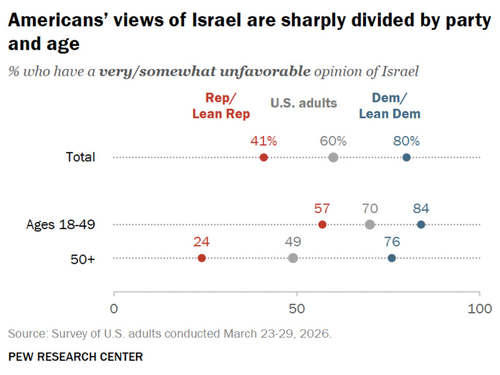
Apr. 7, 2026 update: The Pew Research Center finds that Israel's position among Americans keeps slipping even as the liberal-conservative divide keeps widening.
Eight-in-ten Democrats and Democratic-leaning independents currently have an unfavorable view of Israel, up from 69% last year and 53% in 2022. Democrats under 50 are slightly more likely than older Democrats to say they have a very unfavorable view of Israel (47% vs. 39%).
May 20, 2026 update: A New York Times/Siena Reseach Institute National Poll finds:
- 74 percent of Democratic voters oppose "providing additional economic and military support to Israel" and 20 percent favor further aid to Israel.
- 60 percent of Democrats sympathize more with the Palestinians and 15 percent more with Israel.
- 48 percent of Democrats consider the party has been "too supportive of Israel" and 8 percent say it is not supportive enough.
July 10, 2026 update: The Wall Street Journal has summarized the trend in Democratic attitudes, as reported by Gallup:
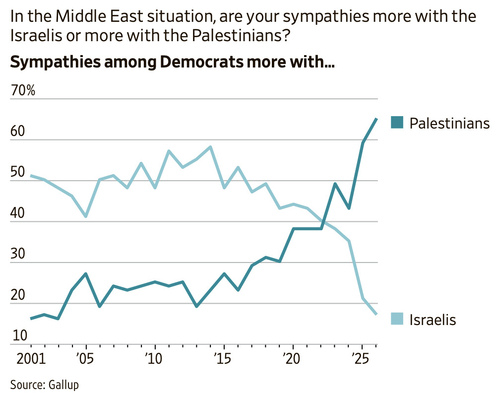
July 15, 2026 update: In a vote widely seen as marking a major turning point, more than half the House Democrats who took a stand voted against aid to Israel, 103 to 98.


