
This weblog supplements my two articles outlining the danger of a collapse of Iraq's Mosul dam:
- "Saddam's Damn Dam [i.e., The Mosul Dam]," Jerusalem Post, Nov. 7, 2007.
- "Iraq's Coming Apocalypse," Washington Times, March 13, 2016.
For details about the report by the U.S. Special Inspector General for Iraq Reconstruction (SIGIR), Stuart W Bowen Jr, to the U.S. Congress, here is Alexandra Wynne in New Civil Engineer. Bowen said
the $27M (18.4M) reconstruction project on the Mosul Dam – the country's largest – has lacked any "significant progress", two years after it began. ... The US government is funding the project to improve basic grouting facilities needed to tackle problems with the dam foundation, while the Iraqi Ministry of Water Resources seeks a longer-term solution.
The document said improvements to concrete-mixing units had not been completed: "Three mixing plants currently provide no usable benefit to the ministry. Because the contract required delivery of five grout-mixing plants by July 2006, the massive grouting and enhance grouting programmes are now more than one year behind schedule." The dangerous security situation in Iraq hampered the SIGIR inspection team and meant it could only conduct site visits for three hours at a time – it made two of these in September.
The day before the quarterly report, the Office of SIGIR published Relief and Reconstruction Funded Work at Mosul Dam, Mosul, Iraq. The report cites a letter sent in May to Iraqi prime minister Nouri al-Maliki from the US ambassador in Baghdad warning that an instantaneous failure of the dam when at its maximum operating level would be catastrophic.
An extract of that urgent letter from both David Petraeus and Ryan Crocker, the U.S. commanding general and ambassador in Iraq, respectively, to Maliki: the dam was constructed on "a foundation of soluble soils that are continuously dissolving, resulting in the formation of cavities and voids underground that place the dam at risk for failure." (November 30, 2007)
Dec. 17, 2007 update: A truck bomb has blown up about 1 kilometer away from the Mosul Dam, killing one policeman, injuring a second, and damaging a section of the main access bridge connecting the dam's two shores, announced Brigadier-General Abdul-Kareem al-Jubouri, the commander of police operations in northern Nineveh province. According to Reuters, "Jubouri said the bomber parked his truck near the bridge, telling police that it had broken down and that he need to fetch a tow truck. Shortly after he left the scene it detonated."
This attack comes just two days later after a report in the Iraqi newspaper Azzaman (edited by Saad Albazzaz) titled "Armed group wants to blow up Mosul Dam":
Security officials say scores of armed men have entered the Province of Nineveh with orders to detonate Mosul Dam. ... "Some 250 armed men have entered Nineveh Province with the aim of detonating the Mosul Dam," one source said. Another source said information was based on intelligence tips passed to provincial authorities recently. "The men were trained in Pakistan," the source added. ... The government is reported to have sent more reinforcements to the area.
Comments: (1) What was the purpose of this exercise? A shot across the bow, an announcement of intentions? But why give a warning?
(2) Given the parlous state of the Mosul Dam, as I detailed in a recent column this news is particularly menacing. At a time when the the U.S. Army Corps of Engineers finds the current probability of failure to be "exceptionally high," the U.S. government is setting itself up for a massive coup of bad publicity by closely associating with a potential disaster waiting to happen.
(3) If it's high time to make it clear to all concerned that the Mosul Dam is an Iraqi problem, not an American one, that is not at all the trend. On Nov. 29, the U.S. Air Force Center for Engineering and the Environment announced it had contracted Versar Inc. to repair Mosul Dam for $320,000 by engaging in an "enhanced grouting" program with geotechnical support. This political mistake could do immense and lasting damage to the American reputation worldwide.
Dec. 18, 2007 update: Some additional details on the bombing, from a Los Angeles Times report:
Syrian trucks coming from the northern Iraqi border use the bridge to transport gasoline and other goods, locals said. U.S. forces and Iraqi security forces also use the bridge. Witnesses said the bomber left the truck on the bridge, pretending it broke down. Police at a checkpoint were suspicious and went to check his documents. As the man proceeded to another checkpoint the bomb went off. Police arrested him, according to reports from the scene.
U.S. Army Maj. Gen. Mark P. Hertling , commander of Multi-National Division - North.
Dec. 20, 2007 update: U.S. Army Maj. Gen. Mark P. Hertling, commander of Multi-National Division – North, had said that Al-Qaeda in Iraq can still carry out attacks against infrastructure projects such as bridges, reports the Associated Press:
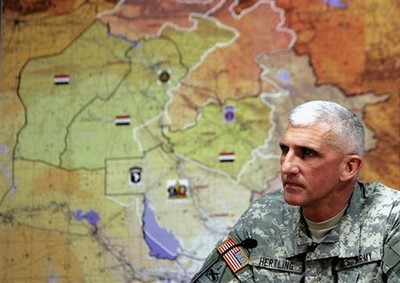
"You know, there are going to be continued spectacular attacks," he said when asked about the bombing of a bridge across Mosul dam on Monday. ... "We have some intelligence that says it was part of a bigger plot. There is some intelligence that they may have wanted to cut off that side of the river to make safe havens," Hertling said. "There are some indications that they wanted to close that route because it is used by coalition forces." Hertling added: "I personally think it is an additional indicator that these people who are trying to disrupt the people of Iraq will do anything to screw up the people of Iraq."
Feb. 20, 2008 update: Khidhr Domle paraphrases Nineveh Deputy Governor Khasraw Goran in the Kurdish Globe on the possibility of the Mosul Dam's collapse. Goran considers this to have become
a serious problem. He said a conference was held in Istanbul with the participation of the Iraqi Minister of Water Recourses, an advisor representing the Iraqi Prime Minister, the Nineveh Deputy, and a number of academics. Conference members concluded that repairing the dam would take three to four years as well as an allocation of $1 million (USD).
Comment: $1 million sounds a bit on the cheap side to me.
May 1, 2008 update: The International Medical Corps (which calls itself "a global, humanitarian, nonprofit organization dedicated to saving lives and relieving suffering through health care training and relief and development programs") is engaged in a multi-month initiative "to draw up a crisis plan for the Mosul dam."
Oct. 19, 2008 update: An elusive news report, "Water resources: filling of al-Mosul dam about to end," translated from As-Sabah newspaper (I could not locate the original) reads in full as follows:
Works of filling al-Mosul dam with cement materials are about to end within its punctuated dates implemented by private cadres of the State Directorate of Dams and Treasures at Water Resources Ministry. The cadres are round-the-clock working to ensure that the dam not be fall down due to the continuous looseness of its bases. The financial allocations reached to ID14 billions [=US$12.1 million] for the current year, while the directorate cadres had ended the first and second phases of geophysics surveys in the region with ID300 millions [=US$260,000].
Dec. 22, 2008 update: Dams break not just in Gaza but also in the United States. The breach took place at an earthen dam holding back a 40-acre retention pond used by the Tennessee Valley Authority, "releasing a frigid mix of water and ash that flooded as many as 10 homes and put hundreds of acres of rural land under water."
Mar. 12, 2009 update: In a paper prepared for the Thirteenth International Water Technology Conference in Hurghada, Egypt, two professors at Mosul University prepared a paper titled "Simulation: Tigris River Flood Wave in Mosul City Due to a Hypothetical Mosul Dam Break" that looks at various outcomes should Mosul Dam experience a catstrophic collapse. The authors, Thair M. Al-Taiee and Anass M. M. Rasheed, explain that they chose to analyse this particular dam because of its defects apparent since 1986. "The objectives of the present research were to predict the characteristics of the flood wave due to a hypothetical Mosul Dam break and to estimate damaged areas downstream, specially in Mosul city."
The authors ran five different scenarios to simulate dam failure. At the high end, it found the most severe flooding would entail:
- A volume of 207,632 meters cubed/second;
- An average velocity of 3.5 meters per second or 12.6 kilometers per hour;
- A high water mark of 25.3 meters above the Tigris River bed within 9 hours after the dam failed;
- A flooded area between the dam and Mosul of 252 square kilometers;
- An inundated area covering about 54% of Mosul city.
Comment: Imagine a wall of water 25 meters high; and if that is too awful, the least severe scenario posits a wall of water half that high.
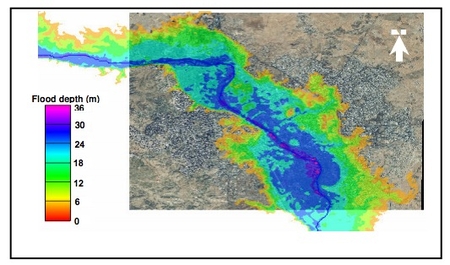 Flood depth map of the Tigris River above and at Mosul city in the most severe scenario of the Mosul Dam failing. |
June 4, 2009 update: In a rare news report to acknowledge the fragility of the Mosul Dam, Heath Druzin of Stars and Stripes writes that "Forces put aside differences to protect vital dam: Iraqi, Kurdish troops to work together to secure structure."
Commanders with the Iraqi army and Kurdish Peshmerga, two forces often at odds in northern Iraq, have come to an agreement on sharing responsibilities for the protection of a vital dam outside Mosul in Ninevah province, according to the U.S. military. "Over the past few days, leaders from the Peshmerga and the Iraqi army came together in a joint effort to ease tensions and develop a peaceful solution," said Brig. Gen. Robert Brown, deputy commanding general of Multi-National Division—North.
Brown believes that the dam agreement has larger implications: "Two days ago there was a temporary solution, but through a joint effort, and extensive communication, it has evolved into a permanent solution that could become the model for the rest of Iraq with regards to solving provincial issues in the disputed areas. What has occurred is a true success."
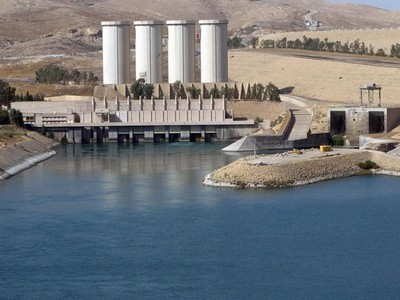
The Mosul Dam.
July 13, 2009 update: According to the LinkTV.org service, Baghdad TV has raised the topic of the Mosul Dam's fragility, as well as that of other dams in Iraq. A reporter states that:
The Iraqi water authorities warned that the Mosul Dam, which is one of the largest Iraqi dams, may collapse. These concerns that the dam may collapse started a few years ago when officials discovered deterioration in many walls of Iraqi dams, most importantly in the Mosul Dam as well as the Haditha Dam on the Euphrates River. Also, Samara Dam on the Tigris River has similar problems.
The report then reiterates the usual fears of what a collapse would mean for Mosul city, Baghdad, and all Iraq. Then, more surprisingly, we learn that something may be done about the looming disaster:
The Ministry of Water announced that it will conduct wide-scale renovation projects for the dam to prevent a real catastrophe from taking place due to possibilities that the Mosul Dam will collapse. The Minister of Water Resources, Abdul Latif Jamal, announced that iron walls are being built at the bottom of the dam's foundation. The ministry reiterated that Iraqi technical teams continue to strengthen the dam. An iron wall, that is more than 200 meters, is being built at the bottom of the dam. This wall is supposed to prevent water leakage and stop the deterioration of the dam's foundation. The Ministry of Water Resources also said that it has contacted international water experts in hopes of receiving special proposals and ideas for renovating Iraqi dams as well as practical solutions to prevent deterioration.
July 14, 2009 update: Perhaps the danger of collapse will be obviated by a lack of water? According to a report by Campbell Robertson in the New York Times today,
The Euphrates is drying up. Strangled by the water policies of Iraq's neighbors, Turkey and Syria; a two-year drought; and years of misuse by Iraq and its farmers, the river is significantly smaller than it was just a few years ago.
Sep. 26, 2009 update: A review of news on Al-Jazeera reports that something is actually happening at the damn dam:
Concerns regarding the stability of the Mosul dam (in addition to several others in Iraq) surfaced years ago, and after initial denials and reassurances by local authorities, the Iraqi government acknowledged that the dam is indeed threatened and requires continuous work to protect its foundations. Local engineers familiar with the dam (originally called "Saddam's Dam") state that the project suffered design flaws from the outset, requiring periodic injection of concrete into its foundations. The relative lack of maintenance during the years of the sanctions and after the US invasion may have compounded the problem and threatened the structure further.
Al-Jazeera quoted the Minister of water resources who announced that a 200 meter long concrete barrier will be built under the structure's foundations, and that work is ongoing on the project. In addition, the Ministry said that it has contacted "international experts" to provide suggestions on the maintenance and upgrade of Iraq's dams.
Oct. 1, 2009 update: A snippet from an article on "A Precarious Peace in Northern Iraq" by Quil Lawrence conveys the precariousness of the current situation there:
In May the guns were drawn again when Maliki sent an urgent mission to secure the aging Mosul Dam, which was one car bomb away from unleashing a torrent that would drown the city. He chose to ignore that the peshmerga had been guarding the dam for nearly six years to forestall just such a disaster. US military observers again smoothed things over, and arranged for joint protection of the dam (the ice was broken nicely when the army realized they had set up no supply lines, and the peshmerga began providing them with food and water).
Oct. 3, 2009 update: Lawrence takes another cut at the same subject, this time in the context of Arab-Kurd joint patrols in northern Iraq:
The largest hydroelectric dam in Iraq is north of the city of Mosul, holding back a trillion gallons of water. Earlier this year, the government in Baghdad sounded the alarm after it realized that no government forces were guarding the aging dam. A single car bomb there could unleash a flood that might kill 500,000 people in Mosul and other cities on the Tigris River.
Army Brig. Gen. Robert Brown, who commands U.S. forces in the province around Mosul, says the government was ignoring the fact that the dam has been guarded for years by Kurdish defense forces, known as peshmerga. The Kurdish forces had recognized the vulnerability of the dam and began guarding it in 2004. "The central government in Baghdad said, 'Hey, get the Iraqi army up there!' " Brown says.
When troops from the mostly Arab Iraqi army reached the dam, they walked into a standoff with the Kurdish peshmerga. "Both sides think the worst — the peshmerga are thinking they're going to kick us out, and the army thinking the peshmerga aren't going to leave," Brown says. It was not the first time that Kurds and Arabs have nearly come to blows. But Brown says the Mosul dam has turned into a positive example.
With some help from the Americans, the Kurdish and Iraqi army forces started protecting the dam together. In fact, when the Iraqi army troops arrived, Iraqi officers soon realized they hadn't arranged for supplies, and the Kurdish soldiers ended up providing them with food and water.
Last week, Brown visited the Mosul dam, which is now protected by about 450 Kurdish peshmerga and the same number of Iraqi army soldiers. He formally thanked the peshmerga for protecting the dam over the past five years and handed out commendations. But almost no Iraqi Arab troops turned up for the ceremony. The Iraqi army commander in the province, Gen. Hassan Abbas, canceled at the last minute.
 July 31, 2010 update: In an unusual statement by Ministry of Electricity's the ministry's information officer, Musaeb al-Mudaress, that the dam "cannot be filled with more than 40% of its capacity" of 11 billion cubic meters of water. Its hydro-electricity power plants used to produce around 320 steady megawatts but now they produce less than 100 erratic megawatts. Khayoun Saleh writes in "Iraq's largest dam loses 60% of its water reserves," for Az-Zaman, that this drastic decline "is catastrophic to Iraqi agriculture since the water reserves were essential to farmers cultivating land on both sides of the River Tigris."
Why the decline? Saleh explains: not due to lowering water levels from the Tigris but due to erosion of its foundations. The reduction is "necessary to preserve its shaky foundations and prevent its failure which is bound to inundate major cities including Mosul and Baghdad if it bursts at full capacity."
Sep. 1, 2010 update: Iraq's minister of water resources Jamal Rashid said that cracks in the Mosul dam cause a loss of half a million dollars per year and causes electricity problem in the country. Therefore, his ministry is offering tenders to treat the cracks.
Nov. 3, 2011 update: Amanda Ellison of the U.S. Army Corps of Engineers refers to the "unprecedented task" to save the Mosul Dam and tells about a group of Iraqi engineers visiting the United States to learn from the American experience:
At the request of the Ministry of Iraq, a five-member delegation from the Iraq Ministry of Water Resources recently completed a brief tour of the east coast of the US to learn about dam structures and cutoff walls. ...
The Wolf Creek Dam project [in Tennessee] is the most similar to Mosul Dam, and was an important stop on the itinerary. However, Wolf Creek doesn't even come close to the size of the effort that will be required at Mosul. The deepest cutoff wall constructed to date at Wolf Creek was 122m. The cutoff wall to be attempted at Mosul Dam will be twice as deep at 244m. The Mosul Dam is ten times deeper than the Herbert Hoover Dike. In fact, equipment for the mammoth cutoff wall for Mosul is still under development.
"There is no precedence to what they are trying to achieve," said David Paul, lead civil engineer for the US Army Corps of Engineers' Risk Management Centre.
The goal of the tour for the Iraqi engineers was to learn how to secure contracts, from bid phase to completion; understand the critical need for construction management; and view different methods of technology being used during cutoff wall construction at various sites. "The trip has created positive interaction," said Paul. "They have a difficult project ahead of them."
The engineers gained great benefits from understanding the history of the Corps' problems with seepage, how the Corps evaluates those conditions, and the decision to use cutoff walls to mitigate seepage concerns. "Our projects are very similar to what they have going at Mosul Dam," said Paul. "They could directly relate their experiences to ours, and I think that was extremely valuable."
The trip to Clearwater Dam provided an opportunity for the group to see actual cranes and rock mills in normal operation. They were also able to discuss crucial construction issues such as rock mill design and handling. ...
"All in all, I think it was a great moment spent collaborating and learning from fellow engineers from around the world," said Bobby Van Cleave, geotechnical engineer at Clearwater Dam. "They have an enormous task at Mosul Dam, and maybe some information they gained from their visit will help them successfully complete that mission."
Nov. 4, 2011 update: Could the Iraqi government be prepared seriously to address Mosul Dam's infrastructural problems? It appears so, judging by the amount of money involved:
German construction and engineering company Bauer said it signed a letter of understanding on a $2.6 billion contract to refurbish a dam in Iraq. ... The project, the company's biggest ever, is scheduled to take about six years to complete It will involve Bauer building a cut-off wall to seal the Mosul Dam in northern Iraq. The ground beneath the 3.6 kilometre-long dam has become increasingly water-permeable.
Comment: Curious that the U.S. government punted on this issue and the Iraqi government has taken responsibility for it. Good for the Iraqis – and lucky for the Americans, who would get the blame for a catastrophe.
Dec. 25, 2011 update: For an aerial view of the dam and its lake, click here.
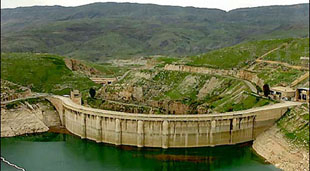
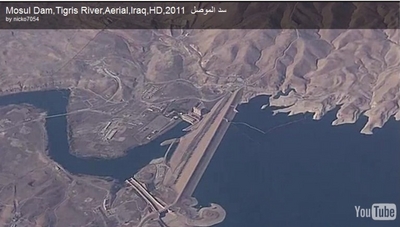 Screen grab from an aerial video of the Mosul Dam and its lake. |
Apr. 2, 2012 update: A series of foreign sources have reported on growing dangers to the Mosul Dam:
- Hermes magazine of Germany's in 2011 published reports that the concrete base on the right hand side of the dam may collapse in 2012 if not attended to immediately.
- The Daily Telegraph (London) reported in detail about increasing cracks and warned of its imminent collapse,
- A Japanese organization pointed to delayed maintenance of the dam and warned of the presence of a high proportion of salt and phosphate in the foundations of the dam causing cracks in the foundation that increase the possibility of a collapse.
The Iraqi Ministry of Water Resources today denied the problem. Ali Hashem, general director of the ministry's projects department said: "The reports obtained by the ministry confirm the absence of any fears from the collapse of the dam, and the reports that foreign and local media mentioned are inaccurate." Hashem said the ministry is working on an ongoing basis to repair and rehabilitate the dam. Government statistics indicate that this maintenance costs about US$500 million a year.
Apr. 15, 2012 update: Issa Elias, Nadhir Al-Ansari, and Sven Knutsson of the Luleå University of Technology in Sweden have published a study on "The effect of operation of Mosul dam on sediment transport in its reservoir Publication."
June 17, 2012 update: In an alarming statement, a geologist named Walid Satee has declared that, at a meeting with engineers and geologists, it was found that "Mosul Dam will collapse within a period that doesn't exceed this month." Satee noted the urgent need to discharge water from the dam "to prevent the occurrence of cracks that would lead to explosions inside its structure," adding that a team of engineers and specialists has been formed which will start to empty water from the dam "and guide it to the southern marshes of Iraq." Should a collapse take place, he went on, "Mosul will sink. The flood waters that will result from the collapse of the dam will reach the capital [of Baghdad] within three days."
In contrast, Iraq's Ministry of Water Resources rejected as "completely untrue and groundless" the predictions of an imminent collapse and asserted that "the dam situation currently is very safe, well-functioning and the maintenance and perpetuation work of the dam is continuing."
Comments: (1) Let us hope the ministry is right and Satee is wrong. (2) How fortunate that U.S. forces are gone from Iraq and, should things go terribly wrong, it will not be seen as an American responsibility. Or will it?
June 27, 2012 update: Abdul Khaliq al-Dabbagh, the director general of the Mosul Dam, said that talk of the dam collapsing is "groundless" and "mere rumor that aims to confuse the situation in the province." Rather, he asserted, "The situation in the dam is safe and it is better than the previous condition due to the continuous works of grouting and injection for the dam's base which started to improve after 2006. ... "We do not have any concerns about the dam's collapse."
July 16, 2012 update: More words of comfort from Iraq's Ministry of Water Resources, though some huge caveats. Minister of Water Resources Muhannad al-Saadi told Shafaq News (with mild English-language editing by me) during a visit to Mosul that "developments at the dam are very reassuring; sustaining and maintenance work is continuing and because of it, there is no fear of collapse."
But then he added several eyebrow-raising points:
- "We are afraid of earthquakes in the region that may occur and lead to the dam's collapse, because these are outside the framework of principles and designs on which the dam was built."
- "There's no fear at all that the dam will collapse for a period of at least twenty years."
- "The cabinet formed a cell crisis a month ago, during a meeting of the National Security Council, which includes relevant ministries and which coordinates the ministries of defense, interior, intelligence and civil defense in the province; they will take appropriate action if the dam collapses."
Comments: (1) That the dam was built without heed to earthquakes confirms how poorly it was constructed. Those responsible for the building of this structure should, at no cost to the Iraqi government, pull down the damn dam in an orderly way, before catastrophe strikes. (2) The good minister appears to be contradicting himself – either a quake can bring it down in the next twenty years or it cannot. (3) Once again, the dangers poised by the Mosul Dam appear not to be taken seriously enough.
Jan. 3, 2013 update: Something else to worry about: according to an analysis, "Sedimentation and New Operational Curves for Mosul Dam, Iraq," by Issa Issa, Nadhir Al-Ansari, and Seven Knutsson of Lulea University of Technology, Sweden, the annual sedimentation rate in the reservoir behind the Mosul Dam is 0.59 percent. The authors conclude that this "suggests that the reservoir will be filled completely within 169 years." Well, it's something to worry about if the dam lasts that long.
Jan. 4, 2014 update: An unnamed Iraqi expert in dam construction told Shafaq News that he holds Saddam Hussein fully responsible should the Mosul Dam collapse because he was aware about the problem of its location but insisted on that current location for political reasons – to cut off Kurdish movement in the area. The engineer also recounted how Russian experts had been brought in to take a look and reported that the ground was not suitable because of its gypsum base, which gets eroded by water. This weak base has meant a need to pump liquid cement under and around the dam.
May 20, 2014 update: For some pictures of the Mosul Dam, click here.
June 10, 2014 update: The group called "The Islamic State in Iraq and Syria" captured Mosul yesterday from the Iraqi government. For a discussion of what this might mean for Iraq's waterworks, see my weblog entry, "Will ISIS Cause an Artificial Drought in Iraq?"
July 1, 2014 update: For the danger not of collapse but manipulation of the Mosul and other Iraqi dams, including the possibility of purposeful flooding see a new weblog entry, "The Acute Danger of Iraqi Dams."
July 2, 2014 update: Keith Johnson has this to say about Mosul Dam in Foreign Policy:
Researchers say it could send as much as 50 million gallons of water per second crashing toward Mosul that would cover more than half the city under 25 meters of water within hours. Further down the Tigris River, Baghdad itself could be under 4 meters of water within three days. It would also wipe out more than 250 square kilometers of prime farmland.
"The only measure which can reasonably be taken to reduce the risk to downstream populations" is building another dam downstream, researchers concluded earlier this year. Construction started on the Badush Dam in the 1990s but never completed.
Mosul Dam's regular maintenance appears to continue uninterrupted by ISIS, said researchers at Lulea University of Technology in Sweden, who have studied the dam. The dam's manager declined to discuss the facility's state or the risks posed by ISIS.
July 4, 2014 update: An American who once worked at the Mosul Dam informs me that it has been directly threatened and an attempted low scale attack has proven to unsuccessful, so far.
He notes that Iraq's Prime Minister Nouri al-Maliki "has had on his desk the repair plans from Germany's Bauer Group for the Mosul Dam for 4 years and has done nothing to begin the process. I had access to the plans and know it was to be a huge project; plus, evaluation teams had already arrived. But when Maliki began consolidating power, progress stopped and things have remained at a standstill since 2010. The world should know that if the dam fails or is blown up, responsibility lies completely at the feet of Maliki."
On the other hand, my informant is optimistic about the Kurdistan Regional Government's growing reach: "The Mosul Dam lies completely within Kurdish territory and now that the KRG is on the move, it will benefit from protection by Kurdish security and might get fixed."
Aug. 7-17, 2014 update: For information on ISIS's brief control of Mosul Dam, see my companion weblog entry, "The Acute Danger of Iraqi Dams." For the general problem of dams endangering downstream populations, both in Syria-Iraq and around the world, see another weblog entry, "Waterworks Catastrophes."
Aug. 8, 2014 update: Fox News discusses the dangers surrounding the Mosul Dam, especially the maintenance issue, in nearly six-minute segment.
 Sep. 1, 2015 update: Volume 5, Issue 3 of the Journal of Earth Sciences and Geotechnical Engineering is devoted entirely to eight articles on this one topic and is titled the "Mystery of Mosul Dam the Most Dangerous Dam in the World." Nov. 1, 2015 update: That special issue has appeared as a book, Nadhir Al-Ansari, Geological and Engineering Investigations of the Most Dangerous Dam in the World (London: ScienPress, 2015).
Dec. 9, 2015 update: A brief essay, "Geological and Engineering investigations of the most dangerous dam in the world," by Nathir Al-Ansari and three other authors offers some background:
After impounding in 1986, new seepage locations were recognized. Grouting operations continued and various studies were conducted to find suitable grout or technique to overcome this problem. The seepage due to the dissolution of gypsum and anhydrite beds raised a big concern about the safety of the dam and its possible failure. This problem was kept in a small closed circle within the Iraqi Ministry of Water Resources (previously Ministry of Irrigation) till the US Army Corps of Engineers conducted a study on Mosul Dam for the period June, 2004 to July, 2006 and highlighted the possibility of the dam failure.
The problem was already known in 1984, when a company called Swiss Consultants worked out the scale of the potential catastrophe, as summarized in this table:
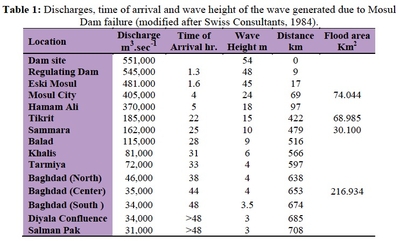 Should the Mosul Dam collapse: a summary of water volume, time of arrival, wave height, and distance |
Comment: One is not surprised that the Saddam Hussein government hid this news; but Swiss Consultants? And why is this disaster still mostly unknown to Iraqis?
Dec. 10, 2015 update: Australia's Department of Foreign Affairs and Trade is advising Australians not to travel to Iraq; one reason for this concerns the Mosul Dam's possible collapse:
The Government of Iraq has begun to take measures to improve the structural integrity of the Mosul Dam. It is currently impossible to predict if or when a dam failure might occur. A dam failure could cause significant flooding and interruption of essential services.
If you are in Iraq, particularly in areas near the Tigris River, including Baghdad, you should ensure that your contingency plan covers the need for you and your family to evacuate ahead of any rising waters. You should not expect the Australian Government to facilitate your departure should commercial options be unavailable. ... We continue to advise against travel to all of Iraq, including Iraqi Kurdistan.
Dec. 20, 2015 update: In a faraway piece of news with harrowing implications for those living downstream from dams around the world, Iranian hackers got access to the control system of the Bowman Avenue Dam, a small barrage that controls flooding near Rye, N.Y., and about 20 miles from New York City, in 2013. Danny Yadron of the Wall Street Journal muses on this incident:
The still-classified dam intrusion illustrates a top concern for U.S. officials as they enter an age of digital state-on-state conflict. America's power grid, factories, pipelines, bridges and dams—all prime targets for digital armies—are sitting largely unprotected on the Internet. ...
Many of the computers controlling industrial systems are old and predate the consumer Internet. In the early digital days, this was touted as a security advantage. But companies, against the advice of hacking gurus, increasingly brought them online in the past decade as a way to add "smarts" to U.S. infrastructure. Often, they are connected directly to office computer networks, which are notoriously easy to breach. These systems control the flow in pipelines, the movements of drawbridges and water releases from dams. A hacker could theoretically cause an explosion, a flood or a traffic jam.
Dec. 17, 2015 update: Italy's Prime Minister Matteo Renzi announced on Dec. 15 the deployment of soldiers to protect the Mosul Dam from ISIS. "The appeal [to protect the dam] was made by an Italian company ... and we will send 450 of our men there to help protect it alongside the Americans." That Italian company is the Trevi Group, a specialist in the field of soil engineering, which won a $2 billion contract to do urgent repair work on the dam. Trevi explains the situation:
A first emergency intervention package is being finalizing with immediate start of the works and lasting 18 months. This represents the first stage of implementation of a permanent solution for the consolidation of the dam in the means and to the extent to which it has been intended for years.
The risks of a potential collapse of the dam are worsened given the lack of maintenance of the dam in recent years, and an intervention for the safety is more than ever necessary. ...
The presence of the Italian army (on the side of the Iraqi Army and international forces) is critical for the safety of the remediation works.
Jan. 10, 2016 update: The New York Times' story today, "Neglect May Do What ISIS Didn't: Breach Iraqi Dam," by Michael R. Gordon, has a much new information about the Mosul Dam:
- The dam is most imperiled in the spring, when the Tigris is swollen by rain and melting snow, and that is also when its collapse would do the most damage.
- The U.S. government has installed 92 monitors to assess the disintegrating gypsum base.
- Barack Obama has stressed to Iraq's Prime Minister Haider al-Abadi the need to make emergency repairs. Likewise the chairman of the U.S. Joint Chiefs of Staff, Gen. Joseph F. Dunford Jr, stressed this point with Abadi.
- American officials have also called on Baghdad to warn the citizenry about the dam and where to find safe refuge in the case of a collapse.
- Over the years, around 600 Iraqis workers three times a day, six days a week drill holes in the gypsum base under the structure and fill them with a cement grout mixture in an attempt to prevent water from eroding the base.
- After ISIS forces briefly held the dam in August 2014, many workers stayed away and regular maintenance has not been kept up.
- While the Italian government planned to dispatched 450 of its troops already in Iraq to protect Italian workers at the dam, the head of the Iraqi Ministry of Water Resources Management, Mohsen al-Shammari, rejected this offer, with an aide saying "There is no need for Italian forces to protect the dam."
Jan. 11, 2016 update: Italy's Prime Minister Matteo Renzi said in December 2015, reports the Daily Mail, that the Mosul Dam could cause a "civilian disaster.'
Jan. 28, 2016 update: In the aftermath of an American team's visit to the Mosul Dam and finding three gaps that need urgent work, U.S. Army Lt. Gen. Sean MacFarland, the top U.S. general in Iraq, has warned of a "catastrophic" collapse and developed a contingency plan to move civilians to safety should this happen. He warned that "when [the dam] goes, it's going to go fast," adding: "If this dam was in the United States, we would have drained the lake behind it."
In response, Riyadh Izeddin, the director general of the dam, said he did not know about any contingency plan. "The Americans didn't tell us anything." Furthermore, displaying the typical official Iraqi indifference, he stated that "There is nothing to be afraid of. There is nothing seriously wrong with the dam."
Feb. 1, 2016 update: Muhsen al-Shammari, Iraq's minister of Water Resources Management has again minimized fears of a dam collapse: "there is no problem in the dam that may lead to its collapse," he asserted. and the ministry is continuing its routine maintenance.
But non-governmental Iraqis are not convinced. Some members of parliament from the Mosul area accused the government of neglecting the dam, others called for an investigation into corruption in its maintenance, and a few even pointed to "a plan to drown Sunni areas." Some MPs want an emergency session to discuss issues surrounding a potential dam collapse and to planning for the worst.
Feb. 2, 2016 update: (1) The Kurdish publication Rudow reports that Iraqi officials and engineers are in full denial mode concerning the danger posed by the Mosul Dam. Some quotes:
- Naufal Hamoudi, the exiled-governor of Mosul province: "We told Baghdad there is no big threat and we asked for reconstructing some parts."
- Abdullah Taaqi, deputy manager of the Mosul Dam's electricity station: "I was only 20 when I first started working here and now my hair is turning all white. But the dam is exactly as it always was." He explained that some of the concerns might be due to technical issues. "The station is capable of producing 1,100 megawatts of electricity but due to technical issues now it only produces 750 megawatts. The threats they are talking about is due to the fact that water is only falling out only on one side, unlike before, when it poured down two sides."
- Jassm Mohammad, an engineer who has been working in the technical department of the dam for more than 15 years: "The problem they are talking about existed from day one" and is simple and easy to resolve.
- Karim Amedi, another engineer: "There is no threat of collapse."
Feb. 2, 2016 update: An article in Al-Ahram, "Row over the Mosul Dam" by Salah Nasrawi, offers information on several topics:
- Conspiracy theories go far to explain Iraqi dismissals of American warnings, including "a plot to partition Iraq, a secret plan to outmanoeuvre Islamist militants in Mosul, and corruption charges."
- Melting snow leads to the annual rainy season in April, which could lead to a breach of the dam.
- The dam contains four 200 megawatt turbines generating 320 megawatts of electricity a day, most of which goes to Mosul and other cities in Iraq's Nineveh Province.
- Maintenance work on the dam was reduced by UN sanctions on Iraq following the 1990 invasion of Kuwait because the microfine cement grout used for grouting could also be used for military airstrips, making it prohibited. The Iraqis managed to produce a low-quality alternative that kept the dam standing but also to its further deterioration.
- Tensions between the Kurdistan Regional Government and Baghdad have obstructed maintenance, especially over the question of Republic of Turkey soldiers.
- Iraqi politicians have gone public about graft related to repair work at the dam.
Bahaa Al-Aaraji, a Shia politician and former deputy prime minister, accused Minister of Higher Education Hussein Shahristani, in charge of the energy sector in the previous government, of ordering a halt to maintenance on the dam "because he wanted to give the contract to a company" of his choice. Experts had suggested another company do the work, Al-Aaraji told Iraqi TV station Al-Sumeria on Saturday.
Viyan Khalil, a Kurdistan Democratic Party MP, has accused current minister of irrigation and water resources Muhsen Al-Shamari of trying to blackmail companies which have made offers to repair the dam.
Feb. 3, 2016 updates: (1) Italy's Foreign Minister Paolo Gentiloni confirmed yesterday that the Iraqi government and the Trevi Group, an Italian engineering firm, have reached a tentative agreement to provide a long-term solution to the Mosul Dam's problems; according to Keith Johnson and C.K. Hickey of Foreign Policy, however, "the tricky repairs needed to prevent a catastrophic failure ... could potentially make a bad situation even worse."
Calling the nearly 100,000 tons of grout pumped under the dam so far "just a Band-aid," they note the absence of consensus how to fix the dam. One approach is to build a "cutoff wall," a concrete wall under the dam's embankment that bars seepage and ends the erosion.
"Putting a cutoff wall at Mosul is likely the only long-term solution to the problem," John Rice, a professor of civil and environmental engineering at Utah State University and an expert on dam stability, told Foreign Policy. The big challenge at Mosul, he said, is that the dam will require a deeper cutoff wall than has ever been built in the world before, about 800 feet below the dam's embankment. "The construction of the cutoff will not be easy and, if done without proper precautions, could increase the probability of failure," he said. But Iraq has few real alternatives: Grouting is a short-term fix at best and can be interrupted at any time due to the security situation on the ground.
Other experts have cautioned against trying to dig under the already unstable Mosul Dam. Nadhir Al-Ansari, a civil engineering professor at the Lulea University of Technology, who has spent years studying the dam, specifically recommended that the Iraqi government forget the idea of building a cutoff wall, warning in the study with his colleagues that it "is not only infeasible technologically and financially, but it could endanger the integrity of the dam itself." "I don't think it is a good solution," Al-Ansari told FP. He said a better way to prevent flooding from a catastrophic breach at Mosul Dam is to finally build a retaining dam downstream on the Tigris River, an expensive project that has been stalled for years.
(2) For another structure in "dire" condition and in danger of collapse, affecting millions adversely, learn about the Kariba Dam on the border between of Zambia and Zimbabwe.
Feb. 9, 2016 update: An Associated Press article draws on an important Jan. 30 report issued by U.S. Army Corps of Engineers and became known in Baghdad yesterday. It concludes that ISIS in two ways made the Mosul Dam even more dangerous than before it seized control of the dam for several weeks in 2014:
U.S.-backed Iraqi forces retook the dam, but no grouting took place for six weeks. Even since then, the grouting has not been up to full levels in part because the militants control the nearby factory that produces the concrete for the dam. As a result, there are "almost certainly ... an unprecedented level of untreated voids" in the dam's foundation from continuing erosion. ... "Mosul Dam is at a significantly higher risk of failure than originally understood and is at a higher risk of failure today than it was a year ago."
American officials have told Prime Minister Haider al-Abadi that a collapse "could be 1,000 times worse than [Hurricane] Katrina."
As usual, Iraqi officialdom dismisses these concerns. For example, Water Resources Minister Mohsen al-Shimari says that "The danger is not imminent, it's far off. The danger is 1 in 1,000. ... The danger for Mosul Dam is no greater than that of other dams."
Relying on Nadhir al-Ansari, a former adviser to the minister of irrigation who witnessed the initial stages of construction in 1980, the article explains that "it was politics that placed it on an eroding geological base. Saddam's deputy Taha Yassin Ramadan chose the site in an effort to bring jobs to Mosul."
"When I went there I was shocked," said al-Ansari, who is now an engineering professor at Lulea University of Technology in Sweden. He recalled walked though large caves at the site that immediately indicated to him it was unstable. Within a year, leaks sprouted and the floor of the reservoir began to collapse, creating sinkholes. The Iraqi government was so concerned it began building the Badush Dam as a replacement. But construction halted in 1990 with the imposition of U.N. sanctions. "It was all just politics, stupid politics that built this dam in such a quick and dangerous way," said Ansari. "And now it's just politics and corruption again, that's why no one has reached a solution for Mosul Dam."
A permanent solution for the dam requires the building of a second dam, the downstream Badush Dam mentioned above. But it would likely cost over US$2 billion. A previous Iraqi government in 2006 looked at resuming the Badush Dam but found the cost too high.
Feb. 10, 2016 update: The Australian military seconds the Americans' appraisal, as explained by Air Chief Marshal Mark Binskin, its Chief of the Defence Force, today at a Senate hearing:
"If the dam goes, there'll be a humanitarian disaster ... [It is] a conflict zone where you've got ISIL [the Islamic State] with no care of any of the civilians operating. Then you'll have the water come through and it will ... flush Mosul out and then it'll move down and through various towns as it comes down the valley and inundate a lot of Baghdad. ...
"So we're quite concerned about this and we keep a very close eye on it from a humanitarian point of view ... but also for force protection for our own people and also other Australians – embassy staff and things like that. So we have contingency plans in place but it would catastrophic if the dam went."
Feb. 13, 2016 update: The World Bank has allocated US$200 million to the Iraqi government urgently to repair Mosul Dam.
Feb. 17, 2016 update: In a first-hand account of his visit to the Mosul Dam, Florian Neuhof writes in Al-Arabiya English about official apathy at "Will Mosul Dam hold? Don't count on it."
The realistic risk of ... a catastrophe should have raised concern among the political class in Baghdad; instead the reaction was one of widespread denial. 'All is well, don't worry' was the gist of the sound bites emanating from the capital. ...
The officials at the site insist that extensive monitoring of the dam shows that the cavities are not weakening the structure, and that the measures taken to stabilize the foundations are adequate. They concede, however, that the people living in areas that would be flooded might not aware of the emergency plans the government is adamant it has put in place.
Since emergency plans that aren't communicated to the very people that will need to follow them are not worth the paper they are written on, the handling of the situation does not exactly inspire confidence. Either there is no plan, in which case the government is lying, or there is a plan that has no chance of being implemented in time, in which case the government is bungling its disaster management even before anything has happened. ... I certainly wouldn't want to be living downstream of the dam.
Feb. 24, 2016 update: Genevieve Belmaker provides new information in an Epoch Times article, "Iraq's Mosul Dam Teetering on the Brink of Collapse."
- Nadhir Al-Ansari, an Iraqi professor in the Department of Civil, Environmental and Natural Resources Engineering at Lulea University of Technology in Sweden, served as a consultant to the Iraqi government during the dam's construction in 1984 and has returned often to the dam since. He says of the gypsum problem: "Nothing worked, they couldn't stop the seepage," so the fix was near-constant grouting "just to keep the seepage constant, not stop it."
- The grouting is a 24-hour-a-day, 7-days-a-week process of pumping cement slurry into boreholes under pressure to fill cavities as they develop. About 96,000 tons of grouting was injected into the dam between 1986 and 2014.
- The new Army Corps of Engineers report states that there are "significant signs of distress and potential failure progression." Further, "All information gathered in the last year indicates Mosul Dam is at a significantly higher risk of failure than originally understood." It is also "at a higher risk of failure today than it was a year ago" because the interrupted maintenance "resulted in an unprecedented level of untreated voids in the foundation." The report implies that the damage may not be treatable.
- Compounding this potential crisis, one of two outlets that releases excess water has been jammed since 2013. This means that the reservoir behind the dam cannot be drained as a way to avert a catastrophe. Ansari explains: "There are only two bottom outlet gates. One of them is stuck, jammed since 2013. If one of the gates is closed, the other one cannot discharge that much water alone."
- March and April are the time of highest annual inflow into the reservoir, when water needs to be released to avoid pressure building up on the dam. Ansari recounts how, in the 1980s, when the Tigris River swelled the dam gates were opened and the water passed through it harmlessly. Now, however, if both gates are not operational, "they are not going to be able to get rid of the excess water." In that case, pressure on the dam could cause it to burst.
- Mohsen al-Shammari, Iraq's minister of Water Resources Management, described Mosul Dam's condition as "good" in a Feb. 7 statement. "There is no problem in the dam that could lead to its collapse."
- Florian Neuhof (whose report is excerpted just above this entry) told Belmaker that the Iraqi officials "are just corrupt and incompetent and they stick their heads in the sand." He notes that even if a contingency plan does exist for a dam collapse, no one is aware of it, rendering it useless. "People need to know which way to go and where to drive. Mosul would go within a few hours. They don't know where to go."
- Ansari points to a growing anxiety among those living downstream from the Mosul Dam: "Almost every day I get tens of emails from people who are friends and even people I don't know asking me 'where should we go, what should we do?'" He does not have answers for them.
Feb. 28, 2016 update: The U.S. embassy in Baghdad unloaded today both a "Statement on Mosul Dam Emergency Preparedness" and a 4-page "Mosul Dam Preparedness Fact Sheet." Highlights of the two:
- The danger: "Mosul Dam faces a serious and unprecedented risk of catastrophic failure with little warning. A catastrophic breach of Iraq's Mosul Dam would result in severe loss of life, mass population displacement, and destruction of the majority of the infrastructure within the path of the projected floodwave."
- The floodwave: It "would resemble an in-land tidal wave between Mosul and Samarra', and would sweep downstream anything in its path, including bodies, buildings, cars, unexploded ordinances, hazardous chemicals, and waste; less than 6 inches of moving water is strong enough to knock a person off his feet, and 16 inches of moving water can carry away most automobiles. Flooding south of Samarra would resemble that of Hurricane Katrina, with standing water that pervades much of Baghdad for weeks to months. As floodwaters recede, mud and waste-covered remnants of previous infrastructure will be left behind." The flood water would be a wall of up to 45 feet in Mosul city 33 feet in Baghdad.
- Immediate aftermath: Approximately 500,000 to 1.47 million Iraqis "would not survive unless they evacuated the floodzone." Many more would be severely harmed, "experiencing dislocation, increased health hazards, limited to no mobility, and losses of homes, buildings, and services."
- Longer-term aftermath: The flood could shut down the entire Iraqi electricity system. "Irrigated agriculture in the affected area would be damaged or destroyed."
- Evacuation: Iraqis living downriver from the dam generally can travel 5-7 kilometers from the riverbank to reach safety, but more in in areas with rivers and wadis that feed into the Tigris. In some cases, such as Samarra, the distance would need be greater (16.5km)—to avoid being cut off by multiple streams of water when the major irrigation canal floods.
- ISIS: Because it controls some of these escape routes, Tigris valley residents may not get away in time.
- Iraqi government incompetence: That the authorities are pretending there's no problem means that the sick, disabled, elderly, et al. will likely be left behind. Actually, those are my words about official ineptitude; the USG version is full of praise for the government ("We welcome the Prime Minister's commitment to undertake all necessary measures"). But the fact that a foreign government feels compelled to offer advice on evacuation details points to the American dismay.
Feb. 29, 2016 update: Couched as a "Security Message to U.S. Citizens," the American embassy in Baghdad issued a severe warning today under the headline "Planning for Possible Collapse of the Mosul Dam." The key passage:
The disruption of maintenance operations in 2014 increased the risk of the Mosul Dam collapsing. The Government of Iraq (GOI) is preparing to initiate emergency maintenance operations to reduce the risk of failure.
A dam failure would cause significant flooding and interruption of essential services in low-lying areas along the Tigris River Valley from Mosul to Baghdad. Some models estimate that Mosul could be inundated by as much as 70 feet (21 meters) of water within hours of the breach. Downriver cities such as Tikrit, Samarra, and Baghdad could be inundated with smaller, but still significant levels of flooding within 24-72 hours of the breach.
We have no specific information that indicates when a breach might occur, but out of an abundance of caution, we would like to underscore that prompt evacuation offers the most effective tool to save lives of the hundreds of thousands of people living in the most dangerous part of the flood path in the event of a breach. Proper preparation could save many lives.
Comments:
- There's not much news here for anyone following developments at the Mosul Dam; but this stark statement is newsworthy in itself and in its first hours has generated considerable media coverage.
- Although presented as a communication to U.S. citizens, the real message is to the government of Iraq: Get your act together immediately to save the dam and make contingency plans in case it collapses.
- This public statement follows many quiet appeals to the Iraqis. Will it make a difference or again fall on deaf Iraqi ears? That is the key question.
Mar. 2, 2016 updates: (1) The Iraqi government has signed a €273-million contract with the Trevi Group to repair and maintain the Mosul Dam for 18 months. Mahdi Rasheed, who is in charge of all Iraqi dams, said the work should start in the "coming few days" and that preparatory work could take four to six months. He added that the agreement "will help improve the situation at the dam and will develop the capabilities of Iraqi cadres with the most needed training and modern technologies."
(2) Julian Borger adds new information about the Mosul dam in the Guardian:
- Nasrat Adamo, the dam's former chief engineer, notes that the dam requires constant grouting, but maintenance has much deteriorated after the brief ISIS occupation in mid-2014. "We used to have 300 people working 24 hours in three shifts but very few of these workers have come back. There are perhaps 30 people there now. The machines for grouting have been looted. There is no cement supply. They can do nothing. It is going from bad to worse, and it is urgent. All we can do is hold our hearts." Adamo said The gates that can open to ease the pressure by allowing water through must be operated in tandem and one of them is stuck. Adamo again: "One of them is jammed, and when one of them is closed the other one has to be closed. They must work together. Otherwise, you get asymmetric flow and that speeds up the erosion."
- Nadhir al-Ansari, another Iraqi engineer with long experience at the dam, adds: "The fact that the bottom outlets are jammed is the thing that really worries us. In April and May, there will be a lot more snow melting and it will bring plenty of water into the reservoir. The water level is now 308 metres but it will go up to over 330 metres. And the dam is not as before. The caverns underneath have increased. I don't think the dam will withstand that pressure. If the dam fails, the water will arrive in Mosul in four hours. It will arrive in Baghdad in 45 hours. Some people say there could be half a million people killed, some say a million. I imagine it will be more in the absence of a good evacuation plan." He called the Iraqi government's telling local people to move 6km from the river banks "ridiculous." "What are all these people, millions of people, supposed to do when they get 6km away? There is no support for them there. Nothing to help them live."
- The idea of a dam north of Mosul first came up in the 1950s but the water-soluble bedrock of gypsum and anhydrite stopped its construction. When Ansari expressed his concerns to his boss, he was told, "Don't worry. This is all being taken care of."
- A second dam, Badush, was started 20 kilometers downstream, intending to blunt the impact of the Mosul dam's collapse. But work on it ended in the 1990s because of the economic sanctions on Iraq, leaving it useless at 40 percent complete.
- An international conference will meet in Rome next month to discuss the Mosul Dam.
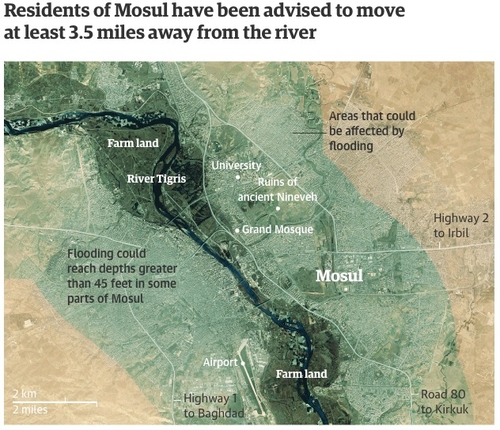 A graphic in the "Guardian." |
Mar. 3, 2016 update: Nasrat Adamo, already cited above, thinks the U.S. government estimate is too low: "All the figures quote between 500,000 to 1.5 million people" dying in case of a collapse, "but at least a few hundred thousand people will be killed immediately." I agree. Between lack of electricity, drought, and disease, the numbers will be immense. Adamo also comments: "The machines for grouting have been looted. There is no cement supply. They can do nothing. It is going from bad to worse, and it is urgent. All we can do is hold our hearts."
Mar. 4, 2016 update: Paul Iddon, a reporter based in Erbil, focuses on the need for a long-range solution, beyond incessant grouting. He quotes Nadhir Al-Ansari:
The solution is to continue to complete Badush Dam downstream Mosul Dam which is designed to hold the wave in case Mosul Dam fails. This is the permanent solution. ... once they build that dam, they can build a smaller dam upstream Mosul Dam so that they can supply the Aljezera Irrigation project with water. Electricity can be temporarily supplied to Mosul through the construction of gas and electricity stations until Badush is completed. Then this dam can supply Mosul and other cities with electricity and serve the same function.
A precedent exists: Fearful of the Imnam Dam in North Korea, the South Korean government built a largely unused "Peace Dam" to break the floodwave should the Imnam collapse. Iddon estimates that Badush (which was started soon after the grouting began but halted in 1990) will cost $10 billion to finish. He notes the Iraqi government's competing priorities (the war against ISIS) and economic problems (the decline of the price of oil) but argues that, "after years of downplaying the threat, it too is acknowledging the dangers of the dam collapsing. And without taking solid steps and a solid plan of action, like the one outlined by Ansari, this dam is an unthinkably devastating disaster waiting to happen."
Mar. 7, 2016 update: Abdel Hamid Zebari of Agence France-Presse took the initiative to visit Wana, at 10 kilometers downstream from the Mosul Dam the first town potentially to be drowned after a collapse to get a sense of its residents' thinking.
Some residents choose to trust the local authorities, who have downplayed alarming assessments by the Iraqi prime minister's office and the US army. "We are relying on Iraqi experts who tell us there is no risk the dam will burst. That is all media hype," said Fadhel Hassan Khalaf, a 52-year-old civil servant who remembers when the dam was built in the early 1980s. Bashir Ismail, 63 years old and a father of 13, owns a small convenience store on Wana's main street. "If the dam was going to collapse, they would have told us to leave the area... It's impossible that they would not tell us," he said.
Others are less trusting.
Zyad Saeed was less sure. "I won't lie to you. We are now very scared that the dam will collapse, and many residents are thinking of leaving their homes and moving to Kurdistan. ... I don't know what to do, there is Daesh on one side, their trucks could just roll in. And on the other side we have this dam that could collapse."
Mohsen Hassan, the deputy head of the dam, has no doubt about the dam's safety: "After the dam was taken back from Daesh, we carried out some tests on the foundations. There was no indication that the dam was at risk." The mayor of Wana, Ali Mohamed Saleh, noted the absence of official alert or evacuation plan from the central government and added a fatalistic note: "So far, the situation is normal here. But if the dam collapses, we will not survive anyway."
Mar. 8, 2016 update: Wilson Fache visited the dam for Al-Monitor and provides new information on several topics:
- Azim Ibrahim, a technician at the dam since 2001, acknowledges that a breach is "possible." More: "We inject cement continuously. We work in three shifts: morning, evening and night. The danger today is the erosion. We have holes with variable depth. ... Some are 70 meters [230 feet] deep."
- Kurdish military officials, in charge of dam security, are confident about the Dam: "If there was any danger, we wouldn't be here right now," says Brig. Gen. Bahjat Taymes. For him, the threat is not the dam's foundation, but the ISIS enemy 20 kilometers away from it.
- Locals tend to agree with this assessment. Saba, the owner of small store, says "It's not true, the dam will not explode" and it if did she and her family would race to safety on high grounds. "There is enough place for everyone. If the dam leaks, we will be fine." For her ISIS "is more dangerous than the dam. IS kills and cuts hands. IS puts people in jail and shoots them in the head. The water is no harm, we are not afraid of it. "What we fear is IS."
Mar. 9, 2016 update: The U.S. government has further raised the alarm, now having its UN ambassador, Samantha Power, bring the reports of experts, which she called "chilling," to inform her peers about the Mosul Dam; they say the dam faces a "serious and unprecedented risk of catastrophic failure with little warning." She also called for an understanding of the "magnitude of the problem and the importance of readiness to prevent a humanitarian catastrophe of epic proportions." Power added in a written statement.
While important steps have been taken to address a potential breach, the dam could still fail, In the event of a breach, there is the potential in some places for a flood wave up to 14 meters high that could sweep up everything in its path, including people, cars, unexploded ordnance, waste and other hazardous material, further endangering massive population centers that lie in the flood path. ... We all must intensify our efforts to ensure that urgently-needed repair work is undertaken as soon as possible and that people across Iraq understand the risks and the best evacuation routes.
A geotechnical expert who had worked on the dam told ABC News: "These are huge and very sophisticated repairs. It's not like going to Home Depot and grabbing some paint and caulk." He expects it will be months before meaningful repairs would begin. In the meantime, the dam could fail anytime: it "could be tomorrow, could be next week, could be 10 years-time."
Mar. 10, 2016 update: Writing in the Guardian, Giles Fraser calls the potential flood in Iraq "a disaster on a biblical scale" and also recalls floods mentioned in the Epic of Gilgamesh. He also offers more timely information:
- "when Islamic State captured the dam in 2014, they ran off with all the grouting equipment. And even though the Kurdish peshmerga retook the dam some six weeks later, it is still close to the Isis front line, and the Kurds have been busy fighting, not grouting."
- Nasrat Adamo, the dam's former chief engineer, says: "The dam is in a very dangerous situation now. The coming floods in March and April will definitely raise the water to alarming levels. My feeling is the dam will fail sometime in the future."
- "it was on the outskirts of the city of Mosul, just a few miles from where the dam now creaks under the pressure of water, that in 1844 the young English explorer Austen Henry Layard first discovered the ruins of the lost city of Nineveh and its magnificent library of clay tablets."
Mar. 29, 2016 update: The Xinhua news agency quotes Riyadh Ezz al-din, head of the dam, adding more evidence of Iraqi government denial: "The dam is not in danger because the level of water in the reservoir is no more than 25 percent of dam's full capacity. There could be danger if the level rise over 60 percent of its capacity."
The Xinhua story also quotes Prime Minister Haider al-Abadi endorsing his government's late February 2016 contingency plan that called on people living near the river to evacuate to higher areas:
The collapse of the dam is very unlikely, especially with the technical and administrative precautions taken by the authorities, but the serious consequences if it did happen necessitate the alert. We have developed a package of precautionary recommendations, in order to avoid any potential risk, God forbid. [The recommendations] have to be taken into consideration by all people.
Jun. 1, 2016 update: Two leading analysts of the Mosul Dam's problems, Nasrat Adamo and Nadhir Al-Ansari (both many times cited in this blog), have published an article of great importance, "Mosul Dam Full Story: Safety Evaluations of Mosul Dam," in the Journal of Earth Sciences and Geotechnical Engineering, 6 (2016): 185-212. They begin with a history of the dam and then go on to provide short- and long-term solutions. The latter include Install Diaphragm Wall, Complete Construction of Badush Dam, and what the authors all a Hybrid Approach.
Oct. 16, 2016 update: Iraqi prime minister Haider al-Abadi has declared the opening of a military offensive to take Mosul back from ISIS. Although not directly connected to the Mosul Dam, this could affect it in terms of maintenance and even sabotage.
Dec. 11, 2016 update: Barbara Bibbo offers new information in a report for Al-Jazeera. First, Trevi's rescue effort finally began in September and it has 18 months to complete its work:
After six months of frantic security and logistical preparations, an Italian company has kicked off the repair works to beef up the dam, under the protection of five hundred Italian soldiers and Kurdish Peshmerga forces. ...
"I don't know if it's a race against time, but we have the know-how and the technology to make the dam safe for the time-being," said a company source on the phone.
But this is only a Band-Aid:
scientists say the repairs are just a temporary solution and that the Iraqi population should get ready to evacuate the Tigris' banks. ...
An in-depth study by the European Commission's Science Centre, released last April, puts the number of Iraqis that could be affected by the dam's floodwater after its collapse at seven million. The 58-page report by the Joint Research Centre simulates different scenarios that may result from the dam's breakdown.
For example, if 26 percent of the dam collapses, the simulation finds :
"a very high wave of water, [up to 25 meters high] ... arriving at Mosul after [100 minutes]. The capital Baghdad is reached after 3.5 days with a maximum water height of 8 meters and a mean of around 2 meters."
Floodwater will destroy the infrastructure of all the cities along the Tigris banks, including Tikrit, until the water eventually stops 700km south of the dam.
A symposium of experts, meeting in Rome convened by the Peace Ambassadors for Iraq, concluded:
"The question is not if the dam will collapse due to current factors, but when. The reality of a deluge of almost biblical proportions rushing down the Tigris River, killing millions of people, is very apparent and time is running out."
The panel said the issue has come down to essentially two options: Attempt to prevent the flood by investing heavily in reinforcing the dam or building a new structure entirely; or focus on how to evacuate millions of lives from the impending devastation following the dam's inevitable failure.
Iraqi minister of water resources, Mohsin Al-Shammari, remains unconvinced.
"The danger is not imminent, it's far off," he told Iraq's al-Sumeria TV recently. "The danger is 1 in 1,000 ... The danger for Mosul Dam is no greater than that of other dams."
In one of its press releases on Mosul Dam, the ministry said: "it stressed multiple times that the situation in Mosul Dam is nothing to worry about". Spokesman Mahdi Rasheed also commented that "the Mosul Dam is working very naturally, and grouting and additional construction and repairs are constant."
Dec. 27, 2016 update: Gareth Davies has some information and pictures of the Mosul Dam at the Daily Mail.
Jan. 2, 2017 update: Dexter Filkins, the New Yorker's star Middle East reporter, visited the Mosul Dam and discovered many new facts about it, starting with the early years:
· When Western specialists began surveying the Tigris to find a site for the dam Saddam Hussein wanted, they found few places with the right topography for a reservoir and geology presented an even greater problem: "The surveys revealed a multilayer foundation of anhydrite, marl, and limestone, all interspersed with gypsum—which dissolves in contact with water. Dams built on this kind of rock are subject to a phenomenon called karstification, in which the foundation becomes shot through with voids and vacuums."
· "The government settled on a site north of Mosul, which had the largest potential reservoir of any of the locations the geologists had scouted."
· During the Iraq-Iran war, the government also had military reasons to build a dam: "Iraq's leaders feared that they were due for another flood, which would strand the Army."
· There's a decades-long argument over who was responsible for choosing such a bad spot for a dam, with some blaming Swiss engineers and others blaming fear of the Almighty Leader. "Iraqi officials were terrified of disappointing Saddam."
· Workers from China did most of the building; nineteen of them died during its construction.
· "Shortly after the dam went into use, Nadhir al-Ansari, a consulting engineer, made an inspection for the Ministry of Water Resources. 'I was shocked,' he told me. Sinkholes were forming around the dam, and pools of water had begun bubbling up on the banks downstream. 'You could see the cracks, you could see the fractures underground."
· A second dam, near Badush, was soon started to help prevent flooding in case the Mosul Dam collapsed. It was 40 percent complete when Saddam invaded Kuwait, which permanently ended that construction.
· During the Kuwait War, American jets had bombed the dam's generator, but the dam remained intact.
New problems arose when ISIS seized the dam on August 7, 2014:
· One day later, Vice-President Joe Biden telephoned Masoud Barzani, president of the Kurdistan Regional Government, urging him to retake the dam as quickly as possible, which it did ten days later.
· After the Kurds re-took the dam, "American officials inspected the dam and became concerned that it was on the brink of collapse."
· Iraqis and Americans disagree on how long the grouting stopped after ISIS took control of the dam, with estimates ranging from less than three weeks to about four months to eighteen months.
· The dam's turbines, ironically, provide gratis electricity to Mosul, although it is under ISIS control and gains from selling the electricity.
· The lapse in grouting hastened the erosion process, as much as twenty-three thousand cubic meters' worth.
· A bathymetric survey of the reservoir floor shows it "pockmarked with sinkholes, some of them sixty-five feet wide" and probably growing.
Disagreements over the dangers posed by the dam are extreme. Some see it as comparable to a nuclear bomb:
· The U.S. Army Corps of Engineers in 2006 found the dam to be "the most dangerous ... in the world" and pressured the Iraqis to lower the reduce pressure on the dam wall by lowering the water level by about thirty feet as well as to modernize the grouting equipment.
· Azzam Alwash, an Iraqi-American civil engineer who has served as an adviser on the dam, says (in Filkins' paraphrase) that "nearly everyone outside the Iraqi government who has examined the dam believes that time is running out: in the spring, snowmelt flows into the Tigris, putting immense pressure on the retaining wall." Were that to happen, "there will be no warning. It's a nuclear bomb with an unpredictable fuse."
· Nasrat Adamo a former senior official at the Iraqi Ministry of Irrigation: "No dam in the world has all the conditions for imminent failure, except the dam in Mosul."
Others are not so worried:
· Mohsen al-Shammari, the Minister for Water Resources who told reporters in November 2015 that there was no chance that the dam would collapse ("Whoever is saying it's about to collapse is only talking") is a follower of Muqtada al-Sadr, the anti-American, pro-Iranian Islamist leader.
· Even his successor, Hassan al-Janabi, won't commit about the dam's dangers: "I have not inspected the dam personally, so I cannot say for sure if there are any problems there. Call me after I have gone there and inspected it."
Riyadh al-Naemi, director of the Mosul Dam.
· Riyadh al-Naemi, the dam's director: "Sure, we have problems. But the Americans are exaggerating. This dam is not going to collapse. Everything is going to be fine." When confronted with satellite photos showing water from the reservoir seeping through the sides of the dam, Naemi replied that "it was not important." The former American official, in contrast, calls the data "terrifying."
· Some Iraqis see the discussion of Mosul Dam dangers as "a big psyops operation by the U.S. government," explains a former senior American official observes.
· He also notes a tradition of inertia dating from Saddam's dictatorship: officials fear punishment for taking initiative. "Iraqis will ignore the problem until the day the dam collapses. I've seen it over and over and over again. If the boss says there's no problem, then there is no problem."
· This situation has prompted the U.S. government, not wanting to embarrass the Iraqis, to go silent.

A constant battle is underway in the depths of the dam:
· Engineers "are engaged in what amounts to an endless struggle against nature. Using antiquated pumps as large as truck engines, they drive enormous quantities of liquid cement into the earth. Since the dam opened, in 1984, engineers working in the gallery have pumped close to a hundred thousand tons of grout—an average of ten tons a day—into the voids below. Up close, the work is wet, improvisatory, and deeply inexact. Gauges line the walls of the gallery, programmed to detect changes in pressure; water seeps through cracks in the floor."
· Hussein al-Jabouri, the deputy director of the dam, "flicked a switch, and, with the high-pitched whine of a motorcycle engine, the machine reversed the pressure and the grout began to flow, displacing the water in the void. 'It's been like this for thirty years,' Jabouri said with a shrug. 'Every day, nonstop'."
· "When I visited, only four grouting machines, instead of the usual eleven, were in use. The engineers operating them can't see the voids they are filling and have no way of discerning their size or shape. 'It's a crapshoot,' Alwash told me. 'There's no X-ray vision. You stop grouting when you can't put any more grout in a hole. It doesn't mean the hole is gone'."
· One of the two control gates, which allow water to be drained from the reservoir quickly, in case heavy rainfall or snowmelt builds up pressure on the dam wall, remains broken: stuck shut.
· American scientists reported in January 2016 that "a thirty-meter-wide block on the western side of the dam had tilted, with one end sinking into the earth a tenth of an inch" suggesting "that the ground underneath may be falling away; the uneven pressure could ultimately cause a breach." They also reported that "sections of the dam were moving unevenly, that water was passing through the foundation rapidly, and that water downstream contained high concentrations of dissolved gypsum—evidence of large voids."
What a breach would do:
· The U.S. Embassy 2016 report on the Mosul Dam foresees a "tsunami-like wave" rushing through Mosul, an inland tidal wave likely damaging the electrical grid and leaving the entire country without power, and at least two-thirds of Iraq's wheat fields flooded. As the land flattens out south of Samarra and floodplain widens, escaping the floods becomes more difficult. Baghdad could come under five meters of water.
· A United Nations report gives up in advance on the Iraqi government's capabilities: "The sheer scale of a catastrophic outburst of the dam would overwhelm in-country capacities to respond." It estimates that assistance will take two weeks or longer to reach Iraqis, about four million of whom would be left homeless.
· Adamo concurs: "I am convinced the dam could fail tomorrow" and the government has "no plan." American officials have come up with the notion of "self-evacuation" and pushed for early-warning sirens along the Tigris, two of which exist: "They're really, really loud" and can be heard for miles.
· The floods could kill 1½ million people and leave most everyone else cold, thirty, hunger, and eventually sick.
Remedies, actual and future:
· Discussions in 2011 with Trevi S.p.A. to begin work on the dam perhaps failed because Trevi refused an Iraqi demand for a kickback. "It was too big" one official confided.
· Trevi has a $300 million contract [from the World Bank], mainly "to install updated equipment, designed to fill the voids beneath the dam more precisely, and to repair the broken control gate. Under the contract, the Italians will do the grouting for a year, and then leave the equipment with their Iraqi counterparts." Trevi engineers are confident they can keep the foundation in place.
· Possible long-term solutions: (1) Rely on Turkish dams and dismantle the Mosul Dam. (2) Resume work on the partially-completed dam at Badush. (3) Build a "mile-long concrete curtain dropped eight hundred feet into the earth," a permanent seal of the existing dam wall. None are likely to happen soon.
A final, fatalistic thought:
· Mohammed Nazir, a Kurdish farmer three miles downstream from the dam, comments: "We survived Saddam, we survived ISIS, and we will survive the Mosul Dam."
Jan.11, 2018 update: Hollie McKay of Fox News reports on the Trevi Group's work: Carlos Morales, deputy project manager, says that "When we started, the risk assessment regarding the potential fate of the dam was very high. And ISIS had stolen everything that was here." But there is progress.
Since the emergency work began just over a year ago, some 15,000 metric tons of cement have been poured into the 370-foot structure and more than 150 miles of electrical grids have been installed. Also, some of the "critical grouting," the pumping of a mixture of clay, water and cement into the dangerously soft bed of gypsum on which the dam wall rests has been completed. Another year of critical grouting is planned.
Accordingly, Trevi calls its work a "success." But its contract, mostly covered by a loan from the World Bank, expires this spring and has not yet been renewed.
Apr. 11, 2018 update: According to Fast Company, the Mosul Dam reservoir "shrank 60% since the 1990s. New dams and hydropower plants in Turkey have reduced the flow of the Tigris and Euphrates rivers by 80%, cutting off Iraq's main supply of water for irrigation, drinking water, and power generation."
Apr. 9, 2019 update: Major storms have caused river waters to swell and the Mosul Dam reservoir to reach its highest level since the facility was built 35 years ago; the reservoir holds 9 out of its capacity 11 billion cubic meters of water. In response, Iraq's water ministry stated, "We are in control of the dams and reservoir levels. We are not worried about their safety or stability."
Others, such as environmental scientist Azzam Alwash, are not convinced, saying the Mosul Dam is at risk. Agence France-Presse reports:
Built in part with gypsum, a mineral that dissolves in water, the Mosul dam requires regular cement injections to fill cracks in its structure. "If you don't fill them quickly, the foundation loses support and the smallest crack, if you don't catch it in time, will result in catastrophic failure," Alwash warned. "If the dam fails when it's full, the area will be under five metres of water."
June 21, 2019 update: Chad Garland writes in Stars and Stripes about the U.S. Army Corps of Engineers finishing up an American-funded $125 million project to provide engineering work and technical advice to stabilize the dam. But the work is hardly finished: "Mosul Dam is effectively a construction project that never ends due to the scale of its maintenance drilling and grouting operations," noted the task force commander for the USACE's Mosul Dam work, Col. Philip M. Secrist III. Iraqis will now continue the pumping.
The article also provides other facts:
- About 40,000 cubic meters of cement have been pumped into the dam's foundation since the USACE began operations at the dam in September 2016, or about one-quarter of the total amount grouted since 1991.
- "Hundreds of sensors now monitor the dam and inform officials of vulnerabilities."
- The project has three grout-mixing plants.
Nov. 10, 2022 update: The "Half as Interesting" podcast has produced a 5-minute video on "Why This is the World's Most Dangerous Dam."
Sep. 16, 2023 update: A storm caused two dams to collapse in Derna, Libya, killing an estimated 10,000 residents. Experts warned of this, as explained in the New York Times: "Dire Warnings About Libya Dams Went Unheeded. "The state wasn't interested," said an engineer who published a paper on why Derna's dams, after decades of postponed repairs, might fail under the stress of a powerful storm."
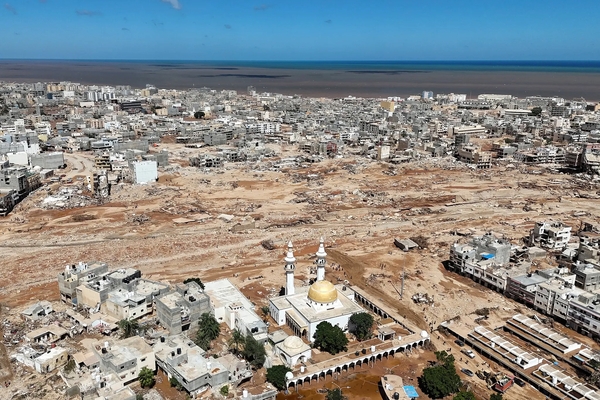 Some of the devastation caused by two broken dams in Derna. |
The example is clear; if it could happen to shoddily built dams in Libya, it can happen on a far vaster scale to a shoddily built dam in Iraq, with a hundred times or more casualties. It is not inconceivable. It is just a matter of time.
Sep. 17, 2023 update: Curiously, in a review of dangerously fragile dams, "Is the Disaster in Libya Coming Soon to an Aging Dam Near You?" Josh Klemm and Isabella Winkler do not mention the Mosul Dam.


