
(This entry follows on two others: "[Naveed Haq and] 'Sudden Jihad Syndrome' in Seattle" and "More on Naveed Haq, Seattle's Sudden Jihadi," and should be read in sequence after them.)
Dayna Klein, hero of the assault on the Jewish Federation of Greater Seattle building, recalls what Naveed Haq did on finding she had defied his wishes and called 911: "He stated that he was a Muslim, this [attack] was his personal statement against Jews and the Bush administration for giving money to Jews, and for us Jews for giving money to Israel, about Hezbollah, the war in Iraq, and he wanted to talk to CNN."
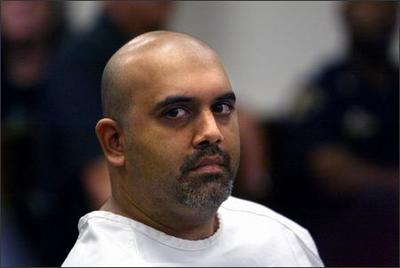 Naveed Haq glares at the media during his court hearing on August 8. |
Even more appalling, the parents of Layla Bush, 23, Haq's most severely wounded victim who is battling for her life, focused entirely on Haq's supposed mental illness. Layla's mother Kathryn said about Haq: "I don't feel any blame or anger toward him." Father Brad added that "It would take somebody who was mentally ill to do this." If anything, the couple agreed, their daughter would be angry at the causes for Haq's hateful eruption and at the lack of funding for the mentally ill.
Institutional Jewish responses from elsewhere struck similar notes, always ignoring radical Islam and the jihad. Marc Fisher, president of the Jewish Federation of Cincinnati, deemed the assault in Seattle "an attack on all peace-loving people who simply want to make their communities better." Rabbi George Barnard of Northern Hills Temple in Ohio, feels secure about his congregation's safety: "I think we're OK. The terrible thing that happened in Seattle doesn't seem to be part of a pattern." (August 9, 2006)
Aug. 17, 2006 update: Dayna Klein, the hero of the Jewish Federation ordeal, spoke out today. Unfortunately, rather than focus on jihad, she devoted her moment in the public eye to gun control. Jennifer Sullivan explains in the Seattle Times:
In the three weeks since a gunman stormed the Belltown office where she works, killed her close friend and shot her in the arm, Dayna Klein has dedicated herself to fighting for tighter gun control laws. Klein, 37, said at a news conference today that she wants to know why the man who "invaded" the Jewish Federation of Greater Seattle on July 28 was able to purchase guns from shops in the Tri-Cities just before the shootings that killed one woman and wounded Klein and four others. ... She views the shootings as a reason for her to call for "a safer society for all."
Asked about Haq, Klein said she doesn't think about him, nor does she have an opinion about whether prosecutors should seek the death penalty. "Naveed Haq has wasted enough of my time."
Comment: I would hope that Klein devotes a lot of her time to Haq, to understand him and then to become a spokeswoman for the need to combat radical Islam and jihad.
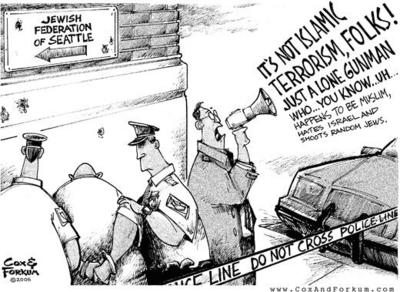 Dec. 21, 2006 update: Given the above responses, it hardly comes as a surprise that King County Prosecutor Norm Maleng decided against seeking the death penalty for Naveed Haq, citing the defendant's supposed long history of mental illness – and of course not mentioning a word about jihad. This despite Maleng calling the murder "one of the most serious crimes that has ever occurred in this city."
Two women who nearly lost their lives at Haq's hands – and are still recovering from their gunshot wounds – endorsed Maleng's decision. Cheryl Stumbo admitted that "The death penalty most likely promulgates further violence and thoughts of revenge," but she does not want the death penalty. Layla Bush said a life sentence would be tougher on Haq than his execution. "I think this guy is someone who could feel remorse in prison. Two wrongs don't make a right." For what it's worth, Haq's attorney, C. Wesley Richards, chimed in: "I am pleased that Mr. Maleng recognized that Mr. Haq has a serious mental illness and, accordingly, that the death penalty is not appropriate."
The only dissenting voices came from Nicole and Mark Waechter, the grown children of the murdered Pamela Waechter, who noted in a written statement that Haq's "cruel and callous disregard for the lives of so many, in our view, forfeited his right to preserve his own." But they showed some embarrassment about this attitude, adding that they respected Maleng's decision and would move on: "We choose instead to spend our energies trying to mend our lives in a way that honors our mother and all she meant to us. We need all of our energies to heal our wounds and those of others."
Layla Bush survived Naveed Haq's jihad, but with injuries.
May 30, 2007 update: Haq faces in total 20 charges for his murderous spree: one count of aggravated first-degree murder, five counts of attempted first-degree murder, one count of first-degree kidnapping, one count of unlawful imprisonment, six counts of first-degree burglary and six counts of malicious harassment. He has pleaded not guilty by reason of insanity.
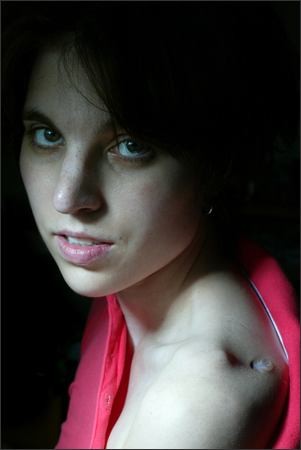
July 27, 2007 update: A year after the rampage at the Jewish Federation, John Iwasaki does a review of circumstances for the Seattle Post-Intelligencer. Some highlights:
Dayna Klein gave birth to a son, Charley, four months after Haq's attack.
Layla Bush survived the shooting that sent bullets to within a half-inch of her heart, lodging near her spine, and exiting through her left shoulder, doing damage to her liver, stomach, pancreas, and left kidney. She "walks gingerly, sometimes with a cane, because of long-term nerve damage to her right leg and weak quadriceps muscles. She can't sit through a movie, stand for much more than an hour or walk her dog. Surgeons removed the bullet from her back in February. Her typical week is filled with up to nine appointments for physical and occupational therapy, checkups, acupuncture and counseling." While still recovering in the hospital, Bush said executing Haq would be "too easy for him." She reiterated that view now, saying she favored life imprisonment. In the aftermath of the shooting, "what made me mad is not him, but that someone with a mental history like that can get guns." She also hoped the people will not forget "how much damage hate can do."
The Jewish Federation closed its building for seven months and remodeled its offices, making many security improvements including reduced interior walls to increase lines of sight.
Mar. 15, 2008 update: A Seattle Times preview of the Haq trial clearly sets out the terms: "Both sides agree that Haq has struggled with mental illness, and the defense does not dispute that Haq entered the federation and committed the shootings. A psychiatrist defense witness, however, is expected to testify that Haq was insane at the time and therefore his ability to premeditate and form intent to kill was diminished." In other words, the trial will not be about Haq's antisemitism and jihadism but the fine points of his mental state in July 2006. Further,
Haq's attorneys have motioned to suppress all evidence discovered at his apartment and the statements he made to police after he surrendered, including statements about Israel, Iraq, Lebanon and Jews, Internet research he told police he did the day before the shootings, his medications and his guns. His attorneys say police violated his legal rights when they continued interrogating him after he requested a lawyer.
Comment: It appears the trial will closely continue the general treatment of Naveed Haq; in the Seattle style, as much as possible, the real issues will be swept aside.
Mar. 31, 2008 update: More glimpses of Haq's motives and state of mind emerged with the playing of a videotaped interview by police soon after Haq's arrest in July 2006. Some snippets, as reported in the Seattle Post-Intelligencer:
Haq said he wanted to make two points: that the United States should get out of Iraq; and that it should stop providing bombs and intelligence to Israel. ... He told investigators that bipolar disorder had "really screwed up" his life and maintained that while raised Muslim, he loved America and was not an extremist. He talked a bit about the shooting, saying he didn't know how many people he hit and that he stopped because "there were no guys" in the building. "I got in there and started firing," he said. "I wasn't really aiming at anybody."
Apr. 1, 2008 update: Another take on what Haq told the police in his videotaped interview, this from a Seattle Times report:
In the candid and chilling videotaped interview, Haq told the detectives that he had planned the attack over a few days, that he stopped shooting "so quickly" because he saw only women in the center, and that he didn't use a shotgun in the rampage because it was "too much of a hassle walking down the street with a shotgun."
Haq told police that his bipolar disorder had "screwed up" his life, that he took two his guns and a knife to the Jewish Federation, and that he invaded the federation's Belltown offices to make "a point" about Jews and the Iraq war. "I don't have anything against America," Haq says in the interview. "I have [sic] against the Jewish people. Because they're busy killing."
"Do you think this is going to be national news?" he asked detectives at one point. "It's probably going to be if I attacked. ... I sympathize with Muslims, you know. But I'm not an extremist," he said. "I didn't want to kill anybody. ... just got in there and started firing. ... I wasn't really aiming at anything," he later said.
Haq appeared confident, even boastful, during parts of the interview. He told detectives he had two college degrees, but had had difficulty holding down a job. He spoke without emotion until he was asked about his parents, when he paused to wipe his eyes. Much of the time, he willingly answered questions.
Apr. 11, 2008 update: King County Superior Court Judge Paris Kallas rendered inadmissible as evidence the 55-minute interview with Haq on the grounds that police detectives ignored his repeated requests to talk to a lawyer.
Comment: This decision will make discussion of Haq's jihadi motives even less likely.
Apr. 14, 2008 update: In its opening statement at the Haq trial, the prosecution argued that Haq had rationally planned the shooting to make a political statement. He prepared by taking four separate trips to gun shops just before the attack, searched the Internet looking for Jewish organizations, and relied on an Internet website to map out the 227-mile trip from Pasco to the Jewish Federation in Seattle. Deputy Prosecutor Erin Ehlert explained that "The defendant, Naveed Haq, was on a mission. ... To go into that location and make a statement—both physically and verbally—to go in, shoot people, take hostages and get on CNN." Further proof of his rationality came in his ranting about Jews, U.S. troops in Iraq and "the situation in the Middle East." He was on a mission. "He thought about what he did. He planned what he did."
Ehlert played back a call to 911 during which Haq asked to be connected to CNN and told the operator he had attacked the Federation building because of U.S. support for Israel and the war in Iraq. "I don't care if I die. This is just to make a point." A bit later, he decided he had made the point. "I'll give myself up. This was just to make a point." Ehlert characterized Haq's rampage as a political mission to establish "That the Jewish people in America have too much power."
Further, a police officer had stopped Haq for a traffic violation close to the Federation building at which time he acted normally, conducting "a normal conversation in a normal tone of voice."
Haq's attorney, John Carpenter, maintains that he was delusional, hearing the voice of God urging him to go on a "mission" and other behavioral problems. The shootings were "the acts of a madman," and said they came "not from a darkened heart, but from a diseased man. ... He actually thought his actions were going to have a positive societal effect. This is insanity."
Apr. 15, 2008 update: Testimony began and one piece of evidence bears on Haq's motives: Cheryl Stumbo recounting Haq saying that he "was an angry Muslim American, and he wanted to make a statement." She also recalled his demeanor: "It was like a normal tone of voice with the volume turned up. His face didn't look angry. It was placid, sort of everyday normal."
Apr. 16, 2008 update: Police Officer Glen Cook took the stand and recounted that when he stopped Haq driving to the Federation everything seemed normal, giving him no sense that Haq would minutes later attack the Federation employees. According to Tracy Johnson in the Seattle Post-Intelligencer:
On July 28, 2006, Cook said, he noticed Haq's white Mazda pickup headed north on Third Avenue at 3:37 p.m.—a rush-hour time when the busy downtown street is mainly limited to bus traffic. He flipped on his lights and chirped his siren. Haq pulled over. Cook said it was a brief exchange. He asked Haq for his license and proof of insurance, took the license back to his motorcycle and returned with a ticket. He then pointed out the signs restricting traffic and told him to get off Third Avenue. "He acknowledged, said 'OK,' something to that effect," Cook said. "Whatever it was, I'm (sure) he understood." The officer said Haq "made eye contact" and "seemed normal." Cook didn't see any weapons. ...
After Cook gave him a ticket and sent him on his way, Haq parked his truck in a garage about six blocks away. Prosecutors say it was about 3:54 p.m. when he went on a deadly rampage inside the federation's Third Avenue offices.
Apr. 21, 2008 update: Dayna Klein, heroine of the Haq assault, took to the stand today and recounted what happened when Haq got on the phone with 911: "He began to state that ... he would like to talk to [CNN talk-show host] Larry King and [that] the Jews ... need to get out of Lebanon and Iraq. This is his Hezbollah, this is his personal statement."
Also today, Jonathan Kay of Canada's National Post muses on the implications of Haq's pleading not guilty by reason of insanity. He finds Haq's trial
a noteworthy skirmish in the war on terror in one critical respect: The unemployed engineer is bipolar, and has pled not guilty by reason of insanity. This is an extreme rarity: Most accused jihadis vigorously shun the insanity label as an insult. ... The reason I find Haq's mental health so interesting is that it puts into sharp relief the sheer inhuman craziness of every terrorist attack. ... In fact, since the war on terrorism began, I have consistently believed that the treatment of the dangerously insane provides a far better legal theory to justify the incarceration of jihadis than either of the two models more commonly used by the United States and other western governments: criminal murderer and prisoner of war.
Apr. 25, 2008 update: A Seattle police computer-forensic specialist, Timothy Luckie, explained to the court that Haq at 5:15 p.m. on July 27, 2006, began entering Internet terms into google.com. Natalie Singer provides details in the Seattle Times:
Haq began with a search for "AIPAC in Sacramento." ... Haq then searched for "future AIPAC events," "evangelists," "national evangelical events" and "AIPAC in Seattle" before he landed on the home page of the Jewish Federation of Greater Seattle, Luckie said. After plugging in "current Jewish Federation events," Haq visited Mapquest.com, where he mapped directions for the 227-mile, 3-½-hour trip from his parents' home in Pasco to the Belltown offices of the federation, according to the testimony. His search took just under 15 minutes. The following day, about 4 p.m., Haq forced his way into the federation offices with two guns and opened fire.
Detectives also uncovered other Internet searches they say relate to the shootings. Early on the morning of July 23 — five days before he drove to Seattle and four days before he purchased a .45-caliber Ruger at a Kennewick sports shop — Haq searched "Iranian Americans in Congress," "Asians in Congress," "Jews in Congress" and "Jews in the House of Representatives," Luckie said.
Comment: These searches provide further proof, as if any were needed, of Haq's purposeful and rational jihadi actions.
Apr. 29, 2008 update: Luckie continued his testimony about Haq's computer, Tracy Johnson reports in the Seattle Post-Intelligencer: he
testified about two documents typed on a computer at the home of Haq's parents, where Haq spent much of his time, five days before the shooting. One was called "Naveed's Khutbah"—or Islamic sermon—and compared Muslims and Jews. It described how Jews have been "an integral part of American Society since the very birth of the nation," but said they were overrepresented in American politics. It said Muslim people "have a long way to go to get positive recognition in America" and suggested various strategies, including writing congressional delegates, giving to charities and mentoring disadvantaged youths. The second document, titled "Sources of Muslim Anger," advocated letting the Middle East sort out its conflicts on its own and lessening the United States' dependence on foreign oil. Luckie could not say for certain whether Haq wrote the two documents.
Also today, Haq's former psychiatrist, Alexandra McLean, an assistant professor at the University of Pennsylvania, testified as the defense's first witness in his trial about his unsteady mental state, as gleaned from 17 sessions with Haq from May 1998 to January 2000. She pointed to such problems as his contemplating suicide, struggling with classes at the University of Pennsylvania dental school, taking large numbers of antidepressants, suffering a nervous breakdown, trying to kill himself by jumping out of a window, twice overdosing on Lithium, and considering ending his life with a shotgun. In addition, Jennifer Sullivan reports in the Seattle Times, "He was angry, anxious and distracted. His body shook with tremors, he couldn't sleep and was certain that he had telepathy." McLean found him suffering from schizoaffective disorder and prescribed a number of medications. During those 20 months of meetings, she did not recall his saying anything against other races and religions.
Comments: (1) Haq's not being a jihadi a decade ago tells nothing about his state of mind in 2006. (2) One can suffer from schizoaffective disorder and also be a violent jihadi. His mental state may have prompted Haq to act on his jihadi outlook but it did not place the views in his head.
May 1, 2008 update: Haq's mother, Nahida Haq, took the stand to tell of Naveed's mental illness and the news report is full of strange goings-on: he took long, scalding showers because he "couldn't feel his body," he whispered out of a fear that "people were listening," and he imagined that he'd gone back in time to the 1980s. "He always thought somebody was controlling his mind, telling him to do things he doesn't want to do."
Haq escorted out of his trial for a lunch break.
May 2, 2008 update: Naveed's younger brother Hasan, 26, and his father Mian have now testified about his behavior.
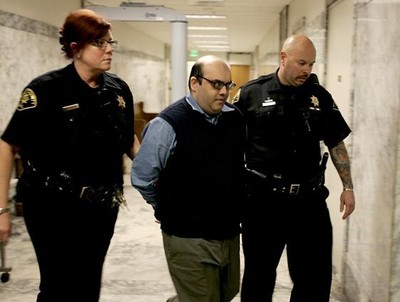
"He would rant about Islam to me," Hasan recounted. Naveed condemned Muslim-majority countries as backward, disparaging Muslims, not Jews. He considered being a Muslim an obstacle to having fun and saw his Pakistani identity as a reason for prejudice against him. He defied Islamic strictures by drinking, eating pork, and eating during Ramadan. He experimented with Christianity, to the point of being baptized. Unhappy with his name, he went briefly by "Nick" and was elated when someone mistook for Hispanic, even plunging into a brief but intense effort to learn Spanish. He constantly came up ideas to make people like him, such as growing a goatee, working out three times a day in a gym, wearing platform shoes to appear taller. But Hasan Haq acknowledged this was old information, as he had distanced himself from his brother in the year before the shooting rampage.
Mian testified that Naveed "used to make fun of our faith" due to its many prayers, fasts, and other demands. "He was always searching for the right religion."
A psychiatrist, Bruce Bennett, who saw Naveed four months before the shooting, said he was delusional, believing the police had him under surveillance.
May 22, 2008 update: As the trial wraps up, Dean Rutz of the Seattle Times explains "the puzzle that is at the heart of this unusual case" that the jury will consider:
Was Haq a social misfit, plagued by a bad childhood, overbearing parents and garden-variety depression that led him to gun down six women in a suicide mission on July 28, 2006? Or was his rampage at the Jewish Federation, which left five women wounded and one dead, an act of insanity fueled by manic psychosis and hallucinations that God was talking to him? Was he, as the defense contends, not guilty by reason of insanity? ...
To find Haq guilty of aggravated first-degree murder, the most serious charge he faces, they will have to agree unanimously that he killed federation employee Pamela Waechter with premeditated intent. Jurors will also be able to consider the lesser crime of second-degree murder, as well as second-degree attempted murder as opposed to first-degree attempted murder as charged.
To find Haq not guilty by reason of insanity, which would result in commitment to a mental hospital, the jury must find that at the time of the shootings, as a result of mental disease or defect, Haq was unable to perceive the nature and quality of the act with which he is charged; or that he was unable to tell right from wrong with reference to that act.
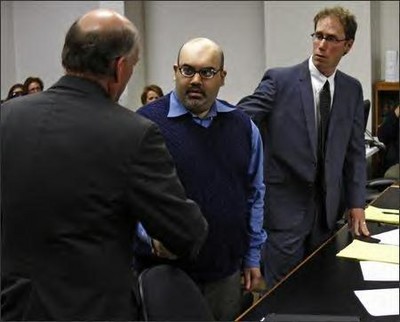
Naveed Haq shakes hands with his attorney, C. Wesley Richards, after a mistrial was declared in his case.
June 4, 2008 update: More than seven days of deliberations left the six-man, six-woman King County jury deadlocked on nearly all of the 15 charges against Naveed Haq and Superior Court Judge Paris Kallas declared a mistrial. They agreed only on Haq being not guilty of one attempted first-degree murder, suggesting a general agreement that the shooting rampage was not a premeditated effort to kill. The King County prosecutor, Dan Satterberg, said he intends to retry Haq quickly on all the same 15 criminal charges, minus that attempted first-degree murder charge. Satterberg called Haq's rampage "one of the most serious crimes ever committed in this city" and called the non-decision of the jury "a disappointment."
June 12, 2008 update: Deborah Weiss brings some sanity to the insanity pleas in her fine analysis of the Haq case, "Radical Muslim or Legally Insane?": "Legal insanity is demonstrated by someone who strangles a man's neck, thinking he is squeezing a lemon. The defense is not intended for clear-headed men who choose to abide by an immoral doctrine."
June 19, 2008 update: The new trial for Haq will begin on September 22.
July 16, 2008 update: Superior Court Judge Paris Kallas postponed Haq's trial until early 2009, mainly so attorneys can review the 500-600 recordings of Haq's telephone calls from the King County Jail since his arrest in July 2006. The calls are newly available as evidence since the state Supreme Court recently decided that inmates' telephone calls are not private, but may be recorded and can be used as court evidence. Haq made statements during the calls about his being a "martyr," declaring "You should be proud of what I did," "I did the right thing," and "I did it for God."
Aug. 7, 2008 update: The Haq trial is now postponed until March 9, 2009 because 100-or-more hours of new recordings of phone calls Haq made from jail may prompt prosecutors to seek additional charges.
Nov. 17, 2008 update: One of Haq's victims appears to remain in utter denial of the cause of her trauma. A person identifying herself as Cheryl Stumbo writes today:
the man who shot me and five of my colleagues (killing one and seriously injuring the rest of us, not to mention traumatizing the entire staff and volunteer base) was raised Muslim, yes, but by peace-loving parents, from all accounts. His problem was long-term, very serious mental illness. Let's not attribute blame to ethnicity/religion when there are documentable medical explanations. Rationality and reason should prevail.
June 11, 2009 update: Important news from the slow-moving Haq retrial: King County Superior Court Judge Paris Kallas has ruled that Haq's taped jailhouse calls will be allowed at the trial, with jury selection now scheduled to begin on September 11.
Dec. 15, 2009 update: After seven weeks of testimony, a King County jury today convicted Haq on all eight counts: aggravated first-degree murder, five counts of attempted first-degree murder, one count of unlawful imprisonment, and one count of malicious harassment. The murder verdict carries an automatic life sentence without parole.
Several victims were present in the courtroom as the verdicts were read and one of the jurors, John Bennett watched them as the verdicts were read: "I had to feel good there was a closing for them." Bennett added that the jury waited "for someone to tell us [that Haq] was insane, and we never saw it."
One possible reason for the different outcome from Haq's hung first trial was the playing of audio recordings from ten phone calls Haq placed to his family from the King County Jail. Among other claims, Haq described himself as "a soldier of Islam."
Jan. 14, 2010 update: Two important developments today:
(1) Haq was sentenced to life in prison and 120 years, without parole.
(2) Haq apologized.
Addressing the court for the first time, Haq blamed the shootings on mental illness and lack of treatment. "I understand you are angry," said Haq, 34. "The tragedy wouldn't have occurred if it wasn't for bad medical care and mental illness." Haq apologized for the attack "from the depth of my being." "I am not a man filled with hate," said the Tri-Cities man. "That Naveed Haq at the Federation that July day was not the real Naveed Haq."
Comment: Haq's statement fits the usual pattern of jihadis blaming their medical condition, not Islam.
Jan. 27, 2013 update: One of Haq's victims, Cheryl Stumbo, found her voice to discuss the horror she underwent in July 2006. But what is the focus of her rage? The NRA and gun ownership. Not a word about Islamism. Comment: It is remarkable how consistently everyone in Seattle draws the wrong conclusion from this tragedy.


