
It finally happened. The Treasury Department on August 15 (1) listed the National Council of Resistance in Iran as a Specially Designated Global Terrorist and (2) "clarified" that the National Council of Resistance and People's Mujahedin of Iran are aliases of the Mujahedeen-e Khalq (MEK). This step has the effect of "freezing all assets and properties and prohibiting transactions between U.S. persons and these organizations." Meanwhile the State Department closed the MEK's two U.S. offices.
 This is not quite what Patrick Clawson and I called for three months ago in our article on the MEK. Rather, we recommended that the U.S. government "should come to the sensible conclusion that [the MEK] poses no threat to the security of the United States or its citizens, and remove it from the list of Foreign Terrorist Organizations."
Others feel the same way: "This group loves the United States. They're assisting us in the war on terrorism; they're pro-U.S. This group has not been fighting against the U.S. It's simply not true," Rep. Ileana Ros-Lehtinen (R-Fla.), chairwoman of the House International Relations Committee's Central Asia and Middle East Subcommittee, has said.
In contrast, the Islamic Republic of Iran bestowed some rare unadulterated praise on Washington, calling this action "a positive step that conforms to its international responsibilities." The regime's reaction certainly did nothing to contradict the MEK's furious reaction (in an unposted statement by Alireza Jafarzadeh) to the recent steps: "The rush to take this action can only be interpreted in the context of a back-channel and dirty deal offered by the religious fascism ruling Iran and in response to its public demands to close down this office."
Despite the seeming finality of the U.S. government's decision, it still appears to be less than whole-hearted. Today's Washington Post reports Jafarzadeh saying that "those who support the group are being left alone by the U.S. government, and non-U.S. citizens are not being deported." So maybe there is still hope against hope for a less than total appeasement of Tehran. (August 17, 2003)
Nov. 9, 2003 update: Despite its being on the terrorism list, the MEK remains in an odd limbo, as described in today's Washington Post:
"The problem is they're still labeled as terrorists, even though we both know they're not," said [U.S.] Sgt. William Sutherland, explaining why a reporter could not enter [the MEK installation in Iraq known as] Camp Ashraf. "Much as I'd like to go and do a story myself on how they're not terrorists—rather, they're patriots—it's not going to happen until they get put on the green list." …
Last month, Secretary of State Colin L. Powell wrote Defense Secretary Donald H. Rumsfeld to remind the Pentagon that the mujaheddin's forces in Iraq are supposed to be U.S. captives, not allies.
At Camp Ashraf, however, U.S. soldiers idling in the chalky dust outside the compound said they were uncertain even whether they were guards. "It's kind of hard to say," said a sergeant who declined to give his name.
Do prisoners invite guards over for dinner? The mujaheddin hosted a banquet for the Americans, laying out a spread of chicken and French fries after showing off a new museum dedicated to the history of their struggle.
As these contradictions suggest, the U.S. government has yet to figure out its relationship with the MEK. The result is policy chaos. Let's hope this means that something constructive might yet come out of it.
Nov. 13, 2003 update: Responding to the above-referenced article on Nov. 9, national security adviser Condoleezza Rice gave an interview insisting that the Bush administration sees the MEK as "part of the global war on terrorism" and its members "are being screened for possible involvement in war crimes, terrorism and other criminal activities." She went on: "I just want to be very clear that the U.S. remains committed to preventing the MEK, which is now contained in Iraq, from engaging in terrorist activities, including activities against Iran, and its reconstitution inside Iraq as a terrorist organization." Will the policy stick this time?
Dec. 21, 2003 update: In a new twist, Paul Bremer announced last night that "We want to involve the UN High Commission for Refugees in settling the mujahideen in three countries," without specifying which countries. But his implication was clear; the roughly 3,800 MEK members in Iraq would be expelled, but not to Iran as the Tehran authorities have been demanding. Predictably, Islamic Republic of Iran Broadcasting reports on the howls of outrage this decision has elicited from Foreign Ministry Spokesman Hamid-Reza Asefi, who called it "unacceptable" and again pointed out that the U.S. government does not treat MEK members like real terrorists: "The US has detained a group of people who are accused of collaborating with the Al-Qaeda in Guantánamo, and on the other hand allows another group of terrorists to freely walk around the world." So, it looks as though good sense is prevailing and the MEK, a would-be if imperfect U.S. ally, is not being sent to its doom in Iran.
July 9, 2004 update: David Ignatius reports in the Washington Post about a secret meeting in May 2003 in Geneva, where U.S. and Iranian officials explored an exchange of their respective captives - Al-Qaeda for Mujahedeen-e Khalq. The Iranians promised amnesty to most of the 3,800 MEK members and not to apply the death penalty for the roughly 65 leaders who would be tried. According to Ignatius, who rues that this deal did not go through, it failed because the Bush administration (surprise!), "bowing to neoconservatives at the Pentagon who hoped to use the Mujahedeen-e Khalq against Tehran," opposed it. (Note how the neoconservatives are implicitly not part of the administration but some alien force.) The muj, it appears, survived another near-miss.
July 27, 2004 update: After 16 months, the State Department and FBI have found there is no basis to charge the 3,800 MEK members held in de facto American custody in Camp Ashraf with violations of American law, reports the New York Times. Then, after MEK members signed an agreement rejecting violence and terrorism, the deputy commanding general in Iraq, Maj. Gen. Geoffrey D. Miller, wrote in a July 21 letter, addressed to the "people of Ashraf," that the U.S. military had designated MEK members "protected persons," giving them new rights of protection against collective punishment and immunity against expulsion. ("Protected persons" are covered in the Fourth Geneva Convention, which deals with civilians in wartime.) Miller wrote that the agreement not to resort to violence "sends a strong signal and is a powerful first step on the road to your final individual disposition." The letter includes General Miller's indicating he was "writing to congratulate each individual living in Camp Ashraf" on their new status.
Nonetheless, the State Department (ever-intent on appeasing the Islamic Republic of Iran) insisted that this determination does not affect the MEK's designation as a designated foreign terrorist organization.
Say again? Well, an unnamed "senior American official" told reporter Douglas Jehl that "A member of a terrorist organization is not necessarily a terrorist. To take action against somebody, you have to demonstrate that they have done something."
Muhammad Mohaddessin of the MEK unsurprisingly took issue with this logic: "the fact of the matter is that there is no reason for keeping the Mujahedeen on the terrorism list at all because if these thousands of people who are in Iraq are not terrorists - when they all have been screened, and no terrorism link has been found - then really there is no basis whatsoever for accusing the Mujahedeen of being a terrorist organization."
July 29, 2004 update: MEK's winning the "protected persons" status, reports Scott Peterson of the Christian Science Monitor, "underscores the divisions in Washington over US strategy in the Middle East and the war against terrorism. It's also a function of the swiftly deteriorating US-Iran dynamic, and a victory for US hawks who favor using the Mujahideen-e Khalq Organization … as a tool against Iran's clerical regime." Certainly, Tehran reacted with predictable fury: "We already knew that America was not serious in fighting terrorism," noted Foreign Ministry spokesman Hamid Reza Asefi, adding sardonically that the U.S. government had created a new category of "good terrorists." For good measure, he denounced the American use of the Geneva Conventions as "naïve and unacceptable."
Peterson also quotes Ali Ansari of the University of St Andrews going so far as to predict that it "will be interpreted in Iran as another link in the chain of the U.S. determination to move onto Iran next," adding that "US-Iran relations are drifting into very dangerous waters at the moment." And for good measure the reporter gives space to the hare-brained notion of Mohamed Hadi Semati of Tehran University, now at the Carnegie Endowment for International Peace in Washington, that the MEK's change of status is related to the U.S. presidential election. "This whole dynamic is tied up with [US] domestic politics...and not about the [MEK] itself."
Oct. 18. 2004 update: Paulo Casaca, a Portuguese Socialist MEP and president of the European Parliament's delegation to the NATO Parliamentary Assembly, writes in the Wall Street Journal about visiting the MEK in Iraq:
Arriving at Camp Ashraf after traveling around Iraq felt like reaching an oasis. Traffic police who imposed fines on speeding; Ashraf was the only place I found in Iraq where traffic rules were respected and enforced. People could move in peace and freedom. The urban infrastructure, such as water, sanitation and electricity, was very well maintained by the Iranians themselves.
The sprawling enclave looked like a microcosm of another Iran. Here, where all the road signs are in Farsi and English, I found an extraordinary collection of mainly middle class, university-educated activists united by their hatred of the Islamic fundamentalist regime in their homeland.
I was also struck by the cultural diversity: Dozens of well-stocked libraries, several theaters and movie halls, five orchestras and, according to Kamyar Izadpanah, a U.S.-educated composer, one of the best Persian music conservatories in the world. Two universities—set up with the help of professors from Baghdad University—teach a wide array of subjects from law to engineering.
Comment: While five orchestras and two universities sounds a bit rich for a community of under 4,000 persons, the lawfulness and orderliness of Camp Ashraf bely the notion that its denizens present a threat to the Americans or Europeans whose governments have placed the MEK on their terror lists.
Dec. 21, 2004 update: Keeping things murky, a three-judge panel of the U.S. 9th Circuit Court of Appeals yesterday reinstated charges (that a lower court had thrown out) against seven Los Angeles-area residents accused of raising funds for the Mujahedeen-e Khalq. The five Iranians and two Iranian Americans were charged with violating a 1996 anti-terrorism law by providing "material support" to the MEK with funds solicited at Los Angeles International Airport.
Dec. 30, 2004 update: Further confusion. We read back in June 2003 that the French government sent out 1,300 police to invade the MEK's international headquarters in Auvers-sur-Oise and arrest 165 MEK members as well as seize its assets. Anti-terrorism judge Jean-Louis Bruguière ordered the raids on the basis of the MEK's "criminal association aimed at preparing terrorism acts and for financing a terrorist enterprise." So, why have I just received a particularly elegant New Year's card from Maryam Rajavi and a season's greeting card from Muhammad Mohaddessin, both sent from its headquarters in Auvers-sur-Oise? (Of note too is the Rajavi card bearing a large French stamp of Vincent van Gogh's La Méridienne d'après Millet.)
Feb. 14, 2005 update: Perhaps things are sorting themselves out. Newsweek reports that the Bush administration "is seeking to cull useful MEK members as operatives for use against Tehran, all while insisting that it does not deal with the MEK as a group. … Some Pentagon civilians and intelligence planners are hoping a corps of informants can be picked from among the MEK prisoners, then split away from the movement and given training as spies" Maryam Rajavi, the MEK leader, acknowledges these efforts but dismissed them: "There have been efforts to recruit individuals, or to dismantle parts of the movement. These have failed."
Apr. 11, 2005 update: Capt. Vivian Gembara, Esq. worked for American forces as a military lawyer with the MEK in Iraq; she has now published an account of her experiences at GlobalPolitician.com and drawn some conclusions from them. Referring to the MEK forces as the National Liberation Army of Iran (NLA), she recounts how U.S. Special Forces were the first to encounter the NLA and understand "their value as potential human intelligence sources." But the NLA was classified as a terrorist organization, what Gembara calls "an outdated and inaccurate label," and that ended the possibility of the cooperation proffered by the NLA. Instead, U.S. forces disarmed NLA soldiers and placed them in Camp Ashraf, where they remain to this day, and where they will remain "until they can shed their terrorist label," something she does not expect to happen soon.
Gembara characterizes the rejection of the NLA's offer to help as "naïve," arguing that "It would have been a far more useful to our troops, and our intelligence efforts, to work with the NLA" than the hold them captive.
Under our direction, they could have secured buildings and provided us with another set of eyes and ears within the communities. Surely their feedback and willingness to help in this capacity far outweighs any information we could have hoped to reap from Camp Ashraf interrogations. Adding insult to injury however is the inconsistent and uneven handling of other militias in Iraq. Despite known ties to the Iranian regime, U.S. officials permitted the Badr Corps, a militant Shiite wing of the Supreme Council for Islamic Revolution, to remain both intact and active.
Given the NLA's potential as an "indispensable intelligence source on Iran," and especially its nuclear capabilities, Gembara considers it "reckless to continue to detain and alienate the NLA."
Apr. 15, 2005 update: Another former U.S. military officer who dealt with the MEK in Iraq has come out in its favor. Eli Lake reports in the New York Sun that the former military police commandant of Camp Ashraf, Lieutenant Colonel Thomas Cantwell, expressed solidarity with fighters he used to guard at a Washington, D.C. rally: "If there is a terrorist group in Ashraf, where are the terrorists?" He explained to reporters his belief that MEK fighters sincerely intended to cooperate with American soldiers after their voluntary disarming after the coalition forces entered Iraq in March 2003. "Our assessment was that the Mujahadin represented a minimal threat to U.S. forces. There were no incidents of violence. They complied with everything we told them to do."
May 22, 2006 update: The Wall Street Journal's Jay Solomon takes up the question of taking the MEK off the terrorism list in "Iranian Exile Group Aims to Build Bridges":
Some U.S. diplomats say that to delist the MEK now would make Washington appear inconsistent on terrorism and could further incite Iranian President Mahmoud Ahmadinejad. They also believe Iran's leadership could use U.S. support of the MEK to further strengthen Mr. Ahmadinejad's position, due to what is perceived as widespread antipathy toward the MEK inside Iran. "It could be incredibly provocative in Iran's eyes," a U.S. official said.
The article also includes a strong statement by Rep. Brad Sherman (Democrat of California): "It's the only group on the terrorist list that's been more helpful to the U.S. and more harmful to our enemies. It played a very important role in telling us what happened [at the Iranian nuclear installation] in Natanz. We should be clear on what we expect of them to get off the list."
June 18, 2006 update: Three years and one day after the French government took over the MEK's headquarters and arrested 165 of its members (on which, see the Dec. 30, 2004 update, above), a French appeals court lifted restrictions on 17 members, including Maryam Rajavi, imposed back then. The 17 can now freely communicate between each other, move about France, and travel abroad.
July 5, 2006 update: Tehran inadvertently betrayed what a valuable tool the MEK offers the West when it postponed crucial nuclear talks with the European Union, apparently angry at a visit by Maryam Rajavi, the MEK leader, to the European Parliament. An Iranian official admitted that the visit "could have had a negative impact on the meeting."
Comment: If a mere visit can so disrupt the Islamic Republic of Iran's plans, imagine what a warmer embrace would do to push it in the right direction.
Aug. 24, 2006 update: For a fascinating and candid first-hand account by an American sergeant of his interactions with the MEK, see the comment on this page by Russell Wohlford, "I met these folks." He concludes that the U.S. government "caged the wrong bird."
Sep. 30, 2006 update: "U.S. citizen found in Iraq charged with supporting terror group" reads an Associated Press headline. But it turns out that the group in question is the MEK. Zeinab Taleb-Jedi, 51, a naturalized citizen of Iranian origins, resident in Herndon, Virginia, is accused of going to Iraq in 1999 to attend an MEK training camp. "During Operation Iraqi Freedom, Taleb-Jedi was discovered by coalition forces in an MEK training camp called Ashraf Base," northwest of Baghdad, the U.S. attorney's office in Los Angeles asserted in a statement. Taleb-Jedi has been indicted by a federal grand jury in Brooklyn for providing material support to a foreign terrorist organization and faces up to 15 years in prison.
Comment: The charade of calling the MEK a terrorist group not only impedes policy toward Tehran but exacts a human price. Taleb-Jedi should be released; the MEK has not engaged in terrorism for decades and her enemies are our enemies. July 29, 2008 update: Federal Judge Brian M. Cogan ruled in United States v. Taleb-Jedi, 06 cr. 652 that the case against Taleb-Jedi may proceed.
Oct. 18. 2006 update: Paulo Casaca, a Portuguese Socialist MEP and president of the European Parliament's delegation to the NATO Parliamentary Assembly, writes in the Wall Street Journal about visiting the MEK in Iraq:
Arriving at Camp Ashraf after traveling around Iraq felt like reaching an oasis. Traffic police who imposed fines on speeding; Ashraf was the only place I found in Iraq where traffic rules were respected and enforced. People could move in peace and freedom. The urban infrastructure, such as water, sanitation and electricity, was very well maintained by the Iranians themselves.
The sprawling enclave looked like a microcosm of another Iran. Here, where all the road signs are in Farsi and English, I found an extraordinary collection of mainly middle class, university-educated activists united by their hatred of the Islamic fundamentalist regime in their homeland.
I was also struck by the cultural diversity: Dozens of well-stocked libraries, several theaters and movie halls, five orchestras and, according to Kamyar Izadpanah, a U.S.-educated composer, one of the best Persian music conservatories in the world. Two universities—set up with the help of professors from Baghdad University—teach a wide array of subjects from law to engineering.
Comment: While five orchestras and two orchestras sounds a bit rich for a community of under 4,000 persons, the lawfulness and orderliness of Camp Ashraf belie the notion that its denizens present a threat to the Americans or Europeans whose governments have placed the MEK on their terror lists.
Dec. 13, 2006 update: The MEK got a major boost towards its rehabilitation yesterday, when the European Court of First Instance, the second highest court, annulled a 2002 European Union decision that froze its funds, along the way raising doubts about the MEK being a terrorist organization.
Mar. 14, 2007 update: Four years after the invasion of Iraq, the MEK remains in limbo, report Ernesto Londoño and Saad al-Izzi of the Washington Post in "Iraq Intensifies Efforts to Expel Iranian Group," unwelcome in Iraq but living there under the protection of the U.S. military, deemed a terrorist group by the State Department but valued for its information by the Pentagon.
American soldiers chauffeur top leaders of the group … to and from their compound, where they have hosted dozens of visitors in an energetic campaign to persuade the State Department to stop designating the group as a terrorist organization. Now the Iraqi government is intensifying its efforts to evict the 3,800 or so members of the group who live in Iraq, although U.S. officials say they are in no hurry to change their policy toward the MEK, which has been a prime source of information about Iran's nuclear program. … The case highlights the occasional discord between the U.S. and Iraqi governments on matters related to Iran. While the U.S. government has accused Iran of supplying Iraqi Shiite militias with sophisticated weapons that it says have been used to kill American troops, Iraq's Shiite-led government has expanded commercial and diplomatic ties with its majority-Shiite neighbor.
The article also contains a first-hand description of Camp Ashraf in January 2007: "It is a largely self-sufficient compound, and the majority of members haven't left in years. It has shops, a swimming pool, an ice cream store, a bakery and a soda factory that makes a cola- and orange-flavored drink locals call Ashraf Cola."
July 10, 2007 update: I today published "Unleash the Iranian Opposition[, the Mujahedeen-e Khalq]," urging the Bush administration to take three steps. "First, let the MEK members leave Camp Ashraf in a humane and secure manner. Second, delist the organization from the terror rolls, unleashing it to challenge the Islamic Republic of Iran. Third, exploit that regime's inordinate fear of the MEK."
Nov. 30, 2007 update: The MEK got a major boost today, as the Proscribed Organizations Appeal Commission in the United Kingdom rejected the Home Office's request to keep it on the UK list of terrorist organizations. The Home Office plans to appeal.
The Associated Press calls this decision "an important victory" for the MEK, which the U.S. government and the European Union still consider a terrorist organization. It comes a year after the European Court of First Instance (see Dec. 13, 2006 update, above) unfroze MEK assets, though without removing it from the terrorist list. (Complicated, no?)
Dec. 1, 2007 update: Patrick Clawson of the Washington Institute for Near East Policy (and my co-author of a 2003 article on the MEK, "[Mujahedeen-e Khalq:] A Terrorist U.S. Ally?") had this to say to the Los Angeles Times about the British decision:
I think this ruling would be a substantial boost to the organization, but I don't think they stand a bat's chance in hell of being able to unseat the regime. But I would also say that is irrelevant to our consideration of whether or not to list them as a terrorist organization. If the Mujahedin want to keep on trying to overthrow the regime, that's their privilege. And we should certainly not base our decision on whether we list organizations as a terrorist organization on whether we approve their political goals, or whether their political goals will facilitate or complicate U.S. foreign policy.
Dec. 2, 2007 update: More on the British court's decision and how the UK government's knickers are just as twisted on this subject as its American counterpart: Christopher Booker reports in "Iranians freed from ban" in the Sunday Telegraph that the decision leaves the Brown Government "in a deep double embarrassment. Not only were ministers found to have acted illegally in outlawing the chief Iranian opposition group, the People's Mujahideen of Iran (PMOI), as a terrorist organization; they now face searching questions from their EU colleagues as to why they have twice incited the European Council to a unique act of defiance by ignoring a ruling from the European Court of Justice."
Booker goes on to tell a "shameful story" that he portrays as "one of the most baffling riddles of contemporary politics: why should our Government have repeatedly acted in breach of the law, to appease the murderous regime in Teheran, which has played a key part in arming the insurgents who are killing British troops in Iraq and Afghanistan?" The details:
This murky tale goes back to 2001 when Jack Straw, as home secretary, branded the PMOI, alongside al-Qa'eda, as a terrorist organization. As Straw himself admitted in 2006, he did this "at the behest of the Teheran regime". … In 2002, at British instigation, the EU added the PMOI to its own list of terrorist groups, a decision that last December was finally ruled "unlawful" by the ECJ. Unprecedentedly, in January, again at British instigation, the Council of the European Union agreed to defy the ruling of its own court, a decision it confirmed last June - even though by then the Foreign Office admitted the Revolutionary Guards were actively aiding the insurgents fighting British forces in Afghanistan and Iraq.
In August, 35 MPs and peers, led by former ministers, including Lord Waddington, a former home secretary, asked the Proscribed Organizations Appeal Committee, a branch of the High Court, to rule that the proscription of the PMOI was unlawful. Their lawyers produced a mass of evidence to show that the PMOI was not a terrorist organization. The Home Office could produce no evidence to show that it was anything other than a non-violent movement campaigning for democracy. On Friday all three judges ruled in the PMOI's favor, finding that the Home Office had ignored important facts, misunderstood the law and reached a "perverse" decision. It told the Home Secretary to lay an order before Parliament removing the PMOI from its list. Home Officer minister Tom McNulty weakly responded that the Government would seek leave to appeal.
Booker concludes by calling this "A good day for British justice, but one that leaves Mr Straw and his colleagues with some very uncomfortable questions to answer."
Dec. 14, 2007 update: "The Home Office plans to appeal," I wrote two weeks ago, of the Proscribed Organization Appeal Commission's decision to require it to lift a ban on the MEK. The Home Office did appeal, and today comes the news that it lost that appeal. It can still try one last time, petitioning the U.K.' s highest court, the Court of Appeals.
Apr. 25, 2008 update: Patrick Clawson notes in "A Roadmap for the Foreign Terrorist Organizations List" the lack of clarity about the process for revoking a terrorist designation. "Even after organizations have renounced terrorism for many years, their designations persist without a clear explanation, and are based on the assumption that historical violence indicates future potential." He then offers some sound advice:
Any designation review should be based only on terrorism issues, not on the general U.S. government view of the organization in question. If the decision to designate a group is made on foreign policy considerations rather than evidence, then the list will be branded as a political instrument, thus reducing its utility as a means for encouraging other governments to take action against certain terrorist organizations. This is what happened to the list of terrorism-sponsoring states, which simply looks like a set of countries the U.S. government does not like.
In the MEK's case, its designation should not be based on the group's political stance or worries about U.S.-Iranian relations, nor should it be a reward for its reports on Iran's nuclear activities. Over the past three years, the State Department's Country Reports on Terrorism have cited no alleged MEK terrorist activity since 2001, yet have increased allegations pertaining the group's non-terrorist activities.
This advice is operational because an in-depth review of the MEK by the State Department is due by October 2008. Clawson wants that review's decision to be based on two factors.
First, the State Department should only decide if the group is or is not a terrorist group, and not bring in irrelevant information. The criteria should be used in an unbiased, professional manner, relying on evidence rather than prejudice or rumor. Second, the decision should be based on clear set of rules regarding how the U.S. government revokes this kind of designation. At present, it seems that past terrorist activities—no matter how old or far removed—are susceptible to being interpreted as evidence of future potential, consequently justifying a group's continued designation.
May 7, 2008 update: The MEK ended a seven-year legal battle when the three-judge UK Court of Appeal rejected a government challenge to the ruling on November 30, when the Proscribed Organizations Appeal Commission rejected a Home Office request to keep the MEK on the list of terrorist organizations. Lord Nicholas Phillips, the lord chief justice, dismissed the Home Office appeal as having "no reasonable prospect of success." He concluded that "The appropriate course is to dismiss her application." Maryam Rajavi replied that "The ruling proves the terror label against the [MEK] was unjust. Western governments and the UK owe the Iranian people and the resistance an apology for this disgraceful labelling. It's time for them to recognise the Iranian people's struggle for democracy." She noted that the immediate practical implication is to unblock frozen MEK assets in Britain and permit it to raise funds there.
May 13, 2008 update: Building on the British momentum, two U.S. representatives, the co-chairs of the Iran Human Rights and Democracy Caucus, Bob Filner (Democrat of California) and Tom Tancredo (Republican of Colorado), hosted a press conference calling for the State Department quickly to follow suit and take the MEK off the terrorist list.
June 23, 2008 update: The British government removed the MEK from its terrorism list.
July 17, 2008 update: I take up the issue of Bush administration policy toward the MEK, especially its Camp Ashraf headquarters, in an article today, "Will Washington Betray Anti-Regime Iranians?"
Oct. 23, 2008 update: The European Court of First Instance, the second-highest court of the European Union, has ruled that the EU invalidly blacklisted the MEK and ordered it to remove it from the list of terrorist groups. But EU spokesmen repeatedly state that it has sufficient evidence to justify the listing. The result is no change in MEK status. This reluctance by the EU to obey court rulings has prompted MEK leader Maryam Rajavi to state that if it defies this verdict too, that clearly shows that "from the very first this listing was the result of a deal with the mullahs' regime, and not based on fact."
Dec. 4, 2008 update: The MEK won another round of legal decisions today, when the European Court of First Instance annulled, for the third time, a decision by the European Union Council to freeze MEK assets.
Dec. 22, 2008 update: The Iraqi government stated today its intention to expel the MEK from Camp Ashraf after the United Nations mandate that regulates foreign troops in Iraq expires on December 31. As reported by Ernesto Londoño:
Iraqi national security adviser Mowaffak al-Rubaie on Saturday traveled to the camp with several other government officials to deliver the message to members of the Mujaheddin-e Khalq. … The government informed the group that it would soon assume responsibility for security at Camp Ashraf and that residents would be repatriated unless they find a third country willing to take them. … "Staying in Iraq is not an option for them," the government said in a statement issued Sunday. … The statement did not set a deadline for removing the MEK. Iraqi officials have pledged to treat the group's members humanely but have made their disdain for the MEK clear. The delegation that visited the camp included officials of the Defense and Interior ministries as well as Iraqi intelligence officials. The statement also said the group is barred from participating in political activities and ordered it to cease media campaigns.
Jan. 12, 2009 update: The MEK is making progress in Europe, winning court cases and getting off terrorism lists, but it has hit a brick wall in the United States, where the State Department has reaffirmed its designation as a terrorist organization.
Jan. 22, 2009 update: The European Union has reached a preliminary agreement to remove the MEK from its list of banned terrorist groups; final approval awaits a meeting of the 27 foreign ministers of member states in Brussels on January 26, who will have before them a terror list without the MEK on it to pass. The list is marked as an "A-point" on the agenda, which in EU parlance means it is to be approved without discussion; only in rare instances does a government ask that an A-point be discussed. "The deal has been done. It will be delisted," said one diplomat.
Jan. 25, 2009 update: A crowd of hundreds in Tehran demonstrated at the French embassy on the eve of the European Union's action vis-à-vis the MEK. removal of Iran's exiled armed opposition from its list of terror groups. Slogans included "Death to Sarkozy." For good measure, they also shouted "Death to America."
Jan. 26, 2009 update: As expected, EU foreign ministers removed the MEK from its list of terrorist organizations.
Jan. 27, 2009 update: Disregarding the EU decision, the U.S. State Department is keeping the MEKwill on its list of terrorist organizations. The decision hardly comes as a surprise, given Barack Obama's stated intention to negotiate with Tehran. An MEK official indicated that the organization appeal the ruling.
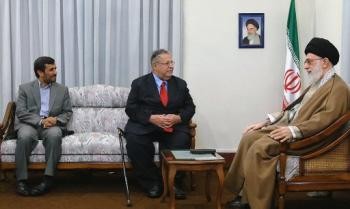
At a meeting in Tehran, from left to right: Mahmoud Ahmadinejad, the Iranian president, Jalal Talabani, the Iraqi president, and Ayatollah Ali Khamenei, the Iranian supreme leader.
Feb. 28, 2009 update: Ayatollah Ali Khamenei, the Iranian supreme leader, publicly urged his guest, Jalal Talabani, the Iraqi president, to expel the MEK from Iraqi territory. "We await the implementation of our agreement regarding the expulsion of the Hypocrites," he said, using Tehran's term for the MEK and referring to Muwafaq al-Rubaie's statement noted above, in the Dec. 22, 2008 update. Khamenei also criticized the European Union's decision to remove the PMOI from the its list of terror groups. Talabani is quoted saying that the MEK "have committed many crimes against the Iraqis, and Iraqi government is determined to expel them and will go forward with its decision."
Mar. 17, 2009 update: The U.S. military has confirmed that it shot down an Iranian Ababil 3 drone 80 miles inside Iraqi territory in February, in what appears to be a first. The New York Times continues:
The drone may well have been intended more to monitor Iranian dissidents in Iraq than to eavesdrop on American or Iraqi military operations. The location where it was shot down is not far from Camp Ashraf, where 3,500 followers of the People's Mujahedeen of Iran, an Iranian dissident organization, have taken refuge. Camp Ashraf is 57 miles northeast of Baghdad. Iraqi troops have surrounded the camp in the past week and clashed with refugees there.
Following up on the last sentence, here is a CNN report from Camp Ashraf, where the MEK says Iraqi forces have beaten and abused them as the Iraqis begin to expel them; in response, the MEK has asked the U.S. government to intervene.
The People's Mujahedin accused the Iraqi military of entering the camp north of Baghdad on Friday and forcibly evacuating a building that served mostly as a women's dormitory. Ashraf residents rallied Monday against the military, chanting for Imam Hussein—the Prophet Mohammed's grandson and a holy figure for Shiite Muslims—to save them from the abuse of the Iraqi soldiers.
Statements from the National Council of Resistance to Iran, an umbrella group of Iranian opposition organizations—the largest of which is the People's Mujahedin—accuse Iraq's Shiite-dominated government of doing the bidding of Iran's supreme leader, Ayatollah Ali Khamenei, also a Shiite. "The Iranian Resistance calls for urgent intervention of the U.S. government and competent international bodies to neutralize plots by the clerical regime and prevent a human catastrophe in Camp Ashraf," said a statement dated Sunday. … The National Council also accused the Iraqis of barring delivery of all supplies to the camp except for food, banning Iraqi workers from entering the camp and blocking families from visiting relatives inside the camp. …
Maryam Rajavi, president-elect of the National Council and the long-time leader of People's Mujahedin, sent a letter to President Obama asking for help against "a conspiracy hatched by the religious dictatorship ruling Iran against the lives of 3,500 residents of Camp Ashraf." Rajavi … asked the president to "issue an order so that the arrangements for the protection of Ashraf are reinstated to that which was in place before January 2009, i.e., the U.S. forces be tasked with the protection of Ashraf." The U.S. military in Iraq had no comment on the matter, referring queries to the State Department, which did not have an immediate comment.
Mowaffak al-Rubaie, the Iraqi national security adviser, gave a detailed briefing on the MEK.
Mar. 28, 2009 update: Mowaffak al-Rubaie, the Iraqi national security adviser, gave a more detailed insight into his government's attitude toward the 3,418 MEK members living in the country, and it's not a positive one, reports Ernesto Londoño in the Washington Post:
MEK members "should understand that their days in Iraq are numbered. We are literally counting them. … The party is over for them. The party is over for coalition protection for them," a reference to the U.S. military. In February, Washington formally handed over control of Camp Ashraf's outer perimeter to Iraqi security forces but has kept a contingent there to protect the MEK.
Rubaie said at one point that his government would not forcibly deport MEK members because "we are a civilized country." Later, however, he indicated it would have a "thick skin" with regard to negative press or international outcry resulting from forced repatriations.
The government intends to move near MEK from Camp Ashraf, 40 miles north of Baghdad and near the Iranian border, to temporary facilities for in western and southern Iraq where "brainwashed cult members" will be separated from the 25 or so leaders, then "detoxified" and repatriated to Iran.
The group includes 900 women of child-bearing age but no children because the MEK bars members from having sex.
The Iraqi government has arrest warrants out for 3 MEK members and the U.S. government has warrants out for 2 others. Iranian officials plan to prosecute more than 50 MEK members and proposed that these prosecutions take place in Iraq.
U.S. military figures show Camp Ashraf's population including 11 Canadians, 5 Americans, 4 Swedes, 3 Dutch and 3 Britons (presumably Iranian-origin individuals with these nationalities). Hundreds of camp residents have legal residency permits issued by France, Germany and other Western countries.
Rubaie recently met with ambassadors from several of the countries and urged them to take in MEK members following a "meticulous vetting process." He warned that if they do not cooperate, "we will provide them with Iranian passports," and "they will wind up on a European street."
In response, the MEK warns that forcible repatriation to Iran will mean torture and execution. Its spokesman, Mohammad Mohaddessin, said that residents of Camp Ashraf "will never leave their home" and warned that Rubaie's plan is "setting the stage for a human catastrophe."
Mar. 31, 2009 update: Lara Logan of CBS News writes in "Reporter's Notebook: Iran Opposition In Iraq Threatened" about the situation on the ground at Camp Ashraf. Excepts:
"Iraqi journalists say that trying to go to Ashraf is a death sentence – 'do not expect to come back,' they say. The reason is simple: Camp Ashraf is the target of those in Iraq's government who are most friendly with the regime in Iran, and Iran wants the camp and its inhabitants shut down forever."
"When Ashraf was under U.S. military control, Iran couldn't touch it. But since the Iraqis took over in January, they've been systematically pressuring the Iraqi government to take action. Now it's been cordoned off for the past 20 days by Iraqi forces, gradually cutting them off from the outside world. Residents chant "Ashraf is the city of peace, it is not a prison," to protest their treatment by Iraqi soldiers."
"Through Iran's allies in the Iraqi government, a noose has been applied around Camp Ashraf and the people living there, and is slowly tightening. So far that has meant stopping fuel supplies, cutting off logistic trucks – allowing only limited shipments of food to the camp. This month, when Iraqi forces occupied a building that had been housing Iranian women, there were clashes with the camp's residents and several were beaten by Iraqi soldiers, until U.S. forces stepped in."
"Although the U.S. still maintains a small monitoring presence, it is now Iraqi soldiers who surround the camp and guard its gates. And that has made it more like a prison than their home."
Apr. 30, 2009 update: The MEK may be off Europe's terrorism list but it's still very much on the American one, as confirmed by a federal indictment of seven mostly Los Angeles-area fundraisers for the organization. In a plea agreement, Roya Rahmani, Alireza Mohammadmoradi, Moustafa Ahmady, Hossein Kalani Afshari, Hassan Rezaie, Navid Taj, and Mohammad Omidvar each have pleaded guilty to one count of conspiracy of providing material support to a designated foreign terrorist organization as well as one count of actually providing hundreds of thousands of dollars to the group. The defendants admitted that for years, when they solicited donations at LAX and other locations on behalf an Iraqi-based charity called the Committee for Human Rights, they in fact knowingly raised funds to support the MEK. The Justice Department deems CHR a "front organization" for the MEK. The defendants each face up to 20 years in prison. sentencing is scheduled for Aug. 10.
The case began in March 2001 with a federal grand jury indictment. A district court then dismissed the indictment, but the 9th U.S. Circuit Court of Appeals reversed the lower court's ruling in 2006 and the U.S. Supreme Court declined to review the matter. In February 2007, the case returned to the district court.
U.S. Attorney Thomas P. O'Brien stated that "We cannot allow any terrorist organization to fundraise on our shores . . . so that they can finance their own terrorism operations." In reply, Ahilan Arulanantham, an ACLU attorney for one of the defendants noted the U.S. government's inconsistency: "It boggles the mind that that these seven refugees would be charged with providing material support for a so-called terrorist organization, when the U.S. government has supported the same organization for years. In the interests of justice, the federal government should drop its prosecution of this case."
June 24, 2009 update: Today, I both describe a MEK meeting ("A Call for American Boldness in Iran") and provide a list of my writings on this organization ("Bibliography – My Writings on the Mujahedeen-e Khalq)".
July 29, 2009 update: The fate of the 3,800 MeK residents of Camp Ashraf in Iraq is getting close to crisis point – and the U.S. attitude remains as mixed and indecisive as ever, as excerpts from a Washington Post story, "Iraq Raids Camp of Exiles From Iran," reveal:
Iraqi troops and police carried out a bloody raid Tuesday on the camp of an Iranian opposition group that the United States has long sheltered, marking the Iraqi government's boldest move since it declared its sovereignty a month ago and offering the latest sign that American influence is waning as Iranian clout rises. The operation, which caught U.S. officials off guard, coincided with a visit by Defense Secretary Robert M. Gates, and analysts said it appeared designed to send a message of Iraqi independence. …
Gen. Ray Odierno, the top U.S. commander in Iraq, said American officials did not oppose an assault on the camp as long as troops treated residents humanely. He said initial reports from Iraqi commanders indicated that their troops had not used lethal force and that no one had been killed. "We didn't know they were going to do this," Odierno said Tuesday night. "We had no prior warning." …
A small contingent of U.S. soldiers remained at a base outside the camp after the Iraqi government assumed nominal control of it Jan. 1. "The Americans were at the scene, but they didn't move a finger," said Behzad Saffari, one of the camp's leaders, who reported witnessing the clashes. "They just stood there taking pictures." The U.S. military would not confirm that American soldiers were present. It referred an inquiry to the U.S. Embassy in Baghdad. An embassy spokeswoman said all questions should be addressed to the Iraqi government.
July 30, 2009 update: A second day of Iraqi government violence against the MeK prompted more American fecklessness. Again, Washington Post excerpts, from "Iraqi Raid Poses Problem for U.S.":
In Washington, Secretary of State Hillary Rodham Clinton described the raid as a legitimate act by a sovereign nation. "Although the U.S. government remains engaged and concerned about this issue, it is a matter for the government of Iraq to resolve in accordance with its laws," she said. Clinton said Iraq had given assurances that camp residents would be treated humanely and would not be relocated anywhere they would have a well-founded fear of persecution. She urged the Iraqis to "show restraint."
U.S. officials are deeply concerned about the reports of violence and have been monitoring the situation using camera-equipped unmanned aircraft, said an official who spoke on the condition of anonymity. "We're asking the Iraqis questions," the official said. "Sometimes they answer, sometimes they don't." A contingent of U.S. soldiers based outside Ashraf have been watching but have declined to intervene, residents said.
The raid and its aftermath represent a conundrum for U.S. officials. Some say they feel obligated to the MEK because its members have provided information about Iran's nuclear program and because American officials vowed to protect them after the 2003 invasion of Iraq. But condemning this week's events could be seen as an affront to Maliki's government just as U.S. officials are talking up Iraq's sovereignty, proclaimed June 30 when American troops withdrew from cities.
Aug. 4, 2009 update: The violence is over but U.S. wavering continues in earnest. Now, excerpts from a Washington Times article oxymoronically titled "U.S. seeks to protect Iran terror group":
A day after the raid, officials at the U.S. Embassy in Baghdad met with members of the Iraqi government to urge restraint. The next day, the U.S. Army helped medevac at least two dozen injured members of the MEK, the officials said. … "Embassy officials met with representatives from the Government of Iraq [GOI] on July 29, to stress the importance of the GOI fulfilling its commitment to the United States Government to treat Ashraf's residents humanely and to propose permitting an assessment of injuries and deaths by U.S. forces," one U.S. official wrote in an e-mail to The Washington Times. "The GOI allowed a U.S. medical assessment team to enter Ashraf and subsequently approved joint U.S.-Iraqi medical assistance to injured MEK Ashraf residents."
Aug. 11, 2009 update: The MeK accused the Obama administration of betraying written U.S. government promises to protect several its members in Camp Ashraf and demanded that the U.S. forces immediately reassert control over it until an United Nations force can take over. "We must underline that the responsibility of the United States in this matter, moral as well as legal, is overwhelming," said a spokesman, referring to commitments reiterated on Dec. 28, 2008 by the U.S. Embassy in Baghdad that the American military would work with the Iraqi government to ensure "a smooth transition" and "a safe future" for the exiles. "They failed to carry out their responsibility to supervise the Iraqis," Maryam Rajavi, head of the MeK, asserted.
Aug. 19, 2009 update: More on the murky U.S. government relationship with the MeK in a Los Angeles Times article today, "U.S. offered assurances about Iranian exiles days before Iraqi raid":
The Obama administration downplayed international fears about the safety of Iranian dissidents living at a camp in Iraq as recently as mid-July, days before a raid by Iraqi security forces killed 11 of the exiles and left scores wounded. … In a July 15 letter to a concerned British politician, the State Department had said U.S. officials were doing their "utmost" to ensure the safety of up to 3,500 Iranians living at Camp Ashraf in Iraq. … "U.S. military representatives are in daily contact with Camp Ashraf residents and continue to monitor their situation," Deputy Assistant Secretary of State Richard J. Schmierer wrote in the letter, sent on behalf of President Obama to Robin Corbett, a member of the British House of Lords. … State Department officials last week criticized Iraqi forces but did not return calls Tuesday concerning assurances given by the administration about the safety of exiles.
Aug. 21, 2009 update: The RAND Corporation has published a 105-page study, The Mujahedin-e Khalq in Iraq: A Policy Conundrum, by Jeremiah Goulka, Lydia Hansell, Elizabeth Wilke, and Judith Larson, the most in-depth analysis of our topic. It argues that "repatriation to Iran is appropriate for the MeK rank and file."
Oct. 4, 2009 update: In an extensive critique of the RAND study, "Who is Behind the Rand Report? A First Review of "The Mujahedin-e Khalq in Iraq: A Policy Conundrum," Donna M. Hughes, Kazem Kazerounian, and Daniel M. Zucker dismiss it as the work of small-timers shilling for James Dobbins, director of the RAND International Security and Defense Policy Center, whom the authors call "an avid advocate of rapprochement with Tehran's ayatollahs."
Dec. 16, 2009 update: A showdown appears likely, as Ernesto Londoño reports from Camp Ashraf:
With loudspeakers mounted on pickup trucks and riot police offering backup, Iraqi troops on Tuesday ordered a group of Iranian dissidents here to vacate their sanctuary, which has become an irritant in Iraq's relationship with Iran. "Today is the day we start moving things out," Brig. Gen. Basel Hamad told reporters during a rare trip to the camp, 40 miles north of Baghdad. "We will not allow any foreigners to establish their own laws on Iraqi soil."
Members of the Mujaheddin-e Khalq, or MEK, who reside in the 10-square-mile compound, have warned that they will not be taken out alive. Residents and Western officials fear the increasingly tense stalemate at Camp Ashraf could end in bloodshed.
The standoff has raised questions about the extent to which the United States, which once protected the MEK, is indebted to armed groups with which it brokered deals during the course of the war. The deadlock also has shed light on the degree to which an increasingly sovereign Iraq is haunted by its past, swayed by erstwhile nemesis Iran and willing to use force.
June 10, 2010 update: Perhaps the presence of American soldiers at the nearby Camp Grizzly explains why the expected showdown hs not yet happened. We'll soon find out, as the U.S. military announced today that it will close the camp on July 1, reports Kim Gamel of the Associated Press:
The U.S. military will relinquish control of a base near a compound housing an Iranian opposition group next month, a move that will close a chapter on one of the most intractable issues in U.S.-Iraqi relations. … U.S. military spokesman Lt. Col. Bob Owen said Thursday that the closure of the base known as Camp Grizzly is part of the transition as American forces prepare to leave the country by the end of next year. …
Shahriar Kia, a spokesman for the group who lives at the camp, expressed fears about the future. "The American government is responsible for the future of the people in this camp," he said in a telephone interview from the camp. "This will give a green light to the Iranian regime for any future attack especially when a new government in Iraq hasn't been established."
June 11, 2010 update: Friends of the MeK, which has good connections in Washington, issued a press release today, "Members of U.S. Congress Call for Continued U.S. Protection of Camp Ashraf," that both calls for continued U.S. protection of Camp Ashraf and an end to the terrorist label on the MeK.
June 16, 2010 update: Here's a curious one from the Associated Press: "The British ambassador was summoned to Iran's Foreign Ministry on Wednesday over allegations of British ties to terrorist activities in the country, the Foreign office said. The semiofficial Mehr news agency said Wednesday that the summons came following the arrest of militants seeking to carry out terrorist attacks." The agency added that the Iranian government was demanding a serious British investigation into its links with the MeK. Britain's Foreign Office stated that "The Iranians were alleging some involvement by people in the U.K. in an alleged MeK plot in Iran" and added "We firmly reject any allegation of our involvement in any such activity."
Comment: I wonder what's behind this.
July 17, 2010 update: A federal appeals court ordered the State Department to reconsider its classifying the MeK as a terrorist group. The Associated Press reports: "The court said the US government must give the Iraq-based group a chance to respond to claims that it continues to engage in terrorist activity or at least retains the capability and intent to do so."
Nov. 25, 2010 update: The European Parliament passed a nearly-unanimous resolution calling on EU foreign policy chief Catherine Ashton to "urge" the U.S. government to remove the MeK from its list of Foreign Terrorist Organizations; and on the Iraqi government to end its blockade of Camp Ashraf.
Dec. 17, 2010 update: John Bolton, Michael Mukasey Tom Ridge, and Frances Townsend – all high-ranking officials in the George W. Bush administration – today urged the U.S. government to take the MeK off the terrorism blacklist as part of a policy to effect regime change in Iran. They did so in the context of a symposium, "Countering Iran's Nuclear and Terrorist Threats: What are the US Policy Options?"
Dec. 23, 2010 update: A similar array - Rudolph Giuliani, Michael Mukasey, Tom Ridge, and Frances Townsend – just made a similar appeal in Paris.
Jan. 1, 2011 update: Camp Ashraf's days appear limited and may end in tragedy, as Christopher Booker reports in the Daily Telegraph:
Government troops, under the personal direction of the prime minister, Nouri al-Maliki, have teamed up with the thugs of Iran's Qods force to step up their assault on Camp Ashraf. …
after besieging the camp for months, cutting off medical supplies and deafening the inhabitants round the clock with 140 loudspeakers, Iraqi and Iranian forces have been beating up and wounding dozens of the exiles (including, over Christmas, patients in the hospital). …
The residents – whose cause is supported by 53 former prime ministers and ministers from across the world, including Britain – fear a final assault, followed by deportation to Iran to face prison or execution. And that promise of protection? Washington, it seems, has washed its hands
Comment: Where are the Muslim organizations in Washington?
Jan. 7, 2011 update: According to a new organization, the U.S. Committee for Camp Ashraf Residents (USCCAR), an assault took place today that was organized by the "Committee for the Closure of Ashraf" in the office of the Iraqi prime minister in coordination with the Iranian embassy in Baghdad, inuring 175 residents.
Around noon, the assailants, with the full backing of the Iraqi Security Forces, began attacking Ashraf residents, hurling petrol bombs, rocks, bricks, and metal bars. The injured, including Ms. Fatemeh Noori who sustained damage to her eye, have been denied urgent medical care.
Jan. 10, 2011 update: Giuliani, Mukasey, Ridge, and Townsend explain today that the "MEK Is Not a Terrorist Group."
Apr. 9, 2011 update: The MeK reports that Iraqi troops killed 33 at Camp Ashraf yesterday. The Associated Press writes, based in part on a six-minute video, that
Tensions boiled over this week when the Iraqi army moved new troops near Camp Ashraf, prompting its residents to pelt soldiers with stones and throw themselves in front of military trucks. About an hour before dawn Friday, the army stormed the camp, hurling smoke bombs at a crowd of about 100 masked people and chasing them with Humvees. … At least one person in the crowd was seen hit by a Humvee, and an Iraqi soldier was seen firing from his AK-47 machine gun although his target was not clear. The video also shows at least six people lying on a the ground, and a dozen of blood-soaked men being treated by doctors.
The U.S. government had troops nearby but did not deploy them; instead, the Department of State condemned the attack ("deeply troubled") after it happened. On the scene, AP reports, "A U.S. Army officer at the camp Friday looked very angry when talking to the Iraqi commander at the scene. Asked why, an Iraqi translator accompanying the U.S. officer replied: 'Because of the high casualties'."
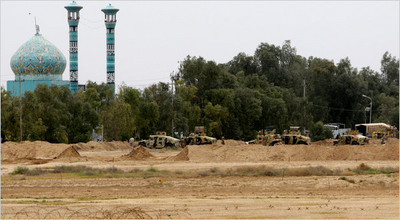 The Iraqi army parked outside Camp Ashraf. |
May 12, 2011 update: I review U.S., EU, and UN policy vis-à-vis the MeK today in a column, "Iraq - A Province of Iran?"
May 13, 2011 update: The Wall Street Journal looks at MeK efforts to be delisted in the United States at "Banned Terror Group Seeks U.S. Rebirth," with a special emphasis on the big names who are arguing for this step.
July 5, 2011 update: The U.S. ambassador to Iraq, James Jeffrey, has announced his government's cooperation with the United Nations to disband the MeK in Iraq, have the residents of Camp Ashraf register as refugees, and then relocate "to a place that is a bit safer" within Iraq. The MeK has reacted very negatively to this plan.
July 22, 2011 update: "Iranian Exile Group Poses Vexing Issue for U.S. in Iraq" reads a New York Times headline with the latest on the troubled U.S.-MeK relationship, now focusing on Lawrence E. Butler's negotiations over where the residents of Camp Ashraf will go before U.S. forces leave in five months. Bottom line: "For now, Mr. Butler is not optimistic about the prospects of getting the group to move, or disband."
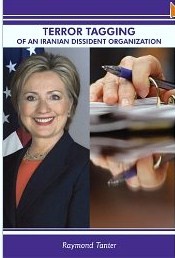
Cover of "Terror Tagging."
Aug. 22, 2011 update: The Washington-based Iran Policy Committee released an important study today, Terror Tagging of an Iranian Opposition Organization. Its main finding is the "absence of evidence to support the conclusion that the Mujahedeen-e-Khalq engages in terrorist activities or terrorism, or has the capability and intent to do so."
Nov. 10, 2011 update: Democratic and Republican members of the House of Representatives sent similar "Dear Secretary Clinton" letters today to the U.S. secretary of state, expressing their concerns "how the withdrawal of all U.S. troops from Iraq by the end of this year will affect the fate of the civilian population at Camp Ashraf."
Nov. 27, 2011 update: Dripping with disdain, Scott Shane writes an article in the New York Times titled "For Obscure Iranian Exile Group, Broad Support in U.S.," dismissing the MeK as "a fringe Iranian opposition group, long an ally of Saddam Hussein, that is designated as a terrorist organization under United States law and described by State Department officials as a repressive cult despised by most Iranians and Iraqis." He lists the major political figures in the MeK's corner (Woolsey, Goss, Freeh, Mukasey, Ridge, James L. Jones, Giuliani, Howard Dean), notes they have been well remunerated for their speeches, and indicates that "Emotions are running high as Secretary of State Hillary Rodham Clinton completes a review of the terrorist designation" even as the Iraqi government plans to close Camp Ashraf by Dec. 31, 2011.
Dec. 4, 2011 update: Who knows what the MeK might be involved in? Writing in the Los Angeles Times, Ken Dilanian speculates about who is behind the various assaults (bombings, assassinations, computer viruses, faulty parts) that are delaying on Iran's nuclear program. "Some analysts suspect that the CIA and Israel's intelligence agency, Mossad, are involved, with possible help from the MEK."
Dec. 6, 2011 update: The Iraqi government has set Dec. 31, 2011, as the deadline to close Camp Ashraf and relocate its residents. The U.N. High Commissioner for Refugees said the deadline is inadequate to process the residents for refugee status.
Dec. 21, 2011 update: Ten days shy of the self-imposed deadline, the Iraqi government has slightly relented, delaying the closure of Camp Ashraf to sometime in January, the exit of its residents to April, and promising not to deport any of them to Iran. In the words of Prime Minister Nouri al-Maliki, "We don't want to hand them over to Iran. We don't want to kill them. We don't want to oppress them and we don't want to starve them. But their presence in Iraq is illegal and illegitimate." An Iraqi spokesman indicated the government plans to move up to 800 of the camp residents to the former American military base Camp Liberty in Baghdad by the end of December.
Also today, the European Court of Justice upheld a 2008 decision to remove the MeK from the EU's terrorism list.
June 3, 2012 update: The U.S. Court of Appeals for the D.C. Circuit ordered the State Department to review the MeK's legal status in July 2010; waiting for naught for nearly two years, the court has now ruled that the department must issue a decision within four months or the court will do so itself.
Sep. 21, 2012 update: The State Department has decided to take the MeK off the terrorism list, in part due to the group's cooperation in leaving Camp Ashraf. I have repeatedly argued for this step.
Sep. 28, 2012 update: In a bewilderingly repetitious and lengthy document, almost 4,000 words in all, the U.S. Department of the Treasury's Office of Foreign Assets Control has formally delisted the MeK and all its variant names and organizations. With that, the "Washington puzzles" topic of this blog ends and so, happily, does the blog itself, after nine years of tracing a complex and contradictory topic.


