Soldiers, sailors, and airmen once determined the outcome of warfare, but no longer. Today, television producers, columnists, preachers, and politicians have the pivotal role in deciding how well the West fights. This shift has deep implications.
In a conventional conflict like World War II, fighting had two premises so basic, they went nearly unnoticed.
The first: Conventional armed forces engage in an all-out fight for victory. The opposing sides deploy serried ranks of soldiers, lines of tanks, fleets of ships, and squadrons of aircraft. Millions of youth go to war as civilians endure privations. Strategy and intelligence matter, but the size of one's population, economy, and arsenal count even more. An observer can assess the progress of war by keeping tabs of such objective factors as steel output, oil stocks, ship construction, and control of land.
Second assumption: Each side's population loyally backs its national leadership. To be sure, traitors and dissidents need to be rooted out, but a wide consensus backs the rulers. This was especially noteworthy in the Soviet Union, where even Stalin's demented mass-murdering did not stop the population from giving its all for "Mother Russia."
Both aspects of this paradigm are now defunct in the West.
First, battling all-out for victory against conventional enemy forces has nearly disappeared, replaced by the more indirect challenge of guerrilla operations, insurgencies, intifadas, and terrorism. This new pattern applied to the French in Algeria, Americans in Vietnam, and Soviets in Afghanistan. It currently holds for Israelis versus Palestinians, coalition forces in Iraq, and in the war on terror.
This change means that what the U.S. military calls "bean counting" – counting soldiers and weapons – is now nearly immaterial, as are diagnoses of the economy or control of territory. Lopsided wars resemble police operations more than combat in earlier eras. As in crime-fighting, the side enjoying a vast superiority in power operates under a dense array of constraints, while the weaker party freely breaks any law and taboo in its ruthless pursuit of power.
Second, the solidarity and consensus of old have unraveled. This process has been underway for just over a century now (starting with the British side of the Boer War in 1899-1902). As I wrote in 2005: "The notion of loyalty has fundamentally changed. Traditionally, a person was assumed faithful to his natal community. A Spaniard or Swede was loyal to his monarch, a Frenchman to his republic, an American to his constitution. That assumption is now obsolete, replaced by a loyalty to one's political community – socialism, liberalism, conservatism, or Islamism, to name some options. Geographical and social ties matter much less than of old."
With loyalties now in play, wars are decided more on the Op Ed pages and less on the battlefield. Good arguments, eloquent rhetoric, subtle spin-doctoring, and strong poll numbers count more than taking a hill or crossing a river. Solidarity, morale, loyalty, and understanding are the new steel, rubber, oil, and ammunition. Opinion leaders are the new flag and general officers. Therefore, as I wrote in August, Western governments "need to see public relations as part of their strategy."
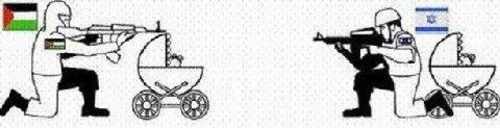 A simple cartoon can have a major impact, such as this one contrasting the role of baby carriages for Palestinian terrorists and Israeli soldiers. |
Even in a case like the Iranian regime's acquisition of atomic weaponry, Western public opinion is the key, not its arsenal. If united, Europeans and Americans will likely dissuade Iranians from going ahead with nuclear weapons. If disunited, Iranians will be emboldened to plunge ahead.
What Carl von Clausewitz called war's "center of gravity" has shifted from force of arms to the hearts and minds of citizens. Do Iranians accept the consequences of nuclear weapons? Do Iraqis welcome coalition troops as liberators? Do Palestinians willingly sacrifice their lives in suicide bombings? Do Europeans and Canadians want a credible military force? Do Americans see Islamism presenting a lethal danger?
Non-Western strategists recognize the primacy of politics and focus on it. A string of triumphs – Algeria in 1962, Vietnam in 1975, and Afghanistan in 1989 – all relied on eroding political will. Al-Qaeda's number two, Ayman al-Zawahiri, codified this idea in a letter in July 2005, observing that more than half of the Islamists' battle "is taking place in the battlefield of the media."
The West is fortunate to predominate in the military and economic arenas, but these no longer suffice. Along with its enemies, it needs to give due attention to the public relations of war.
Oct. 17, 2006 addendum: For background on how we arrived to this point, see my article "The End of Treason."
Oct. 19, 2006 update: For updates on this topic, see "Public Opinion, Now More Important in War than the Literal Battlefield."
Feb. 24, 2022 update: Suddenly, with Putin's invasion of Ukraine, conventional war has returned, with all its traditional features.


