
This weblog entry succeeds two others. The first one, "The Growing Palestinian Anarchy," started in February 2004 and caught a trend most analysts missed. The second one, "Palestinian Anarchy, Post-Arafat," begun in November 2004, focused on an aspect of Palestinian life that most analysts did not expect. I ended the latter entry in January 2006, thinking that Hamas would put an end to the anarchy.
That was a mistake, however, as things are worse than ever. A combination of Hamas aggression and tough Israeli reactions have made the anarchy worse than ever. Here is a sample report, by Ashraf Khalil in the Los Angeles Times, titled "Tension, Violence Running High in Gaza," and subtitled "Isolated economically since Hamas' election and militarily by Israel, Palestinians there, many of them well armed, are turning on one another."
In Khan Yunis, a gritty southern Gaza city that features a thriving gunrunning trade, Brig. Gen. Mustafa Wafi's police force struggles to keep up. "People have a lot of weapons, and the slightest things set them off," he said. Thefts, burglaries and violent neighborhood arguments in Gaza City have risen 70% in recent months, one police officer estimated. Many of the new offenders are teenagers whose families can no longer provide spending money. Their favorite targets: car stereos, generators and especially cellphones. "It used to be one or two cases a day in our area. Now it's at least four or five," said the officer, who requested anonymity because he was not authorized to speak on the record. "It started once the salaries stopped being paid." ...
Thousands of young Palestinian men belong to armed militant groups. The militarization of Gazan society makes it more likely that otherwise harmless scuffles will turn deadly. In a personal conflict, "they end up using the weapons that they have to defend against the occupation against each other," said Abu Thaer, a spokesman for the Al Aqsa Martyrs Brigade militia. There have been at least 20 violent deaths in the last five months in Khan Yunis, more than double the usual rate. Many of those stem from a bloody feud between a pair of heavily armed clans in early spring. ...
The violence has reached into the region's hospitals, with at least three major incidents in the last four months. In May, a 59-year-old man suffering from heart failure was brought into the Khan Yunis hospital's emergency room. When informed of the man's death, his family "went crazy and trashed the emergency room.... Anyone wearing a white coat was beaten," said Dr. Nasser Azaar, the emergency room director. Three months later, Azaar remains shocked by the fact that several local doctors related to the man participated in the frenzied destruction.
Last month, Interior Minister Said Siyam deployed Hamas' newly formed Executive Force to all Gaza hospitals after a clan feud erupted into gunfire inside the emergency room at Shifa. The clash had begun outside but moved into the medical center when one of the wounded men died and his relatives sought revenge on the wounded from the other family.
But the presence of the Executive Force, mostly hardened Hamas fighters, helped trigger the worst incident of hospital violence so far. On Aug. 2, members of the force engaged one of Gaza City's most notorious armed clans at Shifa Hospital. According to several accounts, the fight started when at least 30 armed members of the Jundeya family came to visit a sick relative. Executive Force guards demanded that they surrender their weapons before entering, triggering a confrontation. For two hours, he two forces traded gunfire on the hospital grounds as family elders tried to mediate. There were no deaths, but at least three Executive Force members and an unknown number of Jundeya fighters were injured. Mediation between family elders and senior Interior Ministry officials has since produced a public truce.
But the aggressive behavior of Gaza's clans points to a creeping erosion of public faith in the law, said Hamdi Shaqqura of the Palestine Center of Human Rights. In the absence of a reliable law enforcement or justice system, increasingly desperate Gazans are falling back on family ties for protection and power. "The rule of law has become the rule of the jungle," he said.
(August 24, 2006)
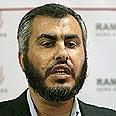 Ghazi Hamad, Palestinian Authority spokesman. |
"Anarchy, wanton killing, land steeling, thuggery ... is the occupation responsible for all?," he asked, saying that the Palestinians should stop espousing conspiracy theories which "limit our thinking." ...
"We didn't succeed in preserving the victory of liberating Gaza. 500 people died in the Strip since the withdrawal, as opposed to 3-4 Israelis killed by rockets. The reality in Gaza today is one of neglect, sadness, and failure. When someone errs we are scared to criticize him to avoid being accused of being against the resistance," Hamad wrote. "When efforts are made to open the Rafah border crossing to ease the humanitarian crisis, there is always someone who fires a rocket on the crossing. When we speak about a truce, there is always someone who fires another rocket."
Hamad appeals to leaders of Palestinian factions saying that resistance against Israel is worthless when "the land is full with anarchy, corruption, thuggery, and gang killings. Isn't building the homeland part of the resistance?"
He also criticized the phenomenon of kidnapping foreigners in Gaza. Two Fox News journalists kidnapped almost two weeks ago by Palestinian gunmen were released on Sunday. Hamad said the phenomenon has become a "profitable business," charging that kidnappers of innocent foreigners apathetic to the harm their deeds cause to the Palestinian cause. "Let's admit to our mistakes, let's do some logical soul searching and place the interest of our people before us and say honestly – We were right here and we erred there. Only then will we see that the faces of Gaza and the homeland changes," he concluded.
Aug. 29, 2006 update: MEMRI provides more excerpts in translation of the Ghazi Hamad article at "Scathing Self-Criticism by the Hamas Government Spokesman."
Sep. 6, 2006 update: In a long and informed article, "Palestinians on the verge of civil war," Paul McGeough documents the extent of the Palestinian anarchy in Sydney Morning Herald. One excerpt:
The Palestinians have been isolated by the world since early this year when they elected a government controlled by Hamas, an Islamist movement with ties to outcast regimes in Iran and Syria. Now, in Gaza and on the West Bank, many of them cower in their homes as Hamas gunmen clash almost daily with loyalists of the regime they defeated. It is their worst nightmare. Caught between the secularists of the late Yassar Arafat's failed Fatah movement and the fundamentalists of Hamas, they fear that the dream of their own separate state might shrivel on the scorched earth of the on-going clash between radical Islam and the West.
June 15, 2007 update: With the Hamas takeover of Gaza yesterday, the era of anarchy may be about to come to an end and a new one of strict control beginning. Here is one report, "After intense bloodletting, Hamas-controlled Gaza witnesses a precarious calm," suggesting the change ahead, from a Palestinian news source:
Early Friday morning [June 15] in the Gaza Strip witnessed a new tranquility, which has been alien to the population over the past five days. Over recent days residents of Gaza have experienced fierce confrontations which led to the deaths of 120 and the injury of more than 500 from Fatah and Hamas, as well as non-combatant civilians.
June 19, 2007 update: I note the new reality of "Hamastan" in a column, "Two Palestines, Anyone?"
Sep. 17, 2007 update: It took longer than I expected, but the iron fist of Hamas has, three months after evicting Fatah, become apparent. Scott Wilson describes the situation in "Hamas's New Order Exacts Toll On Gazans: Party Cements Grip With Harsh Tactics":
Hamas leaders are increasingly imposing harsh interpretations of Islamic law and using brute force to bolster their isolated administration. ... Gaza's streets have taken on an increasingly Islamic cast in recent months. The improved everyday security has brought people back to the markets, beaches and parks, many of them women wearing for the first time the full black gown, gloves and face covering favored by the most conservative Muslims. ...
"We, for the first time, are operating a real security and justice system here," said Mahmoud al-Zahar, a Hamas hard-liner whose influence has grown since the June takeover. "Under the Fatah security forces, it was, A to Z, deeply corrupt." Zahar, a surgeon who served as foreign minister in Hamas's first government, said the movement is unrepentant about routing Fatah in Gaza. He favors "military trials" for the former Fatah security officials who once persecuted Hamas followers in the strip, calling them "American-Israeli collaborators." ...
On the bulletin board in the Health Ministry's lobby hangs another recent fatwa, this one declaring that a partial strike by medical staff at Shifa Hospital runs counter to Islamic teachings. For weeks, doctors at Gaza's largest hospital have been working only three hours each morning, leaving in limbo scores of patients needing post-surgery checkups, medications, examinations or signed permission to leave Gaza for treatment in Israel. Abbas has urged the doctors to stay off the job.
The dispute stems from the recent firing of the hospital's director and its longtime public relations officer because, the doctors say, they supported Fatah. "They told me that if I stayed a bullet might enter my head," said Jumah al-Saqa, 49, the former spokesman, who was removed from his office by Hamas gunmen last month after two decades in the post. "They want Hamas in all those jobs."
Jan. 28, 2012 update: I put the Palestinian situation into a regional context in "Anarchy, the New Threat."
July 18, 2012 update: I look at the same issue from the point of view of the Jewish state in "Anarchy Surrounds Israel."
June 16, 2016 update: Khaled Abu Toameh picks up the thread at "Anarchy Returns to the West Bank." Excerpts:
Hostility towards the Palestinian Authority (PA) seems to have reached unprecedented heights among refugee camp residents. ... Recent incidents are yet another sign of the Palestinian Authority's failure to enforce law and order, especially in refugee camps such as Balata (near Nablus) Qalandya (near Ramallah) and the Jenin refugee camp. Moreover, these incidents are an indication of mounting tensions among rival camps inside Fatah and between the refugees and the Palestinians living in the big cities surrounding the camps.
These camps, which are hotbeds for gunmen and terror groups, have long been off-limits to the Palestinian Authority (PA) security forces. Tens of thousands of Palestinians live in these three major refugee camps in the West Bank. Although the refugee camps there located in areas controlled by the PA, the Palestinian security forces do their best to steer clear of them. Attempts by Palestinian security forces to arrest camp residents wanted for various crimes have often resulted in armed confrontations.
Disgruntled members of PA President Mahmoud Abbas's ruling Fatah faction are mostly responsible for the anarchy and "security chaos." Many of the Fatah members once belonged to Fatah's armed wing, the Aqsa Martyrs Brigades, which was officially dismantled several years ago under pressure from Israel and the international community, specifically the Americans and Europeans, the biggest funders of the Palestinian Authority. ...
Earlier this week, unidentified gunmen intercepted the car of the Palestinian Authority Minister for Social Welfare, Ibrahim Al Shaer, as it was making its way from Ramallah to Jerusalem. When the car reached the Qalandya refugee camp, on the Ramallah-Jerusalem highway, the gunmen stopped it and forced the driver out. The gunmen, who are believed to be members of Fatah, fled with the car. Hours later, the PA security forces managed to recover the minister's stolen vehicle. Palestinians described the carjacking as a severe blow to the Palestinian Authority's "prestige." ...
The return of anarchy to the streets of West Bank cities and refugee camps is a bad omen for President Abbas and his regime. It's also a natural result of the failure of the Palestinian Authority over the past two decades to offer the residents of the refugee camps any realistic hope for a better life.
Aug. 3, 2016 update: Pinhas Inbari describes the growing anarchy in The Fraying Palestinian Political Entity in the West Bank. Not only are matters terrible now (Nablus "has gone into a tailspin of total anarchy") but they are getting worse ("The tearing of the Palestinian political and social fabric will only increase" as Mahmoud Abbas' rule ends). Inbari foresees Islamist forces eventually replacing the Palestinian Authority.
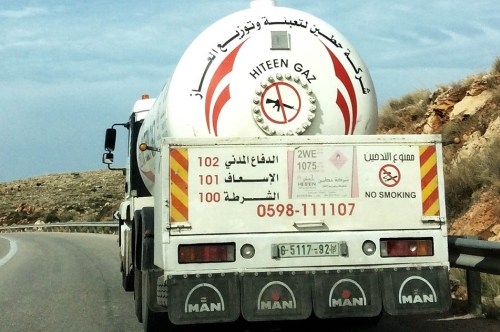 Sign of the times: Note the "Don't shoot" sign on this West Bank gas truck. |
Jan. 13, 2022 update: Yoni Ben Menachem reports that "The Israeli security establishment is concerned with the weakening of the Palestinian Authority (PA) in the Jenin area and its inability to control the anarchy. Hamas is breathing down the PA's neck, and Israeli security officials warn, that in the end, there will be no escape from a major IDF military operation in the Jenin area."


