
The devshirme (in Turkish, devşirme) was a long-standing Ottoman practice of enslaving Christian boys to serve the sultan. Here is a brief description from the Encyclopedia of the Orient:
System of human taxation under the Ottoman Empire, from the fifteenth century until the nineteenth century. Young Christian boys were taken away from their families in the Balkans and made into the property of the sultan in order to become part of the army or the administration. Devşirme is from Turkish, meaning "gathering." ...
It was at all times clear that devşirme was contradictory to Muslim law, Sharia. Sharia had clear instructions to the Muslim ruler to protect and take care of all Christian subjects. But the needs of the empire, as well as tribal traditions, made the rulers instigate the practice. There were numerous protests at the beginning from Muslim scholars. ... From the fifteenth until the seventeenth century, between 200,000 and 300,000 boys were taken out to devşirme.
The "taxation" was performed in the Balkan countryside. At certain times, normally every fourth year, some of the young minor boys from each community were to be given to the sultan. Their age was normally between 8 and 10, but it could at times be as high as 20. And the number of boys given to the sultan as part of devşirme was between every tenth and fourteenth.
Sadly this barbaric practice lives on, in practice and in theory, in Muslim-majority countries, as this blog documents.
Pakistan: In a sensational piece of investigative reporting, Marie Colvin writes today in "Rescued – the Pakistan children seized by Islamist slave traders" about the Pakistani abduction and trade in young boys. She focuses on the fate of a 10-year-old named Akash Aziz in Muridke, a village in eastern Punjab – how he was seized while playing cops and robbers by the agents Gul Khan, a leading member of Jamaat-ud Daawa (JUD), a group linked to the Al-Qaeda terrorist network, the maltreatment he suffered, and the hoax that led to his eventual release. According to Colvin, Khan "planned to sell his young captives to the highest bidder, whether into domestic servitude or the sex trade."
In addition to the grief of his capture and the heart-warming scene of his reunion with his family, what struck me most about the story of Akash and the nineteen other boys, ages six to 12, who shared his captivity is that they are all Christians. And it was a Pakistani Christian missionary and an American evangelist ("Brother David," head of the Help Pakistani Children charity) who saved the boys with US$28,500 in cash and an elaborate sting operation.
Akash's mother said on his return that "We were hopeless. His father searched and searched. We prayed. But we thought he was gone." In other words, the Christians of Pakistan have no effective recourse to this sort of enslavement at the hands of an Al-Qaeda affiliate. (May 21, 2006)
Senegal: Another weird devshirme is taking place in Senegal, this one even more unacceptable from a Shar'i viewpoint, for it involves taking Muslim boys. Rukmini Callimachi of the Associated Press tells the story in "Islamic schools lure African boys into begging" through the prism of a 9-year-old named Coli, one of at least 7,600 child beggars who work the streets of Dakar, Senegal's capital city. According to a February 2008 study by the ILO, UNICEF, and the World Bank, the children make on average US$0.72 cents, per day, which comes to $2 million a year for their masters. Then the shocking part:
Most of the boys — 90 percent, the study found — are sent out to beg under the cover of Islam, placing the problem at the complicated intersection of greed and tradition. For among the cruelest facts of Coli's life is that he was not stolen from his family. He was brought to Dakar with their blessing to learn Islam's holy book. In the name of religion, Coli spent two hours a day memorizing verses from the Quran and over nine hours begging to pad the pockets of the man he called his teacher.
And woe to the boy who fails to bring in his allotted sum:
It was getting dark. Coli had less than half the 72 cents he was told to bring back. He was afraid. He knew what happened to children who failed to meet their daily quotas. They were stripped and doused in cold water. The older boys picked them up like hammocks by their ankles and wrists. Then the teacher whipped them with an electrical cord until the cord ate their skin. Coli's head hurt with hunger. He could already feel the slice of the wire on his back.
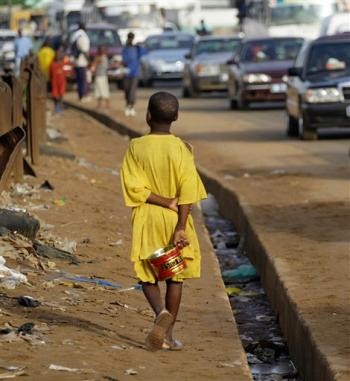 A religious student who begs for his Koran teacher walks along a road of Dakar, Senegal in August 2007. |
Three years ago, a man wearing a skullcap came to Coli's village in the neighboring country of Guinea-Bissau and asked for him. Coli's parents immediately addressed the man as "Serigne," a term of respect for Muslim leaders on Africa's western coast. Many poor villagers believe that giving a Muslim holy man a child to educate will gain an entire family entrance to paradise. Since the 11th century, families have sent their sons to study at the Quranic schools that flourished on Africa's western seaboard with the rise of Islam.
It is forbidden to charge for an Islamic education, so the students, known as talibe, studied for free with their marabouts, or spiritual teachers. In return, the children worked in the marabout's fields. The droughts of the late 1970s and '80s forced many schools to move to cities, where their income began to revolve around begging. Today, children continue to flock to the cities, as food and work in villages run short. ... Middle men trawl for children as far afield as the dunes of Mauritania and the grass-covered huts of Mali. It's become a booming, regional trade that ensnares children as young as 2, who don't know the name of their village or how to return home.
The rest of Callimachi's remarkable tale tells how Coli eventually returns to his family – but then how two of his brothers get shipped to the madrasa and to beg. (April 21, 2008)
Syria: The Associated Press tells about an ISIS camp in Raqqa where more than 120 Yazidi boys ages 8 to 15 were separated from their parents, converted to Islam, given Muslim names, taught Islamist ideology, and taught to serve as jihadi fighters, including training on dolls to learn to cut off heads.
It is part of a concerted effort by the extremists to build a new generation of militants, according to a series of AP interviews with residents who fled or still live under IS in Syria and Iraq. The group is recruiting teens and children, using cash, gifts, intimidation and brainwashing. As a result, children have been plunged into the group's atrocities. Young boys have been turned into killers, shooting captives in the head in videos issued by the group. Last week, for the first time, a video showed a child involved in a beheading: a boy who appeared younger than 13 decapitating a Syrian army captain. Kids also have been used as suicide bombers.
In schools and mosques, the militants infuse children with their extremist doctrine, often turning them against their own parents. Fighters in the street befriend children with toys. IS training camps for children churn out the Ashbal, Arabic for "lion cubs," young fighters for the "caliphate" that IS has declared across the regions its controls.
More details:
The camp where Yahya and other Yazidi boys were taken was the Farouq Institute for Cubs in the Syrian city of Raqqa, which serves as the extremists' de facto capital. The boys were given Muslim Arabic names to replace their Kurdish-language names. Yahya asked that the AP not use his real name because of fears of retaliation against himself or his family.
Yahya, his little brother, their mother and hundreds of Yazidis were captured when the extremists overran the town of Sulagh in northern Iraq last year. They were taken to Syria, where the brothers were separated from their mother and put in the Farouq camp, along with other Yazidi boys aged between 8 and 15, Yahya told the AP.
He spent nearly five months there, undergoing eight to 10 hours a day of training, including running, exercising, weapons training and studying the Quran. The boys hit each other in some exercises. Yahya said he punched his 10-year-old brother, knocking out his tooth. "I was forced to do that. (The trainer) said that if I didn't do it, he'd shoot me," he said. "They ... told us it would make us tougher. They beat us everywhere with their fists."
In an online IS video of the Farouq camp, boys in camouflage do calisthenics. Some repeat back religious interpretation texts they have memorized justifying the killing of prisoners and infidels. An IS fighter sitting with a line of boys says they have studied the principles of jihad "so that in the coming days God Almighty can put them in the front lines to battle the infidels."
IS videos from other training camps show young boys in military fatigues marching with weapons, crawling under barbed wire and practicing shooting. One child lies on the ground and fires a machine gun; he's so small that the recoil bounces his whole body back a few inches. Other scenes show boys undergoing endurance training. They stand unmoving as a trainer punches them or hits their heads with a pole. They lie on the ground as a trainer walks on them.
Most of the children look stony-faced, their only emotion a momentary flicker as they try to remember texts they are told to recite. "By God, Obama and all those allied against the State, we will kill you. Who will? We lion cubs of the caliphate," proclaims one boy who looks younger than 10, holding an automatic rifle as he addresses the U.S. president.
IS has claimed to have hundreds of such camps, though the true number is not known — nor the number of children who have gone through the training. The Syrian Observatory for Human Rights, a Britain-based organization that follows the Syrian war, said it documented at least 1,100 Syrian children under 16 who joined IS so far this year, many of whom were then sent to fight in Syria and Iraq. At least 52 were killed, including eight who blew themselves up in suicide attacks, the organization said.
The effects of the indoctrination are chilling. In an IS video released last month, 25 young boys with pistols take position between 25 captured Syrian soldiers brought into the ancient Roman amphitheater in the Syrian city of Palmyra. Unflinching, each boy shoots a soldier in the back of the head. Previous videos have shown boys killing what IS alleged were an Israeli spy and two Russian agents.
(July 23, 2015)
ISIS, Boko Haram: Raymond Ibrahim documents the Islamist practice of seizing, beating, and indoctrinating in Islam "countless, nameless, faceless children ... until they become willing 'martyrs' and executioners. He shows how ISIS and Boko Haram rely especially on this tactic. Reflecting on its use, he asks why are Islamist groups "resorting to this tactic of enslaving and indoctrinating children into becoming jihadis?" Western analysts tend to
believe this is a reflection of weakened, desperate groups: "The growing trend for ISIS to use child soldiers as suicide bombers, particularly in Iraq, has been suggested as a sign of how stretched their resources are in the region," noted one report.
Ibrahim sees it fitting into the slave soldier pattern:
For over a millennium, Muslim caliphates specialized in seizing and enslaving tens if not hundreds of thousands of young non-Muslim boys, converting them to Islam, and then beating, indoctrinating, and training them into becoming jihadis extraordinaire.
He describes the Ottoman devshirme and notes that Western analysts might understand what's taking place better
if they had Islamic studies departments that actually disseminated facts instead of pro-Islamic myths and propaganda. As with all unsavory aspects of Islamic history, the institution of child slave soldiers has been thoroughly whitewashed. Although young, terrified boys were seized from the clutches of their devastated parents, the academic narrative is that poor Christian families were somewhat happy to see their boys taken to the caliphate where they would have a "bright future" as "soldiers and statesmen."
Comment: ISIS and Boko Haram practices do slightly resemble the historic pattern of military slavery but one difference makes them fundamentally dissimilar: in the classic pattern of slave soldiery, the child was carefully educated and trained for a high position in the armed forces or administration, whereas contemporary groups deploy them as immature cannon fodder. In the end, the two phenomena look to me unrelated. (January 13, 2017)
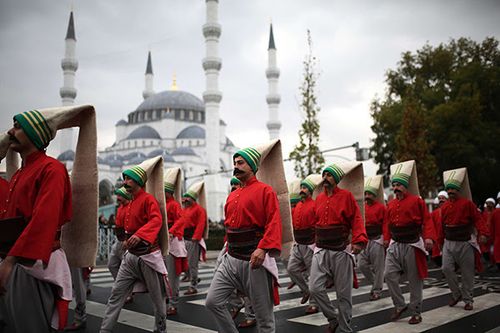
Turkey: Not real slave soldiers this time, but mock ones. Here's the Agence France-Presse caption to the adjoining photograph: Turkish soldiers dressed as Janissaries (Yeniceri) from the Ottoman era, march during the 94th Republic Day parade, from the Grand National Assembly of Turkey to the first Turkish Grand National Assembly building, in the Ulus district in Ankara, Turkey. (October 29, 2017)
Syria: The PKK-aligned Syrian Democratic Forces deploys a version of enslavement to recruit young soldiers:
Late last year, members of a youth group held a computer literacy class in the Syrian town of Amuda. This was no ordinary extracurricular activity: its purpose was to recruit children for military service, and over the course of the lessons, organizers convinced two local girls to leave home and pick up arms. "It was a kidnapping through indirect means, not at the barrel of a gun," said Shams Antar, the aunt of one of the girls, sixteen-year-old Hadiya Abdul Raheem Antar. Hadiya and her friend Ayana persuaded a third classmate who had not attended the computer course, 15-year-old Afeen Jalal Khalil, to tag along on their military adventure, added Shams Antar.
On Nov. 21, 2021, the three girls disappeared. Hadiya and Ayana were picked up by a car after school, while Afeen was spirited away from in front of her home that evening. "They rope in children of both sexes, especially girls, using these classes — whether music classes, computer classes, drawing, language instruction," said Antar.
(January 20, 2022)


