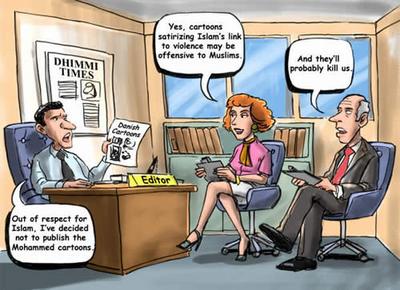
When asked why they did not publish the Danish cartoons of Muhammad, American media offered many high-minded reasons about mutual respect and the like, all of which begged the question why many of the same editors and producers thought it just fine to insult Jesus. But two outlets have come clean, admitting their intimidation.
First, the Boston Phoenix, a weekly, on Feb. 10, 2006, which listed the following as the first of three reasons not to publish the cartoons:
fear of retaliation from the international brotherhood of radical and bloodthirsty Islamists who seek to impose their will on those who do not believe as they do. This is, frankly, our primary reason for not publishing any of the images in question. Simply stated, we are being terrorized, and as deeply as we believe in the principles of free speech and a free press, we could not in good conscience place the men and women who work at the Phoenix and its related companies in physical jeopardy. As we feel forced, literally, to bend to maniacal pressure, this may be the darkest moment in our 40-year publishing history.
(A day later, Tim Rutten of the Los Angeles Times quoted the Phoenix argument approvingly and added that "There is something wonderfully clarifying about honesty.")
Second, the Comedy Central channel, in a generic letter sent to viewers who complained that an image of the Muhammad cartoons had been deleted from "South Park" (to get the details on this complex episode, see Michelle Malkin's coverage):
Comedy Central's belief in the First Amendment has not wavered, despite our decision not to air an image of Muhammad. Our decision was made not to mute the voices of Trey and Matt or because we value one religion over any other. This decision was based solely on concern for public safety in light of recent world events.
For good measure, Borders Books also admitted its fears when it refused to sell an issue of the magazine Free Inquiry: "For us, the safety and security of our customers and employees is a top priority, and we believe that carrying this issue could challenge that priority," said Borders Group Inc. spokeswoman Beth Bingham.
Comments: (1) Admitting to intimidation is not good, but it beats denial. (2) This is the Rushdie Rules in full force, namely fear of Islamists eroding Western freedom of speech when it comes to Islamic issues. (April 20, 2006)
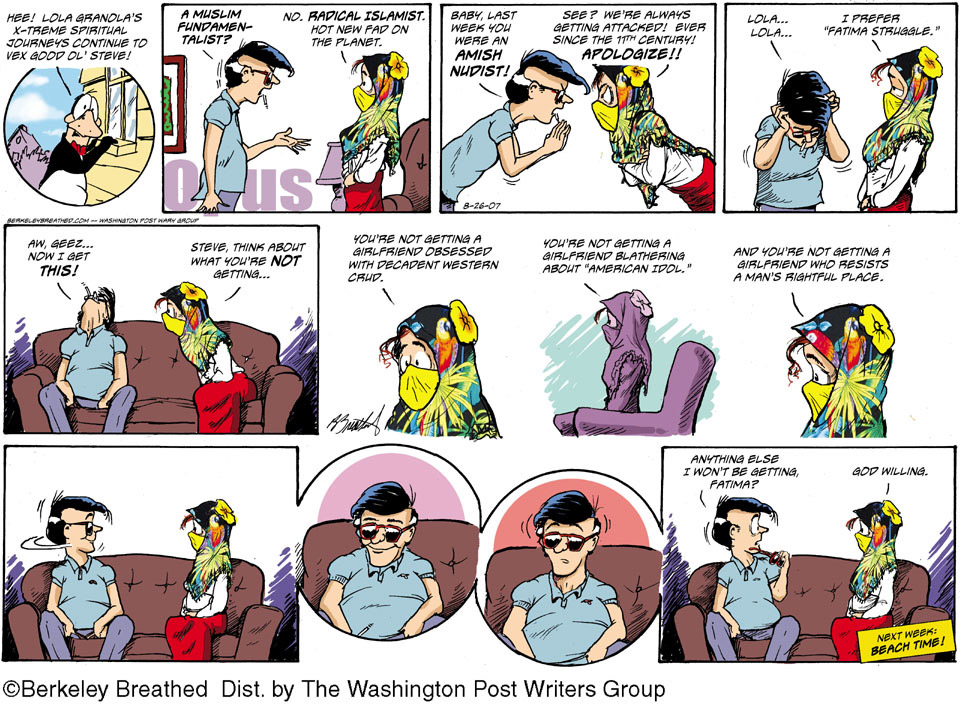
Aug. 28, 2006 update: When Berkeley Breathed's Opus comic strip has the ever-searching and faddish Lola Granola character become an Islamist, the Washington Post yanked the cartoon for two weeks. Fox News explains:
the strips were shown to Muslim staffers at The Washington Post to gauge their reaction, and they responded "emotionally" to the depiction of a woman dressed in traditional Muslim garb and espousing conservative Islamic views. There was also considerable alarm over the strip at the highest echelons of The Washington Post Co., according to the sources.
[Washington Post Writers Group comics editor Amy] Lago said she flagged some of the syndicate's newspaper clients for two reasons: because of the possibility that the jokes about Islam would be misconstrued and because of the sexual innuendo in the punchline. "The strip came in and I knew we would have to send out an alert to all the newspapers," Lago said. "I do that fairly regularly with materials that might pose issues for local areas. ... We knew that because it was a sex joke, it could raise issues. And there is another client that has issues with any Muslim depiction whatsoever."
 "Opus" conjures with Islamism. Click for larger version. |
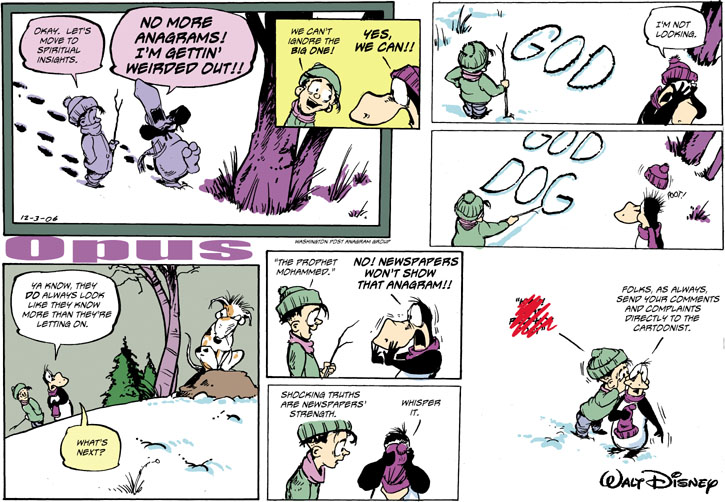
Dec. 3, 2006 update: Breathed returns to the subject of Islamist censorship in a cartoon today. It shows two characters coming up with anagrams (such as "God" and "Dog"), when one of them suggests they work out an anagram for "The Prophet Mohammed." The other replies, "No! Newspapers won't show that anagram!!" The first protests: "Shocking truths are newspapers' strengths." The second replies, "Whisper it." So the first whispers something that's been smudged out and the second looks at the reader and says, "Folks, as always, send your comments and complaints directly to the cartoonist."
Comment: Wordmith.org turns up no less than 55,556 anagrams for "The Prophet Mohammed," but few of them sound like English ("Heptad Morpheme Moth" is ranked first).
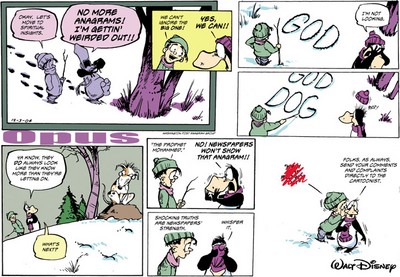 "Opus" of Dec. 3, 2006. Click for larger version. |
Nov. 19, 2007 update: Grayson Perry, described by Ben Hoyle of The Times (London) as "the cross-dressing potter, Turner Prize winner and former Times columnist," admitted: "I've censored myself. The reason I haven't gone all out attacking Islamism in my art is because I feel real fear that someone will slit my throat."
Mar. 28, 2008 update: LiveLeak.com, the British internet site that hosted the Geert Wilders film Fitna, seen by over 3.6 million persons, after one day replaced the film with an explicit cry against censorship:
The Removal of "Fitna": Official Liveleak statement
Following threats to our staff of a very serious nature, and some ill informed reports from certain corners of the British that could directly affect the safety of some staff members, Liveleak has been left with no other choice but to remove Fitna from our servers.
This is a sad day for freedom of speech on the net, but we have to place the safety and well being of our staff above all else. We would like to thank the thousands of people from all backgrounds and religions, who gave us their support. They realised LiveLeak.com is a vehicle for many opinions and not just for the support of one.
Perhaps there is still hope that this situation may produce a discussion that could benefit and educate all of us as to how we can accept one another's culture.
We stood for what we believe in, the ability to be heard, but in the end the price was too high.
Mar. 30, 2008 update: LiveLeak today replaced the above statement with this one:
On the 28th of March LiveLeak.com was left with no other choice but to remove the film "fitna" from our servers following serious threats to our staff and their families. Since that time we have worked constantly on upgrading all security measures thus offering better protection for our staff and families. With these measures in place we have decided to once more make this video live on our site. We will not be pressured into censoring material which is legal and within our rules. We apologise for the removal and the delay in getting it back, but when you run a website you don't consider that some people would be insecure enough to threaten our lives simply because they do not like the content of a video we neither produced nor endorsed but merely hosted.
Apr. 2, 2008 update: Ben Elton, the English comedian and writer, accuses the British Broadcasting Corporation of giving in to Muslim pressure. He talks of
"the genuine fear that the authorities and the community have about provoking the radical elements of Islam. There's no doubt about it, the BBC will let vicar gags pass but they would not let imam gags pass." He said the BBC might pretend that this hesitancy had something to do with moral sensibilities. "But it isn't. It's because they're scared." Elton said the situation was so bad that even everyday sayings were frowned upon: "I wanted to use the phrase 'Mohammed came to the mountain' and everybody said, 'Oh, just don't! Just don't! Don't go there!' It was nothing to do with Islam, I was merely referring to the old proverb, 'If the mountain won't come to Mohammed, Mohammed must go to the mountain'. And people said, 'Let's just not!' It's incredible."
Aug. 7, 2008 update: I cover the canceled publication of The Jewel of Medina, by Sherry Jones at "Extra! Leading New York Publisher Spikes Book Dealing with Islam!"
Aug. 13, 2009 update: Those pesky Muhammad cartoons keep embarrassing the media, this time Yale University Press (publisher of my first book in 1981). Patricia Cohen provides details in "Yale Press Bans Images of Muhammad in New Book":
It's not all that surprising that Yale University Press would be wary of reprinting notoriously controversial cartoons of the Prophet Muhammad in a forthcoming book. ... So Yale University and Yale University Press consulted two dozen authorities, including diplomats and experts on Islam and counterterrorism, and the recommendation was unanimous: The book, The Cartoons That Shook the World, should not include the 12 Danish drawings that originally appeared in September 2005. What's more, they suggested that the Yale press also refrain from publishing any other illustrations of the prophet that were to be included.
The article goes on to explain that the book's author, Jytte Klausen of Brandeis University "reluctantly accepted Yale University Press's decision not to publish the cartoons. But she was disturbed by the withdrawal of the other representations of Muhammad." It also notes that Reza Aslan withdraw a blurb for the book after the press reached this decision, calling it "frankly, idiotic."
Nov. 2, 2009 update: Movie producer Roland Emmerich destroys a bevy of landmarks in his forthcoming 2012, including the White House, parts of the Vatican, and the Christ the Redeemer statue in Rio de Janeiro. But not the Ka'ba in Mecca. He admits the reason is fear (ellipses in the original):
Well, I wanted to do that, I have to admit. But my co-writer Harald said I will not have a fatwa on my head because of a movie. And he was right. ... We have to all ... in the Western world ... think about this. You can actually ... let ... Christian symbols fall apart, but if you would do this with [an] Arab symbol, you would have ... a fatwa, and that sounds a little bit like what the state of this world is. So it's just something which I kind of didn't [think] was [an] important element, anyway, in the film, so I kind of left it out.
Apr. 22, 2010 update: Comedy Central's "South Park" has censored its writers again with reference to Islam, this time due to a threat on an obscure website. Joshua Rhett Miller of Fox News explains at "Comedy Central Censors 'South Park' Episode After Muslim Site's Threats."
RevolutionMuslim.com posted a warning following the 200th episode of Trey Parker and Matt Stone's "South Park," which included a caricature of the Prophet Muhammad disguised in a bear suit. Comedy Central bleeped out all references to the Prophet Muhammad in Wednesday night's episode of the animated show "South Park." The episode was a continuation of last week's episode which depicted the Prophet Muhammad in a bear suit. ... Comedy Central confirmed to FoxNews.com that it had censored the show, and that the episode was not available on its website. In addition to bleeping the words "Prophet Muhammad," the show also covered the character with a large block labeled "Censored."
Apr. 23, 2010 update: The Los Angeles Times reports that "South Park" creators Trey Parker and Matt Stone posted a statement on their website saying that network executives "made a determination to alter the episode" without their approval and that the wrap-up speech did not mention Muhammad but, even so, "it got bleeped too."
Also today is a a report on a June 22, 2009 interview by Doug Herzog, the president of MTV Networks, who admitted that Comedy Central caved to political and commercial pressure in the 2006 episode featuring Mohammed. He also said that he would handle things differently in the future:
The real story was the story you know, which is that the guys wanted to depict Mohammed and the network wouldn't let them. And that was the whole story. And while I think if we had to do it all over again we would do it differently, that was the decision we made at the time. And I regret it somewhat but I've made worse decisions in my life."
May 13, 2010 update: Hans Rotmo, a Norwegian musician, author, and social critic, admits fear of Muslims. He has incurred the wrath of Christians, but dares do likewise with Muslims. "If I would have said what I actually think about Islam, I wouldn't be in this world for long, no ... It will be dangerous if I will decide to do with Islam as I did with Christianity."
May 23, 2010 update: Roxana Shirazi, the Muslim author of The Last Living Slut: Born in Iran, Bred Backstage, about her sex encounters with rock stars, says that several agents and editors rejected her manuscript for fear of a Salman Rushdie-like edict on their heads.
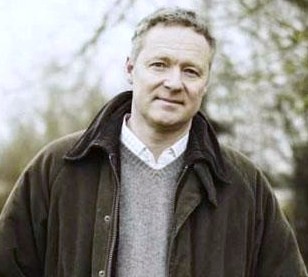 Rory Bremner. |
June 15, 2010 update: Rory Bremner, a British political impressionist, fears joking about Islam because this could lead to his death. He told David Frost in a BBC documentary, Frost on Satire: "When [I'm] writing a sketch about Islam, I'm writing a line and I think, 'If this goes down badly, I'm writing my own death warrant there.' Because there are people who will say, 'Not only do I not think that's funny but I'm going to kill you' – and that's chilling."
Bremner offered the Danish cartoons as an example. "If you're a Danish cartoonist and you work in a Western tradition, people don't take that too seriously. Suddenly you're confronted by a group of people who are fundamentalist and extreme and they say, 'We're going to kill you because of what you have said or drawn.' Where does satire go from there, because we like to be brave but not foolish."
June 24, 2010 update: In an interview with Las Vegas Weekly, Penn Jillette of Penn and Teller gets asked about Islamist intimidation – and frankly acknowledges it:
Are there any groups you won't go after? We haven't tackled Scientology because Showtime doesn't want us to. Maybe they have deals with individual Scientologists—I'm not sure. And we haven't tacked Islam because we have families.
Meaning, you won't attack Islam because you're afraid it'll attack back ... Right, and I think the worst thing you can say about a group in a free society is that you're afraid to talk about it—I can't think of anything more horrific.
Of course, it might please some Islamic fundamentalists to hear you say that you won't talk about them because you're afraid ... It might, but you have to say what you believe, even it if pleases somebody you disagree with—that issue comes up all the time in moral discourse.
You do go after Christians, though ... Teller and I have been brutal to Christians, and their response shows that they're good fucking Americans who believe in freedom of speech. We attack them all the time, and we still get letters that say, "We appreciate your passion. Sincerely yours, in Christ."
Oct. 10, 2010 update: Andrew Alexander, the Washington Post's ombudsman, acknowledges why his newspaper did not run a "Non Sequitor" cartoon drawn by Wiley Miller:
Editors at The Post and many other papers pulled the cartoon and replaced it with one that had appeared previously. They were concerned it might offend and provoke some Post readers, especially Muslims. ... Miller's cartoon is clearly a satirical reference to the global furor that ensued in 2006 after a Danish newspaper invited cartoonists to draw the prophet Muhammad as they see him. After the cartoons were published, Muslims in many countries demonstrated against what they viewed as the lampooning of Islam's holiest figure.
The spiked "Non Sequitor" cartoon by Wiley Miller, "Where's Muhammad?"
Miller's Sunday drawing also keyed on "Everybody Draw Muhammad Day!," a free-speech protest this year by cartoonists responding to what was widely interpreted as a death threat from an Islamic cleric against two animators who depicted Muhammad wearing a bear suit in an episode of the "South Park" television show. If enough cartoonists drew Muhammad, protest organizers reasoned, it would be impractical to threaten all of them.
What is clever about last Sunday's "Where's Muhammad?" comic is that the prophet does not appear in it. Still, Style editor Ned Martel said he decided to yank it, after conferring with others, including Executive Editor Marcus W. Brauchli, because "it seemed a deliberate provocation without a clear message." He added that "the point of the joke was not immediately clear" and that readers might think that Muhammad was somewhere in the drawing.
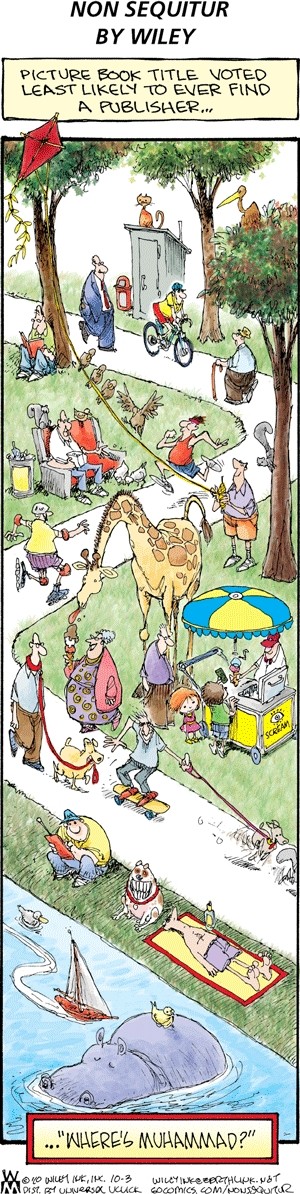
Alexander notes that readers accused the Post of cowardice and provides Miller's reaction:
Miller is fuming. The award-winning cartoonist, who lives in Maine, told me the cartoon was meant to satirize "the insanity of an entire group of people rioting and putting out a hit list over cartoons," as well as "media cowering in fear of printing any cartoon that contains the word 'Muhammad.'"
"The wonderful irony [is that] great newspapers like The Washington Post, that took on Nixon . . . run in fear of this very tame cartoon, thus validating the accuracy of the satire," he said by e-mail.
Alexander then reaches his own judgment:
The Post should always consider the religious sensitivities of readers. But in this case, I think editors were wrong to withhold the cartoon. Clearly, Miller has a right to draw the cartoon, and The Post has the right to run it. But this is a question of editorial judgment.
Yes, Miller was trying to be provocative. But "Non Sequitur" followers expect that. And there's a difference between provoking anger and provoking readers to think. Surely some may be displeased by "Where's Muhammad?" But unlike with the Danish cartoons, it's hard to imagine it would incite protests. Miller intentionally did not depict Muhammad, and the cartoon is not a blasphemous attack on the prophet. If anything, it's a powerful and witty endorsement of freedom of expression.
Post editors believe their decision was prudent, given the past cartoon controversies and heightened sensitivities surrounding Islam. But it also can be seen as timid. And it sets an awfully low threshold for decisions on whether to withhold words or images that might offend.
Feb. 14, 2010 update: After the Council on American-Islamic Relations wrote a letter to the Philadelphia Examiner on Feb. 10, complaining about the writings of Aaron Proctor, the Examiner briefly dropped Proctor and then reinstated him. Proctor wrote a letter to supporters today in which he made this statement:
As a precaution (and of my own free will, not suggested to be by anyone), I've taken down my CAIR articles except the Meehan statements and will no longer focus on any further stories about Islam or CAIR. I guess that's the end game of terrorism: scaring people into speaking out and keeping people away from seeking out their livelihood. It's back to City Council critiques and uncovering RINOs in Philly and complaining about smoking bans for me.
Oct. 11, 2011 update: Terry Jones, 69, starred in Monty Python's 1979 comedy The Life Of Brian making fun of Jesus; asked if he would do a remake about Muhammad, his answer is unequivocal: he and his colleagues would be "frightened" and "think twice." He adds, "looking at Salman Rushdie. I suppose people would be frightened." [For Michael Palin's similar remarks, click here]
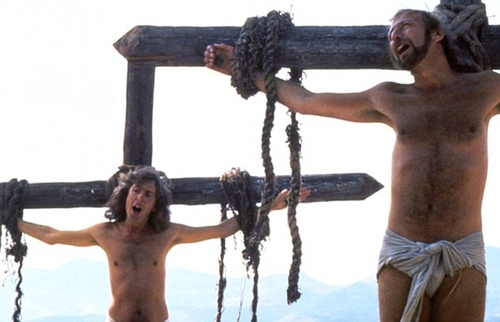 A still from "Life of Brian." |
Jan. 27, 2012 update: Johan Vlemmix, a Dutch satirist, stopped performing his Do the Burqa skit (a parody done to the music of Van McCoy's Do the Hustle) after receiving death threats. But he left it on the internet, where it can still be seen.
Feb. 27, 2012 update: BBC director-general Mark Thompson acknowledges bending to Islamist threats, saying that producers have to consider the possibility of "violent threats" instead of polite complaints:
Without question, "I complain in the strongest possible terms," is different from "I complain in the strongest possible terms and I am loading my AK47 as I write." This definitely raises the stakes. ... The point is that for a Muslim, a depiction, particularly a comic or demeaning depiction, of the Prophet Mohammed might have the emotional force of a piece of grotesque child pornography.
He added that the edict against Salman Rushdie, the 9/11 attacks, and the murder of Theo van Gogh made broadcasters understand that religious controversies can lead to crimes.
Mar. 17, 2012 update: The New York Times explained in a Mar. 13 letter that it would not run an advertisement critical of Islam because "the fallout from running this ad now could put U.S. troops and/or civilians in the [Afghan] region in danger."
May 8, 2012 update: David Rusin takes a look at the British Broadcasting Corporation in "The BBC Broadcasts Its Own Dhimmitude." A brief except, of its director general, Mark Thompson, explaining the corporation's double standards with respect to faith:
Christianity, he explained, receives less sensitive treatment because it is "a broad-shouldered religion, compared to religions which in the UK have a very close identity with ethnic minorities." Specifically, Islam in Britain is "almost entirely a religion practiced by people who may already feel in other ways isolated, prejudiced against, and where they may well regard an attack on their religion as racism by other means." Thus, when asked whether the BBC would run a Muhammad-mocking program on a par with the Jesus-ridiculing Jerry Springer: The Opera, which it aired over Christian protests in 2005, Thompson answered that it would not. Depictions of Islam's prophet, he maintained, could have "the emotional force" of "grotesque child pornography" for Muslims.
Concern about Islamist violence undergirds BBC self-censorship, as evidenced by Thompson's citations of the Salman Rushdie affair, which he described as "an absolute watershed," and 9/11. "A threat to murder ... massively raises the stakes," Thompson pronounced. "'I complain in the strongest possible terms' is different from 'I complain in the strongest possible terms and I'm loading my AK47 as I write.'" Jonathan Neumann of Commentary observes, "The lesson the BBC appears to be teaching — a lesson we always knew and apparently is also policy — is that complaints get more credence if they are backed up by force."
Oct. 8, 2012 update: The pop singer Madonna was going to don a Muslim bridal dress in her next music video but desisted after the dangers were pointed out to her. Alicia Adejobi reports that she still might wear it in the future, however:
"Madonna had the outfit ready to go. She was really proud of it and said it was her 'Terror Bride' costume," a source told The Sun. "She had paraded around in it and said she was going to wear it in her next music video. At first when people started telling her it was madness she just brushed it off." "But when they mentioned that her actions could put her life at risk she decided to ditch it from her video and certainly won't be wearing it on stage."
While Madonna was said to be "disappointed" that she wasn't able to wear the outfit for this music video, she is reportedly considering wearing the outfit in the future. "She was really disappointed as she was so adamant about it," she explained. "And even when she said she wasn't going to go ahead she winked that it was being put aside 'for now'."
Sep. 11, 2012 update: The British Channel 4 has canceled a repeat screening of Islam: The Untold Story, a documentary presented by Tom Holland, author of In The Shadow Of The Sword. The television show received around 1,200 complaints when first broadcast in August and Holland was threatened. A spokeswoman explained: "Having taken security advice, we have reluctantly cancelled a planned screening of the programme Islam: The Untold Story. We remain extremely proud of the film which is still available to view on 4OD." However, repeated attempts to watch the documentary on 4OD met with error messages.
The Independent newspaper sums up the objectional bits: the documentary
investigated the origins of the religion, claiming there was little written evidence about the Prophet Mohammed and questioning the authenticity of many of the stories in the Koran. It examined claims that rather than Islam's doctrine emerging fully-formed in a single text, the religion instead developed gradually over many years with the expansion of Arabic empires.
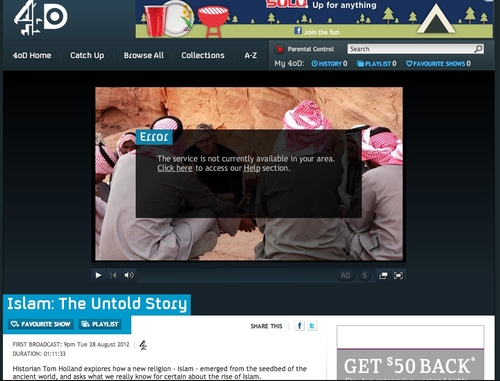 One of the error messages received when trying to view "Islam: The Untold Story." |
July 4, 2013 update: Perhaps the photograph from a forthcoming Harper's Bazaar magazine showing Madonna in a chainmail mask in niqab style, along with the words "The Revolution of Love is on...Inshallah" is the lesser version of that Muslim bridal dress in a music video referred to in the Oct. 8, 2012 entry above?
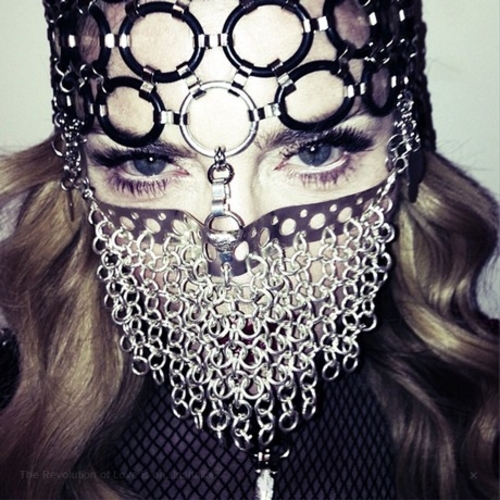 Madonna in a chainmail niqab. |
Michael Palin when in Monty Python.
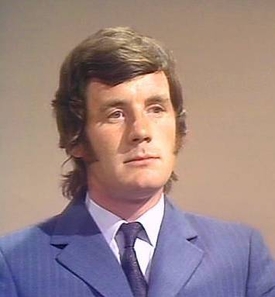
Dec. 29, 2013 update: A second member of the 5-man Monty Python troop has publicly admitted that the Rushdie affair so scared him that he won't touch the Islam topic. Brian Jones acknowledged his fears two years ago (see above, here), and now Michael Palin, 70, has said the same: "Religion is more difficult to talk about [now]. I don't think we could do Life of Brian any more. A parody of Islam would be even harder. We all saw what happened to Salman Rushdie and none of us want to get into all that. It's a pity but that's the way it is. There are people out there without a sense of humour and they're heavily armed."
Comment: Islamist intimidation is evil but acknowledging it is the first step to fighting back against it.
Nov. 14, 2014 update: In his book, Tyranny of Silence, published today, Flemming Rose tells about two Scandanavian cases of self-censorship. One involves Norway's famous newspaper artist Finn Graff; the other Thorbjørn Christoffersen and Kresten Andersen, the Danish directors of the 2008 animated movie, Rejsen til Saturn.
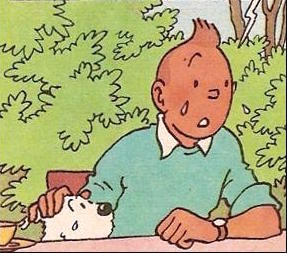 Jan. 22, 2015 update: The Musée Hergé in Louvain-la-Neuve, Belgium, which celebrates the creator of comic book hero Tintin, planned an exhibit in honor of the murdered Charlie Hebdo cartoonists – but then cancelled it out of concern for Islamist danger. "The police presented us with the nature of the potential risks we need to be attentive to," said Director Nick Rodwell. "We decided not to open our exhibition on Thursday morning [Jan. 22] insofar as it could raise the concerns of both museum staff and the residents of Louvain-la-Neuve."
Aug. 31, 2018 update: Even Geert Wilders, the anti-Islamic Dutch politician, has acknowledged that intimidation works. He had scheduled a cartoon drawing contest of Muhammad, the Muslim prophet that spurred death threats against him and large-scale protests in Pakistan that threatened violence against the Netherlands. "To avoid the risk of victims of Islamic violence, I have decided to not let the cartoon contest go ahead," he announced. The government of Pakistan, now led by Prime Minister Imran Khan, took credit for the cancelation. The foreign minister, Shah Mehmood Qureshi, called the cancelation a "great moral victory for the Muslim umma" and noted that a "major crisis" had been averted.
Sep. 8, 2018 update: Hearing that a 19-year-old Afghan stabbed and injured two Americans in Amsterdam's central station at least in part in protest of his (already canceled) Muhammad cartoon contest, Wildersresponded: "For now, I will not be doing it soon again, for sure." He noted a paradox: one "should never give in to people who threaten to use violence against freedom of speech" but when there are other people involved, their safety takes priority. "If it would have been only about me, I would have continued and done it again but it was not only about me — it was about innocent people."