
An Agence France-Presse dispatch, dated today, reads "Matachina: The Madrassa of Martyrs Rebuilt by the USA Remains Empty." It describes a mosque complex in a town near Khost in Afghanistan's southeast. The unnamed reporter tells of finding a stone stele by the side of the road announcing (I am translating here from French) the "Matachina Mosque, rebuilt in 2002 with the assistance of the American people."
The U.S. government has helped pay for a mosque!?
Apparently so. The news report explains that at least 34 persons - combatants, religious students, women, and children – were killed in the U.S. bombardment of the mosque and its adjoining Koranic school on November 16, 2001, in the midst of the American offensive against the Taliban. The new building, paid for by the U.S. Army, is said to be "practically identical" with the previous one, including a wooden door decorated with arabesques out of bronze.
If this report is true, it is a scandal, and an important one. Yet again, it appears, American governmental agencies are giving special treatment to Islam, whether endorsing of the faith or cutting breaks for it by selling land at less than 10 percent of its market price when the purpose is mosque construction. Such privileged treatment is simply not permissible according to the First Amendment to the U.S. Constitution ("Congress shall make no law respecting an establishment of religion") and must come to an immediate end.
As an ironic post-script, the AFP report quotes a nearby soldier in Matachina saying that "Nobody ever comes to this mosque." The journalist elaborates: "Not a resident steps foot in it. Barely rebuilt, the mosque is already abandoned. The faithful prefer to pray elsewhere." So, not only did the U.S. Army illegally build a mosque, but it also wasted taxpayer funds.
Comment: This activity fits into a larger pattern that Mimi Stillman and I documented in "The United States Government: Patron of Islam?" (February 24, 2004)
Feb. 25, 2004 update: For an (imperfect) English translation of the above item, see http://www.news24.com/News24/World/News/0,,2-10-1462_1488957,00.html.
Aug. 30, 2004 update: The U.S. government also is providing money for madrassahs, the Islamic schools blamed for encouraging Islamism in Indonesia, and lots of it - $157 million over five years, to be exact, Reuters reports today. So, taxpayer aid to parochial schools inside the United States is illegal but the same aid in Indonesia is legal?
Oct. 8, 2004 update: The U.S. government has provided $32,000 "for reconstruction of one of the biggest mosques in Northeast Bulgaria," reports a Bulgarian source. It astonishes me how, when it comes to Islamic institutions, antidisestablishmentarianism increasingly prevails.
Feb. 22, 2006 update: After terrorists bombed the dome at the Golden Mosque in Samarra, George W. Bush announced that "the American people pledge to work with the people of Iraq to rebuild and restore the Golden Mosque of Samarra to its former glory." Sounds like a clear violation of church and state to me.
Mar. 7, 2007 update: Not all the U.S.-government sponsored Islamic schools are in faraway places, I report today at "Other Taxpayer-Funded American Madrassas." These schools are in the United States itself.
May 13, 2007 update: "US to build Afghan super-madrassas," writes Gethin Chamberlain in the Sunday Telegraph,
in an attempt to persuade parents not to send their children across the border to Pakistan for instruction at hard-line religious schools. Work has started on two "super-madrassas" in Paktika, which borders Pakistan, and more are planned. The American government is also paying for the refurbishment of mosques in the area, in the hope of winning over religious leaders. ... Each madrassa will accommodate 1,000 boarding pupils, all of them boys.
Aware of the problem inherent in having government-built religious institutions, U.S. Major Jason Smallfield explains: "In Afghan terms it is a madrassa, but those words have baggage and if word gets back to a Western public that we are building madrassas, that is a bad thing. It is a religious school, but it is not a religious education."
Comment: Sounds like gobbly-gook to me. Taxpayers are funding a religious school, period.
May 15, 2007 update: "Hugh Fitzgerald" takes on this issue at "The terminal naivete of Westerners," where he concludes:
The policy of building madrassas and refurbishing mosques in Afghanistan is madness. It is also unconstitutional. American taxes are being used to favor, abroad, a religion, and far worse, one religion over others. Where is the Constitutional challenge to this? There is a case to be brought. Bring it, you pro-bono-seeking lawyers you. Enter the casebooks. Enter history.
Jan. 30, 2008 update: The effort goes on, writes Jon Boone from Khost in "US military funds construction of Islamic schools in Afghanistan" for the Financial Times.
The US military is funding the construction of Islamic schools, or madrassas, in the east of Afghanistan in an attempt to stem the tide of young people going to radical religious schools in Pakistan. ... US reconstruction cash has helped establish two state-run madrassas in the province of Khost, and a third is on its way. Commander David Adams, head of the US provincial reconstruction team in Khost, the province on the border with Pakistan, said more were planned. ... In parts of eastern Afghanistan, US soldiers distribute copies of the Koran and "mosque refurbishment kits" that include sound systems powered by solar panels and prayer rugs.
Mar. 6, 2008 update: "Can a Case Be Made to Enjoin further madrassa and mosque building?" inquires "Brian T." Yes, he replies, based on a review of the case history (Lemon v. Kurtzman, Reid v. Covert, Lamont v. Woods).
Mar. 27, 2008 update: The Canadian government may join its American counterpart in building "moderate" madrassahs in Afghanistan if its people on the ground get their wish, reports Le Figaro.
June 5, 2009 update: "US embassy inaugurates D1.6M Islamic school project" comes a report by Gibairu Janneh from Gambia.
Officials from the US embassy in Banjul, Thursday 4 June, 2009, inaugurated an Islamic school in Kanjabinah village in the Foni Berefect District. The Islamic school, worth 1.6 million dalasis [=$61,000], was funded by the Africa Humanitarian Assistance program of the US government. The school consists of four classrooms, two stores, one office and three outside toilets, all fitted with tiles.
Speaking at the inauguration ceremony, on behalf of the National Assembly member of the area, the chairman of Brikama Area council, Sunkary Bajjie, remarked that America is a true friend of The Gambia. He described the gesture as a representation of the hope and courage that the US President Barack Obama stands for in the world. ...Speaking earlier on, Alkalo of Kanjabinah village, Fabakary Colley, thanked the US for the gesture. But he went on to appeal to the embassy to consider helping the school with furniture for the classrooms, a well and the wages of the teachers who will be teaching at the school.
For his part, the charge d'affaire of the United States embassy, Brian Bachmam, ... noted that education is a basic right the people of the world have and that it is through education that "our greatest hopes for advancement lies. We are very pleased to work with this community towards the inauguration of the school. The school is built by funds given by the United States government and people, under the program of African Command for Humanitarian Assistance."
The highlight of the event was Bachmam's comment that many people might be surprised that the U.S. government is involved in the building of Islamic schools, but he assured them "that is not the case because there are millions of Muslims in the US that freely practice their religion" and that Americans "have great respect for Islam."
July 17, 2009 update: The inspector general of the U.S. Agency for International Development (USAID) issued a 40-page report today, "Audit of USAID's Faith-Based and Community Initiatives," that raises questions about the building of mosques and madrassahs.
The audit asks two questions:
- Were USAID-awarded funds used for religious activities?
- Did USAID implement policies and procedures for awards to faith-based and community organizations in accordance with the principles contained in Executive Order 13279? (That order, dated December 2002, guides Federal agencies to formulate and develop policies with implications for faith-based organizations and other community organizations)
In the process of answering, the IG provides information on many previously unknown Islamic projects such as these four in Fallujah, Iraq:
from Project Tracking Sheet Project Title |
City/District |
Project End Date |
Contracted Cost |
Shorta Mosque and Community Center Rehabilitation |
Fallujah |
8 Jun 07 |
$86,846 |
Jolan Mosque and Community Center Rehabilitation |
Fallujah |
8 Jun 07 |
74,447 |
Jubail Mosque and Community Center Rehabilitation |
Fallujah |
10 Jun 07 |
118,553 |
Al Shuhada Mosque and Community Center Rehabilitation |
Fallujah |
8 Jun 07 |
45,492 |
Total |
$325,338 |
||
The report also provides specific information on the goals in these expenditures:
The program sought benefits from the rehabilitation of the mosques and adjoining community centers. For example, some of the expected benefits from rehabilitating the Al Shuhada Mosque were stimulating the economy, enhancing a sense of pride in the community, reducing opposition to international relief organizations operating in Fallujah, and reducing incentives among young men to participate in violence or insurgent groups. Some of the specific activities funded for the Al Shuhada Mosque included masonry, electrical, and plumbing repairs, the provision of furniture, and the beautification of the mosque's garden.
Against this, the audit notes that
Section 205.1(d) of title 22 of the Code of Federal Regulations (CFR) prohibits USAID funds from being used for the rehabilitation of structures to the extent that those structures are used for "inherently religious activities."
For reference purposes, here is that Section 205.1(d) of title 22 of the Code of Federal Regulations, which in plain English makes clear that current activities are illegal:
USAID funds may not be used for the acquisition, construction, or rehabilitation of structures to the extent that those structures are used for inherently religious activities. USAID funds may be used for the acquisition, construction, or rehabilitation of structures only to the extent that those structures are used for conducting eligible activities under this part. Where a structure is used for both eligible and inherently religious activities, USAID funds may not exceed the cost of those portions of the acquisition, construction, or rehabilitation that are attributable to eligible activities in accordance with the cost accounting requirements applicable to USAID funds in this part.
Sanctuaries, chapels, or other rooms that a USAID-funded religious congregation uses as its principal place of worship, however, are ineligible for USAID-funded improvements. Disposition of real property after the term of the grant, or any change in use of the property during the term of the grant, is subject to government-wide regulations governing real property disposition.
Oddly, the audit does not reach a conclusion on the key issue of constitutionality but kicks the topic upstairs to the White House:
We recommend that the Director of the Center for Faith-Based and Community Initiatives, in consultation with the Office of General Counsel, contact the executive director of the White House Office of Faith-Based and Neighborhood Partnerships to obtain legal guidance about what religious activities USAID may or may not fund overseas without violating the Establishment Clause of the First Amendment of the Constitution.
To which, the USAID management rather strenuously (and lengthily) objects. An excerpt:
Recommendation 1 reaches an unwarranted conclusion regarding the very complex Establishment Clause legal questions that have been raised by certain programmatic activities undertaken by the Agency.
... the draft audit report's conclusion that "some USAID funds were used for religious activities" is not supported by the record. ...
The Constitutionality of USAID programs overseas can only be determined on a case by case basis and thus there can be no "one size fits all" legal resolution of this question. In addition, unless and until a particular fact pattern is litigated, it remains speculation as to whether the requisite compelling foreign policy reason for providing funding exists and therefore whether USAID funds were used for "religious activities" that would be impermissible under the Agency's Final Rule on Participation by Religious Organizations in USAID Programs (Agency Rule) and the Establishment Clause.
July 20, 2009 update: A press release from USAID announces "Restoring Egypt's First Mosque-Amr Ebn El Aas: Effort to lower groundwater rescues a holy place from ruin and benefits Old Cairo residents." The entire text reads:
A high level of groundwater, resulting in part from leaking sewers and the rise and fall of the Nile, threatened the structural integrity of several buildings and monuments in Old Coptic Cairo. USAID and the government of Egypt jointly allocated more than LE57 million ($15 million) to rescue the ancient monuments through a broader effort to imrove the area's sewage system. The project salvaged six monuments in and around Amr Ebn El Aas Mosque, which, built in 642 AD (21 AH) was the first mosque established in Egypt.
The release also contains two photographs of the Amr Ebn El Aas (also spelled 'Amr ibn al-'As) Mosque, from before and after its renovation. The full captions read:
- BEFORE: For two decades, contaminated groundwater gradually rose in Old Cairo until it reached within 20 inches of the main floor of the 1,300-year-old Amr Ebn El Aas Mosque. The main floor of the mosque and other structural elements were threatened and urgent action was required to rescue the site from further deterioration.
- AFTER: The project lowered the groundwater under the main floor of the mosque to safe levels and the Supreme Council of Antiquities conducted restoration work to allow the return of worshipers and visitors. Improved sewage services installed as part of the project benefit the 140,000 citizens who live near the mosque.
Jan. 30, 2010 update: Illegal activity appears to be going on a large scale in Afghanistan, according to a New York Times report, "Marines Invest in Local Afghan Projects." A single Marine company has already financed eight mosque projects and has another twelve on the books. "Mosques are the big thing right now," says Petty Officer Third Class Mark H. Funk.
Feb. 23, 2010 update: A report by a task force convened by the Chicago Council on Global Affairs has produced a document, Engaging Religious Communities Abroad: A New Imperative for U.S. Foreign Policy, that takes up the issue of the First Amendment (the "Establishment Clause") and mosque building abroad and calls for a clarification of policy:
In July 2009 the USAID inspector general raised concerns that USAID may have breached the Establishment Clause by using public funds to rebuild four mosques and adjoining community centers in Fallujah. Such uncertainty acts as a brake on policy innovation and risk taking. A new strategy must provide clarity about what is and is not permissible. Constitutional constraints on U.S. engagement of religious actors abroad, if any, must be clear, reasonable, and appropriate to the task of defending American interests.
The writers of the report themselves are unclear where the boundaries lie:
Within the United States, the Establishment Clause prohibits a range of interactions between government and religion, including
- the fusion of religious and government authority;
- the disbursement of government aid on the basis of religious criteria;
- government approval of or preference for particular religions;
- government adjudication of theological controversies.
It is unclear, however, whether and how these domestic nonestablishment constraints apply to U.S. foreign policy. There are reasonable arguments that the clause imposes significant limits on the conduct of foreign policy, and there are equally reasonable arguments that it imposes only relatively narrow limits that have little or no practical effect on the policies recommended in this report.
Feb. 26, 2010 update: Michael Kessler, a visiting assistant professor of government at Georgetown University, disagrees with the cautions of the Chicago Council on Global Affairs report in an article titled "Establishment Clause doesn't limit foreign policy." In it, he states that "if you want to prevent the President from advancing or inhibiting religion in foreign affairs, you will need to find other ways than the Establishment Clause to constrain the President."
Apr. 27, 2010 update: "Zanzibaris Celebrate U.S.-funded Historic Kizimkazi Mosque Restoration" reads the press release from the U.S. embassy in Tanzania. I quote at length to get the full flavor of this scandalous development::
U.S. Ambassador to Tanzania Alfonso E. Lenhardt and Hon. Haroun Ali Suleiman, Zanzibar's Minister of Education and Vocational Training, joined local villagers to celebrate the renovation of the historic Kizimkazi mosque in Zanzibar on Tuesday.
Kizimkazi Mosque, on the south tip of the island of Zanzibar, is one of the oldest continuously used Islamic places of worship in Africa. However, it was in danger of severe damage due to deterioration. According to Hamad H. Omar, Director of Zanzibar's Department of Archives, Museums and Antiquities Division in Zanzibar, the Antiquities Department requested a grant of $21,500 through the U.S. Ambassador's Fund for Cultural Preservation to restore the historic 12th century mosque in partnership with the American people, so that the valuable structure might last for hundreds more years.
Imam of Kizimkazi mosque, Imam Abdulrahaman Suluhu Muombwa, commented on the restoration saying, "We thank the American people for their assistance, which allowed us to restore the historic mosque, and also build a nice bathroom. We believe now the mosque will serve us and our grandchildren. We thank them and we wish them well for remembering us out of their own free will." ...
The Zanzibari Government undertook the restoration of the mosque under the supervision of a qualified local consultant in the field of preservation of historic buildings. The American grant paid for strengthening the building and protecting the historic mihrab. Additionally, workers built a new roof to protect the interior of the historic site and constructed new washrooms nearby for worshippers.
Nor is this all; we learn from the release that
Work on the Kizimkazi mosque followed another project, also supported by the Ambassador's Fund, to restore two mosques that date from the mid-17th to early 18th century on the island of Pemba. The mosques, which contain unique features that combine Swahili and Persian architecture, had fallen into disrepair from the harsh climate and a lack of funds for maintenance. ...
During the celebration in Kizimkazi, Ambassador Lenhardt noted that the Kizimkazi Mosque, because of its simple beauty and profound cultural and historical significance, should be one of the top landmarks of Zanzibar, for visitors and Tanzanians alike. Reflecting on the ages-old hand-carved mihrab was "humbling," he said.
Comment: In all, then, the American taxpayer has fixed up three working mosques in Tanzania under the guise of "cultural preservation." More accurate would be "promotion of Islam."
Aug. 10, 2010 update: A Washington Times editorial today takes up the issue of "Tax dollars to build mosques: U.S. underwrites fundraising tour for Islamic shrine at Ground Zero." Despite the focus on the "Ground Zero Mosque," the editorial also takes up foreign building projects, remarking that Americans "may be surprised to learn that the United States has been an active participant in mosque construction projects overseas." It then cites the Egyptian and Tanzanian donations mentioned above and concludes:
The mosques being rebuilt by the United States are used for religious worship, which raises important First Amendment questions. U.S. taxpayer money should not be used to preserve and promote Islam, even abroad. ... It is impossible to separate religion from a mosque; any such projects will necessarily support Islam.
Spurred by this editorial, Andy McCarthy writes in National Review Online that "someone in Congress needs to get to the bottom of whether this government is also underwriting Islamic religious institutions, and doing so in violation of U.S. law."
Aug. 24, 2010 update: The Associated Press provides a survey of this topic at "US helps fund mosque, minaret restoration around the world as part of cultural outreach":
This year, the Obama administration will spend nearly $6 million to restore 63 historic and cultural sites, including mosques and minarets, in 55 nations, according to State Department documents.
Under a program established by Congress in 2001, the department will fund at least five projects in as many countries at a cost of more than $271,000. The contributions include $76,135 for the 16th century Grand Mosque in Tongxin, China, and $67,500 for the 18th century Golden Mosque in Lahore, Pakistan. An additional $62,169 will be spent on restoring a 19th century minaret in Mauritania's ancient city of Tichitt; $50,437 for the Sundarwala Burj, a 16th century Islamic Monument in New Delhi, and $15,450 to restore the 18th century Gobarau Minaret in Katsina, Nigeria.
The amount spent on mosque restoration projects is a fraction of the total in the 2010 Ambassadors Fund for Cultural Preservation, which also will fund projects to restore Christian and Buddhist sites as well as museums, forts and palaces.
Since 2001, the U.S. government has spent almost $26 million on the program to fund about 640 cultural preservation projects in more than 100 countries.
Aug. 26, 2010 update: Writing in the Canada Free Press, Laurie Roth states that the U.S. government's mosque building and renovating program operates in 27 countries and costs most likely "hundreds of billions" of dollars. Neither assertion is documented. I can believe the countries but not the dollars. Hundreds of thousands, maybe.
Sep. 6, 2010 update: Two more comments about the funding of Islamic religious structures:
- Robert Spencer: This project is "disastrously wrongheaded and unconstitutional. They are not going to win hearts and minds. It is not as if they are going to say, 'the Americans built this mosque for us so we shouldn't wage jihad on them. A mosque is a mosque is a mosque. It is where prayers happen. That is a religious installation."
- Zuhdi Jasser: "This type of outreach is completely ineffective and that ultimately we have to approach it like the Cold War where we are fighting an ideology. If we are going to have this long war of ideas we cannot fund these religious institutions. We can fund anti-Islamist institutions based in liberty."
Nov. 11, 2010 update: "Mosque Makeovers With Your Tax Dollars" reads the headline from WSB, Channel 2 in Atlanta and it tells how "the State Department is sending millions of dollars to save mosques overseas." Details:
The Channel 2 Action News investigation found a 1,300-year-old Egyptian mosque that was almost flooded by contaminated sewer water that is one of many ancient Cairo mosques and churches that were saved from destruction by the U.S. taxpayers. ... This is part of a $770 million program to rebuild Cairo's sewer system, paid for by the U.S. State Department's USAID program.
Millions more dollars have been sent to places like Cyprus. The State Department displays before and after pictures of mosques refurbished with U.S. tax dollars. ...
The State Department declined a Channel 2 Action News request for an interview. We wanted to ask why are we using tax dollars to refurbish religious buildings overseas. The State Department did send Channel Two Action News an e-mail saying that they are fighting Islamic extremism by building relationships with Islamic leaders. ...
Your tax dollars also fund computers and mosques in places like Tajikistan and Mali. At an ancient mud brick mosque in Mali, the State Department has provided Internet service and computer equipment to local imams.
Jan. 6, 2011 update: As an aside in a New York Times article on Sufism in Pakistan, we learn that the U.S. government, which sees Sufism as a counter force to terrorism, "has helped promote it by giving more than $1.5 million since 2001 on the restoration and conservation of Sufi shrines in Pakistan."
Mar. 8, 2011 update: In an undated press release, "Rescuing 1000-Year-Old Mosque from Decay: USAID program rebuilds ancient relic while creating healthy environment for residents," the United States Agency for International Development focuses on the sanitation aspect of a Cairo mosque, conveniently ignoring its paramount religious nature. The text of the release reads:
The Saleh Talai Mosque in historic Islamic Cairo, dating back to the 10th century, is now active, and open for prayers and tourists. This mosque suffered for decades from rising groundwater contaminated with sewage. USAID, as part of its $770 million Cairo Sewerage Program, allocated $2.3 million for lowering the groundwater at the mosque area, replacing the old sewage collector, and providing a healthier environment for people living in the area.
Rising groundwater, contaminated by leaking sewerage system, flooded the lower level shops in the 1000 year old El Salah Talai Mosque for over twenty years. This caused damage to the structure and created a health hazard to the residents and shop owners. The lower level could not be accessed for restoration, or used by the shop owners and visitors.
The groundwater was successfully lowered below the floor at the Salah El Talai Mosque and the leaking sewerage system was replaced. The structural elements of the mosque and the shops are now accessible for on-going restoration, prayers and visitors. The environment around the mosque is now safe for the residents.
Not content with words, the release includes "before" and "after" pictures of the groundwater problem.
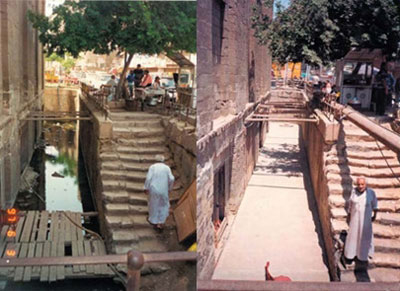 "Before" with groundwater, "after" without it. |
Jan. 12, 2012 update: Also in Pakistan, Huma Imtiaz reports in the Express Tribune, the American taxpayer (via the State Department's Public Diplomacy Programmes for Afghanistan and Pakistan) provided $36,607 to the "Sunni Ittehad Council" to support religious moderation in Pakistan and organize an anti-Taliban rally on August 14, 2009.
In response to a question on whether the US was allowed to fund religious groups, the State Department spokesperson said that the US government is allowed to give grants to religious groups for non-religious activities, adding that the US Embassy in Islamabad closely monitored the grant.
Feb. 1, 2012 update: Andrew Henry, "Uncle Sam's Middle East Mosque Fix" includes quotes from Nonie Darwish on this topic in the February issue of Newsmax, pp. 16-17.
Sep. 26, 2012 update: Frank Crimi makes the important point in FrontPageMag.com today that "Obama rebuilds mosques while churches burn." Some details:
while the State Department was busy repairing Egyptian mosques, scores of Egypt's Coptic Christian churches were being burned down by Muslim mobs, one which included St. George's Church in the Egyptian village of Merinab. ...
In 2010, the State Department provided monetary support for saving three mosques on Zanzibar Island off the coast of Tanzania, mosques which included the 900-year-old Kizimkazi mosque, considered one of the oldest Islamic buildings on the coast of East Africa. That generous American donation was repaid in July 2012 when Muslim mobs, shouting, "Away with the church — we do not want infidels to spoil our community, especially our children," burned down three Christian churches on Zanzibar Island.
In 2011 the State Department provided funds to restore the 15th century Gobarau Minaret in Katsina State in Nigeria's predominantly Muslim north, an area which has become a virtual killing field for Christians at the hands of Muslim militants, led by the al-Qaeda-linked terror group Boko Haram. Since 2009 over 288 Christian churches in Nigeria have been burned, thousands of Christian-owned homes destroyed, and over 2,000 Christians killed, including in July 2012 when fifty members of a northern Nigerian church were burned to death in their pastor's house.
Finally, the State Department provided taxpayer funds to restore the 18th century Golden Mosque in Lahore, in Pakistan's Punjab province, an area which happened to be the scene of an assault on a Christian colony in July 2009 by thousands of Muslims who set fire to over 50 houses and two churches, burning to death eight people, including a seven-year-old child.
June 10, 2013 update: I had no problem when Kansas City International Airport officials installed foot-washing benches in 2007 in an airport restroom for the ablutions that precede the Muslim prayers. It was fine because the cab drivers who used this facility paid for it via a one-dollar per-trip fee. I saw it as the same accommodation in miniature as the military academies offering land on which religious organizations can pay for chapels.
But I have a major problem with foot baths and dedicated prayer room recently installed at San Francisco International Airport that were paid for by taxpayers. That is the picture of special privilege for Islam that I oppose. An airport spokesman explained: "The way we look at it ... this was in the interest of maintaining a good relationship with ground transportation providers." No, this is blatantly unconstitutional, no less so than building and repairing mosques in other countries.
May 19, 2016 update: Things seem to have quieted down in the United States – even as they heat up in Canada. Concerning the Canada 150 Community Infrastructure Program, here's The Rebel's Andrew Lawton:
the Liberal government announced this week that $197,585 had been awarded to the Kitchener Masjid, to help with the Islamic centre's $3.5 million renovation of its gymnasium and prayer space. This isn't just a run of the mill rec centre: it's a mosque. And the manager of the centre said himself that his group wants the money "to transform the mosque to a proper place of worship. ...
More concerning is that the Kitchener Masjid is owned by the Muslim Association of Canada, a group who funnelled money towards a Canadian organization, IRFAN-Canada, which had its charitable status revoked for funding Hamas, a terrorist group. MAC is an off-shoot of the Muslim Brotherhood, and is now getting government subsidies for mosques.
Mar. 31, 2026 update: After nearly a decade of quiet, this news from Bangladesh: "The U.S. Embassy in Dhaka announced a $235,000 Ambassadors Fund for Cultural Preservation (AFCP) grant to restore the historic Mughal-era Musa Khan Mosque."


