In the aftermath of 9/11, one sees an outpouring of sympathy and goodwill for Muslims, especially in the United States. One manifestation is a sharing of the Ramadan fast vigors. (A gesture that is not always reciprocated; see my weblog entry on "Enforcing the Ramadan Fast.") This blog collects some of the more colorful examples of this trend:
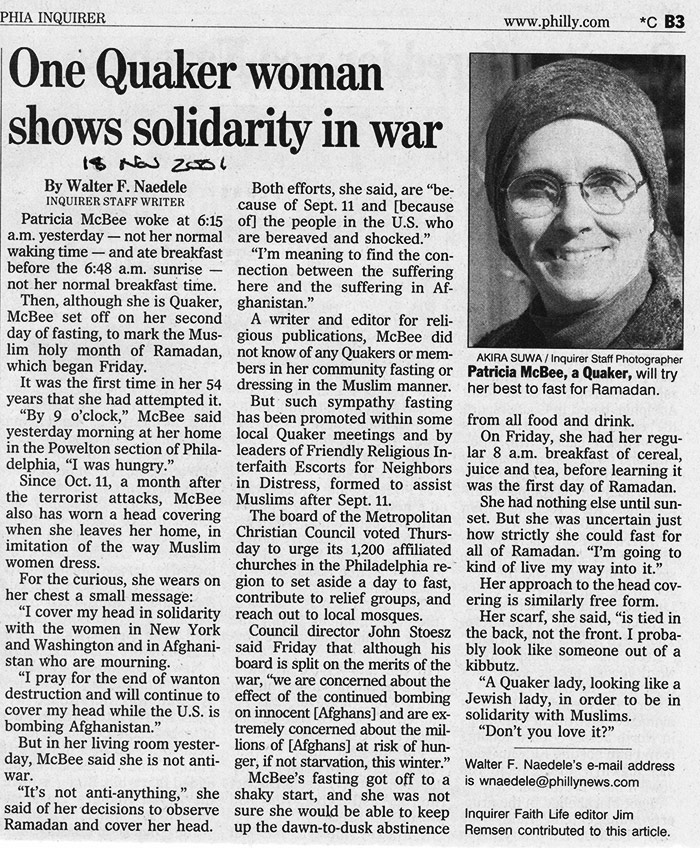
We start with Patricia McBee of Philadelphia, 54 and a Quaker: the Philadelphia Inquirer explains how she decided to show her solidarity with Muslims by wearing an Islamic-style headscarf as well as a message pinned to her chest explaining that she does so "in solidarity with the women in New York and Washington and in Afghanistan who are in mourning." She's currently on her second day of fasting for Ramadan but is not sure she can keep it up. She fasts in conjunction with the decision of the Metropolitan Christian Council, which urged churches to set aside a day for fasting, to contribute to relief efforts, and to reach out to local mosques. (November 18, 2001)
Oct. 25, 2003 update: So, what are coalition forces planning to do for their first Ramadan in Iraq, which begins Monday, Oct. 27, 2003? The Associated Press reports today that they will be very respectful:
No eating, drinking or smoking in public: That word is going out to American soldiers in Iraq as Muslims prepare to observe the holy month of fasting, Ramadan. During Ramadan, expected to begin Sunday, Muslims are supposed to abstain from food, drink, cigarettes and sex during daylight hours. It is a time for reflection, when religious feelings run strong.The U.S.-led coalition is clearly concerned that those feelings could erupt into violence against American troops by religious Iraqis deeply offended that their country will be spending Ramadan under military occupation by non-Muslims. "We have made sure all our forces are well aware of the implication of Ramadan," said Lt. Gen. Ricardo Sanchez, commander of U.S. and coalition troops. "We're making sure our forces clearly understand what the traditions are, and what the sensitivities are to make sure that we're being respectful of the Iraqi people."To that end, American and other allied troops have been attending "cultural sensitivity" classes, where instructors, mostly chaplains, explain Islamic traditions and the meaning of the Islamic holy month. "We don't want our soldiers to challenge any of those social customs or taboos or religious practices out of ignorance," said Lt. Col. Chester C. Egert, a chaplain with the 101st Airborne Division in Mosul.
And not just that, the news item continues:
Some of the troops have taken the sensitivity training to heart. Sgt. John Gainey, who admits he knew "absolutely nothing" about Ramadan, is considering fasting for a day himself, just so he can relate to the Iraqi experience. "It will give me further insight into why Muslims fast," he said. "It will be a good gesture for the Muslim people."
Reflections: (1) This is probably the most "culturally sensitive" occupation of a country in all of recorded history. (2) It is not likely to be rewarded with reciprocal good will. (3) Sgt. John Gainey appears to be on his way to converting to Islam, and he's probably not the only American soldier going down that path. (4) This is not the first time the U.S. military has bent over backwards to accommodate Islamic customs: Who could ever forget the government-issued abayas for female personnel in Saudi Arabia during the 1990s? And to this day, there remains a ban on bibles, erotica, pork, and hops going to soldiers deployed in CENTCOM's region. (October 25, 2003)
Nov. 11, 2003 update: In a related development, IslamOnLine reports today that DePaul University of Chicago, the second largest Catholic university in the United States, has provided nearly $3,000 in funding for the school's Muslim Student Association to sponsor iftars (dinners to break the fast).
Nov. 19, 2003 update: U.S. soldiers in Iraq are not the only American Christians experimenting with the Ramadan fast; they are joined by university students. The Palm Beach Post reported yesterday on the first Ramadan Fast-a-thon at Florida Atlantic University, "a one-day fast that included more than 100 students of all faiths," which had the dual purpose "to raise awareness and contributions for the Daily Bread Food Bank in West Palm Beach." Sujith John, a senior and a Christian reflected on the day's exertion: "It's not only about giving up food and water. It's about cleansing yourself." Meanwhile, at the University of Minnesota, reports the Minneapolis Star Tribune today, the second annual Ramadan Fast-A-Thon took place, with the same dual purpose. Commented Cristina Edelstein, a senior and a Christian, on the experience: "This has been cool tonight. It's how God works, establishing communication between people." The similarity in these projects is no coincidence; the Muslim Student Association, a North American Islamist organization active on campuses, promotes the Fast-a-thon idea at a website. MSA reports that thirty campuses hosted Fast-A-Thon events in 2002, its first year of existence; Google's news search shows thirty items for 2003, suggesting that the program got off to a quick start but has since stalled.
Dec. 3, 2003 update: It's one thing for the Muslim Student Association to sponsor Ramadan Fast-A-Thons and quite another for the public schools of the State of California to do the same. Lowell Ponte notes in today's FrontPageMag.com that Len Cesene, a seventh grade world history teacher in Covina, California, outside of Los Angeles, recently sent the following note home with his students:
ROYAL OAK INTERMEDIATE SCHOOL
World History Mr. CeseneDear Parents or Guardian,As part of the world history curriculum, your student has recently been studying the rise of Islam and the teachings of Mohammed. Fundamental to the Muslim religion are the Five Pillars of Islam. They emphasize the "word of God," prayer, charity for the poor, fasting and the pilgrimage to Mecca. During the month of Ramadan, Muslims refrain from food or drink during daylight hours.In an attempt to promote a greater understanding and empathy towards the Muslim religion and toward other culture, I am encouraging students to participate in an extra credit assignment. Students may choose to fast for one, two or three days. During this time, students may only drink water during daylight hours.Once fasting is completed, students are to type a ½ page summary of their experience. They should describe how it felt to go without food during the day and connect it to the theme of sacrifice. Fasting is inconvenient and sometimes uncomfortable, many religions to consider it an important sacrifice.I wish to emphasize that this is an EXTRA CREDIT assignment and is by no means mandatory. For those unable to fast, they may choose to type a 2 page paper in which they compare different religions that encourage sacrifice during the year. I give my son or daughter permission to fast for one, two or three days.Final papers for either project are due by wed. November 26th.Student signature Parent signature
Far from this being a rogue assignment, Ponte points out, "Cesene was merely carrying out the statewide educational policy direction of the State of California. He was extending the pro-Islamic lessons in textbooks that have been used in California, Alabama, and many individual public school districts."
In response, I endorse what the local San Gabriel Valley Tribune argued in its editorial, "Assignment to fast out of line":
inside the classroom, we support teaching students about these faiths, not asking them to practice them. ... Asking students to practice religion as part of a public school lesson is a violation of the country's separation of church and state laws. Yes, it doesn't matter that this was extra credit or that a student, presumably, could opt out. In this case, the teacher went too far by including the fasting assignment as part of his seventh-grade history lesson. Fasting during Ramadan ... is tantamount to an extra-credit assignment about Catholicism that involves asking a student to practice the Stations of the Cross. Or teaching about Protestantism by requiring a student to take Holy Communion or become baptized. ... Schools need to be sensitive not to cross the line into asking students to practice a religion.
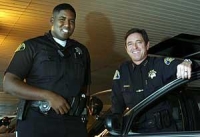 San Jose Police Chief Rob Davis, right, plans to fast for the entire month of Ramadan—Islam's holy month—along with officer Matthew Ra'oof, left, as a gesture of support for the local Muslim community. Ra'oof says of his boss, "He's a man open to every religion, to every ethnic group." PATRICK TEHAN / MERCURY NEWS |
|
Oct. 12, 2004 update: A new Ramadan season means some Christians start fasting. One of the first out of the box is Rob Davis, a Mormon and the police chief of San Jose, Calif.. According to the San Jose Mercury News, Davis was speaking to 7,000 Muslims last year during Ramadan and he realized that the vast crowd, unlike he, was hungry. "It just dawned on me, if I am truly going to understand the nuances of this religion, I should join them in this fast." He plans an iftar each night this year at his home with a different Muslim family as his guests.
Oct. 13, 2004 update: In an editorial, the Mercury News finds that the Ramadan gesture by Davis "promotes one of Silicon Valley's most treasured qualities -- respect for a range of religious and cultural experiences."
Oct. 25, 2004 update: According to the Islamic Cultural Centre at the London Central Mosque, the commissioner of London's Metropolitan Police, Sir John Stevens, visited the ICC today and broke "his special Ramadhan fast at an ICC dinner."
Nov. 6, 2004 update: Holly Lebowitz Rossi of Religion News Service reports that "some non-Muslims, particularly college students, have learned about the philosophical and spiritual underpinnings of the holy month and are adopting the practice of fasting themselves. Reasons range from hunger awareness to a statement of political solidarity to a desire to practice a spiritual discipline." She then gives the example of Cindy Thoman-Terlazzo of York, Penn., a Unitarian Universalist who is fasting for all three reasons. Rossi notes that non-Muslims who fast during Ramadan usually do so in conjunction with a local Muslim community effort, and that the Ramadan Fast-A-Thon is one of the most organized of these efforts. Started in 2001 by a University of Tennessee-Knoxville student, Sanjana Ahmad, the Ramadan Fast-A-Thon in 2003 involved 9,300 non-Muslims and raised $46,000 for charities. This year, it is active at nearly 150 colleges.
Sep. 16, 2005 update: A new Ramadan and a new initiative, this one from the Council on American-Islamic Relations, a "a wonderful new nationwide initiative titled 'Sharing Ramadan'."
"Sharing Ramadan" is a new annual campaign started by CAIR for local communities to host iftar dinner receptions and open houses for our neighbors of other traditions. Since sharing and appreciation are essential components of Ramadan, we hope local mosques, community centers and Islamic schools will take this opportunity to invite their neighbors to join them for a meal during an iftar.
A 13-page "Resource Guide 2005," then gives exact guidelines how to do this, from the media advisory (complete with manufactured quotes), to the guest list, to the invitation letter that warns about men and women sitting separately, to the mix of foods, to the substance of the occasion ("Be sure to have displays and make presentations about Islam and Muslims"). CAIR has thought the whole event through for you.
Oct. 5, 2005 update: Carol Wolman describes herself as a "lifelong peace activist" who "is actively working to impeach Bush and Cheney." From this far-left perch, she also advocates non-Muslims fasting for Ramadan. In an article titled "Why Americans should observe Ramadan: Dissociate from the Bush regime, join the ummah," she explicitly posits Islam as a way for anti-Americans to reject their country.
Any American who considers him/herself a servant of God can join the ummah [which she correctly defines as "the body of Islam"] and observe Ramadan. There are no special ceremonies needed to become a Muslim, one simply has to accept Allah, and the validity of Muhammed's prophetic mission.
Right after her advocating conversion to Islam, Wolman connects this to her political differences with U.S. foreign policy:
Most Americans now disagree with Bush's Iraq policy, feel that invading Iraq was a mistake at best, and that staying there is making matters worse. ...
How can we the people dissociate ourselves from the actions of the non-representative Bush regime, and show our compassion for and solidarity with the Iraqi people?
Observing Ramadan, fasting with the Muslims, is an excellent way to do this. It gives us deeper empathy with their suffering. The voluntary austerity of the Ramadan fast will strengthen us, strengthen our ability to oppose the attack on the ummah perpetrated by the ongoing occupation of Iraq. It will help us identify with people all over the world, and break down the us/them barrier. It also will demonstrate our dedication to peace, and disassociate us from the nefarious policies of the Bush administration.
Fasting for Ramadan brings us closer to God, the God of peace and love. It will move us toward realizing the dream of universal brother/sisterhood.
As though not quite understanding what she has just advocated, Wolman then quotes Psalm 86: 9, links to a Peacemakers Bible Study group, and signs off with "In the name of the Prince of Peace."
Oct. 17, 2005 update: Kharman Aidun, a Zoroastrian student reporter at La Voz Weekly (a publication of De Anza College in Cupertino, California) decided to go the whole way for Ramadan, moving in with a Muslim friend, wearing a hijab, waking for the 5 a.m. prayers, praying five times a day, and (of course) fasting during the daylight hours during. Her conclusion? "I gained insight I would not have had otherwise by immersing myself in this culture for only one week."
Oct. 27, 2005 update: Fr. Labib Kobti, founder of Al-Bushra in San Francisco, an "Arab American Roman Catholic Community," has started "Ramadan Fasters of Christ" a program for American Christians to keep the Ramadan fast. As he explains:
We have joined you in keeping the fast of Ramadan this year, as a freewill offering to God accompanying our prayer for peace, justice, and a spirit of love to grow among the peoples of the Abrahamic religions. It is our desire that all over the world, if God so wills, Muslim, Jew and Christian can learn to stand together in brotherhood in the sight of their Creator.
Then comes the political twist:
But we are mourning many of the deeds of our government and our people, as they continue to involve themselves in the affairs of Islamic peoples, and the lives of Muslim detainees held at United States facilities, without sufficiently caring or understanding what they are doing to the people whose lives they affect. To our sorrow, we see many American Christians trusting, supporting, and following policy-makers whose guiding principle seems to be "let us do evil, that good may come of it," as if they did not know that our own scripture explicitly condemns it (Romans 3:8).
The fast will be undertaken for reasons of political solidarity:
This month we curb our natural appetites during daylight hours to be more mindful of the One to whom we must return, the Highest, our Helper. We perceive, sadly, that many American Christians lack understanding of what it means to be a Muslim. How better to change that than for some of us to join the Muslim world in its Ramadan fast? We also hope that such self-restraint as we gain from the fast might help restore a spirit of self-restraint to American culture, in however small a way, for on our learning self-restraint now seems to depend the saving of the world from ruin.
Comment: It is noteworthy how many different motivations can inspire non-Muslims to fast during Ramadan.
Dec. 8, 2005 update: A scathing editorial today in the Globe and Mail brings another Ramadan-solidarity-fast to my attention. The editorial notes how Hassan Almrei, "an admitted passport forger and that there is good reason to believe he is a holy warrior who espouses Osama bin Laden's murderous philosophy," has won a celebrity following in Canada:
Pierre Trudeau's filmmaker son Alexandre has offered to post a $5,000 bond to help him make bail. Former federal NDP leader Alexa McDonough offered $100 toward bail. Diana Ralph, a Jewish activist who told the court her father was an international lawyer with the Nuremberg war-crimes tribunal, built a $32,000 basement apartment for him in the hope the judge would release the Muslim man into the care of her and her spouse. Ms. Ralph says she knows him better than she knows her own son. (They speak daily on the phone, and she visited him weekly.)
A reader notes that Campaign to Stop Secret Trials in Canada has sponsored an "International Ramadan Solidarity Fast."
The Campaign to Stop Secret Trials in Canada would like to invite you to join an international fast of solidarity with the largely Muslim detainees from the so-called war against terror (a war against democracy really) who are imprisoned across the globe.
Oct. 3, 2006 update: U.S. troops are spending their fourth Ramadan in Iraq and the practice of abstaining from food and drink has, according to a report posted at JihadWatch.org clearly become more official. "Don't you know it's Ramadan?" is an account by a soldier at a weekly meeting somewhere in Iraq.
I arrived in typical fashion, early to get a seat and grab a beverage prior to the rush. When I approached the small fridge to grab a soda, I was told by another staff officer "sorry, no drinks, it's Ramadan". Incredulously, I replied, what!!!? Turns out, we had 2 visiting Iraq Generals briefing a future operation, and in an effort to be culturally sensitive, the order was put out there would be no drinking in the presence of the Iraqis.
Greatly displeased, I drove on and found my seat. This Major was on a mission, there would be no drinking as I watched her chastise numerous officers. She then came to a man of Middle Eastern appearance in civilian dress who took up a seat behind the yet to arrive Iraqi Generals. He pulled out a cranberry juice from his pocket, and was quickly told he would not be aloud to drink anything during the meeting. He was clearly agitated, but put the juice away. It apparently slipped by the dutiful Major that the man she was correcting was an Iraqi translator who was Muslim! He was the Iraqi General's personal translator.
I took a moment to ponder what I had just witnessed. An American infidel enforcing Islamic tradition on an apparently secular Muslim! I was truly in bazzaro world.
Oct. 9, 2006 update: Another Ramadan, another opportunity for non-Muslims to keep the Muslim fast. This year, Pax Christi USA, a left-wing Roman Catholic group announced that thousands of its members are fasting for Ramadan as a gesture to soothe tensions following Pope Benedict XVI's quote of a Byzantine emperor saying that Islam is "evil and inhuman." Likewise, a leftist group (unnamed) in Ann Arbor, Mich. has organized a "solidarity fast" of three-day shifts for the entire 30 days of Ramadan to demonstrate its opposition to the U.S. fighting in Iraq and Afghanistan.
Sgt. Jeremy Pitcher, a spokesman for coalition forces in Iraq, says that dozens of American service members in Iraq's Al-Anbar province are fasting as "a gesture of good will, a gesture of respect for the nation of Iraq, for the culture of Iraq."
Finally, the collegiate Fast-a-thon claims to have spread to more than 250 U.S. campuses this year.
Oct. 11, 2006 update: One of those campuses is Indiana University, where a news report in the Indiana Daily Student reports that 600-700 people have signed up for the Fast-a-thon and 200-300 people are expected at the iftar dinner. Its slogan is "Go hungry for a day so someone else won't have to," the logic of which somewhat escapes me. But what is most noteworthy is that, for each student participant, some local businesses, primarily restaurants, reportedly have agreed to donate money to a community kitchen.
June 12, 2007 update: A feature story by Michael Y. Park, "Islamberg: A Terror Compound in New York ... or Misunderstood Neighbors?" takes a look at the 70-acre compound in which more than 100 Muslims live in seclusion located in Deposit, N.Y., at the foot of the Catskill Mountains. In the course of detailing the relations between Islamberg and the townspeople, Park writes that post-9/11 suspicions of the compound caused a notable cooling. Then this:
And though the community is noticeably less friendly that it once was, some say that it still welcomes those who make an effort to be sympathetic. The doctor at the local clinic in Deposit, John Giannone, now fasts on Ramadan out of respect for the community's beliefs and has maintained a relatively close relationship with the group. When his house was devastated by flooding that nearly wiped Deposit off the map in June 2006, volunteers from Islamberg came down and helped him clear out the debris and clean up the rental home his family had moved into. Giannone says they even did the dishes.
Sep. 25, 2007 update: "Area businesses have promised to donate money for every non-Muslim student who agrees to fast during the daylight hours of October 6, 2007," reports the University of Pennsylvania MSA. Interesting that the donations are only for non-Muslims.
Oct. 21, 2007 update: Fast-a-thon claims that "Over 280 Schools Worldwide Held Fast-a-thons in 2007!"
Aug. 28, 2008 update: If Islamists have their way, non-Muslims won't have a choice about observing the rules of Ramadan, writes Ted Jeory, "Hard to Swallow: Town Hall bid to extend Ramadan fast to non-Muslims fuels row." The town councilors in Tower Hamlets, an area in East London, received an e-mail outlining arrangements for Town Hall committee meetings over the next month, during Ramadan. Jeory explains:
It said that new council leader Lutfur Rahman and his deputy, Siraj Islam, had requested that meetings be kept to a minimum to accommodate fasting councillors. They have also asked all other councillors to resist eating until the breaking of the fast at sunset. ... Council bosses have also ordered that the Town Hall's business agenda should also be reduced, with only seven scheduled committee meetings for the entire month, to deal with the Ramadan restrictions. Officers have also been barred from arranging any more and asked to find ways of dropping some of the scheduled seven. ...
Normally, tea, coffee and sandwiches are set aside for councillors to nibble at during evening meetings. But during Ramadan, these will be reduced and complemented by Iftar food packs containing chicken, lamb and vegetarian snacks. However, in his email the council's head of democratic services John Williams said: "It is requested that members do not partake of any refreshments until aft er the Iftar refreshments are served."
Sep. 9, 2008 update: Hindus are also joining the fast, comes a brief report from Bombay about Bollywood friends Feroz Lakadwala and Vivek Abrol. Feroz keeps the fast and other rituals of Ramadan, despite a grueling schedule: "Ramadan is very important. I have to answer to the Almighty," he says. Vivek plans to observe the fast as well. The reporter concludes that "Vivek and Feroz are the new faces of modern India proving that festivals like Ramadan often help bridge the religious divide."
Sep. 10, 2008 update: The French television station France24 finds a whole pattern of "Christians observing Ramadan." In some cases, the motive is mainly to please a lover or spouse:
Guillaume Maillet, a French medical student, observes Ramadan (a holy month for Muslims). For him it's a gift to his girlfriend. "I've been observing Ramadan for the past two years and I think I'll observe it again in the future. I've nothing to lose. It's manageable physically; and I think it's an ideal way to prove my love to my better half," Maillet says.
At the same time Guillaume doesn't want to go overboard, he fasts only on his days off from work. He enjoys the serene ambiance at home before breaking the day's fast. "In the evening, I love sharing Iftar (the first meal to break the day's fast) with my girlfriend. There is a tiny notion of a reward and there is something euphoric about the whole thing." He recalls the excitement during Christmas when Santa Claus climbs down the chimney to leave gifts. "We wait in excitement, day and night on 24th (Christmas eve), to discover our gifts the next day," says Maillet. While Maillet says the process reminds him to think about those who are starving, he admits that he wasn't motivated by spirituality to observe Ramadan.
Jean-Pierre Malvis, a 32-year-old French engineer, observes Ramadan for a day or two as a sign of "solidarity and respect for his wife."
"I just follow whatever she does. I don't eat, I don't smoke and I restrict myself from the same activities as she does. And imagine this....I don't drink, not even on the sly!" So what does he learn after an entire day of fasting? Nothing much, admits this agnostic who describes himself as someone who doesn't take fasting too seriously. "Apart from the fact that historically Ramadan is for the rich, who deprive themselves of all luxuries to experience what the poverty-stricken people go through, I find no other reason than this," Malvis says.
Aug. 21, 2009 update: Israeli soldiers have been ordered not to eat, drink, or smoke in the presence of Palestinians, particularly at security crossings, during the fasting hours of Ramadan. Aug. 9, 2010 update: The same goes in 2010, Arutz 7 reports:
As one of the gestures, IDF soldiers have been asked not to eat, drink or smoke in front of PA Arabs, many of whom will be fasting during the daytime throughout the month-long holiday. IDF spokesmen explained that soldiers will be allowed to eat when they please, but have been asked to refrain from doing so in public, in order to "demonstrate a high level of respect and understanding." Soldiers and police have been given explanatory material regarding the holiday and its customs.
Sep. 4, 2009 update: London Mayor Boris Johnson wants non-Muslims to fast on Ramadan the better to understand their "Muslim neighbor," he announced during a visit to the East London Mosque and London Muslim Centre. "I urge people, particularly during Ramadan, to find out more about Islam, increase your understanding and learning, even fast for a day with your Muslim neighbour and break your fast at the local mosque. I would be very surprised if you didn't find that you share more in common than you thought."
Sep. 10, 2009 update: About a dozen faculty faculty and 100 students medical school students at the University of Michigan participated in the Muslim Medical Students Association's Fast-A-Thon so that, as present and future physicians, they wanted better to understand how Ramadan fasting affects the lives of Muslim patients. "In terms of understanding the science and the physical effects of fasting, that's something we can learn in lecture. Of course, we know what happens to a person's glucose levels when they don't eat for several hours," said Jess Guh, a student. "As a provider, this helps us understand better why it would be important enough for one of our patients to do this."
Sep. 14, 2009 update: David Rusin considers this phenomenon today at "Non-Muslims Join the Ramadan Fast." He also provides information on another case:
Brian McLaren, a leading American evangelical in the "emergent church" camp, has fasted since Ramadan began in late August. He explains: "As Christians, we want to come close to our Muslim neighbors and to share this important part of life with them. Just as Jesus, a devout Jew, overcame religious prejudice and learned from a Syrophonecian woman and was inspired by her faith two thousand years ago (Matthew 15:21 ff, Mark 7:24 ff), we seek to learn from our Muslim sisters and brothers today."
Sep. 15, 2009 update: One can go to an "Abrahamic Faiths Iftar," also called an "Interfaith Iftar," this evening at Harvard.
The Harvard Islamic Society
Harvard Hillel,
The Catholic Student Association,&
The Harvard-Radcliffe Christian Fellowship
invite you to
__________________________________________________________
Abrahamic Faiths Iftar
_________________________________________________________________________________Ticknor Lounge, Boylston Hall
Tuesday, September 15, 6:45 PMCome join members of four religious organizations on campus
and enjoy great food as we break fast in the Islamic month of Ramadan!Map to Boylston Hall.
We hope to see you there!
Comment: I wonder when Harvard's first interfaith Lent or Yom Kippur will take place.
Sep. 18, 2009 update: The "Home Office Islamic Network," a group of UK Home Office staffers, issued a five-page information sheet on the etiquette of Ramadan that the Department distributed and posted on the its internal internet, giving it official endorsement. The document includes this statement: "In practical terms, please be sensitive when eating lunch near a Muslim colleague who is fasting. This can make an individual feel hungrier and make it more challenging to observe the fast."
Comment: Or, in the Daily Mail's more explicit headline, "Don't eat near Ramadan fasters, Home Office staff told."
Jan. 5, 2011 update: The Royal Canadian Mounted Police may be the most politically-correct police force in the Western world. Brian Lilley reports two items for the Toronto Sun:
First, the RCMP's community outreach office in Ottawa called an emergency meeting of its cultural diversity consultative committee on Aug. 26, 2010 and Cpl. Wayne Russett wrote a memo in anticipation that included this directive:
To show support to our Muslim brothers and sisters during RAMADAN, there will be no food or drink during this most important meeting. This meeting is for one hour only, in order to observe prayer time and the breaking of the fast during RAMADAN.
Second, this meeting was called because RCMP investigators had the audacity to search through homes, computers and seized equipment of three terror suspects (Hiva Mohammad Alizadeh, Misbahuddin Ahmed, and Khurram Syed Sher) on Aug. 25, which happened to fall during Ramadan. The trio, Lilley reports, "were charged with several terrorism-related offences in a plot the Mounties say was aimed at launching a terrorist attack in Canada and supporting terrorism abroad."
Not only did Cpl. Russett hold more than a dozen meetings with Muslim groups in Ottawa, visiting mosques and community centers, eating several iftars along the way, but RCMP and Ottawa police officials apologized about the arrests taking place during Ramadan. As Russett wrote to François Bidal, commanding officer of the RCMP's National Capital Region, "We have been actively engaging the local Muslim Communities and will continue to do so in an attempt to neutralize and elevate any issues of concern." Jan. 6, 2011 update: Happily, Prime Minister Stephen Harper intervened with some adult supervision: "the general approach that this government would expect to see is that the law, our important laws, are enforced every day of the year."
July 14, 2011 update: The Council on American-Islamic Relations has published a 16-page Sharing Ramadan Resource Guide 2011 that urges "local mosques, community centers and Islamic schools [to] take this opportunity to invite their neighbors to join them for a meal during an iftar."
July 16, 2011 update: Although generally well disposed towards CAIR, Imam Luqman Ahmad of Sacramento slams it for the Sharing Ramadan idea in his long (and not quite proofread) post, "CAIR's 'Sharing Ramadan' Campaign: Well intended? Maybe. Bad Idea? Definately!" In brief:
sharing Ramadan, inviting people to fast for a day, sprucing up our behavior for the benefit of the media, or thinking that a non-Muslim will somehow vicariously experience what a believing Muslim feels when he or she breaks their fast, will do little to stem the rising tide of islamophobia or change public opinion about Islam and Muslims except to demonstrate the degree of ostentation (riyaa) which we are willing to embark upon to get someone to like us. It gives the impression that we are a disingenuous and desperate people. Such actions breed more contempt and suspicion than sympathy, or a warm and fuzzy feeling towards Muslims.
Aug. 3, 2011 update: In an ugly manifestation of this same urge to get non-Muslim fasting on Ramadan, comes word from the Hamas affiliated Ar-Risala website that Gilad Shalit, an Israeli hostage of Hamas since June 25, 2006, is fasting. As reported by the Ma'an News Agency:
"A popular proverb goes that if one lives in a community for more 40 days, he becomes one of them. This seems to have come true in the Gaza Strip," the report in Ar-Risala said. After years in Gaza, Shalit has become "embarrassed to ask for food during Ramadan despite the fact that his captors do not deny him that right," the report, in Arabic, continued. Shalit thinks the government "lost interest," it said, and he "abandoned Jewish traditions to mimic Muslims after the good treatment he received from his captors, even while they are fasting."
July 19, 2012 update: Two unusual aspects make the Minneapolis-St. Paul mosque effort to include non-Muslims in the Ramadan celebrations. First, they are invited only to take part in the breaking-of-the-fast meals, which is the easy part. Second, the Minnesota Council of Churches is encouraging participation and helping organize the meals. Here is Gail Anderson, a director with the Council of Churches, in a released statement: "Last year more than 350 guests attended an Iftar during Ramadan. We hope this year will be even bigger. We hope that people who have never had an opportunity to visit a mosque before will come join us for dinner at a mosque in their neighborhood."
July 20, 2012 update: The Federation of Netherlands Trade Unions (Federation Van Nederlandse Vakbonden or FNV) is organizing a free iftar for all members this Ramadan.
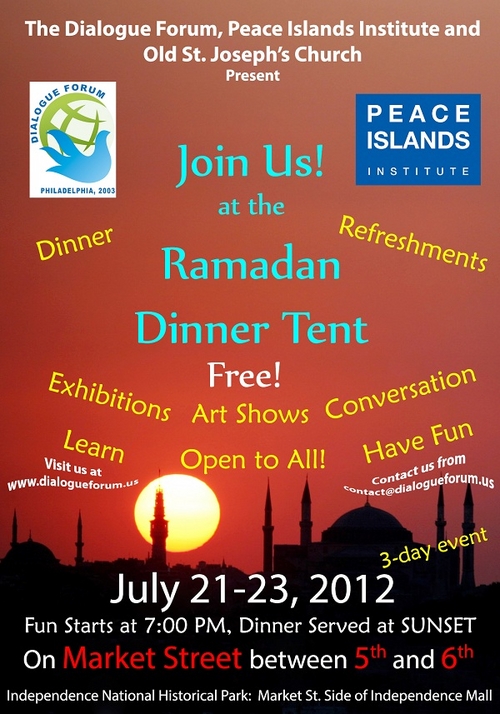
July 21, 2012 update: CAIR's Philadelphia office is promoting a " Community Ramadan Event" which consists of "A special Iftar dinner under a tent in Center City Philadelphia." It explains:
The tradition in some Muslim countries of setting up tents to offer iftar dinners to the poor and needy is first adopted in Philadelphia. Date: July 21-23, 2012 Time: 7:00 PM (dinner served at sunset) Location: Independence National Historical Park (Market St. between 5th & 6th) Free event presented by the Dialogue Forum, Peace Islands Institute and Old St. Joseph's Church.
Note the church participating.
July 29, 2012 update: In Dallas, United Methodist Rev. Wess Magruder is observing the fast for the whole of Ramadan, including its non-food aspects, has decided to "act like a Muslim," is breaking the fast at iftars with Muslims, and is blogging about the experience.
Aug. 14, 2012 update: A report from Amsterdam, about the police commissioner's new tradition of hosting a huge iftar:
In 2003 several Muslims from the Amsterdam [police] corps came up with the idea of once a year to celebrate the Iftar together with colleagues; therefore this will happen [this year] for the tenth time in a row. In the first year there were just 70 visitors at the meal organized by the police, this year there were at least 1,250. The Police Iftar in Amsterdam has, according to RTV North Holland, grown to be the biggest one of all the [police] corps in Europe. Agents, neighborhood captains, and other officials of the police sat with each other at the table in the World Fashion Centre. Among the guests were the head commissioner of the Amsterdam police, Pieter-Jaap Aalbersberg, and Mayor Lodewijk Asscher.
Dec. 2, 2012 update: Lisa Pliskin-Ismail, the Jewish wife of a Muslim man living in Philadelphia, fasts for Ramadan.
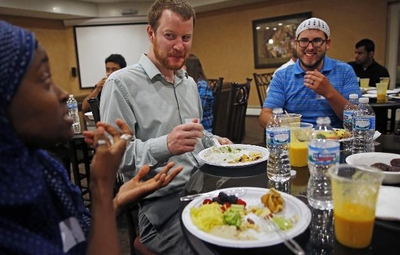
July 10, 2013 update: The Minneapolis Star Tribune gets the 2013 round of non-Muslim-who-fast-for-Ramadan started with a report about an iftar for twenty in a Woodbury apartment complex that included almost half non-Muslims:
Patrick Nervig relished a big bite of steaming yellow rice and spiced lamb — and crossed a religious divide. Tuesday marked the first time the lifelong Lutheran had attended an iftar, the meal ending the daily fast for Muslims during Ramadan, which began Monday at sundown. ... "I don't know too many Muslim people, so I was curious how they would come together for a meal," said Nervig, 29, of St. Paul. "It's really good food that I've never tried before. Got to meet some new people. ... I think just being open-minded and experiencing other people's religion and cultures in general is good."
An iftar in the community room of an apartment complex in Woodbury, Minnesota.
This fits into a larger pattern:
The Minnesota Council of Churches helps to organize an interfaith program that has brought Muslims and Christians together for food and conversation for nearly eight years. This year will have the most participation yet from Muslim groups, with up to 15 area mosques and Islamic centers taking part, said Gail Anderson, the council's director of unity and relationships. Last year, some 350 non-Muslims attended the iftars, including 233 people who had never before set foot in a mosque. This year, even more are expected.
Nov. 24, 2013 update: For a the related phenomenon of non-Muslim women donning Islamic headwear, see "Students take hijab challenge" by Esra Hashem reporting on the Muslim Student Association's "Hijab Challenge," at Fresno State.
June 26, 2014 update: The 8,200 U.S. military personnel living in Bahrain are officially being urged to try fasting during Ramadan. At a briefing on June 24, a cultural adviser at Naval Support Activity Bahrain, Ali Hassan, encouraged the about 150 personnel who attend his lecture, as Hendrick Simoes of Stars and Stripes relates,
to experience Iftar in a Ramadan tent, many of which are set up at various locations around Bahrain during the holy month and welcome non-Muslims. "Make it a point to visit these tents while you're here. You don't know if you'll ever come back to Bahrain in the future."
The newspaper account also informs us that
Navy officials are requiring U.S. personnel to dress more conservatively off-base during Ramadan. Although not a requirement by Bahraini authorities, the Navy is demanding that men wear long-sleeved shirts and women wear sleeved blouses that cover their elbows. Also, men must wear long trousers, and women should wear pants or skirts that cover the knees.
The indoctrination is having an effect:
"It actually made me want to do a lot more research into the religion," said Petty Officer 1st Class James Ramirez. He said the additional requirements during the month aren't a big deal to him. "For such a small period of time, it's a small sacrifice," he said. Other servicemembers echoed that sentiment.
July 8, 2014 update: In a reversal, Vocativ ("coupling the power of cutting-edge technology with a take-no-prisoners attitude toward newsgathering and storytelling") reports how Muslim "Atheists Fake Ramadan Hunger to Avoid Jail." Excerpts:
Threats of arrest or punishment for blasphemy force non-believers to give the impression that they're fasting just as hard as all those around them, or in some cases, to totally adopt the Ramadan fast for fear of being found out and persecuted. The situation is nearly impossible to bear, argue a growing number of atheists in the Muslim world. ...
While a person can abstain from taking part in prayers or certain rituals without drawing unwanted attention, declaring oneself an all-out non-believer during Ramadan is as simple as grabbing an iced coffee. Such a basic act can mean alienating family and friends at best, and attract harsh punishment in the worst cases – including threats of execution from state authorities.
A "vocal but anonymous atheist based in Jeddah, Saudi Arabia (tweeting as @mol7d_Arabi)" tells about his fears:.
"The constant threat of being caught not fasting, which carries severe punishment of lashings and up to a year in prison, makes one vigilant and worried. ... while Ramadan "as a cultural event is somewhat pleasant–there is a great feeling of festivity with family gatherings and lots of food, after sunset of course – the negative aspect is the enforcement of fasting and the feeling of self-loathing of having to perform religious rituals when one utterly does not believe in them. I feel stifled, religion is the only way of life here. It controls every aspect of society. From the laws to the behavior of people, to the way people see and evaluate morality, culture and relationships."
Another atheist, based in one of the Gulf States, runs the "Arab Atheists Broadcasting Center" website which produces pro-atheism YouTube clips; he says "You have to be careful of every word you will say and every action with anybody."
A third, asking to be referred to as "John Silver," tells how he secretly rebels against the fast: "I stay at work without food but every now and then I go to the bathroom to drink water, and when I'm going in the morning to work I go to a hidden place in the car and take a small sandwich." Should he be found out, the consequences would be harsh: "I will lose my job and maybe they will arrest me and put me in jail or they will throw me out of the country. I'm originally from Syria."
Comment: As with my dueling blogs of Western, non-Muslim women wearing hijabs vs glamorous Muslim women not wearing hijabs, here we have non-Muslim fasting on Ramadan and Muslims refusing to fast. The world is a complicated place.
July 9, 2014 update: Now there's a rabbi who's fasting on Ramadan. He's Natan Levy, described by the Times of Israel as an "Orthodox rabbi and interfaith leader living in London ... forty years old and a father of four." He's the most serious non-Muslim of them all, for he's planning to keep the whole of monthlong fast, minus only the Shabbats. Perhaps not surprisingly, the paper adds, "nobody in the Jewish community has opted to join him in the fast," though Levy is hoping others will do so. He is keeping the fast in the expectation that "it opens us some closed doors and builds some new bridges" as well as engage in an "honest conversation with everyday Islam."
July 10, 2014 update: Complementing the fasting rabbi in Great Britain, a synagogue in Cairo, Egypt, has hosted an iftar dinner; not exactly the same as non-Muslims fasting, but similar in spirit.
July 15, 2014 update: The year 1435 seems to be the one for Jews keeping or breaking the Ramadan fast. Now comes news of Congregation Mishkan Israel of Hamden, Connecticut, led by its rabbi, trekking to The Islamic Association of Greater Hartford to break the fast together on the occasion of Shivah Asar B'Tammuz, a Jewish fast day.
July 17, 2014 update: The report in the Philadelphia Jewish Exponent by Eric Berger, "Jews, Muslims Break Fast Together at Kensington Mosque," is not explicit about whether any non-Muslims fasted for Ramadan or not because July 15 is also the Jewish fast of Tammuz. But what about the Christians at the Al Aqsa Islamic Center – did they also fast? It's not clear.
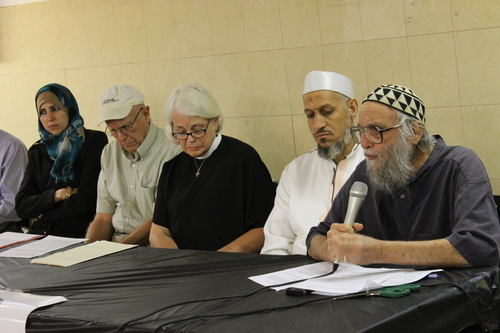 Rabbi Arthur Waskow to the right, with Imam Muhammad Shehata and Rev. Judith Beck, an Episcopalian, sitting next to him. |
July 24, 2014 update: American reality star Khloé Kardashian, 30, is fasting during Ramadan and not drinking alcohol out of respect for the religion of her boyfriend, rapper French Montana, 29. She also revealed that they are abstaining from sex during Ramadan: "There's no sex during Ramadan. That's so fun."
Comments: (1) Kardashian needs to learn more about Islam, for sex is permissible during Ramadan nights. (2) French Montana's real name is Karim Kharbouch, a Moroccan immigrant. His celebration of Ramadan also included a tweet of "Free Palestine!!"
 Khloé Kardashian and French Montana. |
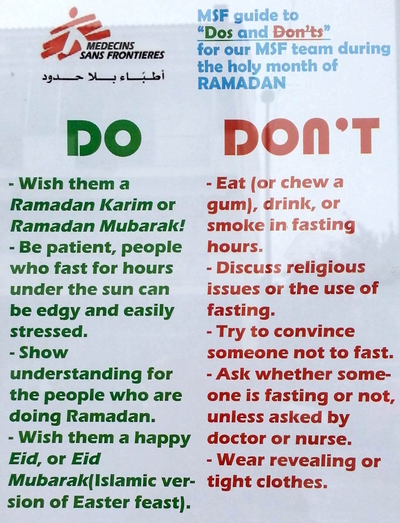
June 3, 2016 update: Véronique Saunier reports that Médecins Sans Frontières (Doctors Without Borders, أطباء بلا حدود) has prepared a "MSF 'Dos and Don'ts' for our MSF teams during the holy month of RAMADAN." The cheat-sheet includes these admonitions:
Don't
- Eat (or chew a gum), drink, or smoke in fasting hours. ...
- Wear revealing or tight clothes.
Comment: Keeping Ramadan by non-Muslim now also extends to clothing.
June 6, 2016 update: For the second consecutive year, Canadian Liberal MP Mark Holland is fasting for the whole month of Ramadan to raise funds for a charity called Give 30 which donates funds to buy food for the needy. Recalling his efforts in 2015, he said described fasting as "an incredible experience."
Aug. 28, 2016 update: "During Ramadan, some Jewish staffers decided to fast alongside their Muslim peers" at the Kings Bay YM-YWHA camp in Brooklyn, New York. That's because some 25-30 out of the Jewish camp's 1,000 children are Muslim.
Feb. 8, 2017 update: Actress Lindsay Lohan explains the circumstances of her carrying a Koran, tells about reading in it, and adds that she experimented by fasting with a friend for three days during Ramadan.
 Lindsay Lohan recounting her Islamic experiences. |
May 17, 2018 update: Mayor Lisa Helps and the council of Victoria, Canada, have challenged the city's residents to join with them and participate in a community-wide fast to mark Ramadan from sunrise to sunset on May 25.
June 14, 2018 update: Non-Muslim police officers in Northamptonshire, England took part in the Ramadan fast. The goal is to "show unity" and "gain a better understanding" to get "deeper into community roots" with Muslims. Positive Action Officer Kamilla Poole described the 18-hour experience:
Fasting for the day with no food and water was quite an experience and I realised that it requires a significant level of dedication and self-control to do it. As part of my role, I want to get deeper into the community roots to help increase participation and recruitment from all parts of the community.
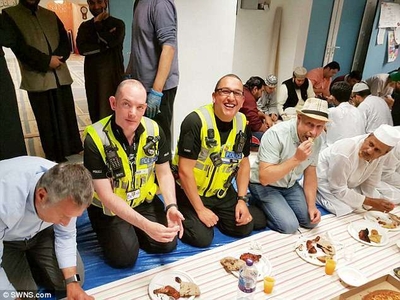 Daily Mail caption: "Officers, police staff and their families joined the local Headlands Mosque in Northampton for the evening iftar meal, after some of them took part in fasting." |
May 4, 2021 update: American Airlines CEO Doug Parker kept the Ramadan fast for 15 hours, from 5:30 a.m. to 8:30 p.m., with no food or drink, to empathize with the company's Muslim employees.
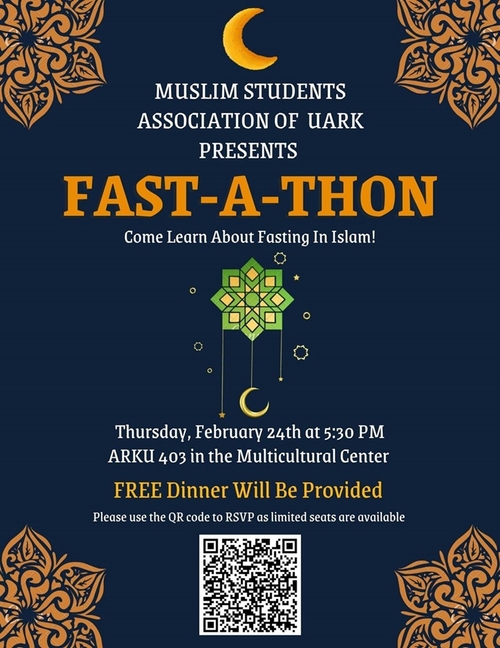
Feb. 16, 2022 update: The Muslim Students Association at the University of Arkansas, Fayetteville, will sponsor a "Fast-A-Thon" in honor of Ramadan on Feb. 24.
We welcome students from all walks of life to fast during the day and join us for dinner. However, fasting is not a requirement to attend this event. We will begin with a short lecture about what fasting encompasses in Islam and the details surrounding fasting in Islam. This will be followed immediately by dinner, which will include shawarmas from Grill 102. ... This event is supported by the Student Activities Fee as a funded event by the Associated Student Government and is free to all currently enrolled University of Arkansas, Fayetteville, students.
Apr. 4, 2022 update: At the University of North Carolina, the student newspaper reports, the Muslim Student Association (MSA)
has planned a "Fast-a-thon" and a large iftar for UNC community members to participate in, regardless of their religion. ... "We are going to have a big community iftar partnered with the Residence Hall Association to have people from across campus to come and break fast together," [MSA Outreach Chairperson Rida] Bayraktar said. "And then that day we will also have the Fast-a-thon, which is that we're inviting everyone to challenge a day of fasting on them to see how it feels like."
Apr. 12, 2022 update: The Wisconsin Muslim Journal reports that
Milwaukee School of Engineering held Ramadan iftar last week for the first time ever. ... About 60 students and a few professors, overwhelmingly non-Muslim, gathered just before sunset in a dining area set up with round tables covered in white linen. A nearby room was available for prayer.
May 2, 2022 update: Brigham Young University student Adnan Khayyat attended the Iftar celebration hosted by the Muslim Students Association said his Christian friends also joined him in his Ramadan celebrations. "I have a lot of friends who are members of The Church of Jesus Christ of Latter-day Saints. They fast with us too."
Mar. 21, 2023 update: Sadiq Khan, mayor of London, turned on the first-ever Ramadan lights at Piccadilly Circus.
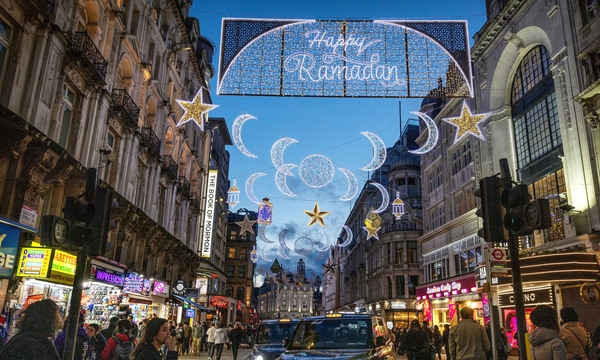 "Happy Ramadan" says the sign over Piccadilly Circus in London. |
Scott Baldauf writes, "As a non-Muslim, ... my family and I have lived in the Eastern Province of Saudi Arabia, and I have occasionally skipped a meal out of common decency when my co-workers were fasting."
It's not quite the same as fasting but the Dearborn, Michigan, fire department is selling "Ramadan Kareem" t-shirts.
 The brand-new Dearborn Fire Department t-shirt with "Ramadan Kareem," a crescent, and (fittingly) a picture of Henry Ford with one of his early cars. |