35 readers online now

Related Topics


Latest Articles


ADVERTISEMENTS


Premium Links
by Wikio

Computers
Electronics
Communication
Appliances

Other Taxpayer-Funded American Madrassas

by Daniel Pipes
Thu, 8 Mar 2007

updated Fri, 18 Apr 2008

Print Send Comment RSS Share:    

The Khalil Gibran International Academy is not the only taxpayer-funded Arabic-language school in the United States and not the only such school with Arabist or Islamist proclivities that need to be watched. This weblog entry will explore those other cases, arranged in rough geographical order, from east to west, north to south.

(This topic, incidentally, is quite apart from the private Islamic schools in the United States, which have problems of their own, and which I have covered in several articles, such as "A Madrassah in Bridgeview, Illinois," "What Are Islamic Schools Teaching?" and "Troubles at Islamic Schools in North America." It is also distinct from the matter of regular public schools being under the control of Islamists, as appears to be the case at Fordson High School in Dearborn, Michigan, where the student body is 95 percent Arab. Finally, this is totally apart from the phenomenon on the U.S. military building madrassas and mosques in places like Afghanistan, Indonesia, Bulgaria, and Iraq.)

Charlestown High School, Massachusetts
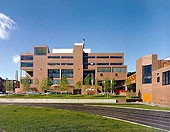
Charlestown High School, Charlestown, Massachusetts.

Charlestown High is one of eight schools nationally to teach Arabic during the summer months, drawing on federal funds to do so. Although it pays obeisance to Arabic as "a national security priority," of course, it has an Islamist component, namely a session at the notorious Islamic Society of Boston, as Tracy Jan reports in the Boston Globe:

On July 7, the students visited the Islamic Society of Boston, a mosque in Cambridge's Central Square, where they sat in a circle on the carpet and learned about Islam from two mosque members. Peberlyn Moreta, 16, said she imagined that the women would be veiled head to toe, and was surprised to see only their heads covered. "I was afraid," said Moreta, a junior at Charlestown High. "I didn't want to offend anyone by the way I was dressed or by my cross."

Moreta, a Catholic who tucked her gold cross under her T-shirt, felt comfortable asking the mosque members why they fast and why women cover their hair. She also asked them to demonstrate a prayer, and they obliged for several minutes, standing and bending and kneeling while reciting parts of a prayer in Arabic, then translating it into English. "It took the fear out of the whole stereotype I had in my mind from the things I see on the news," Moreta said. "It's been a real awakening."

And the anti-Israel component of the curriculum also turns up, right on schedule, via the film Divine Intervention, which one critic, Jordan Hiller, finds contains "pure hatred" toward Israel:

Across the hall, another group of students watched the film Divine Intervention, a 2003 comic tragedy about love on both sides of the Palestinian-Israeli border. They giggled at the repeated scenes of a Palestinian woman holding hands with her lover. But the students quickly turned somber when their teacher, Lama Jarudi, delved into why some people martyr themselves in suicide bombings.

Jan paraphrases Jarudi, who lived in Lebanon until the age of nine, explaining that "she has received mixed feedback from family and friends about teaching Arabic" to Americans: "They fear that I'm helping Americans train more spies. I feel quite the opposite. Anyone who learns the Arabic language inherently has to understand the culture a little bit." (July 15, 2007)

Stuyvesant High School, New York City

The process of bringing Arabic to Stuyvesant High School, a public school, was from the start inextricably tied up with the promotion of Islam, as Sara G. Levin described in September 2005:

Three years after Muslim Student Association began raising money and support, introductory Arabic will be an elective there starting this fall. Students were motivated by a combination of academic curiosity, cultural awareness and religious pride.

Growing up in a religious family, Batool Ali, co-leader of the Stuyvesant M.S.A., had learned to read Arabic from the time she could interpret the prayers, but she has never spoken the language. When she left Al-Iman, a Muslim school in Queens, to attend prestigious Stuyvesant in Lower Manhattan three years ago, she carried Islam with her.

Ali joined M.S.A., where other students, some with religious upbringings and some without, met to discuss interpretations of the Koran. But like her, few of the students, many of whom were from the Asian subcontinent, could speak Arabic and even fewer could read it.

Stuyvesant High School, New York City.

"Stuy already offered about 10 different languages and we said, ‘Why isn't Arabic on the list?'" said Shams Billah, one of last year's M.S.A. leaders. "It's one of the top five languages spoken in the world." … So Billah joined then-M.S.A. leaders like Naazia Husain and began raising money for an elementary Arabic class. Three years and $20,000 later, the class is finally taking off this semester. …

"For Muslims, you have to read the Koran and knowing Arabic adds a more personal aspect," said M.S.A. co-president Ali. By organizing events like the annual Islam forum and fast-a-thon, one of the association's goals is to promote understanding of the religion. Ali added that other students at Stuyvesant are curious about Arabic because language is a way of learning about another culture. …

But raising money from the ground up was no simple task. … "We started writing foundations like the Rockefeller Foundation," Billah said. "We got lots of letters back but no money. What we finally ended up doing was starting private fundraisers. We went to our families' friends, relatives for donations. We went to mosques and after a prayer we'd stand up and speak, ask for donations." Over $2,000 came from the Jamaica Muslim Center in Queens, where some students and their families are members.

Amana Academy, Alpharetta, Georgia

Amana Academy of, Alpharetta, Georgia.

Amana is a public charter school in the suburbs of Atlanta. It boasts of its "institutional partnership" with the Arabic Language Institute Foundation (ALIF), the organization I have shown (at "Does Learning Arabic Prevent Moral Decay?") as portraying the learning of Arabic as a means "to convey the message of Qur'an in North America and Europe" and thus to "help the Western countries recover from the present moral decay." That's a pretty direct religious intent. Less clear, but complementary to this are other features of the school, such as including a female in hijab on the homepage, seeking to practice gender segregation from the 3rd grade on in the classrooms, and describing the school's philosophy as helping students understand "detrimental forces such as materialism, excessive consumerism, pop culture, sexism, and prejudice and developing the means to counter them."

International Academy of Columbus and Westside Academy, in Columbus, Ohio

International Academy of Columbus, in Columbus, Ohio.

These two charter schools were set up by Islamists, as documented by Patrick Poole at FrontPageMag.com. The Islamists include (as Poole describes them):

  • Ahmad Al-Akhras, CAIR national vice chairman.
  • Abukar Arman, the Somali terror apologist who was recently forced to resign from the Central Ohio Homeland Security oversight board.
  • Abdinur Mohamud, business partner of Al-Akhras and Arman who also is listed as director of the Ohio Department of Education's Lau Resource Center.

In addition, Siraj Wahhaj, an unindicted co-conspirator in the 1993 World Trade Center bombing and an advocate of replacing the US Constitution with shari'a law, attended fundraisers of the Islamic school associated with these two charter schools.
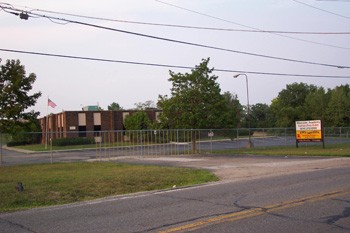
Westside Academy, in Columbus, Ohio.

Poole then surveys the content of the education the schools offer:

Extremist politics, rather than education concerns, seems to be the driving factor of the schools. One of the leaders of the two schools admits to creating a program designed to keep students from integrating into the "racist" American mainstream. In a published education article, "Educating Immigrant Youth in the United States", Abukar Arman and his co-author lay out an educational plan of keeping Somali children from integrating into their new culture, and cite the experience of International Academy as the best example of their recommended "selected acculturation" educational philosophy in practice.

Another indicator of the partisan political and sectarian use of these schools is in an anti-Israel "teach-in" sponsored by CAIR-OH held at International Academy in September 2006, entitled "Palestine 101". The event was co-sponsored by a number of Marxist and extremist organizations: The Committee for Justice in Palestine, International Socialist Union, World Can't Wait-Columbus, and Not In Our Name-Columbus. CAIR national official and school treasurer Ahmad Al-Akhras served as one of the panelists.

Comment: We see here the usual mix of anti-Israel politics and radical Islam. (August 23, 2007)

Islamic School of Oasis, Cleveland, Ohio

Oasis is a taxpayer-funded voucher school. Unlike the other schools considered here, where one has to look around to find the Islamic agenda, it stares one in the face at Oasis, as Time magazine indicated in a 1999 visit:

"Are you afraid of the Judgment Day?" Sister Mira Anne Nattoli, clad in traditional Muslim robes, asks her fifth- and sixth-grade English class. Today's text is "The Twins and the Missing Math Paper," but the lesson is as much religion as English. "Whoever cheats," a young man reads carefully, "is not a good student of Islam." The students, about 95% African American, wear loose-fitting shirts and headdresses—skullcaps called kufis for the boys and scarves called khimars for the girls. Cleveland's Islamic School of Oasis is in many ways a typical Muslim day school, but with a twist. Tuition for more than half its students is paid by Cleveland, Ohio, taxpayers.

The Islamic School of Oasis … requires prayer: Zuhr, a short service, four days a week, and the longer Jumah service on Fridays. The posters here have an Islamic theme, like the MUSLIM CHILD'S ALPHABET, in which each letter has a Muslim reference: A is for Allah and Q is for Qu'ran. "We started as a religious school because the rights of Muslims were not being protected in the public schools," says principal Da'ud Abdul Malik. Before vouchers, about three-fourths of the student body was Muslim. Now, a majority is non-Muslim. But … the religious requirements apply to all.

Despite this school's blatant disregard of the separation of church and state, the U.S. Department of State boasts about Oasis at its "Muslim Life in America" feature.

Islamic Academy School of Arts and Sciences, Cleveland, Ohio

The academy, another taxpayer-funded voucher Islamic school, came to public attention when news came out that it had bilked the government for phantom students and had to shut down. As Americans United for Separation of Church and State explained in March 2000,

A state audit found last year that the Islamic Academy School of Arts and Sciences had received $70,000 from the state by claiming to have enrolled students who were in fact not attending the institution. The school, which also had a convicted murderer on staff, shut down in the wake of the disclosures. State Auditor Jim Petro later issued a report saying that the Academy owes the state $69,967 for voucher payments it received for non-existent students. The Academy also billed the state $11,723 for utility bills and $5,250 in taxi fares to transport the fictitious students.

Tarek ibn Ziyad Academy, Inver Grove Heights, Minnesota

Tarek ibn Ziyad Academy differs from KGIA in being a charter school, so it has more room to maneuver than a regular public school. But it shows alarming connections via its principal, Asad Zaman, to the Muslim American Society, the American branch of the Muslim Brethren, founded in Egypt in 1928 and perhaps the largest, most dangerous Islamist organization in the world.

Plus, the three-year old school has a distinctly Islamist tone, as Kevin Featherly reports in a Minnesota Monthly article, "Brothers' Keeper":

a visitor might well mistake Tarek ibn Ziyad for an Islamic school. Arabic as a second language is mandatory. Headscarves are voluntary, but virtually all the girls wear them. There is a carpeted prayer space in the middle of the building that is similar, Zaman says, to spaces provided by several Minneapolis public schools. And there is the vaguely religious-sounding language used in the school. At one point, a conversation with Zaman is interrupted by the intercom: "Sister Zamia, please call the office. Sister Zamia, 2-2-1." "[Muslims] refer to everyone as a ‘brother' or a ‘sister,' " he explains. "We are all children of Adam."

For more local color, note details in an article, "A Place to Belong," by Tammy J. Oseid, in the Saint Paul Pioneer Press on November 7, 2004:

Boys in uniform khaki pants and girls in headscarves and modest dresses line up neatly to go to Arabic class. The mostly Somali class carefully circumnavigates the carpeted prayer area in the middle of the school as they follow a scarved teacher. Tarek girls aren't required to wear hijab, or headscarves, but almost all do—they say they want to imitate their mothers or teachers. About half of the teaching staff is Muslim and wear hijab; the others are mostly Christian and dress modestly but with uncovered heads. During Ramadan, all the children follow the traditional dawn-to-dark fast, so there's not so much temptation for each child, [parent Eman] Ibrahim said.

Fourth-grader Najma Ahmed says she feels more comfortable at Tarek ibn Ziyad Academy than at Highwood Hills in St. Paul, which she attended previously. She always had plenty of Muslim students to pray with there, but she likes that at Tarek almost all of her classmates are Muslim and many of her teachers are, too. …

A class at the Tarek ibn Ziyad Academy, Inver Grove Heights, Minnesota.

About 1 p.m. every day, Tarek students stream out of classrooms, clean up in the restrooms, kneel down facing the east and begin to pray. Zaman says he doesn't track students' religion, but almost all children participate in the daily prayer. … The school's calendar and day are set up to accommodate Muslim students. Classes break during the noontime prayer; vacation days are scheduled on Muslim holidays instead of traditionally Christian ones. The cafeteria is free of pork and other foods Islam prohibits.

The name of the school itself is also based in religion. General Tarek ibn Ziyad's bloody battle marked the beginning of the Muslim rule of Spain in the eighth century. He famously burnt the boats his army used to cross the Mediterranean sea.

(March 8, 2007)

June 20, 2007 update: Two specialists on charter schools, Lawrence D. Weinberg and Bruce S. Cooper, note the Tarek ibn Ziyad Academy as a pathsetter in terms of bringing religion into charter schools. From their article, "What About Religious Charter Schools?":

What happens when a religious association, such as a Muslim group, opens a new charter school outside Minneapolis supportive of and sensitive to the culture of Islam—its values, beliefs, and leaders—without its being a Muslim religious charter school? How does this school walk the fine line between serving a public purpose (educating children in a sensitive, culturally specific, values-oriented program) and being an Islamic religious school?

The authors answer their own question: "The existence of a religious charter school like the Ziyad Academy could well lead to a string of new religious/cultural charters. Its mission, as stated on the school's Web site, is clear and values-oriented, but not related solely to religion."

Aug. 24, 2007 update: With a reported waiting list of about 1,500 students, Tarek ibn Ziyad Academy has decided to expand beyond its Inver Grove Heights base and open a second Arabic-language school on Sept. 4 in Blaine, Minnesota, a northern suburb of the Minneapolis-St. Paul metropolitan area. "Parents in the north suburbs have been watching our progress over the last four years and suggested that we come to their neighborhood," said Asad Zaman, Tarek ibn Ziyad Academy's executive director. The Inver Grove Heights school has 375 students in K-8; the Blaine school will serve 75 students K-4 students initially and then add a higher grade each year; it will offer the same program, rules, and curriculum as the Inver Grove Heights original.

Mar. 8, 2008 update: Katherine Kersten, the Minneapolis Star Tribune columnist who has done to much to keep tabs on her city's lively Islamist scene, takes a look at the Tarek ibn Ziyad Academy today in "Are taxpayers footing bill for Islamic school in Minnesota?" Although the school's principal, Asad Zaman, would not allow her to visit the school, and responded to neither interview requests nor e-mails seeking written replies, Kersten adds to our knowledge of the academy:

TIZA's strong religious connections date from its founding in 2003. Its co-founders, Zaman and Hesham Hussein, were both imams, or Muslim religious leaders, as well as leaders of the Muslim American Society of Minnesota (MAS-MN). Since then, they have played dual roles: Zaman as TIZA's principal and the current vice-president of MAS-MN, and Hussein as TIZA's school board chair and president of MAS-MN until his death in a car accident in Saudi Arabia in January. … TIZA shares MAS-MN's headquarters building, along with a mosque. …

In fact, TIZA was originally envisioned as a private Islamic school. In 2001, MAS-MN negotiated to buy the current TIZA/MAS-MN building for Al-Amal School, a private religious institution in Fridley, according to Bruce Rimstad of the Inver Grove Heights School District. But many immigrant families can't afford Al-Amal. In 2002, Islamic Relief—headquartered in California—agreed to sponsor a publicly funded charter school, TIZA, at the same location.

TIZA claims to be non-sectarian, as Minnesota law requires charters to be. But "after-school Islamic learning" takes place on weekdays in the same building under MAS-MN's auspices, according to the program for MAS-MN's 2007 convention. At that convention, a TIZA representative at the school's booth told me that students go directly to "Islamic studies" classes at 3:30, when TIZA's day ends. There, they learn "Qur'anic recitation, the Sunnah of the Prophet" and other religious subjects, he said. TIZA's 2006 Contract Performance Review Report states that students engage in unspecified "electives" after school or do homework.

Publicly, TIZA emphasizes that it uses standard curricular materials like those found in other public schools. But when addressing Muslim audiences, school officials make the link to Islam clear. At MAS-MN's 2007 convention, for example, the program featured an advertisement for the "Muslim American Society of Minnesota," superimposed on a picture of a mosque. Under the motto "Establishing Islam in Minnesota," it asked: "Did you know that MAS-MN ... houses a full-time elementary school"? On the adjacent page was an application for TIZA.

Not in her article but in a private communication to me, Kersten further explains the importance of the academy-MAS shared building

I spent an hour and a half in the parking lot of the school last Monday[, March 3]. The building is a former elementary school – TIZA's name is on one side and maybe 30-40 feet away is Muslim American Society-Minnesota's name. An aerial photo shows the structure is one building.

I watched parents come in and go out of this building and they did not differentiate between the part ascribed to TIZA and the part ascribed to MAS-MN, i.e., more parents brought kids out of the MAS-MN side than out of the school entrance before 3:30, when the school day supposedly ends. Actually, very few children came out of the building before 4:15, when religious instruction is over. In other words, the students moved from TIZA classes to "Islamic studies" inside the building, and didn't need to exit to get from one side to the other.

No buses (there are apparently 7; I saw 6 that day) leave before 4:30 p.m., though the school day ostensibly ends at 3:30. A bus driver told me that "the students have Islamic studies till 4:15," though some do opt out. I noted that the kids at the Blaine campus also stay until 4:30.

Kersten concludes:

TIZA uses the language of culture rather than religion to describe its program in public documents. According to its mission statement, the school "recognizes and appreciates the traditions, histories, civilizations and accomplishments of the eastern world (Africa, Asia and Middle East)." But the line between religion and culture is often blurry. There are strong indications that religion plays a central role at TIZA, which is a public school financed by Minnesota taxpayers. Under the U.S. and state constitutions, a public school can accommodate students' religious beliefs but cannot encourage or endorse religion. TIZA raises troubling issues about taxpayer funding of schools that cross that line.

Put differently:

The school is in huge demand, with a waiting list of 1,500. … TIZA has improved the reading and math performance of its mostly low-income students. That's commendable, but should Minnesota taxpayers be funding an Islamic public school?

Kersten also raises the issue of which Islamic organizations are connected to Tarek ibn Ziyad Academy:

Islamic Relief-USA, the school's sponsor, is compared to the Red Cross in several TIZA documents. In 2006, however, the Israeli government announced that Islamic Relief Worldwide, the organization's parent group, "provides support and assistance" to Hamas, designated by the U.S. government as a terrorist group.

Meanwhile, MAS-MN offers on its web site "beneficial and enlightening information" about Islam, which includes statements like "Regularly make the intention to go on jihad with the ambition to die as a martyr."

At its 2007 convention, MAS-MN featured the notorious Shayk Khalid Yasin, who is well-known in Britain and Australia for teaching that husbands can beat disobedient wives, that gays should be executed and that the United States spreads the AIDS virus in Africa through vaccines for tropical diseases. Yasin's topic? "Building a Successful Muslim Community in Minnesota."

Mar. 18, 2008 update: Kersten's article prompted the American Civil Liberties Union of Minnesota to open its own investigation of the academy. It explains in a letter to the principal, Asad Zaman, its concerns about Establishment Clause violations. At a minimum, the ACLU requests, the school "must discontinue recruiting volunteers for Friday Prayers, and must not be involved in promoting or providing special treatment to groups providing religious instruction after school hours."

Apr. 8, 2008 update: Kersten published the twenty questions she posed to Asad Zaman, TIZA's executive director, followed by his replies.

Apr. 9, 2008 update: Kersten's March 8 article also prompted a substitute teacher, Amanda Getz, who worked in two fifth-grade classrooms at TIZA on March 14, to come forward with her experiences at the school. Her testimony concerns two matters, prayers and Islamic studies. On the first:

Arriving on a Friday, the Muslim holy day, she says she was told that the day's schedule included a "school assembly" in the gym after lunch. Before the assembly, she says she was told, her duties would include taking her fifth-grade students to the bathroom, four at a time, to perform "their ritual washing." Afterward, Getz said, "teachers led the kids into the gym, where a man dressed in white with a white cap, who had been at the school all day," was preparing to lead prayer. Beside him, another man "was prostrating himself in prayer on a carpet as the students entered." "The prayer I saw was not voluntary," Getz said. "The kids were corralled by adults and required to go to the assembly where prayer occurred."

On the second:

Islamic Studies was also incorporated into the school day. "When I arrived, I was told ‘after school we have Islamic Studies,' and I might have to stay for hall duty," Getz said. "The teachers had written assignments on the blackboard for classes like math and social studies. Islamic Studies was the last one—the board said the kids were studying the Qur'an. The students were told to copy it into their planner, along with everything else. That gave me the impression that Islamic Studies was a subject like any other."

After school, Getz's fifth-graders stayed in their classroom and the man in white who had led prayer in the gym came in to teach Islamic Studies. TIZA has in effect extended the school day—buses leave only after Islamic Studies is over. Getz did not see evidence of other extra-curricular activity, except for a group of small children playing outside. Significantly, 77 percent of TIZA parents say that their "main reason for choosing TIZA ... was because of after-school programs conducted by various non-profit organizations at the end of the school period in the school building," according to a TIZA report. TIZA may be the only school in Minnesota with this distinction.

Kersten goes on to point out the Minnesota Department of Education's education negligence in allowing this clear breach of use of public monies.

TIZA's operation as a public, taxpayer-funded school is troubling on several fronts. TIZA is skirting the law by operating what is essentially an Islamic school at taxpayer expense. The Department of Education has failed to provide the oversight necessary to catch these illegalities, and appears to lack the tools to do so. In addition, there's a double standard at work here—if TIZA were a Christian school, it would likely be gone in a heartbeat.

She concludes with this warning: "TIZA is now being held up as a national model for a new kind of charter school. If it passes legal muster, Minnesota taxpayers may soon find themselves footing the bill for a separate system of education for Muslims."

In response to the Kersten column, Channel 5 interviewed Getz and TIZA executive director, Azad Zaman. Getz observed: "I've been in a lot of schools and I've never been in a school where they had washing rituals, or they had prayer, or where they had a room where you had to take your shoes off." To with Zaman retorted: "It is most likely that this substitute teacher was sadly mistaken." He also stated that "TIZA does not endorse any religion" and that the school follows state and federal guidelines concerning religion. "We're required under the federal guidelines to allow students to pray when they wish to do so. And as Muslim students, they're allowed to pray around 1:30 p.m., so we allow them to do that."

Also this tidbit uncovered by Channel 5 reporter Beth Jett: Although Minnesota tate law requires schools to fly an American flag during school hours, TIZA flies no flag. Asked about this, Zaman explained that he does not know how to work a flagpole.

Comment: Thanks to Kersten's determined investigation of the Tarek ibn Ziyad Academy, we on the outside know more about it than any other tax-funded American madrassah. This school, rather than the Khalil Gibran International Academy, about which we know so little, should be the one at the focus of a national debate.

The flagpole at the Tarek ibn Ziyad Academy.

Apr. 10, 2008 update: That tidbit about the flag had immediate consequences – leading to an American flag flying over the school a day later, and for the first time since TIZA opened doors in 2003. This occurred despite the school's lawyers insisting that a charter school need not fly the flag. A school attorney also admitted that staff and parents had a difficult time of it after the Kersten column, as outraged citizens around the country flooded the school with messages of anger.

Apr. 12, 2008 update: Thanks to the blogosphere, the Kersten article of April 9 has received close to a million hits – and a good number of readers have contacted TIZA to express their unhappiness. Zaman reports that the school has received harassing and threatening calls and the police are adding extra patrols in its area. We also learn that TIZA is projected to receive $3.8 million for the 2007-08 school year.

Apr. 14, 2008 update: The Council on American-Islamic Relations wants the Federal Bureau of Investigation to get involved, to investigate whether reported threats against TIZA are hate crimes.

Apr. 17, 2008 update: "These vile and vicious attacks on us have resulted in death threats against my students, myself and my family," says Asad Zaman. To which Katherine Kersten replies that while threats are "repellant," they should not "distract attraction from the central issue here, and that is, whether this publicly-financed school is skirting or breaking the law that all others must observe when it comes to religious endorsement. If this were a bunch of Baptists or Catholics with the kids being led to the rosary on Mondays through Thursday and led to Mass on Fridays there wouldn't be any question that this is crossing the line." said Minneapolis Star-Tribune columnist.

As for Minnesota Education Commissioner Alice Seagren, she has issued a statement that "We take seriously the concerns raised regarding Tarek ibn Ziyad Academy and are conducting an appropriate review."

Silicon Valley Academy, Sunnyvale, California

Another a taxpayer-funded voucher school that teaches Islam on the sly, but it got caught in the act in December 2001 by Meredith May of the San Francisco Chronicle:

An unannounced visit to Silicon Valley Academy by The Chronicle last week found Korans in the principal's office, along with children's picture books titled My Little Qur'an. Students reported studying Islam in class and praying with their teachers. The academy appeared to operate like a private religious school, and parents picking up their children in the school parking lot said they thought it was. In the principal's office, decorated with pictures of Mecca, parents wrote tuition checks. And the school's Web site promised to provide instruction and moral values based on dedication to Allah.

Carver Elementary School, San Diego, California

Carver Elementary School, a kindergarten-through-eighth-grade institution, has had an Arabic program since September 2006, explains Helen Gao at "Legality of Arabic Class Questioned." A teacher, Mary-Frances Stephens, told the school board yesterday about her experiences since being assigned to Carver on March 8: according to Gao,

she said she taught a "segregated class" of Muslim girls. She said she was given a lesson plan that included an hour for prayer. She alleged that a teacher's aide led the prayer. Stephens told the school board, "What I saw is clearly a violation of administrative, legislative and judicial guidelines."
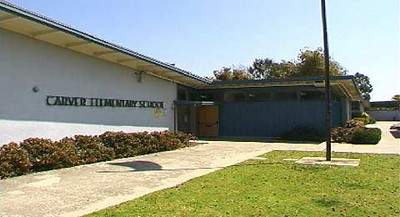
Carver Elementary, San Diego, California.

To these charges, the principal, Kimberlee Kidd, replied by saying that Stephens misconstrued the lesson plan. But, Gao relates, Kidd "confirmed that an assistant was assigned to the classroom for an hour. During that time there was a 15-minute recess. … The aide, who is Muslim, prayed alongside the students but did not lead the prayer." (April 11, 2007)

July 2, 2007 update: The San Diego Unified School District investigated Mary-Frances Stephens' allegations (that religious indoctrination was taking place in Carver Elementary School and that a school aide led Muslim students in prayer) and found them unsubstantiated.

July 27, 2007 update: The San Diego Unified School District may have rejected Mary-Frances Stephens' allegations (see the July 2 entry), but it nonetheless had to change its practices, thereby substantiating her critique. Helen Gao writes at "Prayer OK at lunch, not classes at Carver" that "Carver Elementary's schedule will be reconfigured so students can say their required midday prayers during lunch," which is not a controversial time for praying in public American schools. In addition, the school will eliminate single-gender classes, Superintendent Carl Cohn indicated in a July 18 memo, because they have become "a serious distraction from learning rather than a vehicle to promote learning."

Miscellaneous

July 5, 2007 update: An Islamist organization, the "Muslim American Society Freedom Foundation, North Carolina," has posted an online petition to win Arabic-language instruction in public high schools, "Say Yes to Arabic Language in NC High Schools." The reasons it offers are less than candid, however:

Islamic communities in North Carolina, as well as across the United States, and supporters of diverse pedagogy believe in the importance of cultivating a true appreciation for cultural, ethnic and linguistic diversity. We wish to advance these ideas and encourage students to view culturally inherent differences as building blocks rather than barriers and offer challenging opportunities to explore and grow both academically and socially.

Sep. 5, 2007 update: I published a column today, "Teach Arabic or Recruit Extremists?" that surveys taxpayer-funded pre-collegiate Arabic-language instruction in the United States – other than the Khalil Gibran International Academy. In almost every case I have found, politics and religion pollute what should be a sterile environment. As Martin Kramer notes to me, "The fact is that every form of Arabic instruction involves risk: K-12, university level, immersion overseas." The sooner educational administrators accept this unpalatable fact, the better and faster we can begin to equip Americans with knowledge of this language.

Related Topics: Academia, Middle East studies

TrackBack URL for this post: http://www.danielpipes.org/blog/trackback.php/758/3ff30/781

Reader comments on this weblog entry

Title By Date

Islamic Victimhood to deviate attention of Muslim's trangressions and crimes [103 words]

Ynnatchkah 

Apr 19, 2008 01:20

Thanks to Dr. Pipes. [53 words]

Ynnatchkah 

Apr 16, 2008 01:49

The name itself is a "white-wash" [272 words]

jennifer solis 

Apr 12, 2008 01:27

ACLU investigation of TIZA [21 words]

German Observer 

Apr 11, 2008 11:07

  ACLU---Double Standards [108 words]

Straight_Talk_Luigi 

Apr 17, 2008 01:15

clearly violates seperation clause [198 words]

mz ravin black 

Apr 10, 2008 10:43

  let me clarify my statements [277 words]

mz ravin black 

Apr 10, 2008 11:08

right under our noses [188 words]

Rebecca Moulds 

Mar 9, 2008 13:59

Minnesota Supports Muslim Prayer Rooms at Colleges [107 words]

Bill 

Dec 18, 2007 19:43

Misinformed about the Amana Academy in Alpharetta [163 words]

V. Balasastry Zell 

Sep 25, 2007 21:58

Very interesting [51 words]

David W. Lincoln 

Sep 21, 2007 10:26

Muslim Schools [535 words]

Iftikhar Ahmad 

Sep 21, 2007 07:38

  Coming to Britain [259 words]

Terry 

Sep 23, 2007 16:45

  Muslim Schools [110 words]

Iftikhar Ahmad 

Sep 24, 2007 18:30

  Monomania [182 words]

Vijay 

Sep 25, 2007 18:08

  More real jawahir (gems) from our dear Iftikhar Ahmad [231 words]

dhimmi no more 

Sep 25, 2007 19:14

  Integration [235 words]

Umer Sheikh 

Nov 21, 2007 13:48

This is frightening [25 words]

Dennis Gronquist 

Sep 10, 2007 12:50

Extreme Security Concerns!!!! [632 words]

William Hill 

Sep 10, 2007 12:28

remarkable progress.. [284 words]

donvan 

Sep 4, 2007 14:53

Israel-themed charter school held to strict constitutional standards by school board [51 words]

M. Freiberg 

Sep 1, 2007 14:08

Muslim Schools in America [108 words]

Iftikhar Ahmad 

Aug 29, 2007 15:58

  Why expose Muslims to 'crimes' so much? [212 words]

Vijay 

Sep 2, 2007 06:06

  Dear Ahmad, explain please! [63 words]

Moshe 

Sep 2, 2007 15:54

  Discrimination against Non Muslim teachers that speak Arabic [187 words]

YNNATCHKAH 

Sep 11, 2007 01:12

  To Iftikhar Ahmad- A corollary to your message. [337 words]

YNNATCHKAH 

Sep 11, 2007 01:30

  Muslim Schools in America [34 words]

Iftikhar Ahmad 

Sep 12, 2007 07:23

  Separation of Church & State. If its good for the Christians, its good for the Islamists! [231 words]

Rubicon 

Sep 21, 2007 08:51

  blinded by greed [211 words]

jennifer solis 

Sep 23, 2007 16:33

  Separation of Church and State [45 words]

Linda Haslam 

Apr 10, 2008 10:54

  Muslim Schools [443 words]

Iftikhar Ahmad 

Apr 11, 2008 07:23

  not for fascist ideologies [240 words]

G.Vishvas 

Apr 11, 2008 18:53

  Muslim Schools [358 words]

Iftikhar Ahmad 

Apr 13, 2008 04:39

  Muslim Schools as a Way of Promoting Diversity? [107 words]

Linda Haslam 

Apr 15, 2008 09:09

  arabic for what? [97 words]

G.Vishvas 

Apr 18, 2008 02:31

  RE: coming to USA [70 words]

Straight_Talk_Luigi 

Apr 18, 2008 21:07

Please explain.................. [81 words]

Linda Green 

Aug 29, 2007 13:43

I see they teach taqiyya at the schools, too [68 words]

Mark James 

Aug 20, 2007 19:32

  Toledo, OH public-funded Arabic language charter schools [85 words]

Diane Mills 

Mar 31, 2008 20:03

A madrassa without teaching Islam wouldn't be a madrassa!!! [96 words]

Jaladhi 

Aug 19, 2007 15:33

  Madrassa and kuttab and the wannabe Arabs [70 words]

dhimmi no more 

Aug 21, 2007 17:30

  Because terrorism ... [128 words]

DONVAN 

Sep 4, 2007 15:24

Comment on this weblog entry

Name:
Email Address:

Email me if someone replies to my comment
Title of Comments:
Comments:

Note: Opinions expressed in comments are those of the authors alone and not necessarily those of Daniel Pipes. Comments are screened for relevance, substance, and tone, and in some cases edited, before posting. Reasoned disagreement is welcome, but not hostile, libelous, or otherwise objectionable statements. Original writing only, please. For complete regulations, see Guidelines for Comments.

Top 25 recent comments
Daniel Pipes Blog Homepage

Daniel Pipes Blog Homepage

ADVERTISEMENTS