
Turkey and Iran are two of the largest, most central, advanced, and influential countries of the Middle East; and their governments have a history of rivalry going back to Ottoman-Safavid times and as recent as the 1990s. The past decade, however, has been a time of good relations as both countries experiment with Islamism. Further, they have not made war on each other in nearly two centuries.
Tensions between these two regional heavyweights are increasing, however, and I predict they will continue to do so, with who-knows-what endpoint. This weblog entry notes in reverse chronological order some of the more interesting developments in their relationship.
For a bibliography of my writings on Iran and Turkey, click here.
Turkey ascendant: After Israel trounced Hamas and Hezbollah, followed by the collapse of Bashar al-Assad, Ehud Ya'ari assesses the Turkish-Iranian competition:
The two non-Arab former empires of the Middle East have maintained a mixture of competition and cooperation over the past 200 years. Yet, the transformed geopolitical landscape, brought about by Israel's military campaigns in Lebanon and Gaza, presents new opportunities for Turkey which President Erdoğan is losing no time in exploiting. Turkey seeks to replace Iran as the dominant power in Syria and the rest of the Fertile Crescent. Top Iranian politicians and pundits are attacking Turkish policies and aspirations daily, accusing Erdoğan of neo-Ottoman ambitions. The inauguration of a Farsi station by Turkey's national broadcaster was described in Tehran as a "declaration of war." Iran's designs clash with Turkish dynamism not only by turning Syria into a Turkish zone of influence and striving to crush Kurdish autonomy, but also in Lebanon where Turkey keeps busy reviving Sunni political activism, and in Iraq where Turkey is challenging Iran's supremacy. The rivalry has spread to other regions from the Caucasus to the Horn of Africa.
Clearly, Turkey has many advantages in this competition. Though the two countries have similar size populations, Turkey's economy is three times larger. Turkey's modern army is much bigger and far better equipped than Iran's. Turkey is member of NATO whereas Iran is subject to heavy international sanctions. Arab states feel more comfortable doing business with Turkey than with the Islamic Republic. Furthermore, although hostile to Israel, Turkey can easily switch to rapprochement, as it had done in the past.
Pessimistic assessment: Vahid Yücesoy, a PhD candidate at the University of Montreal with focus on Iran and Turkey, holds that the heyday of Turkey-Iran relations is coming to an end. (May 11 2021)
Controversial poem: Erdoğan recited a Turkish-language poem that exalts the unity of Azerbaijan – half of which is now in Iran – highly annoying the Iranian foreign minister: "Pres. Erdogan was not informed that what he ill-recited in Baku refers to the forcible separation of areas north of Aras from Iranian motherland. Didn't he realize that he was undermining the sovereignty of the Republic of Azerbaijan? NO ONE can talk about OUR beloved Azerbaijan." (December 13, 2020)
Pres. Erdogan was not informed that what he ill-recited in Baku refers to the forcible separation of areas north of Aras from Iranian motherland
Didn't he realize that he was undermining the sovereignty of the Republic of Azerbaijan?
NO ONE can talk about OUR beloved Azerbaijan
— Javad Zarif (@JZarif) December 11, 2020
Growing cooperation: Oved Lobel writes that
Turkey and Iran are not enemies. On the contrary, despite strategic disagreements, particularly in Syria over the fate of Bashar al-Assad's regime, Turkey and Iran have close ties and are becoming closer, whether it's Turkey's sanctions-busting in support of Iran's nuclear program, facilitation of Hezbollah and Hamas, cooperation against the Kurdistan Workers' Party (PKK) or blowing the cover of Israeli spies in Iran.
(November 25, 2020)
Turkey And Iran Coordinate Against The Kurds: So argues Ilan Berman. (June 11, 2020)
Building a geopolitical alliance: Irina Tsukerman argues that "Turkey Is Building a Geopolitical Alliance Between Sunni and Shiite Islamists":
Iran and Turkey, despite seemingly disparate ideologies and competing long-term geopolitical and ideological claims, have cooperated on a strategy to counter the growing Kurdish push for autonomy in both countries and in Syria. Turkey has also been facilitating a money-laundering oil-for-gold scheme with Iran to circumvent sanctions since at least 2012.The Turkey-Iran rapprochement was certainly complicated by their divergent goals in Syria, but that did not inhibit their cooperation on many other fronts
(April 14, 2020)
Report: Soleimani & Fidan: IRGC head Qasem Soleimani met secretly with Hakan Fidan, the head of Turkey's National Intelligence Organization (MIT), in Tehran in 2014. (January 27, 2020)
Enhanced ties: Soon after a new and tougher round of U.S. economic sanctions on Iran, Ankara promised more economic cooperation with Iran. (January 21, 2020)
A limited courtship: Alon J. Doenyas asks "How Sincere Is the Turkey-Iran Friendship?" and replies that he finds it "questionable that Ankara and Tehran will ever get particularly close." (September 5, 2019)
Common enemies: Amir Taheri offers a more positive take on Iran-Turkey relations at "Puffing the Turkish Chibouk in Ankara," stressing such common enemies as the Soviet Union and the Kurds. (August 25, 2017)
"Iran vs. Turkey, the MidEast's Perpetual Rivalry": That's the article of mine in the Washington Times on this topic today. (August 23, 2017)
Collision course? Ali Vaez, the International Crisis Group's senior Iran analyst, raises this possibility:
Turkey and Iran are now on a collision course, mostly because of their involvement as the region's major Sunni and Shiite powers in the deepening sectarian conflicts in Iraq and Syria. Their inability to accommodate each other has the potential to undermine or even undo the strong ties they have developed over the past two decades, as their economies became increasingly intertwined. ... Left unchecked, the present dynamics point toward greater bloodshed, growing instability and greater risks of direct — even if inadvertent — military confrontation.
(December 18, 2016)
"Iran and Turkey: A new round of an ancient rivalry": David Batashvili argues that "Much of the regional international developments in the Middle East will probably be defined" by the rivalry of these two states. (February 1, 2017)
"Did Erdogan threaten Iran?": Arash Karami explores reports of a growing rift between Iran and Turkey resulting from reports that during a phone conversation Turkish President Recep Tayyip Erdoğan warned his Iranian counterpart Hassan Rouhani about the negative press he and his family have been receiving in Iran. (December 8, 2015)
"Turkey and Iran: A Renewed Regional Rivalry": Hay Eytan Cohen Yanarocak explains the evolving state of relations between Iran and Turkey. (May 10, 2015)
"Turkey and Iran: Theater of Make Believe": Burak Bekdil surveys the two countries' shadow-boxing. (April 14, 2015)
Erdoğan says Tehran wants to dominate the Middle East: In the midst of flaring Sunni-Shi'i tensions, Erdoğan has again gone further than any other Sunni leader in lambasting the Iranian regime. Quoting a Voice of America report:
President Recep Tayyip Erdoğan called Monday[, Mar. 30,] on those interfering in Yemen to leave, saying he was watching developments there closely. Last Thursday, [Mar. 26,] Erdoğan accused Tehran of having its forces in Yemen adding that Turkey would not tolerate Iran's attempts to dominate the Middle East.
Political scientist Cengiz Aktar of Istanbul's Süleyman Şah University said Erdoğan's comments herald a major policy change. "It's a very, very new policy now, Turkey pointing at Iran and directly taking Iran as an adversary," Aktar said. "It means that they are getting closer and closer to the Saudis and the Emirates and becoming a full-fledged member of the regional Sunni alliance. The policy of not intervening, or not pointing at Iran, is over and this is a policy which is older than the ruling party."
Ankara has announced it will provide intelligence and logistic support to the Saudi-led military operation against Houthis forces in Yemen. Saudi Arabia has accused Iran of supporting the Houthis—a charge Tehran denies. Since the death of the Saudi King Fahd, Turkey's president has made two visits to the kingdom, in what some see as an attempt to repair strained relations.
(March 30, 2015)
Saudi Arabia: The brand-new Saudi king, Salman, has invited Erdoğan to visit him, raising speculations about his recruiting Ankara to help vis-à-vis Iran. Fehim Taştekin elaborates in "Are Turkey, Saudi Arabia working together against Iran?":
The pro-government [Turkish] daily Yeni Şafak described the Saudi-Turkish understanding as follows: "Iran's sectarian approach in the region was on the agenda of the two leaders. Both were disturbed by Iran's expansionist and sectarian attitude. Iran is spending massive resources on shedding Muslim blood and destabilizing Muslim countries."
Thus, Saudi Arabia, uncomfortable with Iran's growing influence over Iraq, Syria, Lebanon and Yemen, is pulling Turkey to its side. The new Saudi-Turkish alliance seems to be an effort by the Sunnis to form a bloc against the Shiite world. Turkey, which succeeded in staying away from sectarian conflicts until the AKP came to power, is now becoming a part of a sectarian polarization for the sake of blocking Iran. ...
Salman's real concern is to form a Sunni bloc to limit Iran's influence. Erdogan, who in recent years has interfered in Iraq's domestic affairs to achieve just that, is now trying to end his diplomatic isolation by encouraging Salman to include Turkey in the Saudi plan.
(March 5, 2015)
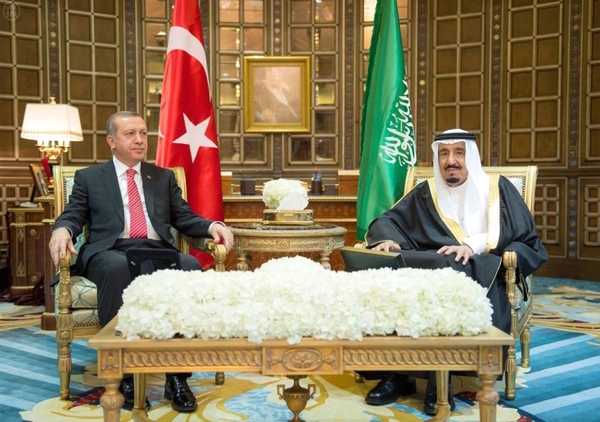 Recep Tayyip Erdoğan (L) visits the new King Salman (R) and his white flower concoction. |
Erdoğan badmouths Khamene'i: Turkish-Iranian tensions in Syria are getting personal, the President Recep Tayyip Erdoğan blasting Supreme Leader Ali Khamene'i in a speech today. (October 13, 2014)
Oil trumps Syria: Alexandra Di Stefano Pironti draws on recent research to argue at the Kurdish website Rûdaw that
Turkey is so determined to get 'the cheap oil and gas it needs to fuel its rise as a regional economic powerhouse that nothing will derail that goal, not even differences over Syria. A report by Turkey's Middle East Institute (MEI) released after Erdoğan's visit, and another by the Rand Corporation in the United States in September, both note that Iran and Turkey are pursuing a pragmatic foreign policy: Tehran needs a close, reliable market for its huge oil and gas reserves, and Turkey's economic progress is tied to uninterrupted supplies of fuel.
(February 3, 2014)
The counterargument: Jonathan Schanzer runs through the ways in which Ankara helps Tehran, and it's a long & important list, in "Is Turkey Abetting Iran?" at The National Interest (November 1, 2013)
Terrorism in Turkey: According to Abdullah Bozkurt, "Turkey fights Iran-backed al-Qaeda," Iranian intelligence services are using Al-Qaeda and other groups to engage in terrorism in Turkey as well as in Syria. Indeed, "Iran is the key suspect in providing funds, logistics and non-Iranian recruits to al-Qaeda terror cells targeting national interests of Turkey." More: Iranian intelligence has sent high-profile operatives to Turkey "to create an impression that [it is]associated with al-Qaeda terror." (October 25, 2013)
Arab upheavals: H. Akın Ünver of Kadir Has University argues that the outbreak of revolts prompted the Syrian and Iranian regimes to behave in ways "determined by sectarian priorities," which then caused Turkey's Islamists to turn against the Assad and mullahs. (December 21, 2012)
Patriot missiles: Maj. Gen. Hassan Firouzabadi, the chief of staff of the Iranian Armed Forces, says that deploying NATO Patriot missiles to Turkey could lead to world war: "Each of the Patriot missiles constitutes a black mark on the global map. They are planning a world war and that is very dangerous for the future of mankind and Europe in particular." (December 16, 2012)
Syria: Bülent Arınç, Turkey's deputy foreign minister, accused Tehran of betraying Islamic principles in keeping silent about the Assad regime's oppression: "Oh, the Islamic Republic of Iran! You carry the word 'Islamic' in your name, and I don't know how worthy you are [of that name], but did you utter a single sentence about the last two days' events in Syria?" Savaş Genç, associate professor of international relations at Istanbul's Fatih University, predicts that "The competition between Iran and Turkey is going to be much harder than before." (February 12, 2012)
NATO missile system: Hossein Ebrahimi, the vice-chairman of the Iranian Parliament's National Security and Foreign Policy Commission, warned that an attack on Iran would lead to its taking out the NATO missile system based in Turkey. In an interview with Shark newspaper, the Iranian MP said that hitting the targets in Turkey is Iran's natural right, and that this will definitely be carried out: "In the case of an attack against us, defending is our natural right." (December 13, 2011)
NATO missile system: Amir Ali Hajizadeh, aerospace commander brigadier general of the Islamic Revolution Guards Corps, has warned that Iranian forces will target the NATO missile shield in Turkey in response to an attack:
"We have prepared ourselves, if any threat is staged against Iran, we will target NATO's missile shield in Turkey and will then attack other targets. ... We are sure that the missile system is deployed by the US for the sake of the Zionist regime, but to deceive the world people, specially the Turkish people, they allege that the system belongs to the NATO. Turkey is a member and cover for the NATO. Today NATO has become a cover for the US (moves) while the US itself has turned into a cover for the Zionist regime."
(November 26, 2011)
PKK: Soner Cagaptay, director of the Turkish Research Program at the Washington Institute for Near East Policy, explains "Why Syria and Iran Are Becoming Turkey's Enemies, Again":
with the start of the Iraq War in 2003, Turkey and Iran became, in a sense, friends. Alarmed by the U.S. military presence to its east in Afghanistan and to its west in Iraq, Tehran concluded that it needed to win its neighbor Turkey to break the grip of the U.S.-led ring of isolation forming around it. Iranian support for the PKK ended, as if cut with a knife, the day U.S. troops started landing in Iraq.
Eight years later, Tehran is re-evaluating its strategic environment. With U.S. troops leaving Iraq and Iran gaining influence there, Tehran feels that it can act differently towards Turkey.
(October 29, 2011)
Power game: Soner Cagaptay looks at "Turkish-Iranian Rivalry Redux":
In the years to come, the overarching rivalry in the Middle East will be neither the Arab-Israeli conflict nor Saudi-Iranian tensions. It will be a revived Turkish-Iranian competition. The Turkish-Persian rivalry is, in fact, the oldest power game in the Middle East....
Take for instance their competition in Iraq. Although both Turkey and Iran opposed the Iraq war at first, the fact that they have supported opposing camps in successive Iraqi elections has rekindled their competition. Today, Ankara and Tehran eye each other warily; neither wants the other to have more influence in Baghdad or over the Iraqi Kurds.
More importantly, the Turkish-Persian rivalry has recently come to a head over Syria. Ankara is the key regional opponent of the al-Assad regime's crackdown on demonstrators. Tehran, on the other hand, not only stands with Assad but funnels funds to the Baath regime so it can continue with its oppression.
This is the most important, and perhaps somewhat unintended, consequence of Turkey's turn to the Middle East. Even if this turn initially appeared to create an Ankara-Tehran axis, it has, in fact, yielded the opposite result: triggering competition for regional dominance and reviving centuries-old memories. ...
In the past decade, PKK attacks against Turkey and PKK franchise Party of Free Life in Kurdistan (PJAK) attacks against Iran led Ankara and Tehran to hold tete-a-tete security discussions. At present however, Iran has made peace with PJAK and reportedly saved the life of PKK leader Murat Karayilan by "taking him into custody" as Turkey was bombing PKK camps in Iraq. Iran and Turkey are slowly showing their hands in the region's oldest power game.
In the Middle East, there is room for one shah or sultan, but not a shah and a sultan. Ankara and Tehran appear locked, once again, in their centuries-old competition to become the region's dominant power.
(October 17, 2011)
Syria: Reviewing Turkish foreign policy, Ely Carmon notes that tensions over Syria have led to many changes in the relationship:
since the Turkish moves against the Assad regime, Teheran has been influential in disrupting Syria's confidence in Turkey by disseminating anti-Turkish propaganda, has stopped intelligence cooperation with Turkey in the fight against the Kurdish PKK in Iraq, and has even threatened it not to intervene in Syrian affairs. Iran was also unhappy about Turkey's support to the Bahraini regime's repression of the Shia rebellion.
(September 4, 2011)
Installing NATO radar: Ankara agreed to install a U.S.-designed radar system as part of a NATO defensive shield against missiles, mainly from Iran. In reporting on this development, the New York Times notes that the Turkish decision "pleased American military officials but was greeted with conspicuous silence by Iran, one of the perceived threats. The decision by Turkey, a NATO member ..., came against a backdrop of new Turkish frictions with Iran. The decision also suggested that Turkey may be shifting closer to the American view that Iran's military assertiveness, most notably its frequent boasts about its growing missile abilities, is a cause for concern." The coverage goes on:
Turkey's decision to participate in the NATO missile shield plan was notable partly because Turkey, in a friendly gesture to Iran, had sought in the past year to help mediate the conflict between Iran and the West over Iran's nuclear program. Turkey even hosted a diplomatic conference attended by them in January, which ended with no progress. Since then, frictions between Iran and Turkey have increased, in particular over the Syrian government's harsh crackdown on a pro-democracy uprising. Turkey has become a vocal critic of the Syrian government because of the crackdown, while Iran is one of Syria's few remaining defenders.
(September 2, 2011)
Hezbollah: Süddeutsche Zeitung quotes Western diplomats saying that Turkish authorities stopped a truck containing a large weapons shipment intended for Hezbollah at Kilis, near Turkey's border with Syria. (August 4, 2011)
Syria: Ankara informed the U.N. Security Council about seizing a weapons shipment, listed as "auto spare parts," that Iranians were trying to export on a Syria-bound plane.
More broadly, the ex-CIA spy who goes by Reza Khalili notes how differently the two regimes have responded to the Syrian uprising against Bashar al-Assad: "the ongoing protests in Syria have the Iranian leadership worried. The survival of the Syrian dictator, Bashar al-Assad, is essential to the dictatorial Islamic regime in Tehran because Syria provides the very gateway to Iran's expansion of power in the Middle East and its extremist policies against Israel and the United States." In contrast, "Neighboring Turkey has denounced the Syrian slaughter. Thousands of fearful residents from the northern regions of Syria have taken refuge in Turkey."
Khalili reports that
A recent article published in the weekly magazine Sobh'eh Sadegh, one of the Iranian Revolutionary Guards' media outlets, sternly warned Turkey against its stance on Syria, emphasizing that Iran stands squarely with the Assad regime. The article, entitled "Iran's Serious Stance in the Face of Syrian Events," warned that "Should Turkish officials insist on their contradictory behavior and if they continue on their present path, serious issues are sure to follow. We will be put in the position of having to choose between Turkey and Syria. Syria's justification in defending herself along with mirroring ideological perceptions would sway Iran toward choosing Syria."
(July 25, 2011)
Additional links:
https://www.al-monitor.com/originals/2021/10/turkeys-spy- bust-escalates-rivalry-iran


