
As someone who has been sounding the alarm ever since the AKP won its first election in 2002, I now warn: Elections taking place today are likely to be the last fair and free ones in Turkey.
With Turkey's leading Islamist party controlling all three branches of the government and the military sidelined, little will stop it from changing the rules to keep power into the indefinite future. And should the AKP manage to gain a 2/3s parliamentary majority, either on its own or in alliance with others, it will change the constitution, speeding up this process. (June 12, 2011)
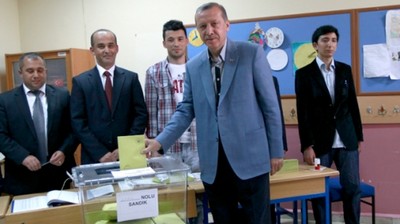 Recep Tayyip Erdoğan, AKP boss and Turkish prime minister, votes today. |
Dec. 21, 2013 update: Cem Toker, chairman of Turkey's Liberal Democratic Party, argues in "Elections in Turkey: Fair or Fraud-Ridden?" that the country's Supreme Election Board (YSK) "advertently or inadvertently, might be involved in manipulating" voting results. He notes that
The YSK is comprised of senior judges whose rulings regarding the elections cannot be appealed to any other legal body including the Constitutional Court, and is thus an extremely powerful institution of Turkey's electoral system.
He points to several anomalies:
According to the official numbers of the YSK, the number of registered voters went up by 1.02 percent between 2002-7. It is surprising that the total number of voters between 2007-14 increased by 29 percent. More surprising is that the population of Turkey increased by less than 10 percent in this latter period.
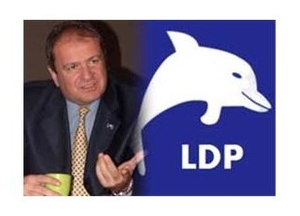
Cem Toker with the logo of Turkey's Liberal Democratic Party.
Also,
In a controversial and unprecedented decision, the Turkish Statistics Institution (TUIK) decided on 20 November 2008 to destroy all records used for "address-based voter registry" –less than a year after it was made public. Despite objections from political parties and opinion leaders, the agency destroyed all data.
In another controversial decision, in 2009 the YSK decided –after decades of use– to stop the practice of placing dye on the index finger of the voters in order to avoid duplicate voting. Furthermore, YSK refused to publish the results of the 2010 referendum on ballot box basis, meaning it was impossible to find out the breakdown of votes at a ballot box, only aggregate figures were shared.
It should also be noted that Turkey first began using the software developed by Sun Microsystems called Computer Supported Centralized Voter Roll System (SECSIS) in 2007, before the parliamentary elections. The technical debate surrounding the controversy of this system still continues in Turkey. Critics suggest that this system is vulnerable to electronic manipulation and programming, thus also having the potential to skew ballot box results.
He then probes the suspicious circumstances surrounding ballot irregularities, for example a huge increase in the number of surplus ballots printed. In addition,
It is no secret that, after each election, used and unused ballots turn up in dumpsters in Turkey. Since they are believed not to be in quantities significant enough to change the outcome of the elections, however, no legal steps have been taken so far.
From this mess, Toker concludes that
Any informed citizen, after putting the pieces of this puzzle together, would have reasonable doubt about the controversial practices utilized before and after each election since the AKP came to power in 2002.
Apr. 1, 2014 update: A report from Ankara today tells of the police using water cannons and stun grenades
to disperse crowds protesting voting irregularities in one of the closest races in [Mar. 30,] Sunday's local elections, which brought a landslide victory nationwide for the Islamic-rooted governing party. Television reports showed two antiriot vehicles moving along a street and firing water cannons at groups calling for a recount. Mansur Yavaş, the opposition mayoral candidate, filed an appeal at the Supreme Electoral Board for examination of irregularities in light of findings by more than 1,000 volunteers working to pin down fraud.
Photographs of dozens of ballot box information forms posted on Twitter, which the government moved to shut down last month, showed discrepancies between handwritten vote counts for the opposition party and entries in the digital counting system. The Supreme Electoral Board said on Tuesday that the official count was a legal process and urged parties to remain calm.
Apr. 17, 2014 update: Reporting from Ankara about rigged voting, Sayed Abdel-Maguid writes for Al-Ahram that
the controversy over reports of foul play in the conduct and counting of the results of the municipal elections that took place on 30 March looks as if it will continue to rage into the foreseeable future. What is certain is that this controversy has further damaged Turkey's democratic credentials in the EU and US.
Abdel-Maguid notoes that the Gülen newspaper Zaman
devoted an editorial to the question of why US President Barack Obama had not congratulated Erdoğan on his election victory. Surely, the answer was that the fraud and tampering in the recent polls were so flagrant as to shock Europe and the US and heighten their fears over Turkey's commitment to democracy and democratic values. This was why Obama, contrary to custom, did not pick up the phone to congratulate Erdoğan.
I am skeptical about the import of this lack of call, however, as the elections were municipal, not national. More importantly, as Toker feared:
On top of the reports of electoral crimes and irregularities, the Turkish government has been actively obstructing the legal mechanisms for investigating them and bringing them before the courts.
Aug. 6, 2014 updates: (1) Boris Kálnoky, "18 Millionen Stimmzettel mehr als Wahlberechtigte," exposes electoral fraud surrounding excessive numbers of ballots.
(2) Sayed Abdel Meguid of Al-Ahram reviews the media bias ahead of the presidential election on Aug. 10:
Although the Turkish press is privately owned, Erdogan has managed to bend most of the print media to his interests. He has done this through an astute manipulation of the newspapers' need for funding, lower taxes, rescheduling of debts and providing easy-term loans. The government-run television (TRT) is the most shameless in its obsequiousness, according to Murat Yetkin, a journalist for the Radikal newspaper.
Thanks to the AKP and government strongman Bülent Arınç, who purged the broadcaster of troublemakers who sought more journalistic neutrality, TRT has now become Erdogan's personal mouthpiece. It has been trumpeting his accomplishments 24/7, among them that Turkish exports have quintupled under his rule to over US$160 billion, while skirting around the fact that Turkish imports have soared to some US$20 billion more than that figure.
TRT broadcasts live coverage of every speech made by Erdogan. It follows him on his tours and along the campaign trail. The coverage shows him surrounded by officials. Sometimes the station accompanies the footage with soundtracks that have a Bollywood ring to them.
Routinely, viewers see the prime minister cutting ribbons or performing similar rituals for the inaugural ceremonies of major projects. Some of these openings have been intentionally delayed so they can coincide with the run-up to the presidential polls. This was the case with the inauguration of the construction of Istanbul's third international airport and the Ankara-Istanbul high-speed railway, officially opened two weeks ago.
Erdogan does not allow journalists to ask him questions about his electoral platform. At the end of his campaign rallies, he rushes off to meet with local officials to coordinate strategy for the upcoming vote.
As for the rival candidates in the presidential elections, Ekmeleddin Ihsanoglu and Selahettin Demirtas, they can count on coverage from a couple of the smaller private satellite TV channels and a handful of daily newspapers. This discrepancy between the media outlets available to Erdogan and those of his challengers raises grave concerns about the credibility of the election.
Aug. 11, 2014 update: A preliminary European assessment of yesterday's first-ever direct presidential elections found that "Freedoms of assembly and association were respected. However, the use of official position by the Prime Minister as well as biased media coverage gave him a distinct advantage over the other candidates."
May 13, 2015 update: Sayed Abdel-Meguid, Al-Ahram's excellent Turkey correspondent, first tells how Erdoğan hogs the airwaves to the exclusion of everyone else in the run up to the June 7 elections, then he tells about the AKP's backup plans:
According to some sources, certain instructions are to be delivered to public school directors who will be supervising the ballot boxes and the tallying of votes. In preparation for this, school directors from parties other than the ruling JDP [i.e., AKP] have been dismissed. In addition, in blatant violation of the electoral law, and as the Supreme Election Board looked on without saying a word, JDP officials convened a large meeting with electoral ward officials. So clearly something is being cooked up in the manner of the recipes that adjusted the results of the municipal elections in March 2014.
In this regard, a survey published 7 May reports that a considerable majority of Turkish voters expect the government to rig the polls. The study, "Turkish public opinion dynamics ahead of the June 2015 elections," conducted by the Open Society Institute, Koç University and Ohio State University, found that 77 per cent of voters oppose the government and do not expect that the elections will be fair, and that 73 per cent of voters do not approve of the presidential system Erdoğan is bent on imposing in his name.
May 14, 2015 update: As parliamentary elections gear up and Erdoğan seeks a majority large enough to change the constitution to empower himself as president, concerns about unfair tactics proliferate. Thomas Siebert writes:
Erdogan's critics are concerned that the president might resort to foul play to ensure an AKP landslide. The secularist Republican People's Party (CHP), Turkey's biggest opposition group, says it will send a total of 525,000 volunteers to observe vote-counting on polling day. One reason the opposition is worried is that several power cuts hindered vote-counting after local elections last year, triggering accusations of vote-rigging to the AKP's benefit. At the time, the government said a cat had entered a power distribution unit and caused a short circuit.
Wondering out loud what the problem this year might be. A rat?
May 19, 2015 update: The senior columnist Cengiz Çandar notes AKP fears of the Kurdish HDP party making the 10 percent threshold and getting into parliament, thereby depriving the AKP of the super-majority it needs to make constitutional changes to enhance the president's power:
Many worry that election security is not guaranteed and will not be guaranteed on the day of the election. This could mean that the HDP's passing the 10% threshold might not just depend on the electorate, but on officialdom as well. There are worries that there might be a lot of election rigging by AKP leaders to push the HDP below the election threshold.
May 22, 2015 update: Gareth Jenkins writes:
Opinion polls suggest that support for the HDP is currently running at around 10 per cent. If the party fails to win any seats on June 7, most of its supporters are likely to assume that it is because of electoral fraud, and distrust of the Erdoğan regime will deepen still further as a result. There is a high risk that this resentment will trigger a cascade of civil unrest, both in southeast Turkey and in urban areas in the west of the country.
May 28, 2015 update: In "Turkish civic society mobilizes against election fraud," Kadri Gürsel reviews the discussion about this particularly sensitive issue.
Remarkably, a significant part of the Turkish public expect irregularities in the count, or, to put it plainly, vote-rigging. A survey made public May 5 by Koç University academics Ali Çarkoğlu and Erdem Aytaç provided a striking illustration of how popular confidence in fair elections has eroded.
According to the survey, ... 46% of voters are convinced the ballots will not be counted properly. The figure stands at 15% even among AKP supporters and reaches up to 72% among opposition voters. Similarly, 43% of the electorate believes the June 7 elections will not be fair. The party breakdown shows that 11% of AKP backers and 69% of opposition supporters hold this opinion. ...
Similar surveys ahead of the 2007 general election found that 28% of voters believed the polls would not be fair; the figure was 30% in 2011. A 13-point increase four years later sounds a serious alarm.
Of course, vote rigging is more effective in close races. A Kurdish figure, Murat Karayilan, explains what this means for the Kurdish party, the Peoples' Democratic Party (Halkların Demokratik Partisi, or HDP):
"I don't think the HDP could surpass the threshold with 10.5% or 11% of the vote because they [the government and its supporters] will be cheating. They will be invalidating votes or stealing votes."
He thinks the HDP has to win 12 percent of the vote to make sure it passes the 10 percent threshold.
A booklet sarcastically titled The Manual of a Vote Thief points to common means of effecting electoral fraud in Turkey:
Moving voters from one constituency to another with the help of civil registry officials and neighborhood headmen.
Removing voters of rival parties from electoral registers.
Multiple voting.
Falsifying votes, whereby surplus ballot papers are stamped in advance and arranged to match electoral registers. Bags full of fake votes are then put in place of the real ones.
Power outages during vote counting.
This last has became notorious.
Multiple, simultaneous power outages became a hallmark of the 2014 municipal polls, going down in Turkish political history as the "cat in the transformer" incident. While vote counting was underway in the evening of March 30, simultaneous power cuts hit 35 provinces across Turkey, including Istanbul. Two days later, Energy Minister Taner Yıldız went down in history by claiming that a cat had slipped into an electrical transformer unit, causing a short-circuit failure. "Cats" have since become a sarcastic metaphor for vote theft in opposition jargon.
Because opposition parties have failed to focus on voter fraud, others have taken up the slack, and especially a group that emerged out of the 2013 Gezi Park protests called Vote and Beyond (which in Turkish comes out euphonically as Oy ve Ötesi).
The movement made its name during the 2014 municipal elections when it deployed 30,000 volunteer observers at polling stations across the country. For the June 7 elections, Vote and Beyond plans to mobilize up to 70,000 volunteers to monitor vote counting at 106,000 ballot boxes in 162 districts in 45 of Turkey's 81 provinces. The 162 districts include the country's 100 largest districts and 62 districts where the margin between the first and the second party is less than 3%. In other words, those are the districts where electoral fraud could sway the overall outcome.
Sercan Çelebi, chairman of the Vote and Beyond Association, notes that its
volunteers will be able to watch only the vote-casting and counting process, which is the observable part of the election, taking place at 175,000 ballot boxes in 970 districts across the country. The process of entering the counts into the centralized computer system and the announcement of final results is not open to observation. To compensate for that, the group has prepared its own software, a sophisticated program of cross-checking and control, which will be used to compare the official results and the results the group will collect through its observers.
Even low-level fraud can make a difference, Çelebi points out:
"An average of 370 votes are cast in each ballot box. If three votes change place in each ballot box, this means a 1% shift in the national total overall." Rigging just 1% of the vote could well leave the HDP out of parliament and put Turkey on an extremely alarming course. Thus, preventing even minuscule fraud, on decimal fractions of the vote, is now more important than ever for Turkey in the June 7 polls.
June 8, 2015 update: Any voter fraud by the AKP in yesterday's election did not amount to much, as the party got only 258 seats, well below the 276 needed to form a government on its own.
Sep. 22, 2015 update: The main opposition party, the CHP claims that 650,000 votes were uncounted in the June 7 election because the AKP's local minions thought they had voted for other parties.
Oct. 23, 2015 update: Abdullah Bozkurt, a columnist for Today's Zaman, has a long analysis, "Hacking democracy in Turkey," how the AKP might steal the forthcoming vote. He starts out by positing that the only way for Erdoğan to achieve 276 seats is "to steal the election in plain sight on Nov. 1 and crush the ensuing uprising with brute force," much like Khamene'i did in Iran in June 2009. But Turkey is different from Iran,
given the strong public awareness of the significance of vote counting among opposition parties, media and advocacy groups. Furthermore, the international observers' missions by the Parliamentary Assembly of the Council of Europe (PACE) and the Organization for Security and Cooperation in Europe (OSCE), whose blessings give a legitimacy to elections, serve as a deterrent to possible fraud activity en masse.
Bozkurt then gets into the technicalities of the heist, focusing on Elector Record System (SEÇSİS) software officially run by the Supreme Election Board (YSK) but in fact controlled by the Ministry of Justice, which is in turn under a loyal Erdoğan henchman, Kenan İpek. Bozkurt mentions rumors about a hacker team from India tasked with reprogramming the software to favor the AKP in close races. Given that results must be contested within 48 hours, this operation "will require vast human resources and an army of lawyers." This will be the more difficult because, he expects, the AKP will likely have the state-run Anadolu news agency report bogus results, making the fraud hard to trace. Only the private Cihan news agency, with its network, resources, and manpower, can pull the data and relay it to the opposition parties and media. Accordingly, he figures, Cihan will be targeted by "Erdoğan's thugs if they decide to rig the elections."
What if the AKP does manipulate the election results and is found out? Bozkurt expects that an "anger that has been boiling for some time in Turkish society against Erdoğan and his party will erupt like a volcano ... which will prompt Erdoğan ... to order a massive crackdown on protests," hoping that by crushing opposition rallies that "the opposition will give up the fight over time." Not only that, but they will round up politicians, human rights defenders, journalists and activists. What then? This is where things get really nasty:
Neither the military nor the police force will risk confronting such a tsunami and definitely won't side with Erdoğan against the people. The president knows this as well. And perhaps that is why he has been grooming paramilitary forces, such as the Ottoman Hearths, attached to the AKP's youth branches. Radical Islamist groups who have been trained and have fought in Syria under the political cover and logistical support of Turkey's Islamist rulers may come in handy when confronting Erdoğan's foes.
Comment: This scenario is certainly possible but, as I have explained elsewhere, it's much easier for Erdoğan to sideline the parliament and the formal government, running the show from his massive palace with the thousands of operatives.
Nov. 2, 2015 update: The huge increase in the AKP's percentage of the vote in yesterday's elections has prompted immediate and widespread concerns about vote rigging. As one account notes, "The news agencies announced the results very rapidly. The election was called for the AKP within only a few hours, despite the fact that many votes were not even delivered to the counting boots. Social media was abuzz with allegations of election fraud, as angry Turks documented their claims with photographs and videos."
Nov. 3, 2015 update: For a discussion of the role of fraud in the Nov. 1 election results, see my blog, "Will Turks Accept the Election Results?"
Nov. 7, 2015 update: A CHP protest in Istanbul led to a recount of 85 ballot boxes. As a result, the AKP vote went down 3,504, the CHP one went up 912. As Cem Toker notes, that's just 85 out of 175,000 ballot boxes and in Istanbul, the great metropolitan capital, not some rural outpost. One wonders what the overall miscount comes to.
Apr. 28, 2017 update: Hany Ghoraba summarizes the fraud in the Apr. 16 referendum legally bestowing dictatorial powers on Erdoğan:
For many decades, Turkish people always took pride in their democratic process and considered it among the finest in the world. Nevertheless, during past decades, the activities of the Islamist ruling AKP have eroded that pride and confidence as a result of constant riggings of elections in favour of the party.
A few hours from the beginning of the referendum, all indications and reports from Turkey pointed towards mass rigging operations. There is an overwhelming amount of evidence that if presented to any impartial court of law in Turkey it would annul the entire referendum process. However, since Erdogan has purged most of the impartial judges following the alleged coup attempt in 2016, any evidence presented by the two main opposition parties — the Republican People's Party (CHP) and the People's Democratic Party (HDP) — or others may find itself tossed out of court by a pro-Erdogan judge. That is exactly what took place after the opposition appealed the result of the referendum to Turkey's High Election Board.
The narrow percentage of the "yes" vote, at 51.41 per cent against 48.59 per cent to "no", displays the inability of the Turkish president to sway a landslide majority towards his preposterous constitutional amendment. The rigging methods included all the classic methods, such as pre-marked ballot papers, switching of official ballot boxes with unstamped forged ones, and getting rid of entire ballot boxes containing "no" votes. Moreover, the entire process was marred by abuse, verbal and physical threats by Erdogan's supporters (Erdogoons) towards the Hayir (No) campaigners. The intimidation tactics used on public and social media against the "No" campaign were unprecedented and leave not a shred of doubt that the entire process was conducted under duress.
Mar. 13, 2018 update: Erdoğan has abandoned even the pretense of electoral fairness with the adoption of a new election law. Details from Selcan Hacaoğlu of Bloomberg:
The voting came at the end of a stormy, 20-hour debate in the parliament in Ankara where opposition parties warned that changes would undermine the integrity of the electoral process and increase the risk of vote fraud. ...
The amendments allow parties to form alliances that would help them enter parliament, relaxing the current rule that requires each to secure 10 percent of the national vote. The most likely beneficiary would be the nationalist MHP, which some analysts say has lost support since it started backing Erdogan's ruling AKP after the failed coup attempt in 2016. ...
Under the amendments, authorities would also be able to appoint government officials to run ballot stations, relocate election stations on security grounds, let law-enforcement officials monitor voting, and permit the counting of unstamped ballot papers—an issue that clouded the 2017 referendum on presidential rule. The government said the changes are necessary to secure the vote in Turkey's southeast from the influence of Kurdish separatists.
May 5, 2018 update: Burak Bekdil asks "Turkey's Elections: But Who Counts the Votes?" He replies:
In March, Turkey's parliament, controlled by Erdoğan's Justice and Development Party and its ally, MHP, passed sweeping changes to electoral laws designed to help Erdoğan tighten his grip on power. ...
Under the new electoral laws, authorities would be able to appoint government officials to run ballot stations, relocate election stations on security grounds, let law-enforcement officials monitor voting, and permit the counting of unstamped ballot papers. "The risk of holding elections under the shadow of guns could put voters under pressure," Uğur Bayraktutan, an opposition lawmaker, told a parliamentary committee, referring to the prospect of armed security forces in voting stations.
"The president knows that a small shift in votes could mean a defeat in a contest he cannot lose," Wolfango Piccoli, co-founder of Teneo Intelligence in London, told Bloomberg. "Further initiatives to maximize the chances of a positive outcome on ballot day are likely".
Shortly after the 2017 referendum, an Austrian member of the Council of Europe said that up to 2.5 million Turkish votes could have been manipulated. Since then Erdoğan has further consolidated power by legislation (see new electoral laws) and law enforcement (see police brutality) increasing the risk of election fraud on June 24.
Once again, in Turkey, who votes for whom will matter less than who counts the vote.
May 29, 2018 update: Of course, the snap presidential and parliamentary elections to be held on June 24 are rife with potential fraud, especially as concerns the Higher Electoral Board (known as the YSK). Mahmut Bozarslanexplains the two main issue. One involves Kurds:
the YSK said May 28 it had decided to relocate polling stations in predominantly Kurdish areas that would affect 144,000 voters, citing security reasons. The move, made possible by the March amendments, infuriated the pro-Kurdish Peoples' Democratic Party (HDP), which claims the authorities are maneuvering to push the party below the 10% threshold required to enter parliament.
"This has nothing to do with security; rather it is a move to break the will of voters," HDP lawmaker Mithat Sancar told Al-Monitor.
HDP spokesman Ayhan Bilgen told a press conference that the decision involved moving ballot boxes from villages where the HDP "gets around 75-80% of votes" to villages where the ruling Justice and Development Party (AKP) "gets 75-80% of votes." The head of the YSK said the ballot boxes would be moved to "a walking distance of 5 kilometers [3.1 miles] at most." The HDP worries that, in remote, impoverished areas in the mainly Kurdish southeast, even such distances could discourage or prevent villagers from voting.
According to Bilgen, the 144,000 affected voters represent "a significant numeric quantity that could sway the outcome of the election."
The state of emergency in place for almost two years is the other issue in the southeast:
The region has been under heavy security presence since a military crackdown on the outlawed Kurdistan Workers Party (PKK) that preceded the putsch. The aftermath of the coup saw a ferocious clampdown on oppositional quarters across Turkey, including the Kurdish political movement, which had its municipal administrations seized and many of its leaders and activists arrested.
Then there is the little matter of allowing "unstamped ballots to be admitted, formalizing the YSK's controversial measure during the referendum."
Feb. 4, 2019 update: Uzay Bulut reports on the worrisome "volunteer security guards" that Erdoğan's Interior Ministry is sending out to polling places in the Mar. 31 elections.


