
I noted in my column this week, "Enforce Islamic Law in Canada?" that "efforts to integrate Muslims into the West [often] upset a benign status quo" and gave as one example the banning of Santas, Nativity plays, Christmas carols, and Bibles so as not to offend Muslim sensitivities. Here I will catalogue other proscribed items as they come to my attention, with the exception of pigs, who already have their own weblog entry, "Ridding the West of Pigs, Pork, Pig Stories, and Piggy Banks.".
The Open University in Britain has spawned an Arab Open University, based in Kuwait, with students primarily in Kuwait and Saudi Arabia. The contents of the two institutions' teachings are revealingly different, Ferdinand Mount notes in the Daily Telegraph, with the latter "to a greater or lesser extent, adapted, expurgated and bowdlerised in order to avoid offending the authorities in their target countries." This process, known as "versioning," means that all references to pork, alcohol, homosexuality, and unmarried mothers have to be deleted from texts. "Bizarrely, any mention of football stadia seems to be forbidden, too." Darwinian theory is taught but accompanied by a statement of the Islamic doctrine of creation. Paintings by J.M.W. Turner have been excluded. Analyses of selling bras and alcohol got dropped. Mount adds that
staff at the OU in Britain appear to feel absolutely no unease or discomfort at all this. They even post news of their latest versioning efforts on the web. When Anthony Williams, an OU postgraduate student, wrote to complain to the secretary and the vice-chancellor, and then to the chancellor, the blessed Betty Boothroyd, they all replied politely, but seemed bemused by his indignation. The university's senate, HEFCE, the QAA, even the DfES itself - the entire educational alphabet in fact - seems to have waved through this wholesale censorship without a second thought.
(October 3, 2005)
Chief Inspector of Prisons Anne Owers has forbidden British prison officers from wearing a St. George's Cross tie-pin, although it is the national flag of England, due to its connection to the Crusades. Chris Doyle, director of the Council for the Advancement of Arab-British Understanding, approved of the step, noting that "A lot of Muslims and Arabs view the Crusades as a bloody episode in our history," Doyle added that it was now time for England to find a new flag and a patron saint who is "not associated with our bloody past and one we can all identify with." (October 4, 2005)
Schools in Hillsborough, Florida, for years had vacation days on Good Friday, the Monday after Easter, and Yom Kippur, but when the Council on American-Islamic Relations asked that Eid al-Fitr be added, the school board decided (by a 5-1 vote) to go with a secular calendar for 2006-07 that takes away student vacation days for religious holidays, with the exception of Christmas. The three Christian and Jewish holidays will be replaced with Presidents Day and two days between spring break and the last day of school. The board members like the new calendar, saying it is more fair and preempts future requests from other religious groups: "I don't know where we're going to draw the line," board member Susan Valdes observed. Several Muslims said they feared Muslims will be blamed for taking away everyone's holidays. (October 13, 2005) Nov 9, 2005 update: The Hillsborough County School Board voted to restore Good Friday, Easter Monday and Yom Kippur to the 2006-07 school calendar.
 Homer Simpson and donut |
|
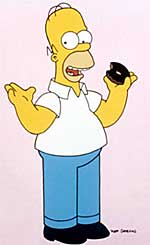
If the Open University bowdlerizing is high comedy, Homer Simpson's is the low version. Yasmine El-Rashidi reports in the Wall Street Journal on the transformation of this legendary cartoon figure for an Arabic-speaking audience:
"Omar Shamshoon," as he is called on the show, looks like the same Homer Simpson, but he has given up beer and bacon, which are both against Islam, and he no longer hangs out at "seedy bars with bums and lowlifes." In Arabia, Homer's beer is soda, and his hot dogs are barbequed Egyptian beef sausages. And the donut-shaped snacks he gobbles are the traditional Arab cookies called kahk.
(October 14, 2005)
Christopher Marlowe: Marlowe's 1580s play, Tamburlaine the Great, contains some pretty strong language spoken in Act V, Scene I by the title figure (usually known as Tamerlane, more properly Timur-i Lang, or Timur the Lame, c. 1336–1405, one of the worst butchers of history). He disparages "the Turkish Alcoran" and "all the heaps of superstitious books Found in the temples of that Mahomet," then burns the Koran and challenges the Prophet Muhammad to punish him: "Now, Mahomet, if thou have any power, Come down thyself and work a miracle." Tamerlane also declares that "Mahomet remains in hell."
The play was the surprise hit of the autumn 2005 season in London, winning rave reviews and selling out at the Barbican night after night. Now, it comes out that the producers censored the above passages. The Koran was not burnt, instead it was "a load of books" immolated. The "remains in hell" reference was dropped, and so on. Simon Reade, artistic director of the Bristol Old Vic, said that the director of the play, David Farr, felt that burning the Koran "would have been unnecessarily inflammatory." Curiously, Inayat Bunglawala of the Muslim Council of Britain disagreed: "In the context of a fictional play, I don't think it will have offended many people." (November 24, 2005)
Australian flag: In the aftermath of Australia's summer beach riots, the Green- and Labour-dominated town council in Waverley (a beach town near Sydney) voted 6-5 on December 13 against a proposal to fly an Australian and an Aboriginal flag over the pavilion at Bondi Beach. It did so out of fear the flags would incite more violence, as George Copeland, a Green, explained: "The Australian flag was used by both sides as a symbol around which to perpetrate racial violence. The people from Lakemba [i.e., Muslims] burnt the flag and the Cronulla people [i.e., non-Muslims] swathed themselves in it while pounding people. We didn't want to wave a red rag in front of either side on New Year's Eve." But another councilor, Waverley deputy mayor George Newhouse, gave a totally different explanation: "We already fly the flag at Bondi, we proudly fly the flag at Bondi and this decision has absolutely nothing to do with racism or Cronulla. It has everything to do with practical common sense. The Pavilion is a heritage-listed building and it will cost thousands of dollars to perform a heritage study and then erect the poles, which don't exist."
Ironically, Keysar Trad of the Islamic Friendship Association of Australia spurned the council's decision. "To suggest that Muslims would be offended at the sight of the Australian flag is naive. A great deal of Muslims call Australia home and they are just as happy to see the flag flying high." The premier of New South Wales, Morris Iemma, urged the Waverley council to rethink its decision. "Our flag is a symbol of national unity and the council decision is just ridiculous, they want to reconsider it and reconsider immediately. There's no excuse for anyone else to be saying 'Well, because of the incidents, the riots of two weeks ago we're not going to fly the Australian flag'. That is just ridiculous." (January 2, 2006)
 The BMI official abaya and hijab combination. |
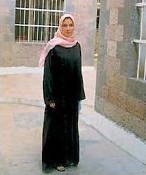
Women walk two paces behind men: British Midland International, the only British airline flying to Saudi Arabia, has issued astonishing orders to its flight crews working on that route: no wearing of crucifixes or St Christopher medals, no Bibles, teddy bears, or cuddly toys. Stewardesses must cover themselves from head to foot in an abaya. To be precise, the staff handbook reads: "Prior to disembarking the aircraft all female crew will be required to put on their company issued abaya. It will be issued with the headscarf which must be worn." The BMI explains the rules are part of its "obligation" to "respect the customs" of Saudi Arabia. And then the kicker: the women must walk two paces behind their male colleagues. (January 8, 2006)
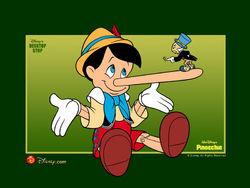
"Pinocchio and friends converted to Islam": London's Daily Telegraph reports startling news from the culture front:
Pinocchio, Tom Sawyer and other characters have been converted to Islam in new versions of 100 classic stories on the Turkish school curriculum. "Give me some bread, for Allah's sake," Pinocchio says to Geppetto, his maker, in a book stamped with the crest of the ministry of education. "Thanks be to Allah," the puppet says later. In The Three Musketeers, D'Artagnan is told that he cannot visit Aramis. The reason would surprise the author, Alexandre Dumas. An old woman explains: "He is surrounded by men of religion. He converted to Islam after his illness."
Tom Sawyer may always have shirked his homework, but he is more conscientious in learning his Islamic prayers. He is given a "special treat" for learning the Arabic words. Pollyanna, seen by some as the embodiment of Christian forgiveness, says that she believes in the end of the world as predicted in the Koran. Heidi, the Swiss orphan girl in the tale by Johanna Spyri, is told that praying to Allah will help her to relax.
Several more books have been altered, including La Fontaine's fables and Victor Hugo's Les Miserables.
 Pinocchio |
(August 31, 2006)
 No more Nick in some of Vienna's schools. |
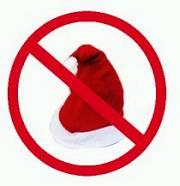
And no more Santa Claus for some children in the Head Start program in St. Peter, Minnesota this year because, as an administrator put it,
We have Somali families in the program. We're respecting the wishes of families in the program. … The simple truth is that southern Minnesota has become a much more culturally diverse society than it was a few decades ago. Part of our challenge in Head Start is providing an environment where young children from many different cultures can all feel comfortable.
(December 14, 2010)
'Kultursensible' Geschichtsfälschung in Wien: Türkenbelagerung aus Schulbüchern gestrichen": More news from a Viennese elementary school: a principal has instructed teachers, on pain of being transferred, not to discuss the two Turkish sieges of their city in 1529 and 1683, thereby making sure that Turkish pupils not be humiliated on learning of these defeats. (Apr. 1, 2013)


