
The speaker of those words is one Ziad Zaranda, the Gazan whose fiancée, Yusra Azzami, 20, was murdered because the couple were seen walking by the sea and Hamas operatives decided this act was so immoral, she deserved to die.
The young couple's tale is fraught with implications for Palestinian political and social life, but I focus on Zaranda's statement that Hamas is worse than Israel because it fits a theme I have researched for some years and have just gone into print with. Titled "The Hell of Israel Is Better than the Paradise of Arafat" and dated spring 2005, the longish article provides what may be the first-ever compilation of pro-Israel statements by Palestinians, then draws some conclusions from this recurring pattern.
But history does not stop with the publication of an article, so I shall continue to collect statements and actions by Palestinians and other Muslims, and post them here as they reach me. I shall also post earlier examples. (April 13, 2005)
May 28, 1996 update: The Islamist writer Muhammad 'Abd al-Quddus analysed his society's problems in an oped in the Egyptian publication Ash-Sha'b, as reported by FBIS: He
notes that the State of Israel is stronger than all the dilapidated Arab regimes in the region, not only because the United States is behind it, but also because the Jews have "managed to create a 'modern' and 'democratic' society, something that is missing in the Arab world." Noting that "our enemies have succeeded where we have failed," 'Abd al-Quddus explains that Israel does not know the kind of "despotic" regimes we have. Any quick comparison between the Israeli and Egyptian elections will show how "backward" we are, he notes.
'Abd al-Quddus adds:
It is my belief that the domestic strength of Israel stems from two specific things: A solid religious doctrine on which the state is based and a modern democratic regime that adopts all the requirements of progress and does not allow an individual or a party to monopolize power. In our country, however, the first enemy of our rulers at present is the Islamic current, and the Islamic trials are the best proof of this. Our president's monopoly of power needs no evidence.
Oct. 1, 2001 update: Yusuf Samir, an Egyptian-Israeli journalist: many Palestinians on the West Bank and in Gaza "wish they were back under Israeli rule." (Israel Heute, October 2001. Trans. by Outpost, December 2001,)
Dec. 18, 2002 update: Palestinian Media Watch has started a series titled Israel in a positive light; the first example is "Palestinian boy says Israeli soldiers show restraint during the Intifada."
May 25, 2003 update: Ismail Abu Shanab, a senior political leader of Hamas, criticized Palestinian self-rule to an American reporter while at in his home in Gaza City: "When the Israelis were here, we lived our lives better than now, in every way. Believe me. Look how the streets of Gaza are not clean,"
Dec. 22, 2005 update: "I think that Iran is more dangerous to Iraq than Israel because of the assassinations that the Iranians have been doing. I think Israel would have been more merciful," says Added Hamid Hashim, 30, an Iraqi Sunni, referring to recent killings of prominent Sunnis. "I hated Israel before the war, but now I hate Iran even more."
His is one of several quotes collected by Nancy A. Youssef in an article, "Many Sunni Muslims diverting anger from Israel to Iran." She finds a reassessment underway since the results of Iraq's national assembly election on Dec. 15 show that Shiite Muslim candidates, many of them backed by the Iranian government, would dominate the new parliament. "Sunni Muslims have begun to ask: Is Israel really Iraq's enemy, or is it neighboring Iran? ... privately many said Israel has not done anything lately to harm them; Iran has."
Mustafa Mohammed Kamal, 58, a retired schoolteacher observes that Iranian interference in the election "was very clear and that makes Iran the number one enemy of Iraq. The Iranians have many supporters in Iraq. Israel is an enemy, but they are not as egregious."
Mithal al Alusi, who has long called for stronger ties with Israel, finds Iraqis are warming to a stronger relationship with Israel. "They are afraid of Iran's extremist political system. ... We don't have border problems with Israel. We don't have historical problems with Israel."
June 14, 2006 update: "The Israelis are better than you," shouted a Palestinian Authority employee at a member of the Palestinian Legislative Council, distressed at not having been paid for some time.
Aug. 23, 2006 update: After a horrible bus crash in Egyptian territory near the Sinai resort town of Nueiba, in which ten Israeli Arabs and another tourist were killed, the Egyptian authorities performed in their usual feckless way, leaving the wounded untended by the roadside for three hours, then taking them to a local clinic, and delaying their evacuation to Israeli hospitals. Some of the injured Israeli-Arab tourists commented that they would never visit Egypt again and Nadi Hilu, a female Arab member of Israel's parliament called on all Israelis to cancel their travel plans to Egypt in protest.
May 28, 2007 update: One Palestinian remarks, about two-thirds into a news video: "Now, most of the people here, in this area, they say, 'We pray that Israel will come back and rule us again'."
June 1, 2007 update: C. Jacob of the Middle East Media and Research Institute (MEMRI) published "We Are Facing a Second Nakba'- Reactions in the Palestinian Press to the Hamas-Fatah Clashes," with a section titled "Columnists: People in Gaza Long for the Return of the Israeli Occupation." It reads as follows:
Papers reported that some people in Gaza even want the Israelis to return to the Strip. Faiz Abbas and Muhammad Awwad, journalists for the Israeli-Arab weekly Al-Sinara, wrote: "People in Gaza are hoping that Israel will reenter the Gaza Strip, wipe out both Hamas and Fatah, and then withdraw again... They also say that, since the [start of the] massacres, they [have begun to] miss the Israelis, since Israel is more merciful than [the Palestinian gunmen] who do not even know why they are fighting and killing one another. It's like organized crime, [they said]. Once, we resisted Israel together, but now we call for the return of the Israeli army to Gaza." [20]
Al-Hayat Al-Jadida columnist Yahya Rabah wrote: "When the national unity government was formed, I thought, 'This will be a government of national salvation.' If a government that includes Fatah, Hamas, other factions and independents associated with [various] factions has not been able to save the day, it means that no one can, unless Israel decides that its army should intervene. Then it will invade [the Gaza Strip], kill and arrest [people] - but this time not as an occupying [force] but as an international peace-keeping force. Look what we have come to, how far we have deteriorated, and what we have done to ourselves." [21]
Palestinian journalist Majed Azzam wrote: "We should have the courage to acknowledge the truth... The [only] thing that prevents the chaos and turmoil in Gaza from spreading to the West Bank is the presence of the Israeli occupation [in the West Bank]... [as opposed to] its absence from the Gaza Strip." [22]
Bassem Al-Nabris, a Palestinian poet from Khan Younis in the Gaza Strip, wrote: "If a there was a referendum in the Gaza Strip [on the question of] 'would you like the Israeli occupation to return?' half the population would vote 'yes'... But in practice, I believe that the number of those in favor is at least 70%, if not more - [a figure] much higher than is assumed by the political analysts and those who follow [events]. For the million and a half people living in this small region, things have [simply] gone too far - in practice, not just as a metaphor. [It did not begin] with the internal conflicts, but even earlier, in the days of the previous Palestinian administration, which was corrupt and did not give the people even the tiniest [ray of] hope. The fundamentalist forces which came into power [after it] also promised change and reform, but [instead, people] got a siege, with no security and no [chance of] making a living... If the occupation returns, at least there will be no civil war, and the occupier will have a moral and legal obligation to provide the occupied people with employment and food, which they now lack." [23]
Oct. 16, 2007 update: Israel's Prime Minister Ehud Olmert just raised the idea that Israel might cede some heavily Arab areas of eastern Jerusalem to the Palestinian Authority; "Was it necessary to annex the Shuafat refugee camp, al-Sawahra, Walajeh and other villages and state that this is also Jerusalem? I must admit, one can ask some legitimate questions on the issue."
In response, Mark MacKinnon found that "Some Palestinians prefer life in Israel: In East Jerusalem, residents say they would fight a handover to Abbas regime," the title of his article in today's Globe and Mail.
After 40 years of living under Israeli occupation, two stints in Israeli prisons and a military checkpoint on the same road as his odds-and-ends shop, one would think Nabil Gheit would be happy to hear an Israeli prime minister contemplate handing over parts of East Jerusalem to Palestinian control. But the mayor of Ras Hamis [more correctly: the mukhtar of Ras Khamis, DP], a Palestinian neighbourhood on the eastern fringe of this divided city, says that he can't think of a worse fate for him and his constituents than being handed over to the weak and ineffective Palestinian Authority right now. "If there was a referendum here, no one would vote to join the Palestinian Authority," Mr. Gheit said, smoking a water pipe as he whiled away the afternoon watching Lebanese music videos. "We will not accept it. There would be another intifada [uprising] to defend ourselves from the PA."
Residents of Ras Khamis and other neighbourhoods, MacKinnon reports,
dislike the idea of their neighbourhoods, which are generally more prosperous than other parts of the West Bank, being absorbed into the chaotic Palestinian territories. Mr. Gheit, with two posters of "the martyr Saddam Hussein" hanging over his cash register, can hardly be called an admirer of the Jewish state. But he says that an already difficult life would get worse if those living in Ras Hamis and the adjoining Shuafat refugee camp were suddenly no longer able to work in Israel, or use its publicly funded health system. The 53-year-old said he'd be happy to one day live in a properly independent Palestinian state, but not one that looks anything like the corruption-racked and violence-prone areas that are split between the warring Hamas and Fatah factions. "I don't believe in these factions. I only believe in putting bread on the table for my children. I fight only for them. At least in Israel, there's law."
These are not merely abstract sentiments but ones that can cause people to change their lives:
Mr. Gheit said that over the past five years, some 5,000 people have moved into Ras Hamis from other parts of the West Bank, concerned that they would lose their Israeli identification cards if they didn't live within the city limits. There would be a mass exodus into other parts of the city, or other towns in Israel, if it looked likely that Ras Hamis and Shuafat, home to a combined 50,000 people, were about to be declared no longer part of Jerusalem, he said.
Comments: (1) The final quote is puzzling, as West Bankers do not have Israeli IDs and moving to Jerusalem will not acquire these for them.
(2) This may be a suitable moment to mention that I have a study, titled "Muslim Aliyah," in the works. As the name implies, it surveys the topic of Muslim immigration to Israel.
Nov. 6, 2007 update: Palestinians are reluctant to be pushed by Israel into the arms of the Palestinian Authority, these reported by Ilene R. Prusher of the Christian Science Monitor:
"I don't want to have any part in the PA. I want the health insurance, the schools, all the things we get by living here," says Ranya Mohammed as she does her afternoon shopping in Shuafat. "I'll go and live in Israel before I'll stay here and live under the PA, even if it means taking an Israeli passport," says Mrs. Mohammed, whose husband earns a good living from doing business here. "I have seen their suffering in the PA. We have a lot of privileges I'm not ready to give up."
Nabil Gheet, a neighborhood leader who runs a gift and kitchenware outfit in the adjacent town of Ras Khamis, also resists coming under the PA's control. "We have no faith in the Palestinian Authority. It has no credibility," he says, as his afternoon customers trickle in and out. "I do not want to be ruled by Abbas's gang," he says, referring to Palestinian President Mahmoud Abbas.
Nov. 7, 2007 update: As the prospect of dividing Jerusalem again comes up, many Palestinian residents of the city are predictably showing how very much they want to stay in Israel. Ronny Shaked looks into one aspect of this in his Yedi'ot Aharonot article, "Thousands of Palestinians apply for Israeli citizenship," where he finds that "talk of a future division of the city has prompted a staggering increase in nationalization requests by Palestinians seeking to escape life under the Palestinian Authority." Statistics show a ten-fold increase in interest:
Some 250,000 Palestinians currently reside in Jerusalem. Only 12,000 of them have sought to obtain an Israeli citizenship since 1967, an average of about 300 new citizens a year. But over the past four months the Interior Ministry has registered an unprecedented 3,000 applications, primarily residents of the Arab neighborhoods unlikely to remain under Israeli sovereignty according to the political initiative currently on the agenda.
Indeed, Palestinian residents of Jerusalem seeking to apply for Israeli citizenship are discovering that the next available date for an appointment at the Interior Ministry is in April 2008, nearly a half year off. Shaked quotes one Jerusalemite saying of his neighbors, "They've weighed the pros and cons of life under the Palestinian Authority and those under Israel and they've chosen." He gives the example of Samar Qassam, 33, who is applying for Israeli citizenship to improve his family's future.
I was born in Jerusalem, this is where I grew up and this is where I make my living. My entire life is here. My wife comes from the West Bank, so I do fear she may be deported and therefore filed a naturalization request for her as well. I want to keep living here with my wife and child without having to worry about our future. That's why I want an Israeli citizenship. I don't know what the future holds. There's talk of the Palestinian Authority coming to Jerusalem. Personally, I don't think that will happen. But only God knows what will happen. I work as a mechanic for an Israeli company, I have both Jewish and Arab friends. I speak Hebrew and go out to Tel Aviv and Akko in the evenings. I just want a better future.
Nov. 12, 2007 update: Joshua Mitnick further documents the Palestinian reaction in a Jerusalem Report article, "Better the Devil You Know" (not online). A few choice quotes:
"If they put a border here, we'll move to Haifa and Tel Aviv. You'll have 50,000 people who live here leaving East Jerusalem in minutes." ...
When Israel started to build the barrier, [Jamil] Sanduqa got the message and rented an apartment in a neighborhood on the Israeli side of the fence even though he stayed in Ras Hamis. "I want to live in peace and to raise my children in an orderly school," said the unemployed council head. "I don't want to raise my child on throwing stones, or on Hamas." ...
[Nabil[ Gheit won't hear of being transferred to the authority of the PA, either. "I'll never go," he says. "Where are the jobs that the Palestinian Authority can offer us? Do they want us too to be beggars waiting for international aid?" ...
"They are being overtaxed and the state isn't giving them what they need," says Mohammed Dajani, a political science professor at Al-Quds University. "Nevertheless, they feel the benefits that Israel is providing - health care, free movement and jobs. People are worried about what will happen to them, and what their situation will be, because their livelihood is in Jerusalem and they fear they may lose access to Jerusalem." ...
"I want the camp to stay with Israel because the PA is a ruthless institution."
A two-story IDF watchtower at the entrance of the neighborhood dominates the warrens of this United Nations-administered slum. The government wanted to route its separation barrier to cut this refugee camp off from the rest of the city, but an injunction against its construction is in force, after the residents challenged the route in the Supreme Court. None of that bothers Imad Abed Thai, a middle-aged women wearing a black dress and head covering, who says she relies on welfare paid by Israeli social security to support her nine children. "They won't give us any money in the Palestinian Authority."
Nov. 14, 2007 update: "lazar" at Aegean Stables provides a personal account from his Israel military experience:
When my company assumed responsibility for the security of the Erez crossing in the wake of the Hamas coup in the Gaza Strip, I sat down to eat lunch beside a group of Palestinian workers. Conversation turned to the deepening crisis in Hamas' Gaza Strip, and one man said. "It wasn't like this when Israel controlled it. We had jobs, and were safe. Now, Hamas has made Gaza into a mess. No one wants to live there." The other workers nodded emphatically.
Nov. 26, 2007 update: More Israeli Arab appreciation of Israel and outrage at the thought of being made part of the Palestinian Authority in an article by Eetta Prince-Gibson, "Land (Swap) For Peace?" in The Jerusalem Report.
All the heads of Arab regional councils and cities wrote Prime Minister Ehud Olmert and the members of his cabinet a letter that responded to a demand by Strategic Affairs Minister Avigdor Lieberman of the Yisrael Beiteinu party that a final status agreement with the Palestinian Authority include a land swap (meaning, parts of Arab-dominated Israel turned over to the PA in return for parts of Jewish-dominated West Bank under Israeli sovereignty). It stated:
We wish to express our sharp opposition to any initiative taken by the State of Israel and the Palestinian Authority with regard to our civil, political and human rights ...We wish to make it clear that as citizens of the State of Israel since 1948-1949... the proposed moving of borders will deprive us of these human rights and tear apart the social and economic ties that have been constructed on the basis of a long and difficult struggle.
The first signatory of that letter, Mayor Hasham Abed Elrahman of Umm el-Fahm (pop. 45,000), the largest Muslim city in Israel, who happens also to be a leader in the Northern Islamic Movement, adds:
This is a painful subject. Why would anyone assume that because I am a Palestinian, I must live in Palestine? After all, no one would say that if I were a Jew, I must live in Israel. I am a Palestinian citizen of Israel, a country that was established in 1948 according to international agreements, so I accept the fact that the State of Israel exists as a sovereign state. But I also expect the State of Israel to grant me equality and not to question my right to citizenship. Of course, I live with a conflict - between my nationality, Arab and Palestinian, and my citizenship, Israeli. But the Zionists created this dilemma, so you have to solve it - by giving us equality, by giving us equal rights and equal budgets, and by not trading on our citizenship.
Asked by Prince-Gibson if he understand that Jews "fear him, Umm el-Fahm, and the Islamic movement?" Abed Elrahman replies: "I cannot argue with feelings. I can tell you that we want to work together with the Jewish majority for the betterment of all of Israel. Religiously, politically and socially, we want to remain part of the State of Israel."
Prince-Gibson persists: "But you want to establish an Islamic state here." Abed Elrahman denies it: "Why do you say that? As a religious man, I tell you: I am not religiously required to establish or even to strive to establish an Islamic state here. It's your fear, but not my reality."
Others express similar sentiments. Sa'id Agbariah, 34, who has a B.A. in economics from Haifa University but now works in a gas station, boasts that during the October 2000 riots he threw stones at Jews and public institutions and also tried to block the highways and roads. He says
he is deeply disappointed that the Jewish majority in Israel "hasn't learned anything from those riots and still won't give us equality or equal opportunity." Yet when asked about the land swap proposal that would confer Palestinian citizenship on him, he bristles. "What can the Palestinian Authority offer me? Poverty without hope of a better life? I'd rather stay here, even if I have to struggle for my rights."
Su'ad (a pseudonym) is a 26-year-old student, married, and pregnant with her first child. She nearly begins to cry when this topic comes up.
"I don't want you to use my name," she says. "When the Jews talk about swapping me, it's as though they are denying my right to be a person, and my baby's right, too. They want to move me around, like I'm no one. So I don't want them to know my name." Umm el-Fahm, she says, is her home. "It's not just where I live, it's who I am. I'm a Palestinian and I'm an Israeli, too. For 60 years, we've lived here. I think like a Palestinian, but I think like an Israeli, too. My daily life is Israeli."
Prince-Gibson does find one taker for the PA:
Dressed in the white robe and head covering of a devout Muslim, Abdullah finishes tanking up his late-model Honda Civic and joins the conversation. "I want to be part of Palestine," he offers, "because I want to establish an Islamic state, like the Hamas has done in Gaza, only better. I don't care at all about my Israeli citizenship." But he acknowledges that he only knows "a very few people" who agree with him and says that he doesn't bring the subject up when he's with his family. "They're all against it. They've always lived here, for 60 years they've been part of Israel, and that's how they want it to be."
Dec. 26, 2007 update: A poll taken by Keevoon Research, Strategy & Communications asked this question of a representative sample of 514 Israeli Arabs over 18 years if age by telephone during the period December 3-5, resulting in a ±4.5 percent margin of error:
There has been a lot of talk lately about the formation of a new Palestinian State. It has been suggested by some that Israeli Arabs could continue to live in Israel, but change their citizenship to the new Palestinian State. Given the choice, and continuing to live where you presently live today, would you prefer to be a citizen of Israel or of a new Palestinian state?
The replies:
- Remain Israeli citizens: 62 percent
- Join a future Palestinian state: 14 percent
- No opinion/refused to answer: 24 percent
That's a ratio of nearly 4.5 to 1 in favor of remaining Israeli. Some interesting sidelights:
- Druze have the highest preference for staying Israeli citizens: 84 percent.
- Lower income households choosing Israel: 71 percent.
- Men more than women wish to remain Israeli: 67 percent vs. 56 percent.
- Students most want to join a future Palestinian state: 21 percent.
- Christian Arab Israelis are the most undecided or refuse to reply: 43 percent.
Comment: This poll confirms what was known from a mountain of anecdotal evidence, usefully adding a statistical dimension.
Dec. 27, 2007 update: Coincidentally, more polling on this issue, just a day later. The Arabic-language newspaper As-Sennara asked, in a telephone poll of 450 adult Arabs living in the Galilee, Triangle, and Negev (all in Israel): "Do you support transferring the Triangle to the Palestinian Authority?" The replies:
- Favor: 18 percent
- Oppose: 78 percent
The ratio here is nearly identical to the Keevon poll a day earlier, a ratio of nearly 4.5 to 1, nicely confirming it.
Jan. 2, 2008 update: My column today, "Palestinians Who Prefer Israel," documents the Palestinian response to an Israeli initiative to withdraw from parts of Jerusalem.
Salim and Samia Shabane, with their children.
Jan. 19, 2008 update: "More Jerusalem Arabs seek Israeli citizenship" reports Dion Nissenbaum for the McClatchy Newspapers. The dispatch focuses on the case of Salim Shabane, who is introduced as considering himself a Palestinian:

But his life and work are intertwined with Israel, where he runs an auto shop. So, despite his tacit support for a Palestinian state, Shabane is part of a new surge of Jerusalem Arabs applying for Israeli citizenship. "I live in Israel," said Shabane, "why shouldn't I be an Israeli citizen?" ... "My work and my life are inside Israel," Shabane said. "I am very proud to be an Arab and Palestinian, but for practical reasons I'm not able to be part of the Palestinian Authority." ...
For most of his adult life, he's worked as an auto mechanic and, with a Jewish partner, he owns a garage in a Jerusalem suburb. If the Arab neighborhoods of Jerusalem are transferred to the Palestinian Authority, Shabane fears that new border restrictions could prevent him from getting to his garage. Shabane's family lives outside the Old City walls, and it's unlikely that Israel would agree to give up control of his East Jerusalem neighborhood. But Shabane and others seeking Israeli citizenship don't want to take any chances.
Shabane has a particular worry in the status of his wife Samia.
Because she was born in Bethlehem, Samia Shabane has a West Bank ID that restricts her ability to live with her family in Jerusalem. She must request a new temporary entry permit every six months, can't send her children to Jerusalem schools and doesn't have access to Israeli public health care. Shabane hopes that getting Israeli citizenship will make it easier for his wife, even though current family unification procedures in Israel are restrictive.
"Enough of the B.S.," a frustrated Shabane said after his wife declared herself to be a proud Palestinian. "I want her to get an Israeli ID. God forbid that she gets sick. Where can I take her?" Shabane understands the political complexities of his case, but he's made his decision. "If I choose to be Israeli, then the Palestinians will be unhappy," he said. "If I choose to be Arab, I don't get citizenship. I'm in a trap."
Nissenbaum finds that 200 residents of East Jerusalem requested Israeli passports in each of 2004, 2005, and 2006, but that the number shot up to 500 in 2007 as negotiations made the possibility of parts of Jerusalem being handed to the tender mercies of Fatah, Hamas, and company.
Jan. 24, 2008 update: Thousands of Jerusalem-area Arabs moving into Jewish neighborhoods can bring about a "potentially profound transformation" of the city, writes Dina Kraft of JTA at "Arabs moving to Jewish Jerusalem."
The number of Arabs moving into French Hill, as well as other Jewish neighborhoods of Jerusalem, is rising. Wanting to be on the Israeli side of the West Bank security fence, which in the vicinity of Jerusalem is mostly a concrete barrier some 20 feet high, thousands of Jerusalem Arabs are heading to the west side of the fence. ... As a consequence, outlying Jerusalem neighborhoods like French Hill, Neve Yaakov and Pisgat Zeev—which are on the Israeli side of the West Bank fence but east of the Green Line and therefore technically part of the West Bank—are becoming mixed Arab-Jewish neighborhoods.
This shift "is prompting Jewish Jerusalemites unhappy with the changes to talk about leaving their neighborhoods or the city entirely." Yisrael Kimche, an urban planner at the Jerusalem Institute for Israel Studies, recently wrote that "Processes of this kind are known the world over; seam neighborhoods tend to be the most severely affected. Should the phenomenon continue to spread, it may have consequences for the future of Israeli Jerusalem as the capital of the Jewish state."
Kraft looks at ways Jews in French Hill are responding. She quotes a longtime female resident:
It is just weird sometimes when you go, for example, to the shopping center and it seems like there are only Arabs there. It does not particularly bother me that there are a lot of Arabs here now, but the thing that strikes me is that I did not come from the United States 37 years ago to become a minority. When I start feeling like a minority it is unsettling.
Some Jewish residents are "setting up committees to prevent Arabs from moving in, and some are circulating fliers in synagogues against selling or renting homes to Arabs." Benita Raphaely, an real estate agent at Jerusalem Homes Realty, comments on the response to Arabs moving in:
We encounter apartment sellers who tell us that they only want to sell to Jews and those who don't mind who buys their property. There is a difference in people's willingness to contemplate selling to Christian Arabs and Armenians rather than to Muslims. Like most things in this country, very fine distinctions are made.
One potential seller, Shlomo Sirkus, a retired Bank of Israel executive, finds there is not much choice anymore in French Hill: "I think only Arabs will buy my house because at this point most Jews would not consider buying in a development where there is such a large number of Arabs." Another longtime resident of French Hill agrees that Jewish buyers are becoming scarce, adding about her Jewish neighbors renting or selling to Arabs: "Their intentions are good. But will there be consequences later? That is the concern."
Mar. 9, 2008 update: A Jerusalem Arab, Ala Abu Dhaim, 25, carried out the terrorist attack on March 6 at the Mercaz Harav Yeshiva, killing eight students, prompting fears among the 220,000 Jerusalem Arabs that their long-standing privileges as holders of blue Israeli ID cards may be taken away. Other than not voting in elections for the Knesset, the national parliament, they live like Israelis: National Insurance Institute coverage, free health care and education, unemployment benefits, freedom of movement, and even yellow license plates on cars.
For example, a school teacher, Majdi Shweiki, asserted that "the majority of the Arabs in Jerusalem would prefer to continue living under Israeli rule." A lawyer thought it possible the authorities would widely revoke the Israeli ID card in response to the attack. Some, like Hisham Shkirat, fear even worse consequences "This attack has caused huge damage to the Arabs in Jerusalem. I'm very worried when I hear some people in Israel talk about expelling Arabs from the city in response to the attack."
June 23, 2008 update: As part of the "Allophilia Project," Todd L. Pittinsky, Jennifer J. Ratcliff, and Laura A. Maruskin of the Harvard Kennedy School, conducted an opinion survey, "Coexistence in Israel: A National Study," that confirms how much the Arabs of Israel wish to remain part of that country. Conducted in Hebrew and Arabic, including 448 adult Arab citizens of Israel, it found that 76.9 percent of the Arab citizens answered positively and 21.9 negatively to the question, "I would prefer to live in the State of Israel than in any other country in the world." Of this number, 48.8 percent agreed and 28.1 percent tended to agree. On the other side, 13.8 percent disagreed and 8.1 percent tended to disagree.
Comment: Over three-quarters of Israel's Arabs having such an attitude is exactly consistent with the results in the two polls cited above, at the Dec. 26, 2007 and Dec. 27, 2007 updates.
Aug. 5, 2008 update: Beirut's Daily Star ran an eye-catching editorial today, "Hamas and Fatah are a bigger threat to the Palestinians than Israel," and it is worth quoting at length:
It is a damning indication of just how bad things have become in the Hamas-ruled Gaza Strip when Fatah militants there must look to Israel for protection from their Palestinian rivals. The Jewish state announced on Monday [Aug.4] that it would help a group of 150 Fatah fighters who had fled weekend clashes in Gaza relocate to the West Bank, after determining that they would face "imminent danger" if they were to return home.
The scenes of Israel coming to the rescue of Palestinians after a bout of Arab fratricide were reminiscent of the events of Black September, during which scores of Palestinians sought asylum in Israel to escape King Hussein's crackdown on the Palestine Liberation Organization. The only difference this time around is that instead of seeking refuge from a heavy-handed Arab crackdown, Palestinians are fleeing from the murderous hands of their own Palestinian brothers. ...
We have seen Palestinians denigrating the legitimacy of other Palestinians, Palestinians making war on other Palestinians, and Palestinians arresting other Palestinians, while the Jewish state has come to the rescue of those Palestinians who fear for their lives. Israel has never looked so good.
Aug. 12, 2008 update: "In one town, Gazans yearn for previous Israeli presence" reads the title of an article by Rafael D. Frankel in the Christian Science Monitor, referring to the town of Mawassi, a mixed Palestinian and Bedouin town that was within Gush Katif before 2005, isolated from the rest of Gaza. Frankel describes the scene:
Three years ago, before Israel withdrew, Mawassi was a town of fertile corn crops and greenhouses, which – like the ones in the Jewish settlements – grew cherry tomatoes, sweet peppers, and strawberries. Now, in the ethnic Palestinian section of town, nearly half the land lies barren. Only shells remain of many of the greenhouses that were stripped of valuable materials. A city that fed itself with its produce and the money its men made from working with the settlers, Mawassi is now dependent on food handouts from the United Nations.
Riyad al-Laham, an unemployed father of eight who worked for Gush Katif for nearly 20 years, has strong opinions on the subject: "I want [the Israelis] to come back. All the Mawassi people used to work in the settlements and make good money. Now there is nothing to do. Even our own agricultural land is barren." The Israelis, he says, "used to take responsibility for us as occupiers. Neither [Hamas nor Fatah] knocked on the doors to ask what we need. People are fed up. ... We have become beggars. At 9 a.m. in every other country, everyone is at his desk doing his work. Here, people are by the side of the road with their arms crossed together."
Salem al-Bahabsa, grandfather of 24, agrees: "We are all now unemployed and depend on charity for food. My sons were farmers in the greenhouses. We worked in the settlements and had resources. Now, I don't think I could survive without [the UN]. ... Before was better."
Dec. 4, 2008 update: Similar attitudes attend the Hamas obstruction of Gazans going on the hajj to Mecca, as Taghreed El-Khodary and Ethan Bronner explain:
For the first time since the 1973 Arab-Israeli war, no Palestinians from Gaza are making the sacred annual pilgrimage to Mecca this year because of a power struggle over which Palestinian government is legitimate.
Saudi Arabia, which runs the pilgrimage, known as the hajj, sought to bolster the Palestinian Authority of the West Bank, run by President Mahmoud Abbas and backed by the West and Israel, by asking it to compose the list of pilgrims, 4,000 from the West Bank and 2,200 from Gaza. Egypt added its support by opening its border with Gaza to allow the pilgrims out.
The West Bank residents left two weeks ago but Hamas, the Islamist militant group that runs Gaza, insisted on submitting its own list of eligible Gazans. When the Saudis said they would not grant any of them visas, Hamas set up eight checkpoints along the route to the Egyptian border and barred passage to those on the other list.
Witnesses said the police used sticks to beat those who did not turn back. Five tourism company owners who dealt with the West Bank officials for the hajj were jailed by Hamas security men, according to Maher Amin, owner of another such company. The result is that Gazans, isolated by an Israeli, Egyptian and Western closure for the past year and a half, now have another reason to feel besieged — they are being deprived of the chance to perform one of the most basic duties of a Muslim, the Mecca pilgrimage.
"Even the Israelis never dared prevent the pilgrimage this way," Mr. Amin complained.
Dec. 10, 2008 update: Linda Gradstein writes in "Israeli Wall Fuels Migration: Palestinians With Economic, Social Services Ties to Jewish State Are Integrating Neighborhoods That Won't Be Blocked by Barrier" about new moves by Palestinians to Israel. She starts with an anecdote:
Samih Bashir, a Palestinian lawyer, plans to move early next year to a large house with two living rooms, three bathrooms and a big backyard where his four children can play. It is in a Jerusalem neighborhood called French Hill—a part of the city that Israel says will never become part of a Palestinian state. Bashir worries that his current neighborhood, Beit Hanina, would end up under Palestinian control if the two sides ever reach a peace deal.
In some ways, the move is a psychological one. There is no legal difference between Beit Hanina and French Hill. Both are parts of East Jerusalem that Israel occupied during the 1967 Arab-Israeli war and unilaterally annexed soon after, a status not recognized by the international community. But French Hill is a predominantly Jewish neighborhood, and Beit Hanina is overwhelmingly Arab.
"They're talking about giving this area back to the Palestinians, and then we would be stuck here," Bashir, who holds Israeli citizenship, said of Beit Hanina. "My wife works in the Jerusalem municipality as a social worker. How would she get to her job if this area becomes Palestinian?"
Bashir is hardly alone, according to Gradstein: "Many of the 250,000 Palestinians who are residents of East Jerusalem, but who are not Israeli citizens, are equally concerned about losing access to Israeli services such as medical care and social security if their neighborhoods became part of a Palestinian state." Accordingly, and despite supposed Palestinian rage at Jewish "settlements," a growing number of Palestinians "are moving into predominantly Jewish neighborhoods such as French Hill or Pisgat Zeev—areas that Palestinian officials consider to be illegal Israeli settlements." One real estate agent, Jamal Natshe, indicates that "thousands of families from East Jerusalem, the West Bank and even Jordan have moved into mostly Jewish areas in the past two years."
The Palestinian Authority is taking an attitude of "if you can't beat them, join them":
Palestinian officials say they want Palestinians to move into mainly Jewish neighborhoods. "We encourage people to buy in the settlements because we think this is all Palestine," said Hatem Abdul Qader, a member of the Palestinian parliament from Jerusalem. ... Abdul Qader said more than 30,000 families would like to move.
Conversely,
Some Israelis who support a Palestinian state say they do not believe that Palestinians moving into mainly Jewish areas of Jerusalem will help that cause. Daniel Seidemann, a lawyer who has been an outspoken opponent of the Israeli barrier, said that since the end of the Crusades, Jews and Arabs have preferred to live in separate neighborhoods. ... "This is a greater blurring of the distinctions between Jewish and Arab neighborhoods than anything we've seen since 1967," he said. "Palestinians cannot allow themselves to be trapped on the Palestinian side of the wall lest they be plummeted into poverty. They are culturally, politically and religiously tied to the West Bank, but economically connected to Israel."
Dec. 22, 2008 update: Taking a look at my 1990 book, Greater Syria: The History of an Ambition (New York: Oxford University Press), I noted a few lines pertinent to this topic on pp. 137-38, with quotations deriving from 1985, 1985, and 1983:
The shooting of a former mayor of Hebron and current member of the PLO Executive Committee, Fahd al-Qawasma, prompted bitter comments from 'Arafat. Addressing the dead man at his burial, he said: "The Zionists in the occupied territories tried to kill you, and when they failed, they deported you. However, the Arab Zionists represented by the rulers of Damascus thought this was insufficient, so you fell as a martyr." A PLO radio broadcast described Asad's policy as one designed "to kill us as Palestinians." One of 'Arafat's aides echoed this sentiment when he argued that crimes committed by the Asad regime against the Palestinian people "surpassed those of the Israeli enemy."
Jan. 25, 2009 update: Ahmed Abu Matar, a prominent Palestinian academic and writer, accused Hamas of imposing a repressive dictatorship in the Gaza Strip and held it responsible for the death and persecution of many Palestinians. By way of proof he pointed to some 150 Fatah leaders and members having fled to Israel after being targeted by Hamas. He noted the sad irony that Palestinians at times have considered the Israeli occupation to be more "merciful" than Hamas's paramilitary and Executive Force.
Mar. 4, 2009 update: This update is not 100 percent on subject, but it's close enough. "Arab men seek Israeli brides" reads the title of the Yedi'ot Aharonot news story, and here is the complete text by Itamar Eichner:
"I'm asking for your help. I would like to meet an Israeli woman for marriage purposes," Abdullah, a resident of Saudi Arabia, said in a recent letter to the Foreign Ministry in Jerusalem. "I have heard that the Israeli women are very smart and beautiful," he added. "I'm ready to pay a dowry of camels, herds or even money. Please help me."
Dozens of such appeals are received every year by the Foreign Ministry's department for Arab media. Emails have been arriving from people in Iraq, Yemen, Saudi Arabia and Egypt. According to Foreign Ministry official Adel Hino, almost all men identify themselves by their full name and are not afraid to leave their telephone number and address as contact details.
The Foreign Ministry recently received a letter from a resident of the United Arab Emirates in the Persian Gulf, who introduced himself as a wealthy man with a fleet of automobiles, looking for a Jewish bride from Israel.
Many appeals have also been received from Iraqi men, who say their dream is to marry an Israeli woman. One of them, a Baghdad resident, even said he is married to four women and would like the Israeli Foreign Ministry to introduce him to another woman, this time an Israeli one. "I promise you that she will fit in well with the rest of my wives," he wrote.
"The Israeli woman must have a remarkable image in the Arab world," says Hino. "The Arab men reiterate in their letters that the Israeli women are beautiful and smart, but we politely answer all of them that with all due respect, the Foreign Ministry is not a matchmaking agency."
Comment: This longing fits two undercurrents of Arab attitudes toward Israel: First, admiration for the spunky country that wins wars, has become rich, and seemingly controls the United States of America. Second, a fascination with the women of Israel – tough prime ministers, sports stars, and bikini-clad beauties.
Mar. 26, 2009 update: I write today at "Palestinians Who Helped Create Israel" about Hillel Cohen's remarkable book, Army of Shadows: Palestinian Collaboration with Zionism, 1917–1948 (translated by Haim Watzman, University of California Press, 2006). In it, he
demonstrates the many roles that accommodating Palestinians played for the Yishuv, the pre-state Jewish community in the Holy Land. They provided labor, engaged in commerce, sold land, sold arms, handed over state assets, provided intelligence about enemy forces, spread rumors and dissension, convinced fellow Palestinians to surrender, fought the Yishuv's enemies, and even operated behind enemy lines. So great was their cumulative assistance, one wonders if the State of Israel could have come into existence without their contribution.
July 25, 2009 update: Mehdi Karoubi, one of the four candidates for the position of Iranian president last month, wrote a letter addressed to Intelligence Minister Gholamhossein Mohseni-Ejei, according to his website, that included the assertion that "The behavior of Iran's security agents is worse than that of the Zionist [entity] in occupied Palestine."
Sep. 5, 2009 update: More information, this time from Ben Hubbard of the Associated Press, on "Holy City Twist: Arabs Moving into Jewish Areas": Who lives where "is much more than a simple matter of real estate. Demographics could figure heavily in how Jerusalem is partitioned in a future peace deal. If that happens, it is expected the city will be split along ethnic lines — Jewish neighborhoods to Israel, Arab neighborhoods to Palestine."
In 2007, the latest year with available statistics, about 1,300 of Pisgat Zeev's 42,000 residents were Arabs. In nearby French Hill, population 7,000, nearly one-sixth are Arabs, among them students at the neighboring Hebrew University of Jerusalem. Neve Yaakov, with 20,000 people, had 600 Arabs, according to the Israel Center for Jerusalem Studies, a respected think tank. ...
Ironically, much of the Arab migration was set off by the separation barrier which Israel started building through the West Bank in 2002 during a wave of suicide bombings. Its Jerusalem segment meanders to scoop up as many Jewish areas as possible and make several Arab neighborhoods a part of the West Bank. The wall stranded tens of thousands of Jerusalem Arabs on the "West Bank side," and many moved to Arab neighborhoods on the Jerusalem side for easier access to jobs and schools. But a housing shortage in those districts is pushing the overflow into Jewish areas, residents and real estate agents said.
The stakes being so high, Hubbard reports, Jews are adopting an Arab tactic:
Palestinians have long accused those among them who sell land to Jews of betraying their homeland, and last week similar language was heard from a group of rabbis. Meeting in Pisgat Zeev, they issued an edict denouncing Jews who sell land to Arabs as "traitors" and barring them from participating in communal prayers. "This is a war, and if the Arabs conquer one neighborhood, they will conquer others and they will strangle the Jews," said Hillel Weiss, a spokesman for the "New Sanhedrin," which takes its name from the supreme court of ancient Israel.
Mar. 1, 2010 update: Danny Rubenstein writes in "Seeking Status" (in the Jerusalem Report, pp. 24-25, not online) that "growing numbers of East Jerusalem Palestinians are applying for full Israeli citizenship":
The phenomenon is well-known among the Arabs of East Jerusalem, but rarely discussed openly. Whispers on street corners, a bit of gossip here and there, a brief exchange of opinions - but almost never a public discussion. The Palestinian press won't report on this trend, either. But it's well-known and has been going on for a long time: increasing numbers — residents say a flood — of Arab Jerusalemites are trying to become naturalized Israeli citizens. ...
How many residents are we talking about? Spokespersons for the Interior Ministry tell The Jerusalem Report that last year alone, some 1,000 Palestinians applied for citizenship. ...
In terms of rights and obligations, the status of "permanent resident" given to the Arabs of East Jerusalem is similar to the status of a full citizen. ... There are two things that they can't do: They are not entitled to vote or run for the Israeli Knesset (they are entitled to vote only in municipal elections, but the Arabs of Jerusalem have almost always boycotted these elections); and they are not entitled to receive an Israeli passport. ...
The real problem that a "permanent resident" of East Jerusalem faces is the ease with which he could lose his residency rights. If the Israeli Interior Ministry discovers that he has moved out of Jerusalem - to Ramallah, say, or Abu Dis or Bethlehem - or that he has been abroad for an extended period of time - then the ministry will revoke his status as a permanent resident.
In other words, the blue ID card of an East Jerusalemite is essentially a document that attests to the right to live in the city, but nothing more. Anyone who doesn't actually live in Jerusalem loses that right. An Israeli citizen basically can't, almost ever, lose his citizenship, no matter where he lives. That is the most serious disadvantage of permanent residency in comparison to citizenship.
Rubinstein cites a spokeswoman for the Israeli Interior Ministry, 12,000 Palestinians have become naturalized Israeli citizens in the last decade or so, and the numbers are growing. The basic reason is security. "Citizenship can't be taken away from you and you can't be evicted from the city." Also, "traveling abroad on an Israeli passport is so much easier than traveling on a laissez-passé. ... even in the Arab states, and especially in Jordan, the bearer of an Israeli passport is treated with respect — and certainly with more respect than the bearer of a passport issued by the Palestinian Authority."
And one more factor should not be underestimated: The residents of East Jerusalem are familiar with Israeli life and reality — which, while it discriminates against them in comparison to the Jews in East Jerusalem, is still, in many cases, much better than living under the Palestinian Authority.
Comment: This account stresses security, which differs from but complements the more usual reasons for wanting to remain as part of Israel.
Mar. 16, 2010 update: MEMRI provides the partial text of an article on Feb. 21, 2010, by Mahdi Majid 'Abdallah, a liberal Kurdish writer, "Israel's Better for Us than Bin Laden." As summarized by MEMRI, he explains that "unlike the terror organizations, Israel is a democratic state, not an aggressive one, and is characterized by freedom of worship and speech and a culture of peace and enlightenment." An excerpt:
Israel is a democratic state that does not use force except to protect itself from terrorists... We never hear that an Israeli has blown himself up, set up a terror organization, or used Torah texts to harm someone.
In Israel, there are more mosques than there are in some Arab and Muslim countries. There is freedom of worship and expression – so much so that Arabs and Muslims living in Tel Aviv curse the Israeli president openly and publicly, without anyone hurting them or settling accounts with them. This doesn't happen in the Islamic countries. And it goes without saying that there is a culture of love of peace and enlightenment, spread by Israeli universities, colleges, and centers throughout the world.
June 29, 2010 update: Rhonda Spivak provides anecdotal evidence in "East Jerusalem Arabs Tell Me They Prefer Israel over the PA." For example:
although he sells a soccer jersey saying PALESTINE, Asem is in no rush to have East Jerusalem become the capital of a Palestinian state under PA President Abbas. When I ask him if he would prefer to live under Abbas in a state of Palestine, rather than under Israeli sovereignty, he gives me the opposite answer of what I expected. "No, I would rather live under Israelis than under Abbas. Abbas is a thief like Arafat was. But I would rather have Abbas than King Abdullah." When I ask him why he prefers to stay under Israeli rule than PA rule, he answers, "At least here I can say what I want. In Syria, if you say what you want, you can go missing forever. In Jordan too. And under Abbas, too. It is chaos there [under PA rule]. Abbas can stay in Ramallah, and stay out of Jerusalem."
July 6, 2010 update: Khaled Abu Toameh writes in "Hamas and Life in Israel" about the comically desperate efforts by four Hamas members, who should be trying to eliminate Israel, to keep their sorry selves in the Jewish state.
Four Hamas political figures facing expulsion from Jerusalem have expressed their readiness to do almost anything to remain in the city under Israeli sovereignty, including renouncing their ties to the radical Islamist movement.
The Israeli Ministry of Interior had revoked the status of the four Hamas representatives as permanent residents of Jerusalem, paving the way for their expulsion from the city. These representatives who are fighting to retrieve their Israeli ID cards belong to the same organization whose leaders used to send young men and women to blow themselves up in Israel, killing hundreds of innocent civilians—including Arabs.
The four men—three legislators and a former minister—have good reason to put up a good fight to stay in Jerusalem. The last thing they would want is to be deported to the West Bank, the Gaza Strip or any Arab country.
To prevent their expulsion, they have even chosen to appeal to courts of the country that they do not recognize and would so much like to destroy: Israel.
Abu Toameh concludes: "If the choice is between membership in an Islamist movement and life in Israel, to the Hamas leaders, the latter option seems more attractive."
July 26, 2010 update: Rhonda Spivak offers more anecdotal evidence at "It Happened Again: More East Jerusalem Arabs Tell Me They Prefer Israel over the Palestinian Authority; POLLSTER EXPLAINS WHY."
Oct. 6, 2010 update: The Palestinian Center for Policy and Survey Research published a poll of Jerusalem Arabs asking about their political preferences. In its summary:
a solid majority prefers Palestinian or international sovereignty over East Jerusalem. Yet, with high levels of satisfaction with Israeli basic services, and significant worry about losing Israeli medical services, free movement inside Israel, and loss of freedom of expression in the permanent settlement, three quarters of East Jerusalemites prefer to see East and West Jerusalem as an open city and one quarter prefers to hold Israeli citizenship.
See the center's website for replies to the many questions.
Dec. 16, 2010 update: A University of Maryland-Saban Center for Middle East Policy poll of 600 Arab citizens of Israel found, according to a summary of the results:
When asked if they would support the transfer of Arab towns in Israel to PA control in a land swap, 58% said no. Of those, 42% gave their reason for wishing to stay in Israel as "job and living standards are better in Israel," 22% said they do not want to be separated from other Arabs living in Israel, and 9% said Israel is more likely to be democratic than is a PA state. Another 9% said they feel "no affinity" with PA Arabs, up from just 2% who said the same in 2009.
Dec. 21, 2010 update: On the much-watched Al-Jazeera show, Al-Ittijah al-Mu'akis, in the course of discussing why Arab intelligence services (mukhabarat) treat their own populations so badly, Mudar Zahran, a Palestinian from Jordan, brought in the Israeli contrast. Here are his words in Arabic along with translation:
 Mudar Zahran. |
"نت شبهتها بأنه مثلا عدو مثل إسرائيل، والله يا ريت يعاملونا الدول العربية أجهزتها المتسلطة تعامل شعبها كما تعامل إسرائيل الفلسطينيين أو كما تعامل أميركا الناس في العراق."
"You said they [the Arab security agencies] are an enemy like Israel. By God, I wish the Arab countries and its oppressive agencies would treat its people the way Israel treats the Palestinians, or as America treats people in Iraq."
"الموساد لا يضرب مواطنيه ولا يؤذي مواطنيه"
"The Mossad does not beat up its citizens, does not hurt its own citizens."
"بالله عليكم لما يعقوب بري وأيسر هاريل مدير الموساد الشهير يتقاعد في بيت صغير في تل أبيب لا أحد يعتدي عليه ولا أحد يخافه."
"For God's sake, when Yaakov Perry, and Isser Harel, the famous Mossad chief, retired in a small home in Tel Aviv and nobody hurts him or fears him."
Jan. 12, 2011 update: Pechter Middle East Polls has released in conjunction with the Council on Foreign Relations, a survey, "The Palestinians of East Jerusalem: What Do They Really Want?" that confirms and extends the information provided in this weblog. Quoting from the summary:
This survey explored the attitudes of Palestinian Arabs, living in all 19 neighborhoods of East Jerusalem, about their satisfactions and dissatisfactions with life in East Jerusalem, and their concerns and anticipated benefits of having their neighborhood become part of a new Palestinian state, or alternatively, having their neighborhood become an internationally recognized part of Israel and its residents become full Israeli citizens. ...
The most striking finding relates to East Jerusalemite preferences for citizenship after a two‐state solution has been reached. When asked if they preferred to become a citizen of Palestine, with all of the rights and privileges of other citizens of Palestine, or a citizen of Israel, with all of the rights and privileges of other citizens of Israel, only 30% chose Palestinian citizenship. Thirty five percent chose Israeli citizenship and 35% declined to answer or said they didn't know. A similar question asked respondents if "most people in your neighborhood" would prefer to become citizens of Palestine or of Israel: 31% estimated that most people prefer Palestinian citizenship; 39% estimated that most people prefer Israeli citizenship; and 30% declined to answer or said they didn't know.
Furthermore, when asked if they would move to a different home inside Israel, if their neighborhood became part of Palestine, 40% said they were likely to move to Israel. (Twenty seven percent said they would likely move to Palestine if their neighborhood became part of Israel.)
Jan. 24, 2011 update: Al-Jazeera, of all places, has an article on how attached the Arabs of Israel are to living in the Jewish state. Gregg Carlstrom writes from Baqa al-Gharbiyya, an agricultural village, an hour's drive northeast from Tel Aviv.
Despite the discrimination most Arabs experience in Israel, they say few will renounce their Israeli citizenship to become Palestinians. "I'm here in this state now," said Jamil, the owner of a small bakery near one of the town's green-domed mosques. "My family has been here since before 1948. I don't want to go out to Palestine. I don't like the wars, I have problems with the [Israeli] government, but a Palestinian state? No." ...
In dozens of interviews on a visit earlier this month, only one Baqa al-Gharbiyya resident said he would prefer to live in a Palestinian state. Asked why, many cited economic reasons; even the jobless thought their future prospects were better in Israel. "Our circumstances here are better than there, even though here we don't feel that we are in the community, or in the society of the Jewish people," said Bashar al-Alimi, an unemployed 38-year-old.
"It's a difficult question," said Mounir Abu Hussain, a 34-year-old mechanic. "But my job is here, the work is good here, and maybe it would be hard to go into a Palestinian state." "[Israel] is a Western country, it's more developed, there are more options, less corruption," said Ismail Athmani, 34. "And I was born in Israel. I'm not leaving."
But the economy wasn't the only reason why Baqa al-Gharbiyya residents said they prefer Israel to Palestine. Several described the West Bank as a police state, and said that – despite the discrimination they face – they prefer the level of political freedom in Israel. "It's bad in the West Bank. We have family there, we hear things. The police in Palestine, you can't talk about politics unless you're in the most closed-off place. Otherwise you die," Athmani said. His friend Abu Mokh leaned across the table to interrupt him. "Not die," he said with a rueful grin. "You just disappear." ...
Many families in these villages have lived in Israel since before 1948 – before there was a state of Israel, in other words. One man described himself as "more Israeli than Lieberman," referring to the Soviet Union-born foreign minister who immigrated to Israel at the age of 20. "Netanyahu cannot take me and tell me, 'you are living here,'" Fayoum said. "I am Israeli, only Israeli."
The article also cites several polls of Israeli Arabs over the last decade, noting how they consistently find that most Arabs would rather live in Israel than under Palestinian jurisdiction.
A December 2010 survey by the Brookings Institution found that 58 per cent of Israeli Arabs oppose the sorts of swaps proposed by Lieberman and Livni. The Jewish-Arab Relations Index, an annual publication from the University of Haifa, consistently finds majority support for that view (57 per cent in the most recent survey, in 2008). Similarly, a 2000 poll of Umm al-Fahm residents found that 83 per cent want their city to remain Israeli.
Louai Faisal, 27, a Palestinian from Hebron who found Israeli prisons superior to Palestinian Authority prisons.

Jan. 25, 2011 update: Drawing on Al Jazeera's "Palestine Papers," Barak Ravid reports in Ha'aretz that Israel's Foreign Minister Tzipi Livni proposed to the Palestinian Authority in April-June 2008 a territorial exchange involving Israeli Arab border communities Barta'a, Baka al-Garbiyeh, and Beit Safafa being transferred to the PA; the PA rejected this idea.
Livni to Ahmed Qureia in Jerusalem's Inbal Hotel on April 8, 2008:
Let us be fair. You referred to 1967 line. We have not talked about Jerusalem yet. There are some Palestinian villages that are located on both sides of the 1967 line about which we need to have an answer, such as Beit Safafa, Barta'a, and Baka al-Garbiyeh. There are also some settlements that were built behind 1967 line but expanded inside 1967 line illegally, such as Uranit settlement south of Hebron.
The Palestinian side did not respond. Livni again raised the issue again with him at the Inbal Hotel on June 21, 2008:
Livni: "Two issues related to the borders. When you talk about the line of 1967, there were some Palestinian villages separated by 1967. I visited an Israeli Palestinian village on Friday - in Wadi Ara."
Qureia: "What were you doing there? Campaigning?"
Livni: "There are 12,000 Palestinian members of Kadima ... I said from the beginning that it can be part of the swaps."
Qureia: "Absolutely not."
Apr. 28, 2011 update: From a Reuters article by Suleiman al-Khalidi about Syrian governmental atrocities against its subjects: "A Syrian mother of six who opened the door to a secret policeman in the border town of Deraa just had time to scream 'Israelis are more merciful than you' before he shot her dead, relatives said."
May 6, 2011 update: In an article on the Hamas-Palestinian Authority accord, a New York Times article mentions in passing the comparative prison experience of one Palestinian from Hebron:
Louai Faisal, 27, a Palestinian resident of this West Bank city long considered a Hamas stronghold, has spent three periods in Israeli prisons, starting in 2003 when he was sentenced to two and a half years as a would-be suicide bomber for Hamas. More recently, he has spent three terms in Palestinian Authority prisons in the West Bank, arrested each time by a different security apparatus, he said, and interrogated because he was suspected of belonging to Hamas. The latest detention lasted six weeks and ended in March. Mr. Faisal said he was never tortured in Israel, only in the Palestinian Authority prisons, where the treatment, he said, was "much worse."
May 30, 2011 update: Jerusalem Arabs not eager to come under control of the Palestinian Authority will testify today to the Knesset's Interior Committee during a special session regarding eastern and northern Jerusalem. Aryeh King of the Israel Land Fund explains that some Arabs who worry about the Israeli government giving up its sovereignty in these areas will speak at the hearing. "This is the first time they're coming out publicly in this way. Yes, it's dangerous for them, but they see that what's happening will lead directly to their children and grandchildren growing up in a terrorist hothouse. They have been placed in a walled ghetto, and then a terrorist regime will control them. Who would ever agree to live like that?"
Sep. 7, 2011 update: David Pollock reports on survey research among the almost 300,000 Palestinians living in 19 Arab neighborhoods in the eastern half of Jerusalem that asked them, after many preliminaries, "If you had to choose, would you prefer to be a citizen of Israel or a citizen of a new Palestinian state."
We found that more Palestinians in east Jerusalem would prefer to become citizens of Israel rather than citizens of a new Palestinian state: 35 percent would prefer to become citizens of Israel, 30 percent citizens of Palestine, and 35 percent either don't know or refused to answer.
After the interviews were completed, we did a statistical analysis of the 35 percent who said they did not know, and analyzed their responses to other questions in the survey in order to make a judgment. We determined that the people who said they did not know or would not answer were in the middle in their views on all the different issues that make up their lives. Statistically speaking, that 35 percent leans slightly in the direction of the people who say they would prefer Israeli rather than Palestinian citizenship. Out of 50 different variables that we analyzed, the people that said "I don't know" or "I refuse to answer," answered more like the people who preferred Israel on 27 of those 50 variables, more like the people who said Palestine on 17 of those variables, and exactly in the middle on the rest of the 50 variables.
Pollsters often use a sort of trick question when they are asking about very controversial issues. In order to make it safer to answer, we ask people what they think their neighbor thinks, or what do people like them think about the issue. When we asked that question, we found that slightly more, 39 percent, said they thought that most of their neighbors would prefer Israeli to Palestinian citizenship. This gives us an indication that the answers to this question are probably honest. When people say roughly the same thing about what they think and what they think their neighbors think, that is usually an indication in polling practice that people are telling you candidly what their real opinions are.
We went a step further and asked people an even harder question: Would they move in order to be a citizen of whichever side they preferred if that choice became a necessity as part of a peace settlement or as part of a division of the city between Palestinian and Israeli rule? When we asked people whether they would move into Palestine, most said no, but when we asked whether they would move in order to become a citizen of Israel if their existing neighborhood came under Palestinian rule, fully 40 percent of the Palestinians in east Jerusalem said they would probably or definitely move in order to live under Israeli rather than Palestinian rule.
We presented these results to the Council on Foreign Relations in Washington and New York, and there were Palestinian activists present. As one of these Palestinians put it, the PA has a problem with this population—they are not on their side. We also presented these results to a Palestinian audience in east Jerusalem and found that they are convinced that these are valid findings. They conform to their own experiences and perceptions of the people around them.
In addition, we found that there is not a whole lot of difference in most demographic categories on most questions. In other words, young and old, rich and poor, better educated and less educated are not that different. The younger segment of the population is slightly more inclined to say that they would prefer Israeli citizenship, but not by a whole lot.
Even in Shuafat refugee camp, where attitudes are the least moderate, you do not get a majority saying that they would rather be Palestinian citizens, which is incredible and even counter-intuitive.
Pollock then goes on to explain why Palestinians hold these views and draws implications for U.S. policy.
Nov. 2, 2011 update: Pollock reports on a follow-up poll of eastern Jerusalem Arabs that found
half (53 percent) said they would prefer Palestinian citizenship, compared to just 30 percent in November 2010. Yet fewer than half (44 percent) said they would probably move, if necessary, in order to obtain it. This change suggests that, as discussion of Palestinian statehood and the future of Jerusalem has become more explicit, views have shifted toward this option among the one-third who previously voiced uncertainty or refused to answer these questions.
Dec. 17, 2011 update: Jerusalem's Mayor Nir Barkat suggested a plan that would hand the small parts of Jerusalem that on the far side of the security barrier to the Palestinian Authority, not Israel, for the practical reason that the latter cannot access those areas.
We must relinquish areas of the municipality that are located outside of the fence. I recommend keeping the fence the way it is, and relinquishing parts of the municipality that are on the other side of the fence and annexing the areas confined on the Israeli side of the fence that are not under the responsibility of the municipality.
That would place about 60,000 Jerusalem residents, in the neighborhoods of Kafr Aqab, Shuafat, Semiramis, Zughayer and Atarot, under PA rule. Melanie Lidman explains in the Jerusalem Post:
Additionally, around 20,000 Palestinians live in small pockets of land on the Israeli side of the barrier in land in "Area B," under Israeli security and PA civilian control.
The idea is to annex the Area B parts, and give up the parts of Jerusalem outside the barrier. According to a municipal source familiar with the project, the exchange would result in a very small territorial gain for Jerusalem, with a loss of approximately 40,000 Arab residents.
Of course, Arabs on the far side are not keen on this plan. City Councilor Meir Margalit (Meretz), who holds the east Jerusalem portfolio, notes that, in Lidman's words, "any change in Jerusalem's borders would produce a mass immigration of Israeli residents living east of the fence back into Jerusalem, in order to keep their residency and rights."
Mar. 3, 2012 update: A Syrian factory owner says that "The mukhabarat [state security forces] attacked my house seven times, they robbed my home. They told my nine-year old boy they would kill his father. We'd rather accept Israel than Bashar. The Israelis didn't do to the Palestinians what Bashar has done to Syria."
June 7, 2012 update: According to an index of Arab-Jewish Relations for 2011 conducted by Sammy Smooha of the University of Haifa, 68.3 percent of Arab-Israelis prefer to live in Israel more than in any other country in the world. Comment: This figure is about 10 percent lower than the responses above to living in Israel or the Palestinian Authority.
Nov. 27, 2012 update: MEMRI put out a dispatch today, "Arab Columnists: Assad's Regime Is Much Crueler to Its Citizens Than Israel Is to the Gazans." The introduction reads:
In response to the recent events in Gaza, Arab media organs, especially those known for opposing the Syrian regime, published several articles comparing Israel's strikes on Gaza to the Syrian regime's reaction to the uprising against it, both in terms of the death toll and in terms of the Arabs' response to each crisis. The articles stated that the response of the Syrian regime has been far more brutal than Israel's operation in Gaza, and that the Arab world, which was quick to address the events in Gaza, has been hesitant in responding to the crisis in Syria.
Dec. 20, 2012 update: A study by the International Crisis Group, Extreme Makeover? (II): The Withering of Arab Jerusalem, finds
a dramatic lessening in the stigma attached to seeking Israeli citizenship. Those who secure it are less coy about it than they once were, while others are much readier to contemplate it. A professor from Al-Quds University said that among the city's intellectuals and elites, "it's hard to find a dinner party nowadays where people don't discuss it". The PA is reported to be so concerned that it is taking action to stop a rise in applications by, for example, sending its representatives to discourage applicants. ...
In terms of applications, the interior ministry said that almost 7,000 individuals applied for citizenship between 2001 and 2010 – a relatively small number – yet two thirds of these applications were made from 2008-2010. Other researchers, based on different government data, have concluded that the increase is considerably more substantial. Anecdotal evidence suggests a trend as well.
Working out these numbers: approximately 4,500 Palestinians living in East Jerusalem applied for Israeli citizenship in 2008-10, a 4-fold annual jump from the 2,500 applications in the years 2001-07.
Dec. 29, 2012 update: In a major analysis, "A surprising process of 'Israelization' is taking place among Palestinians in East Jerusalem," Nir Hasson of Ha'aretz documents, explains, and considers the implications of east Jerusalemites recently accepting their place in Israeli society, from postal and water services to education and even citizenship. A few excerpts from this 6,000-word article:
Along with the nationalist radicalization, widespread support for Hamas and violent clashes reported in the media, far-reaching changes are taking place among the local Palestinians. These processes can be described as "Israelization," "normalization" or just plain adaptation. The Israeli authorities, with the Jerusalem Municipality at the forefront, are encouraging and in some cases fomenting this process, and displaying surprising bureaucratic flexibility along the way.
Examples of this trend are legion. They include: increasing numbers of applications for an Israeli ID card; more high-school students taking the Israeli matriculation exams; greater numbers enrolling in Israeli academic institutions; a decline in the birthrate; more requests for building permits; a rising number of East Jerusalem youth volunteering for national service; a higher level of satisfaction according to polls of residents; a revolution in the approach to health services; a survey showing that in a final settlement more East Jerusalem Palestinians would prefer to remain under Israeli rule, and so on.
But dry statistics tell only a small part of the story; other elements are not quantifiable. For example, there is the pronounced presence of Palestinians in the center of West Jerusalem, in malls, on the light-rail train and in the open shopping area in Mamilla, adjacent to the Old City's Jaffa Gate. These people are not street cleaners or dishwashers, but consumers and salespeople. Another phenomenon is the growing cooperation between merchants in the Old City and the municipality. Everyone involved in developments in East Jerusalem agrees that a tectonic shift is occurring, the likes of which has not been known since the city came under Israeli rule in 1967.
Palestinian women choose Hanukkah doughnuts in a west Jerusalem bakery.

Analysts disagree why this "tectonic shift" is taking place now:
Some believe it sprang from below, propelled by the Palestinians' feelings of despair and their belief that an independent state is not likely to come into being. Others think it is due to a revised approach to the eastern part of the city by Israeli authorities, spearheaded by the municipality. Everyone mentions the separation barrier, which abruptly cut off Jerusalem from its natural hinterland − the cities and villages of the West Bank − as a factor that compelled the Palestinians in Al Quds ("the holy sanctuary") to look westward, toward the Jews. The huge light-rail project, which cuts across the city and greatly facilitates access from the eastern neighborhoods to the city center, is also contributing to the transformation.
Hasson draws a huge conclusion from these developments:
their consequences could be dramatic, particularly with regard to the possibility of dividing Jerusalem − and the country. It is very possible that Jerusalem has already chosen the binational solution.
Education is one important area of change:
there are now about 10 colleges in East Jerusalem that specialize in preparing students for Israeli universities and colleges. One of the biggest is the Anta Ma'ana ("You are with us") Institute on Al-Zahara Street. Students of various ages crowd into a small classroom to receive help in preparing for the Israeli matriculation exams and mandatory pre-university psychometric test. "It used to be unacceptable. People would make comments − 'Why are you going to school with the Jews?' − but now we are closed in and we have to stay in Jerusalem," says Abdel Gani, the institute's director. To which Eid Abu Ramila, who teaches civics, adds, "And then you see that the Hebrew University is just five minutes away. If you go to school in Bethlehem or to Al-Quds University, the only place you'll be able to find work after you graduate is at the PA, for NIS 2,000 a month. So everyone is now flocking to Israel."
Another are municipal services. Itay Tsachar, an adviser to Mayor Nir Barkat and his project director for East Jerusalem notes about the provisioning of water:
Let's say I am an incorrigible Palestinian nationalist, but I also want to shower. What can I do? In that case, [asking to be supplied with] Israeli water is legitimate and pragmatic, and it will also be available all the time. I can fly a Palestinian flag next to the water container on the roof, but I would rather get the water on a regular basis.
Also health services:
the gap between the Jews in the west and their neighbors in the east has almost closed: public health. The past decade witnessed something of a mini-revolution in this sphere in Jerusalem. Until about 15 years ago, the Arabs of East Jerusalem were severely disadvantaged in terms of health care, mainly when it came to the health maintenance organizations. ... almost every neighborhood now has a number of clinics that boast advanced equipment. ... Prof. Yosef Frost, director of the Jerusalem district of Clalit, describes the health developments in East Jerusalem over the past few years as an international record. "Take the quality indices, which are objective and universal, and examine the quality of medical service," he says. "Four years ago, the indices were extremely low, whereas now they are almost equal to the Israeli national average. Some of the clinics in East Jerusalem are the leaders in the whole district; I could easily put them in the center of Tel Aviv."
Then there is the matter of getting an Israeli ID card: An attorney Amnon Mazar, who specializes in applications for citizenship, observes that
The shame barrier has fallen. People have reached the conclusion that the PA will not be their salvation and that Israel is a cornucopia. So they do it for their personal benefit. People who obtain Israeli citizenship are no longer necessarily considered traitors to their nation. It's the trend. They don't feel they have anything to be ashamed of.
Asmahan Masry-Herzalla, a researcher at the Jerusalem Institute for Israel Studies, notes that, ironically, this process of "Israelization" bolsters the Jerusalem Arabs' sense of Palestinian identity.
It's sheer survival. It doesn't mean they want to become Israelis. They want to walk between the raindrops. But when a young Palestinian man engages in study, it will heighten his awareness and reinforce his identity. Look what happened to the Arabs in Israel: the more they integrated, the more aware they became of their Palestinian identity.
Mar. 28, 2013 update: As civil war in Syria approaches the border with Israel, civilians and combatants alike are increasingly crossing over to the Jewish state in search of medical treatment, which in some cases they are getting. Here's a typical report on this phenomenon, from today's Israel Hayom:
Seven injured Syrians approached the Israel-Syria border on Wednesday[, Mar. 27,] seeking medical assistance. IDF Chief of Staff Lt. Gen. Benny Gantz authorized military paramedics to treat them. Five of the men were treated on site and released back to Syria. Two of the Syrians, in their 30s, were critically wounded and rushed to the Ziv Medical Center in Safed. Once stabilized, they were transferred to the Western Galilee Hospital in Nahariya.
Hospital Director Dr. Masad Barhoum said that both men suffered severe head wounds and underwent emergency surgery. One man, who was shot in the head, died several hours after being admitted to the hospital. The other remained in critical condition. Hospital spokesman Hagai Einav said the wounded men were believed to be civilians. It was not clear how the Syrians were wounded or how they reached the border.
Wednesday's incident marked the third time since the onset of the Syrian civil war in March 2011 that Israel — citing humanitarian grounds — authorized the medical treatment of wounded Syrians.
Apr. 14, 2013 update: From Arutz Sheva, "PA Teen in Jewish Town: I Wanted to Be Arrested":
A Palestinian Authority-resident teenager managed to enter the Israeli town of Kochav Yaakov in the Binyamin region late on Saturday night. The teen managed to come within a few hundred meters of a populated area before he was intercepted by security forces. He was unarmed, and told soldiers that he had come with the purpose of being arrested. The youth explained that his father beats him, and that he would prefer to be in an Israeli prison than to remain at home.
But a caution: "Security forces were not entirely convinced by his story, and still fear that he was sent by a terrorist group. Terrorists often send unarmed Arab youth to scout out potential targets before attacks."
June 4, 2013 update: Al-Monitor has translated an article, "Gaza Youth Flee Harsh Life to Israel," by Abeer Ayyoub that speaks volumes about the real views of Palestinians toward life in Israel. For some who make the trek, it matters less whether they succeed in entering the Jewish state or get arrested by the police – both beat continued life in Gaza. Here is one example:
Mohammad Abu Huzayen dropped out of elementary school to look for a job to support his nine-member family. Frustrated with the lack of opportunities, the 17-year-old from Al-Nusayrat refugee camp in central Gaza turned to an unexpected option: escaping to Israel. Along with three friends of roughly the same age, Abu Huzayen planned to take the risk of sneaking into Israel in February. The motivation of the four friends was to seek a modest life after losing hope finding it in their besieged enclave. The teens were sure they would either be able to sneak in or get arrested; both options were welcome to them. "We wanted anything outside Gaza, even if it was jail. It's not even a life here," Abu Huzayen told Al-Monitor.
The teens did get captured and Abu Huzayen recounts how he felt: "When the Israeli soldier was handcuffing me, I was still happy that I would be able to start a new phase of my life away from my miserable life here." After three months in various Israeli institutions, mostly at a reformatory, they were released back to Gaza.
"It was a good experience. I enjoyed my time there, having a comfortable life and good labor," Abu Huzayen recalled.
The inmates would be woken up at 7 a.m. and then taken to their workplace, located near the reformatory. Their job was to sort restaurant items into boxes. For each box made, they were paid roughly $5. After work, at 1 p.m., the teens would return to their rooms and watch television. "We weren't directly paid the money; the [prison] administration would accumulate it in the storehouse of the reformatory so we could purchase things when we wanted," Abu Huzayen explained. ... Although Abu Huzayen was happy to be released, he is eager to attempt crossing the border once again. "At the reformatory, I used to eat good food, make good money and receive good treatment. I need nothing more from this world."
June 6, 2013 update: Dozens of Syrian civilians fled an outburst the civil war in Quneitra, just 200 yards from the border with Israel, by asking permission to enter the Jewish state, which they did temporarily until their return was deemed safe.
July 8, 2013 update: Mahmoud Badia, a top leader of Egypt's Muslim Brotherhood, has accused the Egyptian Army of instigating a Syrian-style civil war in Egypt when it opened fire on innocent protesters. He added that this crime was so evil "that even the Jews have never done to Egypt what the army did."
Aug. 13, 2013 update: Kurbaj, a Syrian Druze man, said of the jihadi rebels that "Even our greatest enemy, Israel, has not treated us the way these infidels have behaved."
Jan. 1, 2014 update: Another trial balloon has been floated about exchanging a majority Muslim area of Israel to the Palestinian Authority, with presumably as much success as prior such notions (for Sharon's effort along these lines almost exactly a decade ago, click here).
Ma'ariv reports, as conveyed by Stuart Winer in Israel Hayom, that
Israel has raised the idea of transferring parts of the territory in "the triangle" southeast of Haifa — along with the hundreds of thousands of Israeli-Arab citizens who live there — to a future Palestinian state in return for annexing West Bank territory including settlement blocs. ...
Unnamed sources told Ma'ariv that the "triangle" plan has come up during talks between Israel and US officials at various levels, including at least one occasion when very senior officials, including Kerry, were in attendance. Israeli legal officials have begun investigating legal aspects of such an arrangement.
Ma'ariv estimates that 300,000 of Israel's close to 1.6 million Arabs live in the "Triangle." It ascribes this idea to Foreign Minister Avigdor Lieberman, noting that he often raises this idea with Western interlocutors.
Comment: This idea faces two main problems: Israeli Arabs won't stand for it and, should it be forced through anyway, they can pick up and move to another part of Israel.
Jan. 6, 2014 update: Khaled Abu Toameh looks at the Israeli Arab reaction to the most recent trial balloon for the Gatestone Institute, finding it "has been strongly rejected by leaders of the Israeli Arabs, who expressed outrage over the idea."
It was hard this week to find even one Israeli Arab who publicly supported the proposal. "This is an imaginary proposal that relates to the Arabs as if they were chess pieces that could be moved around according to the wish of the players," said Ahmed Tibi, an Arab member of the Knesset. Another Arab Knesset member, Afu Ighbarriyeh, said, "Citizens of a democratic state are not tools or hostages in the hands of their government."
These views express the outlook of their constituents:
A public opinion poll conducted by the Arab Center for Applied Social Research in November 2007 found that more than 70% of Israeli Arabs are opposed to any proposal to annex towns and villages in the triangle area to the Palestinian Authority in exchange for the annexation of the settlements to Israel. Another poll by Professor Sammy Smooha of the University of Haifa showed that three-quarters of Israeli Arabs believe Arab representatives should deal with daily issues and not the Israeli-Palestinian conflict.
But, Abu Toameh goes on to note,
what the Arab Knesset members are not saying openly is that they do not want to wake up in the morning and discover that they are citizens of a Palestinian state. It is much easier for them to accuse Israel of racism than to admit that they do not want to be part of a Palestinian state. ... These Knesset members are fully aware that they would lose most of their privileges under most Arab regimes—the real reason why they are strongly opposed to the latest proposal.
He correctly concludes: "If the Arab Knesset members are so worried about becoming citizens of a Palestinian state, they should be working toward integration into, and not separation from, Israel."
Jan. 6, 2014 update: On Jan. 5, Avigdor Lieberman, announced: "I will not support an accord unless it includes land and population swaps. I am referring to the Triangle and Wadi Ara. I'm not talking about [a population] transfer or [evacuation] as in disengagement; no one is being evicted from their homes and no one is being dispossessed of their possessions. Everyone will remain in place. Only the border will move in the direction of Road 6."
Reflecting on this statement, Shlomi Eldar sees Umm al-Fahm, an entirely Arab town of 50,000 residents, being attached to Jenin. More surprisingly, he claims (without explaining his reasons) that shifting the border in this way "would constitute a substantive security blow to the state of Israel."
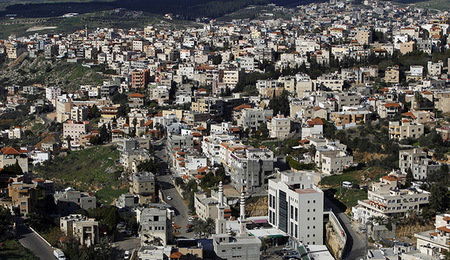 Umm al-Fahm from the air. |
Jan. 7, 2014 update: Shlomi Eldar finds that Lieberman's statement "caused an uproar ... the sense of anger and insult are enormous. ... Suddenly, about 300,000 residents of the Wadi Ara Triangle, and the rest of the Arab citizens of the State of Israel, understood that not only is their loyalty shrouded in doubt but also their very citizenship." He interviewed several residents of Umm al-Fahm and quotes them:
Wisam Agbariya, deputy mayor: "It is a hallucinatory proposal. ... How can a country that is viewed by Europe as 'advanced,' tell a segment of its population that it does not want them? Is this the true face of the State of Israel?"
Ahmed Machmid, a bookkeeper, nursing student, and father of two: "I am worried what will be if it does happen. What will be with us? How will we live? How will we become part of a state that has not been established yet? And if it [a Palestinian state] is established, that will be the beginning of our destruction. How does a country that calls itself democratic, dare to expel 300,000 people? Are we supposed to be the victims of this peace? ... Only few people call themselves Palestinians and define themselves as such. I was born in the State of Israel, and I am in favor of the security of the State of Israel and I honor its laws. I am not a Palestinian, I am an Arab-Israeli. That is my identity. ... Go out to the street to talk to the people and ask who is willing to become part of the Palestinian Authority. No one. ... If they expel us, I won't live in a Palestinian state; I'll emigrate abroad. Just imagine, all the laborers working in Jewish cities will suddenly lose their livelihoods. Who will support them? Just imagine what kind of unemployment will prevail. I am in favor of peace and I want there to be peace and that the Palestinians will have a state of their own, but as far as I am concerned, my country was established in 1948. This is my country, I was born in this country. What is the problem with Arabs also living in the Jewish state?
Khaled Pauwer, father of two. "You know what, I'm Israeli. Sometimes I visit Jenin, sometimes Ramallah and I see a different mentality there, different culture, different people. I don't belong to Palestine, I am Israeli — in my opinions, my thoughts. Do you know what my wife says? That we should move to Nazareth, maybe it won't catch up with us there. What can I tell her, that it's impossible to escape? ... My children made a joke out of [Lieberman's statement]. There are some children from the territories [i.e., the West Bank] who sold sweets and Band-Aids in the [Israeli] Arab cities so my kid said to me, 'Dad, I am going to sell things, get the stuff ready for me.' As a father, how will I explain to them? That maybe we'll become like those children who come from Tulkarm and Jenin to beg for alms? What will I tell the child, that we won't have a livelihood? That his mother, who is a teacher in a school, would no longer be able to teach in her school? ... There is a handful of people who champion the Palestinian nationality, they are the minority.
Muhamed Machamid: "They won't accept us there in the territories because they don't like us. It will take years and years until we become integrated there, economically and socially. I believe that there will be riots. Just imagine 300,000 people whom you uproot from their land. You get them angry, they'll be on the lookout for the State of Israel, they'll want to take revenge. Israel will create an enemy for itself, an enemy from within."
A city resident who asked not to be named: "The vast majority of the Wadi Ara residents are good citizens of their country. Don't make a historic mistake, it will be painful for everyone."
Jan. 8, 2014 update: Lieberman defended his plan in a statement on his Facebook page.
The Arabs of Wadi Ara have suddenly become adorers of Zion. In interviews with the residents of Umm al-Fahm on the various television stations we saw those same people who, instead of celebrating [Israel's] Independence Day, mark Nakba Day and wave black flags instead of Israeli flags, those same people who, in their rallies wave pictures of [Hezbollah head Hassan] Nasrallah and the flags of Hamas and Hezbollah — those people are now objecting to the intention that as part of a peace agreement that will include land and population transfers, they will be citizens of a Palestinian state. All of a sudden, they are an integral part of the State of Israel, suddenly Herzl is their national hero, Hatikva is a hit, and MK Ahmad Tibi [who has come out against the plan] and his friends have a 'yearning Jewish soul [a phrase in the Israeli national anthem].
He also took a dig at Mahmoud Abbas: "Abbas, who is so concerned about freeing the Israeli Arabs sitting in prison because of terror activities against Israel, is suddenly crying out in protest against the thought that they will become his citizens."
Jan. 17, 2014 update: Lazar Berman reports in Times of Israel that Israel's prime minister accepts the idea of moving some part of the Triangle to the PA:
Unnamed official sources told the newspaper that Netanyahu has concluded that, in the event of an agreement with the Palestinians, the demographic factor must be taken into consideration, which would mean amending the borders to include some Israeli Arab towns in the new Palestinian state as Israel would include some West Bank Jewish settlements. The officials said that, during negotiations with the Palestinian Authority in recent months, Livni brought up the names of specific towns and villages to be included in the Palestinian state.
"She is now expressing support for expanding the principle in the direction of the Lieberman plan," one source said. "Pay attention to the fact that, after the things Lieberman said at the ambassadors' summit [to the effect that peace required exchanging territory and populations], there were two people who chose not to discuss the issue — Netanyahu and Livni," a senior official said. "It's not a coincidence."
Apr. 17, 2014 update: Lieberman has reiterated his plan to move the Triangle to the Palestinian Authority in any future agreement, writing on his Facebook page:
I can promise that Umm al-Fahm will be part of the Palestinian state and not part of Israel. ... I can promise all the inciters that we will do everything to ensure that in any future diplomatic arrangement they will find themselves were they belong.
Sep. 23, 2014 update: Palestinian Media Watch reports that "Official PA daily lauds Israel's treatment of Palestinian workers."
Nov. 28, 2014 update: Avigdor Liberman has published a peace plan that involves paying Arabs to leave Israel; let's see how those Arabs respond to it. The Times of Israel reports:
he favors ceding Arab-majority areas in northern Israel to a future Palestinian state and providing economic incentives for Arab-Israelis — about 20 percent of Israel's population — who do not identify with the state to encourage them to leave the country, and make a future Palestinian state their home.
An offer to Israeli-Arabs "who feel part of the Palestinian people [to leave the country] will solve the problem of divided loyalties and 'split personality' they suffer from. They can decide if they are part of the state of Israel or Palestine."
"Those who decide that they identify as Palestinian could give up their Israeli citizenship and become citizens of a future Palestinian state. The State of Israel should encourage this via a system of economic incentives," the plan states. ...
"The conflict Israel faces is not just a territorial conflict with the Palestinians; rather it is a combined three-dimensional conflict: Arab countries, Palestinians and Israeli-Arabs. Therefore, any agreement with the Palestinians has to include peace agreements with the Arab states and population and territory exchanges with Israeli-Arabs," reads the manifesto. ... "The nation of Israel is more important than the land of Israel," the paper quotes Liberman saying, explaining why he's willing to give up land.
Jan. 4, 2015 update: The Israel Democracy Institute's annual Democracy Index finds that 65 percent of Israeli Arabs describe themselves as either very or quite proud to be Israeli.
Jan. 15, 2015 update: Avigdor Liberman, head of the Yisrael Beytenu party, unveiled his party's campaign slogan: "Ariel to Israel, Umm al-Fahm to Palestine." He explained: "There's no reason that inciters such as [MK Hanin] Zoabi, [MK Ahmad] Tibi and Raed Salah [leader of the northern branch of the Islamic Movement in Israel] should be Israeli citizens. ... We're presenting a pragmatic approach of the national camp in Israel: Israel as a Jewish state with a faithful population."
To which, Umm al-Fahm's Deputy Mayor Wissam Qahwash replied that the slogan is "a disgrace to us, that a party eliminates citizens of the country in an abusive manner like this. This slogan is appropriate for World War II."
Apr. 6, 2015 update: Yediot Ahronot quotes M, a resident of Yarmouk, the so-called Palestinian refugee camp in Damascus under siege by ISIS:
Today I walked through the bombs and sniper fire to feed my children," he tells Ynet. "You have to understand, my neighbor went to get food for his children, was shot by a sniper and died. Today we buried him. That's how it here: If you want to feed your children, you need to take your funeral shroud with you. There are snipers on every street, you are not safe anywhere. ... There is no choice but to call on Israel for help; the Israelis are more compassionate than the Arabs.
May 11, 2015 update: An Urdu-language Pakistani weekly, Haftroza al-Qalam, published by the jihadi organization Jaish-e-Muhammad, called the Islamic Republic of Iran a bigger threat to the Muslim world than Israel.
July 5, 2015 update: After Hamas demolished an ISIS-affiliated mosque in Gaza, ISIS called Hamas "worse than the Jewish and American occupiers."
July 20, 2015 update: Here's a novel twist: "Arab workers demand Israeli law be applied to the factory in Samaria where they work - Israeli court rejects the petition." Details from Arutz Sheva:
A group of Arab residents of Samaria living under the administration of the Palestinian Authority (PA) has submitted a legal demand asking that Israeli employment laws be implemented in the area where they work - the industrial region of Nitzanei Shalom, just over the 1949 Armistice lines to the east of Netanya.
The reason for the suit is a desire on the part of the Arab workers to receive various social rights enshrined in the Israeli laws, benefits they currently do not enjoy under the PA.
However, a Tel Aviv-Yafo regional court ruled against the workers, deciding not to apply Israeli law to their work conditions. The Arab litigants were even forced to pay 20,000 shekels (over $5,200) for legal expenses and attorney's fees. The Palestinians appealed to the national labor court, but to no avail: the court upheld the previous verdict.
Aug. 3, 2015 update: "Breaking taboo, Jerusalem Palestinians seek Israeli citizenship" writes Maayan Lubell. Details:
More and more Muslim residents are swearing the oath, "I declare I will be a loyal citizen of the state of Israel," to become a naturalized Israeli citizen.
Data obtained by the Jerusalem Institute for Israel Studies indicates a jump over the past decade, rising from 114 applications in 2003 to between 800 and 1,000 a year now, around half of which are successful. ... Interior Ministry figures obtained by Reuters show there were 1,434 applications in 2012-13, of which 189 were approved, 1,061 are still being processed and 169 were rejected. The remainder are in limbo.
The reasons are complex:
In part it reflects a loss of hope that an independent Palestinian state will ever emerge. But it also reflects a hard-headed pragmatism - an acknowledgement that having Israeli citizenship will make it easier to get or change jobs, buy or move house, travel abroad and receive access to services. ... For many East Jerusalemites, part of the fear is that Israel could revoke their blue ID at any time.
Aug. 11, 2015 update: Even Hussam Ayloush of CAIR, who viciously calls Israelis "Zionazis," has a good word for their police when compared to law enforcement in Syria or Egypt.
Aug. 21, 2015 update: David Pollock sums up a new poll: "Half of Jerusalem's Palestinians Would Prefer Israeli to Palestinian Citizenship." The context:
In a similar poll in September 2010, one-third picked Israeli over Palestinian citizenship; by September 2011, that proportion had risen to 40%. As of today it has risen again to just over half. This is dramatically different from results in the West Bank or Gaza, where a mere 4% and 12%, respectively, would prefer Israeli citizenship.
Sep. 3, 2015 update: Some Gazans are desperate to move to Israel:
IDF sources say there has been a dramatic upswing in the number of Gazans seeking shelter in Israel.
There is no shortage of Gazans seeking to provide Israel with intelligence, the sources said, because many see such deals as their "ticket" out of Gaza, which has become much more oppressive since the end of Operation Protective Edge.
According to the army, there has also been a huge increase in the number of Gazans seeking to sneak into Israel. Almost all are arrested within a few hundred meters of the border fence, and are usually returned to Gaza – although, say officials, many of them beg to be allowed to remain in Israel.
Sep. 16, 2015 update: Prolonged periods without electricity during a heat wave has prompted pro-Israel statements, Arutz Sheva reports in "Angry Gazans Say 'Israel Better Than Hamas'." Details:
Prolonged disputes between Hamas and the Palestinian Authority (PA) have left Gazans without electricity for eight-hour stretches - and Gazans say that they prefer Israel over their Hamas rulers as the crisis continues. "The Israelis are better," Ibrahim, one Gazan, told Channel 2 Wednesday. "All talk on the street is about the electricity. All the public talks about is how hard it is in Gaza."
Sep. 23, 2015 update: Al-Monitor, ever-hostile to Israel, manages to turn a story, by Adnan Abu Amer, "Palestinians search for better life in Israel," into negative coverage of Israel. Some highlights:
High unemployment rates and poor living conditions are driving some Palestinians to seek relief by illegally crossing into Israel.
The Israeli army announced Sept. 14 that it had arrested five Palestinians who had breached the border fence east of Khan Yunis in the southern Gaza Strip. On Sept. 20, a security source in Gaza said, on condition of anonymity, that 45 young men had tried to infiltrate Israel from the Gaza Strip just since the beginning of this month.
Those numbers shed light on the phenomenon of young Palestinians risking detention or even death to seek job opportunities in Israel. The eight-year blockade of Gaza has created an incredible unemployment rate there. The Palestinian Central Bureau of Statistics said the rate reached 44% in April.
Iyad Bezm, spokesman for the Interior Ministry in Gaza:
"Infiltrators from Gaza range between 17 and 24 years of age and their primary motive is to escape the poor economic situation. The security services in Gaza deal with each individual on a case-by-case basis by subjecting them to investigation to find out the motives of their infiltration. These services take all procedures to prevent infiltration, given its security risk to the people of the Strip and the resistance." ...
In addition to escaping poverty, infiltrators have three main motivations: to escape criminal prosecution, to act as an agent for Israeli intelligence and to avoid falling into the hands of armed Palestinian factions. The factions have executed people trying to escape to Israel, especially during the 2014 war on Gaza.
Dec. 22, 2015 update: The renowned journalist Faisal al-Qassem published side-by-side pictures of an a plump prisoner (the notorious Samir Kuntar) in Israel and an emaciated one in Syria, then praised Israel. "Samir Kuntar left an Israeli prison with a beer belly and a doctorate. At the other extreme, this is how Syrians leave Assad's prisons."
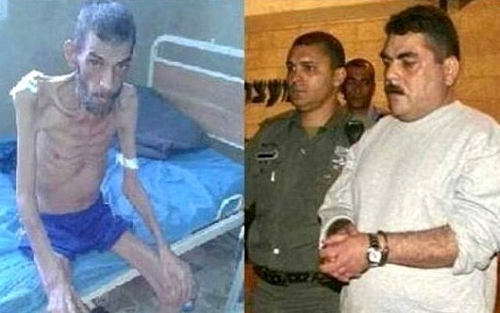
May 10, 2016 update: Emad Halayqa, an activist in the Hamas-affiliated student organization Kutla Islamiya at Birzeit University in Ramallah, described on his Facebook page how he was beaten by Fatah's security agency. At the end of his post, he added: "Send me the Jews. I wish they would arrest me and save me from your violations."
Aug. 8, 2016 update: Ahmad Adnan, a Saudi journalist, writing in Al Arabiya: "the practices of Iran, a Muslim country, are worse than those of Israel."
Sep. 12, 2016 update: For the first time since he became Israel's defense minister, Avigdor Liberman has reiterated his call for the transfer of some Israeli Arabs to the future Palestinian state: "I don't see a reason why the [Arab] 'Triangle' and Umm al-Fahm need to be a part of Israel."
Sep. 26, 2016 update: An increased Palestinian interest in becoming Israelis is not meeting with an enthusiastic Israeli response, writes Dov Lieber at "Israel almost entirely halts citizenship approvals for East Jerusalemites." Details:
Since Israel captured East Jerusalem in 1967, it has formally offered residents living in that area the option to apply for Israeli citizenship. Until around a decade ago, very few did, as the vast majority identified, and still do identify, as Palestinian. ...
According to statistics obtained by The Times of Israel, between 2003 and 2013, Israeli citizenship was denied or delayed to about half of East Jerusalemites who applied for it. However, over the past three years, the processing of citizenship applications for East Jerusalemites has come to an almost complete halt. Between 2014 and September 2016, of 4,152 East Jerusalemites who applied for citizenship, only 84 were approved and 161 were rejected. The rest of the applications are pending — formally, still being processed. ...
Some East Jerusalemites and the lawyers who deal with their citizenship requests say the government deliberately makes the application process itself difficult in order to discourage East Jerusalemites from even requesting citizenship. This includes the long-standing demand they have proficient Hebrew, even though Arabic, their native tongue, is an official language of the Israeli state.
The Population and Immigration Authority, which is responsible for the process, strongly denies this accusation, and contends that it is carrying out its responsibilities under the law. "The claim of allegedly posing obstacles is unfounded and each request is examined in its own right," the authority's spokesperson told The Times of Israel.
Sep. 28, 2016 update: Seyyed Hassan Nasrallah, secretary-general of Hezbollah said, according to Lebanon's Al-Akhbar, that "Wahhabism is more evil than Israel, especially [in] that it seeks to destroy others and eliminate whatever thing that has to do with Islam and its history."
Jan. 4, 2017 update: Ben Lynfield notes that Prime Minister Netanyahu's coming under investigation, just like any other citizen, has some Arabs admiring Israel.
Fayez Abu Shamaleh, a Gazan political analyst:
No one is above the law in Israel. The gates of the prisons [were] locked behind the president of the state and the former prime minister Olmert. ... Don't ask me why Israel achieved a victory over all the Arab countries.
Sufian Abu Zaida, a former PA "minister" of prisoner affairs:
The investigation of the prime minister for corruption and bribe taking is the real expression of independence of the judiciary and separation of authorities. It's the real expression of a genuine state of law where everyone is equal before the law and not a state of counterfeit law.
It is of no use to Netanyahu that he is responsible for the Israeli police – he can't threaten anyone to get them to overlook the suspicions or accusations he faces, he can't evade the investigation by portraying it as a conspiracy against the nation. He can delay it for a day or two or a week but he can't avoid it forever or use his powers to cancel the investigation.
Netanyahu can't use the security apparatus like the Shin Bet or Mossad to threaten anyone from the police or judiciary under various pretexts. In the rule of law their mission is to protect the country, the law and the citizen. Their mission is not to protect the president or the prime minister or any other official. ...
He must give convincing answers to the questions put to him. If they are not convincing, it will end in a charge sheet and a trial and his fate will be like that of his predecessor Olmert. ...
In a state of law, the security, executive and judicial apparatuses are not used to serve the president or the prime minister or to be used as a tool or sword on the head of political opponents by fabricating accusations against them of corruption and if they are heavyweight former officials, accusing them of killing. In the state of law, livelihoods are not used as a sword against the necks of people.
Feb. 16, 2017 update: A complex poll of Israelis and Palestinians finds that the latter say that working in and having access to Israel are among the most important incentives to accept a detailed "peace package" with Israel.
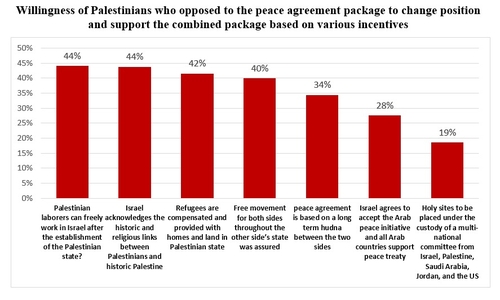
Mar. 24, 2017 update: Jerusalem's Palestinians are rushing to take out Israeli citizenship even as the Israeli authorities are dragging their feet at bestowing it.
Jan. 28, 2020 update: The Trump administration's "Peace to Prosperity" vision, released with fanfare today, includes a paragraph about moving the Triangle to the Palestinian Authority, which then turns into the State of Palestine (I have fixed the errors):
The Triangle Communities consist of Kafr Qara, Ar'ara, Baqa al-Gharbiyye, Umm al Fahm, Qalansawe, Tayibe, Kafr Qasim, Tira, Kafr Bara and Jaljulia. These communities, which largely self-identify as Palestinian, were originally designated to fall under Jordanian control during the negotiations of the Armistice Line of 1949, but ultimately were retained by Israel for military reasons that have since been mitigated. The Vision contemplates the possibility, subject to agreement of the parties, that the borders of Israel will be redrawn such that the Triangle Communities become part of the State of Palestine. In this agreement, the civil rights of the residents of the triangle communities would be subject to the applicable laws and judicial rulings of the relevant authorities.
Comments: (1) Note that the idea is tentative: "contemplates the possibility, subject to agreement of the parties."
(2) The plural, "parties," implies general agreement to this shift in borders.
(3) Given the anecdotal evidence, survey research, and politicians' statements cited above, such agreement appears impossible to attain.
Feb. 4, 2020 update: I analyze the just-released Trump plan today at "Israeli Arabs Say No to Palestine."
Apr. 23, 2020 update: The Jewish People Policy Institute has published its 2020 Pluralism Index with a surprising result concerning the primary identity of the Muslims of Israel, whether Arab, Israeli, Palestinian, or Arab Israeli: it finds they feel ever-more Israeli.
This year a very meaningful difference was detected on this question, compared with last year, mainly in the responses of Muslim Arabs (who constitute the decisive majority of non-Jews in Israel). The change consists primarily of a steep rise in the percentage of those who define their primary identity as "Israeli," versus a substantial decline in the percentage of those who define themselves as "Arab," and a sharp drop in the percentage of those who define themselves as "Palestinian." In fact, in this year's survey fewer than one in ten non-Jews in Israel said that their primary identity was "Palestinian," while a quarter of the respondents (23%) defined themselves as "Israeli." The percentage of respondents who self-defined as "Arab Israeli" remained virtually unchanged, such that, on the whole, nearly three out of four non-Jews in Israel defined themselves as "Israeli" or "Arab Israeli."
Why has this happened? One hypothesis concerns unprecedented recent developments:
that it resulted from the discourse surrounding the elections; the substantial Arab election-day turnouts; and the notable presence of the party representing most Arab voters (the Joint List) in the Israeli political arena, including coalition-building efforts and other parliamentary maneuvers. To this we may add the high visibility of Arab medical personnel during the coronavirus crisis.
This could be big:
Much has been said and written this year about the 2019-2020 election period as a turning point in terms of Arab willingness to participate in the national political sphere. It is likely that the JPPI survey reflects this change and the way in which it is also reshaping Arab Israeli consciousness.
June 24, 2020 update: Israeli reporter Zvi Yechezkeli went undercover to the West Bank and asked questions about attitudes toward Israel. Some replies:
One Palestinian woman speaking to the reporter by phone estimated that in her village, about 80 percent of people would prefer Israeli citizenship and 20 percent want it but would not say so publicly. ...
Another man noted that many Palestinians support getting Israeli identification papers. "That's what everyone thinks. Believe me, ask a child. Even he will tell you, even if he doesn't work in the settlements, he prefers to get Israeli citizenship as a child and then he won't be restricted at the checkpoints or anywhere."
Speaking to a man leaning on his car, Yechezkeli asked him, "Do you prefer living under Israeli sovereignty or the P.A.?" He answered, "No, Israel, really. The soldier's military boots are preferable to Abu Mazen [P.A. head Mahmoud Abbas] on my head."
Another Palestinian man on the street said, "The Palestinians are a nation of idiots. Come on! The Israelis are a million times more compassionate than the P.A." "You mean it's better if Israel's responsible for the whole area," asked Yechezkeli. Answered the man: "A million times better."
July 7, 2021 update: A young Palestinian builder spent 10 days in a Palestinian jail says he was arrested over an oblique insult aimed at the Palestinian Authority he posted on Facebook. In jail, he said he had been roughed up and humiliated during daily interrogations. Previously, he had spent 30 months in Israeli prisons for throwing stones at soldiers, so he could compare the two: "They have rules," he said of the Israelis. "There's a law, a system. There's no law in the authority."
Jan. 5, 2022 update: Taghreed Ali reports in Al-Monitor that some 80,000 Palestinian residents out of a total population of 330,000 in eastern Jerusalem have applied for Israeli citizenship, or roughly one-quarter of those eligible.
Feb. 23, 2022 update: An Israeli Muslim was arrested in Saudi Arabia while on the lesser pilgrimage for praising Israel. A video clip shows Sami al-Obara fuming that he had wanted to see a doctor but was instead sent to the pharmacy, then saying: "I swear to it, my brother, we live a good country. Israel is the best country in the world. Israel is the best country in the world."
Mar. 17, 2022 update: A report from the Israel Democracy Institute, the Annual Statistical Report on Arab Society, provides much good news about the Muslims of Israel. For a summary, click here.
July 8, 2022 update: A Washington Institute for Near Eastern Policy poll finds that nearly half of Arab residents of Jerusalem would prefer to become Israeli citizens rather than citizens of a Palestinian state.


