
That's the brief description for plans for the new U.S. embassy in Baghdad in today's Washington Post. Here are some details:
The Bush administration is scrambling behind the scenes to finalize plans for a new Baghdad embassy that will require as many as 4,000 staff but, because of security fears, will remain headquartered in Saddam Hussein's former palace in the U.S.-protected Green Zone after the occupation ends, U.S. officials said.The sheer magnitude of the embassy—which will house the U.S. military command and administer an aid program more than three times as large as foreign assistance allocated to the rest of the world—has taxed State Department and Pentagon planners who have been commuting between Baghdad and Washington in recent weeks. ...The administration had originally considered opening a token embassy presence in a facility outside the Green Zone, where an ambassador could at least carry out ceremonial functions—and avoid the imagery of remaining in Hussein's Republican Palace. But Washington has abandoned the idea because the facility and U.S. Embassy personnel would be too vulnerable to attacks, U.S. officials said.
Comment: I am left uneasy by the monumental size of this embassy, its massive aid program (read this phrase again: "more than three times as large as foreign assistance allocated to the rest of the world"), and the need to huddle in Saddam's old palace grounds. Far better would be to turn decisionmaking over to a strong Iraqi leader and maintain a small U.S. presence. If not done earlier, I fear, this will be done later, and under less auspicious circumstances. (March 9, 2004)
Apr. 22, 2004 update: Undersecretary of State Marc Grossman indicated in congressional testimony that the State Department plans for only 1,000 Americans to work in the Vatican-sized Baghdad embassy – and not 3,000, as had been earlier projected.
Apr. 22, 2006 update: Two years later, the embassy looms more gargantuan than ever. An Associated Press report notes that 5,500 Americans and Iraqis working at the embassy and that the fortress-like complex on the Tigris River will include, by its completion in mid-2007, 21 buildings on 104 acres (making it two-thirds the size of the National Mall in Washington, D.C.). Original cost estimates were more than $1 billion. It will have its own water wells, electricity plant, wastewater-treatment facility, and so on, so as "to allow 100 percent independence from city utilities." Six apartment buildings, 2 major diplomatic office buildings, villas for the ambassador and the deputy, will be complemented by a recreation building with swimming pool, gym, commissary, food court, and American Club. In all,
"Embassy Baghdad" will dwarf new U.S. embassies elsewhere, projects that typically cover 10 acres. The embassy's 104-acre parcel is six times larger than the United Nations' compound in New York, and two-thirds the acreage of the Mall in Washington.
The second-most expensive embassy is the $434 million U.S. mission underway in Peking.
The International Crisis Group joins me in lambasting this excess: "The presence of a massive U.S. Embassy—by far the largest in the world—co-located in the Green Zone with the Iraqi government is seen by Iraqis as an indication of who actually exercises power in their country." The State Department spokesman, Justin Higgins, defends its size: "It's somewhat self-evident that there's going to be a fairly sizable commitment to Iraq by the U.S. government in all forms for several years."
Comment: That commitment would be best shown by treating the Iraqis as adults and expressed by staffing the country with a normal-sized embassy.
June 7, 2006 update: More facts on the U.S. "super-embassy" in Baghdad, courtesy of Oliver Poole in the Daily Telegraph (London):
Once an army of more than 3,500 construction workers have completed it in June 2007, the vast complex will be the new hub of the American administration in Iraq. Protected by 15ft thick walls and ringed by military guards, it signals the seriousness of America's intentions to retain a large and long-term presence in the country.
The £315 million building's existence is meant to be a secret. Any request for a comment from the US State Department is met with a terse rebuff, and a plea for a photo opportunity is deemed out of the question. But it is impossible to keep hidden a complex that will be the size of Vatican City with the population of a small town, especially when it is lit up at nightfall to permit work on it to continue 24 hours a day.
America's largest existing embassy, covering 10 acres and consisting of five buildings, is in Beijing. It will soon be dwarfed by the new Baghdad mission. It takes nearly five minutes to drive along just one side of its 104 acres, which will contain 21 buildings, the first floors of which are clearly visible along with the metal trellising that provides protection from mortars. The surrounding city may still have erratic clean water supplies and intermittent electricity but the new embassy will have a guaranteed supply with its own water treatment facilities and a generator.
The only details of what the completed complex will look like can be found in a recent Senate Foreign Relations Committee report. There will be six blocks with 619 one-bedroom flats, a recreation building, a beauty parlour, gym, swimming pool and even its own school. A lavish "American Club" will provide a venue to relax in the evening and a site to host receptions for visiting dignitaries.
The majority of the construction workers have been brought from Kuwait amid security concerns about hiring Iraqis. But American staff are completing the most sensitive parts of the facility. The report also explains why such a luxurious site is needed: the State Department is finding it more and more difficult to persuade its employees to come to Iraq with its constant threat of violence. The present accommodation in the Republican Palace in the centre of the Green Zone further dissuades the faint-hearted. Lack of space means many of its 3,000 staff have to sleep in trailers and its temporary offices lack even enough chairs.
It is only in recent weeks that Iraqis have begun to realize the new complex is being built. Last month a local newspaper became the first to write an article on it. It questioned why the US had been given land in the centre of Baghdad for free instead of having to pay the market price for it.
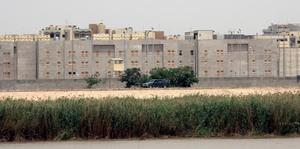
Part of the U.S. Embassy in Baghdad, Iraq, viewed from across the Tigris River.
Comment: If you ask me, the Iraqis are asking a reasonable question.
Mar. 2, 2007 update: Former secretary of state Lawrence Eagleburger explodes when asked about the current U.S. Embassy in Baghdad – not the one being built. "I defy anyone to tell me how you can use that many people. It is nuts . . . it's insane and it's counterproductive . . . and it won't work. I've been around the State Department long enough to know you can't run an outfit like that. ... We're throwing people and money at something without estimating what the culture demands. It's hubris."
May 24, 2007 update: In "A white elephant?" Anne Gearan of the Associated Press looks dubiously at the Baghdad embassy. She reports that the 21-building complex in a 104-acre compound – now set to open in September 2007 (earlier, it was to be June 2007) – will cost $592 million, offer desk space for about 1,000, and house about 615 people in "comfortable but not opulent" one-bedroom apartments. Note that these latter numbers are way down from earlier plans.
As Gearan delicately puts it, "The complex quickly could become a white elephant if the United States scales back its presence and ambitions in Iraq." Or as Secretary of State Condoleezza Rice even more delicately told a Senate panel earlier this month, "We do believe that the embassy compound was right-size at the time that it was presented to the Congress. There have been some additional issues since that time."
May 30, 2007 update: For an aerial view of the 104 prime, riverside acres in the middle of Baghdad, plus what is being built there, see "Eyeballing the US Embassy Baghdad."
June 19, 2007 update: The embassy's problems are also current, not just future, reports Glenn Kessler in the Washington Post.
With a 2007 budget of more than $1 billion and a staff that has expanded to more than 1,000 Americans and 4,000 third-country nationals, the embassy has become the center of a bureaucratic battle between Crocker, who wants to strengthen the staff, and some members of Congress, who are increasingly skeptical about the diplomatic mission's rising costs. ... "Having said over and over again that we don't want to be seen as an occupying force in Iraq, we're building the largest embassy that we have. . . . And it just seems to grow and grow and grow," Sen. Patrick J. Leahy (D-Vt.) said to Rice during a hearing last month. "Can we just review who we really need and send the rest of the people home?"
July 5, 2007 update: The vast new embassy is not only conceptually flawed but logistically a nightmare, as Glenn Kessler of the Washington Post details in "Construction Woes Add to Fears at Embassy in Iraq."
A toughly worded cable sent from the embassy to State Department headquarters on May 29 highlights a cascade of building and safety blunders in a new facility to house the security guards protecting the embassy. The guards' base, which remains unopened today, is just a small part of a $592 million project to build the largest U.S. embassy in the world. ...
The first signs of trouble, according to the cable, emerged when the kitchen staff tried to cook the inaugural meal in the new guard base on May 15. Some appliances did not work. Workers began to get electric shocks. Then a burning smell enveloped the kitchen as the wiring began to melt. All the food from the old guard camp—a collection of tents—had been carted to the new facility, in the expectation that the 1,200 guards would begin moving in the next day. But according to the cable, the electrical meltdown was just the first problem in a series of construction mistakes that soon left the base uninhabitable, including wiring problems, fuel leaks and noxious fumes in the sleeping trailers.
"Poor quality construction . . . life safety issues . . . left [the embassy] with no recourse but to shut the camp down, in spite of the blistering heat in Baghdad," the May 29 cable informed Washington. ... After the electrical problem was discovered and no quick fix seemed available, the embassy was forced to serve the guards MREs (meals-ready-to-eat) for several days until all the food could be moved back to the old housing, known as Camp Jackson, according to the embassy cable's detailed account. The original plan was for the guards to wait only one or two weeks before the electrical issues were fixed.
But the problems mounted. The 252 prefabricated residential trailers, with either two or three rooms each, filled with formaldehyde fumes. The trailer manufacturer, a Saudi company called Red Sea Housing Services Co., confirmed to the embassy it had used the toxic chemical in preparing the housing. Red Sea told the embassy to keep the windows open and use charcoal in the rooms to absorb the odor, but "the fumes are still prevalent," the cable said.
The embassy cable noted that five people had been identified at various times as the project manager, and that it was all but impossible for embassy officials to obtain information from them, with no one seeming to be in charge. "Two of the project managers have had extremely limited previous project management experience," the cable said. A $500,000 project to install a fire-suppression system appeared to be proceeding without proper supervision, it added. ...
The embassy cable noted that there had been at least four fires in dining facilities in Iraq blamed on similar problems. At a May 16 meeting, officials showed photos indicating fire hazards in the dining hall's wiring that were so serious that the few guards who had moved into the base's new residential housing were sent back to Camp Jackson. "It was unknown as to whether similar wiring was present in the residential trailers," the cable said.
The guard camp is far from the only challenge at the embassy complex. There's also, for example, a little problem with the electrical system.
On May 24, OBO [Overseas Buildings Operations, a division of the State Department] declared that the wiring problem had been fixed, but KBR [a Texas-based company that runs many facilities in Iraq for the U.S. government] conducted an inspection a day later and said the problems remained. KBR found that the reworked wiring "is still substandard," the cable said. The embassy also said that it believes it has discovered counterfeit wiring, labeled as 10mm when it was actually 6mm.
Meanwhile, on May 18, OBO unexpectedly informed the embassy that it would soon stop maintaining the power stations and water-treatment facilities at the new guard base. The embassy protested that it had limited staff to operate the equipment, which needs to be in operation constantly to avoid costly repairs. First Kuwaiti provided only "minimal spare parts" for the power generators and "less than minimal spare parts" for the water-treatment plant, the cable said.
Finally, on May 25, a KBR hazardous-materials expert discovered that all 10 generators had developed leaks. The fuel tanks were installed without corrosion protection or leak detectors, and fuel had begun to saturate the soil around the tanks. The cable said that Teflon tape designed for water pipes had been used on the fuel tanks, and that such tape "will dissolve on contact with diesel fuel." KBR refused to operate the power generators unless its liability was waived. The result, the cable concluded, is that the guards will continue to stay in "tents and deplorable living conditions." Officials now say that the guard base will not be ready until Aug. 1.
Sep. 1, 2007 update: In "Fortress America," Jane C. Loeffler, author of The Architecture of Diplomacy: Building America's Embassies, takes a whack at the Baghdad extravaganza, calling it "a massive, fortified compound" that "stands out like the crusader castles that once dotted the landscape of the Middle East." For her, "Its size and scope bring into question whether it is even correct to call this facility an 'embassy'." After running through the stats, Loeffler criticizes it for being "this huge, this costly, and this isolated from events taking place outside its walls."
Traditionally, at least, embassies were designed to further interaction with the community in which they were built. Diplomats visited the offices of local government officials, shopped at local businesses, took their suits to the neighborhood dry cleaner, socialized with community leaders, and mixed with the general public. Diplomacy is not the sort of work that can be done by remote control. It takes direct contact to build goodwill for the United States and promote democratic values. Otherwise, there would be no reason for the United States to maintain its 250-plus diplomatic posts around the world. The embassy in Baghdad, however, appears to represent a sea change in U.S. diplomacy. Although U.S. diplomats will technically be "in Iraq," they may as well be in Washington.
Loeffler sees the Baghdad compound as part of a larger trend to seclusion. "Since al Qaeda bombed the American missions in Kenya and Tanzania in 1998, the State Department has been aggressively replacing obsolete or vulnerable embassies with ones designed under a program it calls Standard Embassy Design." She also notes its inner contradiction:
Although the U.S. government regularly proclaims confidence in Iraq's democratic future, the United States has designed an embassy that conveys no confidence in Iraqis and little hope for their future. Instead, the United States has built a fortress capable of sustaining a massive, long-term presence in the face of continued violence. ... Given the costs of the new compound, the United States would not likely part with its latest Baghdad embassy under almost any circumstances, including escalating violence.
Comment: The more one learns about and thinks about this embassy, the worse a project it appears to be.
Oct. 4, 2007 update: More bad news about U.S. Embassy Baghdad, concerning major construction and logistical problems:
"They are substantially behind [plans] at this point," and it would be surprising if any offices or living quarters could be occupied before the end of the year, one [U.S. government] official told The Associated Press on Thursday. Problems identified so far are related to the complex's physical plant, including electrical systems, and do not pose a security risk, said the official, who was not authorized to speak publicly. ... That official, and another who works in Iraq, said it had been clear for some time that the promised September completion date could not be met and that State Department officials had been overly optimistic in insisting the timeline was realistic.
State Department spokesmen have in the past played down construction problems at the embassy and attributed them to the normal hurdles faced in building such a large complex. Deputy spokesman Tom Casey said Thursday he was not aware of any new major delay in the opening of the embassy that will sit on a 104-acre (42-hectare) site and have working space for about 1,000 people. The U.S. official said the complex was supposed to be substantially completed in August. The first move of offices or personnel from temporary quarters in the fortified Green Zone had been planned for this fall.
Oct. 7, 2007 update: Further bad news: US Embassy Baghdad's costs have just soared $144 million beyond the $592 million that was budgeted, as well as being months behind schedule. Here's one reason, according to a Washington Post report: "The cafeteria was originally designed for the light duty expected at a typical embassy, where people live in their own apartments and eat only lunch on the job. But now it is being redesigned, at a cost of $27.9 million, to provide three meals a day—and to be rocket-, bomb- and mortar-proof." As for the chancery, it and another building will not be finished until early 2009. A facility to house embassy security guards due to open last December is not yet operational "because of formaldehyde fumes in 252 prefabricated residential trailers."
The cost overruns are due to a combination of "poor planning, shoddy workmanship, internal disputes and last-minute changes sought by State Department officials." For one example of the behind-the-scenes mess:
The Baghdad project has been complicated by a dispute between the U.S. ambassador in Iraq, Ryan C. Crocker, and the top Washington-based official charged with overseeing the project. That official, James L. Golden, has been barred from entering Iraq by Crocker because he allegedly disobeyed embassy orders during an investigation of a worker's death, sources said. The sources, speaking on the condition of anonymity because they were revealing sensitive internal matters, said Golden—who is a contract employee—was suspected of destroying evidence in the case. When confronted by embassy officials, he allegedly told them he worked for Washington, not the embassy. Crocker then banished him from the country.
Nov. 1, 2007 update: William Langewiesche of Vanity Fair places the embassy behemoth in historical context in "The Mega-Bunker of Baghdad," showing it to be the logical culmination of a trend that began with the overrunning of U.S. embassies in Saigon and Tehran, the Inman standards of 1985, and the East Africa attacks of 1998. Langewiesche dilates on some of the security apparatus:
The perimeter walls stand at least nine feet high and are made of reinforced concrete strong enough to deflect the blast from mortars, rockets, and car bombs that might detonate outside. Presumably the walls are watched over by fortified towers and are set back from a perimeter wire by swaths of prohibited free-fire zones. There are five defensible entrance gates, most of which remain closed. There is also a special emergency gate, meant to handle contingencies such as the collapse of the Green Zone or an American rout. Inside the compound, or very near, there is a helipad to serve the ambassador and other top officials as they shuttle around on important business. Implicit in the construction of such a helipad is the hope in the worst case of avoiding the sort of panicked public rooftop departure that marked the American defeat in Vietnam. ...
At the core stands the embassy itself, a massive exercise in the New American Bunker style, with recessed slits for windows, a filtered and pressurized air-conditioning system against chemical or biological attack, and sufficient office space for hundreds of staff. Both the ambassador and deputy ambassador have been awarded fortified residences grand enough to allow for elegant diplomatic receptions even with the possibility of mortar rounds dropping in from above.
The modern era of embassy building dates to Colin Powell's becoming secretary of state in 2001, when he revamped the department's facilities office, Overseas Buildings Operations, or O.B.O., and the development of a single architectural model, dubbed the New Embassy Compound, or NEC, for all U.S. missions, costing $35 million to $100 million apiece depending on size and other considerations. Langewiesche calls these embassies "the artifacts of fear" because
They are located away from city centers, wrapped in perimeter walls, set back from the streets, and guarded by Marines. On average they encompass 10 acres. Their reception areas are isolated frontline structures where the security checks are done. These armored chambers are designed not just to repel mobs, as in the past, but to contain individual killers and the blast from their bombs. Visitors who pass muster may be let through, but only to proceed directly to their destinations under escort, and while displaying a badge warning that the escort is required. That badge is the chain with which visitors are leashed. It can be broken by trips to the bathrooms, which however temporarily may provide some relief. ... The windows are heavy-paned slivers set high in the walls. Is it hot outside, is it cold? The natural air is filtered and conditioned before it is allowed in.
Langewiesche notes the self-contained American quality of the place: residents of the embassy compound keep away the frustrations of life in Baghdad
with simulations of home—elements of America in the heart of Baghdad that seem to have been imported from Orange County or the Virginia suburbs. The new embassy has tennis courts, a landscaped swimming pool, a pool house, and a bomb-resistant recreation center with a well-equipped gym. It has a department store with bargain prices, where residents (with appropriate credentials) can spend some of their supplemental hazardous-duty and hardship pay. It has a community center, a beauty salon, a movie theater, and an American Club, where alcohol is served. And it has a food court where third-country workers (themselves ultra-thin) dish up a wealth of choices to please every palate. The food is free. Take-out snacks, fresh fruit and vegetables, sushi rolls, and low-calorie specials. Sandwiches, salads, and hamburgers. American comfort food, and theme cuisines from around the world, though rarely if ever from the Middle East. Ice cream and apple pie. All of it is delivered by armed convoys up the deadly roads from Kuwait. Dread ripples through the embassy's population when, for instance, the yogurt supply runs low.
Trouble is, the "need for protection has limited [the diplomats'] views at the very time when globalization has diminished their roles. Security is their requirement and their curse. ... A dynamic is in play, a process paradox, in which the means rise to dominance as the ends recede from view. The United States has worldwide interests, and needs the tools to pursue them, but in a wild and wired 21st century the static diplomatic embassy, a product of the distant past, is no longer of much use." He explains:
We have built a fortified America in the middle of a hostile city, peopled it with a thousand officials from every agency of government, and provided them with a budget to hire thousands of contractors to take up the slack. Half of this collective is involved in self-defense. The other half is so isolated from Iraq that, when it is not dispensing funds into the Iraqi ether, it is engaged in nothing more productive than sustaining itself. The isolation is necessary for safety, but again, the process paradox is at play—and not just in Iraq. Faced with the failure of an obsolete idea—the necessity of traditional embassies and all the elaboration they entail—we have not stood back to remember their purpose, but have plunged ahead with closely focused concentration to build them bigger and stronger. One day soon they may reach a state of perfection: impregnable and pointless.
Apr. 15, 2008 update: After all the cost overrides, the delays, and the sub-standard work, the U.S. government took ownership of its new Baghdad embassy yesterday. The "certificate of occupancy" gives it the right to leave the Saddam Hussein palace it has been using and occupy the 27 buildings within the Green Zone, a move expected in late May or early June.
Apr. 25, 2008 update: It may have cost over US$700 million but the new embassy complex "does not have enough fortified living quarters for hundreds of diplomats and other workers, who must remain temporarily in trailers without special rooftop protection against mortars and rockets" writes Bradley Brooks in an Associated Press investigation. To make matters worse, the personnel might not move in until 2009.
Nov. 6, 2008 update: The embassy has not yet officially opened but the U.S. ambassador, Ryan C. Crocker, opened its doors anyway to host about 250 Iraqi officials, foreign diplomats, and varied dignitaries for a party to celebrate the 2008 American elections. Hoshyar Zebari, the Iraqi foreign minister, was present and took solace in the dimensions of the embassy: "The size of this embassy and the number of employees who will occupy it are a sign of the American government's commitment to democracy in Iraq."
The plaque commemorating the official opening of Embassy Baghdad.
Jan. 5, 2009 update: Five years later, the embassy finally opened today. Excerpts from the Fox News coverage of this event, relying in part on the Associated Press:
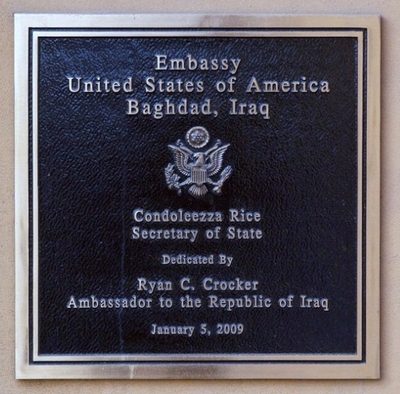
After much delay the United States opened its new $700 million embassy in Iraq on Monday, inaugurating the largest — and most expensive — embassy ever built. The 104-acre compound, bigger than the Vatican and about the size of 80 football fields, boasts 21 buildings, a commissary, cinema, retail and shopping areas, restaurants, schools, a fire station, power and water treatment plants, as well as telecommunications and wastewater treatment facilities. The compound is six times larger than the United Nations compound in New York, and two-thirds the size of the National Mall in Washington. It has space for 1,000 employees with six apartment blocks and is 10 times larger than any other U.S. embassy. ...
U.S. diplomats and military officials moved into the embassy on Dec. 31 after spending almost six years housed in Saddam Hussein's Republican Palace, which they occupied when they captured Baghdad in April 2003. ... Iraqi President Jalal Talabani praised President George W. Bush and the new embassy. "The building of this site would not be possible without the courageous decision by President Bush to liberate Iraq," said Talabani. "This building is not only a compound for the embassy but a symbol of the deep friendship between the two peoples of Iraq and America."
July 23, 2009 update: Barely has the largest embassy in the world opened but spoilsports in Washington demand a cut in its number of employees. On opening In January, it was said to have space for 1,000 employees; however, the State Department's inspector general says it has 1,873 staff. He wants a cut to acknowledge both the changing U.S. role in Iraq and the government's budgetary problems.
Aug. 29, 2009 update: Cutting back the numbers of employees won't make much of a difference for the overall embassy budget, predicts Harold W. Geisel, the State Department's acting inspector general, in a report. In fact, it will go up from a measly US$1.5 billion in 2009 to $1.8 billion in each of 2010 and 2011. Not only that, but life is about to get distinctly less comfortable as Iraqi sovereignty grows:
The Iraqi government is expanding access to the Green Zone, where the embassy is located, and two large U.S. military bases near the embassy will close over the next couple of years. American military officers are training Iraqi soldiers who patrol the Green Zone. As the Green Zone "transitions to greater Iraqi control and public access, the performance and reliability of these Iraqi forces to protect the [embassy] personnel, especially from the very real threat of kidnapping, will be paramount," the report said.
As the U.S. military leaves, diplomats will begin taking commercial flights into and out of Baghdad and will need to find new ways to get fuel for their vehicles and food supplies, almost certainly at a higher cost, the report said. U.S. Embassy employees currently fly on military aircraft to Iraq, in violation of the security agreement, the inspector general said. The Iraqi government "has not yet objected" to this, Geisel said, but the "technical violation" is of concern to U.S. military officials in Baghdad.
Oct. 27, 2009 update: The bad news about the world's biggest- and most-expensive-ever embassy never seems to end. Now, "Auditor Faults Work on U.S. Embassy in Iraq," writes John Leland. According to a 57-page report by the State Department's inspector general, the embassy complex is (in Leland's words)
a monument to shoddy work and incompetent oversight. Walls and walkways are cracking, sewage gas flows back into residences, wiring is substandard, fire protection systems are faulty and other safety provisions are not up to contract specifications. ... The report details problems with water, wiring, design, automation, sewage, walls, ceilings, power generators, emergency safe areas and structural reinforcement to protect the embassy from earthquakes.
Construction "was significantly deficient in multiple areas" and may not even meet safety codes. The IG wants the State Department to seek US$132 million in damages from the main construction company, First Kuwaiti General Trading and Contracting, which was paid $470 million for its work on the embassy.
The errors listed in the report are large and small. The inspector general called for the bureau to seek $4.6 million in restitution from First Kuwaiti to repair safe areas for staff members, which were not built to specification; $14 million to install seismic bracing against earthquakes; $11 million to compensate for an inefficient power plant; $4.6 million to replace fire protection systems; and $1.5 million to repair faulty plumbing in 200 locations where sewage gas could escape.
Mar. 30, 2010 update: I published a column on this topic today, "White Elephant in Baghdad."
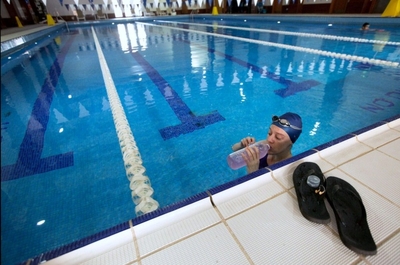
The good life - Embassy Baghdad's swimming pool.
July 25, 2010 update: And what happens to the approximately 5,000 State Department employees working at the world's biggest embassy after the American soldiers leave Iraq? Rowan Scarborough re ports on an imminent panic for The Washington Times:
"I can't think of another time when the State Department will have been required to take over a mission of this magnitude," Grant S. Green, a member of the special Commission on Wartime Contracting in Iraq and Afghanistan, told The Washington Times. ... "It's a huge, huge undertaking," Mr. Green said. "I don't know how well you know State, but there is not a lot of bench strength over there. They've got huge challenges ahead of them taking over these missions, many of which they've got zero experience. ... Some of the things they will have to take over are just not in their DNA, principally in some of the security missions [the military] is performing for them today."
State sounded the alarm in an April memo that argued for continuing logistics programs and for transfering DoD equipment to State:
"If we do not acquire critical military assets before December, 2011, [State] will be forced to use less-effective technology and equipment as [State], on its own, does not have the resources or capability to provide this type of materiel support either for the Embassy in Baghdad or for [posts outside the city]. As a result, the security of [State Department] personnel in Iraq will be degraded significantly and we can expect increased casualties."
Oct. 8, 2011 update: Mary Beth Sheridan and Dan Zak write at "State Department readies Iraq operation, its biggest since Marshall Plan" in the Washington Post that after U.S. forces leave Iraq, "an estimated 16,000 civilians [will remain] under the American ambassador."
The list of responsibilities the State Department will pick up from the military is daunting. It will have to provide security for the roughly 1,750 traditional embassy personnel — diplomats, aid workers, Treasury employees and so on — in a country rocked by daily bombings and assassinations.
To do so, the department is contracting about 5,000 security personnel. They will protect the U.S. Embassy in Baghdad plus two consulates, a pair of support sites at Iraqi airports and three police-training facilities.
The department will also operate its own air service — the 46-aircraft Embassy Air Iraq — and its own hospitals, functions the U.S. military has been performing. About 4,600 contractors, mostly non-American, will provide cooking, cleaning, medical care and other services. Rounding out the civilian presence will be about 4,600 people scattered over 10 or 11 sites, where Iraqis will be instructed on how to use U.S. military equipment their country has purchased. ...
The department's inspector general reported in May that there was a risk that some of the new embassy facilities, such as hospitals and housing, wouldn't be ready by year's end.
A State Department official acknowledged that housing construction will probably extend into 2012. But temporary accommodations, at least, will be ready by the end of this year for 10,000 people at the embassy in Baghdad, said the official, who was not authorized to comment on the record. There will be no need, as initially feared, to make people use beds in shifts. "We will have the basics for everyone," he said.
Feb. 7, 2012 update: This blog has chronicled the rise of the White Elephant. A new one, "Embassy Baghdad in Decline," documents its downward trajectory.
Apr. 10, 2024 update: Beirut now has the honor of hosting the second largest U.S. embassy in the world, as Habib Battah documents in "Beirut and the Birth of the Fortress Embassy." How can this be - such a small country with a tiny economy? He explains: "the new embassy, like that of Baghdad, speaks to longstanding US military interests and activity in Lebanon and the wider region." For U.S. government information on the new embassy compound, click here.


