 Joan Peters, author of "From Time Immemorial." |
This discrepancy made little impression on her at first, Miss Peters recounts. But as she continued, the anomaly of the Palestinians "began to nag and unravel" the outline of her book. Why a separate definition for the Palestinians? What was it about them that had to be incorporated in the official description of eligibility for refugee status? Reading historical materials about Palestine in the years before 1948, Miss Peters came across a statement by Winston Churchill that she says opened her eyes to the situation in Palestine. In 1939 Churchill challenged the common notion that Jewish immigration into Palestine had uprooted its Arab residents. To the contrary, according to him, "So far from being persecuted, the Arabs have crowded into the country and multiplied till their population has increased more than even all world Jewry could lift up the Jewish population."
Arabs crowded into Palestine? As Miss Peters pursued this angle she found a fund of obscure information that confirmed Churchill's observation. Drawing on census statistics and a great number of contemporary accounts, she pieced together the dimensions of Arab immigration into Palestine before 1948. Although others have noted this phenomenon, she is the first to document it, to attempt to quantify it, and to draw conclusions from it. Her historical detective work has produced startling results, which should materially influence the future course of the debate about the Palestinian problem.
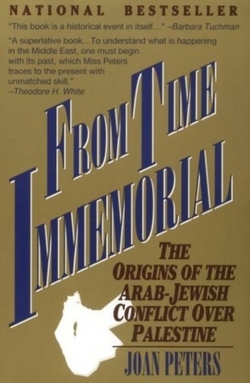 Joan Peters, "From Time Immemorial". |
Making use of work done by Kemal Karpat in the Ottoman records, Miss Peters ascertains the non-Jewish population in 1893 of the area that would later form Palestine under the British Mandate. She then divides this area into three parts: one without Jewish settlement, one with light Jewish settlement, and one with heavy Jewish settlement. She compares the non-Jewish population of each of these parts in 1893 and 1947, on the eve of Israel's independence. In the area of no Jewish settlement, the non-Jewish population stood in 1893 at 337,200; in 1947 it was 730,000, a growth of 116 percent. In the area of light Jewish settlement, the non-Jewish population grew in the same period from 38,900 to 110,900 or 185 percent. Finally, in the area of heavy Jewish settlement, the non-Jewish population grew from 92,300 in 1893 to 462,000 in 1947—or 401 percent. From these figures Miss Peters concludes that "the Arab population appears to have increased in direct proportion to the Jewish presence."
The great variance in the figures usually gets obscured because the three regions are lumped together and counted as a single unit. Population in the whole area of Mandatory Palestine grew 178 percent in fifty-four years. This increase can be accounted for through natural reproduction alone; it therefore raises few questions. But 401 percent cannot be explained in this way, much less the vast difference in growth rates among the three divisions.
How, then, to account for the varying rates? By the movement of peoples. Although the Jews alone moved to Palestine for ideological reasons, they were not alone in emigrating there. Arabs joined them in large numbers, from the first aliyah in 1882 to the creation of Israel in 1948. "The Arabs were moving into the very areas where Jewish settlement had preceded them and was luring them." Arab immigration received much less attention because both the Turkish and British administrators (before and after 1917, respectively) took little interest in them. Under the latter, for instance, "there was not even a serious gauge for considering the incidence of Arab immigration" into Palestine. The return of Zionists to the land of their ancestors was a topic of nearly universal fascination, both positive and negative. Arabs crossing newly-established and artificial boundaries caught no one's interest.
As a result, officials in Palestine counted only a small percentage of the Arab immigrants. British records for 1934 show only 1,734 non-Jews as legal immigrants and about 3,000 as illegals. Yet, according to a newspaper interview in August 1934 with the governor of the Hauran district in Syria, "In the last few months from 30,000 to 36,000 Hauranese had entered Palestine and settled there." In 1947, British officials had counted only 37,000 Arabs as the aggregate of non-Jewish immigrants in Palestine since 1917—hardly more than had come from one district of Syria in less than one year alone.
Non-Jewish immigrants came from all parts of the Middle East, including Turkey, Syria, Iraq, Lebanon, Transjordan (as Jordan was once known), Saudi Arabia, the Yemens, Egypt, Sudan, and Libya. Thanks to British unconcern, Arab immigrants were generally left alone and allowed to settle in Mandatory Palestine. So many Arabs came, Miss Peters estimates, that "if all those Jews and all those Arabs who arrived in ... Palestine between 1893 and 1948 had remained, and if they were forced to leave now, a dual exodus of at least equal proportion would in all probability take place. Palestine would be depopulated once again."
Some British administrators complained about the laxness toward Arab immigration, but to little avail. The author devotes sixteen pages to the memoranda sent in the latter part of 1937 by the British consul in Damascus, Colonel Gilbert MacKereth, in which he urges a more effective patrolling of Palestine's borders. MacKereth failed in this because British concern with immigration remained always focused on the Jews.
What took hundreds of thousands of Arabs to Palestine? Economic opportunity. The Zionists brought the skills and resources of Europe. Like other Europeans settling scarcely populated areas in recent times—in Australia, Southern Africa, or the American West—the Jews in Palestine initiated economic activities that created jobs and wealth on a level far beyond that of the indigenous peoples. In response, large numbers of Arabs moved toward the settlers to find employment.
The conventional picture has it that Jewish immigrants bought up Arab properties, forcing the former owners into unemployment. Miss Peters argues exactly the contrary, that the Jews created new opportunities, which attracted emigrants from distant places. To the extent that there was unemployment among the Arabs, it was mostly among the recent arrivals.
This reversal of the usual interpretation implies a wholly different way of seeing the Arab position in Mandatory Palestine. As C. S. Jarvis, governor of the Sinai in 1923-36, [DP: this corrects the 1984 text, which wrongly ascribed the following quote to Winston Churchill] observed, "It is very difficult to make a case out for the misery of the Arabs if at the same time their compatriots from adjoining states could not be kept from going in to share that misery." The data unearthed by Joan Peters indicate that Arabs benefited economically so much by the presence of Jewish settlers from Europe that they traveled hundreds of miles to get closer to them.
In turn, this explains why the definition of a refugee from Palestine in 1948 is a person who lived there for just two years: because many Arab residents in 1948 had immigrated so recently. The usual definition would have cut out a substantial portion of the persons who later claimed to be refugees from Palestine.
Thus, the "Palestinian problem" lacks firm grounding. Many of those who now consider themselves Palestinian refugees were either immigrants themselves before 1948 or the children of immigrants. This historical fact reduces their claim to the land of Israel; it also reinforces the point that the real problem in the Middle East has little to do with Palestinian-Arab rights.
Mar. 27, 1986 update: I replied here to a review of the Peters book by Yehoshua Porath in the New York Review of Books.
July 1, 1986 update: See "Whose Palestine" by Rael Isaac in Commentary for a review of the debate over From Time Immemorial.
Oct. 1, 1986 update: The debate continues in Commentary with erudite letters-to-the-editor about the Isaac article.
Jan. 1, 2003 update: For a slimmed-down and more reliable version of the Peters' thesis, see Fred M. Gottheil, "The Smoking Gun: Arab Immigration into Palestine, 1922-1931," Middle East Quarterly, Winter 2003.
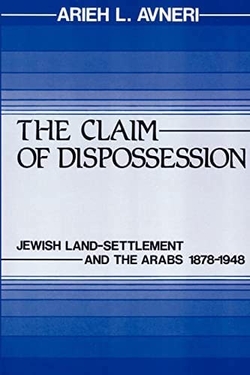 Belated mention should also be made of the important study by Arieh L. Avneri, The Claim of Dispossession: Jewish Land-Settlement and the Arabs, 1878-1948. First published in Hebrew in 1980, it appeared in English translation from Transaction Books in 1984, or the same year as Peters' analysis.
Aug. 20, 2009 update: In "The lost Palestinian Jews," David Shamah of the Jerusalem Post tells about the unlikely work of Tsvi Misinai. In sum:
After years of research, Misinai says that he can declare with certainty that nearly 90 percent of all Palestinians are descended from the Jews. "And what's more, about half of them know it," he says.
For details, read the fascinating article.
June 7, 2011 update: David P. Goldman notes in "Israel, Ireland and the peace of the aging" that the pattern of Arabs huddling for economic reasons with Jews continues as much as ever:
5,800 Palestinians are working at technology companies on the West Bank, and the booming Israeli software sector is outsourcing to the West Bank, with a third of Palestinian software companies filling orders for Israeli firms, Bloomberg News reported March 15.
And the top school for Palestinian computer science students is Ariel University in Samaria, in the midst of a settlement near Nablus. "Administrators at the Ariel University Center are proud to have the Arab students, saying their enrollment is an example of loyalty and equality among Israeli citizens. For their part, the Arab students seem not to feel uncomfortable attending the college despite its reputation and location," wrote the Chronicle of Higher Education.
"On campus the fact that we are in occupied territory is irrelevant - it doesn't affect us at all. We leave all the politics outside," the Chronicle quoted Manar Dewany, a 20-year-old student in math and computer science who commutes each day from the Israeli Arab town of Taybeh. "I never even considered it a reason for not coming here," Ms Dewany added. "I have no problem with it. Why not come here? This place is full of Arabs."
No one outsources computer technology to Egypt, where very few of each year's crop of 700,000 college graduates meets world standards. The education that young Arabs receive at the settlers' university on the West Bank is better than anything available among Israel's Arab neighbors. In a quiet way, the settlers of Samaria may do more for peace than the diplomats.
Apr. 1, 2013 update: A Ḥamas leader, Fathi Ḥammad, said on March 23, 2012, that "half of the Palestinians are Egyptian and the other half are Saudis," providing Gideon M. Kressel and the late Reuven Aharoni with a proof text for their brave and original study, Egyptian Émigrés in the Levant of the 19th and 20th Centuries. In it, they establish that many "Palestinians" in fact came from Egypt. Indeed, "the Egyptian population is a very large component that, relatively speaking, only recently arrived in Palestine."
 Jan 5, 2015 update: Joan Peters died today, age 78. I can now note that, as a friend of my parents, Richard and Irene, she was none too happy with the review and letter (referenced) above, and made her views known to them. Here she is at right with my father in Washington, D.C. in November 1981.
Sep. 3, 2018 update: Nadav Shragai has written "A salute to Joan Peters" to honor her role in the U.S. government's decision to stop funding UNRWA.
Through her thorough research, Peters was the first to expose the lie that is Palestinian refugeeism. Now, when UNRWA, the U.N. agency for Palestinian refugees, is trying to fool the world into believing there are 5.2 million Palestinian refugees, is the perfect time to return to Peters and her grand opus. ... Now that the truth is coming to light on a grand scale, we should keep in mind that Peters was the first and salute her.


