 Danny Burmawi: Last year when we first met, I asked you why you consistently use the term "Islamism" rather than "Islam." You answered in part that the entire Islam/Islamism debate ultimately comes down to two fundamental questions: Those skeptical of Islamism as a concept ask, "Was Muhammad a Muslim or an Islamist?" Those advocating this concept ask, "If you give up on Muslims reforming Islam, how will you battle Islamism?" Please clarify and expand on what you meant.
Daniel Pipes: "Was Muhammad a Muslim or an Islamist?" Islam's founder was a plain Muslim, not an Islamist. Islamism, a totalitarian ideology, emerged a century ago in the penumbra of fascism in Italy and communism in the Soviet Union.
"If you give up on Muslims reforming Islam, how will you battle Islamism?" Dismissing anti-Islamist Muslims undercuts their effort to offer a moderate alternative.
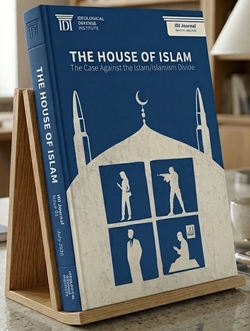
Burmawi: In this issue [of the IDI Journal], we argue that Islamism is not a separate ideology but simply Islam itself. We present Islam as a complete "House" in which religion (prayer, fasting, personal piety) is only one room. The other rooms, politics, sharia, governance, jihad, and total societal control, are equally integral to the structure, all built according to the Qur'an, the Sunnah, and the Hadith. Those who fully occupy the political, legal, and jihad rooms are not "Islamists" living in a different building, we argue; they are simply the most consistent Muslims. How do you respond?
Pipes: The very most extreme of Islamist groups, ISIS, learnedly draws on precedents from 1,400 years ago and quite accurately applies them to modern life. Its emergence in 2015 alienated most Muslims, who do not wish to emulate its bizarrely anachronistic behavior. To take one example, ISIS considers Islamic rules of slavery fully valid today. This is not consistency but crazed and widely rejected extremism.
Burmawi: What are the canonical scriptures of "Islamism"? Aren't they exactly the same as those of Islam, the Qur'an and the Hadith? Who is the prophet of Islamism, isn't it the same Prophet Muhammad? What are the authoritative interpretation books that Islamists rely upon, aren't they the same core tafsirs and fiqh texts used in mainstream Islam for fourteen centuries? Doesn't the use of the term "Islamism" deceive people into thinking that it is some kind of fringe or modern deviation, when in reality it represents the most fundamental and authentic presentation of classical Islam?
 Thomas of Torquemada. |
Burmawi: Do you agree that the linguistic and conceptual distinction between Islam and Islamism has become the dominant paradigm in Western policy and academia?
Pipes: No, I see wide rejection of the distinction, from U.S. Rep. Randy Fine preferring dogs over Muslims to leftists screaming "Islamophobia" in response to critiques of Islamism.
Burmawi: In our judgment, this distinction hinders the West's ability to understand and respond to the civilizational challenge posed by Islam and has, perhaps unintentionally, served as a shield for the House itself. Your response, please.
Pipes: The Islam/Islamism distinction has a crucial role in developing an effective response by non-Muslims to Islamism.
First, modern secular states can fight an ideology but not a religion. They cannot turn into Crusader states. Just as they previously fought fascism and communism, they can now fight Islamism.
Second, only anti-Islamist Muslims can offer a modern, moderate alternative to Islamism. The Islam/Islamism distinction permits an alliance between them and non-Muslims to combat this scourge. Let me offer an analogy: the Western victors in World War II distinguished between Germans and Nazis, therefore they could rely on Konrad Adenauer to build a peaceful Federal Republic of Germany.
Third, Muslims deserve the same rights and duties as every other citizen, neither special rights nor unique disabilities.
Burmawi: The term Islamism originally emerged during the Enlightenment as largely synonymous with Islam itself; today, however, it carries multiple and often conflicting meanings. The Iranian scholar Mehdi Mozaffari has even described it as a URO or "Unidentified Religious Object." Given the lack of a single agreed-upon definition of Islamism, how can the term be useful analytically?
Pipes: Yes, as Martin Kramer has shown, the word [Islamism] has had a long and colorful career. But so have many other words evolved over the centuries and acquired a specific meaning today. When I was young, the adjective gay meant happy; now the noun means homosexual.
By the way, Islam is also difficult to define: does it include the Ahmadiyya? Alawism? Alavism? The Nation of Islam and its derivative groups?
As for defining Islamism, here goes: an ideology that claims to solve all modern problems by reverting to a medieval law code, the sharia.
Burmawi: Pew Research Center surveys show that significant majorities of Muslims in many countries support the implementation of sharia law in some form. If support for sharia is taken as one of the defining features of Islamism, does that not imply that a majority of Muslims worldwide would qualify as Islamists? If so, does the term [Islamism] not lose its utility?
Pipes: No and no. The sharia has two components, private and public. The former concerns such matters as personal cleanliness, prayer ritual, food consumption, and sexual relations. The latter concerns authority, justice, taxation, and warfare. To some degree, most Muslims follow the private sharia; this alone does not make them Islamists. In contrast, demanding the application of public sharia nearly always signals an Islamist mentality, from the privileging of Islam and Muslims to the waging of jihad.
Burmawi: You have often argued that "Radical Islam is the problem, moderate Islam is the solution" and that the West should support moderate Muslims. In your estimation, can a Muslim truly be "moderate" while continuing to affirm the full authority of the Qur'an and the Prophetic Example as perfect and eternal models for all aspects of life?
Pipes: Yes. Plenty of Muslims follow the private sharia and not the public one. They pray five times a day but have no intention of going off to war to acquire slaves. A pious Muslim need not be an Islamist.
Burmawi: Looking at the current situation in Europe, do you believe the continent still has the cultural confidence and political will to halt the expansion of the House of Islam into its neighborhoods, or have they already passed the point where containment is realistic?
Pipes: It might [halt the expansion]. We are still at the beginning of a long story. Should indigenous Europeans decide to halt or reverse the Muslim presence, they can do so, for they outnumber Muslims by about a ratio of 14-to-1, so if the former decide they have had enough of Islamism, they can do whatever they want to fight it.
 Danny Burmawi |
Pipes: I have come to recognize Islamism's variations. My first book on the topic, In the Path of God, deals with what in 1983 was termed the Islamic revival as basically a single phenomenon. Only with time did the full range of the phenomenon, including its criminal and lawful variants, from Al-Qaeda to the Gülen movement, become apparent.
Burmawi: If you could sit down with your younger self in the 1970s, just as you were beginning this journey, what would you tell him now about the true scale and character of the threat?
Pipes: Islamism is not confined to Africa and Asia but threatens globally. Specifically, until the crisis over Salman Rushdie's 1988 novel The Satanic Verses, I did not fully appreciate the Islamist potential in the West. I count myself as the third analyst to recognize this danger, following Bat Ye'or and Steven Emerson.


