
"Iran is the world's most conspiracy-minded country" I declared in my book, The Hidden Hand: Middle East Fears of Conspiracy. An entire chapter of that study focused on the Islamic revolution of 1978-79, documenting how "Regardless of political complexion, Iranians interpret the revolution not as an act of will but as the manifestation of mysterious forces. They debate less the causes of the upheaval than the identity of those forces." Another chapter took up the Iran-Iraq war. In both cases, I showed how the conspiracy mentality had a major role in the evolution of events.
And so, as the events of the past month unrolled in Iran – an intense buildup to elections on June 12, the regime's blatant act of electoral fraud, the massive street demonstrations, and the violent crack-down – I watched with special interest the role of conspiracy theories in Iranian political life. To my surprise and delight, their role appeared to be minimal. For once, Iranians were dealing with realities in Iran rather than imagining foreign bogeymen manipulating events in the country.
Then, as the crackdown ensued, the authorities resorted to form and, starting with Ali Khamene'i's key speech on June 19, they began blaming perfidious foreigners, and especially the British government, for their problems. Khamene'i described Western countries as "hungry wolves ambushing us and removing the diplomatic cover from their faces. Do not neglect these people." He went on:
The outstanding diplomats of some western countries who have talked to us with diplomatic courtesy up to now, have, during the past few days, taken the masquerade away from their faces and are showing their true image. They are showing their true enmity towards the Iranian Islamic state and the most evil of them is the British government.
The crowd responded by chanting of "Death to Britain."
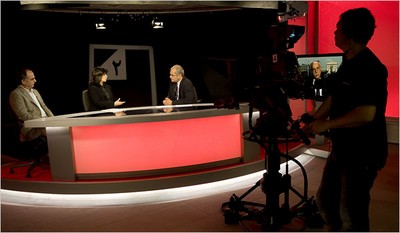
The regime followed up by focusing on the Persian television service of the British Broadcasting Corporation, as John F. Burns explains in "Persian Station in Britain Rattles Officials in Iran":
As Iran's ruling ayatollahs tell it, the main strike force plotting to end Islamic rule in their country is not on the streets of Tehran but on the upper floors of a celebrated Art Deco building in central London. The propagators of an "all-out war" against the Islamic republic, as Iran's semiofficial news agency has called them, are a group of 140 men and women who work at the BBC's Broadcasting House, a stone's throw from the shopping mecca of Oxford Street in London. Mainly expatriate Iranians, they staff the BBC's Persian-language television service, on air for only six months and reaching a daily audience of six million to eight million Iranians — a powerful fraction of viewers in Iran, with its population of 70 million. …
The set of the BBC's Persian television service.
The government has singled out several foreign news broadcasters for what it calls biased coverage: CNN, broadcasting in English, as well as the Voice of America and the BBC, which broadcast in Iran in Persian, the country's national language. But the BBC's Persian channel has been cast as the main threat, partly, BBC officials say, because Britain's colonial past has earned it a special place in Iran's official demonography. Hamid Reza Moqaddamfar, chief of the semiofficial Fars news agency, has described the channel's coverage as "psychological warfare," and said its mission was "spreading lies and rumors and distorting facts."
A pro-Ahmadinejad newspaper, Vatan Emrouz, even claimed that Jon Leyne, the BBC's Tehran correspondent, expelled from Iran on June 21, paid "a thug" to kill Neda Agha-Soltan, the young woman who became a martyr to the protesters after she was shot dead during the demonstrations.
State-run television has interviewed protesters who said the Persian channel influenced them to take to the streets. One woman said the channel inspired her and her son to go out armed with hand grenades. Another woman said the channel's report that the riot police had attacked protesters prompted her to go to the streets, where she said she had found that it was the protesters, not the police, who were "beating up people."
Comment: It is one thing for the mullahs to raise conspiracy theories and another for the population to believe in them. I don't live in Iran and cannot judge the situation at first hand, but I get a sense from news reports that Iranians no longer suffer under the sway of their historic conspiracist mindset. If so, this would be a huge advance for the country. (June 29, 2009)
Aug. 31, 2009 update: Laura Secor interprets things similarly in the New Yorker, noting that "The [Iranian] regime has lost control of the political discussion within Iran, which is focussing on the abuse of prisoners rather than on the perfidy of foreigners or the futility of resistance."


