
I have devoted an entry, "The West Bank to Jordan, Gaza to Egypt," to those voices (including mine) who have given up on the two-state solution and instead advocate for or against the idea that the Jordanian and Egyptian governments take over, respectively, the West Bank and Gaza.
But this leaves out the growing debate over the two-state solution that does not mention the Jordan-Egypt option; their ideas will be recorded here, as a complement to the original weblog entry.
I shall also include a few prominent voices that continue to place their hopes in a Palestinian state – starting with the newly-inaugurated Barack Obama, who said today, "I think it is possible for us to see a Palestinian state—I'm not going to put a time frame on it—that is contiguous, that allows freedom of movement for its people, that allows for trade with other countries, that allows the creation of businesses and commerce so that people have a better life." (January 26, 2009)
Feb. 1, 2009 update: Nathan J. Brown of the Carnegie Endowment for International Peace concludes in "Palestine and Israel: Time for Plan B" that "the international effort to achieve a two-state solution to the Israeli–Palestinian conflict has come to a dead end." His Plan B offers makes no mention of Jordan-Egypt but involves three steps that center on recognizing Hamas:
The first step in a new diplomatic approach must be to establish a cease-fire that builds on the common interest of both Israel and Hamas to avoid fighting in the short term. ...
The second step must be an armistice that would offer each side what they crave for the present—Israel would get quiet and a limit on arms to Hamas; Palestinians would get open borders, a freeze on settlements, and an opportunity to rebuild their shattered institutions. Such an armistice must go beyond a one-year cease-fire to become something sustainable for at least five to ten years.
Finally, the calm provided by the armistice must be used to rebuild Palestinian institutions and force Palestinians and Israelis to confront rather than avoid the choices before them.
Comment: One has to wonder what planet Brown lives on, making plans on the basis that Hamas can be tamed and made to accept the existence of a sovereign Jewish state between the Mediterranean Sea and the Jordan River.
Feb. 17, 2009 update: Giora Eiland, a leading Israeli strategist, has issued a study, "The Future of the Two-State Solution," in which he calls the two-state solution "a big illusion." In its stead, he offers a baroque plan whereby Cairo grants Gaza 600 sq. km. of its territory, Jerusalem annexes 600 sq. km. of territory on the West Bank and it grants a final 600 sq. km. of territory in the Negev desert to Egypt. Eiland does not explicitly say this last tranche would cut Israel in two, but that is implied when he writes that "Egypt could get a land corridor to enable movement from Egypt to the rest of the Middle East without the need to cross Israel." Comment: This has to be concurrently the least likely and least good idea anyone has come up with lately. Mar. 4, 2009 update: In a much less baroque analysis, "No chance for 2 states." Eiland dismisses this idea as "a bad solution" that "will likely never be achieved," then gives his reasons for this negative appraisal.
Feb. 28, 2009 update: Binyamin Netanyahu punts when asked in an interview if he endorses the 2-state solution, saying neither yes or no:
Q. What do you say when asked if you believe in a two-state solution as George Bush outlined in 2002?
A. Substantively, I think there is broad agreement inside Israel and outside that the Palestinians should have the ability to govern their lives but not to threaten ours.
 Israel's Likud party leader Benjamin Netanyahu (R) shakes hands with Foreign Minister and Kadima party leader Tzipi Livni in Jerusalem February 22, 2009. |
Israel is facing challenges and I told him that Kadima would support the correct moves made by the government. But to deal with the challenges, I wanted three basic principles that you know about. Two states for two peoples is not an empty slogan. It is the only way Israel can remain Jewish and fight terrorism. It's a fundamental issue. ... This meeting has ended without agreements on issues that I see as essential.
(The other two demands were changes to the electoral system and reforms in the Interior Ministry.)
Comment: (1) Coalition talks are where the real platform gets hammered out. (2) But the evolution of Likud's Ariel Sharon in 2003 shows how the real platform can change dramatically. Here is my account of what happened then:
Mr. Sharon decisively won re-election in January 2003 over Amram Mitzna, a Labor opponent who advocated an Oslo-style unilateral retreat from Gaza. Mr. Sharon unambiguously condemned this idea back then: "A unilateral withdrawal is not a recipe for peace. It is a recipe for war." After winning the election, his talks in February 2003 about forming a coalition government with Mr. Mitzna failed because Mr. Sharon so heavily emphasized the "strategic importance" of Israelis living in Gaza. By December 2003, however, Mr. Sharon himself endorsed Mr. Mitzna's unilateral withdrawal from Gaza.
So, coalition talks are a good but not entirely reliable guide to future policy.
Mar. 1, 2009 update bis: Aluf Benn of Ha'aretz points to "obvious political reasons" to explain Netanyahu's reticence on this issue: "It would cost him his potential coalition with the right-wing National Union and Habayit Hayehudi, and force him into a rotation arrangement with Livni." Plus, writes Benn, his opposition to a Palestinian state "is also a matter of principle, one he has held for many years." Finally,
Netanyahu also has a tactical reason for objecting to a Palestinian state: He believes that this must come through negotiations, rather than being something conceded by Israel in advance. He considers the Annapolis process that outgoing prime minister Ehud Olmert and Foreign Minister Livni conducted with the Palestinian Authority's Mahmoud Abbas and Ahmed Qureia to be a joke. In his opinion, Israel must not offer a near-total withdrawal from the West Bank in advance, which he believes would achieve nothing and only encourage the Palestinians to demand more.
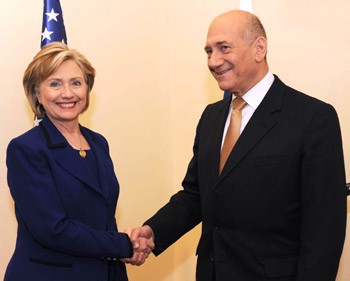 Hilary Clinton and Ehud Olmert. |
I will share with the Secretary of State the position my Government has taken to advance peace between us and the Palestinians, and together we will discuss ways to advance peace in the region as part of the two-state solution. This is the only solution - there is no doubt - and it reflects absolutely Israel's supreme strategic interest as well as the interest of the Palestinian people.
Mar. 5, 2009 update: Aaron Lerner credits Binyamin Netanyahu for not giving in on the 2-state solution during recent negotiations with Kadima.
Binyamin Netanyahu surprised many of his detractors in the national camp when he took the high road on the "two state solution" after being assigned by President Peres to form a government. Netanyahu could have tried to get away with saying "two states" while mumbling under his breath that the "Palestinian state" would be an "autonomous" rather than fully "independent" state. But he didn't. Instead he took the high road and declined to recite that holy mantra "two state solutions".
Mar. 28, 2009 update: The European Union could not be coming down harder in favor of a two-state solution, announcing publicly that its relations with Israel will suffer if the Netanyahu government has the temerity to abandon this formula:
EU foreign policy chief Javier Solana: "Let me say very clearly that the way the European Union will relate to an [Israeli] government that is not committed to a two-state solution will be very, very different."
Czech Foreign Minister Karel Schwarzenberg, whose country currently holds the EU presidency: if the new Israeli government does not commit itself to establishing a Palestinian state, "relations would become very difficult indeed. At one of our next ministerial meetings we would have to discuss what consequences the EU would draw from that. Both parties must stick to their commitments from the past: A two-state solution and all agreements reached over the past few years."
Apr. 1, 2009 update: In a telephone survey conducted on March 30-31, 2009 by the Tami Steinmetz Center for Peace Research and the Evens Program in Mediation and Conflict Resolution, both at Tel Aviv University, found that in contrast "to Netanyahu's refusal to commit himself to the formula of two states for two peoples, a majority of both sectors (56% of the Jews and 78% of the Arabs) currently favors working toward this solution." Confusingly, the survey goes on to report that
support for the two-state idea is especially evident when comparing it to two other possibilities: continuing the existing situation or establishing a binational state. Among the Jews, 51% now back the two-state formula, 28% favor continuing the existing situation, and only 7% are for setting up a binational state. For the Arabs the parallel figures are 66% for the two-state formula, 8% for continuing the existing situation, and 17% for binationalism.
Confusing because it's not clear if Jewish Israeli support for the two-state solution is 56 percent or 51 percent. In any case, it makes up a majority.
Apr. 10, 2009 update: Writing for the far-leftist Inter Press Service, Helena Cobban gives up on the two-state solution and instead advocates "a single bi-national state between the Jordan River and the Mediterranean, in which both Hebrew-speaking Jewish Israelis and Arabic-speaking Palestinians would have equal rights as citizens, and find themselves equally at home."
Apr. 17, 2009 update: George Mitchell announced today in Israel: "U.S. policy favors, with respect to the Israeli-Palestinian conflict, a two-state solution which will have a Palestinian state living in peace alongside the Jewish state of Israel."
Apr. 22, 2009 update: Another poll, this one sponsored by One Voice, found that the two-state solution "continues to be the most widely accepted option for both Israelis and Palestinians and all other options presently being considered are less likely to gain as much support in both societies as a basis for a peace agreement." Here are the specific polling results on alternate final status arrangements:
| PALESTINIAN per cent | Essential | Desirable | Acceptable | Tolerable | Unacceptable |
| 1. (PALESTINIANS ONLY) Historic Palestine – From the Jordanian river to the sea as an Islamic Waqf |
59 | 12 | 7 | 5 | 12 |
| 2. (PALESTINIANS ONLY) Historic Palestine – From the Jordanian river to the sea |
71 | 11 | 5 | 3 | 7 |
| 3. (PALESTINIANS ONLY) One joint state – A state in which Israelis and Palestinians are equal citizens |
18 | 13 | 10 | 12 | 43 |
| 4. One shared state - Bi-national federal state in which Israelis and Palestinians share power | 8 | 7 | 7 | 12 | 59 |
| 5. Two state solution - Two states for two peoples: Israel and Palestine | 38 | 15 | 10 | 11 | 24 |
| 6. Political status quo with economic development of Palestinian/the West Bank/Gaza (territories) | 32 | 10 | 8 | 8 | 40 |
| 7. Confederation between West Bank and Jordan and between Gaza and Egypt | 12 | 7 | 7 | 5 | 65 |
| 8. (ISRAELIS ONLY) Greater Israel – A Jewish state from the Jordanian border to the sea |
| ISRAELI per cent | Essential | Desirable | Acceptable | Tolerable | Unacceptable |
| 1. (PALESTINIANS ONLY) Historic Palestine – From the Jordanian river to the sea as an Islamic Waqf |
|||||
| 2. (PALESTINIANS ONLY) Historic Palestine – From the Jordanian river to the sea |
|||||
| 3. (PALESTINIANS ONLY) One joint state – A state in which Israelis and Palestinians are equal citizens |
|||||
| 4. One shared state - Bi-national federal state in which Israelis and Palestinians share power | 7 | 6 | 11 | 8 | 66 |
| 5. Two state solution - Two states for two peoples: Israel and Palestine | 32 | 13 | 16 | 17 | 21 |
| 6. Political status quo with economic development of Palestinian/the West Bank/Gaza (territories) | 27 | 18 | 12 | 14 | 24 |
| 7. Confederation between West Bank and Jordan and between Gaza and Egypt | 19 | 20 | 15 | 17 | 21 |
| 8. (ISRAELIS ONLY) Greater Israel – A Jewish state from the Jordanian border to the sea |
17 | 10 | 11 | 8 | 47 |
May 14, 2009 update: Abbas Zaki, the PLO "ambassador" to Lebanon spoke about the two-state solution on ANB TV on May 7 and MEMRI made it known today:
With the two-state solution, in my opinion, Israel will collapse, because if they get out of Jerusalem, what will become of all the talk about the Promised Land and the Chosen People? What will become of all the sacrifices they made - just to be told to leave? They consider Jerusalem to have a spiritual status. The Jews consider Judea and Samaria to be their historic dream. If the Jews leave those places, the Zionist idea will begin to collapse. It will regress of its own accord. Then we will move forward.
July 2, 2009 update: According to Zogby International – whose slogan should be "interesting if true" – polls of Israelis, Palestinians and Americans shows wide support for the two-state solution.
Aug. 18, 2009 update: Mike Huckabee, a former governor of Arkansas and candidate for president, opposes the creation of a Palestinian state. "The question is should the Palestinians have a place to call their own? Yes, I have no problem with that. Should it be in the middle of the Jewish homeland? That's what I think has to be honestly assessed as virtually unrealistic."
May 31, 2011 update: Binyamin Netanyahu accepted "two states for two peoples" in 2009 but his minister without portfolio, Benny Begin, does not. Gavriel Queenann reports that Begin, speaking on Arutz Sheva radio,
rejected the creation of an Arab state west of the Jordan River saying the right of the Jewish people to their ancestral homeland was 'obvious' and that such a state would become a 'haven of impunity' for terror. ... "I think any second state of any nature, another sovereignty west of the Jordan River, especially when it comprises the PLO or Hamas, would negate or contradict two basic rights of the Jewish people and the citizens of Israel. One is the right of the Jewish people to our homeland, and our right to our homeland does not stop exactly east of the 1949 armistice demarcation lines, also known as the "Green Line." It has no historic significance whatsoever. It just marks a balance of military power back then, in 1948 or 1949, between [Israel's] local Arab neighbors and the newborn state of Israel in their attempt to smother the baby state in its cradle. Our right to our land – including of course to the cradle of our history in Judea and Samaria – is obvious.
There is also the question of national security, and we have had some experience in the the last twenty years under the banner "territory for peace"... the actual events have been territory for terror. Every piece of land, every hectare, every acre, that was consigned to the PLO reign, became a haven of impunity for terrorism. And we should anticipate that once we transfer parts of our homeland to the PLO it will be, actually, an indirect transfer of land through the PLO to Hamas, and to Iran.
Begin did not offer an alternative solution.
July 15, 2011 update: The Israel Project commissioned American pollster Stanley Greenberg and the Palestinian Center for Public Opinion to probe Palestinian sentiments on the two-state solution and found that only 34 percent of them accepts this resolution. Completed this week, the survey was intensive and face-to-face, in Arabic, and included 1,010 Palestinian adults in the West Bank and the Gaza Strip and has a margin of error of 3.1 percentage points.
Jan. 3, 2013 update: A poll by Geocartography of a representative sample of adult Israelis (including Arabs) asks the question "Do you support or oppose the concept that the establishment of two states is the solution to the conflict with the Palestinians?" In reply, 40 percent support the concept, 45 percent oppose, and 14 percent do not reply.
Apr. 17, 2013 update: Cheery news: Secretary of State John Kerry told the House Foreign Affairs Committee today: "I believe the window for a two-state solution is shutting ... I think we have some period of time - a year, a year-and-a-half, two years - or it's over." Let's hope that Klueless Kerry gives up this quixotic quest by late 2015.
Sep. 17, 2013 update: Proving that it's becoming ever more eccentric, the New York Times published an opinion piece today, "Two-State Illusion" by the loopy Ian S. Lustick of the University of Pennsylvania.
Starting from the false premised that "All sides have been wedded to the notion that there must be two states, one Palestinian and one Israeli," he goes on to argue that Israel may well be a temporary phenomenon by noting "how quickly the Soviet, Pahlavi Iranian, apartheid South African, Baathist Iraqi and Yugoslavian states unraveled," as though Israel had anything in common with those tyrannies.
Lustick goes on to inform us that "The issue is no longer where to draw political boundaries between Jews and Arabs on a map but how equality of political rights is to be achieved," his coy way of saying goodbye to the Jewish state: "Israel may no longer exist as the Jewish and democratic vision of its Zionist founders." Now in full form, he goes on to give his vision of what will follow Israel:
In such a radically new environment, secular Palestinians in Israel and the West Bank could ally with Tel Aviv's post-Zionists, non-Jewish Russian-speaking immigrants, foreign workers and global-village Israeli entrepreneurs. Anti-nationalist ultra-Orthodox Jews might find common cause with Muslim traditionalists. Untethered to statist Zionism in a rapidly changing Middle East, Israelis whose families came from Arab countries might find new reasons to think of themselves not as "Eastern," but as Arab.
Comment: How embarrassing to recall that I was a steady contributor to the New York Times between 1980 and 1996.
Nov. 5, 2013 update: William Booth and Ruth Eglash of the Washington Post survey alternative ideas on the Israeli Right to the two-state solution at "A Greater Israel? Faction says no to two-state solution, yes to annexing Palestinian areas." These matter because high-ranking figures in the Israeli government such as Uri Ariel, Naftali Bennett, Danny Danon, Ze'ev Elkin, and Tzipi Hotovely,
are in revolt against the international community's long-held consensus that there should be two states between the Jordan River and the Mediterranean Sea. In the process, they are seeking to overturn the commitments of every U.S. president since Bill Clinton and at least four Israeli prime ministers, including the current one.
These opponents, they report, are no longer simply negative about the two-state idea but "are preparing details of their own vision for how Israel should proceed unilaterally." The article then specifies the views of each of the politicians named above.
Dec. 12, 2014 update: According to a Times of Israel report by Haviv Rettig Gur, Yair Lapid of Israel's Yesh Atid party sees a similar solution to the Palestinian issue: "Egypt can help secure Gaza and Sinai, and Jordan wields some influence over the West Bank and East Jerusalem."
Mar. 30, 2015 update: A Washington Post-ABC News poll finds that American support for a Palestinian state is at a low - only 39 percent. Aaron Blake of the Washington Post writes that this "is the lowest that number has been in WaPo-ABC and Gallup polling since 1998."
June 23, 2015 update: A new poll shows that support for the two-state solution has decreased among both Palestinians and Israelis to 51 on each side. (The poll was jointly conducted by the Hebrew University and the Palestinian Center for Policy and Survey Research.)
May 25, 2016 update: Khaled Abu Toameh reports, in "Palestinians and Jordan: Will a Confederation Work?" of revived Jordanian interest in controlling the West Bank. Excerpts:
Talk about a confederation between the Palestinians and Jordan has once again resurfaced, this time after a series of unofficial meetings in Amman and the West Bank in the past few weeks. ...
The confederation talk returned during a recent high-profile visit to the West Bank by former Jordanian Prime Minister Abdel Salam Majali. During a meeting with representatives of large Palestinian clans in Nablus, Majali voiced his support for the confederation idea, saying it was the "best solution for both Palestinians and Jordanians." ...
In a rare moment of truth, Majali admitted that the Palestinians were not "fully qualified to assume their responsibilities, especially in the financial field, in wake of the failure of the Arab countries to support them." ...
So Majali is basically telling the Palestinians: "You can't rely on your Arab brothers to help you build a state. Jordan is the only Arab country that cares about you." ...
While most Jordanians seem to be strongly opposed to the idea of adding another three or four million Palestinians to the kingdom's population, Palestinians in the West Bank and Gaza Strip appear to be divided over the idea. ...
The renewed talk about a confederation between the Palestinians and Jordan underscores the Palestinian leadership's failure to convince many Palestinians of its ability to lead them towards statehood.
Aug. 14, 2018 update: A new poll by the Tel Aviv University and the Palestinian Center for Policy and Survey Research finds a new low in support for the two-state solution: 43 percent among both Israelis and Palestinians.


