
When I lived in Cairo in the 1970s, I conducted a little experiment: What, using only Arabic-language sources, could I learn about Jews, Judaism, Jewish history, Jewish culture, and the like? The paucity of resources stunned me; basically, the best way to learn about these subjects was to read between the lines of antisemitic tracts.
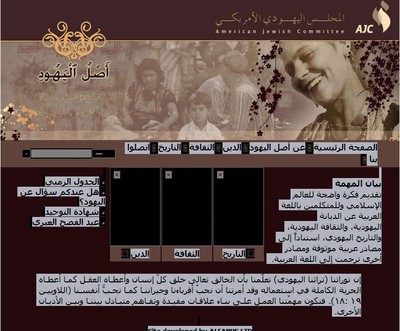
It is therefore with delight that I read today that the American Jewish Committee, under the directorship of Yehudit Barsky, has launched a new website, Asl Al-Yahud ("origins of the Jews"), that deals in Arabic with these subjects, with an emphasis on the history of Jews in Arabic-speaking lands. As a press release explains,
The website offers information about Jewish lifecycle events, holidays and religious practice. The website also contains a timeline of Jewish history, audio and graphic components, and a special section for users to submit questions. An Asl Al-Yahud staff member will answer the questions, in Arabic, allowing users to comfortably interact in their native tongue. The content was created originally in Arabic by Ephraim Gabbai, a descendent of the Iraqi Jewish community. The site is visually authentic to Middle Eastern design and highlights cultural practices shared by Muslims and Jews from Arabic-speaking nations around the globe.
May 6, 2008 update: Gideon M. Kressel of Ben-Gurion University writes me he has studied this subject and found that, "While Hebrew is taught in several universities in Arabic-speaking countries, no faculty of Jewish studies is to be found. Nor, for that matter, is there a program of studies concerning the Christian creed anywhere in the Arab-Muslim World."


