
 Daniel Fried, Assistant U.S. Secretary of State for European and Eurasian affairs. |
|
Fried, whose experience is mostly in eastern Europe, also calls the Muslim presence in Europe "a fascinating issue and one that the American government is just now trying to get its mind around. It's a huge problem, we are thinking about it seriously, and we've tried to do some intellectual framing-up." He believes in social conditions as an explanation for problems, rather than Islamism:
The unrest that existed in poor neighborhoods had nothing to do with jihad and much to do with social conditions. That's why we have to put the emphasis on improving the social conditions—schools, jobs, better housing—and hopefully all this will trigger better absorption in the social fabric of France of this minority.
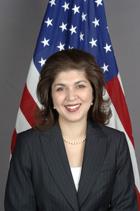 Farah Pandith, Senior Advisor, Bureau of European and Eurasian Affairs, U.S. Department of State. |
||
Comments: (1) I see this as a low-key assertion of what will quite quickly become a major theme in U.S.-European relations.
(2) It articulates much more mildly what Ralph Peters, who expects an anti-Muslim backlash in Europe, has written about: a scenario in which "U.S. Navy ships are at anchor and U.S. Marines have gone ashore at Brest, Bremerhaven or Bari to guarantee the safe evacuation of Europe's Muslims." (February 13, 2007)
April 4, 2007 update: Secretary of Homeland Security Michael Chertoff reiterated this point to a British newspaper:
Our Muslim population is better educated and economically better off than the average American. So, from a standpoint of mobility in society, it's a successful immigrant population. To some degree, the whole country is a country of immigrants, and therefore there's no sense that we have insiders or outsiders. In some countries [in Europe], you had an influx of people that came in as a colonial legacy and may have always have felt, to some extent, that they were viewed as second-class citizens, and they've tended to impact and be kind of clustered in some areas.


