
Greater Syria: The History of an Ambition is the title of a book I published in 1990 that traces the pan-Syrian movement from its origins in the mid-nineteenth century to the regime of Hafez al-Assad. But with Assad's demise in 2000, and the succession of his barely-competent son Bashar, Greater Syria has disappeared into the historical shadows. Indeed, two of the outstanding issues, Hatay and Lebanon, may to be en route to resolution.
But first, note some older items I missed in the book:
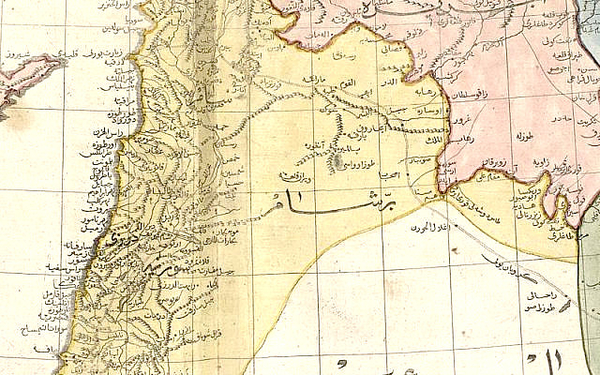
(1) The 1803 Jadid Atlas showing Syria (in yellow) extending from Anatolia to the Sinai Peninsula.
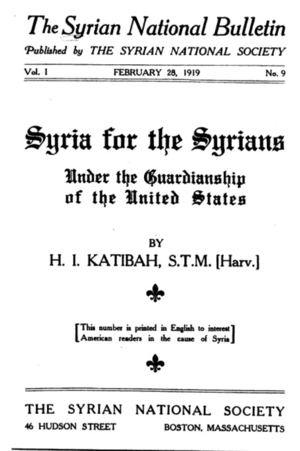
(2) Habib Ibrahim Katibah's Syria for the Syrians: Under the Guardianship of the United States (Boston: Syrian National Society, Feb. 26, 1919).
(3) Awni Abd al-Hadi, to the Peel Commission in 1937, about Palestine, "There is no such country! 'Palestine' is a term the Zionists invented! There is no Palestine in the Bible. Our country was for centuries part of Syria."
(4) From the Jerusalem Center for Public Affairs website: "Arab demonstration in Jerusalem, circa 1920. The sign on the left says: 'We resist the Jewish immigration'; the sign on the right says: 'Palestine is part of Syria'."
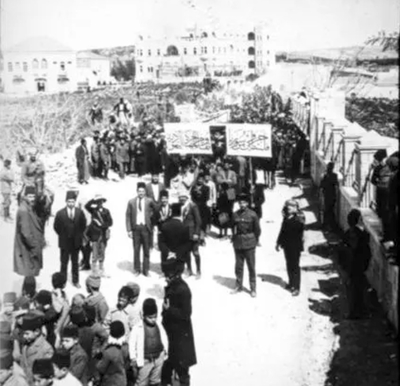 The sign on the right says "Palestine is part of Syria." |
"Arab demonstration outside of the Damascus Gate in Jerusalem, 1920. The speaker may be Aref al Aref. The signs declared support for Palestine as part of Syria."
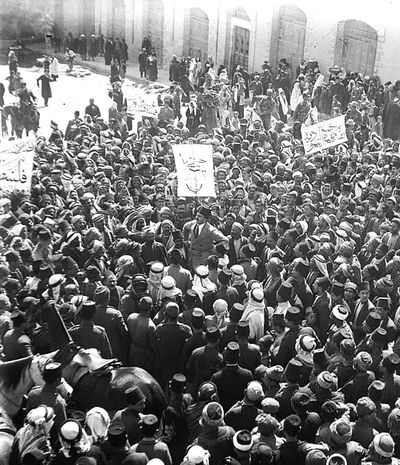 The signs declare support for Palestine as part of Syria. |
It came as a surprise to hear Tony Snow, the spokesman for President George W. Bush, bring up the concept of Greater Syria in the course of his daily press briefing today on the subject of diplomacy to end the war in Lebanon.
Q: Why shouldn't the President be the one to mount an aggressive diplomacy, pick up the phone, call Assad of Syria and say, put an end to this, and start negotiating directly with the Syrians?
MR. SNOW: Because the track record stinks. I don't know if you remember all the old pictures of diplomats in the Reagan years going -- in the Carter, Reagan, and maybe even the early Bush years, the first Bush administration -- who knows, Clinton may have done it, too -- sitting around there drinking tea with Hafez al-Assad, the father, having to sit there for five, six, ten hours, listening to polite but long discourses on Greater Syria, and at the end of that, having gotten nothing.
Comment: Snow has it just right, except the marathon sessions began even earlier, in the Nixon and Ford administrations, when Henry Kissinger so memorably fenced with the Syrian president. (July 19, 2006)
May 27, 2007 update: In a letter recently sent by the Al-Qaeda deputy leader, Ayman al-Zawahiri, to the leader of Al-Qaeda in Iraq, Abu Hamza al-Muhajer (and intercepted by an unnamed Middle Eastern intelligence service), Zawahiri urges supporters to extend their jihad to other Middle Eastern countries. Specifically, he reiterates a goal first outlined two years ago, of an Islamic Greater Syria, consisting of Lebanon, Palestine and Syria.
Jan. 8, 2009 update: Speaking in Hebrew on Israeli television the Israeli Arab member of parliament Azmi Bishara stated: "I don't think there's a Palestinian nation. There's an Arab nation. I don't think there's a Palestinian nation. That's a colonial invention. Since when were there Palestinians? I think there's only an Arab nation. Until the end of the 19th century, Palestine was the southern part of Greater Syria."
Oct. 14, 2009 update: Seemingly out of nowhere, Turki Al-Sudairi, editor-in-chief of the Saudi government daily Al-Riyadh published two articles and gave an interview to Alarabiya.net suggesting that the solution to Lebanon's permanent unrest is to bring it under Syrian control. Sudairi emphasized that this is his personal opinion. For more details, see the MEMRI study linked above.
Oct. 15, 2009 update: A day later, Sudairi retracted his ideas in an article today titled "Yes, I Was Wrong in My Ideas and Statements."
Oct. 25, 2009 update: Again, out of nowhere, Mish'an Jabouri, a former Iraqi MP and owner of the Syria-based Ar-Ra'i television, is raising the Greater Syria dream, but this time its "Suraqiya" variant – a combination of Greater Syria and Iraq. (To see the video, click here.)
We support good relations between Syria and Iraq, but not between Syria and the [Nouri] al-Maliki government. We support good relations between Iraq and Syria regardless of who the ruler is, because we believe that this serves the people and their interests, and that it is a positive factor. Personally, I believe in the philosophy and notion of "Suraqiya" - Greater Syria and Iraq. This is what I dream about. Just like some people dream of Arab unity and others of Islamic unity, I adhere to the notion of Suraqiya.
Comment: Is this Bashshar al-Asad's idea? A new fantasy for the Syrian government to pursue?
Nov. 1, 2010 update: In a detailed historical study, "The 'Missing Dimension': Britain's Secret War against France in Syria and Lebanon, 1942–45 – Part II," Meir Zamir of Ben-Gurion University shows from newly uncovered documents that the British government was keen during World War II to establish a Greater Syria. Meir writes that, for London, "Restoring Greater Syria and uniting it with Iraq under British hegemony would solve two pressing issues: Iraq's instability in the face of internal and external threats, and the question of Palestine." For proof, see in particular Document 12, "British secret proposal (MacKereth) via Sulh to Jabri," and Document 85, "Quwatli–Shone secret agreement."
July 29, 2011 update: In the course of an article in Ha'aretz about Druze students from the Golan Heights and studying in Syrian universities, it slips out that, just as they receive full scholarships from the Syrian government because they are considered citizens, so do students from Alexandretta benefit from this arrangement. Here is the key passage:
Like all Syrian citizens, the Druze residents of the Golan Heights are entitled to free academic studies in one of Syria's seven public universities. In many cases, they also receive funding for dorms, work permits, state health insurance and other benefits. They are exempt from entrance exams and from having to show an Israeli matriculation certificate - a situation which makes studies in Syrian particularly attractive for them. Almost all the Golan Druze enroll at the University of Damascus, the country's largest institution of higher learning and generally considered one of its best universities. They usually rent an apartment in the Bab Touma neighborhood, the city's old Christian Quarter, or in the Rukn al-Din neighborhood, where many foreign students live.
Quite a few of the Druze say they have formed good relations in particular with young people from the Alexandretta district, which was annexed to Turkey in 1939 and have a similar civil status in Syria.
Mar. 10, 2014 update: Adel Beshara published today The Origins of Syrian Nationhood: Histories, Pioneers and Identity, (CRC Press) which contains information about Greater Syria.
May 31, 2014 update: "As Lebanon and Syria become one" avers Avi Issacharoff in the Times of Israel, implying that the incompetent Bashar has managed to pull off the trick that his brilliant father Hafez never achieved.
More than one million Syrian civilians live in Lebanon today. According to some estimates, the number has reached one-and-a-half million. Some are refugees from the civil war; others lived in Lebanon before the outbreak of anti-regime demonstrations in 2011. The changing make-up of the population in Lebanon, alongside the involvement of groups from both sides of the border in the fighting, underline the extent to which the borders between the two states are being erased as the war drags on.
It's hard to think of Lebanon as a sovereign, independent entity today. ... The fighting in Syria and Lebanon has become a religious war unconnected to country: Shiites against Sunnis, as if nothing has changed since the second half of the 7th century.
June 11, 2014 update: The organization that goes by the name of "The Islamic State in Iraq and Sham" (Arabic: لدولة الاسلامية في العراق والشاما) has intended to combine these two parts of the Fertile Crescent into a single whole since it took on this name at an unclear date a few years ago. Until today, that seemed like a remote dream.
Well, today ISIS took a giant step in this direction yesterday, when it eliminated the border controls at the al-Ya'rubiya crossing on the road between Mosul in Iraq and Qamishli in Syria.
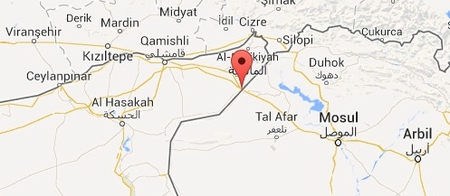 The red marker indicates the Ya'rubiya crossing. |
Comment: Until now, the Greater Syria project has had almost nothing to do with Islamism, so this achievement comes as a considerable surprise.
July 2, 2014 update: More on the erasure of the Syria-Iraq border. MEMRI reports (in a mailing that is not online):
On June 29, 2014, the Islamic State of Iraq and Syria (ISIS) released two new videos celebrating the effective erasure of the border between Iraq and Syria following the organization's recent military achievements in northern Iraq. The first video, titled "Breaking the Borders", 12 minutes in duration, shows footage of the symbolic tearing down of the border, carried out by ISIS fighters, as well as short speeches delivered by ISIS leaders at the scene. The second video shows a Chilean ISIS fighter identified as Abu Safiyya give a tour of the destroyed border Iraqi border outpost.
Jan. 3, 2015 update: On one level, the news that the government of Lebanon is about to impose visa restrictions on Syrians starting on Jan. 5 is hardly a surprise, given the massive influx, estimated at more than 1.1 million refugees, who have entered Lebanon in the past four years, amounting to about 20 percent of the total Lebanese population.
On another level, however, this is a major development. For nearly a century, since the emergence of Lebanon as an independent country, its governments have always deferred to the Syrian notion that Lebanon should be part of Syria by not antagonizing Damascus with border controls. Lebanese desperation and Assad regime weakness have now combined to change this equation. One does wonder, though, how the Assad regime will respond to this.
Curiously, this occurred just as the Syrian border with Iraq has disappeared. Ironically, then, the very central Syrian claim to Lebanon is failing while the peripheral Syrian claim to Iraq is flourishing.
Oct. 6, 2015 update: James Jeffrey, a former U.S. ambassador to Turkey, notes the Russian overflight of Hatay, the Turkish province claimed by Syria's government, reviews the history of this province, and concludes with a question:
So can one conclude that the overflight was deliberate? A means of warning Turkey that if it does not behave on the Syrian issue, where it is deeply at odds with Russia and Assad, it might pay a high price one day? Perhaps.
What one can say with more certainty is that a rational military organization, knowing the history, would have given special warnings to its pilots and radar controllers to not violate Hatay airspace, in part to avoid generating articles like this one suspecting the worst. At minimum, it seems unlikely that such warnings were given.
More broadly, as Putin scrambles the deck with force in the Middle East, as he has done in Eastern Europe since 2008, the international community can no longer exclude any motivation for his actions.
June 14, 2016 update: Stefan Winter, associate professor of history at the Université du Québec à Montréal, analyses a controversial document in "The Asad Petition of 1936: Bashar's Grandfather Was Pro-Unionist."
May. 1, 2017 update: In "Heading for 'Syria Minor'." Amotz Asa-El writes in the Jerusalem Report (not online) about the collapse of Hafiz al-Assad's dream of a Greater Syria into Bashar's reality of a Smaller Syria:
Inspired by longings for the medieval Umayyad Caliphate, which was ruled from Damascus and sprawled from Pakistan to Spain, the Greater Syria outlook underpinned the thinking of Hafez Assad. The 1989 Taif Agreement that ended the Lebanese Civil War effectively recognized Syria's domination of Lebanon and marked this vision's first diplomatic success. It was also the last.
The fall of the Berlin Wall three weeks later and subsequent end of the Cold War reshuffled the international system in a way that brought an ever-sober Assad down to earth. With his Soviet patrons suddenly gone from the atlas, the Syrian strongman shrewdly joined the Cold War's victors and the military coalition that evicted Iraq from Kuwait.
It was a much better position than the one at which Assad's archrival Saddam Hussein had arrived, but it also meant that Greater Syria would remain a dream because the superpower that now dominated the Middle East flatly rejected its every aspect.
Despite an historical error (the Umayyad Caliphate did not inspire Hafiz al-Assad), this account provides the interesting thesis that Hafiz al-Assad's Greater Syria dream collapsed along with the collapse of the Soviet Union.
This also has the implication that my book, Greater Syria: The History of an Ambition (1990) served as an obituary to the Greater Syrian ambition.
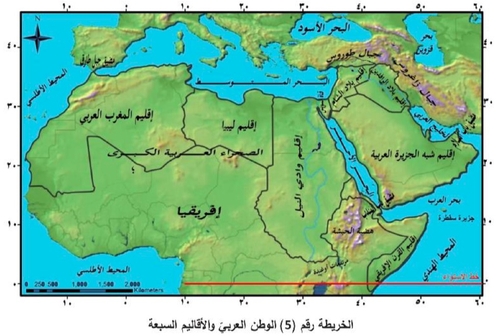
July 1, 2018 update: Eldad J. Pardo and Maya Jacobi have published Syrian National Identity: Reformulating School Textbooks During the Civil War, which contains some references to Greater Syria. It defines Bilad al-Sham as current-day Syria, Jordan, Israel, the Palestinian Authority, Lebanon, and a part of Turkey. It is one of seven regions (iqlims) of the "Arab Homeland" (al-watan al-'Arabi). The other six are Mesopotamia, the Arabian Peninsula, the Horn of Africa, the Nile Valley, Libya, and the Arab Maghreb.
Dec. 8, 2024 update: The overthrow of the Assad regime today by forces led by Hayʼat Tahrir al-Sham (HTS, Council for the Liberation of Greater Syria) suddenly thrusts the concept of Greater Syria back into the spotlight after a near-quarter-century of eclipse since the death of Hafiz al-Assad.
Mar. 28, 2025 update: In a step that only historians might find remarkable, the Lebanese and Syrian defense ministers signed an agreement demarcating their borders in a ceremony witnessed by the Saudi defense minister.
To put it simply, this agreement comes after close to a century of Syrian reluctance to acknowledge the sovereign state of Lebanon; that the agent of a movement with Greater Syria in its name did this makes the even twice as unexpected. Apr. 3, 2025 update: Hanin Ghaddar explains the significance of this accord at "Lebanon-Syria Border Talks Can Help Restrain Hezbollah."
July 7, 2025 update: MEMRI summarizes a television discussion thus:
Sweden-based Syrian journalist Dr. Kamal Al-Labwani said in an interview that was posted to the Lebanese YouTube channel Spot Shot on July 7, 2025 that if the superpowers take Latakia and Tartus from Syria, then Syria will have no choice but to invade Lebanon and annex Tripoli and Sidon by force, because it needs an outlet to the Mediterranean Sea. He accused the Lebanese army, under the command of current Lebanese President Aoun, of preparing barrel bombs for the Assad regime, and claimed that Lebanon had sent Hizbullah to occupy and destroy Syria. Al-Labwani said Lebanon is not a "real country" but a "historical lie" created by General Gouraud after World War I, and he declared that he wants to return the Lebanese people to their motherland of Syria. He also warned that any attempt to change Syria's borders will lead to the "annihilation of Lebanon." Dr. Kamal al-Labwani is a Syrian opposition figure and former political prisoner, known for his advocacy of democratic reform and cross-border dialogue.
July 1, 2026 update: Further confirmation that the concept of Greater Syria died with the Assad regime comes today in response to Trump's cockamamy suggestion that the Syrian government should eliminate Hezbollah in Lebanon. To this, Syria's President al-Sharaa replied that a solution for Lebanon that involves Syria "does not mean war and does not mean the old image of Syrian tutelage over Lebanon under the former regime. We tried war, and we do not wish it on anyone."


