
Is Europe finished? Some major authors, such as Bat Ye'or, Oriana Fallaci, and Jean Raspail, say "yes." But I think not; there is still fight left in the old continent, as the 2004 French ban on hijabs in public schools signaled. And although I usually focus on the Europeans' willingness to bend to Muslim demands, this entry documents some cases, in reverse chronological order, when they stand up for their historic ways, even when the expression is petty.
Man denied German citizenship for refusing to shake woman's hand: The Administrative Court of Baden-Württemberg (VGH) ruled that an unnamed 40-year-old Lebanese doctor – who came to Germany in 2002, who had the best possible score on the German naturalization test, but who then refused to shake hands with the female official handing over his citizenship papers in 2015 – will not receive those papers. His case was first rejected by the Stuttgart Administrative Court and now the VGH. He can still appeal to the Federal Administrative Court.
Danish citizens shake hands: A new law requires anyone who gains Danish citizenship, starting Jan. 1, to shake hands at the naturalization ceremony. In the words of Integration Minister Inger Stojberg, a handshake is a "visible sign that you've taken Denmark to heart." (December 21, 2018)
Swiss citizens shake hands: A Muslim couple have been denied Swiss citizenship after they refused to shake hands with members of the opposite sex during their interview. (August 18, 2018)
French citizens shake hands: The Council of State, France's top administrative court, has ruled that an Algerian woman's refusing to shake hands with male officials at a naturalization ceremony is grounds to deny her French citizenship. It said that her refusal "in a place and at a moment that are symbolic," shows her not being assimilated. (April 21, 2018)
Germans stand up for homosexual teachers: When Muslim parents took their children out of a school because of their being exposed to gay kindergarten teachers, non-Muslim Germans responded with a roar of support for the school and the teachers. (March 29, 2017)
Swiss can demand coed swimming: The European Court of Human Rights has ruled that the Swiss government is within its rights to demand that two Muslim girls, 9 and 7 at the time of the dispute in 2008, attend swimming classes with boys. The court held that "The public interest in following the full school curriculum should prevail over the applicants' private interest in obtaining an exemption from mixed swimming lessons for their daughters." The ruling is seen as potentially setting an important precedent when European and Islamic values conflict. (January 11, 2017)
Cannes bans full-body 'burkini' swimsuits from beaches: The mayor of Cannes, a French Riviera resort town, has banned full-body, head-covering swimsuits known sometimes as burkinis (a combination of burqa and bikini) from its beaches on security grounds. A violation costs €38.
According to an ordinance issued by Mayor David Lisnard, beachwear must respect "good morals and secularism." According to him, clothing "manifesting religious affiliation in an ostentatious way, while France and its religious sites are currently the target of terrorist attacks, could create risks of trouble to public order." He deems burkinis "the uniform of extremist Islamism, not of the Muslim religion." For good measure, he added that ban might also apply to saris worn by Indian bathers, on the grounds that the clothing could get in the way of rescuing drowning bathers.
In short, this mayor is standing up for the one-piece or bikini bathing suit. Trouble is, as the BBC points out in a graphic, it can be difficult to distinguish between a burkini and a wet suit.
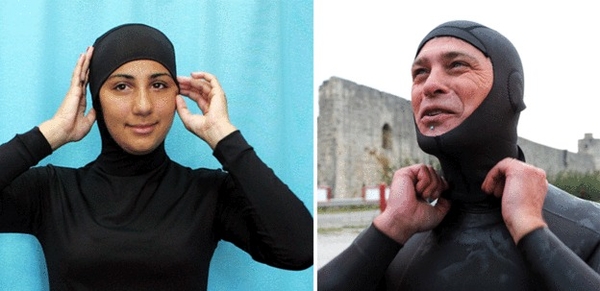 Which is the burkini and which is the wet suit? |
(August 12, 2016)
"Swiss deny citizenship to Muslim girls who balked at swimming with boys": Swiss authorities rejected the application for citizenship of two Muslim immigrant girls, 12 and 14, living in Basel who refused to take school swimming lessons because boys were present, thus not complying with the school curriculum. "Whoever doesn't fulfill these conditions violates the law and therefore cannot be naturalized," Stefan Wehrle, president of the naturalization committee, explained. He portrayed this as a precedent for future applications. (June 28, 2016)
"Switzerland: Muslim students must shake teacher's hand": A middle school in the town of Therwil in the northern canton of Basel-Country allowed two Syrian brothers, 14 and 15, not to shake their female teacher's hand at the beginning and end of lessons, a long-standing Swiss custom signaling respect. When news of this came out, it caused a national uproar. The canton said teachers "had the right" to demand handshakes and Justice Minister Simonetta Sommaruga added that "shaking hands is part of our culture."
Parents or guardians in Basel-Country now face fines of up to 5,000 Swiss francs (US$5,000) if their children disobey the ruling. But the boys announced that "nobody could make them" shake hands with a woman. (May 25, 2016)
"David Cameron says Britain must 'proudly' defend its Christian values in the face of Islamic extremists": The British prime minister's Easter message encourages Britons "proudly" to stand together as a "Christian country with Christian values." (March 27, 2015)
No wine, no dinner: The French and Iranian presidents won't be dining together because they can't agree on the wine issue. (November 9, 2015)
"Woman is thrown out of Paris opera after cast refused to perform unless she removed Muslim veil": A woman in the front row, wearing a niqab and thought to come from the Persian Gulf, declined the cast of La Traviata's insistence on Oct. 3 that she take off her face cover and was ejected from the Opéra de la Bastille. (October 20, 2014)
"'Drunk' Belgium diplomat specialising in protocol is arrested for tearing full-face veil off a Qatari princess: A woman in a burqa, who turns out to be a Qatari princess, asked Jean-Marie Pire, chief of protocol for Brussels, for directions to the Grand Place (Grote Markt). The Daily Mail continues:
"I said I don't talk to anyone if I can't see their face," said Mr Pire. "With this reply, I wanted to make it clear that the veil is banned in Belgium. Because the person asking me a question didn't seem to hear me, I lifted her veil. I know I shouldn't have done that, but what she did wasn't legal either!" ... She has made an official complaint to Brussels prosecutors, who may now charge Mr Pire with assault. The woman herself faces a fine of around £115 and up to seven days in prison for wearing the veil in public. Some onlookers have claimed that Mr Pire was drunk at the time of the incident, although he denies this, saying it was "three o'clock in the afternoon," adding: "Besides, I don't drink much." As the Chief of Protocol for the city of Brussels, one of Mr Pire's main jobs is to welcome foreign dignitaries, including many from the Middle East
Read more: http://www.dailymail.co.uk/news/article-2728932/Senior-Belgian-diplomat-arrested-tearing-face-veil-Qatari-princess-asked-directions.html#ixzz3BSJhmQ6w
Follow us: @MailOnline on Twitter | DailyMail on Facebook.
Comments: (1) You could not make this up. (2) There's a lot of repressed European rage going around. (August 19, 2014)
"French women have a duty to wear a bikini on the beach, says former minister": Nadine Morano, a French member of European Parliament, a former minister, and a close ally of former president Nicolas Sarkozy, has created a row in France by posting to Twitter a picture of a veiled woman on a beach and commenting "When one sees this scene, one cannot but help feel an attack on our culture that goes against our sexual equality. ... If you choose to come to France, a state of law, a secular state, one should respect our culture and women's rights. If not, go elsewhere!" She also posted a picture of Brigitte Bardot in a bikini.
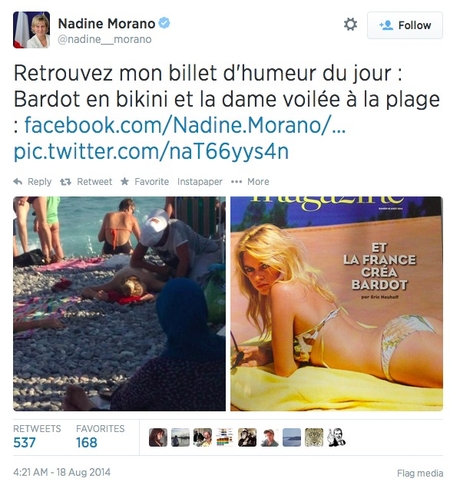 Nadine Morano's burqa vs bikini Twitter post. |
When criticized, Morano replied that France needs a "national institution for respecting French culture. French culture is equality between men and women." (August 19, 2014)
"Muslim girl cannot skip swim class: German high court": The Federal Administrative Court in Leipzig rejected an appeal by a Muslim schoolgirl from Morocco living in Frankfurt to skip swimming lessons on the basis that the Koran forbids her from showing herself to boys and also seeing the topless boys. The court argued that in warm weather, men in Grmany go about bare-chested and it will not suppress this "social reality." It advised her to wear a "burkini." This decision upheld a September 2012 ruling by an administrative court in Kassel. (September 11, 2013)
"Muslim teens not exempt from swim lessons": Switzerland's highest court has ruled that a 14-year-old girl from a strict Muslim family in Aargau must attend swimming class at school, though she can do so in a full-body swimsuit (known as a burkini). The decision specifically referred to the need not to permit "parallel societies" to develop in Switzerland. (May 10, 2013)
Burqa, no handshake doom French citizenship: The French immigration ministry announced that a Moroccan man living in France since 1999 and married to a French woman since 2004, failed to "assimilate into French society" and displayed a "discriminatory attitude toward women," and so has been denied French citizenship.
He "refused to shake the hand of a female official whom he met at the state prefecture because it was 'against his religion'," said a statement. The man's wife wore the full veil and only agreed to uncover herself in a room where no men would be present.
(July 9, 2010)
"No Religion at School: Berlin Court Rules Against Muslim Student Prayers": A Berlin court ruled in 2009 in favor of a 16-year-old Muslim praying in a room by himself on the grounds of his private school in the Wedding district. The city government's education department appealed the ruling on the grounds of state neutrality with regard to religion.A higher Berlin court has now overturned that judgement on the grounds that such prayers could disturb school peace. Its ruling in turn is likely to be appealed to the Federal Administrative Court. (May 27, 2010)
"Une Marocaine en burqa se voit refuser la nationalité française" ("A Moroccan woman in burqa is refused French nationality"): The Council of State refused to grant citizenship to a woman of Moroccan origins, married to a French citizen, and mother of three children born in France, because it deemed, in a statement dated June 27, that she had "adopted, in the name of a radical practice of her religion, a public behavior incompatible with the core values of French society, in particular the principle of gender equality" ("a adopté, au nom d'une pratique radicale de sa religion, un comportement en société incompatible avec les valeurs essentielles de la communauté française, et notamment le principe d'égalité des sexes").
Comment: This is a complex story, heavily covered in the French press, with many implications. Suffice to say here that this step reflects a European hope to fend off radical Islam. (June 11, 2008) July 19, 2008 update: For English-language coverage of this topic, see "A Veil Closes France's Door to Citizenship" by Katrin Bennhold.
"Parents protest at school's 'Halal-only' lunch": The administration at Kingsgate Primary in West Hampstead, North London, whose student body is about three-quarter Muslim, has decided to serve only halal meat. But then, what the Daily Mail terms "furious parents" carried placards and staged protests outside the school. Abusive callers to the school led the staff at Kingsgate to stop accepting inbound calls. A mother, Jacqueline Gomm, explained her views:
I sent my kids to this school because I don't want them to be affected by religion. We can't force our culture on someone else because that's not right so we shouldn't have someone else's culture forced on us. The little culture that we have is being lost. I don't know any other country that would do the same. I totally deny being guilty of racism. We allow people to come into this country and we end up being in a minority. We accommodate other cultures at the expense of ours.
She went on to say about the British National Party: "the sad thing is, many people will turn to them because they feel there is no other choice."
A father, Neville Grant, who entered the school to challenge the principal's claim that a parental survey showed a preference for halal meat had the police called on him and says he is now liable to be arrested if he steps inside the Kingsgate grounds. "I went to the school to protest because I didn't believe the statistics but the headteacher refused to show me them. The next thing I know is when my daughter called me and said that three police cars and a van had pulled up outside my house. I'm a next of kin for my son and now I can't even go into the school. It's outrageous." A spokeswoman for the Camden Council, however, denied Grant had been banned from the school grounds.
The spokeswoman noted that Kingsgate is one of four schools in Camden Borough to have adopted halal-only menus, adding that "There will also be a vegetarian choice and a jacket potato with toppings of choose, beans or fish, so there is always a hot, healthy option available for all children." (February 9, 2007)
Muslim teacher sacked over hand shake: The Vader Rijn College in Utrecht, Netherlands, a vocational school, has sent a letter of dismissal to a female Muslim teacher who last summer began refusing to shake hands with men, which she previously has been willing to do. The director of the college said the teacher gave a bad example to students. The Equal Treatment Commission, however, issued an advisory ruling granting the teacher the right to refuse a hand shake and stated that the college could not dismiss her for this reason alone. (December 20, 2006)
"Godless Europeans turn to cultural Christianity": Michael Burleigh, author of Earthly Powers: Politics and Religion in Europe (Harper Collins) sees Europeans turning to a "cultural Christianity" to establish a common identity and fend off radical Islam. The term, he says, is borrowed from Jews who identify themselves culturally, not religiously, with their traditions.
Across Europe ... the threat from radical Islam has made it imperative to find a minimum consensus to bind our atomised societies together. ... Everywhere, governments are cobbling together civil religions. The Dutch send would-be migrants a video spelling out life in The Netherlands. It shows, clogs, tulips and windmills, as well as naked sunbathers and gay strollers. The Germans have introduced citizenship tests, the only snag being the questions are harder than on the German version of the show Who Wants to be a Millionaire? The British have new citizenship ceremonies as well as a lengthy guide to life in the UK. The historical section of it is riddled with mistakes: even the date of the Act of Union is out by 100 years.
These things are a panicky reaction to radical Islam, whose effect on our societies has been analogous to the takeover of a quiescent hive by aggressive African bees. Suddenly we have in our midst people who totally reject Western modernity and who fantasise about a future caliphate reaching into Spain's southern Andalusia, in which cleric and ruler will be one. ...
It may well be the case that in coming years, more and more Europeans will say they are cultural Christians - as even such figures as novelist Umberto Eco or veteran leftist Regis Debray are doing - as a means of self-assertion against reactionary Islam. In other words, while Europe may continue to be godless, it may see a great deal more religion than anyone bargained for.
(June 2, 2006)
"Integration book to explain Flemish norms and values": The Belgians are taking it slower than the Dutch (see the March 16, 2006 update, below). An "integration guidebook" to be distributed at immigrant reception centers tells about family services, informs how to obtain subsidized housing, runs through the Belgian system of government, and more broadly provides "a compass to navigate a path in Flemish society," according to Flemish Integration Minister Marino Keulen. The commission (made up of both native and immigrant Belgians) reached a quick consensus over norms and values, such as liberty, equality, solidarity, respect and citizenship. As for attitudes toward homosexuals, freedom of religion, abortion, euthanasia, and the equality of men and women, the head of the commission, Marc Bossuyt, said immigrants don't have to applaud these views but resistance against such freedoms should not be urged either. "Social norms cannot be imposed. We plead for tolerance and dialogue." (May 2, 2006)
"'Migrant test' raises concerns": Andrew Robb, parliamentary secretary to Immigration Minister Amanda Vanstone, has raised the idea of introducing a compulsory citizenship test for prospective immigrants, one requiring them to demonstrate their knowledge of English and of Australia's values, customs, laws and history. "From my point of view, successful integration is overwhelmingly in the interests of migrants and the broader community. For this reason, I am prepared to have a serious look, over the next couple of months, at the merits of introducing a compulsory citizenship test." The opposition Labor party backs the proposal in theory. "We would need to look at who is going to decide what would be in the test, what consultation there would be and how the test would be assessed," said its immigration spokeswoman, Annette Hurley. (April 28, 2006)
"A Dutch Film Warning: Nudity and Gay Kisses Ahead": The Dutch government has produced a two-hour-long film, titled "To the Netherlands," intended to give potential immigrants a taste of life in the country they might be moving to. It asserts Dutch values in a number of ways. For one, it shows, according to a New York Times report, "an attractive woman sunbathing topless." The narrator counsels viewers: "People do not make a fuss about nudity."
That lesson, about the Netherlands' nude beaches, is followed by another: homosexuals have the same rights here as heterosexuals do, including the chance to marry. Just to make sure everyone gets the message, two men are shown kissing in a meadow. ... Well aware that simply watching a naked woman on film, for example, is prohibited by law in some countries, the Dutch authorities have created a second version of the film, minus bare breasts and gay kisses. "Someone from Iran doesn't need to order the tape with the gays and the topless woman," [Maud Bredero, a spokeswoman for Minister of Immigration Rita Verdonk] explained. "They'll get an edited version." But even in that version, nudity and homosexuality are discussed and portrayed because the applicant could be asked a question about them on the exam, Ms. Bredero added.
(March 16, 2006)
"Muhammad cartoon row intensifies": Until now, Europeans have taken a stand on some pretty minor issues – wine with meals, co-ed swimming, burqas. Today, that all changed. Cartoons might also seem minor, but not when they are caricatures of the Prophet Muhammad. The issue has been brewing for four months, since the Danish paper Jyllands-Posten published the twelve cartoons on September 30, 2005. Today, eight major newspapers in six countries (France, Germany, Italy, the Netherlands,, Spain, and Switzerland) reprinted the cartoons. I plan to deal with this topic at greater length in a column but here are a few observations for now:
- There is indeed, "fight left in the old continent." This decision to publish by a few editors could well mark a cultural and political turning point.
- This issue recalls the Rushdie affair of seventeen years ago, in that both involved making fun of the Muslim prophet and both involved threats of violence, economic boycotts, and the like by Muslim states.
- But there was nothing like today's response in 1989.
- The Rushdie and the Jyllands-Posten issues are both pure, dealing with religion, politics, and culture, rather raising issues of unemployment, discrimination, and the like. They therefore heighten emotions.
- Violence – including a second French intifada – might well ensue. (February 1, 2006)
"Berlin school bans languages other than German": The Herbert-Hoover Realschule in Berlin's heavily-immigrant Wedding district has banned students from speaking languages other than German while on school grounds or on school excursions. The "house rules" that every pupil must sign state that "The language of our school is German, the official language of the Federal Republic of Germany. Every pupil is obliged to only communicate in this language within the jurisdiction of the house rules." (Jan. 20, 2006)
"Flag burner first to be jailed over riots": Hadi Khawaja, 24, was sentenced to three months in jail for burning the Australian flag, thereby becoming the first person jailed for his part in the Sydney-area beach riots last month. To be technical, he pleaded guilty to malicious damage and entering enclosed lands on December 11 with intent to commit an indictable offence. The magistrate, Paul Falzon, described burning the flag as a matter "of great significance" and therefore he ordered a toughter penalty than would usually be the case. "It's vandalism of a particular kind. It's extreme vandalism ... because of the nature of what was obtained to be burnt in the context of what happened and what was happening around this time." Khawaja, of Peakhurst in southern Sydney, arrived in Australia from Lebanon at the age of six and is an Australian citizen. (Jan. 13, 2006)
"Une pièce de Voltaire sous protection policière": By way of background, here is a 1998 account by Koenraad Elst in "The Rushdie Rules":
In 1994, the city government of Geneva organized the performance of all of Voltaire's theatre plays to celebrate the famous freethinker's 300th birthday. However, the Muslim community (not Islamists, but state-subsidized cultural foundations) objected to the staging by director Hervé Loichemol of Voltaire's play, first staged in 1742, Mahomet, ou le fanatisme, an attack on religious intolerance based on the Muslim biography of Muhammad in which he orders the murder of his critics. The city government withdrew funding for the play and no one dared come forward in response to Loichemol's plea for private sponsorship, so the performance was cancelled.
And here is the update: Eleven years later, Loichemol finally staged a production of Mahomet, ou le fanatisme. It was a reading on Dec. 8 in Saint-Genis-Pouilly, a French town near Geneva, where the mayor, Hubert Bertrand, provided police protection. In response to a Muslim spokesman's protest at a reception before the theatrical event, Bertrand asserted that "Freedom of speech is important, it is a critical part of laïcité." Loichemol was more angry: "You have no right to come here and tell us what we do or do not have the right to produce in the theater." After the performance began, one car and several trash cans were set on fire, which the mayor condemned as unacceptable. (Dec. 9, 2005)
"Dutch virtue of tolerance under strain": "We don't expect them to go ice-skating in winter or put on clogs," said a senior figure in the governing VVD party. "But we do expect them to learn our language and accept basic values like the equality of men and women." Such a statement is important for it is part of the sorting out of what immigrants are expected to adopt and what not. So too is the comment by Folkert Jensma, editor in chief of the Handelsblad daily: "It's funny We now want to teach immigrants more about our identity, and we discover that we're not sure what's left of it!" (Oct. 17, 2005)
"French march La Marseillaise into class": Starting this month, France's national anthem, La Marseillaise, must by law now be sung and its history learned in primary schools throughout the country. The Daily Telegraph explains: "Politicians behind the anthem's addition to the national curriculum see the move as an aid to preserving the purity of French culture in an increasingly multi-racial society in which Islam is now the second biggest religion." Jérôme Rivière, the member of parliament whose idea this law was, said the the anthem lyrics "demonstrate the respect of others and the individual freedoms that are at the base of our society." (Sep. 13, 2005)
"Italy bans Islamic burqas": This does not quite fit the pattern, except that women showing their faces certainly is a European custom. The Italian government, in a rare show of bipartisanship, approved a measure banning burqas in public places, as part of a counterterrorism package. Offenders who cover their face can be jailed up to two years and fined 2,000. In addition, law enforcement or soldiers may detain violators for 24 hours without a lawyer present, extract DNA samples without their consent, and deport foreigners suspected of terrorism. (Aug. 1, 2005)
"British Culture – Worth Saving?": That's the title of my blog that considers how the London bombers of a week ago have prompted their fellow British citizens to assert the worth of their culture. This is a stunning new theme in European life. (July 14, 2005)
"EU brushes off Belgian Islam hand-shake spat": The main thrust of this article by Andrew Rettman in the EUobserver concerns the dhimmitude of the European Union's foreign affairs chief, Javier Solana, on receiving Iranian parliamentary delegates meeting in Brussels, serving coffee, fruit juice and water, and perfectly happy to accept that the Iranian males did not shake hands with the EU women ("The Iranians do not shake hands with women. It's their personal decision and they are our guests").
But Rettman also adds that one day earlier, on June 30, the president of Belgium's upper house, Anne-Marie Lizin, canceled her meeting with the same Iranian delegation because of the hand-shake dispute; and the speaker of the lower house, Herman de Croo, cancelled a lunch with the Iranian group after it insisted on there being no alcohol at all at the event. Instead, he briefly met with them in his parliamentary office. As a spokesman for the Belgian senate memorably commented to Rettman, "You can't force the authorities of Belgium to drink water." (July 1, 2005)
"German Court: Muslim Students Must Swim": In a landmark case, Germany's chief administrative court dismissed a complaint brought by two deeply religious Muslim parents from Wuppertal intent on keeping their 11-year-old son out of a co-ed school swimming class, where he would mix with girls in bathing suits. They called this "a dangerous influence on the emotional world of young people." The court rejected their argument, holding that religious beliefs cannot prevent children from attending swimming classes. More assertively, the judges stated, "we live in a western society in which we don't live by the rules of the Koran." (June 1, 2005)
"Muslim citizenship applicants told: 'You can only have one wife'" (also available at muslimnews.co.uk): Married Muslim men seeking Irish citizenship, reports the Irish Independent, "are being asked to swear that they will not take more than one wife." This means having to sign an affidavit promising they will not take a second wife. A spokeswoman for the Department of Justice said such inquiries were made in circumstances where "there was reason to believe that person's cultural or religious beliefs comprehended the possibility of more than one spouse at the same time." To which, predictably, the Irish Council of Civil Liberties (ICCL) responded by denouncing the requirement as "despicable." (June 17, 2004)
"No wine, no dinner, Iran told": The Spanish government cancelled a state banquet to be hosted by King Juan Carlos for the visiting President Mohammed Khatami of Iran, and for an interesting reason. The Iranians insisted that there be no wine on the table but the Spanish refused to give it up. "It was to avoid a stand-off between the protocol offices of the two countries," said a Spanish Foreign Ministry spokesman, "and so that the Spanish custom of drinking wine with meals was not dishonoured." His Iranian counterpart said that "Islamic principles are very important for Iran." The newspaper El Mundo reported that the king was ready to make this concession but Prime Minister Jose Maria Aznar did not agree. The government has put "a lot of emphasis on the cultural tradition that surrounds the consumption of wine in a country like Spain."
This resolution brings to mind an identical problem three years earlier, when Khatami visited France.
Wrangling over the serving of wine had delayed the visit, the first to France by an Iranian leader since the 1979 revolution. Protocol problems were resolved, with France coming up with an arrangement "that preserves the traditions of all," [Foreign Ministry spokeswoman Anne] Gazeau-Secret said. France, she said, will forego the traditional dinner—in which wine is always served—and offer Khatami a reception with "refreshments," instead.
Related to this flap, Khatami's visit was downgraded from "state" to "official."
In the end, neither European country would host a state banquest without alcohol. (October 10, 2002)


