
In a cutting-edge editorial (or, as the British say, leader), the Daily Telegraph defines in "The fundamentals of law in this country..." the stakes in the war with radical Islam. The editorial defines five "values which are immanent in our culture, and which every citizen should be expected to agree with." (The wording is clumsy, so I have done some rephrasing.)
- The rule of law as defined by common law and Parliament (and not the Shari'a) prevails.
- Political legitimacy flows upwards, from the will of the people and the traditions of the constitution (not downwards, from the interpretation of the will of God).
- The state has a monopoly of coercion (jihad is unacceptable).
- The nation is the ultimate object of political loyalty (not Islam).
- A secular state, in which the free expression of religious beliefs is allowed (and not the special privileging of Islam).
Comment: While on one level banal – this editorial restates some obvious features of British life – its implications are profound indeed. The publication of this affirmation of legal fundamentals one week after the London terror wave implies that the Telegraph editors understand the ultimate issue is not defeating terror but saving Western civilization, starting with its British variant.
Nor are those editors alone in coming to this conclusion. Home Secretary Charles Clarke noted that there had been "a very strong response" to the London bombings from the whole of British society,
But it is a question of going further than that now. It is a question of saying we have to defend the values of that kind of society against those who would destroy it. That means standing out against, in a very strong way, anybody who preaches the kind of fundamentalism.
(July 14, 2005)
July 23, 2005 update: Anthony Browne takes up similar profound questions in "The Left's war on Britishness," where he asks why Britain became "the first country in the developed world to produce its own suicide bombers" and replies with a scathing analysis:
the real answer to why Britain spawned people fuelled with maniacal hate for their country is that Britain hates itself. In hating Britain, these British suicide bombers were as British as a police warning for flying the union flag.
Britain's self-loathing is deep, pervasive and lethally dangerous. We get bombed, and we say it's all our own fault. Schools refuse to teach history that risks making pupils proud, and use it instead as a means of instilling liberal guilt. The government and the BBC gush over "the other," but recoil at the merest hint of British culture. The only thing we are licensed to be proud of is London's internationalism — in other words, that there is little British left about it.
Browne asserts that what is needed "is something to make the people who live in these islands feel good about being British," and he proceeds to recount, in 1,100 words, the country's immense contributions to mankind. It makes for wonderful reading and reminds me why – for all my criticism of "Londonistan" - I remain a life-long Anglophile.
Aug. 1, 2005 update: Aatish Taseer confirms Browne's point about the results of British self-loathing in his fascinating interview, "A British jihadist," with Hassan Butt, 25, one of the country's more outspoken Islamists. In his introduction, Taseer gives some background about the predicament of being of Pakistani heritage in the UK:
Britishness is the most nominal aspect of identity to many young British Pakistanis. The thinking in Britain's political class has at last begun to move on this front, but when our tube bombers were growing up, any notion that an idea of Britishness should be imposed on minorities was seen as offensive. Britons themselves were having a hard time believing in Britishness. If you denigrate your own culture you face the risk of your newer arrivals looking for one elsewhere. So far afield in this case, that for many second-generation British Pakistanis, the desert culture of the Arabs held more appeal than either British or subcontinental culture. Three times removed from a durable sense of identity, the energised extra-national worldview of radical Islam became one available identity for second-generation Pakistanis. The few who took it did so with the convert's zeal: plus Arabe que les Arabes.
Aug. 5, 2005 update: In a press conference, Tony Blair announced that "coming to Britain is not a right, and even when people have come here, staying here carries with it a duty. That duty is to share and support the values that sustain the British way of life. ... when you have people who have been here sometimes 20 years or more and who still don't speak English, that worries me. It worries me because I think there's a separateness there that might be unhealthy."
Aug. 24, 2005 update: In a powerful speech, the British shadow education secretary, David Cameron, dwelt at length on the need to maintain his country's character. The key passage reads:
There's a long list of things we might include in any description of our national character, or "Britishness". But I don't think we need engage in some protracted exercise to define our shared values. We can do it in a single phrase: freedom under the rule of law. This simple, yet profound expression explains almost everything you need to know about our country, our institutions, our history, our culture - even our economy.
Sep. 24, 2005 update: In reaction to a documentary called Young, British and Muslim, Janice Turner stands up for British culture in the Times (London). The documentary features Hadil, described as an unsmiling girl of Iraqi origins in a black hijab: Giving her views to an audience at the National Film Theatre, Hadil shrugged in reply to the question "Do you feel British?" and replied: "I look at British culture and see no moral values which appeal to me." The stereotype of the U.K. she draws, according to Turner, involves "a national taste for getting bladdered at nightclubs, an insistence that girls wear sexy, skimpy clothes, are judged solely on their looks and whether they'll put out for boys." Upset, Turner tells how, after the discussion, she asked Hadil if there was nothing about British society she admired?
Did she not believe women should be able to vote? (Yes, she did.) If she had to appear in court, did she think her testimony was worth that of any man? (Too right.) Had she not just enjoyed, that very afternoon, freedom of religious expression — indeed of an expensive, state-funded, multi-media variety? (Well, yes.) Wasn't it fabulous that while given the choice of wearing the hijab, she was not compelled to do so? (Yes.) And that, although she does receive the occasional rude remark about her chosen dress, she mostly walks the streets unmolested? Were not these freedoms also part of British morality, just as much as throwing up outside All Bar One or wearing your knickers above your jeans? And was there a Muslim nation on earth that would afford her the same rights? (Probably not.)
Turner then reaches a triumphant conclusion: "Yes, apart from equality, democracy, religious tolerance and freedom of speech, British morality had done nothing for Hadil."
Nov. 22, 2005 update: In a remarkable statement, John Sentamu, a Ugandan immigrant who in a week's time will be enthroned as Archbishop of York, the number-two position in the Church of England, has called on the British to stand up for their culture and reject multiculturalism. In an interview with Ruth Gledhill of the Times (London) he makes these points:
- Too many people are embarrassed about being English. "I speak as a foreigner really. The English are somehow embarrassed about some of the good things they have done." They should take pride in their country.
- Multiculturalism fails to convey the essence of what it meant to be English. It "has seemed to imply, wrongly for me, let other cultures be allowed to express themselves but do not let the majority culture at all tell us its glories, its struggles, its joys, its pains."
- The English need to rediscover their cultural identity, which means everything from celebrating St George's Day on April 23 to asking deep questions. "What is it to be English? It is a very serious question. I think we have not engaged with English culture as it has developed. When you ask a lot of people in this country, 'What is English culture?', they are very vague. It is a culture that whether we like it or not has given us parliamentary democracy. It is the mother of it. It is the mother of arguing that if you want a change of government, you vote them in or you vote them out. It is a place that has allowed reason to be at the heart of all these things, that has allowed genuine dissent without resort to violence, that has allowed all the fantastic music that we experience in our culture."
- Accepting the Christian roots of English culture and the Church's central role. "I think the Church in many ways has to be like a midwife, bringing to birth possibilities of what is authentically very good in the English mind."
- The failure of England to rediscover its culture will lead to political extremism.
Dec. 20, 2005 update: In a major effort to discern what it means to be British, the socialist Fabian Review devotes a whole edition to "The Britishness Issue" (not online; for a discussion of its contents, see David Goodhart, "Union Jacked," Foreign Policy, May/June 2006). For a taste of the results, note the "Britishness poll" the Fabians make available online (the poll contacted 1,006 members of the public by telephone on November 25-27, 2005).
Deborah Mattinson reports on an Opinion Leader Research poll and focus group research which suggests that "Britons feel we are at a turning point: that building our positive identity matters more than it has done in the past, and that it will matter more still in the future." 86% are proud to be British, but divided opinions about whether modern Britain is personified by the Justice Britain of Bob Geldof, the Smart Britain of Shakespeare and Science or the Yob Britain of Vicky Pollard and friends.
- 75% Britain is about Justice. We pride ourselves on our tolerance, fairness and fair play.
- 71% Britain has a reputation for being Clever and innovative. Our creativity in the arts and sciences is world renowned.
- 49% We now live in Yob Britain. It expects failure and sneers at success. It lacks ambition and can not be bothered.
- 50% believe that we run the real risk of a divided society if we don't promote what Britishness means, 27% disagree.
- 41% say being British has become more important to them after the July 7th bombings, 33% disagree.
- 43% think race relations are better in the UK than in our European neighbours, while 22% disagree.
- 29% say they often feel ashamed to be British, while 55% disagree.
Jan. 1, 2006 update: Douglas Murray, a British writer, discusses the Dutch in "Targetted Jihad in the Netherlands" but what he says applies no less to the United Kingdom. In addition to the government engaging in counterterrorism,
The battle that writers and intellectuals must wage is largely a cultural one. ... the Dutch people must be persuaded that they have not only a past to be proud of, but also a past which is their only way of assuring they have a future. If they insist on selling themselves not on Rembrandt and Erasmus, but on red-light districts, their culture will be over within a few generations. We must remind the people of Europe that they have a heritage which is not only worth the fight, but also central to the fight. Armed with Dante or Shakespeare alone we could thwack these jihadists back into the dark ages from which they come. And yet we attack them with our weakest sticks, with cultural waste and nihilistic detritus.
Jan. 9, 2006 update: The UK's Department for Culture, Media and Sport unveiled its new £1 million website today, "ICONS - A Portrait of England," which features the first 12 of 120 "national treasures" that help define English culture. What are those 12?
- Stonehenge
- The King James Bible
- Holbein's portrait of Henry VIII
- A cup of tea
- Punch and Judy
- Alice in Wonderland
- The Football Association Cup
- The Jerusalem hymn
- The Spitfire
- The SS Empire Windrush
- The Routemaster double-decker bus
- The Angel of the North statue.
The dozen are intended to prompt a debate on what constitutes "Englishness." The other 108 items will be added over the next year on the basis of suggestions from a public and an advisory board.
The website also includes suggestions not included in the initial 12, such as the Mini car, real ale, the red telephone box, Wallace and Gromit, the funeral of Diana and former prime minister's Harold Wilson's smoking pipe. Anything but people can be nominated to build up a picture of England's essence. According to David Lammy, the minister of culture, media and sport, "The ICONS website helps us to build up a national identity." Should funding be available, the project will be extended to Wales, Scotland, and Ireland,.
Comments: (1) It's hard to decide whether to laugh or cry. Good for the government for taking steps to inculcate today's English in the glories of their culture. But what a method and what choices. (2) How come Bovril and Marmite failed to make the top dozen? They would certainly make my short list.
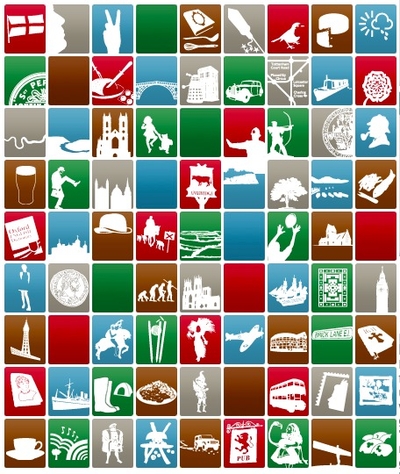 The complete 120 icons, in iconic format. |
June 16, 2006 update: Well, not all efforts at building a sense of Britishness are working. The Times (London) exposes the contents of a teaching pack, 9/11: The Main Chance, used in the "citizenship" class at some state schools. Among its features:
- Asking pupils to imagine themselves organizing a terrorist attack. One worksheet asks the pupils to imagine what terrorist targets there are in their neighborhoods. They then suggest what weapons and methods should be used to ensure the most effective results.
- Linking to terrorism-related articles, including one on food terrorism and how fast-food chains could be attacked.
- Linking to websites propounding conspiracy theories on 9/11, e.g., that Vice President Dick Cheney directed the attacks or that the U.S. military shot down flight United 93.
- Linking to a "news" website that includes references to images of Satan appearing in the smoke over the World Trade Center.
Tim Window, one of the creators of 9/11: The Main Chance, denied that the packs were culturally insensitive and said that they were about teaching pupils to bring "impartial and unbiased information" to a subject.
June 10, 2007 update: The new prime minister, Gordon Brown, has called for a "British Day" to be celebrated in an effort to imbue a common sense of Britishness, prompting some navel-gazing by a trio of Observer journalists, Ned Temko, Jo Revill and Amelia Hill in "What does it mean to be British?"
They quote a dubious recent African Muslim immigrant saying "Britishness is a hazy thing. Even if we want to adopt the culture of this country, the dictates of religion remain a far clearer and more precise identity. This isn't immigrants' fault. It doesn't mean anything sinister about loyalty to Britain. It's human nature." Likewise, Fahad Ehsan, a 27-year-old salesman who arrived three years ago from Lahore, Pakistan, said: "All this talk of a test, or a day to celebrate Britishness, misses the point: Britain doesn't have a clearly defined culture any more - which is not necessarily a bad thing."
In contrast, a born-Briton in his 60s, Graham Garrett, noted that "Britishness means completely different things to different people, depending on their age and their background. But this accumulation of little things used to all be glued together by a common glue, and it's that glue that has disappeared. We're unravelling as a country. And yes, that makes me sad. It's not that I can't define Britishness, it's that I no longer even know what we have in common."
Both Brown and his conservative rival, David Cameron, look to the United States as a model, seeking
a more "American" sense of national belonging, national assertiveness, national pride. Brown, in a major speech more than a year ago in which he first hinted at a Britain Day, spoke admiringly of how Americans proudly plant the national flag in the backyards. And just last week, Cameron - at a high-profile conference at London's Lancaster House, specifically aimed at tackling the issue of ensuring that Muslims feel a sense of "Britishness" - held up as a model the Americans' shared pride in the daily Pledge of Allegiance to the flag, and holidays such as Independence Day and Thanksgiving.
In that spirit, Liam Byrne, the immigration minister, observes that "Everyone should sit down once a year and think how lucky they are to be British." In contrast, the Ugandan-born British writer Yasmin Alibhai-Brown reacted furiously to Brown's Britishness agenda.
Rather than question newcomers' loyalty, or teach 'citizenship', she advocated a return to good old-fashioned history and literature. How did the Britishness brigade expect Muslims or other immigrants to prove their national credentials, she asked. 'Sleeping with "real" Brits? Photographing themselves getting hammered in pubs? By abusing foreigners?' And she concluded with a call instead for 'fair play and all that, as we say in Blighty'.


