
How many Muslims are Islamists, that is, seek to apply the Shari'a (Islamic law) in its entirety and have a caliph as the worldwide authority?
I proffered the estimate of 10 to 15 percent several days after September 11, 2001; this figure has been questioned, but it also has been quite widely accepted and repeated. In "Counting Islamists," I replied on October 8, 2008, to criticism of the 10-15 percent estimate of Islamists by building on and extending the facts recorded here.
Others have offered a range of numbers. Here is a sampling, in reverse chronological order:
Seats in Jordan's parliament: The Muslim Brotherhood won 16 seats in Jordan's 130-member house, or 12 percent of the seats. (September 22, 2016)
44 percent of Muslims in Europe: A survey by the Czech organization Evropské hodnoty ("European Values") finds that 44 percent of Muslims in Europe have values consistent with Islamism. (May 27, 2016)
5 to 20 percent: Rep. Loretta Sanchez (Democrat of California), who is running for an open Senate seat, gives her estimate:
We know that there is a small group, and we don't know how big that is – it can be anywhere between 5 and 20 percent, from the people that I speak to – that Islam is their religion and who have a desire for a caliphate and to institute that in any way possible. They are not content enough to have their way of looking at the world, they want to put their way on everybody in the world. And again, I don't know how big that is, and depending on who you talk to, but they are certainly – they are willing to go to extremes. They are willing to use and they do use terrorism.
(December 10, 2015)
Up to 11.5 percent of Arab-speakers support ISIS: Ryan Mauro relies on four polls to come up with this maximum estimate. If one counts the total number of Arabs at 370 million, that means up to 42 million out of them in some fashion back ISIS. (June 28, 2015)
The Turkish population identifies as Islamists within the range of my estimate, according to three recent polls:
- A TESEV/KONDA survey released in September 2012 found that, when asked how they would define themselves, 18.9 percent chose the label "Islamist" while 15.6 percent chose "conservative."
- The Open Society Foundation-Turkey found in October 2012 that self-identified "conservatives" dropped from 16.6 percent in 2006 to 10 percent in 2012.
- MetroPOLL found in the second half of 2012 that self-identified Islamists make up 9.6 percent of the population and "religious conservatives" 6.4 percent.
(Sevgi Akarçeşme, "Changing faces of conservatism, Islamism in normalizing Turkey," Today's Zaman, January 20, 2013)
Pew Global Attitudes Project: A survey of Muslims conducted in seven Muslim-majority countries between April 12 to May 7, 2010 (but only now released) finds very high rates of support among Muslims for severe Shar'i punishments:
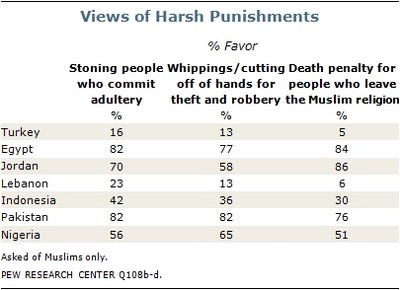 A Pew Research poll finds high rates of support for Islamic law. |
Comment: With a high of 84 percent approval, these numbers trend far higher than 10-15 percent. One wonders if these three issues – adultery, theft, and apostasy – represent attitudes toward Shari'a as a whole. (December 2, 2010)
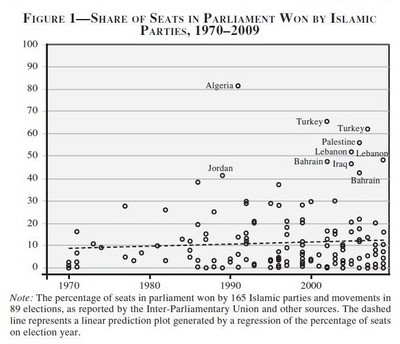
40 years, 89 elections: Charles Kurzman and Ijlal Naqvi, both of the University of North Carolina at Chapel Hill, ask in "Do Muslims Vote Islamic?" the Journal of Democracy. Their findings from combing through all the elections in which Islamist parties took part since 1970:
Across all 89 parliamentary elections of the past forty years in which an Islamic party participated, the median performance was 7.3 percent of the vote and 6 percent of the seats. If we combine the tallies of all the Islamic parties that participated in a given election, the median Islamic party performance is 15.5 percent of votes and 15 percent of seats.
For details of these elections, they provide a graph:
Comments:
(1) The 15.5 percent of the vote fits nicely with my estimate of 10-15 percent of Muslims having Islamist views.
(2) Note how those elections in which Islamists do well get disproportionate attention, implying that Islamists do not fare as well than their reputation would have it.
(3) 15 percent of the vote is pretty meager and suggests that fair elections would not bring Islamists to power in Muslim-majority countries.
(April 1, 2010)
Danish study: The Capacent Institute found that 18 percent of Muslims in Denmark either "agree" or "completely agree" that "Sharia law should be integrated into Danish law." ("Denmark: 18% of Muslims want to see Sharia law implemented," Islam in Europe Blog, April 29, 2009)
Indonesian poll 2008: A survey of 8,000 Indonesians by Roy Morgan Research, an Australian company, finds that 52 per cent favor some form of Islamic legal code (such as religious arbitration in family disputes), although only 40 percent favor a hadd punishment such as cutting the hands of thieves. Ira Soekirman of Roy Morgan Research points out that "A lot of people think the idea is very good, but when you start talking of every day implications, the number dropped." (Thomas Bell, "Indonesia backs sharia law, poll shows," The Daily Telegraph, June 24, 2008)
Program on International Public Attitudes: Responding to my estimate in the documentary Obsession that "10 to 15 percent of Muslims worldwide support militant Islam," Shibley Telhami of the University of Maryland cites data from the Program on International Public Attitudes to conclude that "about 6 percent of about 300-million people in the Arab world support al-Qaida's message of confronting the United States." Telhami also parses my word support, noting that "Support is often a reflection of anger rather than ideology. It's far different from joining groups or being prepared to conduct terrorism." (Quoted in Meg Laughlin, "McCollum, Muslims to discuss film," St. Petersburg Times, February 12, 2008)
Comment: Shibley changed the topic. I spoke about percentages of Muslims who support Islamism not who support "al-Qaida's message of confronting the United States." One can be an Islamist and not support Al-Qaeda's anti-American violence; one can also be not an Islamist and support the violence. It's a different issue and Shibley falsely conflates them.
Turkish elections: The Justice and Development Party (known by its Turkish acronym, AKP) won 47 percent of the vote and 62 percent of the parliamentary seats in the election yesterday. ("Turkish PM vows to pursue reform," British Broadcasting Corporation, July 23, 2007)
The Muslim Public Affairs Council, MPAC, an Islamist organization deems my 10-15 estimate "utterly unsubstantiated" and goes on to call me names; typical of MPAC, it did not bother to read this weblog. (Sepember. 18, 2008)
Indonesian poll 2006: A survey conducted by the Indonesian Survey Circle, a private pollster, finds that almost 70 percent of Indonesians (including non-Muslim citizens) back the current secular system of Pancasila. Given that some 85 per cent of Indonesians are Muslims, and presuming that only Muslims would want an Islamic order, that points to about one-quarter of the country's Muslims wanting something different. The poll also found about 55 percent opposing law, with stronger opposition to some parts of the Shari'a.
- Object to stoning for adultery: 63.3 percent.
- Oppose the death penalty for Muslims converting from Islam: 71.2 percent.
- Oppose making women wear Muslim dress: 77 percent.
- Against cutting off the hand of a thief: 77.3 percent.
(Australian Associated Press, "Indonesians oppose strict Islam, says poll," August 24, 2006)
British polls: In a survey of ten surveys at "Trouble in Londonistan," I find that "more than half of British Muslims want Islamic law and 5% endorse violence to achieve that end." (July 11, 2006)
Dutch study: The new "Centrum voor Radicalisme en Extremisme Studies" at the University of Amsterdam has researched the radicalization of Moroccan youth and found that 40 percent of the Moroccan youth in the Netherlands reject western values and democracy, while 6-7 percent of them are prepared to use force to defend Islam. (Expatica, "Centre for extremist studies established," June 14, 2006)
Gallup Islamic world poll: Gallup's Poll of the Islamic World, run by John Esposito and Dalia Mogahed, polled over 50,000 Muslims around the world and found in "The Battle for Hearts and Minds: Moderate vs. Extremist Views in the Muslim World" a wide range of percentages of Muslims whose views are consistent with being Islamist. (Islamism is defined by attitudes toward the Shari'a, not the United States, so this survey offers only a hint about our subject.)
In order to investigate characteristics that distinguish Muslim world residents who are potentially prone to extremist views, we divided respondents from the region into two groups. Classified as political radicals were those who met the following criteria: 1) they felt the terrorist attacks of Sept. 11, 2001, were "completely justified", and 2) they indicate that they have an "unfavorable" or "very unfavorable" opinion of the United States. Those who did not say the attacks were completely justified were termed moderates. The "radical" group represents about 7% of the total population across the 10 countries included in the study, ranging from a high of 26% in Egypt to a low of 1% in Morocco.
 "Who Speaks for Islam? What a Billion Muslims Really Think," by John Esposito and Dalia Mogahed. |
Hamas victory: In Palestinian Authority elections, the Islamist terrorist group Hamas won 44 percent of the popular vote. (January 26, 2006)
Margaret Nydell: "The militant Muslim groups cannot represent even 1 percent of Muslims in the United States (that would be 50,000) or the world (that would be 15 million). If that were true, we would be overrun with wild-eyed fanatics. Islamists who resort to violence add up to less than one tenth of 1 percent." (Understanding Arabs: A Guide for Modern Times, 4th ed., International Press, 2005, p. 104) Comment: Nydell makes the inexplicable mistake of equating Islamists with terrorists, as though all of the former are the latter. And this from a professor at Georgetown University. Some unsolicited advice for her: stick closer to linguistics, in which you got your degree, and stay clear away from politics.
Husain Haqqani, author of Pakistan: Between Mosque and Military (Washington, DC: Carnegie Endowment for International Peace, 2005) writes on p. 1: "Pakistan's Islamists made their strongest showing in a general election during parliamentary polls held in October 2002, when they secured 11.1 percent of the popular vote."
British polls: Two just-released opinion surveys of British Muslims suggest a very substantial Islamist percentage. Of the many questions asked, perhaps the most revealing in this regard is the one whether the respondent agrees that "Western society is decadent and immoral and that Muslims should seek to bring it to an end." An astounding 1/3rd of those asked did agree with this statement. (Anthony King, "One in four Muslims sympathises with motives of terrorists," The Daily Telegraph, July 23, 2005)
John O'Sullivan: "Estimates of the number of (generally young male) Muslims who are actively sympathetic to Islamism are inevitably ... speculative. The usual guess is that 15 percent of the Muslim population is sympathetic to Islamism and a much smaller percentage, say 4 percent, actively so." ("The Islamic Republic of Holland," National Review, July 18, 2005)
Otto Schily, Germany's interior minister, spoke today at the release of the 2004 Verfassungsschutzbericht, the annual report by the domestic security agency that surveys Germany's extremist movements, as I have written, in a "frank and constructive way." Schily announced that, at the end of 2004, there were exactly 31,800 Islamist radicals resident in Germany, or 1 percent of the Muslim population of Germany. (May 15, 2005) May 22, 2006 update: The number has increased to 32,100 Islamists in Germany for 2005, says the Verfassungsschutz.
Hisham Kabbani, head of Islamic Supreme Council of America: 5 to 10 percent of American Muslims are extremists. (Steven Vincent, "Where Are the Moderate Muslims?" The American Enterprise, April/May 2005, p. 27).
Kamal Nawash, head, Free Muslims Against Terrorism: "as many as 50 percent of Muslims around the world support the goals of the extremists." ("O'Reilly Factor," Fox News Channel, Aug. 5, 2004)
Daniel Yankelovich, pollster: At one extreme of Muslim society "are the hate-America Islamist fundamentalists, who are the most militant and totalitarian. The magnitude and influence of this group varies enormously. For example, in Indonesia this group has doubled, tripled, or quadrupled over the last few years. I would estimate that this group averages about 10% of all Muslims, with enormous variation from one Muslim country to another and particular strength in Arab nations." ("Cutting the Lifeline of Terror: What's Next After Iraq?" July 14, 2004, p. 20) (May 17, 2005)
Jordanian elections: In the Jordanian parliamentary elections of 1989, the Muslim Brotherhood "attained 30 percent of the seats, in addition to independent Islamists who won 10 seats. This was the highest percentage of seats ever gained by Islamists in Jordan or anywhere else in the region." (Angel M. Rabasa, et al., The Muslim World After 9/11, Santa Monica: RAND, 2004, p. 116)
B Raman, former head of counter-terrorism for Indian intelligence, the Research and Analysis Wing (RAW): The U.S. government should focus on reforming Islamist madrasas; there are currently up to one million madrasas in Pakistan , a minority of which, perhaps 15 percent, indoctrinate their pupils with Islamist vitriol and militancy. ("Expert tells US to focus on Pak madrasas," Times of India, October 31, 2003)
Israeli elections: "The northern faction of the fundamentalist Islamic Movement retained its firm control on [the Israeli Arab town of] Umm el-Fahm ... in local elections that were otherwise marked by fragmentation in the Arab sector. The movement's candidate in Umm el-Fahm, Sheikh Hashem Abdel Rahman, won 75 percent of the votes compared to around 23% for Said Agbariya, who headed a coalition of predominantly secular political groups." (David Rudge, "Strong Islamic sentiment drives Arab elections," The Jerusalem Post, October 30, 2003)
Indonesian poll 2003: "Survey and election results show that the number of Islamists, Muslims who want an Islamic state, is no more than 15 percent of the total Indonesian Muslim population of 200 million. The remaining 85 percent are moderately or strongly opposed to an Islamic state. Most important and least recognized in the current climate of fear in the non-Muslim world, Islamism as a political ideology appears to be losing ground in Indonesia, not gaining it." (R. William Liddle and Saiful Mujani, "The Real Face of Indonesian Islam," The New York Times, October 11, 2003)


