
This weblog entry builds on my 1999 article, " The Road to Damascus: What Netanyahu almost gave away," adding new pieces of information as they become available on the topic of the Lauder-Nader round of negotiations between Israel and Syria in August-September 1998.
For starters, the Israeli newspaper Yedioth Aharonoth today published a photograph of the complete draft "Treaty of Peace between Israel and Syria" carried by Ronald Lauder from Netanyahu to Assad and dated Aug. 29, 1998; IMRA has posted it. Article 2 states that in accordance with Security Council Resolutions 242 and 338, "Israel will withdraw from the Syrian lands taken in 1967"; and that "a commonly agreed border based on the international line of 1923" would be drawn up. The document also contains a handwritten note: "given to President Clinton 17.11.98." (April 13, 2001)
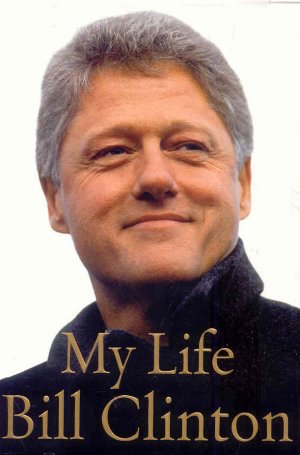 June 22, 2004 update: Bill Clinton's autobiography, My Life, published today, has revived this seemingly forgotten topic. The former U.S. president roughly confirms my investigative article of July 1999, where I wrote that Binyamin Netanyahu "agreed that Israel would ... return to the 1967 lines" separating the two countries. Clinton, in the context of the January 2000 Syria-Israel talks in Shepherdstown, Virginia, writes:
Before he was killed, Yitzhak Rabin had given me a commitment to withdraw from the Golan to the June 4, 1967, borders as long as Israel's concerns were satisfied. The commitment was given on the condition that I keep it "in my pocket" until it could be formally presented to Syria in the context of a complete solution.
After Yitzhak's death, Shimon Peres reaffirmed the pocket commitment, and on this basis we had sponsored talks between the Syrians and the Israelis in 1996 at Wye River. Peres wanted me to sign a security treaty with Israel if it gave up the Golan, an idea that was suggested to me later by Netanyahu and would be advanced again by [Ehud] Barak. I had told them I was willing to do it.
This vague statement ("gave up the Golan" can mean many things) has prompted several reactions in Israel.
June 24, 2004 update: Ha'aretz today quotes Lauder saying in April 2001 the draft expressed only his personal view, and that the agreement was rejected by Netanyahu, who wanted a border that would give Israel more than either the 1923 border or the June 4, 1967, lines.
Uri Saguy, Ehud Barak's chief Syria negotiator, has confirmed that Netanyahu agreed to withdraw to the June 4, 1967, lines, i.e., to the water line of the Sea of Galilee. Saguy says that when he took on the task of coordinating negotiations with Syria, he read up on previous negotiations under four governments – those of Rabin, Peres, Netanyahu and Barak.
Anyone with eyes in his head, not to mention the Syrians, could have understood that all of the Israeli leaders were willing to leave all of the Golan Heights if satisfied in the realms of security, water, normalization, and also regarding a settlement in Lebanon.
By reading these documents, I learned that if I were a Syrian, I would understand from the proposal brought by [negotiator for Israel, Ronald] Lauder that if Israel can be satisfied regarding all of the abovementioned points, it would be willing to withdraw to the June 4, 1967, lines.
June 27, 2004 update: Netanyahu has rejected Clinton's assertion. "I never agreed to withdraw from the Golan Heights in any situation or in any talks," he said in one radio interview. "The negotiations were unsuccessful because I insisted that the final international border be located miles eastward of the current border."
In another radio interview, he repeated this with more details: "In no situation did I agree to leave the Golan. That's what caused the break-up of the negotiations. ... I agreed only to make concessions in the Golan - concessions that were defined as setting the border 'kilometers' from the Kinneret (Sea of Galilee) - or, to be exact, 'miles.' That's what we wrote there."
Ehud Barak, Netanyahu's successor, also rejected Clinton's account: "Netanyahu did not speak of returning to the international border line, rather a line that would leave a strip up to two miles wide."
Comment: I outlined the two sides of this dispute in my July 1999 article and by all measures, they are still very much locked in place.
July 4, 2004 update: Ronald Lauder issued a statement, quoted in full in today's Yedi'ot Aharonot, in which he states that "Prime Minister Netanyahu never approved a retreat to 1967 borders," adding that "None of the documents that were drafted during these talks was official, and no document was approved by Prime Minister Netanyahu."
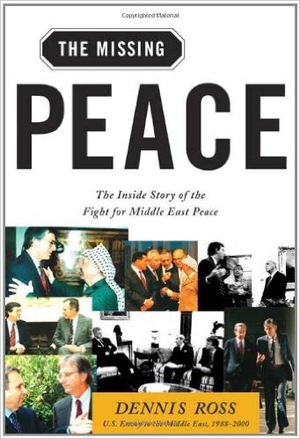 July 9, 2004 update: Dennis Ross' memoir, The Missing Peace: The Inside Story of the Fight for Middle East Peace (Farrar Straus Giroux) confirms on pp. 527-28 that Netanyahu had promised to return to the June 4 lines. Specifically, he tells about Bill Clinton in September 1999 receiving from Ronald Lauder "an eight-point paper which he claimed included the final points that had been agreed upon by both sides in 1998" and it indicated an agreement by Netanyahu for a "withdrawal to a commonly agreed border based on the June 4, 1967 lines." Ross notes with irony that this "meant that Barak's position on peace with Syria was less forthcoming than Netanyahu's."
Aug. 6, 2004 update: I provide a fuller analysis today of The Missing Peace at "[Dennis Ross on] Strange Twists in Syrian-Israeli Diplomacy."
Apr. 24, 2008 update: With the Olmert government reportedly willing to turn the Golan Heights over to Syria, what Binyamin Netanyahu, now the leader of the opposition, did in 1998 has reappeared as a political issue. Today, the Jerusalem Post reports, Major General Ze'ev Livne (res), Netanyahu's military attaché, told Israel's Army Radio that Netanyahu "was willing to make prodigious concessions in order to seal a peace deal, but it was unsuccessful and was unrealized." Livne added his hope that such a deal "is realized in the future."
Apr. 27, 2008 update: Netanyahu and Olmert traded attacks on the incipient diplomacy. In response to reports that Olmert had indicated to Bashar al-Assad that he would withdraw Israeli control from the Golan Heights, Netanyahu said that "The Golan must stay in our hands, because if we withdraw, we will receive Iran on our northern border. ... I am very surprised that the prime minister is willing to give up the entire Golan Heights, even before negotiations have begun, in such an amateurish, reckless way. ... This is not how you build peace."
Olmert's office replied: "In order to refresh Mr. Netanyahu's memory, he was the one [who] sent then-Syrian President Hafez Assad an American businessman [i.e., Ronald Lauder] to relinquish the Golan Heights in Israel's name, before any negotiations had begun."
To which Netanyahu's his office replied that "despite Olmert's attempts to mislead the public, Netanyahu insisted on keeping the Golan Heights, and that was why the talks were stopped."
May 22, 2008 update: As debate over the Golan Heights heats up in Israel, news accounts quoted Likud Party faction chairman Gideon Sa'ar saying that if Netanyahu wins the next election, he would not be obligated by any agreements reached by Ehud Olmert with Damascus. To this, Netanyahu replied otherwise, that he would abide by such an agreement. At the same time, his office released a statement predicting that if Olmert does sign a deal with Damascus, the Knesset and the public will overwhelmingly reject it.
Netanyahu expressed his own opposition to such a deal, saying that Syria is "an inseparable part of the axis of evil." Conceding the Golan, he maintained, would allow Iran to endanger all of Israel. "If you believe the Syrian Foreign Minister Walid Mualem that Olmert has already promised to give up the Golan up to the banks of the Galilee before the negotiations have begun, it is unprecedented diplomatic and security abandonment." In an interview, Netanyahu added that he does not rule out negotiating with Damascus, but he ruled out retreating from the Golan Heights.
Also interesting, in light of Netanyahu's 1998 negotiations with Damascus, was his comment about Olmert's political straits:
There is wide agreement from Right to Left that the diplomatic process cannot be used to shelter politicians in distress. Most of the public knows the prime minister expedited the talks with Syria and set the exact time for revealing them to distract the public from the investigations against him. Olmert, who is up to his neck in investigations, has no moral or public mandate to conduct fateful negotiations on Israel's future.
Feb. 22, 2009 update: In an article on Netanyahu's current policies toward Syria, Uzi Mahnaimi quotes him saying in a 2007 interview: "Indeed I did have negotiations with the Syrians. I told Assad I'd need Mount Hermon because I need radar to look towards Iran, and Assad gave up the mountain. I was surprised and happy."
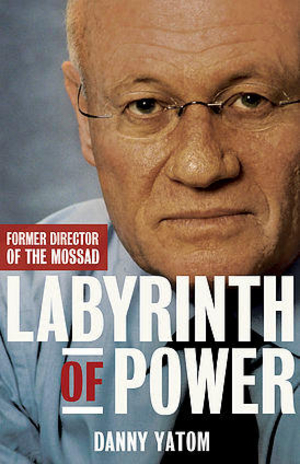 Feb. 2, 2016 update: Major General (Ret.) Danny Yatom, director of the Mossad in 1996-98 and then the prime minister's chief of staff and security advisor in 1999-2001, provides a new account of the Lauder-Nader mission in his book, out today, The Labyrinth of Power (ContentoNow). His account very closely tracks with mine, to the point that he titles his 3,300-word chapter 16 on this topic, "Look Me in the Eye" (referring to a quote I made central to my original story on this topic). Excerpts:
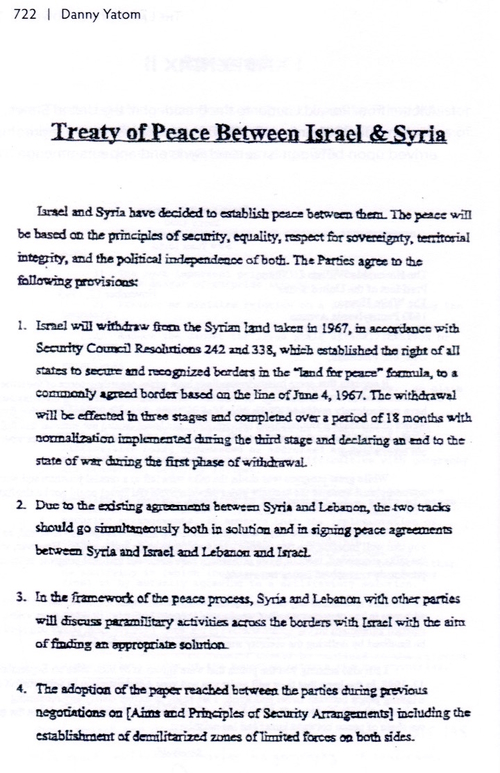
In the vaults of the Prime Minister's office we found two documents that were used by Lauder. One was written by him on August 25, 1998, and included discussion points Lauder had used with Assad, and the other was from September 29, 1998, and was a list of ten provisions entitled "Peace Agreement between Israel and Syria." From the information that came to us, we learned that under Lauder's initiative, Netanyahu had agreed to withdraw to the border as it was on June 4, 1967.
The British journalist and informal Syrian negotiator Patrick Seale came to Israel from meeting with Assad, Faruq al-Sharaa, and other top officials, recounting that
al-Sharaa said that Lauder had telephoned the Syrian ambassador to the United States Walid Muallem, and informed him that Netanyahu had authorized him to say that Israel would withdraw to the line of June 4, 1967 as part of a peace treaty. According to al-Sharaa, Lauder also added that he was willing to say these things to Assad as well, if the latter would agree to meet him - and on the basis of this statement, Lauder had come to Syria.
Seale told us that Assad said to him, "Lauder met with me and stated Netanyahu's agreement to a full withdrawal to the line of June 4, 1967. However, Lauder said that Netanyahu would not be able to say these things out loud, because they were contrary to his election platform, based on which he was elected. To my astonishment," Assad continued, "I heard from Lauder that Netanyahu believes it is possible to reach an agreement with Syria within fifteen days, and that he wishes to announce a full agreement as early as possible, and surprise the entire world."
Seale went on to quote Assad, who had said, "Lauder went on to talk about other matters, and I realized that a map is required to ensure that we are talking about the same thing. I asked Lauder that at our next meeting he bring a map from Netanyahu, on which should appear the outline of the June 4, 1967 line as Israel sees it. It was my understanding that Netanyahu was willing to give us this map, but this did not happen, so the talks were suspended."
The new Israeli government of Ehud Barak then confirmed with Lauder the accuracy of what Seale had quoted Assad as saying:
After the Lauder documents, which Netanyahu had authorized him to present to Assad, had come into our hands and confirmed everything that Seale had said, Clinton approached Lauder and invited him to a meeting in which he asked him to report on his contacts with the Syrians during Netanyahu's period.
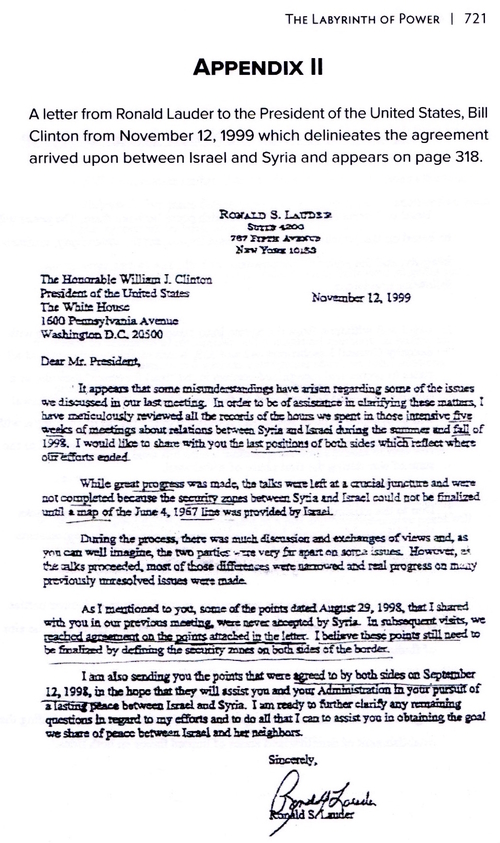
On November 12, 1999, Lauder wrote a letter to Clinton, in which he sought to clarify some matters after having reviewed his notes. In his letter, he stated that he was referring to a period of five meetings during the summer and fall of 1998. Lauder wrote that although great progress was made in the talks they had not been completed, because it was impossible to delineate the security zones between Syria and Israel as long as Syria did not receive an Israeli map on which the line of June 4, 1967 was marked.
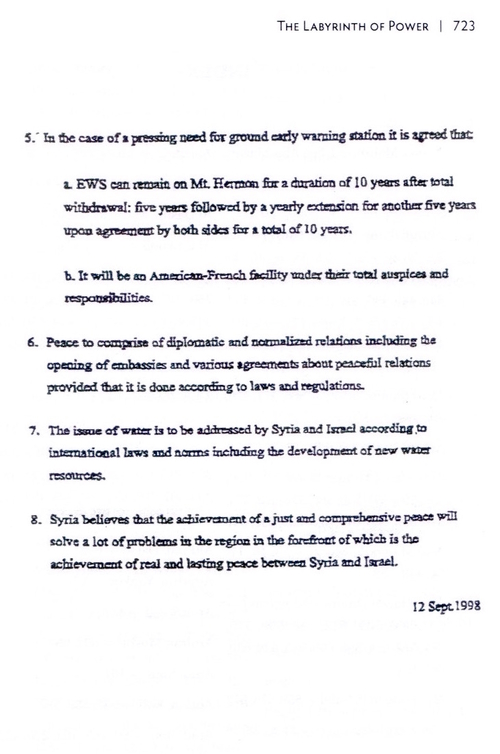
Lauder further wrote that in the meetings he had held with the Syrians, an agreement had been reached on some points, "I believe that these points still need to be finalized by defining the security zones on both sides of the border. These points were agreed to by both parties on September 12."
The letter then lists eight main points on which the parties had agreed: peaceful relations, Lebanon a separate track, deal with paramilitary activities, the creation of demilitarized zones on both sides of the border, permitting early warning stations, normalization of relations, water issues to be addressed, and regional impact.
When Yatom earlier had asked Dennis Ross about the Lauder-Nader talks, Ross told him that
Netanyahu had told Assad that he was committed to withdraw to the line of June 4,1967. Ross noted that Netanyahu's statement was much more substantial than Rabin's, as Netanyahu had undertaken a commitment, while Rabin spoken in conditional terms – only if all conditions would be fulfilled, would he agree to a full withdrawal.
Ross said he had heard this from two people: Walid Muallem, Syria's ambassador to Washington, told him that one day, Ron Lauder and Daniel Abraham (a Jewish-American businessman and millionaire) came to his office, asking to convey a message from Netanyahu to Assad. Muallem said to them that there was no point passing a message from Netanyahu to Assad unless Netanyahu would commit to withdraw to the line of June 1967. Eight months later, Daniel Abraham came to Muallem once again and said to him: I have received a commitment from Netanyahu to withdraw to the line of June 1967.
Ross proceeded to tell us that the other source for Netanyahu's willingness to withdraw from the Golan was Miguel Moratinos, the European Union's special envoy to the Middle East. Moratinos updated Ross that Netanyahu had told him that he had committed to the Syrians to withdraw to the line of June 1967, and was working to prepare a paper that would ratify this.
At this point, Martin lndyk intervened, noting that
Lauder had had nine meetings in Damascus with Assad, and in their final meeting, Assad had demanded a map with Netanyahu's signature on it, upon which the line of June 4, 1967 would be marked – the line to which Israel undertakes to withdraw. lndyk added that Yitzhak Mordechai, who was then the Israeli Minister of Defense, had refused to give this map to the Syrians, because he was dissatisfied with the security arrangements. He also said that on his way to meet with Arafat in the Wye Plantation, Netanyahu had made a detour in his journey, specifically in order to meet with Lauder and give him a message to pass on to Muallem - to the effect that Netanyahu himself had been willing to give Assad the map, and that he had been willing to go to Damascus for this purpose, but Assad had refused the offer.
Yatom concludes:
from the documents and various reports we had received, it could be seen that in total contrast to his statements, and according to Lauder and others, Benjamin Netanyahu had been prepared to withdraw from the Golan to the line of June 4, 1967, and had even pledged to do so before the Syrians.
Hence, when Mordechai told Netanyahu on live television that he had, in fact, promised the Syrians to withdraw from the Golan Heights, and Netanyahu denied it, Mordechai fixed his gaze at Netanyahu and said to him, "Look me in the eye!" At that point, both knew exactly what Mordechai was referring to.
Whenever Barak said that three prime ministers had promised to withdraw from the Gola n Heights, including Netanyahu, he knew what he was talking about, and when Netanyahu responded that "nothing of the kind ever happened" - he was being inaccurate, to say the least.
Yatom includes the Nov. 12, 1999 letter from Lauder to Clinton, with its appendix, which I reproduce here.
Oct. 22, 2026 update: Ronald Lauder has given a fuller version of the 1998 negotiations. Excerpts from an interview he gave to Ha'aretz:
This is the first time I'm talking about it in 20-30 years. ... In the late 1990s, the Syrians asked me to obtain Israel's approval to negotiate with them on a potential peace plan. I got that approval from Prime Minister Netanyahu. I came to Israel and told him I was going to put together a peace plan with Syria and potentially with Lebanon as well. He agreed on the condition that I keep him informed of every single detail.
Over the course of 10 or 15 months, I made numerous trips between Israel and Syria, and sometimes Lebanon as well. We developed a 10-point plan with Hafez al- Assad, and later with Lebanese Prime Minister Rafik al- Hariri. By the end of that period, we had finalized a document setting out the terms of an agreement. Assad was ready to sign it. It was there for Bibi to sign. Bibi decided not to sign.
Michael Hauser Tov of Ha'aretz asks, "How did all this come about? Why did they turn to you specifically?" Lauder replies: "Assad, Sr. heard about me from his ambassador in Washington and from other people, because I had been involved in going into Syria for the Jewish community there." The talks were something he had considered for years: "I was one of the few Jews who really looked for peace" between Israel and other countries, he attests. Tov then asks: "What were the visits to Syria like?"
They were frightening and clandestine. We would land in Syria, and my plane would be parked where no one could see it. I would immediately be taken to a car with blacked-out windows. I slept there one night in a hotel on the 14th floor. Let's just say there was no 14th floor in the hotel. I was on a nonexistent floor, a ghost floor. I met [Assad] at his palace in Damascus. It was a true palace, and he was the only occupant. There was myself, a person who came with me, Assad and his translator. And that was it. He did not speak English. He had a sense of humor.
Once he complained that every time he was in his bathroom, he would look out the window, see Mount Hermon and think about the Israelis on it. It really bothered him. He said, "What should I do?" So I said, "Move your bathroom." He started to laugh. My conversations with Assad would sometimes last for six to 10 hours.
It wasn't just about a peace treaty. He wanted to know as much as I could tell him about America, about Israel – about other things that he never had a chance to see. He wanted to know everything about Broadway, about how people think. He wanted to tell me about his feelings toward Israel, what can be done and what should be done, and his feelings for his family. And it was very enlightening. In my last conversation with Assad, he invited me to Aleppo. But I never went to Aleppo with him, because shortly after that, he died. And thus ended the story.
Were you suspicious of each other?
We were like two old friends. Or like two heads of state meeting. It was very special. Everyone understood everybody, it was amazing. Sure, we disagreed about certain matters, like issues of water and who has rights over the Sea of Galilee, things like that.
And each time you reported back to Jerusalem?
Each time when I came back, I dealt with one point. One point at a time. I didn't just convey messages; I was also a confidant. I didn't want to say, "Bibi agrees to this and that," but rather I said: "This is what Bibi wants, and I think it's a fair thing to say." Because what Bibi truly wanted was fair.
What did he want? "That I can't say. I refuse to give the details. This is more than I have ever spoken about this." According to Lauder, by the time the accord was drawn up, Netanyahu and Assad were in complete agreement over its ten points. "The final version of the agreement has only two copies, and they are with me."
Replying to Netanyahu's denying that he ever agreed to give back the Golan Heights, that only his envoy, meaning Lauder, had agreed to withdraw, Lauder replies:
If that were the case, he didn't have to speak to me, he could have just said no. I would have told Assad I can't go any further, and I would have stopped it. At the end, he [Bibi] wanted to blame someone else for the agreement so that he didn't have to take responsibility for it. If asked today, he would say "I was violently against it." He wasn't.
Did Netanyahu agree to withdraw from the Golan Heights?
Yes, [even though he's] totally, completely right-wing. If I believed for one minute Bibi would be a right-wing nut about this, I would have never wasted my time going there. I believed, I believe to this day, that if certain things had happened, he would have signed an agreement happily and taken credit for it. Because it would have changed Israel ... But the final version, I believe, was exactly what he wanted. I spent a lot of time working on it, took a lot of chances. He had a chance, and he walked away from it. Plain and simple.
Tov then writes that
Lauder refuses to share what exactly appeared in the agreement. He offers a few anecdotes, including the Syrian request to avoid stationing uniformed soldiers at one of the outposts – a request that was met with a suggestion: "Okay, wear blue jeans and a Harvard sweatshirt." And there were other minor subjects he raised before the Syrian leader. "For example, I told Assad: 'Look, the best wine I've drunk in Israel is produced in the Golan Heights. You can't touch the wine.' He replied: 'Well, we also produce good wine.' I told him, 'Your wine is crap.' He burst out laughing and said: 'You're right. I also like Israeli wine.'"
When Assad's side signed the agreement, Lauder maintains, he took it to Netanyahu to sign. But Netanyahu, noting that the deal would affect him politically, told Lauder first to get the consent of his defense minister, Ariel Sharon.
What he did was so outrageous. I spent months and months getting this thing together, and he says, "only if you convince Sharon." So, I said, "Sharon will never agree to this. Even if it was the greatest thing in the world, he doesn't want you to get credit. So why don't you sign it and stand up for Israel?" He wouldn't do it.
From that point on, Bibi made me promise not to talk about it. And for almost 30 years, I didn't talk about it. I feel it's time to say: He chose politics over peace. He put his political future before the deal. That's where he lost me. I saw him afterward, but it was never the same. He betrayed me. That's Bibi.
In my last conversation with Assad, he invited me to Aleppo, because he knew part of my family was from Aleppo. He said, "Let's see Aleppo together." And I never went to Aleppo with him, because shortly after that he died. And thus ended the story.


